Tad Richards' odyssey through the catalog of Prestige Records:an unofficial and idiosyncratic history of jazz in the 50s and 60s. With occasional digressions.
This is what happened after Jackie and his pal left to down a couple of cold ones and talk about what they could have done better (hint: not much). The rest of the afternoon was given over to Red Garland, Paul Chambers and Art Taylor: once again, not a full album's worth of music, so the session would be issued piecemeal.
Garland had just recorded Frank Loesser's "If I Were a Bell" three months earlier as part of the final Miles Davis contractual marathon series. He opens his version of it with the same memorable chime-like intro, so I went back to listen to that version.
Garland actually had relatively little solo space on the Miles recording--when you have Miles and Trane, there's not a lot of space left oer--and what there was, was mostly duets with Chambers, so here he really has room to stretch out and show what he can do, which is a lot. Fascinating to listen to both versions.
"Willow Weep for Me" is a great standard both for singers and instrumentalists, and both have a debt
to Ann Ronell, who wrote words and music. You might guess that "Willow Weep for Me" is Ronell's best known song, and it sort of is, but that depends on who you talk to. She also wrote "Who's Afraid of the Big Bad Wolf." A protege of George Gershwin, Ronell was one of the first women to break into the boys' club of popular songwriting. Along with Loesser, she was one of the few composers who wrote their own lyrics.
Like the McLean session, this was broken up and mixed with a later date. "If I Were a Bell" and "I Know Why" came out on Red Garland's Piano, "Willow Weep for Me" and "What Can I Say Dear" on Groovy, another one of my purchases in my very early days of jazz collecting.
Jackie McLean was by now a veteran of Prestige sessions, but not quite as much of a veteran as you'd think. Yes, he goes back to the early days--1951, and the notorious Miles Davis "Dig" session (notorious for Miles having appropriated the composition as his own). But after that, a long hiatus, not just from Prestige, but from recording altogether. There was a live recording of a couple of nights at Birdland, and session a few days later for Blue Note, all in 1952 but not, I believe, released till much later. Then nothing at all until 1955, and it's hard to say why not. He was battling addiction, but lots of musicians were fighting this fight at the time, and many of them still recorded. When Jackie did come back into the studio in 1955, with Miles again, he was only used on two tunes of a four-tune session, and Miles said later that Jackie was so high, he could barely play. Miles never used him again.
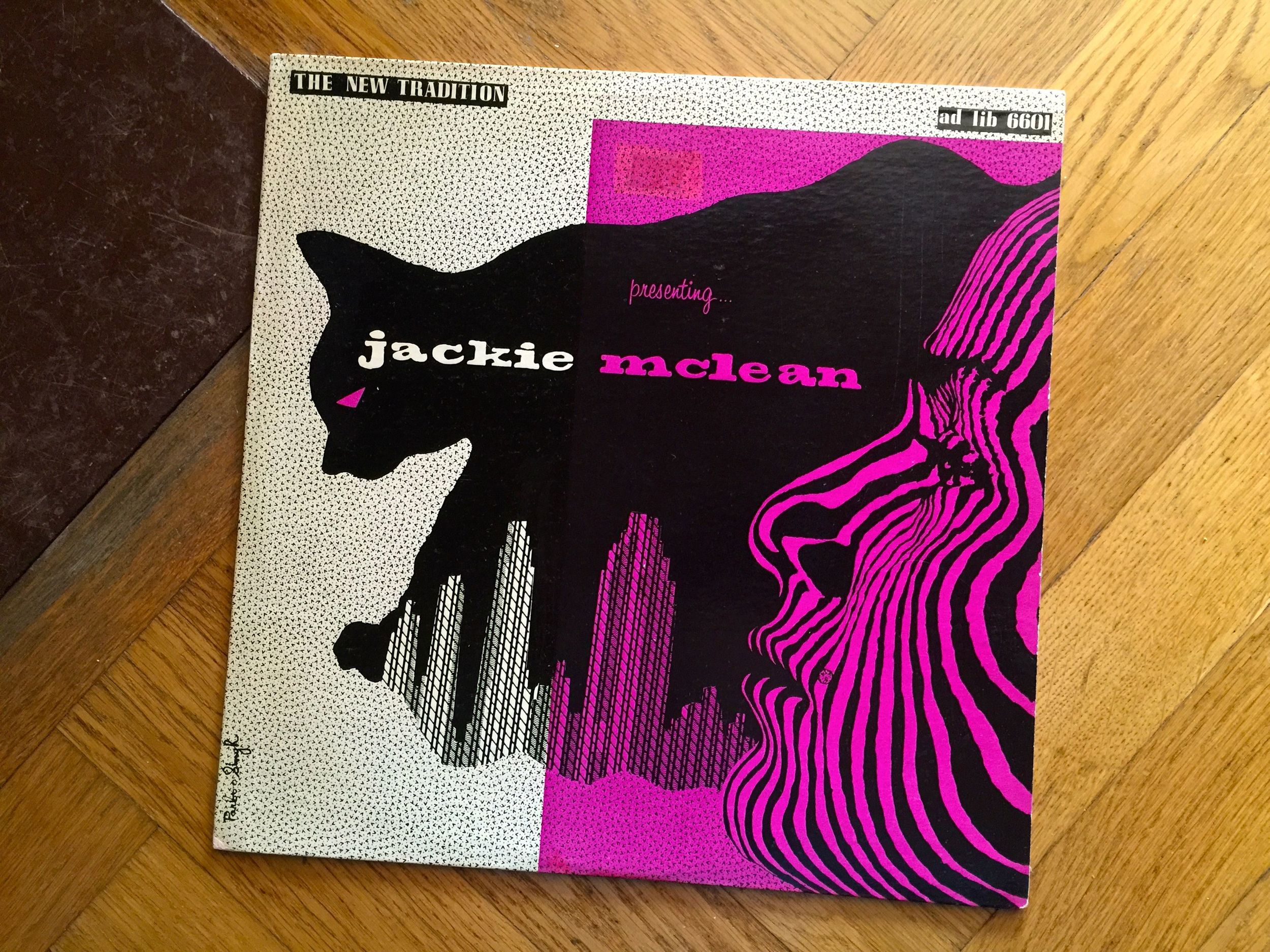
He played on a couple more sessions in '55--one with George Wallington, the other under his own leadership, Both were released on tiny labels: the Wallington live album on Progressive, the McLean Sextet album on Ad Lib. This one, according to the Rare Vinyl Jazz Collector (and aren't you glad such people exist), is "possibly the rarest of all the jazz collectibles out there." So since, like the ivory-billed woodpecker, it may never actually be seen in the wild, here's a picture of the album cover. I don't know who did the art, but it's a gem.
So, veteran or no, 1956 was really his debut year as a jazz force. He recorded for Prestige, Atlantic (with Mingus) and Columbia (with Blakey). By August, he was considered enough of a star that Bill Hardman was introduced on his first recording session as ""Jackie's Pal."
Jackie's pal is back with him for this abbreviated session, along with Red Garland, Paul Chambers and Art Taylor, who would take center stage as a trio for the rest of the afternoon. They do two standards and an original.
It's wonderful listening. The interplay between the two pals is intricate and yet straightforward, especially on "McLean's Scene." And this rhythm section continues to reward, every time out. Some great solos by Red Garland and Art Taylor, but it's Paul Chambers who takes your breath away. You expect a bass solo to come somewhere in the middle of a quintet piece, but on "Gone With the Wind" Chambers is the penultimate solo, right before McLean and and the restatement of the head.
You expect a piano vamp to begin a jazz quartet or quintet number--sometimes an extended vamp that becomes the head and an improvised solo. On "Mean to Me," though the first notes one hears are Garland's, Paul Chambers steps in and takes over that job. Cool.
Because this was an abbreviated session, it had to wait for LP release. It was combined with a 1957 McLean session with a different lineup, and released in 1959 on New Jazz.
Am I getting too much 1950s jazz? Is it all starting to sound alike?
No, and no.
Every album, every recording session, has been a unique and uniquely satisfying experience, and I continue to find this one of the most rewarding projects I have ever undertaken.
Obviously, I can't say that some sessions have been more uniquely satisfying than others, not if I have any respect for the English language. Each has been unique; each has given me something new and significant in my understanding and appreciation of jazz. But some have leapt out at me with particular force. Like the one before this, making me appreciate the richness of Tadd Dameron's compositions, made all the more special because he recorded so seldom.
On the other hand, I'm very familiar with Sonny Rollins's gifts as a composer and an improviser, and Lord knows his recording career has been prolific. But this one leapt out at me nonetheless. Why? Just because. Because his playing is so hot on this session: so creative, such high energy. Another reason could be that this is my farewell to Sonny on Prestige. He'll move on to a number of different labels: Blue Note and Riverside in New York, Contemporary on the West Coast. He'll record for RCA Victor for a while, and for various European labels. Then for Impulse, for Milestone, for lots of other folks. Anyway, I only found this out after I started reading background stuff, so it wasn't part of my immediate response.
The session contains three compositions by Sonny, and three songs by others. The Rollins compositions are the ones where the energy level really goes through the roof. "Ee-ah," in particular, combines the honking urgency of rhythm and blues with the creative daring of bop. I love it. 'B Quick" and "B Swift" are, if anything, taken at an even higher level of intensity, propelled by an unflagging and unforgiving Max Roach, over an incredible nine minutes for the first number. I like to imagine a spectator in the booth, drenched with sweat and exhausted just from listening to what these cats are doing, saying, "I betcha you can't do that again." "I betcha we can," Max retorts..."but maybe a little shorter this time." "B Swift is just as intense, but clocks in at five minutes."
And so to "Sonny Boy," which does what only jazz can do--it takes a familiar melody and turns into something entirely new. Screenwriter William Goldman, in his fascinating book, Adventures in the Screen Trade, discusses a screenplay he wrote for Gene Hackman, about a druggist who tries to break up an affair between his son and a married woman, but ends up having an affair with her himself. Goldman points out that the story is what it is because of a set of decisions that could as easily have gone in different directions. Instead of being a drama, it could have been a bedroom farce, which lovers hiding in closet s and under beds. If, instead of Gene Hackman, the producers had cast Faye Dunaway as the lead, it would have been story of a wife having to juggle not just one lover, but two, and then finding out that they were father and son. Or they could have cast John Travolta as a boy whose Oedipal problems take on a whole new twist. Or maybe they could cast Robert Duvall as the husband, a macho firefighter who loves his wife but has neglected her...
"Sonny Boy" was written by Tin Pan Alley stalwarts DaSylva, Brown and Henderson as a tearjerking vehicle for Al Jolson, and the emotional center of the song is the doting father. But in Sonny's version, we've changed the focus. Jolson as kindly, sentimental old father figure is no longer the star. Now it's Rollins as Sonny Boy, and he's not climbing up on anyone's knee. The song is completely transformed. It's macho, it swaggers...and it works. A number of jazz musicians, most notably Lester Young, have said that they always hear the words of a ballad when they play it. My guess is that Sonny pretty much tossed out the words when he did this one.
The two Earl Coleman cuts don't work quite as well, Coleman had cut loose from his Billy Eckstine roots in his last outing for Prestige, and was really beginning to develop as a contemporary jazz singer. Here, in spite of having Rollins, Drew and Roach to inspire him, he's back in the Mr. B. groove.
He's also working with not the best material. Every now and then, Prestige would give a contemporary hit ballad to one of its jazz acts, and they do that here with "Two Different Worlds," a 1956 chart hit for Don Rondo. The Great American Songbook had mostly closed by 1956, and a lot ballads from those years simply weren't that good. "Two Different Worlds," written by Al Frisch, known for not much besides this song (he did write "Broadway at Basin Street," an early Cannonball Adderley recording) and Sid Wayne, known for writing most of the really second rate songs that weighed down the Elvis movies, is one of those not very good ballads, and maybe a lush Mr. B-type approach is all you can do with it.
His second song is "My Ideal," written by Richard Whiting, one of the A-list tunesmiths. It's become a standard, and there have been some great jazz recordings, but for me the version that stands out is the one by Whiting's daughter Margaret, with the pure and lyrical innocence of a young girl yet to find her first love. That's not Mr. B., and it's not Earl Coleman.
Perhaps Bob Weinstock was looking for a cover record to Don Rondo's hit (Roger Williams / Jane Morgan and Nat "King" Cole also covered it), but if so, he must have changed his mind, because Coleman's numbers never were released on 45. "Ee-Ah" was, with "They Can't Take That Away from Me" from the Bird tribute album on the flip side. Let's hope that got some play on the rhythm and blues stations. It deserved to.
"Ee-Ah," the two "B" cuts, and the two Earl Coleman cuts were released in 1957 as Tour de Force. The same tracks plus "Sonny Boy" and minus Coleman came out as Sonny Boy" in 1961. Also on the latter album: "The House I Live In," written as a leftist anthem by Earl Robinson but co-opted as a patriotic ditty by Columbia and Frank Sinatra, and recorded earlier in 1956 by Rollins on the Bird session.
I spent some time in my just-finished entry on Art Farmer talking about the considerable composing talents of Farmer, Hank Mobley, Gigi Gryce and Kenny Drew. Then I turn around and run smack into one of the great composers of American music: Tadd Dameron.
Dameron is sufficiently highly regarded in the jazz world to have merited a tribute band (Dameronia, formed by Philly Joe Jones, which released three albums of Dameron's compositions during the 1980s), but nowhere near as well known to the general public as he should be. He has said his greatest influences were George Gershwin and Duke Ellington, both of whom are household names. And maybe Dameron isn't quite in that pantheon because maybe no one is, but certainly he deserves to be named among the elite.
Part of the reason Dameron isn't better known is that his own output is very slim. 1956 may have been his banner year, with this and another album for Prestige. They were very close to his last recordings. There would be one more for Riverside in 1962, making his total output five albums, one of which was released postunously, plus isolated tracks on a few other albums released after his death.
Dameron wrote and arranged for a number of big bands, including those of Count Basie, Artie Shaw, Jimmie Lunceford, Dizzy Gillespie, Billy Eckstine, and Sarah Vaughan, and he liked that big sound. Most of his recordings are with eight to ten pieces, which makes this quartet album all the more unusual.
But with John Coltrane's tenor and Dameron's compositions, what more do you really need? This is a great album, one that I couldn't listen to enough. "Mating Call" and "Soultrane" may be the ones that grab a listener first, but if I were a practitioner of vocalese, and were looking for a piece to write lyrics to, I might choose "Gnid." It is so melodic. I'd probably have to change the title, if I were looking for a catchy lyric.
Coltrane is as good a choice as you could make to round out this quintet: because he's Coltrane, and a brilliant improviser, but also because he has great respect for Dameron's melodies, and lets them shine through at all times.
Dameron contributes some great solos too, giving his own interpretation to his compositions. Philly Joe Jones contributes some brilliant solos. John Simmons was a frequent contributor to Dameron's music, and if his solos here suggest that the art of bass soloing has gone a little beyond him by the mid-1950s, he's still a strong anchor to a rhythm section.
The session was booked as the Tadd Dameron Quartet, but the initial prestige release calls it Tadd Dameron with John Coltrane, which becomes, on subsequent releases, John Coltrane with Tadd Dameron, and some cuts are included on other Coltrane repackagings.
Dameron's tunes have been widely recorded. On Chet Baker's 1964 comeback album, he included a number of Dameron compositions, including "Mating Call," "Soultrane" and "Gnid."
This album was recorded in late November of 1956, but it appears not to have been released until 1959, not unlike some of Farmer's other early Prestige sessions, which languished on the back shelves even longer, which may have been one of the reasons why Farmer would soon leave the label.
Farmer was very active for Prestige during this period. Like many of the young artists who had toured Europe with Lionel Hampton in 1953, he had returned with a burnished reputation and a number of closely forged musical relationships, two of the foremost being Quincy Jones and Gigi Gryce--his first session as leader, in 1953, was released as Art Farmer Plays the Arrangements and Compositions of Quincy Jones and Gigi Gryce, An early 1954 session featuring Sonny Rollins and Horace Silver wasn't actually released until 1962, and it's hard to figure out why (a quartet session from 1955 was also shelved until this release, as Early Art). Next he was reunited with Gigi Gryce for the album titled When Farmer Met Gryce, although this was scarcely a first meeting.
In 1955 he recorded with a septet, an augmented small group (or truncated big band) situation that Farmer thrived in, then with Gryce again, and with Donald Byrd (released as 2 Trumpets). He would also record as a sideman --with Gene Ammons a couple of times, backing up singer Earl Coleman (Gryce was on that session too), with Bennie Green, and with Gil Melle, and if that's not range, I don't know what is.
This session is part quintet (with Hank Mobley), and part quartet. Gigi Gryce is present again, but only as composer: the beautiful "Reminiscing," one of the quartet pieces, which affords Farmer the space for some marvelously lyrical ballad work, and does the same for Kenny Drew.
Drew is also represented with two originals on the session, which is pretty much a showcase for some of the best young composers of the era, as Farmer also weighs in with a tune--in his case, one that was already on its way to becoming a classic: "Farmer's Market." This is a very different treatment than the one Farmer gave it with Wardell Gray in his recording debut, and while it features some outstanding work by Farmer and Hank Mobley (who also contributed an original), Drew takes the first solo, and he's the one you walk away remembering most vividly.
Elvin Jones was just beginning to make his mark. He had recorded once in 1948, as part of the legendary Blue Bird Inn house band in Detroit, but his first New York recording had been in 1955, on a Miles Davis session for Charles Mingus's Debut label. He would make several contributions to Prestige and New Jazz over the next couple of years, before taking his music in a different direction and becoming one of the most important drummers of the 1960s and 70s.
In spite of the fact that one of Drew's compositions is "With Prestige," this turns out not quite to have been with Prestige. The label had come into existence, a decade earlier, as New Jazz, and in 1958, Bob Weinstock decided to revive the New Jazz label as a subsidiary (there would be a handful of other subsidiaries launched around the same time). Farmer's Market would be the third New Jazz release, following a Mal Waldron album and a Prestige All-Stars session which Farmer was not a part of. It's hard to exactly make sense of New Jazz. Maybe Weinstock was recording artists faster than he could release them? The Waldron album (Mal-3) seems to have been released fairly promptly, and may have been recorded with this new imprint in mind, but the next several were sessions that had been on the shelf for a couple of years. Anyway, the good news is, they did see the light of day, and we have this music now.
Being a jazz fan in the 1950s conferred a certain mantle of hip on one, and I say that unapologetically, and without fear of contradiction, since no one ever comments on this blog.
In that decade, probably in every decade, the hip stance was to be quiet about it, because too many people weren't. Norman Mailer, in 1957, explained how to be hip in excruciating detail in his essay "The White Negro." Mailer's main point was something like this: to be hip you (you, of course, being white) had to act like a Negro, and the quickest way to think and act like a Negro was to listen to jazz.
Leaving out the colonialist racism of the essay, he was also probably wrong about the shortcut. As Nelson George points out in his classic book, The Death of Rhythm and Blues, the average African American was more likely to be listening to rhythm and blues. (I won't get into a discussion of the contemporary misappropriation of "hipster" and "R&B.")
Allen Ginsberg, in 1956, wrote of angelheaded hipsters who hung out in the supernatural darkness of cold-water flats and contemplated jazz. Ginsberg used jazz more as a metaphor than anything else, and when the angelheaded hipsters gave way to acidheaded hippies he switched his allegiance to rock.
Herbert Gold, in a Playboy essay on the Beat Generation, advised me that if anyone were to come up to me at a party and say "Hey, man, you dig Bird? Zen? Proust?" the correct answer was an inscrutable "I'm hip." Alas, no one ever did, although years later, I was at a party where, I was told, I had just missed Neal Cassidy, who had split ten minutes earlier.
Someone else, or maybe it was Mailer or Gold again, wrote that if hip could be studied and learned, Robert Kennedy would study it and learn it. "But it can't."
Playboy, in those days, was setting itself up as the Bible for all those who thought that hip could be studied and learned...or learned without much studying, just by following Playboy's guide. "The magazine of sports cars and seduction," Mort Sahl labeled it. "The sports cars in front under 'science,' and the other...science fiction?"
Sports cars and Italian tailoring and...jazz. And this isn't a putdown of Playboy or its readers. They bought jazz records. And when Brubeck brought jazz to college, he opened up new audiences, and created new venues, even if those venues were't on the cutting edge of hip. When The Jazztet played SUNY New Paltz in 1965, my first year teaching there, I bought a ticket to the concert but was denied admission to it by the Greek organization that sponsored it, because I wasn't wearing a tie.
The Playboy reader knew about Miles Davis and Horace Silver and Stan Getz and Dave Brubeck, and the major label stalwarts like Stan Kenton and Errol Garner.
But he didn't know about Mal Waldron.
Mal Waldron, with the evocative, slightly sinister name, the New York vibes (born in NYC), the somewhat secretive personality (he switched from saxophone to piano because he didn't think he had the personality to be out front of a band), the attitude (the London Jazz Collector says that you won't find a Waldron album cover without a cigarette dangling from his lips (an exaggeration), and if that sounds uncool now, it didn't then).
You'd really have to have been hip, in 1956, to bea Mal Waldron fan. And by "you," I don't mean me. I didn't even start listening to jazz until 1957.
And you would have needed to be hip enough to recognize rhythm and blues as a first cousin to bop, which I might have done. I was already a serious rhythm and blues fan by 1956, although still a country kid, and with very little access to urban record stores.
Not that any amount of access would have helped very much. Rhythm and blues records were issued on 45 (or 78), without personnel listings. And in Waldron's case, they weren't necessarily issued at all. Jazzdisco.com (how do they research these things?) has Waldron doing two songs for Atlantic in 1949, which were never released. Then in 1952 he hooked up with a band that featured Ike Quebec on tenor, backing a singer named Frank Price for Hi-Lo records, cutting two songs that were not released. Hi-Lo did release a single by Emmitt Davis with the same band, and then an instrumental single led by Quebec. Then a couple of R&B sessions for Savoy, which was a bigger label, but those were mostly unreleased too, even though one of the dates featured Varetta Dillard.
Waldron came within range of the hip jazz fan's radar in 1954, when he recorded an album with Charles Mingus, also for Savoy. He spent a couple of years with Mingus, appearing on a live album from 1955, released on Mingus's own Debut Records, and one of Mingus's best-known albums, Pithecanthropus Erectus, for Atlantic, in 1956.
Mingus put him on the jazz musicians' radar, and through 1956 the serious fan would start seeing his name: on a Teddy Charles album for Atlantic, and perhaps on a recording with Donald Byrd and Jackie McLean for the tiny Ad Lib label. With Byrd and McLean he was knocking on the Prestige door -- or walking through the door, in a way, since the session was laid down at Rudy Van Gelder's studio. Prestige then signed him on for a Jackie McLean / Gene Ammons session in July. followed by two more with Jackie, and then in November this first session under his leadership.
The session features two Waldron originals, one of which, "Dee's Dilemma," had been his contribution to the August Jackie McLean date he had played on. Waldron would go on to become an important jazz composer.There's a Jerome Kern standard and a Benny Golson tune, "Stablemates," which had already been recorded by Paul Chambers and John Coltrane, then by Miles Davis, and was well on its way to becoming one of the most popular jazz standards of all time, with recordings by Stan Getz, Chet Baker, Tito Puente and others. Idrees Suleiman contributed a tune; and I was surprised to see that with a composer as formidable as Gigi Gryce on the session, they wouldn't have included anything by him, until I discovered that "Lee Sears," composer of "Transfiguration," was actually Gryce (Lee Sears was his wife's name).
Of particular interest to me, listening to this album, was the unfamiliar-to-Prestige rhythm section: no Paul Chambers, no Doug Watkins, no Art Taylor, no Philly Joe Jones. And I was interested to note what a difference it made.
Waldron was at the beginning of a long and distinguished career, though not one that would win him any Playboy jazz polls. Prestige titled this album Mal-1, signalling a longer commitment to this new artist, which they were to keep, through Mal-4.
Donald Byrd was apparently a contract player with Prestige at this tine, as he appears on several of the Prestige All-Stars sessions, but he was hardly exclusive with the label, and he was in demand. 1955 had been his breakthrough year, and by this time in 1956, he had already recorded on Prestige with George Wallington, Jackie McLean (three different sessions), Elmo Hope, Phil Woods, Gene Ammons, Hank Mobley, and the Prestige All-Stars. Art Farmer and Jackie McLean were also featured on that date, but on subsequent re-releases, leader credit was given to the two trumpeters and then to Byrd alone. Here are Byrd's other record dates from that same year.
For Savoy: three sessions with Kenny Clarke, one with Hank Mobley.
For ABC-Paramount: Billy Taylor. ABC-Paramount, started in 1955, released a lot of jazz in its early years, which surprises me. I had never thought of it as a jazz label at all.
For Columbia: Several sessions with Art Blakey, some instrumental, others backing Dutch singer Rita Reys. I had never heard of Reys, so I listened to a little of this session, and she's very, very good. There's also some great solo work by Byrd. Reys primarily performed in Europe, where she was known as "Europe's First Lady of Jazz." She continued performing and recording into this millennium. She died in 2013. Also a couple of sessions with Horace Silver on Columbia subsidiary Epic.
For Blue Note, with whom he would become most closely associated over the next decades, he appeared on Paul Chambers' first album as leader, which also featured John Coltrane. By the end of the year, he seemed almost constantly in Rudy Van Gelder's studio for either Prestige or Blue Note, recording for the latter label with Horace Silver, Hank Mobley and Sonny Rollins, As a leader, he recorded a session in Boston for Transition Records, a label founded by Tom Wilson, later to gain fame as Bob Dylan's producer, and a second session under Doug Watkins' leadership.;So these were formative years for Byrd, playing with a wide range of musicians, absorbing a lot. He was 24 years old in 1956, and this session, with Phil Woods, represents a wide range of ages and musical experience all by itself.
Woods was 25, like Byrd really coming into his own in the mid-50s, like Byrd destined to go on to significant commercial success--Byrd in the jazz fusion field, Woods most famously with Billy Joel -- while retaining the respect of the jazz world.
Al Haig was only 34, but pretty much at the end of his jazz career, at least during this period. This was close to his last recording (there'd be one with Chet Baker in 1958) until he experienced a renaissance in the mid-70s. According to jazz historian Brian Case,
Jazz pianism, ever more percussive in a crass simplification of [Bud] Powell's methods, had no room for the crystalline touch and swift, logical turnover of ideas. Haig got by with semi-cocktail piano in New York bars.
Teddy Kotick had been around since the birth of bebop, but jazz generations can turn over swiftly, and although he was only 28 years old at the time of this recording, he already seemed to belong to a previous generation. He dropped out of music for a while--I understand he returned to his native Massachusetts and worked as a mailman. I presented him in several concerts at Opus 40 in the 1980s with J. R. Monterose.
Charli Persip, only a year younger than Kotick, was at the beginning of his career (and was still spelling his name "Charlie"). He had spent several years with Dizzy Gillespie's big band, and had appeared on a couple of albums with Dizzy's band, but this was his first recording with a small ensemble.
Persip was known for his proficiency at sight reading music, and he explained in an interview in All About Jazz how he developed that skill:
Mainly because I objected to the word that was going around that jazz drummers couldn't read well. Then it translated into black drummers couldn't read well. I totally took umbrage to that. I said OK I'm gonna be the best reader in the land—I'll fix you. I spent many hours practicing, I took music books to bed with me to read instead of novels. I was fighting the fight for the good name of black jazz drummers.
The grizzled old-timer of 28 and the young pup of 27 come together to lay down a fine rhythm foundation for this album. As with many bassists of his generation, like Curly Russell or Tommy Potter, Kotick wasn't much for soloing, although he does take a couple of solos on this session, modest but excellent. As with many drummers of his generation, Persip is assertive when it's called for, and knocks out some less modest but also excellent solos.
The early 50s were marked by artists like John Lewis and Miles Davis trying to get away from the head/solos/head formula, but Lord knows Miles came back to it, and Lord knows it didn't go away, nor should it have, although artists like the MJQ and Gil Melle, and Miles as his career progressed and Birth of the Cool finally gained wider release, blazed new and important trails.
This is the dichotomy of many art forms. Some poets find working in 14 lines, with a regular meter and rhyme scheme, artificial and confining. Others find it infinitely subtle and flexible. When, in the 1940s, virtuoso soloists became the center of jazz, this format proved to be the one most suited for those soloists to create in. That remained true through the 40s and 50s, and like the sonnet, it has never gone away altogether.
Phil Woods is the main composer here. "Lover Man" is a standard and "Dewey Square" a Charlie Parker composition, but the rest are all Woods. "House of Chan" is a tribute to Charlie Parker, who used "Charlie Chan," taking his wife's first name, as a pseudonym when he needed one for contractual reasons. But then, everything Woods did is to some extent a tribute to Charlie Parker. But even more than that, it's dedicated to Chan Parker, Bird's widow, whom Woods had grown close to, and whom he would marry in 1957.
Prestige released this as The Young Bloods, with co-leader credit given to Woods and Byrd. It would later be rereleased as House of Byrd.
This is the last round of the Contractual Marathon: twelve tunes, one afternoon, and Miles is out the door. And what more is there to say about what was...well, one can't say one of the most fruitful periods of Miles's career, because they were all fruitful, but probably one of the most beloved?
What's not to love? Miles with one of jazz's storied quintets, playing timeless tunes. "I'll play it and tell you what is after," Miles says at the beginning of the session, but there's scarcely any need. We always know what it is. Classic tunes from the Great American Songbook. Jazz standards from Monk and Rollins and Miles himself.
So rather than think a lot about it, I just listened to them. A lot. In the car, in the house. In a box, with a fox. And I did like them, Sam-I-Am.
Music that has been orchestrated into the sound track of your life, that you first heard when jazz was becoming as necessary to you as a pulse, can become one with that pulse over time and resolve itself into background music, but not in a bad way. It's never going to be elevator music. But it has the warm familiarity of a thirty year marriage. And then, suddenly, it will surprise you in a new, unexpected and challenging way, like...well, like a thirty year marriage.
So goodbye, Prince of Darkness. Like Tristano, and Getz, and Monk, and the MJQ, you're moving on from Prestige, although your bandmates will still be here for a while, Kind of Blue lies ahead of you, and Sketches of Spain, and In a Silent Way, and Bitches Brew, and Big Fun, and Jack Johnson, and the Fillmore. Thanks for the memories and the music.
After the last of the Contractual Marathon sessions had been recorded, Miles was free to pursue his career with Columbia. Her didn't have to wait for the records to be released, and in fact, their release dates were spread out.
"My Funny Valentine," "Blues by Five" (by Red Garland), "Airegin" (by Sonny Rollins, first
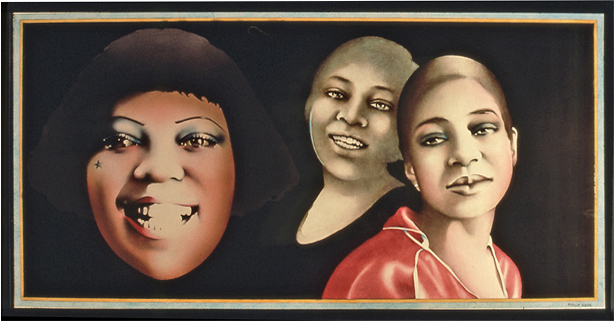
recorded by Miles in 1954 and already on its way to becoming a jazz standard), "Tune Up/When Lights Are Low" (presented as a medley, the first a Miles original and the second by Benny Carter and Spencer Williams) made up Cookin' with the Miles Davis Quintet, released in July 1957 as the first album in this series. The cover art was by Phil Hays, who, like Miles, would move on to Columbia, where he became noted for his album cover portraits of Bessie Smith and others.
Standards "If I Were a Bell," "You're My Everything" and "I Could Write a Book," along with Rollins's "Oleo," were on the second album, Relaxin', released in February, 1958. "Half Nelson" saw daylight two years later, on Workin', February, 1960. "Well, You Needn't" was on Steamin', not released until August, 1961.
Prestige also got several 45 RPM releases from this session: "If I Were A Bell," Part 1&2, "Airegin / 'Round Midnight," "Tune Up / Oleo," and "My Funny Valentine / Smooch," the last one perhaps a Valentine's Day special.
I was sitting with Margaret Whiting one day when she got a call from the organizers of the Kool Jazz Festival, asking her if she'd perform.
"But I'm not a jazz singer," she said. "I only sing the melody."
"We know," the festival guy said, "and do you know how hard it is to find someone who can really do that?"
What is a jazz singer, exactly? Someone who improvises around the melody? What about Frank Sinatra? Some would call him one of the greatest of all jazz singers, and he pretty much sang the melody, although he did improvise around the beat.
Some people, most notably Mel Tormé, have said that "jazz singer" is an oxymoron, there's no such thing as a jazz singer.
But if there is, what makes a jazz singer? Why is June Christy a jazz singer and Jo Stafford not? Why is Peggy Lee sometimes a jazz singer and sometimes not? How about Eartha Kitt? Why was Rosemary Clooney not a jazz singer until she was one? It was said of Sarah Vaughan, whose jazz credentials even Mel Tormé would have a hard time denying, that she used her voice like a horn, but what does that mean, exactly? Annie Ross sang dizzyingly difficult jazz solos, but in a way she was singing the melody -- a melodic line established by an instrumentalist like Wardell Gray. Her famous version of "Twisted," a jazz classic, has been covered by non-jazz singers like Bette Midler, or does singing "Twisted" make Midler a jazz singer? Edie Hart was a jazz singer, but she only sang the last few bars of songs, and then only when Peter Gunn was in the room.
It doesn't get any easier if move into the contemporary postmodern world, where you can probably be everything if you set your mind to it, like Amy Winehouse or Cassandra Wilson or Esperanza Spalding.
Google "what makes a jazz singer a jazz singer," and you get not much of any definitions at all, but you do get advice to aspiring jazz singers, and that advice boils down to: listen to a lotta jazz.
So is a jazz singer someone who sings and listens to a lotta jazz? That's hard to quantify.
So I'll offer this as a definition: a jazz singer is a singer who sings with jazz musicians.
And even that isn't enough. Connie Kay played drums on most of Atlantic's rock and roll sessions, but that didn't make those performers jazz singers. Margaret Whiting is a self-described non-jazz singer (although she did play that Kool Jazz Festival, and knocked 'em dead), but her greatest hit and signature song, "Moonlight in Vermont," was recorded with Billy Butterfield.
So I'll revise my definition. Taking off from the "listen to a lotta jazz" advice, I'll say that a jazz singer is someone who sings with a lotta jazz musicians.
I suppose even that is dodgy. Margaret Whiting recorded "Moonlight in Vermont" with Billy Butterfield and his orchestra, but not really. It was Les Brown's dance band, but for contractual reasons they couldn't use Brown's name.
Which brings us to Barbara Lea, who came into Rudy Van Gelder's studio for two consecutive days
to record a group of songs with a jazz group led by Johnny Windhurst, although the supporting personnel changed between one day and the next. And what makes her a jazz singer, and a very good one, is that she sings with jazz musicians, and connects with them. You can feel the chemistry. This comes through on every song, but if you really want to hear her interacting with jazz musicians, listen to "My Honey's Loving Arms" or "I'm Coming Virginia."
The session is a little unusual for Prestige, especially in the mid-50s, in that the musicians are essentially old school, which was generally Lea's choice. And if it wasn't to Bob Weinstock's mainstream taste, it was an inspired detour. The album was critically acclaimed, and Lea was named Best New Vocalist of the year by Down Beat, which tended to be more than a little snobbish about what was jazz and what wasn't.
Her first New York recording session was two songs released on the Cadillac label (not the Chicago label that later became Chess) in 1954, with a band led by Eddie Barefield, Pee Wee Erwin, and Cutty Cutshall. In 1955 he recorded for Riverside, with a band that included Billy Taylor regulars Earl May and Percy Brice. The songs were included on an album that threw together a hodgepodge of groups,
and came out under Mundell Lowe's name.
Then the Prestige sessions, and she would record for them through 1957, after which her recording career would come to a standstill until the late 1970s, when she made a number of records for Audiophile over the next decade, and Whitney Baillett declared in The New Yorker that "Barbara Lea has no superior among popular singers."
The groups on both of the October sessions are led by trumpeter Johnny Windhurst, with whom Lea worked frequently. Windhurst's career went back to 1944, when Sidney Bechet tapped him to replace Bunk Johnson in his group. Trad jazz giant Ruby Braff has listed him as his major influence. He's little remembered today, partly because he was a trad jazzer after trad jazz had mostly faded into critical irrelevance, partly because he seemed not to have wanted the spotlight. He left New York and moved upstate to Poughkeepsie, in my native Hudson Valley, where he lived with his mother and played in the house band at Frivolous Sal's Last Chance Saloon. Frivolous Sal's, which later became The Chance, one of the Hudson Valley's major music venues, was a place where they played Dixieland jazz and the waiters wore ersatz Gay Nineties outfits. In short, the kind of place that I would not have been caught dead at, which means I missed hearing a great trumpet player. The moral
of this story -- don't turn up your nose at any place that plays live music, especially with musicians who are a little older.
The October 18th session featured Richard Lowman on piano. "Richard Lowman" was a pseudonym -- if you think about it for a minute, you can probably figure out for whom. Ready? Thinking?
.......
Dick Hyman.
Only four songs were recorded the first day: "Baltimore Oriole," "I Had Myself A True Love," "Nobody Else But Me" and "Thursday's Child."`Perhaps Van Gelder had to spend some adjusting for the presence of a vocalist, because the next day they came back and did eight more.
On the 19th, Lowman/Hyman had bowed out, and Dick Cary, who had played alto horn (not to be confused with alto sax) the first day, doubled on horn and piano. He was equally adept at both instruments. He had made his first mark as a pianist in 1947, when a promoter wanted to present Louis Armstrong, who had been leading a big orchestra for years, in a small group setting, including Jack Teagarden and Bobby Hackett. Cary was the rehearsal pianist. Armstrong didn't actually show up for any of the rehearsals, and on the night of the first performance at Town Hall, there was no one else, and Cary stayed on piano. That turned out to be the beginning of the Louis Armstrong All-Stars, and when they began booking regular gigs, Armstrong remembered "the kid who did the concert," and Cary became the All-Stars' first piano player. His first recordings on alto horn were with Billy Butterfield, and he also played trumpet at Eddie Condon's. According to his obituary,
Unlike the Dixielanders, he was a progressive musician and his apartment became the centre for jam sessions with players like Zoot Sims, Bob Brookmeyer, Bill Evans and Jimmy Raney. From 1956 he worked in the progressive band led by Bobby Hackett.
Al Hall and Osie Johnson were the rhythm section on both sessions, and both were respected music veterans who could play bebop as well as older styles. Hall is best known for his work with Errol Garner, but he also played bebop with Bud Powell, swing with Teddy Wilson, and rock and roll with Frankie Lymon and the Teenagers. Johnson also moved deftly between swing and bebop, no mean feat for a drummer since the demands were so different, and he was a favorite of jazz singers (whatever that means) like Carmen McRae and Dinah Washington.
The second session adds Al Casamenti on guitar, and he had, if anything, an even wider range, from easy listening (Enoch Light) to rhythm and blues (King Curtis) to rock and roll (Screamin' Jay Hawkins) to jazz (Billy Taylor, Wes Montgomery) to Latin (Tito Puente) to pop (Johnnie Ray, Frankie Laine -- including "Rawhide") to jazz singers (Ella Fitzgerald). His lead-in to "My Honey's Loving Arms" is particularly tasty.
The Prestige album is self-titled.
I've had to skip over an album recorded by Herbie Mann in Sweden because I can't find it anywhere.
Everything that every jazz musician plays is, at root, a tribute to Bird. Today, those tributes are most often paid by musicians who were not yet born when Bird died, but they're nonetheless sincere, and those younger musicians still feel that closeness to Bird. But this session was recorded in 1956, when Bird was only one year and a few months dead, and he was still very much a living presence to every jazz musician, and much more profoundly than the ubiquitous "Bird Lives" graffiti of those days (my favorite legend is the one that said at the moment of Bird's death, a single feather fell from the rafters of Carnegie Hall.
Sonny Rollins had played with Charlie Parker on the 1953 Miles Davis session which would ultimately be part of the Collector's Items album, not to be released until December of 1956. He remembered Parker's powerful personal influence when interviewed by Art Taylor, for Taylor's powerful book Notes and Tones: Musician-to-Musician Interviews:
Bird was not only great to me as far as music goes; he also befriended me at a very important time in my life. You know that Bird helped me get off drugs when I was younger. When I made Collector's Items...Bird found out that I had been indulging. He really didn't like it. I saw for the first time that he didn't dig my doing that. I realized I must be doing the wrong thing. Up until that time I had thought it was all fun and games and that it was okay to use drugs. I subsequently got myself off drugs, when he showed me that wasn't the way to go. Unfortunately, when I did get myself straight, I was anxious to let him see I had dug his message, but as life would have it, he passed away before I was able to meet him again,
Rollins entered the federal drug treatment center in Lexington, Kentucky in 1955. Charlie Parker died in March of 1955, probably while Rollins was still at Lexington, so one can only imagine the extent that Parker was still on his mind.
Max Roach played on a number of Parker sessions, including his first Savoy recordings in 1945, and the legendary Massey Hall concert. He would record his own Parker tribute album a year later, for EmArcy.
Kenny Dorham must have had Parker very much on his mind. He had played with Bird on the great altoist's last gig, on March 5, 1955, at Birdland. Bird would be dead only a week later.
George Morrow never recorded with Bird, but he did play with him, on a number of gigs during Bird's 1946 California sojourn. Morrow, who was 30 at the time of this session, had played with the Roach-Clifford Brown quintet on all their recordings.
Wade Legge, at 22, was the youngest musician to be tabbed for this session, and though he had never
played with Bird, he had gotten his start in Dizzy Gillespie's orchestra. Dizzy, recognizing his talent, originally hired him as a bassist, but then heard him suggesting some innovative changes to the piano player. The bebop great liked what he heard, and immediately installed Legge on piano, the instrument he would play for the rest of his short career. He was highly sought after in the late 1950s, appearing on more than 50 recording sessions, and making one album under his own name (for French Vogue, reissued on Blue Note). By 1959 he had retired back to his native Buffalo, probably for reasons of health. He died at 29 of a bleeding ulcer.
The Bird medley begins with the classic "Parker's Mood" opening riff, then goes into standards closely associated with Parker, and original Parker compositions. "I Remember You" (written by Victor Scherzinger as a vehicle for Dorothy Lamour) is from a 1948 Savoy recording (with Max Roach on drums) and features Rollins as chief soloist. The musicians take turns as leader in each part of the medley. Kenny Dorham is up next on "My Melancholy Baby," recorded in 1950 for the Clef album Bird and Diz, the last studio Parker/Gillespie collaboration, a recording which rescued the 1912 melody from the provenance of weepy drunks in late night piano bars.
"Melancholy Baby" has an odd story, which I'll digress to share. From Wikipedia:
Ernie Burnett, who composed the music, was wounded fighting in the First World War, and he lost his memory together with his identity dog-tags. While recuperating in hospital, a pianist entertained the patients with popular tunes including "Melancholy Baby". Burnett rose from his sickbed and exclaimed: "That's my song!" He had regained his memory.
"Old Folks" is sweetly sentimental, and it comes from the ill-fated Charlie Parker with Voices collaboration with Dave Lambert. The criticism of this session is not unfair, but Bird's solo has a lot of feeling, and it's not hard to see why the guys picked it to be part of this tribute. The medley is not so much an attempt to play like Bird as it is an expression of how musicians felt about Bird, and this one goes to Wade Legge, both horns sitting out. "They Can't Take That Away From Me" is the gorgeous Gershwin melody, recorded by Bird on the Charlie Parker with Strings album, controversial at the time, now pretty universally beloved. Rollins takes the lead. Dorham comes back for "Just Friends."
"My Little Suede Shoes" is one of the catchiest of Bird's original compositions, originally recorded with a Latin percussion, which would seem to make it a natural for Rollins, but Legge takes the lead, and listen to this if you want to appreciated just how good this largely forgotten pianist was. The whole ensemble comes in for the finale. "Star Eyes."
The rest of the album is less Bird-oriented. "Kids Know" is a Rollins original, and one might wonder if a title like "Kids Know" in 1956 was a suggestion that Sonny was going to try rock and roll, but no. Sonny did try rock and roll years later, with the Rolling Stones. When he played a concert at SUNY New Paltz one time, it was promoted as "Sonny Rollins (from the Rolling Stones' Tattoo You album)," so maybe kids don't know everything. My Fair Lady opened on Broadway in 1956, so Bird would never have heard "I've Grown Accustomed to Her Face." "The House I Live In" was written as a leftist anthem by Earl Robinson, became a patriotic anthem when recorded by Frank Sinatra, and here serves as a reminder of Rollins's far-ranging ears. It's one of those tunes you can't hear without having the lyrics run through your head, so you can take it as leftist or patriotic, or both.
"They Can't Take That Away From Me" was plucked out of the medley for release as one side of a 45.
Prestige is generally considered to lag behind Blue Note in the artistry of its album covers, but this is often unfair. The cover for Rollins Plays for Bird, by Reid Miles. is stunning. It's only fair to note, however, that Miles was a Blue Note artist.
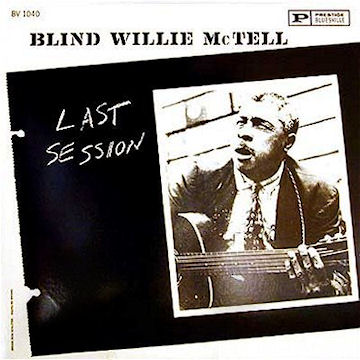
In 1956, Blind Willie McTell was singing on the streets of Atlanta. He was recorded by a local record store owner, but before the recordings could ever find a label or be released, McTell was dead.
He died in 1959. Bob Weinstock founded his Bluesville subsidiary in 1960, which was actually a little ahead of the curve. King of the Delta Blues Singers, the rerelease of Robert Johnson's Vocalion recordings of 1936 and 1937, didn't come until 1961. Charley Patton, one of the earliest pioneers of Delta Blues, had his reissue in 1962, 28 years after his death.
The Blues Hall of Fame started recognizing the titans of the Blues in 1980, did not get an actual building until 2015.
In 1940, John Lomax had recorded McTell for the Library of Congress Archives. He would do very little recording in the intervening years.
Recorded blues had an odd and spotty history. The first blues recording came out in 1920. An African American songwriter, Perry Bradford, one of the very few composers working on Tin Pan Alley, the tight cluster of New York music publishing firms that produced most of America's popular music in the first quarter of the 19th Century. had written a song called "Crazy Blues." He first offered it to Sophie Tucker, one of the most popular singers of her day, but she wasn't looking at any new material just then. A couple of other singers passed on it, so Bradford suggested recording it with a colored singer. The response: Bradford was crazier than his blues. No one would ever by a record by a colored singer. But they did take a chance and record "Crazy Blues" with Mamie Smith, and it was a smash, and it started the blues craze of the 1920s. But the Depression forced cutbacks in the recording industry, and the black performers were the first to be cut.
The real return of recorded blues was post-World War II, and it was part of the developing interest in
folk music (the vital electric blues being recorded in Chicago, Detroit and Los Angeles was considered commercial and inauthentic by the folkies). And this made for an interesting development, since the blues was essentially a music of realism, with the underlying message that things were never going to get better, and the white leftists who were a great part of the folkie audience believed that we could get together and make a better world.
The blues that were to become the center of the new blues explosion were from the Mississippi Delta. Delta musicians like Muddy Waters and Sonny Boy Williamson made their way north to Chicago, where they created an electric blues style that folk purists wanted nothing to do with. Musicians from Oklahoma and Texas went to Los Angeles, where they created their own electric style (T-Bone Walker was one of the pioneers of the electric guitar). There was much less of a blues scene in New York, always more of a jazz town, hospitable to jazz-based blues singers like Bessie Smith. The blues musicians who came to New York were mostly from the East Coast, and played in a style that came to be known as Piedmont blues, which was characterized by many things, but one of them was that many of its exponents, like Sonny Terry and Brownie McGhee, sang in accents that were easier for the mostly white folkie audience in New York than the heavier accents of Delta bluesmen like Charley Patton. The Delta bluesmen would soon be championed by a new group, the blues purists, who were different in many respects from the folk purists. Brownie McGhee had been recorded by Bob Weinstock early in his career, when he was trying to make a name as a rhythm and blues singer.
All of this would change with the nascence of the blues purists, who were a different breed altogether from the folk purists, and the British blues imitators, who were not purists at all.
Blind Willie McTell was a Piedmont bluesman, and although Bob Weinstock was a jazzer rather than a folkie, this seems to have been one of the styles he gravitated toward. But I actually probably shouldn't be spending anywhere near this much time on McTell, since he wasn't one of Weinstock's recordees, or one of his first Bluesville releases, for that matter.
But he was a good pickup for Bluesville, and it's good that these late recordings are available. Bob Dylan sang that no one could sing the blues like Blind Willie McTell, but it may have been more true that no one's name fit the rhythm and rhyme scheme of his song like Blind Willie McTell's. McTell in many ways hearkened back to an earlier age. The black street singers in the South were "songsters," and they sang a bit of everything, including the blues. When the blues craze of the 1920s hit, the songsters became bluesmen. By 1956, McTell was still singing on the street, and he had some of the repertoire of the old songsters, like "Wabash Cannonball," a 19th century ballad popularized by country and western pioneer Roy Acuff. It was cool to hear it done with a blues twist.
Also on the session, "Beedle Um Bum," which had been recorded by Tampa Red and McKinney's Cotton Pickers.
The Bluesville album was released in 1962 as Last Session. The following year, "Beedle Um Bum" made a reappearance on a compilation album called Bawdy Blues.
Anyway, more about Bluesville and Bob Weinstock's blues when we get to 1960.
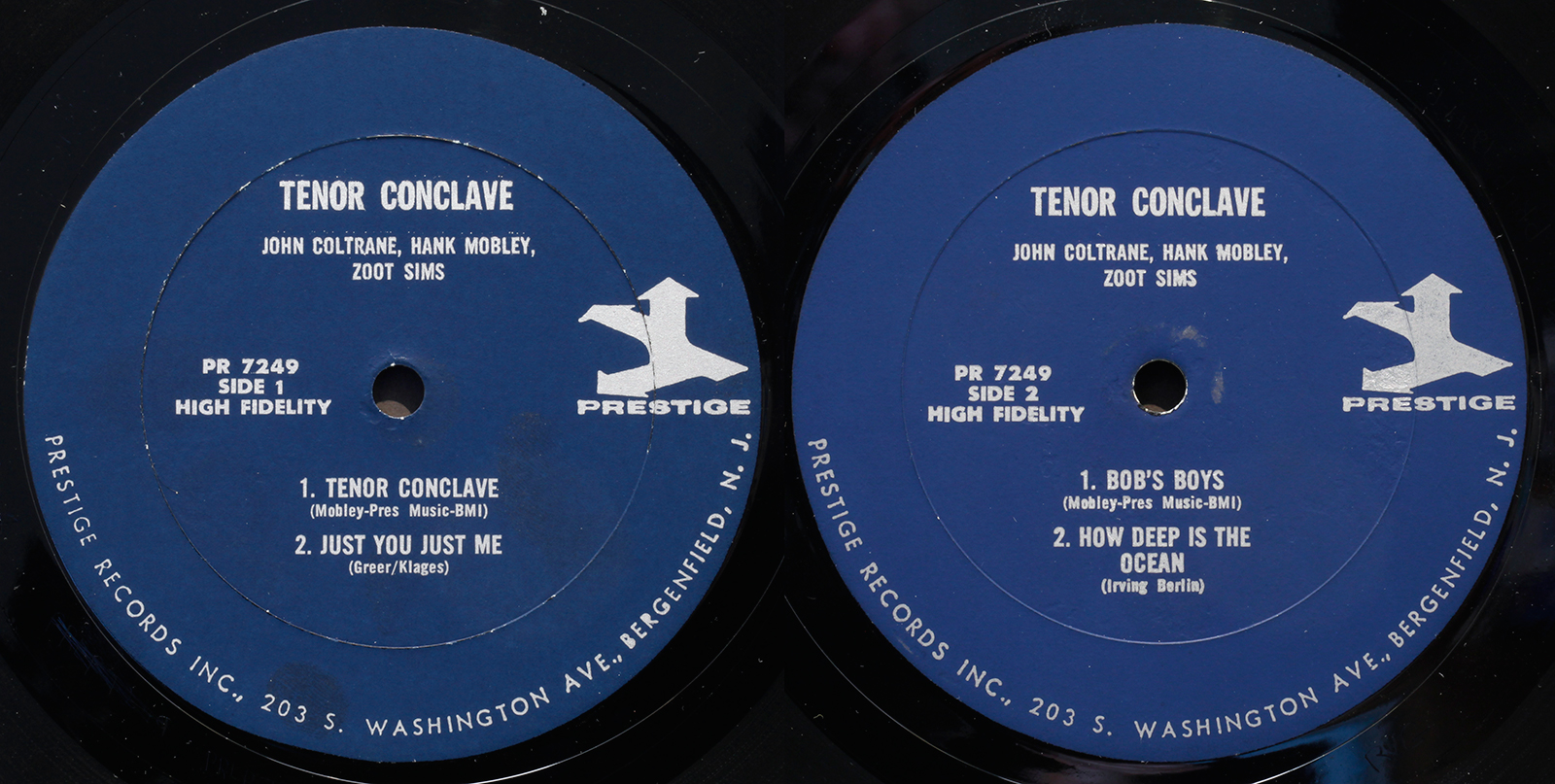
John Coltrane, Hank Mobley, Al Cohn and Zoot Sims together as the sax section for one recording session. What could possibly go wrong?
Nothing, as it turns out. Talk about four brothers! These are four of the all-time greats on the instrument that became the heart and soul of jazz and rhythm and blues of the 40s and 50s.
No one is listed as the leader on the session, although it may have sort of been Hank Mobley, who contributed two original compositions (the other two tunes are standards). Eventually, as John Coltrane's star continued to rise, the album was reissued under his name. Interestingly, although that star continued until Trane had risen to the firmament populated by Miles, Bird and Armstrong, it's the leaderless Tenor Conclave cover that adorned the CD reissue.
And no one takes over as leader, or tries to. in her liner notes to the reissue, Ann Giudici* says
As opposed to the popular "cutting session" of years gone by, this date merely offers four different players a chance to display their ideas. No one was out to blow the other off the stand. The atmosphere is one of forceful but relaxed blowing."
Maybe this is a characteristic of jazz of the Fifties. Certainly we've heard competitive sessions, like the Coltrane/Sonny Rollins Tenor Madness. But as often as not, the leitmotif is camaraderie. We heard it in the earlier Prestige All-Stars session, with Art Farmer, Donald Byrd and Jackie McLean. Or the Phil Woods session from back in June, with Woods and Gene Quill paired on altos, Donald Byrd and Kenny Dorham on trumpets.
How good an album is this?
Very, very good.
Is it four times as good as an album with one of them?
The answer is yes and no.
No, because if you compare it with albums featuring any one of them -- say, John Coltrane with the Red Garland Trio, one of my all time favorites, and also on Prestige, you wouldn't want to even consider the question of which one is better. It would be like choosing between your children.
But yes, because it's mythic. Like knowing that "Tenor Madness" is the only recorded collaboration between Coltrane and Sonny Rollins. Like the discovery, five decades after the fact, of a live recording of Coltrane and Thelonious Monk at Town Hall.
The myth is important. One of the wonders of art is that it stays with you, and gestates inside your mind and your soul until it becomes a new entity, the offspring of you and the artist(s). And that new enitycomes out into the world and plays with new friends, half-sisters and brothers, the offspring of the artist(s) and your friends, or people you meet in online forums, or people you meet by reading their books and articles and liner notes and poems (like Michael S. Harper's paeans to Dear John, Dear Coltrane). Imagine making love to someone after listening, together, to Stan Getz or Louis Armstrong or Ornette Coleman. You're imagining (or better yet) remembering three very different experiences, aren't you? And each one with a special richness that would not be there without Stan or Louis or Ornette. **
Part of that gestation is the art itself, and part is the history, the personalities, the stories--especially in jazz, which is such a collaborative art, and such an endless melding and blending and separating of personalities and sensibilities, the Miles Davis nonet or J.J. and Kai or James Moody and Tito Puente or the musicians Norman Granz brought together for Jazz at the Philharmonic or Ella Fitzgerald and George Gershwin.
In a review of the album on allmusic.com, Lindsay Planer says that " It takes a couple of passes and somewhat of a trained ear to be able to link the players with their contributions," and this is certainly true to my not very trained ear, but the sense of those different voices and sensibilities coming together is palpable and intoxicating. The London Jazz Collector, in his blog, characterizes the four voices as "Mobley’s tone is pure chocolate, Coltrane is spiced lime, Sims is a good Claret, Cohn is mocha garnacha." Which is beautiful and allusive and mysterious, especially since I had no idea what mocha garnacha is.
Ira Gitler, always helpful, runs down the solos in his liner notes to the original album:
* Always interested in new names that crop up on the periphery of the music and the scene, I looked up Ann Giudici and found not very much. In the early 60s, she was apparently producing plays off-Broadway, and Hackensack station WJRZ, which was having success with old time radio dramas, hired Ann Giudici to produce original dramas and adaptations of short stories with a local repertory company. JRZ had a varied format including jazz (Les Davis was a DJ), but shortly afterwards they switched to an all-country format.
** Here's an imagined look at jazz and lovemaking. This will be included in my forthcoming collaboration between me (poems) and Nancy Ostrovsky (drawings), She Took Off Her Dress.
SHE SAID
She said jazz
is how life should be
flexible rhythm but
you count it off
beyond that
improvisation
melody left behind
now it’s your call
you know where
the roots are you don’t
know where it’s taking you
she herself was
Chet Baker
Gerry Mulligan
touching where you didn’t
know you tingled
or she was
Thelonious Monk
threading her way along
narrow pathways
with broad steps
on either side are
Arizona cactus
long spined blooming


 Like the McLean session, this was broken up and mixed with a later date. "If I Were a Bell" and "I Know Why" came out on Red Garland's Piano, "Willow Weep for Me" and "What Can I Say Dear" on Groovy, another one of my purchases in my very early days of jazz collecting.