Showing posts with label Benny Golson big band. Show all posts

Tuesday, May 30, 2023

Listening to Prestige 691 - Jack McDuff


LISTEN TO ONE: 'Sokay

 July, 1964. was a busy time in dear old Stockholm. Jack McDuff, now solidly Brother Jack McDuff, was there too, recorded live in Stockholm's Golden Circle  with his group, and then in the studio with a Swedish big band. I do wonder if Benny Golson was tempted, after his previous success with McDuff and a big band, to bring the organist and is group into his Stockholm project, but probably not. Golson was looking in a quite different direction. More likely, perhaps, McDuff got the idea of using a Swedish big band from dropping in on his old friend Benny's recording session. More likely yet is the theory that Lew Futterman, McDuff's manager/producer, who had also produced Golson's Stockholm session, was the organizing force behind all of this, and the one who, as before, brought Golson in to arrange the big band session.


LISTEN TO ONE: Au Privave

Soul jazz and the organ combo was still a relatively new sound to Scandinavia--indeed to most of Europe. Jimmy Smith had toured, but European audiences, having graduated from le jazz hot to bebop, were sufficiently skeptical that Futterman had a tough time booking McDuff's tour. As Futterman observes in his liner notes to The Concert McDuff:

Whether or not European jazz audiences, noted for their attraction to the cerebral, would take to McDuff was highly dubious.

But as Futterman goes on to note, at their first stop, the Jazz Festival on the Riviera,


McDuff and his group stole the show. According to Nice Matin, "McDuff a vaincu tout le monde." And in Sweden, the amazed proprietors of Stockholm's famous jazz club, the Golden Circle, saw their audiences dancing in the aisles.

There was enough musical depth in McDuff's music to satisfy the most cerebral of Europeans. And it seemes as though those intellectuals hadn't forgotten how to respond to le jazz hot.

From a historical perspective, it's tempting to focus on the development of young George Benson in McDuff's group, and certainly by the time of this live show at Gyllene Cirkeln (the Golden Circle), he could no longer be considered an apprentice. But while Benson went on to become an international superstar, still regarded to this day as a living legend, and Red Holloway is remembered, if at all, as one of a number of very good tenor saxophonists of the era, it would be a mistake to underestimate Holloway's contribution. His solo on "'Sokay," from the live album, may well be the highlight of that number.

The band that Golson put together for the McDuff/Stockholm studio session is labeled The Big Soul Band, which seems an odd choice for a bunch of Swedes, but it's not out of place. If anyone knew how to arrange a big band to back up Jack McDuff, it was Benny Golson, and the soul is provided by McDuff, Dukes, Benson and Holloway. It's an album very much worth listening to, if you can find it. It doesn't appear to be on Spotify or Amazon Music, and "'Sokay" is the only track I've found on YouTube, which is becoming more and more my source for hard-to-find jazz. 

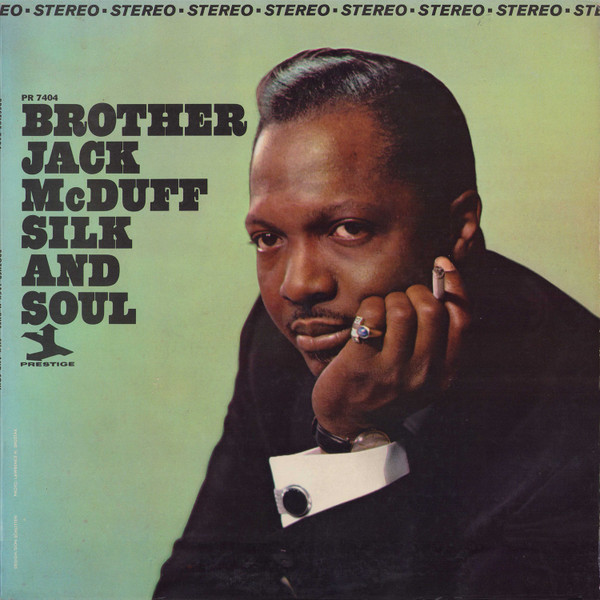
The live album is titled The Brother Jack McDuff Quartet Recorded Live! In Concert Around The World - The Concert McDuff, or more familiarly The Concert McDuff. The Big Soul Band numbers became part of an album called Silk and Soul, which incorporated tunes from two other sessions and was released in 1965. Lew Futterman produced all of the sessions.

July, 1964, was a busy time for Jack McDuff, in and out of Stockholm. During the same month (presumably on his return from Europe, though there are no precise dates for any of these sessions) he was back in New York for a hardworking session during which he recorded nine songs with his basic quartet. all of them in that groove that you can call soul jazz, or funk, or hard bop, or rhythm and blues. Or you can call it by a name that hadn't been invented yet, but which McDuff, Holloway, Benson and Dukes may have pioneered, as several of these cuts would later be collected in an anthology collection called Legends of Acid Jazz

At the time of their recording, they weren't collected anywhere, exactly. McDuff would make a couple more albums for Prestige before moving over to Atlantic in 1966, so Bob Weinstock's label mixed and matched for a few more releases. "Scufflin'," the first tune off the session, had been added to Silk and Soul. "East of the Sun," "Au Privave" and "Hallelujah Time" made it to Hallelujah Time!, a 1967 album that threw it together with one cut from a 1963 session and a few from a later date. Another bits and pieces album, Midnight Sun, also issued in 1963, contained "Misconstrued," and yet another, 1968's Soul Circle, found room for "Lew's Piece" and Horace Silver's "Opus de Funk." Ray Charles's "I Got a Woman" is the title cut to a 1969 release, and again in 1969, Steppin' Out included "Our Miss Brooks."


Wednesday, April 20, 2022

Listening to Prestige 625: Jack McDuff - Benny Golson


LISTEN TO ONE: The Pink Panther

 Jack McDuff's manager Lew Futterman, in the liner notes for the next session, describes how he got Golson and McDuff together:

McDuff had opened [at Birdland], and I was down there to see him...Benny and I ended up at the same table. While I was well aware of his writing, playing and arranging, we had never before met. I asked him how he liked McDuff. He said, "Great!" Since he was unaware what my relationship was to Jack, I pushed him a little farther by telling him I didn't like Jack's playing. His response was immediate. "You're entitled to your opinion. But I've never heard a jazz organist play with the feeling this man has. He shows such a great emotional quality, such a sympathy for the music that I could listen to him all night."


...He proceeded to say what I had felt since first hearing Jack play but had never been able to verbalize so succinctly--namely, that Jack McDuff exhibits a rare intuitive understanding of jazz, and of music in general. Nothing he plays seems stiff or structured, moving instinctively from one musical idea to the next, with no apparent disparity between what he feels he wants to play and what he can play. The excitement he generates is organic, rather than forced, as if he were thinking with his fingers.

At that point, Futterman outed himself to Golson, and asked if he'd consider writing some arrangements for McDuff.

"Only if I can write what I want to." I started to give him a qualified "yes," but decided better of it. A man with Golson's talent...deserves a free hand.

It seems quite certain that Golson had a free hand, because how else explain Henry Mancini's "Pink Panther Theme" on a jazz album? Or such was my first thought, on hearing it. But "Pink Panther" was a huge hit in 1964, the year of the movie's release, and a few different jazz artists covered it. There was a rhythm and bluesy version by Earl Bostic, another organ interpretation by Jimmy McGriff, and another big band arrangement by Quincy Jones.


As it turns out, they're all worth a listen. As a composer, Henry Mancini may have been a master of the obvious, but the operative word there is "master." The tune may have been perky and ubiquitous to have even become the punch line of a joke (What did the Pink Panther say when he stepped on an ant? --Dead ant...dead ant...dead ant dead ant dead ant....), but it was brilliant in its own silly way, and it responded nicely to the big band treatment, and to McDuff's bravura organ work.

The album's cover, however, promotes another movie tie-in--the theme from The Carpetbaggers, which is odd, in that although The Carpetbaggers was a blockbuster movie, its score, by the redoubtable Elmer Bernstein, was not a breakout success. Secondhandsongs, the website that keeps track of cover versions of nearly everything, cannot find a single one for the Carpetbaggers theme. YouTube turns up one other, by Jimmy Smith. Still, it's Elmer Bernstein, which means it's bound to be a decent tune (if a little too reminiscent of Bernstein's more popular theme from The Man With the Golden Arm), and Golson and McDuff certainly make it worth listening to. 

Golson takes two from the movies, two from Broadway. The Broadway tunes are both from musicals of the 1960s. "Once in a Lifetime," by Leslie Bricusse and Anthony Newley, was one of the breakout hits from the musical Stop the World--I Want to Get Off, the star vehicle for Newley which had opened in 1962 and was still running. "You Better Love Me" was from the just-opened High Spirits, composed by Hugh Martin (best known for the songs from Meet Me in St. Louis) and Timothy Gray. One has to figure that all of these not-exactly-standards were chosen by Golson for how they'd sound with Jack McDuff counterpointed against an orchestra, and the proof is in the pudding. Golson was right.

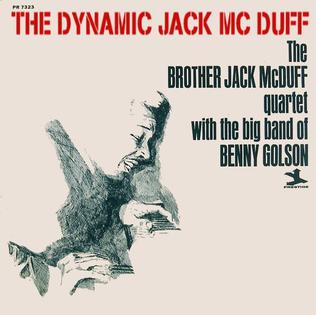
McDuff brings his regular group. Golson brings an orchestra, personnel unidentified. The four tunes were all they recorded, and the B side of the album comes from McDuff's earlier date on the West Coast. Lew Futterman produced both sessions. The album is entitled The Dynamic Jack McDuff. "Pink Panther" and "Carpetbaggers" were released on 45. The version I've linked to on "Listen to One" is the 45 RPM version. Weighing in at 3:20, as opposed to the album's 5:15, which means more theme and less improvisation, but hey, it's the Pink Panther! Dead ant...dead ant...."Once in a Lifetime" was also released on 45, as the flip side of "Rail Head," from the earlier session.


Friday, February 11, 2022

Listening to Prestige 609: Jack McDuff


LISTEN TO ONE: A Kettle of Fish / Carry Me Home

A big band backing a soul jazz organ combo is a unique idea, but these are the guys to make it work.

I'm always interested in the guys who are part of the rich fabric of jazz, even though their names aren't in the forefront. Here's what I could find about the musicians Benny Golson gathered for this session. Jerry Kail we've seen before as a member of Oliver Nelson's orchestra for his 1961 recordings. Billy Byers was on the same session, and made an earlier Prestige date as a member of Hal McKusick's quintet in 1957. Danny Stiles was on TV with the Merv Griffin show's orchestra, and played in two of the best big bands, Woody Herman's and Gerry Mulligan's. He also stepped out of the sections to make one album as co-leader with Bill Watrous, for the Famous Door label. 


Burt Collins was tabbed for inclusion--usually on trumpet-- by virtually everyone who ever put together a big band, including, surprisingly enough, Albert Ayler. In the 1970s, he formed a group with Joe Shepley, and one of their albums was a jazz tribute to Paul McCartney. He also cut albums for Music Minus One.

Tom McIntosh hardly belongs in this group of background figures. A distinguished composer as well as a trombonist, he was named and NEA Jazz Master in 2008. 

Don Ashworth joined the Tonight show orchestra when Johnny Carson took over its helm in 1962 and, like Johnny, remained there for the next 30 years. 

Bob Northern, after working as a session musician for many of the top names in jazz during the 1950s and 1960s, became interested in world music in the 1970s, went to Africa to study, and released several albums during that decade.

Marvin "Doc" Holliday can be heard playing and talking about his career in music on YouTube


George Marge, on baritone sax here, played nearly every reed instrument and was in wide demand as s a session musician, not just with the jazz greats but also with pop stars like Paul Simon and John Denver.

Put them all together with McDuff's usual group, plus Mel Lewis joining Joe Dukes on drums, and Benny Golson leading the band, and one can only be surprised that no one thought of it before. Golson's arrangement and some serious professionalism from the musicians provide a rich and full-throated backing for McDuff, who is solidly equal to the task of fronting this aggregation. The classic big bands were about good time music, soul jazz is about good time music, and between them, they let the good times roll.

The session was produced by Lew Futterman and Peter Paul, who had previously given us Brother Jack live in San Francisco, and away from the friendly confines of Rudy Van Gelder's studio. The album was entitled Prelude, after the Benny Golson tune which was on the album, along with McDuff originals and standards. "Prelude" was also on one of the two 45 RPM singles, along with "Oh, Look at Me Now," composed by Joe Bushkin, made famous by Frank Sinatra. The other 45 was two McDuff tunes, "A Kettle of Fish" and "Carry Me Home."