Showing posts with label Ira Gitler. Show all posts

Wednesday, February 10, 2016

Listening to Prestige Part 170: Elmo Hope All-Star Sextet

Elmo Hope's star, never as bright as it should have been, was perhaps beginning to wane at this point. The session is listed as "Elmo Hope All-Star Sextet," and the album was released as by the Elmo Hope Sextet, but at exactly the same time, so it would seem, it was also released as by Hank Mobley and John Coltrane, as Prestige PRLP 7043 and 7043 (alt).

And Ira Gitler, in his liner notes, describes the session as being "the nominal leader on the date," whatever that means. Gitler also suggests, without actually saying it, that the session is a buncha guys who happened to drop in at Rudy's parents' living room on a Friday afternoon to see what was happening.


If so. that would make this just about the perfect Bob Weinstock jam session, and maybe Gitler is exaggerating the casualness of the ensemble a little bit, but maybe not. I'm willing to take it as mostly true, and I'm willing to credit it as a quintessential tribute to the Weinstock philosophy of what jazz is.

As Gitler goes on to point, out, these musicians were hardly strangers to each other. Donald Byrd and Hank Mobley had played together in the Jazz Messengers; John Coltrane, Paul Chambers and Philly Joe Jones were the nucleus of the new Miles Davis Quintet, and Jones and Hope went even farther back.

It's interesting to note how strong the rhythm and blues roots were for these musicians. Jones and Hope had first played together in Joe Morris's band, Hank Mobley with Paul Gayten, John Coltrane with Eddie "Cleanhead" Vinson. Also interesting that when they get together for a casual jam session, they go to bebop, not rhythm and blues, as a lingua franca.

Even more interesting, to me, is how powerful a lingua franca this is. Gitler, in his liner notes, lists the order of solos, as he oftenh does, and I wonder if he got, or gets, enough credit for this service. Too many serious jazz aficionados are also jazz snobs, and would dismiss this as pablum, but for the rest of us, it's very useful in following a jazz recording. In this case, Gitler gives us a remarkably involved and complex series of solos:
Weejah: Opening riff, Hank, Donald, Trane (bridge), Hank, Donald (4), Hank (2), Trane (2), Hank (1), Trane (1), Hank (1), Trane (1), Elmo (3), Chambers (2), Donald, Hank, Trane in fours with Joe (1), Joe (1), out chorus in same order as opener.
And even with Ira's help, I get lost. Well, I did recognize when Elmo came in. Or:

On it: Donald (8), Elmo (8), Hank (3), Trane (3), then two choruses each, followed by one chorus each, followed by two choruses of fours, two of twos, and another of fours. Hank is first at the beginning of the conversations.
This is a good thing to keep in mind the next time I'm tempted to criticize Gitler as a commentator on jazz. Yeah, I got lost again here. But there are a couple of reasons. One is, at a certain point I have to give up feeling the pressure -- am I going to be able to tell where they go from trading fours to trading twos? -- and just listen to the music.

The other is--it's almost beyond understanding how completely these loose, informal jammers are on the same page. Very often, especially in the early days of bebop, when the music was shifting from dance-centric to listener-centric, and the idea of a virtuoso solo was moved to the forefront, a soloist would finish off his turn with a little statement -- "Here, what are you going to do with that?" -- and there'd be a vamp by the piano or bass (not so often bass when recording engineers couldn't pick him us as well), for the listener and the next soloist to reflect on what had just been heard. Not so here. This music is seamless, so much so that you sometimes even forget to notice whether you're listening to Byrd or Coltrane -- and that's not leaving out of account that we're listening to some of the most distinctive voices in jazz.

Two of the pieces are Elmo Hope compositions -- "riffers which expedite the blowing," in Gitler's words, but they're more than that. Both, especially the bluesy "On It," are lyrical. Hope was a gifted composers, and these two tunes justify this being labeled as an Elmo Hope sessions.

The other two are standards, very much "mainly vehicles for blowing," in that like the two Hope tunes, they give the soloists the basis for work which is so seamless it almost makes a succession of solos sound like an ensemble. "Polka Dots and Moonbeams" was a Jimmy Van Heusen pop hit for Tommy Dorsey/Sinatra which has become a favorite of the moderns, with versions by Bud Powell, Chet Baker, Bill Evans, Wes Montgomery, Blue Mitchell...it has been listed as one of the most frequently recorded jazz standards.

I've commented before on how many times beboppers have reached back to a very early age, taking songs from operetta to transform into a modern idiom. "Avalon," in a way, harkens back even farther. It's credited to Al Jolson, Buddy deSylva and Vincent Rose, and while it's questionable whether Jolson really did any of the writing, it's also sort of questionable whether Rose did. The melody is close enough to an aria from Tosca that the Puccini estate was able to sue for plagiarism and win.

Are there any other modern jazz versions of operatic arias (not counting Porgy and Bess)? Probably. There must be some from Carmen. But I can't think of any offhand.
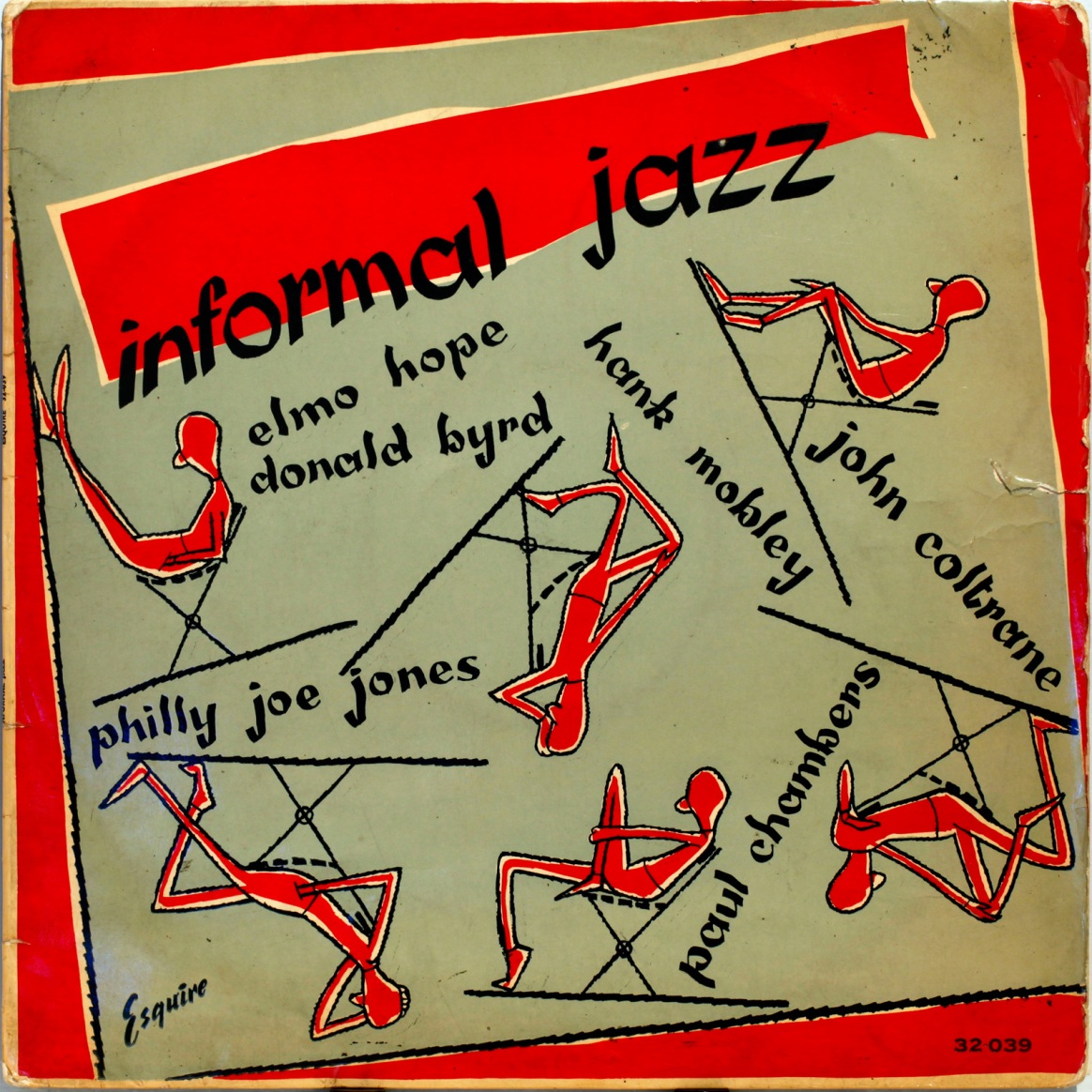
A couple of digressions before I let you go. A lot of the Prestige catalog was licensed in England to the Esquire label. The Esquire release of this album, which must have been not long after the Prestige release, has cover art by Ralph Steadman. Steadman is one of the great illustrators of our era, and I suspect he may be pretty embarrassed by this, which doesn't begin to suggest Alice in Wonderland or Fear and Loathing in Las Vegas. He must have still been an art student at this time, and nowhere in his biography does it mention any work as an illustrator for record labels.

Second digression. And I know I'm preaching to the choir here. Everyone who cares about music, or cares about education, knows how important music education is. Donald Byrd went to Cass Technical High School in Detroit. We think of Detroit today as the epicenter of urban blight and hopelessness, but Cass Tech has held onto its music ed program, and according to its Wiki page, "Cass Tech students' strong academic performances draw recruiters from across the country, including Ivy League representatives eager to attract the top minority applicants."

Because Cass Tech continues to have a music education program, its graduates have made their mark from swing to hip-hop, not to mention opera and gospel. I promise I won't keep posting lists like this, but here are some of Cass Tech's graduates, and of course I'm not including the kids who went on to become teachers, or the kids who simply stayed in school because there was a band and a concert choir.


  • Dorothy Ashby, jazz harpist and composer.
  • Geri Allen, post bop jazz pianist.
  • Sean Anderson aka Big Sean; hip-hop artist signed to Kanye West's Label (G.O.O.D. Music).
  • Kenny Burrell, jazz guitarist.
  • Ellen Burstyn, won Academy Award for Best Actress for Alice Doesn't Live Here Anymore and starred in The Exorcist, Tony Award winner, Emmy Award winner, Golden Globe Award winner (did not graduate).
  • Donald Byrd, jazz and rhythm-and-blues trumpeter.
  • Regina Carter, jazz violinist.
  • Ron Carter, jazz double-bassist.
  • Doug Watkins, jazz bassist.
  • Paul Chambers, jazz bassist.
  • Alice Coltrane, jazz pianist, organist, harpist, composer, and the wife of John Coltrane.
  • Muriel Costa-Greenspon, mezzo-soprano who had a lengthy career at the New York City Opera between 1963 and 1993.
  • Jerald Daemyon, electric jazz violinist, composer and producer known for bringing technical refinement to violin improvisation.
  • Delores Ivory Davis, was internationally recognized in opera, oratorio, and for performances with Springfield (Mass.) Symphony, St. Paul Symphony, and Detroit Symphony Orchestra.
  • Carole Gist, 1990 Miss USA, first African American woman to win the Miss USA title.
  • Wardell Gray, jazz tenor saxophonist who straddled the swing and bebop periods.
  • David Alan Grier, actor, comedian.
  • J. C. Heard,[36] swing, bop, and blues drummer.
  • Major Holley, jazz upright bassist.
  • Ali Jackson, jazz drummer.
  • Philip Johnson actor, leading role in the Lifetime movie America.
  • Ella Joyce, actress.
  • Hugh Lawson,[36] was one of many talented Detroit jazz pianists of the 1950s
  • Donyale Luna, model and actress.
  • Howard McGhee, one of the first bebop jazz trumpeters, together with Dizzy Gillespie, Fats Navarro and Idrees Sulieman.
  • Al McKibbon,[36] jazz double bassist, known for his work in bop, hard bop, and Latin jazz.
  • Billy Mitchell,[36] jazz tenor saxophonist best known for his work with Woody Herman when he replaced Gene Ammons in his band.
  • Kenya Moore, 1993 Miss USA.
  • Naima Mora, fashion model, America's Next Top Model winner (Season 4).
  • J. Moss (aka James Moss), Grammy Award-winning gospel singer-songwriter, composer, arranger, and record producer.
  • Greg Phillinganes, (1974) session keyboardist.
  • Della Reese, singer, actress, later famous for playing Tess on the television show Touched by an Angel
  • Frank Rosolino,[37] was an American jazz trombonist.
  • Diana Ross (1962), singer, actress, graduated one full semester ahead of her classmates; major listed in Cass Tech Triangle Yearbook was "home economics"; studied costume design as her curriculum path; 2007 Kennedy Center Honors recipient.
  • Donald Sinta, classical saxophonist, educator, and administrator; in 1969 he was the first elected chair of the World Saxophone Congress.
  • Cornelius Smith Jr., actor, 2010 NAACP Image Award winner for Outstanding Actor in a Daytime Drama Series.
  • Lucky Thompson,[36] jazz tenor and soprano saxophonist.
  • Lily Tomlin, comedian, actress, 2014 Kennedy Center Honors recipient; winner of two Tony Awards, a Grammy Award, 5 Emmy Awards and a Daytime Emmy Award. Listed and pictured in the Yearbook as Mary Jane Tomlin – a cheerleader.
  • Jack White, acclaimed musician and member of The White Stripes, The Raconteurs, and The Dead Weather.[38]
  • Gerald Wilson, influential jazz trumpeter, Big Band leader and composer.

This session was released simultaneously under Hope's name as Informal Jazz, and under Coltrane's and Mobley's names as Two Tenors. Later, as Coltrane became the big star, it was reissued under his name as Two Tenors with Hank Mobley.


.

Friday, January 29, 2016

Listening to Prestige Part 166: Miles Davis

This was part of the Contractual Miles period, but not one of the marathon sessions, and not one of the new quintet sessions, which is interesting, because Miles was pretty well committed to the new quintet at that point. They played on the late 1955 session and the marathon sessions of later this year.

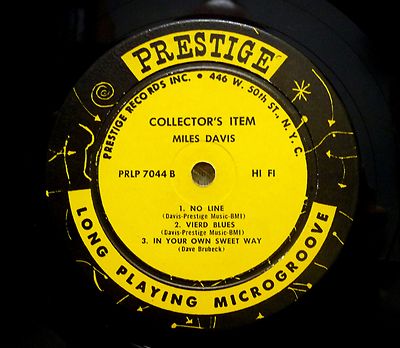
Also interesting was the brevity of this session. Only three songs, but it turned out that was all they needed to make up one of the albums that Miles owed Bob Weinstock. They had an unreleased session from 1953,  and they put it together with this session to make the album called Collector's Items.

This sent me back to the 1953 session. Miles, in his autobiography*, paints that session as something of a disaster. Miles himself was heading into the depths of his heroin addiction. Bird was drunk. He polished off a quart of vodka at the rehearsal, according to this account, but since Bob Weinstock didn't do rehearsals, this was probably at the session itself. At some point he fell asleep, and Davis recalls being so mad he played poorly, or at least that was his opinion, and session producer Ira Gitler's, and this is probably why the session wasn't released at the time. In the liner notes to Collector's Items, Gitler says that the session was shelved because it was too short, and that may be part of it. But Prestige was releasing 45 RPM EPs at the time, and it could have been brought out that way.

Probably a good part of the reason the session was so short was that given the condition of the participants. Sonny Rollins was also addicted at this time, as were Walter Bishop and Philly Joe Jones.

So was the session good enough to be released in Contractual Year 1956?

It was good enough to be released any time.

Don't forget there's another joker in the contractual deck. Miles has already cut his first album for Columbia, due to be released after the Contractual Completion. That album, when it comes out in early 1957, will be called Round About Midnight, and will feature the quintet's version of the Monk classic. Did Weinstock know this, and was he trying to steal a march on George Avakian and the Columbia marketing division?

And this circles back around to a question I pondered in my last Miles blog entry:

The first Columbia album, Round About Midnight, came out in 1957, and was not all that well reviewed. Critics found it wanting in comparison to the Prestige albums, though this judgment was to change over time, and Round About Midnight would become a classic and beloved jewel in the Davis crown. But the first response to it was tepid, and this strikes me as interesting.
...what really interests me here is the possibility that the passing of time may have led to a changing of tastes. Today, there's a lot more awareness of the evils of conglomerates and mega-corporations than there was in the 50s, and an indie label, or no label at all, might get a more sympathetic ear from critics, especially indie critics. But back then, I don't think this would have been an important issue.  
...Today some critics, perhaps many of them born and raised in the in the era of studio perfection, are a little snarky in assessing the Prestige catalog. Ragged, they say. Bob Weinstock preferred quantity to quality, rushed his sessions, didn't allow his musicians to rehearse, never did more than a couple of takes. But maybe back then, that ragged edge was more appealing, more authentic. Maybe the critics of 1957 were put off a little by the studio-perfected sound.

Maybe. And the 1953 "Charlie Chan" session provides an even greater contrast: a finely honed, rehearsed session vs. a total mess. And out of that whole chaotic fiasco, "Round Midnight" was probably the most chaotic. As Gitler describes it euphemistically, "for various reasons the date had not jelled to expectations," and by six o'clock, when the engineer (not Van Gelder) was scheduled to go off duty, and had announced that there'd be no overtime, they only had three tunes in the sack. Actually, only two, but for Collector's Items they use two different versions of "The Serpent's Tooth." They were planning to finish off the day with Monk's "Well, You Needn't," but they couldn't get it together. With 15 of studio time left, they somehow managed to pull it off.

Which is better, the once-maligned, now treasured Columbia version, or the once-shelved, now mostly overlooked collector's item?

Dumb question, of course. They're both magnificent, and no one should be expected to choose one. But, God help me, I like the earlier one. Gitler, in his liner notes, says that Bird's opening solo "is full of the pain and disappointment he knew too well. That borders on the pathetic fallacy, assigning such specific emotions to an abstraction like a piece of music.

But Gitler is right. The pain is nearly palpable. One can't help but be moved.

So, on to the new session, with only Paul Chambers from the
quintet, with Miles in full possession of his Harmon-muted voice, And with another unexpected collaboration-of-sorts, between the two jazz mega-stars of their era: Miles and Dave Brubeck. The session starts with a beautiful Brubeck composition, "In Your Own Sweet Way." There are some--not many-- who have reservations about Brubeck as a pianist, but I don't think anyone can question his brilliance as a composer. Miles would record "In Your Own Sweet Way" again with the quartet, and it has become a kind of touchstone for trumpeters, with versions by Chet Baker, Woody Shaw and Art Farmer.

"Vierd Blues" is a Miles composition that has become a standard, often for pianists (Bill Evans, George Shearing, Oscar Peterson), but also for unlikely artists such as German avant-gardist Albert Mangelsdorff. It has a striking piano solo here by Tommy Flanagan, who had just arrived in New York from Detroit (where he had been house pianist at the Blue Bird Inn) with a reputation that preceded him: in one week in March, he broke into the recorded jazz canon with sessions with Thad Jones, Kenny Burrell, Jones again, and this session with Miles.

This is a session without much or a history. It was released in 1956, and then again in a 1971 compilation-of-this-and-that reissue. But like everything else Miles did in his Contractual Farewell Tour, it has immediacy and urgency.


* Taken from Wikipedia

Listening to Prestige, Vol 1, 1949-53, available in book or Kindle format here.

Sunday, February 08, 2015

Listening to Prestige Records Part 80: Miles Davis

There's a session in between these two very different Miles Davis sessions. Bob Weinstock never had much luck with rhythm and blues, and maybe it's just as well. He might have yielded to the temptation to become another rhythm and blues label, and while there were many labels putting out great R&B, there were very few who can boast the jazz catalog Prestige put together.
Billy Valentine cut four sides on February 6—Valentine on piano and vocals, Mickey Baker on guitar. Two were issued on PAR Presentation, two never issued. Of the two that were issued, I can't find a trace. Too bad. I'm a huge Mickey Baker fan, although I wasn't familiar with Billy Valentine. A little research turns up one cut with Johnny Moore's Three Blazers. He must have replaced Charles Brown, because Valentine's "Walking Blues" is a direct remake of Brown's hit "Drifting Blues." Valentine is no Charles Brown, but he's pretty good.
So on to Miles, and an unusual lineup, and an unusual--but very good--record. John Lewis and Kenny Clarke are on board. They'd just made one record with a new group, but hey, who knows if a new group will stay together? Best get work while you can.  
Sonny Truitt is another one of those unsung pros who can be counted on to do the job. The only bio I can find for him says he's mostly known for his work with Miles.
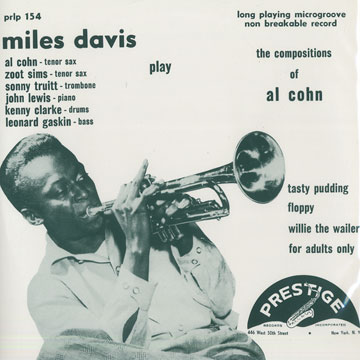
Al Cohn and Zoot Sims, separately and together, but most famously together, had a major impact on the jazz of the 40s and 50s. Davis brought them into this gig together, but it's Cohn who made the major contribution. These tunes were released by Prestige in various configurations, but one of them was a 10-inch LP called Miles Davis Plays the Compositions of Al Cohn. All four were written by Cohn, and all except "Tasty Pudding" specifically for this group.
Why is this session, in all its LP configurations, not better known? I think the answer may lie to some degree in the liner notes by Ira Gitler to the Compositions of Al Cohn release (Gitler by this time was regularly producing for Prestige, as well as writing the liner notes):
Since the "records heard 'round the world," GODCHILD, JERU, MOVE et al, Miles Davis has made many other fine recordings to enhance his position as top modern trumpeter, but in the main they have been three horn groups (including himself) with an emphasis on solo work. After the original melody, usually stated in tight unison, each hornman played again only when his solo turn came. The soloists had to be good to sustain interest, and they were, but it was felt Miles needed a change of pace for his next recording date: compositions and arrangements which would suit him and result in a happy composition of arranged music and solo work.


With all due respect to Gitler, whose liner notes for Prestige. as well as his work for Down Beat, Metronome and other jazz publications, provide an invaluable and insightful narrative of some of jazz's greatest years, this is mostly bullshit.
Let's leave aside "each hornman played again only when his solo turn came." That's an oversimplfication--it leaves out trading fours, interpolated notes, and even concurrent solos, but it's a short piece, and the oversimplication is still more or less accurate.
But why was everyone who wrote about it, in that era, so eager to put down, and put to rest, the classic bebop formulation? Gitler is better than most. The New Yorker, in every "Goings On About Town" mention of jazz, gives the back of the hand do bebop's death throes. John Lewis and Miles Davis are both described as being frustrated by the confines of the theme-solos-theme format. But made for so much great jazz, and not just in the Forties.
OK, it's not mostly bullshit. He's not really wrong about anything. And I'm nitpicking way too much about a far greater jazz writer than myself. But what about the "records heard 'round the world"? That's a problem. The Birth of the Cool sessions are among the most important in jazz, and Gitler was perceptive enough to realize it, but at the time he was writing this, they were only the records heard 'round the world to a discerning few. Probably most musicians, probably not that much of the public. The Royal Roost sessions had not drawn fans, the 78s hadn't sold well. So maybe as good as this session is, and as good as the Lee Konitz session was,. there wasn't an audience for it yet, and even over time it hasn't gotten the traction to pull it even with the other Davis LPs on Prestige.
The Konitz session was probably more experimental than the Birth of the Cool sessions, this probably less. But it's beautifully played, and brilliantly written. I'm not sure one would immediately think of Miles Davis and Al Cohn as the most likely of musical partners, but whoever thought this one up was inspired. Miles himself? Bob Weinstock? Ira Gitler? Cohn?: Some combination of all four?
Maybe Gil Evans had a hand in it? He's not credited with any part of the Davis oeuvre from Birth of the Cool to Miles Ahead, but Evans didn't take credit for a lot of things he was involved in, and he and Miles were always close.
In any event, this is a terrific album, and one that deserves a higher spot in the Davis canon than it probably has.
"For Adults Only" has a very familiar melody. Is it also called something else? Or is it just really catchy?
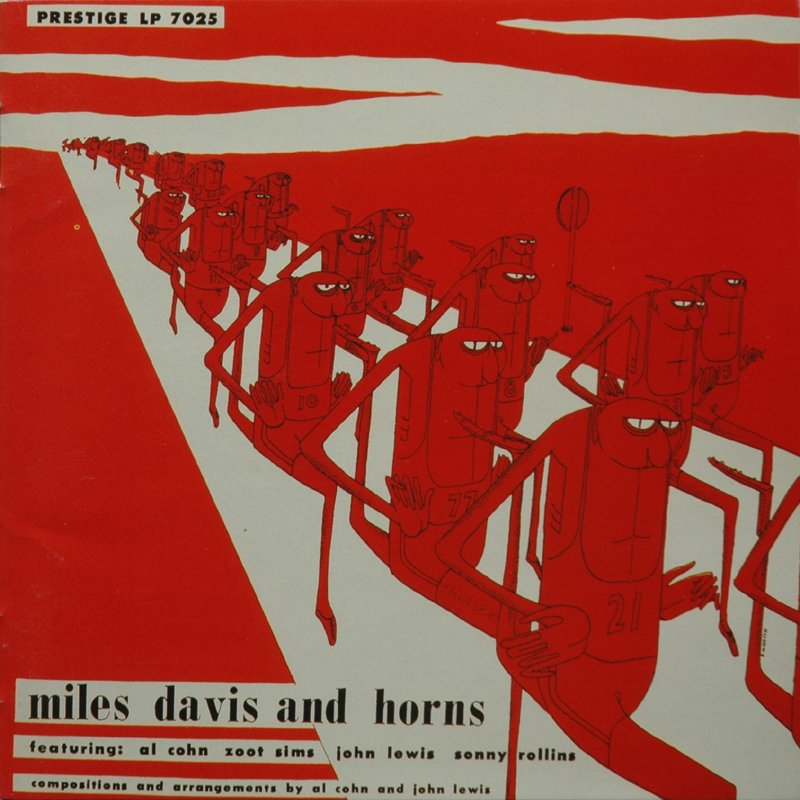
"Tasty Pudding" was released as 78; Miles Davis Plays the Compositions of Al Cohn was the 10-inch. A later reissue was on a 12-inch 7000-series as Early Miles 1951 & 1953, and on a 1955 reissue called Miles Davis and Horns, which is interesting not only for its music but for its cover art, by Don Martin, of Mad fame. Mad and Miles seem an odd combination, but Martin did several covers for Prestige.
  I don't comment on the post-1972 reissues for the most part, but there is a reissue called Dig - Miles Davis and Sonny Rollins, which includes the sides from the Al Cohn session, which is a good thing, but has what may be the world's worst cover art, replacing the dark, atmospheric, supercool young Miles with a bad photo of heavy equipment at a construction site.


Sunday, November 16, 2014

Listening to Prestige Records Part 51: Miles Davis Sextet

I keep finding myself drawn back to the nonet and the 1948-49 Birth of the Cool sessions, because they were so important, and because no one seemed to know it at the time. Certainly no one one in New York. The engagement at the Royal Roost had been a flop, in good part, perhaps, because Count Basie was headliner, and Basie's audience might not have been the most receptive to the cool sound. And hardly anyone had listened to, or cared much about, the 78 RPM records that came out of the studio sessions for Capitol. Gerry Mulligan took the sound as far away from New York as he could, to California, where he developed it and adapted it for smaller groups, and created West Coast jazz -- or, as many said, gave birth to a new, cool jazz sound. Gil Evans seems to have gone fairly quiet-- we do know that he was always in touch with Miles.

Miles is thought to have completely turned his back on the experimental sound of the Nonet, bitter and disillusioned by the failure of the Jazz public and critics to appreciate what he had done for them, and that's mostly true, but not completely. He did make that one very experimental recording session with Lee Konitz. And, like Mulligan, he went as far away from New York as possible, but in the other direction, to Paris. 

I knew Miles had been embittered by the nonet's reception, but I didn't realize how much. He stayed away from New York -- first Paris, then the Midwest, where the answer to how you gonna keep them down on the farm, after they've seen Paree? seemed to be, in part, a lot of heroin, but another was just that...staying out on the farm. Plenty of first class musicians came through Chicago, and we've already talked about the Detroit scene.

Bob Weinstock, in an interview, recalls tracking him down.

 Miles had vanished after he did those Capitol sides with the (Birth of the Cool) Nonet. Nobody knew where he was. Somebody had said that he may be at home in East St. Louis, so while I was in Chicago on business I tracked him down. His father was a dentist, so I knew that his number would be in the phone book. I had met Miles at a Dial session where he recorded with Bird, but he didn't remember me. Anyway, he said if I'd send him money to get to New York, he'd be happy to record. I said that I was interested in doing a series of recordings, and that I wanted to sign him to a contract. He said alright, just get him to New York and we'd talk about it then. So, our basic idea was just to make records with different people, to record with the best people around. That's what we did until the end, when he had the quintet with John Coltrane, Red Garland, Paul Chambers, and Philly Joe Jones. But everything up to that point developed from where we would sit down and talk about it. Miles would mention who was in town, who he would like to record with. I'd say who I'd like to hear him record with. We'd kick ideas around.

His first studio album for Prestige was the January session with Bennie Green, Sonny Rollins and John Lewis. 

This time it was Sonny Rollins, who, like Miles, was just hitting his stride as a major jazz figure, and who, like Miles, would become a colossus of American music. Tommy Potter and Art Blakey were veterans of bebop and of Prestige recording session. Walter Bishop, Jr., had made a couple of records, and had played at Minton's for a variety of people, idolizing Charlie Parker, learning from Bud Powell.

His bio in Allmusic.com says that he was "a valuable utility pianist on many a modern jazz session during the bebop era," which means what, exactly? A valuable utility infielder in baseball is someone who's not quite good enough to make the starting lineup, but can fill in at any position if the regular guy can't play that day. Doesn't seem to fit Bishop too well.

Jackie McLean was making his first record. He was in some impressive company--and it's said that he was more than a little nervous, because Charlie Parker was hanging out in the studio that day. So was Charles Mingus.and though he's not credited, it's generally accepted that Mingus played bass on "Conception."McLean definitely made a good impression, and not just with his alto sax playing. It's believed by many that he wrote "Dig." 

Jazz blogger Peter Spitzer asked McLean about it.

I asked him about “Dig.” He said that he had brought that tune to a recording session with Miles, in 1951. Sonny Rollins was there too, and had brought a tune called “Out of the Blue.” When the album came out, Miles was listed as the composer of both tunes. Jackie was willing to consider it an error by the recording engineer. He later talked to a lawyer about getting proper credit, but was told that the returns would not justify the cost of pursuing it, so he just let it go.

Spitzer mentions several other tunes credited to Miles that were probably written by other artists, and then he says,

Some people have pointed out that in those years, it was not unusual for leaders to take credit for the work of their sidemen. 

Now, I'm not here to defend Miles, who (a) doesn't need my defense, and (b) is guilty anyway, but I did wonder about that last statement, because it makes a certain amount of sense, because what exactly is jazz composition? Contemporary jazzman Steve Coleman has this to say about Charlie Parker:
I view Parker as a major composer, albeit primarily a spontaneous composer. His written compositions, similar to many other very strong spontaneous composers, were mainly jumping-off points for his spontaneous discussions.
Bird was noted for "spontaneous composition" -- that is, his improvised solos were actually original compositions, created on the spot. And what is a jazz composition, exactly? It's a tune, or a riff, or a series of riffs, that's played for one or two choruses at the beginning of a performance, and then played again at the end. In the interim, the musicians -- that's Davis, Rollins, McLean himself, Bishop, even Blakey -- are improvising, leaving the melody behind and creating their own musical units, in a piece that lasts for 7 1/2 minutes. The improvised solos are based on the chord structure of the opening chorus (at least until Ornette Coleman came along), and while they do follow that chord structure, it is, in many jazz compositions, the chord structure of an existing song. In the case of "Dig," it's "Sweet Georgia Brown." This is based on research -- I can't listen to "Dig" and say, "Oh, yeah, that's 'Sweet Georgia Brown.'" So maybe it's not so far-fetched for the leader to take composition credit. Or maybe it is.

That being said, "Dig" is a hell of a tune -- draws you in right away. But in spite of that,  McLean's lawyer was probably right about the returns not justifying the cost of pursuing it. I haven't been able to find any other recordings.

And yes, it's 7 1/2 minutes long. In fact, all the tunes from this session are more than five minutes -- "My Old Flame" and "Out of the Blue" came out on 78s, each split up into Part 1 and Part 2. "Only a Paper Moon" and "Dig" the same, but also on 45. "Bluing" was too long even for that, so Parts 1 and 2 were on one 78, and Part 3 on the flip side of "Conception," which at 4:02 must have been just short enough to squeeze onto a disc.They were also all released on 45 RPM EPs. and "Dig" / "It's Only a Paper Moon" also came out as Prestige 45-321, which must also have been an EP, although not labeled as such, and also must have been much later. The 300 series of 45s includes later-generation jazzers like Yusef Lateef, and even rockers like Manfred Mann, as well as a lot of blues artists like Eddie Kirkland.

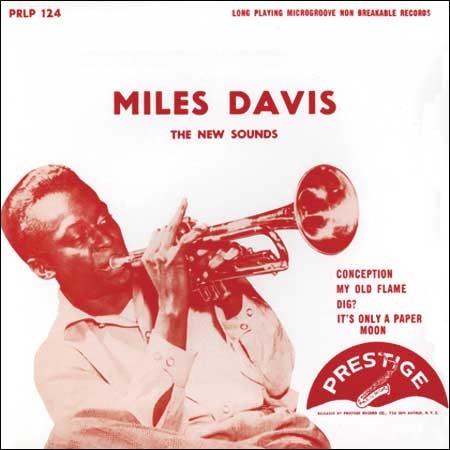
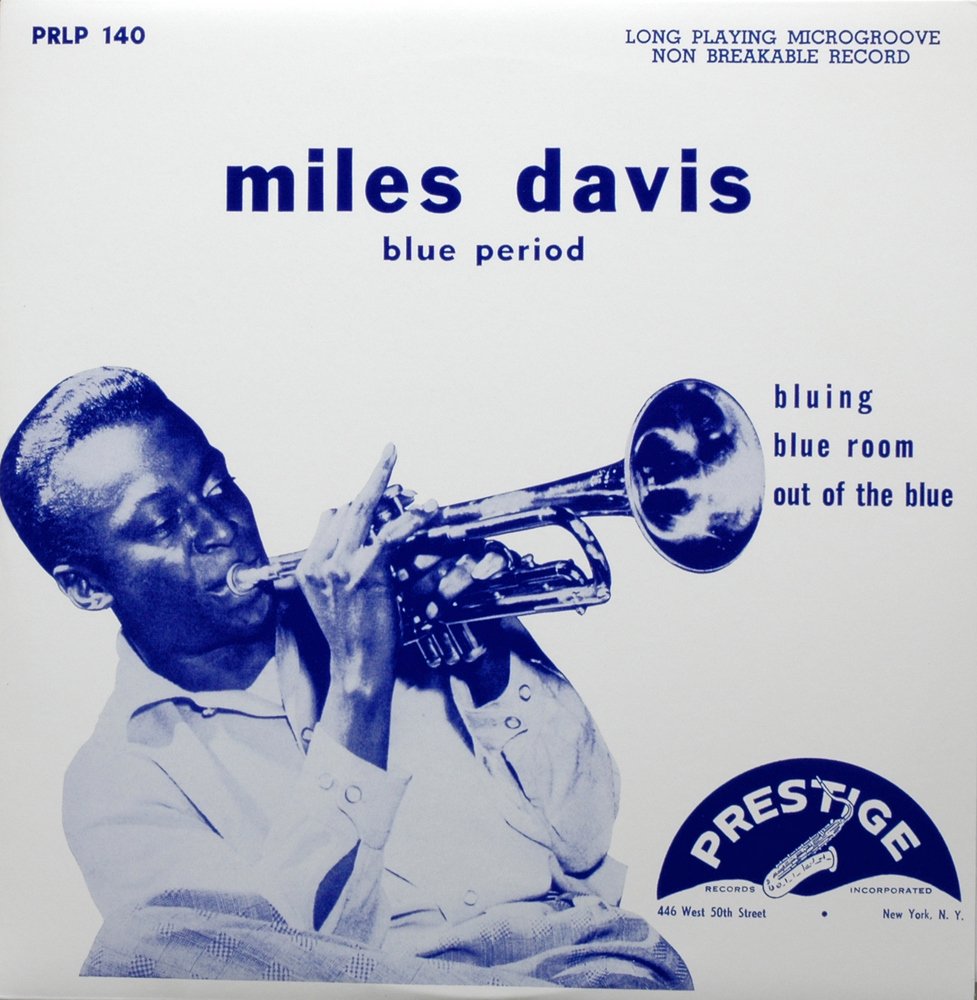
But this may have been the first Prestige session directly aimed at the LP format, and it was released in a few different formats -- as PRLP 124 - Miles Davis: The New Sounds (Conception/Dig/My Old Flame/It's Only a Paper Moon) and PRLP 140 - The Blue Period ("Bluing" and "Out of the Blue," along with the alternate take of "Blue Room" from the previous session). Ira Gitler was writing the album cover notes by that time, and here's what he had to say (liner notes thanks to the Plosin website, very complete on Miles).

THE NEW SOUNDS
When an artist is simultaneously recognized, by critics, fellow artists, and the public analogous to his art, as the foremost in his particular field, the work of the artist invariably substantiates the status given him by this audience. Such is the position of Miles Davis as the most important creative trumpeter today. Acknowledged first by musicians, Miles, soon drew the ears of discerning critics into appreciative attentiveness and finally the jazz public accorded him their appreciation in the Metronome and
Downbeat polls.
Of course, Miles is to be appreciated for bringing a new sound and conception to the trumpet but what really gives him his greatness are the intangibles he possesses, which enable him to transmit sweeping joy with his "wailing" solos and reflective beauty in the delicacy of his ballads.
This album gives Miles more freedom than he has ever had on record for time limits were not strictly enforced. There is opportunity to build ideas into a definite cumulative effect. These ideas sound much more like air-shots than studio recordings.
Upon the wonderful rhythmic foundation of Art Blakey's drums, Tommy Potter's bass, and Walter Bishop's piano, tenorman Sonny Rollins and altoman Jackie McLean are able to enjoy some of the unlimited time for their solo efforts. Rollins demonstrates the impact of the intangibles, again, with his solo on "Paper Moon". The way in which the solo is constructed and the feeling and time with which it is played, overshadow the marring reed trouble. McLean, still in his teens, is heard only on "Dig". He need not apologize for his youth after his work here. Walter Bishop appears in solo for a brief moment on "Conception" which gives only an inkling of his marvelous playing.
Here are New Sounds at greater length. Listen to them at great length.


and

MILES DAVIS - BLUE PERIOD
An album by Miles Davis represents modern jazz at its best. In this album as in Miles' PRESTIGE LP 124, the length of time for each selection is not restricted to the usual limits except in the case of BLUE ROOM, which was cut at a more conventional session. BLUING, the high spot of this set, is over nine minutes of freedom of expression on
modern blues chord changes. At the very end, Art Blakey continues playing after everyone else has stopped. If you listen closely, you will hear Miles say something like, "You know that ending man, let's do it again", but why do it again when you've captured the feeling in the solos of Walter Bishop, Miles, Sonny Rollins, Jack McLean, and the inventive drumming of Art Blakey. The advantage given by LP, of not having to make a "product" for the juke bokes, allowed us to keep this take. OUT OF THE BLUE (Miles' plea to get happy) was done at the same session and although not as lengthy as BLUING, still provided ample time for relaxed improvisation.
This album is a must to those who appreciate our modern jazzmen. I know that people who have missed hearing these musicians in person, will be especially gratified, because this is what they have been missing.

But the major release of this one came in 1956, remastered by recording genius Rudy Van Gelder, and issued as a 12-inch LP as Dig. This, with the moody, dark cover image of Miles in shadow, and the terse title, was one of the benchmarks of hip in my young life.

And here's Gitler on the reissue:

These are some of the first "longer playing" recordings made possible by the advent of the LP. Recorded on October 5, 1951, this entire session has been remastered by top engineer Rudy Van Gelder. (The two remaining selections from this date, Conception and My Old Flame, are included in CONCEPTION, PRLP 7013)
Miles Davis and Sonny Rollins form one of the most empathetic and powerfully moving duos in jazz. Although they had recorded together before (Morpheus, Down, Whispering, Blue Room) this was their first chance to "stretch out" together on records.
These recordings have much warmth. The emotions jut out of all the solos. On Paper
Moon and Bluing this is especially true, but it is in evidence on the upper tempos too. Dig is fluid. The chord changes lend themselves to the long melodic lines that the soloists employ. There is also a continuity of feeling from one soloist to another which points up the aforementioned empathy.
The group is made a sextet by altoman Jackie McLean on all numbers but Paper Moon. Jackie, in his teens when these recordings were made, was then a disciple of Charlie Parker. The Bird influence is still with him but the light of it is partly directed through the prism of Sonny Rollins.
Incidentally, Bird was present for part of this record sort of visiting with his children: Miles who gained his greatest experience and had his largest pleasures playing with him; Jackie, the young disciple; and Sonny, the reed voice who has become the foremost standard bearer and advancer of the Parker tradition.
The swinging rhythm here features the explosive drive of Art Blakey, the subtle power of Tommy Potter and the sensitive accompaniment and solos of the unduly underrated Walter Bishop.


More credit to Jackie McLean for those chord changes (even if they are the chord changes to "Sweet Georgia Brown") that lend themselves to long melodic lines. And more credit given to McLean by Gitler, who had said on the previous liner note that he only appeared on "Dig."

And by the way, a busy day for Art Blakey. He played on the Bennie Green session as well.