Showing posts with label Ronnie Mathews. Show all posts

Monday, February 14, 2022

Listening to Prestige 611: Sonny Stitt


LISTEN TO ONE: Baion Baby

Sonny Stitt had recorded a soul jazz album (with Jack McDuff) for Prestige in September of 1963, and then moved over to Latin in November with an album for Verve, featuring a young Chick Corea in at the beginning of his career (he had made one earlier recording with Mongo Santamaria) and Latin percussionists. For this New Year's Eve celebration of an album, whoever decided on the the title--Primitivo Soul!--seems to have been trying to bring the two together, which is legitimate. The Latin element is once again in the ascendent here, but Stitt is always soulful. And most of the tunes here are his, and while the percussionists give them a delicious Latin rhythm, Stitt can hardly be described as a Latin composer.


Stitt comes by his soul credentials organically. Regarded by many as the quintessential bebopper and heir to the mantle of Charlie Parker, Stitt cut his blues teeth with Tiny Bradshaw, and the blues was always at the heart of his playing. And in a era marked by the startling experimentalism of the free jazz players, Stitt preferred to stay close to the source. "I don't like strange music." he told a Down Beat interviewer (quoted on the liner notes to Prmitivo Soul!):

I'm not on "Cloud Nine." Music should be a flowing melodic thing. I think you should always be around the basic melody. Improvise, but stick to the basic melody. Bird was always 85% to 90% around the melody.

Stitt had been one of Prestige's mainstay recording artists throughout the 1950s, most frequently paired with Gene Ammons, another bebopper who loved the melody, and played the blues. But outside of his long association with Ammons, he preferred to keep moving, and to play with a wide variety of musicians. Here he links up with newcomer Ronnie Mathews, fresh from his debut as leader, and the veteran rhythm tandem of Leonard Gaskin and Herbie Lovelle. To that basic group are added two percussionists, Marcelino Valdez on congas and Osvaldo "Chihuahua" Martinez on bongos.


At this point in jazz history, Latin percussionists were still pretty anonymous to the jazz listening public as a whole--Down Beat had still to recognize "percussion" as a separate category in its annual jazz polls--but these two were certainly known to the Latin community, having worked with Ray Barretto, Willie Bobo and Mongo Santamaria, among others. Martinez, who also appeared on Stitt's Verve album, was featured on Santamaria's classic "Watermelon Man."

The two non-Stitt compositions on the date are "Slave Maidens," by Nato Lima, writing under the pseudonym Mussapere, and "Estrellita," by Manuel Ponce.

It's hard to imagine an instrumental composition being entitled "Slave Maidens" today (just as it's hard to imagine an album of any form of world music being labeled "primitivo"), but the choice of tune is certainly a good one. Nato Lima was one of the two brothers, both guitar virtuosos, who formed the Brazilian folk/classical duo Los Indios Tabajaras, and had a huge stateside hit with their arrangement of a Brazilian folk tune, "Maria Elena." Manuel Ponce was was a composer primarily in the classical field, educated in Europe at the Ă‰cole Normale de Musique. Like his fellow student, Brazilian Hector Villa-Lobos, he was a pioneer in creating a composed music based on the indigenous folk traditions of his country. "Estrellita" has not become ubiquitous in the jazz repertoire, but it has won the attention of some major figures, with recordings by Benny Goodman, Charlie Parker, Dave Brubeck and others. Stitt had also recorded it the previous June for Impulse!

The rest of the session is devoted to tunes written by Stitt for the date, and blending bebop, blues and Latin. Ronnie Mathews contributes some fine solos. Sonny Stitt was one of the most prolific of the major jazz soloists, and his explorations, and his collaborations, cover a wide range. We can only be grateful that these sojourns south of the border were included.


Friday, February 11, 2022

Listening to Prestige 608: Ronnie Mathews - Freddie Hubbard


LISTEN TO ONE: The Thang

Ronnie Mathews debut album as a leader might have been the start of a distinguished career -- and it was, actually, but most of that career was under the radar, and when he died (of pancreatic cancer, in 2019) most of his obituaries took note of the fact that he was not as well known as he might have been, considering the significance of his accomplishment. The New York Times gave us both sides of that picture:

Mr. Matthews spent most of his career out of the spotlight. But he was highly valued by many noted fellow musicians for his harmonic acuity, his imagination as an improviser and his sensitivity as an accompanist.


And his friend and colleague Cedar Walton said:

I like to equate Ronnie to a great character actor who may be well known in the business but not so well known outside of the business. If you go back, you could equate him to actors like Peter Lorre or Sydney Greenstreet. They were always around but not in the forefront so much. And the time that they had on the screen made an impact. That was Ronnie. He may have been underappreciated by the general public, but I’ll certainly never forget him. 

It';s a good bet that Cedar had recently watched The Maltese Falcon. Mathews would not record again as a leader until the mid-1970s, and then his output was on tiny labels with limited distribution. But as a sideman he continued to be in demand, and not altogether unnoticed. Reviewing a 1981 appearance at the Village Vanguard by Johnny Griffin, with whom Mathews worked frequently, New York Times critic John S. Wilson commented on "the dashing flair that [Griffin] brings to his playing, and then went on to say that:

His pianist, Ronnie Matthews, reflects [that flair] so well that he is a constant and provocative challenge to Mr. Griffin.

Even more than Mr. Griffin, Mr. Matthews is the energizer of the group, developing solos that rise out of preliminary single-note noodling to become swinging, swirling juggernauts. 

At the same that Mathews was poised to embark on four decades of respected obscurity, his partner for


this session, Freddie Hubbard, was on the brink of a career in the jazz limelight, appearing on some of the most important albums of the 1960s (Ornette Coleman's Free Jazz, Oliver Nelson's Blues and the Abstract Truth, Herbie Hancock's Maiden Voyage), and then attaining jazz superstardom in the 1970s.

You can hear all of that on this session: Mathews's power as a composer, improviser, and the glue holding the session together, Hubbard's untrammeled, hair-raising virtuosity. They make for a great combination--sort of what John S. Wilson heard that night at the Vanguard with Mathews and Johnny Griffin.

The rhythm section is rounded out by Eddie Khan and Albert "Tootie" Heath, another pair whose reputations were to go in opposite directions. Heath was a member of the gifted musical family who would perform together as the Heath Brothers in the 1970s. In 2020 he was honored as an NEA Jazz Master. Jazz buffs have had a hard time tracking down any information on Khan, who stopped playing in the 1970s, and died of cancer some years later in California. He is believed to have worked as a cameraman for CBS News in Los Angeles.


And baritone saxophone player Charles Davis made his mark on an instrument that doesn't get the headlines too often, so even though he won best baritone sax player in Down Beat's 1954 International Critics Poll, his name is hardly a household word, even in jazz households. But he had a long association with both Sun Ra and Kenny Dorham, and he was noteworthy as a producer of jazz events.

The tunes are Mathews's except for Duke Ellington's "Prelude to a Kiss" and one Charles Davis composition, "1239-A." Ozzie Cadena produced, and the Prestige release was entitled Doin' That Thang.


Sunday, January 16, 2022

Listening to Prestige 602: Roy Haynes


LISTEN TO ONE: Modette

 Elvin Jones once said:

 The greatest contribution jazz has made in music has been to replace the role of the conductor with a member of the ensemble who, instead of waving his arms to keep time and convey mood, is an active member of the musical statement. That person is the drummer. 

Jones did, of course, see the world through a drummer-centric prism, but that doesn't make him wrong. And in sessions led by a drummer, the argument is made forcefully. Art Blakey's Jazz Messengers set the tone for so much of Blue Note's


catalog. Max Roach and Tony Williams showed new directions in jazz through groups that they led. Across the Atlantic, expatriate Kenny Clarke showed how a drummer could conduct a large ensemble with the Clarke-Boland big band.

Roy Haynes was one of the most prolific drummers of his era, and his era is virtually an eon. He came on the jazz scene in the early 1940s, recording with Lester Young, then with Charlie Parker. As the 21st century entered its third decade, he was still playing, well into his 90s. I can never hear his name without hearing Sarah Vaughan, on her great 1950s recording of "Shulie a Bop," announcing her musicians, ending with "Roy (drumroll)....Haynes!" (drumroll). He is one of the most prolifically recorded drummers of all time, with 28 previous sessions on Prestige.

These include three previous sessions as leader. In 1958 he recorded We Three, a trio album with Paul Chambers and Phineas Newborn, Jr., and in 1960 he followed it with Just Us, this time with Richard Wyands on piano and Eddie de Haas on bass. While Elvin Jones's statement is meant to apply to the importance of the drummer in a large ensemble, you can hear it more plainly in a small group session where the drummer is the leader, and Haynes makes a powerful impression with these trio sessions.


In April of 1963, just five months before this session, he co-led a quartet featuring Booker Ervin. Ervin was really starting to establish himself as one of the major new jazz stars of the decade. Here he's back with the quartet format again, including worked with Ronnie Mathews and Larry Ridley, from the Ervin session, and Frank Strozier, who was heard once earlier on Prestige, playing alto sax in a group led by Booker Ervin. Here he plays flute as well as alto.

All three of these guys were young, near the beginning of their careers, and Haynes gives them all ample opportunity to shine. This includes the playing of their compositions--"Modette" and "La Palomeinding" were written by Strozier; "Go 'n' Git It" is by Mathews. All of them get the substantial benefit of Haynes's leadership on drums. Another Strozier composition, "Hag" (one of Haynes's nicknames) is included as part of a medley, unusual but not unheard of for a jazz album, and actually a frequent concluding number for Haynes's live sets, always including his own (with Richard Wyands) composition "Cymbalism," which had previously been on the Just Us album. Here they finish up with Sonny Rollins's jazz standard "Oleo."

"Cymbalism" becomes the title track for this LP, which was issued by New Jazz, and was the last album to be recorded for New Jazz, although several reissues followed it before the label was finally put to rest. Ozzie Cadena produced.


Thursday, September 30, 2021

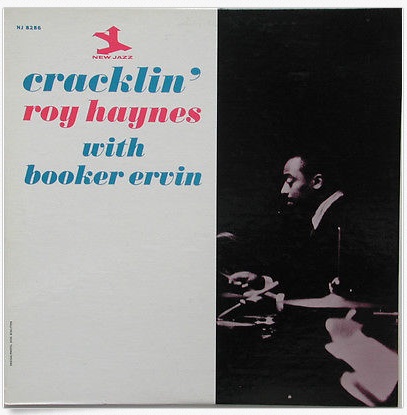
Listening to Prestige 589: Roy Haynes with Booker Ervin


LISTEN TO ONE: Scoochie

Booker Ervin had been in the studio for Prestige earlier in 1963, for a session with Larry Young, that was inexplicably shelved, not to see the light of day until many years later, in the CD reissue era, when it was coupled with an Ervin-Pony Poindexter recording which was made later in the year. He had appeared on one previous New Jazz recording, with Eric Dolphy and Mal Waldron. He was to become a mainstay of Prestige over the next few years.

Roy Haynes was already a Prestige mainstay, appearing with musicians covering the spectrum


from Willis Jackson to Phil Woods to Eric Dolphy. He'd played soul jazz with Shirley Scott, harp jazz with Dorothy Ashby, blues with Sonny Terry and Brownie McGhee, and a little bit of everything with master of eclecticism Jaki Byard. 

He had led his own trio (Phineas Newborn, Paul Chambers) in 1958, for a particularly beautiful album, We Three, and followed it in 1969 with another trio album (Richard Wyands, Eddie de Haas), Just Us. He had put together a couple of earlier sessions as leader with Mercury/EmArcy, and one with a smaller independent label. He told Ira Gitler that wanted to do more work as leader, because he could "set more of a pace," or as Gitler put it, he could "[pick] the tunes, the order they should be programmed in, and the tempo they should follow. The last, of course, is closest to the drummer's domain. Before he can do any of these things, a leader has to make his most important decisions--choosing the men who will play with him. Haynes has chosen well in the past, and his current quartet again reflects his good taste."

For his first Prestige album, Haynes had chosen two of the finest--and most talked about--of the younger musicians on the scene. For his second, he chose musicians who would never have the honors or name recognition of Phineas Newborn and Paul Chambers, but who were bold and sensitive, and delivered the music that Haynes was looking for. A 1962 session for Impulse! featured the rising star Roland Kirk.

Here, in Booker Ervin, he has another rising star, that would blaze forth through the rest of the 1960s on albums for Prestige and Blue Note, before Ervin's untimely death from kidney disease in 1970.

At 28, Ronnie Mathews was another young talent, and one who apparently appealed to the era's finest drummers--he had been discovered by Max Roach, and also worked extensively with Art Blakey. He had made his recording debut for Prestige in 1961 with Roland Alexander, and would lead a session of his own for the label later in 1963.

Larry Ridley was 26 when this record was made, and he had a fine career as a bassist ahead of, playing with Chet Baker, Kenny Burrell, Dexter Gordon and Stephane Grappelli among others, but perhaps an even more important contribution to the music was his work as an educator and administrator. He served as (and I'll just quote his Wikipedia entry here):

chairman of the Jazz Panel of the National Endowment for the Arts (NEA) and was the

organization's National Coordinator of the "Jazz Artists in Schools" Program for five years (1978–1982). Ridley is a recipient of the MidAtlantic Arts Foundation's "Living Legacy Jazz Award", a 1998 inductee the International Association for Jazz Education Hall of Fame (IAJE), an inductee of the Downbeat Magazine Jazz Education Hall of Fame, a recipient of the Benny Golson Jazz Award from Howard University, and was honored by a Juneteenth 2006 Proclamation Award from the New York City Council. Ridley is currently the Executive Director of the African American Jazz Caucus, Inc., an affiliate of IAJE. He is also the IAJE Northeast Regional Coordinator. He continues to actively teach as Professor of Jazz Bass at the Manhattan School of Music. Ridley is currently serving as Jazz Artist in Residence at the Harlem based New York Public Library/Schomburg Center for Research in Black Culture. He established an annual series there dedicated to presenting the compositions of jazz masters that are performed by Ridley and his Jazz Legacy Ensemble.

  Haynes also utilized the composing talents of the musicians he brought in. Ronnie Mathews composed "Dorian" and "Honeydew." Booker Ervin contributed "Scoochie," and Haynes finished the session with his own "Bad News Blues." Randy Weston is represented by his tribute to Melba Liston, "Sketch of Melba."  


They play one semi-standard, "Under Paris Skies," originally composed by Hubert Giraud for the French film Sous le Ciel de Paris, later recorded by Edith Piaf. With English lyrics, it became a favorite of vocalists and mostly of sweet-music dance bands, although it has had some jazz adherents, most prominently Duke Ellington. Art Van Damme and Quincy Jones both also recorded it. Haynes liked the tune, and featured it in his club performances, often with Frank Strozier soloing on flute. Haynes's virtuoso lead-ins are a strong feature of all the tracks on this album, but on this one he really goes to town, driving all thoughts of sweet strings out of your head. Larry Ridley joins him on bass before--over thirty seconds in--Ervin enters, playing the familiar melody, and sticking mostly close to the melody for a full three minutes, as Haynes continues to kick it hard. The real improvisation starts with Mathews, and continues with Ervin, until the head is briefly restated at the end, this time by Mathews, perhaps somewhat sardonically. 

"Bad News Blues" is a first rate example of what sound engineer Rudy Van Gelder used to call a "five-o-clock blues" -- it's the end of a session, we've played all the tunes we came in with, let's just play some blues. Prestige founder and president Bob Weinstock loved a good jam session, and a lot of good ones came out of this approach, with "Bad News Blues" being a prime example, Haynes setting the pace and everyone getting some room to blow.

Mathews's "Dorian" is in the Dorian mode, the minor-key modal structure made most famous by Miles Davis's "So What" and here turned into a moody, emotionally stirring piece, particularly in Mathews's own solo. All of this is taken at a quick tempo, not what you'd think of as the first choice for moody introspection, but it works. "Honeydew" is altogether different, with Ridley playing the blues right out of the gate, with Mathews and Ervin joining to create a full-bore, major scale excursion into rhythm and blues with Haynes providing a complex but driving alternative to the back beat.

"Scoochie" is Ervin's, and it is not only scoochie, it is downright scorchy. Ervin had introduced the tune a few years earlier in the sculpture garden of the Museum of Modern Art, in a group led by Teddy Charles and also featuring Booker Little. If that rendition scooched the statues into life, this one would have scorched and singed them, with Haynes providing the beat, Ervin flying high, and Mathews turning in a piano solo that echoes and extends what Teddy Charles did in the Garden.

Haynes had entered a phase of his career where he wanted to work more as a leader, with his own groups, but he was only to make one more record for Prestige, and then one for Pacific Jazz, and nothing else in the 1960s, though the 1970s were a much more fruitful decade for him in the leader role, and he was to continue as a jazz stalwart, and a jazz legend, into his 90s.

Cracklin' was the title of the New Jazz album release,and the title credit was Roy Haynes with Booker Ervin. The two Mathews compositions, "Dorian" and "Honeydew," were a 45 RPM single. Ozzie Cadena produced.

Friday, March 27, 2020

Listening to Prestige 468: Roland Alexander

Tenor saxophonist Roland Alexander cut this session for Prestige in 1961, and his only other date as leader, for the short-lived avant-garde label Kharma, in 1978. He would record once more after that, with James Spaulding in 1991. Because his work grew more and more free form, it didn't always command a large audience or cause record companies to beat down his door, but it had the respect of his contemporaries.

And in the middle of all that, in 1973, his first recording was released. It was dated 1956, and his bandmates were John Coltrane, Curtis Fuller, Pepper Adams, Paul Chambers and Philly Joe Jones.

Wait a second. Who was on piano?\

Oh, yes, that. That was 20-year-old Roland Alexander.

So perhaps we'd better start at the beginning. Alexander was born and grew up in Boston and Cambridge, where he studied composition at the Boston Conservatoryy, and his first instrument was piano, although he took up the saxophone quite early. While he was still a conservatory student, he began playing local gigs around (this was not unheard of--Makanda Ken McIntyre was a fellow student).

Apparently Miles Davis, with his new young wunderkind Paul Chambers on bass, must have been playing a gig in Boston, when Blue Note decided they wanted to feature Paul Chambers as leader on an album. Fuller and Adams must also have been playing gigs in Boston at the same time, so they were called in on the session, but for whatever reason, Red Garland didn't show up. They played two numbers without a piano, but called upon the conservatory kid who happened to be in or around the studio to fill in on piano for the third tune, "Trane's Strain." He sounds good--appropriately for the session, very much in the Garland vein.

Blue Note shelved the session, although they did record Chambers again later that summer, in the Van Gelders' living room. So by the time it was finally released, it bore little or no resemblance to the music Alexander was making,

But when Alexander made his debut on Prestige in 1961, this session, with his idols from New York and the jazz world that the young conservatorian dreamed of entering, must still have been very much a part of his maturing self. He had come to New York in 1958. He had started building a reputation, and had played on two sessions for Bethlehem, one led by Howard McGhee and the other by Charlie Persip. And stylistically, he was still very much under the influence of Coltrane--not so much the Coltrane of Giant Steps as the Trane of the Prestige sessions with Red Garland. It was a sound that was starting to be superseded by newer styles, but it never went away completely, and it still sounds good.

Alexander's bop-time band was made up of young players, all new to Prestige. Of them, trumpeter Marcus Belgrave would go on to make the biggest impression in the music world. Belgrave had joined the Ray Charles band in 1957, and while off the road, in between tours with Charles, began to make a reputation in New York, working with Charles Mingus and Max Roach, among others. But not long after his session with Alexander, he moved to Detroit, reversing the trend of so many great Detroit musicians who had come east to New York. Many years later, he explained his motivation in an interview. “This was just a natural place for me to come.This was probably the only place in the country where music was No. 1.”

Although many of Detroit's top jazz musicians had left, there was still an active jazz scene, and the Motor City was about to become a music center all over again, with the arrival of Berry Gordy and Motown Records. Detroit's jazz musicians formed the core of the Motown house band celebrated in the documentary Standing in the Shadows of Motown, and Belgrave was one of the key players. When Motown Records decamped for Los Angeles, Belgrave stayed in Detroit, where he taught and mentored young musicians.

This was Ronnie Matthews' first recording session, and the beginning of a distinguished career. Unusually for a pianist, he didn't make all that many sessions as a leader, but he was a longtime member of Max Roach's group, of Art Blakey's Jazz Messengers, and for another generation, with T. S. Monk. He played with Dizzy Gillespie, Dexter Gordon, and many others.

Gene Taylor came to Alexander on loan from the Horace Silver Quintet, with whom he played from 1958-63. Among his other considerable accomplishments was writing the "Why? (The King of Love is Dead)," about the assassination of Martin Luther King, which Nina Simone recorded (he was working with Simone at the time). They were all young. Roland Alexander was 26, Marcus Belgrave 25, Ronnie Mathews 26, “Scoby” Stroman 29. Gene Taylor was the senior citizen of the bunch at 32.

For Clarence Stroman, in the session log, "Scoby" is given as nickname, but for his 1996 obituary in The New York Times, it's his middle name: C. Scoby Stroman. Either way, he built a fine reputation not only as a drummer but also as a dancer, and as performance poet before that appellation was widely used. He called what he did "drummetry" -- a combination of drumming and poetry.

"Dorman Road" is a good example of Alexander's talent, and of his debt, at this stage of his career to Coltrane. An original Alexander composition, it's a tribute to Coltrane and takes its name from the road that ran past Coltrane's home. It develops off a riff that owes a lot to Trane. You can hear echoes of "Moment's Notice," on Blue Train, and a couple of other Trane riffs.

Ozzie Cadena produced, and the album was released on New Jazz.