Showing posts with label Jaki Byard. Show all posts

Tuesday, November 07, 2023

Listening to Prestige 711: Jaki Byard


LISTEN TO ONE: Denise

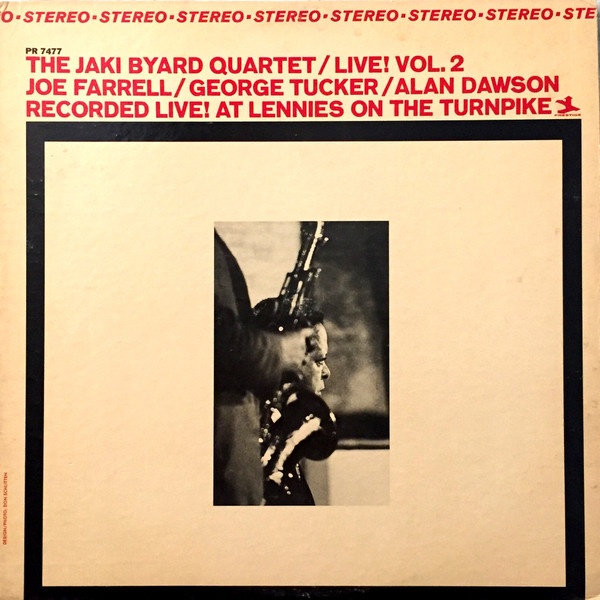
 I talked from time to time about swing-to-bop, in writing about the early days of Prestige, and artists like Zoot Sims. It may be time to consider a new kind of transitional music -- perhaps we should call it straight-ahead-to-free. I don't know what else to call this marvelous live album by Jaki Byard, except perhaps to add that its genesis seems to blossom from Charles Mingus and Earl Hines. To explain that, I'll have to quote extensively fron the liner notes to the original album, by the incomparable Ira Gitler.

Gitler desdribes a night when Don Schlitten came to hear two groups who were sharing the stage at the Village Vanguard--Mingus and Hines. Byard was playing with Mingus then, and he approached Schltten with an idea. Lennie Sogoloff, of the small but well-regarded north-of-Boston jazz club, Lennie's on the Turnpike, had heard Jaki's work on Booker


Ervin's The Freedom Book album, annd he wanted Jaki to bring the trio he had used to back up Ervin--Richard Davis and Alan Dawson.  Dawson was a Boston resident, and Sogoloff had already line him up.

Jaki, in turn, asked Schlitten if Prestige would like to record on the spot,

Don was immediately in favor of the idea and put his creative brain to work helping to shape the date. Since Davis was unable to leave New York at the time, he suggested George Tucker, then playing bass with Hines. Byard liked this and suggested multi-reed man Joe Farrell...Unwilling to trust the unknown, Schitten decided to employ a New York engineer...Dick Alderson was his man. 

The group opened on a Monday. By Thursday, when Schlitten and Alderson arrived...the four men were really getting it together...Byard told [Don] they were ready. This was an understatement. Schlitten describes it as "One of the most beautiful experiencesI've ever had in listening to jazz." 

I wouldn't argue with him.

It is interesting to note that the inception of this recording came at a time when Jaki was playing opposite Earl Hines.  "Out of all the bands," [Byard has said], "The only one I used to dig was...Fatha Hines. That was the only band that intrigued me."

The Mingus-Hines week at the Vanguard was an inspirational one for Byard...Hines plays as if he is a big band, [and] it seemed to inspire Byard to emphasize his own leanings in this direction when he got to Lennie's. "I never heard Jaki play this way," says Schlitten. "He was like a 16-piece band. One second he would be playing the piano part, and then he would resolve and sound like a saxophone section. Behind Joe Farrell he became a punching trumpet section. Throughout the whole thing he was a bandleader. Here was a quartet that sounded like three times that many."


...For all the rough edges involved in such a mercuarial improvising process, there is nothing "haphazard." Even when they go "outside" -- and Jaki knows what he is doing when he is "out there" -- they are always under the firm control of the leader who is able to bring everything and everyone back "inside" to a logical, satisfying conclusion.

Schlitten recalls how the people at Lennie's were completely taken with Byard's ability to capture the entire history of jazz piano playing, (As he has made clear before, Jaki does not fool around in the various styles he is capable of adopting. He does not parody but instead transmits the "feeling" of the greats that he is able to embody as well.) ...Don states, "he runs the gamut from Scott Joplin, James P., Fats, Basie, Duke, to Garner, Bud, Bill Evans, Monk..." He also does the things that Brubeck and Cecil Taylor each try to do but either fall short or don't know when to stop.

 Ira Gitler is, of course, one of the great jazz writers of his era, but he  is of his era, and it's now a half century since he wrote this, and times change, and tastes change, and perspectives change. Gitler could be forgiven if his attitudes, and his critical perspective, had fallen somewhat out of step with today's tastes. 

And maybe they have. Maybe mine have. We live in a time when some young critics reject all of Coltrane's early work as being hokey and not worth listening to...and I mean, even Giant Steps.

But I don't buy that, nor do I think it's a universally held opinion. We also live in a time when young jazz musicians study their craft in college and are denigrated for that, often unfairly, and grow up with a respect for the totality of jazz.

So I'm going to continue to do the only thing I can do, which is to consider my 21st century perspective, and my judgment of Ira Gitler in 1965, to be a valid one, and continue from there.

What's remarkable is how spot-on Gitler was, even about Jaki Byard vis-a-vis Dave Brubeck and Cecil Taylor. Listening to Byard today, you can still hear what Gitler heard, and even putting into the context of a lot more years and a lot more music, Gitler is still right -- he always knew what he was doing when he was "out there," and he knew when and how to bring it back "inside." And it wasn't because he chickened out, and wouldn't stay as far "out there" or as long "out there" as Cecil Taylor or Albert Ayler. It's because he heard it all, and wanted it all, and found a way to include it all.


And all of this leads me, in 2023, in a post-postmodern age, an age informed by the conservatorship of Wynton Marsalis and Jazz at Lincoln Center and jazz goes to college and jazz meets rock and electronica and more jazz in heaven and earth, Horatio, / Than are dreamt of in your philosophy, to wonder why Jaki Byard, who encompassed all of it, and always with vision, and always with soul, is so underappreciated? If you look at the internet lists of greatest jazz pianists, lists made up by people who range in age from younger than me to ridiculously younger that me, where is he? Ranker, which is entirely based on fan voting and boasts over 8.7K voters, has Byard not included at all in a list of 70 names. The uDiscover list, compiled by" a team of respected authors and journalists who are passionate about what they do, with decades’ worth of experience in print, online, radio and TV journalism," does have him in the top 50, at number 41. But to the general public -- the general jazz-listening public, that is, the Ranker public, which knows enough to vote Art Tatum number one and Oscar Peterson number two, he doesn't exist.

Listen to what the man does. Start with my Listen to One, then check out the rest of this album, which you can find on YouTube but not on Spotify. Then listen to more.

On my last blog entry, I castigated those long-ago record company owners (visionaries all, who don't deserve my castigation except in this case) for only recording Andy and the Bey Sisters three times during their eleven years as a team. Fortunately, Jaki Byard did not suffer the same fate. Bob Weinstock stayed with him. This is his tenth appearance on Prestige, his fourth as leader of his own group. He would record six more albums as leader, and 23 more for other, mostly smaller labels up through 1998. On Prestige alone, he recorded with Don Ellis, Eric Dolphy and Booker Ervin; on other labels, with Maynard Ferguson, Quincy Jones, Roland Kirk, and others. And of course, most famously with Charles Mingus (13 albums).

He was with Prestige pretty much right up to the end, so I'll keep coming back to him. And there'll be more to say, since he wasn't much for repeating himself.

These were released as The Jaki Byard Quartet - Live! Vol. 1 (1965) and Vol. 2 (1967). One cut, "Spanish Tinge," was included on a 1967 studio album, On the Spot. And several previously unissued cuts -- the alternate take of "Twelve," "Dolphy" numbers 1 and 2, "St. Mark's Place Among The Sewers," plus Jaki's Ballad Medley which had been on Volume 2, were released in 2003 under the Prestige label, although by that time Prestige was a part of Fantasy and about to be bundled into the Concord group, as The Last From Lennie's, so someone still remembered Jaki in the 21st century (he died in 1999). Don Schlitten produced.


Tuesday, August 15, 2023

Listening to Prestige 698: Booker Ervin


LISTEN TO ONE: Number Two

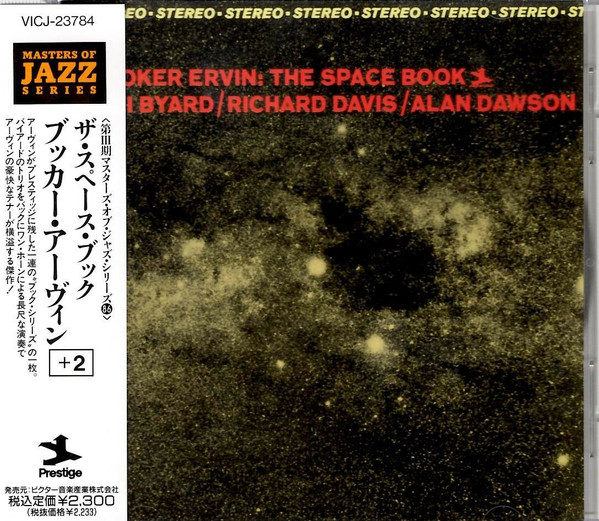
 The title of this album is The Space Book, and the cover art reflects it, with what appears to be a black hole in the Milky Way. The contents live up to the packaging. With this album, Ervin crosses over the bridge to free jazz, and free jazz is the better for it. Certainly with some of the free guys -- not the best ones -- aas with some of the abstract expressionists, or the practitioners of what came to be called L*A*N*G*U*A*G*E poetry, one can't help but wonder if they're doing all this crazy stuff to cover up the fact that can't really draw, can't really play a scale, can't really write a line of poetry that will scan. 


Such is not the case with Ervin. He brings all his chops with him into outer space. It's not the case with the people in his group either. Jaki Byard could play anything, and frequently did. He has as much claim as anyone you can think of to be called the greatest unsung piano player of all time. Bassist Richard Davis, Ervin's longtime collaborator, could play anything, and his discography shows it -- Eric Dolphy and Pharaoh Sanders, Louis Armstrong and Bo Diddley. Drummer Alan Dawson also worked exrensively with Ervin, after which he replaced Joe Morello in the Dave Brubeck Quartet. Outer space, Booker Ervin style, was open range for these guys, and they were home on the range. They can play as fast as any bebopper, and they always know what they're doing.

You can count on it that I don't know enough about music to tell you what's going on in free jazz, so just let me say that this is a great album. It's free, it's structured, it's melodic, it's jagged, it's rhythmic, it's somewhere beyond rhythm. It sounds as fresh and original today as it did when it was recorded. The brilliance of Ervin's solos are matched by Byard and Davis.


Ervin plays two originals and two standards, neither of which you'd expect to find on a free jazz album -- George Gershwin's swing era classic "I Can't Get Started," and "There is No Greater Love." standaed bordering on schmaltz, first recorded by composer Isham Jones in 1936, covered by Guy Lombardo and then Jimmy Dorsey, before becoming, like "I Can'r Get Started," a ubiquitous standard. For both tunes, Ervin gives you enough of the melody that you can recognize it if you're listening for it.

Don Schlitten produced. Two cuts from the session, "The Second #2" and "Bass IX," were held over and appeared on the 1966 album, Groovin' High.


Wednesday, July 20, 2022

Listening to Prestige 632: Jaki Byard


LISTEN TO ONE: European Episode

 Prestige, in its twenty-odd years of existence, left us an amazing legacy, a portrait of two of the most fruitful periods in American jazz. The middle part of its second decade is rich with some of the key figures of the avant garde, and some of the key figures of soul jazz. But one of the richest and most wonderful parts of that legacy is surely found in the 12 albums Prestige put out by Jaki Byard, a musician who fit in neither of those categories, or any other, really. His music has been described as "spanning the 20th century from ragtime to no time," and it's an apt description. It was not just that he could play anything from the most traditional to free jazz. Other skilled technicians, other dedicated artists, could do that. Byard spoke each language, each dialect of jazz like a native, and he could express himself with subtlety and nuance, with intellect and emotion, in every one of them.


And perhaps all of that is the reason why he is not remembered as well as he ought to be. An article about him on the web page of the Music Museum of New England (Byard was born in Worcester, MA) says that he "won many awards for his contributions over the years," but then it's hard pressed to come up with anything more than:

 In 1988 Mayor Ray Flynn awarded him the Dr. Martin Luther King Jr. Award for Outstanding Contributions in Black Music and Presence in Boston. In 1995 NYC Mayor Rudolph Guliani presented him with an award for his outstanding contributions with the Apollo Stompers.

 This is Byard's third album as a leader with Prestige (he'd also appeared as a supporting player on several other dates, the most recent one being with Booker Ervin, who returns the gesture on the first of these two sessions). That was the May 21 session, with Richard Williams, Williams was also well known to Prestige collectors. Williams and Ervin sit out "Lush Life," as well as all of the second session.

On bass and drums for both sessions are Bob Cranshaw and Walter Perkins. Cranshaw had made his first Prestige recording just a few weeks earlier, with Shirley Scott and Stanley Turrentine, but he had already begun his long association with Sonny Rollins, and had been with Rollins on his 1962 recording of The Bridge for RCA Victor, the album that heralded Rollins's return from self-imposed exile. Perkins was by this time a familiar face in Prestige sessions.


The album shows a good deal of Byard's range and versatility, and in fact a few different styles and voicings are in evidence on a single cut--"European Episode," at just over 12 minutes more a suite than a single tune. One more facet of his versatility is showcased on "When Sunny Gets Blue," a leftover take from Byard's maiden session for Prestige in 1961, with Ron Carter and Roy Haynes, and featuring Byard on alto sax.

Esmond Edwards had produced the earlier session; the two that make up the bulk of this album were produced by Ozzie Cadena. The album was titled Out Front! "I Like to Lead When I Dance" and "After the Lights Go Down Low" were not included on the album, but made the later CD release.

Wednesday, February 09, 2022

Listening to Prestige 607: Booker Ervin


LISTEN TO ONE: Grant's Stand

 Before free jazz became the universally agreed upon name for the music that was being pioneered in the early 1960s by Ornette Coleman, John Coltrane, Eric Dolphy and others, it had other names. Arthur Taylor, in his book Notes and Tones, a collection of interviews with fellow musicians conducted between 1968 and 1972, frequently discusses "freedom music." Musicians don't always get to decide what their albums are going to be called, but it's likely that Booker Ervin had some input into The Freedom Book the title for this one, as he edges from bop toward freedom music, paying his tuition to both schools, and establishing himself as one of the distinctive voices of this period.


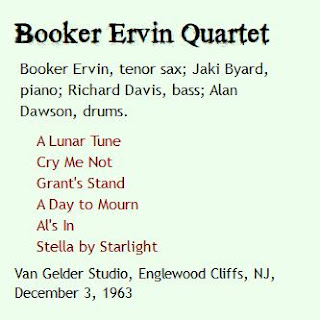
The quartet Ervin assembled for this session was to stay with him throughout his career with Prestige, and the three sidemen would work as a trio under Jaki Byard's leadership on a series of Prestige albums. They were the right group for where Ervin was going, eclectic musicians who could play in any style, even styles that hadn't been invented yet, and that Ervin was maybe making up as he went along.

Jaki Byard was as wide-ranging a talent as you're likely to find, from working with Eric Dolphy to playing the music of James P. Johnson and Fats Waller. Ervin was mostly unfamiliar with Byard's work before hiring him for this session on the strong recommendation of producer Don Schlitten. Schlitten was right, as their continued association would prove.

Richard Davis's credentials range from Dolphy (the great Dolphy-Booker Little Quintet) to Frank Sinatra to Van Morrison (he was on Morrison's groundbreaking Astral Weeks album). New on the New York scene after several years on the road with Sarah Vaughan, he had been making his mark all over town when tabbed for this gig.

Alan Dawson made  his Prestige debut back in 1953 when, as a member of Lionel Hampton's European touring band, he joined Quincy Jones for a session in Sweden. An educator of note (Tony Williams was a student), he was teaching at Berklee in Boston when Ervin called him for this session, explaining:

Yeah, Alan's a bitch...I played with Alan in Boston about ten years ago and it was one of the greatest experiences I've had in music...with Alan you can forget about the time, go beyond it. He's got drive but he also knows how to build a climax, then take it down to a different level where you can get yourself together and then build it back up again. Man, with Alan you can play forever!


He followed his stint with Ervin by replacing Joe Morello in the Dave Brubeck quartet, where almost certainly did not duplicate his stick work with the Booker Ervin quartet.

It's no accident that a musician of Ervin's gifts, and Ervin's vision, would put together a group this gifted, and it's a blessing that he was able to keep them together. This is an amazing album, that gets better every time you listen to it. I'm hard-pressed to pick a "Listen to One." The uptempo numbers, "A Lunar Tune," "Grant's Stand" and "Al's In," push the freedom envelope a little more. The ballads. especially "A Day to Mourn" have some fine ensemble playing and some remarkable individual virtuosity. You should really listen to the whole album. If the freedom sound sort of passed you by, and you think you ought to have given it more of a shot, but it was just too far out for you, you'll love this album. If you're a free jazz devotee, you'll love this album. Go out and buy it on vinyl.

Randy Weston wrote "Cry Me Not." All the others on the album are Ervin's compositions. They also recorded the standard, "Stella by Starlight," but that was held back, and appeared on a 1966 album. Groovin' High, which was the extras from all his previous sessions.  


Thursday, February 18, 2021

Listening to Prestige 542 - Honi Gordon


LISTEN TO ONE: My Kokomo

 This turned out to be the only solo album Honi Gordon ever made. She is categorized, if she is mentioned at all, as one of a number of "one-album wonders," female jazz singers who got that one shot, and then were forgotten, as the Beatles, and the new rock explosion in general, found jazz, and especially jazz vocalists, fading in popularity. Playboy would rename its Jazz Poll the Jazz and Pop Poll (and the Village Voice would mockingly call its music column "Pazz and Jop"). But there's more to her than that.


Her career started as part of a family singing group, The Gordons (her father, two brothers, and her), and if the Gordons never made it quite into public visibility, they were good enough to get the respect of their peers, as evidenced by the company they kept in the recording studio, starting in 1953, when Honi was 15. 

Their 1953 debut was on Debut, the Charles Mingus-Max Roach label. They appear on two tracks, and are described in the liner notes as "Max Roach discoveries," although they, and particularly Honi, would become much more closely associated with Mingus. On the Debut album, they perform with Mingus, Roach, and Hank Jones, and they recorded more than those two tracks ("Bebopper" and "Can You Blame Me"), because three more would eventually appear on record. The Original Jazz Classics CD, Debut Rarities Volume 4, released in 1993, has "You Go to My Head," "You and Me," and "Cupid." All but "You Go to My Head" are credited to George Gordon, and throughout her career, Honi would make a point of featuring her father's songs.

In 1954, the Gordons recorded one tune for Columbia with a group that included Al Cohn, but it appears never to have been released.

In 1956, they appeared on a Lionel Hampton session for Jazztone, a record-of-the-month club that was started by two chemical engineer brothers who were offered 20 tons of vinyl resin at a bargain price, and then had to figure out something to do with it. The session featured Hampton, Oscar Dennard, Oscar Pettiford and Gus Johnson, and their version of "Take the A Train" is highly prized by cognoscenti. They are featured on one cut of a 1957 Dizzy Gillespie-Stuff Smith album for Verve.

Honi then went on her own, working twice with Eddie Jefferson. In 1959 they collaborated on three


tunes, two of which were released on 45 by the Triumph label ("Sherry" and "Body and Soul"), and all three (including "Now's the Time") on a couple of Jefferson reissues. They reunited in 1961, again for Triumph, for four songs with a vocal quartet which also included Babs Gonzales. These appear never to have been released at the time (Triumph had probably already gone under), but have appeared on later Jefferson reissues.

1959 also saw her reunited with Charles Mingus for the Mingus Dynasty album for Columbia, which included a version of "Strollin'," the Mingus/George Gordon collaboration. Mingus was one of the two artists who most enthusiastically championed her career.

1962 was her Prestige year, and after that, instead of aggressively pursuing a solo career, she reunited with her family, perhaps because Mary Lou Williams, the other artist who most appreciated her talent, needed a vocal ensemble for her devotional work, Black Christ of the Andes, recorded in 1963.  She would record with Williams twice more, both times with devotional music: in 1967, for a live performance at Carnegie Hall, and 1972, on Williams's own Mary label. Mingus and Williams are two artists known for their uncompromising commitment to musical excellence, which should tell you something about Honi Gordon.

Further work with Mingus included a live Columbia recording in 1972 (Charles Mingus and Friends in Concert), and Mingus Moves in 1973, on Atlantic.

Then nothing, although she seems to have kept singing. in 2007, she performed with Andy Bey and Geri Allen at a Fordham University tribute to Mary Lou Williams, which suggests that she must have been based around New York.

Of the Prestige album. a present-day reviewer (for Allmusic.com) wrote that Gordon "had an appealing style that was influenced by Sarah Vaughan, Ella Fitzgerald, and Billie Holiday, as well as Annie Ross. There were also hints of Chris Connor..." while a contemporary of hers (Sidney Falco, who wrote the liner notes for the album) says the opposite: Gordon is "if you will, original: one cannot point to her work, as it is so easy to do in many cases, and say where such and such a phrase or stylistic trick came from." And perhaps they're both right. The one thing you can say for certain about Gordon's singing is that it sounds like jazz.

Part of the uniqueness of her style (and part of the reason why AllMusic's Alex Henderson compared her to Annie Ross) comes from her choice of material--her father's material, especially. George Gordon was a unique composer--and I use "unique" in its original sense. I don't believe anyone else did what he did. "Vocalese" was in its heyday back then, and it meant the same thing for everyone who practiced, from the innovative work of Eddie Jefferson and King Pleasure through the complex arrangements of Dave Lambert to the lyric inspiration of Annie Ross -- who wrote the brilliant "Farmer's Market" and the now-classic "Twisted" in one night, after Bob Weinstock had played her "Moody's Mood" and asked if she could do something like that. It meant writing a vocal line to a jazz soloist's improvisation.

But George Gordon did something a little different. You can listen to "My Kokomo" and start digging through your old wax or your new Spotify to find the "Kokomo" and the improvised solo it came from, but to no avail. Gordon wrote the whole thing, words and music. The only exception is "Strollin'," where Gordon put a lyric to Charles Mingus's "Nostalgia in Times Square." George Gordon was a remarkable composer, and Honi Gordon a fitting interpreter (and, except for "Strollin'," her father's only interpreter).

Honi does four of her father's songs on this album: "Strollin'," "My Kokomo," "Love Affair," and "Cupid." She also stretches her range in other directions. There are standards: "Ill Wind" (Harold Arlen Ted Koehler) and "Why Try to Change Me Now" (Cy Coleman, Joseph McCarthy). There's a song by Esmond Edwards, who didn't write all that many -- "Lament of the Lonely." Both of her champions are included: Mingus with "Strollin'," Mary Lou Williams with "Walkin' Out the Door." "Why" was written by Consuela Lee Moorhead, who had something in common with George Gordon. He wrote for his daughter; she contributed music, and a song, to a movie by her nephew, Spike Lee.

Honi Gordon's adventurous spirit is shown in her choice of musicians for the session, the equally adventurous Jaki Byard and Ken McIntyre (later Makanda Ken McIntyre).

Honi Gordon Sings was a Prestige release.


Sunday, November 29, 2020

Listening to Prestige 530: Jaki Byard


LISTEN TO ONE: Blues in the Closet

Jaki Byard’s importance was always recognized by the jazz community, not l.ways by the general public. That he was so widely recorded — at least 35 albums as leader, more than 50 as sideman - are a testimonial to the willingness of jazz record labels to want to record the best people, even if not many people are buying those records. That almost all of these records were made for tiny labels suggests that maybe the majors and major independents aren’t all that willing to record artists who don’t sell a lot.

That the sole exception to that generalization was Prestige—12 albums over 8 years, from 1961 to 1969–is a pretty solid testimonial to Bob Weinstock’s

commitment to excellence in jazz. And one should include the Prestige front office team in general—5 more of Byard’s albums were made for Muse and High Note, labels started by Joe Fields, who had been an executive with Prestige through most of the 1960s (although the three High Note albums were only released after Byard’s death).


This was Byard’s second Prestige album as leader (there had also been two with Eric Dolphy and one with Don Ellis). Like the first, it was a trio album, and like the first, it featured Ron Carter on bass. For this session, Pete La Roca replaces Roy Haynes on drums, for his only Prestige session.

La Roca was in demand as a drummer throughout most of the decade. Later, he decided he would no longer work as a sideman, and since opportunities to record as a leader were sparse, he also followed other pursuits, including studying for a law degree. This education came in handy when a record company which had released one of his two dates as leader rereleased it under Chick Corea’s name. He sued them and won.

This session was made up of three originals, four covers, and one sort of odd attribution. I'll concentrate for today on the non-originals, because they tell a story of their own.

The odd attribution is "Excerpts from Yamecraw." Yamecraw was a symphonic piece written in 1928 by James P. Johnson, orchestrated by Willian Grant Still, and premiered with Fats Waller as pianist. Byard, interviewed by Nat Hentoff for the liner notes, describes being approached by music publisher Perry Bradford, who had been making the rounds trying to find a jazz pianist interested in doing the piece, with no takers. 

That was perhaps not surprising. Bradford had been an important figure, as a performer and composer, but primarily as one of the first Black music industry executives. It was Bradford who convinced Okeh records to take a chance on recording his song, "Crazy Blues," with a Black singer, when the conventional wisdom of the day was that no one would buy a record by a Black singer. Mamie Smith's recording of "Crazy Blues" was a surprise hit, and ushered in the recorded blues craze of the 1920s.

But by the 1960s, Bradford was a hanger-on, a forgotten figure, and no one was much listening to him. It's probably more surprising that Byard did. But Byard was one of the great students of piano jazz of every era, and Johnson and Waller were two of his heroes. The curiosity is that "Excerpts from Yamecraw," which is described by Hentoff as "Jaki excerpted a 12-bar phrase from the suite and constructed his own absorbing variations on that base" is listed as a Byard composition.

And there's nothing wrong with that. Brahms did the same thing, and his "Variations on a Theme by Haydn" or "Variations and Fugue on a theme by Handel" are unquestionably the work of Brahms. But isn't this pretty much what all jazz musicians do? Coleman Hawkins famously ushered in the modern jazz era with his recording of "Body and Soul," where he basically never plays the melody. But it's "Body and Soul," and Johnny Green gets composer credit and royalties. Eddie Jefferson's "Moody's Mood For Love" is his lyrics to James Moody's improvisation, not to the original tune, but Jimmy McHugh sued and won a share of the composer credit and royalties. 


Often jazz musicians have successfully gotten around the royalty issue by taking the chord changes to a song they liked and building a completely new melody around them -- much the same as what Hawkins did with "Body and Soul," except that they also changed the name of the piece, like Charlie Parker's "Ornithology." built on the changes to "How High the Moon," or the dozens of pieces written to the chord changes of George Gershwin's "I Got Rhythm." 

So when does the invention of a jazz musician (or a classical composer, like Brahms) become a new composition? It does matter, because songwriters get screwed out of royalties all the time. But it also sorta doesn't.

What's important about "Excerpts from Yamecraw" is Byard's homage to Johnson and Waller. And the other outside compositions in Hi-Fly provide insights into his mind and his musicality, starting with the title track, composed by Randy Weston. 

About "Lullabye of Birdland," Byard told Hentoff, "I know it's fashionable to put down George Shearing, but I feel he's made a contribution, and this tune of his has certainly lasted." Shearing had come over from England as one of the most original modern jazz pianists around, had jammed with Charlie Parker, and had gradually tempered his style to more accessible "cocktail jazz." At the time, with modern jazz so identified with rebellion, playing in a cocktail lounge was considered the very definition of selling out. Ahmad Jamal had the same label hung on him, until Miles Davis revealed that he was a fan of Jamal's rich improvisational skills. So it's no surprise that Byard, who listened to everything, picked up on Shearing.

"Round Midnight" is Monk, and here's what Byard had to say about the great pianist/composer:
For me, the most astounding thing about Monk as a composer is his lyric sense. Monk's pieces could be show tunes. You take a bunch of his originals, and you'd have a good musical. His melodic sense is so strong that you can sing anything he writes, and always, you know it's him.
"Blues in the Closet" was written by Oscar Pettiford, but it's still a tribute to another piano hero of Byard's--Bud Powell, for whom it became a signature piece. Of Powell, Byard told Hentoff:
Bud was the main influence for all of us in terms of showing what could be done with single-line playing,

So many influences--and in Byard's case, "influences" doesn't do his art justice. Generally an influence is one overriding master whom the artist works through to find his or her own style. Byard absorbed and used and created something new and original and constantly changing, out of so many different voices.

I've chosen "Blues in the Closet" for my "Listen to One." Each piece on the album is a distinctive look into Jaki Byard, but "Blues in the Closet' also showcases Carter and La Roca effectively.

Was Byard always destined to be underappreciated? Nat Hentoff seemed to think so as early as 1962, when he wrote this on the liner notes to Hi-Fly:  "Whether or not it is true that the thunderbolt of sudden fame has missed Jaki...."

Hentoff goes on to hedge his bet a little:
I expect that his reputation will continue to grow on so solid a base of accomplishment that in a few years, it will suddenly occur to many jazz listeners that Jaki has been a major jazz figure for quite a long time, no matter what the polls have said.

And still today, "Jaki Byard" and "underappreciated" seem to be almost synonymous. On one recent online list of the 50 greatest jazz pianists, this one compiled by a critic, Byard is listed at #41, and critic Charles Waring had this to say:

Though revered by the critics, Byard’s unique sound was less well-received by the public.

In Ranker.com. reflecting today's jazz listening public, with votes open to everyone who chooses to participate, Byard is nowhere to be found, in a list of 150 piano players. One might question the collective judgment of the Rankers (Bill Evans #72?), but it is what it is. Much of today's jazz audience has forgotten Jaki Byard. Rateyourmusic.com's voters are often quirkier and more perspicacious than Ranker's, but they rate Hi-Fly well below the top 200 albums of 1962 (again, voter  polls on the internet are always subject to change, especially on the lower levels).

Should he have been higher than 41 in the critic's judgement? Higher than whom? It's not for me to say. In the 530 entries I've written to Listen to One, you've never seen me use the word "overrated." I never have, and never will, deprecate the contributions of any of the gifted and dedicated musicians who have contributed to this great American art form. But surely Jaki Byard was one of the very best. 

 Hi-Fly was released on New Jazz. Esmond Edwards produced.

Tuesday, February 18, 2020

Listening to Prestige 458: Don Ellis

You can't necessarily count on it that an album that calls itself "new ideas" will actually deliver new ideas, but this one does. Don Ellis not only presents a departure from anything Prestige has been doing in this new jazz era, each track of the album is a departure from the track before.

Ellis came from very nearly out of nowhere. He had played with the Glenn Miller Orchestra. He had played with the Maynard Ferguson Orchestra, which was a good deal more progressive, but still a dance band. Then suddenly he was in the center of the avant garde, working with George Russell, Paul Bley, Steve Swallow. He made one album in 1959
with Charles Mingus (Mingus Dynasty) and a couple in 1961 with George Russell. One was with Russell and Eric Dolphy for Riverside, but that one wasn't released until years later.

Even the photos of him follow the same out of nowhere pattern. The earliest shows him crew cut, chubby faced and whiter than Wonder Bread. A photo taken around the time of New Ideas shows him gaunt, still white, but looking more like Andre Gregory than Glenn Miller.

His first album as leader in 1960 was How Time Passes, for the Candid label, with Jaki Byard, Ron Carter and Charlie Persip. A second album for Candid, featuring Paul Bley and Steve Swallow, was recorded in April of 1961, just three weeks before New Ideas, but it would not see the light of day until 1988. Time Passes was all Ellis originals. The second album came to be called Out of Nowhere, and in 1988 it must have really seemed to be coming out of nowhere. And it came out of nowhere considering the direction Ellis's music was taken, because this was an album of standards, and ones that were so standard they were virtually chestnuts -- "My Funny Valentine," "I'll Remember April," "Just One of Those Things." Perhaps Candid didn't release the album because they were expecting something more like How Time Passes, a real Don Ellis album, not a bunch of standards. Or perhaps they decided not to release it because they  were expecting an album of standards, and they got...certainly not something Glenn Miller or even Maynard Ferguson would have recorded. In other words, a real Don Ellis album.

Whatever that nay be. Ellis's muse was forever dancing on ahead. This was his only album for Prestige, and as he moved through record labels (pausing for a few years and several albums on Columbia), he moved through ideas and formats. Much of his later and best-known work was for larger ensembles.

At this point in his career. the George Russell influence is certainly there. There are suggestions of Tristano, still a powerful influence on the jazz avant garde. Suggestions of Gil Mellé, though he's more of a musician than Mellé was. Like Mellé, he would go on to film scoring, The French Connection being his best known. He was known for his experiments with time signatures, but he's nothing like Dave Brubeck. For one thing, he had a sense of humor. One of his compositions is called "Beat Me, Daddy, 7 to the Bar;" one of his time signatures is 3½ / 4 and another is 15/16. One can hear in his work suggestions of avant garde composers like Moondog (he somehow manages to suggest some of Moondog's ambient street noises on the trumpet). How Time Passes was subtitled Third Stream Jazz, and no less an authority on the third stream than Gunther Schuller said of him, when Ellis was his student in 1960 at the Lenox, MA, School of Jazz:
[Ellis] represents one of the few true syntheses of jazz and classical elements, without the slightest self‐consciousness and without any loss of excitement and raw spontaneity that the best of jazz has always had.
By the time of New Ideas, the Third Stream was no longer a dominant force in Ellis's development, but you can hear it.

We've heard Jaki Byard on three earlier Prestige sessions, one with a trio and two with Eric Dolphy. Equally at home in mainstream or avant garde settings, he was also one of the first to bring jazz to the world of higher education, creating the Jazz Studies program at the New England Conservatory of Music.

Ron Carter and Charlie Persip are more associated with mainstream than avant garde, but they both make important contributions. Persip is inventive and unexpected. So is Carter, but he's also the pulse of the ensemble, keeping it on track through time signature changes.

New Ideas features a remarkable vibes player named Al Francis, and his entire recorded output seems to have been this album and a trio session from 1986 called Jazz Bohemia Revisited. Why there's not more, or why Ellis didn't go on working with him, it's impossible to say, but the jazz world lost a distinctive and original voice when they passed over Francis. It's painful to think of all the music he made between 1961 and 1986 that we'll never hear.

Ellis would go on working with small groups for a couple of years, often with Paul Bley.  In 1963, he was trumpet soloist for the New York Philharmonic with Leonard Bernstein conducting, and again with Gunther Schuller conducting, for Schuller's composition Journey into Jazz.

In 1965 he put together his first orchestra, and the work with large ensembles became his best known.  He's also known for an instrumental innovation, the four-valve trumpet, which was more than just a gimmick: it allowed him to play quarter-tones.

Ellis died young, at 44, leaving behind him several lifetimes worth of experimentation.

Esmond Edwards produced the session, and New Ideas was released on New Jazz.

I'm making a Listen to Two for this Ellis session, because it's the only album he made for Prestige, and since one track is not enough to do justice to his range. Neither are two, actually.


Sunday, December 29, 2019

Listening to Prestige 441: Jaki Byard

March of 1961 came in like a lion for Prestige. Wednesday, March 1, saw them back in the studio with one of the most important musicians of his era, Eric Dolphy, in a match made in heaven with Oliver Nelson. Then they didn't even wait a week. On Tuesday, March 7, they brought two groups out to Englewood Cliffs. First, probably their biggest star of the decade, Shirley Scott; then, a major new talent, Walt Dickerson. And the following Tuesday, they unveiled a monster talent.

Jaki Byard had recorded twice for Prestige, with Dolphy, who knew talent and who recognized the forward-thinking musicians who could keep pace with his rapidly expanding ideas.

He was not a youthful prodigy. When he made his debut as a leader with Prestige (there'd been one solo album for Candid the year before) he was 39 years old. He had actually made his first record in 1950, in Boston with Charlie Mariano, back in the days of 10-inch LPs, on the West Coast rhythm and blues label Imperial. A 1957 gig with Herb Pomeroy (he played tenor sax) was released on Roulette, but again, that was primarily a Boston audience.

Byard was to remain with Prestige throughout the decade, so I'll have a lot more to say about him as time goes on, and fortunately, there's a lot to say, because his creativity and originality was never-ending. Listening to Byard, and reading about him, makes me think of what people said about the young Sammy Davis Jr. That he was so gifted, and had absorbed -- and could reproduce -- so many styles, that he didn't really have a style of his own. Which
was wrong, of course. Byard was similar -- he could incorporate any style, or several different styles in the same piece. Nowadays, that's not so unusual. In the post-Wynton Marsalis era, young piano players have to be able to play ragtime, bebop, and Monk, just to get noticed. But Byard did it because that was who he was. He did with respect and humor at the same time, and he created a style that was unique and personal out of it.

This album contains five originals and three by other composers. The originals include "To My Wife," a tribute to a love affair that lasted four decades, and "Garnerin' a Bit," a tribute to Erroll Garner, one of his early heroes.

"When Sunny Gets Blue" was a 1956 vehicle for Johnny Mathis, and Byard shows off his own crooner chops with it, but on the alto sax. It was left off his debut album, but picked up a couple of albums down the road, on Out Front!

He takes on Gershwin in a Porgy and Bess medley, "Bess You Is My Woman Now" and "It Ain't Necssarily So."

And most interestingly, he becomes the first jazz artist to record a new version of John Coltrane's "Giant Steps," from the album that had revolutionized jazz just the year before. With Ron Carter and Roy Haynes, he takes it apart, puts it back together, reimagines it for the piano, makes something new out of something that was already startlingly new, and does it all in two minutes and 22 seconds, ending so abruptly it's almost in mid-phrase.

Here's Jaki  was produced by Esmond Edwards, and brought out on New Jazz.

Listening to Prestige Vol. 2, 1955-56, and Vol. 3, 1957-58 now include, in the Kindle editions, links to all the "Listen to One" selections. All three volumes available from Amazon. 

And Volume 4 in preparation!

The most interesting book of its kind that I have ever seen. If any of you real jazz lovers want to know about some of the classic records made by some of the legends of jazz, get this book. LOVED IT.
– Terry Gibbs


Thursday, October 10, 2019

Listening to Prestige 420: Eric Dolphy - Booker Little

This is one of the most storied pairings in jazz lore, like Charlie Parker and Dizzy Gillespie, or Clifford Brown and Max Roach, and like them, it was destined to end much too soon. Bird, of course, was destroyed by drugs. Clifford Brown died in an auto accident. And both Eric Dolphy and Booker Little succumbed to illness--Little at the age of 23, less than a year after making this recording.

During a period in which Prestige was turning a lot of its attention to the tradition, with its Swingville and Bluesville sessions, Eric Dolphy was their standard bearer for what one of Ornette Coleman's album titles had described as the shape of jazz to come. Dolphy had last been in the studio as a leader on August 31, and that album had been titled Out There. The labelsthat were taking a chance on the new jazz were not at all shy about marketing its newness. Other Atlantic titles for Coleman were Tomorrow is the Question and Change of the Century. Albert Ayler's debut was Something Different!!!!!! (yes, with all the exclamation points). Cecil Taylor, who may have been the first important jazz figure to enter the avant garde, or this particular avant garde, put out albums called Jazz Advance and Looking Ahead! John Coltrane's step into the next incarnation of jazz was a little more modestly--but absolutely accurately--called Giant Steps.

This session by Dolphy would be titled--an evocative touch, rather than a manifesto--Far Cry, but it still carries the message. This was staking out new ground, and if Little hadn't yet gone quite as far into uncharted waters, Dolphy saw something there, and Little responded. The quintet they formed together played one memorable two-week gig (also recorded by Prestige) at the Five Spot in June of 1961, but by October Little was gone, a victim of complications from uremia.

It had already been a busy day for Dolphy by the time he got to Englewood Cliffs. Earlier in the day, he had participated in a groundbreaking Ornette Coleman session for Atlantic. The Atlantic album would be called Free Jazz, and it featured a double quartet--that is, two separate quartets, each playing over a separate stereo channel: on the left, Coleman and Don Cherry, with Scott LoFaro and Billy Higgins on bass and drums; on the right, Dolphy and Freddie Hubbard, with Charlie Haden and Ed Blackwell. This one, like so much of the new jazz, was an opinion divider: Downbeat assigned it to two reviewers, of whom gave it five stars and the other, no stars.

Dolphy was well into the world of jazz by this album; it was a newer experience for Booker Little, but Dolphy hadn't picked him capriciously: he heard something.

The session begins with two Parker tributes: one to Charlie, one to his mother, both composed by Jaki Byard, who had also been with Dolphy on his debut album for Prestige from the previous April. "Ode to Charlie Parker" has a dirgelike quality at the head, but the soloists break free from that, each in his own way. Dolphy, playing flute, is certainly the freest. Little's solo comes next, and it gives the jazz listener who's grown up with bebop more reference points to hold onto, but it's still in keeping with Dolphy. Byard takes the third solo, and I love what he's doing too. One might say he keeps the melody a little more in mind, but then, it's his melody. When they come back to the head, it still starts with the dirge-like statement, but then, still playing it, they rise above it to a kind of exaltation, almost like the brass bands returning from a New Orleans jazz funeral. How's that for a cross-cultural reference? But that is what it feels like.

For whatever reason, Parker's mother gets the more uptempo, boppish tune. Dolphy plays bass clarinet on this one, but we don't get to him right away. The first solo goes to Little, and it'll make your head spin, for both its passion and its virtuosity. Byard keeps it up, and then Dolphy comes in and blows the roof off. This is a sound that can take you back to 1960, to the realization that the jazz torch is being passed to a new generation, and you're here to bear witness to it, and marvel at it, and if you listen closely, to tell yourself yes, this is the way it has to go.

Ron Carter dazzles with a bowed bass solo, and the number finishes with some ensemble playing that makes you rethink everything you ever thought you knew about playing together.

From there, they go into "It's Magic," a syrupy romantic ballad that was a favorite of crooners, not so much of jazz instrumentalists. In fact, this was probably the first jazz treatment of it, and there have precious few since. Little starts out with a surprisingly straight version of the melody, and then--well, you could say it's the standard bebop small group structure: head, solo, solo, solo, head. And why not? Not everyone agreed with John Lewis that jazz had to break free from that template. Musicians like Dolphy, Byard and Little were here to prove you could break free within that template. As they come back to an almost, but not quite, straightforward statement of the melody, still somewhat syrupy but not the way Little plays it, you know you've been taken a far cry from Doris Day and her Latin lover who introduced the song in a forgotten 1948 movie.

"It's Magic" featured Dolphy again on bass clarinet, and so does "Serene," a Dolphy composition that didn't make it onto the LP but was added to the CD reissue. "Serene" is the kind of title that jazz musicians often give to workouts that are anything but. However, in this case, there is a certain serenity to the tone, at least as serene as a group of avant garde musicians who are pushing limits can get. Little seems to keep taking more chances with each cut, and in this one especially, Dolphy keeps prodding him onward. Dolphy as a bandleader was famous for not giving a lot of verbal instruction to his bandmates, but it's pretty clear from this session that he didn't need to.

"Miss Ann" is a Dolphy composition which hasn't quite become a standard but has gotten its share of adherents and has been recorded several times over the years. "Far Cry" is the final Dolphy original. He plays alto sax on both of them, matching the instrumentation of the original Ornette Coleman combo with Don Cherry, but Dolphy and Little are finding their own paths to freedom, abetted by Jaki Byard (Coleman had a pianoless quartet), who is finding his own way, too.

"Left Alone" is Mal Waldron's tribute to Billie Holiday. "Tenderly" is the standard by Walter Gross, with Dolphy alone on alto sax, everyone else dropping out. It's lyrical and disturbing, respectful of the melody and willing to leave it behind at a moment's notice, It's lovely.

Far Cry became the name of the album, which was issued on New Jazz.. Esmond Edwards produced.


Listening to Prestige Vol. 2, 1955-56, and Vol. 3, 1957-58 now include, in the Kindle editions, links to all the "Listen to One" selections. All three volumes available from Amazon.

The most interesting book of its kind that I have ever seen. If any of you real jazz lovers want to know about some of the classic records made by some of the legends of jazz, get this book. LOVED IT.
– Terry Gibbs


Friday, October 12, 2018

Listening to Prestige 349: Eric Dolphy

We move away from the old pros of Swingville. They were wonderful, but it's time to look to the future, and the future enters like a panzer division with Eric Dolphy. He was one of the most important musicians, along with Coleman and Coltrane, in tearing up the old rulebook and writing a new set of rules.

Or maybe not. Leonard Feather, interviewing Dolphy, tried to figure out just what those new rules were, but he didn't get very far.
LF: For one thing, I would I would like to make it clear that I don't think I understand...as a musician you know certain things I don't understand about what you are doing and I...would like to maybe get them clarified in my own mind so that I can make it clear for the average reader ... what is happening and what people like you are doing harmonically. It's very hard to explain, very hard to analyze. Can you put it into words?
ED: Well, it, you know, it always depends on the subject of what you're improvising on of course, and then, uh... Of course if you're playing freer forms and the harmony...  improvisation is much more freer and you have much more things that you can play...the lines are not held to no chord patterns, harmonically.
LF: No, but, what I don't understand is what ARE they held to? I mean what is, what is the difference between the limitations, there must be some limitations otherwise it, you would be arbitrary, you could just play any notes that you like.
ED: Well that's the idea you CAN play every note that you like. Of course, you only can play what you can hear, and quite naturally... more or less I guess what I hear is not to your hearing, to what you're hearing. So quite naturally, I hear, uh, more notes on uh, on the same thing that's been said before.
Robert Frost famously said that writing free verse was like playing tennis without a net. Maybe Blowup, without a ball. Only you and whoever you're playing with know where the ball is going and whether you've hit it squarely. But there are spins and trajectories and lobs and smashes that only you can hear. If you get it right, you're Eric Dolphy and Freddie Hubbard. Get it wrong, and you're that tenor saxophonist on Jazzmobile who was told by Frank Foster to "feel something in B-flat, motherfucker."
playing free jazz is like Michelangelo Antonioni's tennis match in

This is Dolphy's debut album as leader. He had recorded in Los Angeles with Chico Hamilton, and also with Clifford Brown, although that one has an odder history. Dolphy was a native Los Angeleno, and his dad, ever supportive of his music, built him a recording studio, and a lot of musicians--not just his friends, but serious musicians, would come by to jam with the kid. One of these sessions, with Brownie, was recorded and the recording was saved, to be released in 2005. He would pack a lot of recording into the next four years of an all-too-brief life, both as leader and sideman, including a lot of work with Charles Mingus. Much of his output would not be released until after his death in 1964.

It marks a return to the cutting edge Prestige. Esmond Edwards produced. Dolphy recorded three of his own compositions, two standards, and one tune by a contemporary, Charles "Majeed" Greenlee.

Freddie Hubbard would later become known for a more crowd-friendly style, but in these younger days he was very much in tune with the avant-garde, recording with both Coltrane and Coleman in addition to Dolphy. When there are no limitations, it puts an interesting burden on the second soloist. He has to follow in a path laid out for him by someone who adhered to no path but an inner one--what he could hear.  If he scurries back to the road more traveled, he'll seem tame by comparison. If he's faking it, or he doesn't know what he's doing, it's "feel something in B-flat, motherfucker."

All this reminds me somehow of a poem I once wrote about the wilderness mapping itself, which I'll append to the end of this.

Jaki Byard, a multi-instrumentalist although the piano was his main instrument, was new to Prestige but a jazz world veteran, though mostly in Boston, where he had played and recorded with Herb Pomeroy and Charlie Mariano. This was his first New York recording gig, and the beginning of a long and important career, including a number of albums for Prestige. He also had a distinguished career as an educator, including establishing the jazz studies program at the New England Conservatory of Music.

George Tucker, like Dolphy, would not be around for long. He died in 1965 without achieving the outsized reputation of Dolphy, but being quietly respected by his peers and by younger bassists. It easy to understand why, listening to his work on this session. As the bassist, it's his job to keep the beat, and he does so, but with a full appreciation of the complexity of the music and the need of the beat to reflect that.

And it's not hard to understand why Dolphy chose Roy Haynes rather than a younger drummer more identified with the free jazz movement. All you have to do is listen.

The Dolphy compositions are freer. The standards are still grounded in melody and chord structure, although Dolphy moves further and further out as he develops his improvisation. The Charles Greenlee composition is a bit of a surprise. Although Greenlee began his career in Detroit in the 1940s, he's probably best known for his avant-garde work in the late 1960s and 1970s with Archie Shepp, so the surprise is that "Miss Toni" is really the most boppish piece of the day.

The balance is a good one, for the listener of the day to get used to the direction Dolphy was headed in, and maybe for the musicians who were playing with him, too.

Most of this session was released in 1960 as Dolphy's first Prestige album, Outward Bound. The alternate takes of "G. W." and "245" would eventually see daylight on much later compilation releases, and "April Fool" would be included in a posthumous release, 1966's Here and There. Outward Bound was first released on New Jazz, later on Prestige.