Showing posts with label Osie Johnson. Show all posts

Thursday, December 18, 2025

Sylvia Syms

Listening to Prestige: Chronicling Its Classic Jazz Recordings, 1949–1972, my history of Prestige Records, will be published in January 2026. Order in advance from Amazon or through your local independent bookstore.


LISTEN TO ONE: More Than You Know

Sylvia Syms was in mid-career when she came to Prestige in 1965. A native New Yorker, she found the jazz clubs on 52nd Street as a teenager, and became a protégé of Billie Holiday’s. In 1941, she made her own debut on 52nd Street, performing at Kelly’s Stable. In 1948, Mae West, who was heading up a revue that played the swanky end of New York night life – the Copacabana and the Stork Club – heard Syms and signed the hard working singer for her revue. That led to future cabaret work, and an appearance on Eddie Condon’s Floor Show, believed to be the first live jazz show on network television. 

Atlantic Records signed her in 1952 and she got her first record release, a 10-inch LP with a trio led by Barbara Carroll, also just starting on Atlantic. After a couple of records with Atlantic, she moved over to Decca, where she sang with an orchestra conducted by Sy Oliver, and her one big hit. My Fair Lady’s “I Could Have Danced All Night,” which won her a gold record. But her talent was best suited to a more intimate setting – Frank Sinatra had called he “the ultimate saloon singer” and Decca next put her with a jazz quartet led by two guitars, Mundell Lowe and Barry Galbraith. 


As the decade rolled over, she recorded one-shot albums for Columbia, Kapp, and 20th Century Fox Records, the less successful arm of the entertainment conglomerate (although they were responsible for that Christmas staple, the Harry Simeon Chorale’s “The Little Drummer Boy”). Her recordings were generally praised for their intimacy and emotional honesty, though critics tended to find her improvisational skills limited. 

  Prestige signed her in 1965, and brought her to Englewood Cliffs for two sessions. The first, on August 11, matched her with a trio led by Kenny Burrell. The second, two days later, added Bucky Pizzarelli as a second guitar and Willie Rodriguez on percussion. This was an ideal setting for her, capturing the saloon-singer intimacy, and giving her the support she needed for some very satisfying improvisation. 

 The trio session featured mostly standards. “More Than You Know,” written by Vincent Youmans, lyrics by Billy Rose and Edward Eliscu, sounds as though it could have been written for Syms, although virtually every other cabaret and torch singer seems to have felt the same way about it. First recorded in 1929 by Helen Morgan, it has been taken into the studio more than 400 times. 

“I’m Afraid the Masquerade is Over” (Allie Wrubel, Herb Magidson) is another often-recorded standard, but Syms and producer Cal Lampley weren’t wrong in picking them. The yoking of a good song and a good singer is always going to be welcome, especially with the tasteful and inventive backing of Burrell, Hinton and Johnson. “God Bless the Child” is going to be a tribute to Billie Holiday no matter who sings it, even if you secularize the lyrics (“So the Bible says” becomes “so the wise man says” in Syms’s version). 


The second session, two days later, added the second guitar of Bucky Pizzarelli and the percussion of Willie Rodriguez, and song choices go a bit farther afield. The addition of Rodriguez opens the door to some Latin rhythms. “Brazil” was already a chestnut by the time Syms took it on, but the other Latin tune, “Cuando te Fuiste de Mi” (When you left me) is one that Syms, Lampley, Burrell and Rodriguez plucked from obscurity – at least, from mainstream obscurity. It had originally been recorded by Cuban singer Vicentico Valdes for the Seeco label, one of the more prominent independent New York labels specializing in Latin music (Celia Cruz was one of their artists). The bolero – romantic, melodic, gently rhythmic – is a nice fit for a cabaret singer, although not too many non-Latin artists incorporated it. Syms, with sensitive percussion work by Rodriguez, makes it work. “Cuando te Fuiste de Mi” would be rediscovered in the next decade by Charlie Palmieri, who reworked it with a salsa rhythm, and gave it new popularity, The two Prestige sessions became one album, Sylvia Is!, released in 1965 with testimonials on album cover from such notables as Woody Allen, Errol Garner, Tony Bennett – and Hollywood producer Ross Hunter, whose Wild is the Wind was the source of a song Syms included in the second session. 

This was her only Prestige album, but she continued working and recording, mostly for smaller labels, with one notable exception: a 1982 album for Reprise, backed by an orchestra conducted by Frank Sinatra and called Syms by Sinatra. She sang her last note on May 10, 1992, when she was struck down by a heart attack in mid-performance – appropriately enough, in one of New York’s most iconic supper clubs, the Oak Room at the Algonquin Hotel.


Friday, November 03, 2023

Listening to Prestige 710: Andy and the Bey Sisters


LISTEN TO ONE: Hallelujah I Love Her So

 This was the third and last album that Andy and his sisters made together, and one can't fault them for deciding to go their separate ways, career-wise. They all had artistically rewarding careers, although probably not with the recognition that they all deserved. One can certainly, however, fault the record company executives who passed up the chance to pass up recording this amazing trio -- only three albums in eleven years. 

Family harmony groups have made their mark in gospel, in country, in rhythm and blues and soul, but there has never been a family harmony group in jazz like Andy and the Bey Sisters. The Mills Brothers made their contribution to jazz as well as to


pop, but there were none that I can recall with the modern phrasing and sensibility of the three Beys. Add the close, supportive feeling of a family group to the dangerous edginess of the modern sound, and you have something unique.

They start out with "Tammy," from the folksy-corny movie of the same name with Debbie Reynolds. I should probably turn in my hipster credentials for saying this, but I love the melody of "Tammy." It was written by Hollywood jinglemasters Ray Evans and Jay Livingston, and I think it's one of the most beautiful melodies to come out of 1950s pop. But it is simple, it is a little naive, and while what the Beys do with it is edgy and interesting, it may be a little more than the melody can bear.

But then they get something they can sink their teeth into, Ray Charles's "Hallelujah, I Love Her So." With gospel's deep tradition of family harmony, Charles's sensual overlay, and their own contemporary arrangement, they come bursting out, riding Kenny Burrell's guitar and Andy's piano to a thrilling treatment of this rhythm and blues classic. Remarkably, they distance themselves from Ray by taking it almost completely out of the church, and they make it work.

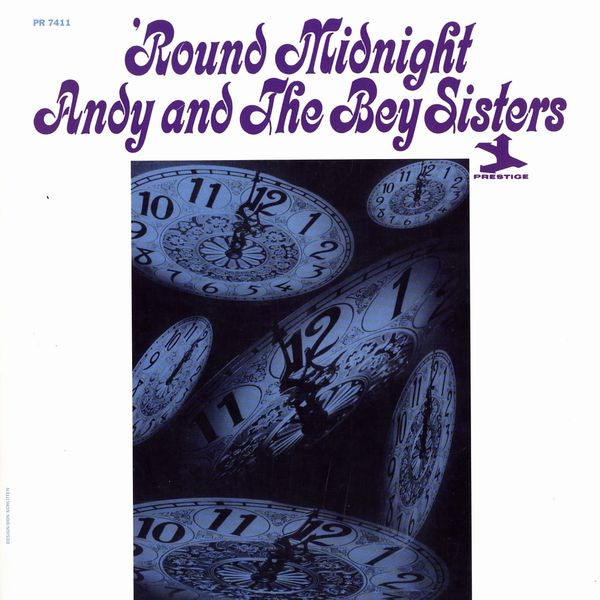
"Everybody Loves My Baby" takes this Spencer Williams anthem of the Roaring Twenties and moves from a scatted intro by Andy into three-part harmony that notches another decade on the Beys' scorecard. "Round Midnight" reaches into a totally different world, that of Thelonious Monk, and drawe it too into the Beys' world, with the harmonies, the Burrell guitar, and some lovely solo parts by Andy.


And I could go on. Every track on this album is a new delight. Each of them gets a solo turn, as they prepare to launch into three solo careers--each of them tintroducing her or himself on the "Love Melody" that came from the second session but became the first track of the album -- Salome on "Love is Just Around the Corner," Geraldine on "I Love You," Andy on "Love You Madly."

Few swan song albums have done it better.

Cal Lampley produced. 'Round Midnight was the album title. There were no 45 RPM singles from either session, which is a bit of a surprise, given that Prestige always did well with vocals.

Saturday, August 19, 2023

Listening to Prestige 701: Pat Bowie


LISTEN TO ONE: Get out of Town / I've Got Your Number

Pat Bowie is primarily a stage actress, having appeared in several productions of August Wilson's plays, among numerous other credits. She has recently had recurring roles in Orange is the New Black and And Just Like That..., the reboot of Sex and the City. This, and one later album for Prestige, were her only ventures into recorded jazz singing, and from the evidence here, she certainly could have had a career as a jazz singer, although it's entirely possible that recurring roles on hit TV series pay better than singing in jazz clubs.


Certainly the Prestige brain trust must have thought highly of Bowie's singing abilities. They brought her back into the studio for three different sessions, and surrounded her with a dream team of musicians.

Bowie takes a brisk, hard-edged, no-nonsense approach to a song, cutting off Seldon Powell when she's had enough of his solo and getting through "Get Out of Town" in under two minutes, which is pretty close to unheard of for a jazz recording, Ray Bryant returns the favor by breaking right in when she threatens to hold a note on "I've Got Your Number," and taking an authoritative piano solo. It all works, and perhaps this conservation of energy is what has enabled her to have a fine career going 60 years after the making of this record.

Cal Lampley produced--a new name on the Prestige label, Lampley was starting to spread his wings and freelance in a few different places, after having spent nine years with Columbia, starting as a tape editor and working his way up to Recording Director of the Popular Albums Department, although his producing range extended farther than that: he worked with Leonard Bernstein, Victor Borge, Mahalia Jackson and Dave Brubeck, just to name a few.

The album was entitled Pat Bowie--Out of Sight!

Thursday, July 06, 2023

Listening to Prestige 694: Andy and the Bey Sisters


LISTEN TO ONE: Since I Fell for You

 Andy Bey's work with his sisters occupies a very small part of a long and legendary career (which is not over yet). It covers three albums, one with RCA Victor in 1961 and two with Prestige, and some television appearances, so we have some live work by the trio available on video. But it's an important part of his legacy--and that of Salome and Geraldine Bey, who also went on to have distinguished, if very different, careers.

We'll start with the sisters. Salome, born and raised in Newark, moved to Canada shortly after the trio broke up, and made a life and a career there. She came to be known as "Canada's First Lady of the Blues," and she was all that and more. She appeared on Broadway in Your Arms too Short to Box with God and received a Grammy nomination for the


original cast album; and her own show, Indigo, a celebration of the history of black music, won a Dora Mavor Moore Award, honouring theatre, dance and opera productions in Toronto. Her appearances at the Montreux Jazz Festival were captured in a live album and on video--check out this stirring performance at Montreux of Billy Taylor's "I Wish I Knew How it Would Feel to be Free." After her death in 2020, she was honored on a Canadian postage stamp.

I've written about Geraldine Bey de Haas and her husband before, but I'm going to quote it here again, because it's such a significant story in the history of jazz'

if you are from Chicago, and a jazz fan, you quite likely have heard of the deHaases, for the music and civic involvement that they gave to the City of the Big Shoulders. When they retired in 2103, because of health problems, to go and live with family in New Jersey, here's a part of the tribute columnist Howard Reich of the Chicago Tribune gave to "two artists who have been central to jazz here for nearly half a century":

It was Geraldine de Haas, after all, who led many like-minded spirits in creating the first Duke Ellington celebration concert in Grant Park, in 1974, just after the master's death. The event proved so successful that it became an annual soiree, paving the way for the emergence of the Chicago Jazz Festival in 1979 and setting the stage for all the other city-sponsored music fests that followed.

When de Haas launched her campaign to stage the aforementioned Ellington tribute in Grant Park, she faced widespread resistance, even from fellow jazz musicians.

"The South Side musicians were talking about doing (the Ellington homage) on the South Side of Chicago" in Washington Park, recalls de Haas. "My suggestion was: 'Why don't you do it in the main park (downtown)? Duke Ellington was so important to all of us.'"

"(But) the black musicians were conditioned to think one way, and the white musicians were conditioned another away. They never thought about getting everyone to participate. … I was emphatic about that.

 "They said: 'If you can get it, good luck.'"

Geraldine got it, in spite of resistance from the city parks commissioners, whom one has to assume were white. They told her there had been riots the last time they tried to hold a jazz concert. Riots? Jazz? It turned out they were talking about Sly and the Family Stone.

But if Geraldine wanted to give jazz to the whole city, "bringing jazz to a major downtown setting – and therefore bringing black, white and others together in a dramatic way that reflected both the cross-racial appeal of the music and the unifying characteristics of Ellington's art," she didn't forget the South Side either, creating a new and successful festival, "Jazz Comes Home," in 1981. In her words, again quoted by Reich,

"It was time to expose the music to the young people" where they lived, says de Haas. "The legacy left by a lot of African-American musicians – they needed to know about it. That was one of my missions in Chicago."

Andy Bey is still performing, into his eighties. After a meteoric career as a young man, with and then without his sisters, he slipped into obscurity, never stopped performing, was rediscovered, and is now a living legend, widely considered to be among the first rank of jazz singers. He and his sisters made two LP records for Prestige, so I'll have more to say about him next time. But let's get on to the music.


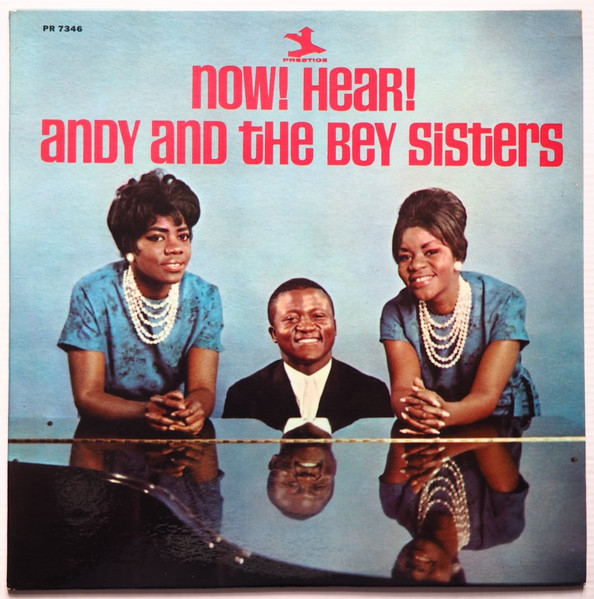
What became one album, Now! Hear!, was recorded in two sessions, three days apart, with Jerome Richardson the only musician to play both sessions. I don't know the reason for the change. Perhaps producer Cal Lampley, was dissatisfied with the first group (he needn't have been -- they are wonderful). Perhaps, new to Prestige, he decided he wanted a younger, hipper sound. All the musicians on the second date represent a different generation from the first group. Perhaps it was just a scheduling conflict. At any rate, it's not cause for complaints. Each group brings a distinctive and satisfying sound. And in any case, the focus is on the Beys, and their tight sound. In any musical field, from country to doo wop to jazz, there is something distinctive about a family harmony group. Andy recognized this from a vantage point of half a century, as he told Chris Slawecki in a 2020 interview for All About Jazz:

I was doing things with my sisters that I'm still doing somewhat, in terms of the tempo and in terms of the rhythmic attack we used to use. I used to sing the lower part, having the male voice. We have a family sound, we basically all sound the same. Like the Cole family, him and his brothers sound basically the same when they sang. They're not identical, but you can hear that family sound.

You can certainly hear that family sound on Buddy Johnson's "Since I Fell for You." The tune was written for his sister Ella, but the group harmony possibilities of it were quickly realized by a number of doowop groups, most notably the Harpton. Andy's Nat Cole-influenced piano anchors this one, with some wonderful guitar fills by Barry Galbraith.

"Willow Weep for Me" provides a good introduction to the second group, with particularly notable work by Richardson and drummer Osie Johnson, and again those family harmonies.

It's good that the Beys went their separate ways. Each of them had a distinctive and important career, contributing so much to American music. But it's also really good that they did this work, and recorded this work, together,

Prestige released two 45 RPM singles. each featuring one song from each session. "Willow Weep For Me" / "Quiet Nights Of Quiet Stars," and the second was "A Taste Of Honey" / "Besame Mucho."    


Saturday, February 13, 2021

Listening to Prestige 541 - Frank Wess


LISTEN TO ONE: Southern Comfort

 I suspect Frank Wess is best known for his work with Count Basie, but his catalogue encompasses a lot more than that, work with a variety of other musicians and as a leader of his own ensembles. This was his 11th session for Prestige. He had previously recorded with Gene Ammons and with Lem Winchester; he had done three Prestige All Stars sessions, including one with John Coltrane; a Basie alumni session with Joe Newman; and a session with vocalist Etta Jones. He had co-led two remarkable sessions with harpist Dorothy Ashby, and had done a Moodsville session as leader in 1960.


Recording Frank Wess in 1962 is one indication of the eclectic range Prestige was pursuing in these years. The label had embraced the new soul jazz with its organ combos; the new free jazz, or "freedom music" as it was called in those days, with Eric Dolphy; modern takes on the swing era with its Swingville series; the blues with Bluesville; a softer (but still swinging) sound with Moodsville. It had embraced the rhythm and blues side of jazz with King Curtis, Willis "Gator Tail" Jackson and Sam "the Man" Taylor, and Latin jazz with Juan Amalbert's Latin Jazz Quintet -- two genres too overlooked. And it was not overlooking the bebop/hard bop music that had come to fruition in the previous decade, and as it continued through more shifts and permutations of jazz expression would come to be known as "straight ahead jazz."

Frank Wess, with his Basie roots and his modern roots, was as straight ahead as they come, and he has a versatile straight-ahead rhythm section behind him, with Prestige veterans Tommy Flanagan, George Duvivier, Osie Johnson and Ray Barreto, and similar versatility from George Barrow, whose baritone (and occasionally tenor) sax would be featured on a number of Prestige albums, and on Oliver Nelson's  The Blues and the Abstract Truth.


New to Prestige is trumpeter Al Aarons, not Detroit-born, but Detroit-bred--a Wayne State graduate, he played with Yusef Lateef and Barry Harris, and had a regular gig at the Flame Show Bar backing up visiting talent from Billie Holiday to Jackie Wilson, before touring with Wild Bill Davis and then joining the Countasie band in 1961, and stayed with the Count for the rest of the decade, and he joined Gene Ammons for one more Prestige session near the end of the label's independent life. Later on he would play jazz fusion with Stanley Clarke and accompany both Ella Fitzgerald and Sarah Vaughan, and record an album with B. B. King and Bobby "Blue" Bland. He also started his own record label in Los Angeles.

And finally, the session had an arranger. Oliver Nelson. A septet isn't quite a big enough ensemble to require an arranger, but it can't hurt to have one, especially when it's Oliver Nelson.

Just as the Prestige Swingville records, featuring swing stars of the 1930s and 1940s, were not  duplications or rehashes of those earlier decades, so the music of this session, with Nelson's arrangements, does not sound like something that might have been made seven or eight years earlier. It's straight ahead music, but music of its time. Listen to the extended duet by Johnson and Barretto on "Southern Comfort."

Wess plays both flute and tenor sax for this session. Esmond Edwards produced. There are two compositions by Wess ("Gin's Beguine" and "Summer Frost"), two by Nelson ("Southern Comfort" and "Shufflin'"). "Blues for Butterball" is by a lesser known composer, Bob Bryant (he was Vic Damone's musical director), and it's credited as having lyrics by Maine humorist Marshall Dodge, but I haven't been able to find a vocal version. "Butterball" was Oliver Nelson's nickname. "Blue Skies" (Irving Berlin) and "Dancing in the Dark (Howard Dietz, Arthur Schwartz) are standards.

Saturday, October 06, 2018

Listening to Prestige 347: Pee Wee Russell

Listening to Prestige continues to be an enriching experience beyond what I even expected, as the Swingville catalog expands and showcases exemplars of a style of music I haven't always paid enough attention to. Pee Wee Russell played jazz over five decades, making a name for himself as one of the leading Dixieland and Chicago-style musicians, playing for most of his career with solid traditionalists like Eddie Condon and Henry "Red" Allen, yet always known as an odd duck in a field that did not always take kindly to odd ducks. Dixieland players, especially as, like Eddie Condon, they dug in their heels against modernism, prided themselves on hitting notes squarely, but Russell never exactly did that. His style was always punctuated by growls, swoops, yelps, and off-notes that would have felt right at home in a bebop setting. Indeed, he is certainly the only traditional jazz musician ever to play the Newport Festival as part of Thelonious Monk's group. With Condon, partly because of his unorthodox style and partly because of his hangdog looks, he was the comic relief for Condon's stage schtick, but there was nothing ridiculous about it when he stepped out front and started soloing.

Russell was on a comeback that had almost seemed impossible. In 1951, alcohol had caused a physical breakdown that sent him to the hospital, where many thought he would not recover.

Esmond Edwards, for his Prestige debut, put him together with a versatile group of musicians. Buck Clayton is perhaps best known for his work with Count Basie, and for a swing-era style, but in his time with Norman Granz's Jazz at the Philharmonic he played with everyone, including Charlie Parker. The rhythm section is equally versatile, and together, they create a session that is satisfyingly mainstream and still full of surprises.

In fact, everyone in this session is capable of delivering up surprises, and they do--even Wendell Marshall, who's tasked with keeping everyone in line and is up to the job, his walking bass weaving in and out among the soloists. Osie Johnson delivers a couple of stinging solos.

And Tommy Flanagan, raised in the bebop hotbed of Detroit but capable of playing with anyone, raises some serious eyebrows here. He doesn't come close to staying within the conventions of traditional jazz, and yet everything he does works, making this a session that is absolutely located within Swingville, but rewarding for anyone of any jazz taste who takes the time to give it a listen.

The best YouTube presentation is the whole album, so that's what I've put up, but if I were able to single out a Listen to One, it would be "Lulu's Back in Town"--a Dixieland chestnut, but not the way they play it.

The Swingville album was titled Swingin' with Pee Wee.

Sunday, June 17, 2018

Listening to Prestige 339: Coleman Hawkins

This is a Moodsville session, and it can legitimately be described as mood music: Coleman Hawkins and a rhythm section, a selection of well-chosen ballads, all of them familiar, none of them over-familiar. Two of them ("While We're Young" and "Trouble is a Man") were composed by Alec Wilder, who, if he didn't coin the phrase "Great American Songbook," can certainly be accorded credit for popularizing the concept with his 1972 book American Popular Song: The Great Innovators 1900-1950.


The cover art for the Moodsville series makes it clear what they're selling: the mood. But the musicians don't go into the studio to make mood music, and with Coleman Hawkins, you know you're getting a lot more.

And that's not to put down mood music. Music as background is sometimes unfairly derided. It's part of our lives when we don't necessarily want it to be, in elevators or supermarkets or when we're on hold. But it's the background to our lives when we choose it, to read, to work out or make love, to paint or sculpt or clean out the garage. But that background has to be foregroundable. It has to be music that you can stop sculpting for a few minutes, wipe your brow, take a breath, and shift your attention to what you're listening to. It needs to be something good, something that's every bit as challenging and absorbing as it is relaxing and soothing.

Hawkins fits all of those requirements. So does Tommy Flanagan, who is a very good match for Hawkins.

The album is called At Ease With Coleman Hawkins. Esmond Edwards produced.

Monday, June 04, 2018

Listening to Prestige 335: Coleman Hawkins

Not much new to say about Coleman Hawkins by this time. It seems almost beside the point to write anything. Better to turn the volume to just the right level (not all the way up to eleven), sit back, and enjoy sound that is so smooth you could spread it on Wonder Bread without ripping up big hunks.

Except you would never spread it on Wonder Bread. This is the real thing, the blues, the real America, three-dimensional and full-toned and flavored like Huck Finn's stew. Unlike the Widow Douglas's white-bread cuisine where "everything was cooked by itself," you have "a barrel of odds and ends," where "things get mixed up, and the juice kind of swaps around, and the things go better."

So this is music for pure enjoyment,  but isn't that what it's all for? As Hawkins and his group were in Englewood Cliffs cutting this session, Ornette Coleman was at the Five Spot making music that hurt the ears of many, but to my 19-year-old ears it was pure bliss, thrilling new, complex and simple, challenging and direct. And that's what you look for from art. The doors open where you find them, sometimes where you were looking, sometimes where you least expected, and each door that you go through broadens your range of appreciation, so that your capacity for enjoyment keeps expanding.

Hawkins has brought some old friends to this session, Osie Johnson has some swing credentials, having spent three years with Earl Hines, Tommy Flanagan and Wendell Marshall have young hands and timeless ears. But his horn players have the kind of time-tested chops that the Hawk himself brings.

Vic Dickenson kept a fairly high profile for a traditional player during the modern jazz era. A Down Beat International Critics Poll in 1963 placed him third among trombonists, tied with Lawrence Brown. And there were still plenty of great trombonists around. J. J. Johnson was still leader of the pack, Curtis Fuller and Slide Hampton were at the peak of their careers, Kai Winding was making hit records, Urbie Green and Bennie Green were still active, and Dickenson was pushing 60. But he  kept busy throughout the 1950s and 1960s, recording with Hawkins, Johnny Hodges, Dicky Wells, Buster Bailey, Budd Johnson and, interestingly, Langston Hughes. He was a member of the outfit called The World's Greatest Jazz Band, which played the style of traditional jazz somewhat uncomfortably referred to as Dixieland, and which had a good enough lineup to justify the name.

Much less well-known, but regarded with reverence by those familiar with him, was trumpeter Joe Thomas. One such is Michael Steinman of the Jazz Lives blog, who has said of Thomas:
Joe knew how to structure a solo through space, to make his phrases ring by leaving breathing room between them.  Like Bix or Basie, Joe embodied restraint while everyone around him was being urgent.  His pure dark sound is as important as the notes he plays — or chooses to omit...

A simple phrase, in Thomas’s world, is a beautifully burnished object.  And one phrase flows into another, so at the end of the solo, one has embraced a new melody, resonant in three dimensions, that wasn’t there before, full of shadings, deep and logically constructed.
And more:
 Joe’s tone, dark and shining, makes the simple playing of a written line something to marvel at, and each of his notes seems a careful choice yet all is fresh, never by rote: someone speaking words that have become true because he has just discovered they are the right ones for the moment.

I've commented on this before, but it's worth repeating: What Coleman Hawkins, and other artists who recorded for Bob Weinstock's Swingville label, played was not traditional swing (as opposed, for example to The World's Greatest Jazz Band, which essentially did play traditional Dixieland). Swing was big band jazz, essentially an arranger's art form, and what followed it was a small group music with emphasis on the soloist. Of course, there had always been small groups. Louis Armstrong's Hot Five was one of the most important, and they preceded swing.

Hawkins played his own kind of music. He had virtually invented the modern improvised solo with his 1939 recording of "Body and Soul," and though his music at this stage of his career had a mellow nostalgic feeling to it, it was definitely the music of the guy who had recorded "Body and Soul" and had played on the first bebop recording.

And his traditionalist partners, Thomas and Dickenson, were right there with him. They could play traditional Dixieland when it was called for, but they could play with Hawkins, doing what Hawkins did, as well. As Dickenson once said:
I like to play the melody, and I want it still to be heard, but I like to rephrase it and bring out something fresh in it, as though I were talking or singing to someone. I don't want to play it as written, because there's usually something square in it.

Of course, the center of the Kansas City swing that Hawkins grew up with, and the center of bebop as well, is the blues, and all of these cats know how to play the blues, and it infuses even their Tin Pan Alley pop standards like "I'm Beginning to See the Light." It's part of what knits them together. The rest is a shared musical understanding that allows for solo to build on solo, in a most satisfying way.

The Swingville release was entitled Coleman Hawkins All Stars .

Monday, April 16, 2018

Listening to Prestige 330: Buddy Tate

Buddy Tate's first appearance on Prestige was with Shirley Scott and an all-star sax section: Coleman Hawkins, Eddie "Lockjaw" Davis, Arnett Cobb. Here he's back for Swingville, and with his own group.

Tate had a regular gig at the Celebrity Club in Harlem from the early 1950s through the mid-1970s, which says something about the enduring popularity of swing in general, and the musicianship of Tate and his band in particular. Tate had had a longtime gig as first tenor sax in the Count Basie orchestra, following Herschel Evans, and most of his musical associates are from that Basie orbit, including his band from the Celebrity Club, which is essentially the band he recorded with for this Prestige Swingville date. These are professional sidemen, guys who never
stepped out to lead their own bands, or at least never recorded as leaders, but who never lacked for work on the highest levels of jazz, because they could get the job done, and more--they could add their own touch to both solo and ensemble work.

Trumpeter Pat Jenkins joined Tate in 1951, when the saxophonist had secured the Celebrity Club gig, and stayed with him for the next 21 years, or the run of the gig. Before that, he had been best known for another long term gig: the Savoy Sultans, house band at the Savoy Ballroom. The Savoy booked the hottest bands in the nation, and the Sultans' job was to fill in the times when the headline band was on break, and keep people dancing with no letup. In the Savoy management's policy, no letup meant that the house band had to be good enough that when Chick Webb or Lucky Millinder or Count Basie stopped playing, the audience didn't feel a letdown, but it also meant no letup. According to terry Monaghan's obituary for Jenkins in The Guardian:
The Savoy's policy was to minimise breaks in the music, so bands were expected to pick up immediately from their predecessors. Masters of seguing, the Sultan's rhythm section would join in the last number of any "opposite" band which had struck a groove. When the latter band stopped, the Sultans would carry on. Pat recalled some bandleaders being amused by this tactic while others were angered at such blatant upstaging.

 Eli Robinson, Tate's trombonist, has that kind of resume. McKinney's Cotton Pickers, Blanche Calloway, Willie Bryant's Apollo house band, Lucky Millinder, Roy Eldridge, Count Basie, and finally Buddy Tate. If you wanted music you could dance to, swing to, groove to, listen to, snap your fingers to, court the love of your life or score a hot date for Saturday night to, chances are Eli Robinson was in the band that was playing it.

On this session, he shows his composing chops, too, with "Me 'n You," "Blow Low," and "Miss Ruby Jones" to his credit.

Ben Richardson also passed through Blanche Calloway's ensemble, and was another of Tate's Celebrity Club regulars.

Sadik Hakim had more of a bebop background than did Tate's other regulars, having recorded with Charlie Parker, Dexter Gordon, and others. In the early 50s, before he joined Tate, he had been with James Moody. But he had worked the swing side of the street, too, with Ben Webster, Henry "Red" Allen, J. C. Higginbotham, Roy Eldridge, Stuff Smith.

An aside. I've always said if I could time travel, I would go back to being 20 years old at the time I was born, 1940, and I would head straight for 52nd Street, and uptown to Minton's. Here's just one example of why, from an interview with Sadik Hakim:

 The rhythm section at the Onyx Club became Eddie Nicholson (drums), Gene Ramey (bass) and myself.  Many times Roy Eldridge would play with us, or Stuff Smith, or Bob Dorsey, a great tenor player. Then it was Bird—always late.  Mike Weston, the Onyx Club owner, would be frowning as Bird came in late, but after a couple of Bird’s choruses, he’d be smiling.  One night Bird was very, very late. Bird came in while Ben Webster was drinking at the bar; the rest of us were trioing.  Bird picked up Ben’s tenor and said I Cherokee. He played that tenor like he owned it, and Ben was shook.  He just kept saying “Give me another double.” The thing about this was that nobody could get a sound out of Ben’s tenor but Ben himself, due to the thickness of the reed, etc.  I saw many great tenor players try-Prez, Buddy Tate, Ike Quebec, no good!

Dicky Wells was another member of Tate's Celebrity Club ensemble. He didn't make this recording session in person, but he did by proxy, with two of his compositions: "Moon Dog" and "No Kiddin'." The remaining tune, "Idling," is Hakim's.

For Tate himself, here's a description of his style by The New Yorker's jazz critic Whitney Balliett:


Tate's solos do not depend simply on improvisation, or even on design, but on burst after burst of emotion. These are shaped into long, falling blue notes, crooning phrases that end in fluttering vibratos, and  cries that arch upon the upper register. Tate's emotions, which are blue and sorrowing, have none of the self-pity and boohooing that leak from the work of some contemporaries. He seems to say, Damn, my heart aches; hear it. He has Herschel Evans' tone, fine rhythmic agility, and a neat harmonic sense.


Tate's Date was Swingville's third release.


Listening to Prestige Vol. 2, 1954-1956 is here! You can order your signed copy or copies through the link above.

Tad Richards will strike a nerve with all of us who were privileged to have
lived thru the beginnings of bebop, and with those who have since
fallen under the spell of this American phenomenon…a one-of-a-kind
reference book, that will surely take its place in the history of this
music.
                                                                                                                                   
--Dave Grusin

An important reference book of all the Prestige recordings during the time
period. Furthermore, Each song chosen is a brilliant representation of
the artist which leaves the listener free to explore further. The
stories behind the making of each track are incredibly informative and
give a glimpse deeper into the artists at work.
                                                                                                                --Murali Coryell

Friday, January 19, 2018

Listening to Prestige 304: Coleman Hawkins

As Prestige roars into its tenth anniversary year, new ideas are taking shape, and everything old is new again. The 19-year-old who as a youngster had gone out with his father collecting traditional jazz 78s by the bushel, who had experienced the epiphany of Thelonious Monk and begun a new label to become an apostle of bebop, was 29 now, and looking around at the music scene on the cusp of a new decade.

Ten years as president of a record label will also give you new ideas about marketing, and as 1959 rolled on, Bob Weinstock was preparing to unleash three new subsidiary labels, Moodsville, Swingville and Bluesville.

These were not the "budget" labels that a lot of record labels put out in those days: LPs that were repackagings of earlier recordings, or masters that had been bought up from defunct labels. The budget labels were cheaply pressed and cheaply packaged, and were a way that companies tried to squeeze a few last nickels out of music that they probably weren't going to see a payday any other way. It's not widely known, but in 1977 RCA Victor was planning a massive budget rerelease of the music of one of its declining stars, Elvis Presley. That, of course, was the year that Elvis achieved true immortality by dying, and RCA changed its plans in a hurry.

New Jazz was sort of a budget label for Prestige, although its catalog feature some of Prestige's best artist doing some of their best work. The London Jazz Collector notes that some New Jazz titles:
 are sometimes marred by “hissy vinyl”, due to the raw vinylite being bulked up with recycled vinyl (containing minute detritus and fragments of paper label, which the stylus picks up as a continuous hiss) . Some pressings are ok, others have the dreaded hiss throughout, sometimes minor, on  other copies quite prominent. There is no consistency – even the same title can be found with hissy copies and not hissy copies. Perhaps it all depended on whether the vinylite stock delivered to the XYZ pressing plant that week had been bulked up with recycled vinyl or not. I have not encountered the problem with any other labels than Prestige, and does not occur with pre-Bergenfield [Prestige moved from New York City to Bergenfield, NJ, in the mid-1960s] label pressings or those from Abbey Manufacturing, so the finger points to reckless cost-cutting or dubious quality at some plants.
But for the most part, New Jazz records had pretty good quality control. Status was the real budget label, and even there, according to the London Jazz Collector, it's
difficult to see what was budget apart from saving on ink, providing minimal information saved nothing, but made it look budget. Working in Marketing in the Seventies, the big fear was always “cannibalisation”. You wanted all the sales you could get at the premium price, and extra sales at the budget price, without losing the one to the other. Extra effort was incurred to make things look less attractive. More marketing genius from Weinstock.
Swingville, Bluesville and Moodsville do not appear to have been budget labels at all. There's a lengthy discussion of this question online at the Organissimo jazz forum, and Chris Albertson, jazz historian and producer of many a Prestige session, weighs in with this:
I really don't think there was any serious marketing decision involved in the creation of the Bluesville, Swingville, Moodsville, etc. series. Remember, these were not stand-alone subsidiary labels--it was always Prestige Moodsville, Prestige Swingville, etc. I don't recall if the pricing was different--if so, that may have been a factor. As a dj when these first came out, and later as a Prestige employee, I never thought of them as anything but Prestige albums with a series name.
Sometimes I think that consumers/collectors make more out of such details than the facts call for. When I produced a session, it was a Prestige session--whether it came out on Prestige, Prestige Bluesville or Prestige Swingville, made no difference.
If Bob Weinstock was, as the London Jazz Collector suggests, a marketing genius, perhaps he was also by this time pretty savvy about accounting, and maybe there was a tax advantage to these subsidiary labels.

Or maybe it was just about the music. I'll deal with Bluesville and Moodsville later, but Weinstock, who had grown up on swing, and whose Times Square offices were still within hailing distance of the Metropole, was already assembling quite a collection swing era veterans, to the extent that he could have created a whole new line of Prestige All Stars or Prestige Blues Swingers. Because All Stars these gents certainly were, starting with one of the all stars of all of jazz history, Coleman Hawkins, who is gracing the ten-year-anniversary halls of Prestige and the Van Gelder Studio with his larger than life presence. And here, joined by:
  • Charlie Shavers, 42 years old, first recruited by Prestige for the February 20 Hal Singer session. Swing credentials include Tommy Dorsey, Billie Holiday, Benny Goodman, Jazz at the Philharmonic, Count Basie, Gene Krupa and Buddy Rich, Budd Johnson, and his own band with Terry Gibbs and Louis Bellson. He is the composer of  "Undecided," which had its origin in a tune that Shavers liked enough to send off to his publishers. They liked it too, and asked for a title. Shavers was trying to decide between  a couple of catchy titles, but hadn't made up his mind yet, so he wrote "Undecided." The publishers immediately sent it off to lyricist Leo Robin, and the rest is history--and some 200 recordings.
  • Ray Bryant, the kid of the group at 28, but a kid who felt perfectly at home sitting in with the old guys at the Metropole in the afternoon, then heading downtown to play with the moderns in the evening.
  • Tiny Grimes, 43, veteran of three earlier Prestige sessions, including a swinging soirée with J. C. Higginbotham, would be a Swingville staple. Played with Slam Stewart, Art Tatum, Billie Holiday. He had a hit with a swing version of the Scottish folk song "Loch Lomond." On the strength of that, he organized  Tiny Grimes and his Rocking Highlanders, which featured Red Prysock until Red quit because he refused to wear a kilt.
  • George Duvivier, 39, made his mark with the Shirley Scott and Eddie “Lockjaw” Davis sessions, but his first Prestige gig had been two years earlier, with Gil Melle, of all people. He played with Lucky Millinder, Cab Calloway, Louis Bellson, Count Basie, Benny Carter, Anita O’Day, and lots of moderns too. Pretty nearly everyone.
  • Osie Johnson, 36, played with Earl Hines, Zoot Sims, Dinah Washington, Paul Gonsalves. He first hit Prestige in 1955 with Bennie Green, and stuck around over the next four years to back up Barbara Lea, Tiny Grimes and J. C. Higginbotham, 
Coleman Hawkins was 55 when he stepped the studio with this aggregation and in the middle of yet another career renaissance.

So what are these Swingville all stars playing? It’s nothing that you would have heard from a Benny Goodman radio broadcast on a Saturday night high atop the Rainbow Room. It’s nothing like the jump, jive and wail you would have heard from an old Louis Prima record or from a contemporary group like the Stray Cats when swing music and swing dancing had a renaissance among the kids in the 1990s. This is small group jazz from New York musicians in the 1950s, guys who have been around long enough to remember when jazz was dance music, but who know that today’s listeners want to hear inventive solos that’ll take them someplace new. You’d go to a Swingville album, as the label established itself, to hear music that would give you a certain traditional feel, but would also give you the modern jazz you’d come to expect from Prestige.

Coleman Hawkins, the architect of the saxophone sound in jazz, the guy who played with Fletcher Henderson, who gave new meaning to the improvised jazz solo with “Body and Soul,” who played with Dizzy on 52nd Street, who was still playing, the amalgam of everything he ever knew, was the perfect choice to build a new label around. In fact, it’s not hard to imagine that signing the Hawk to Prestige was what gave Weinstock the idea for Swingville.

Hawk Eyes' first release was on Prestige, but it soon became one of Swingville's early releases.


Listening to Prestige Vol. 2, 1954-1956 is here! You can order your signed copy or copies through the link above.


Tad Richards will strike a nerve with all of us who were privileged to have
lived thru the beginnings of bebop, and with those who have since
fallen under the spell of this American phenomenon…a one-of-a-kind
reference book, that will surely take its place in the history of this
music.
                                                                                                                                             
--Dave Grusin

An
important reference book of all the Prestige recordings during the time
period. Furthermore, Each song chosen is a brilliant representation of
the artist which leaves the listener free to explore further. The
stories behind the making of each track are incredibly informative and
give a glimpse deeper into the artists at work.
                                                                                                                --Murali Coryell

Saturday, January 13, 2018

Listening to Prestige 301: Arnett Cobb

If you’ve got that soulful, bluesy sound on the tenor sax, and you want to make a record in 1959, you’re going to need an organ.

You’re not going to be able to get Jimmy Smith. He’s way too big, way too much in demand. And he's signed to Blue Note. Shirley Scott’s made a bunch of recordings for your label, but she’s not available either. And your old pal Wild Bill Davis, who just sat in on your debut album for your new label, was just passing through and is out for this one.

So who you gonna call?


Or...this being 1959, and a jazz organist being what you require, here’s a better question: Where you gonna call?

Philadelphia!!!

It's amazing how one city can be so much the hot center of the newest craze to be sweeping jazz. Jimmy Smith took up the Hammond B-3 because its tones were generated electronically, so unlike the piano, it never went out of tune. This can be a big deal for a keyboard player who's on the road a lot, playing Lord knows what instrument in Lord knows what state of repair.

What keyboard instruments have in common is that if you press down one key you get a note, and if you press down a few keys at the same time, you get a chord. Beyond that, not much. So Smith, with his Hammond B-3 organ, really had to create a whole new sound, and the sound that he created inspired a generation of keyboard players.

Shirley Scott was one of the first. and we've listened to her exploration of the whole range of the two 61-key keyboards on the Hammond, and the excitement of finding new voicings and new sounds. But she would not be the only one. Jimmy McGriff, a Philadelphia cop, gave up walking his beat for a different beat, studied with Smith, and went on to make his own mark. Richard "Groove" Holmes was another. Charles Earland followed him, as did a second generation Philadelphia organist, "Papa John" deFrancesco's son Joey.

Philadelphia and the organ go even farther back. Bill Doggett was from Philadelphia, as was Doc Bagby, jazz veteran who hit the rhythm and blues charts with "Dumplin's." And many more who may not have left town, but continued to play the Philly jazz clubs and give the city its rich organ heritage.

One such was the gentleman who for decades needed only to be known in his home town, and up and down Catherine Street,  as "Mitchell at the Hammond Organ," but when he made the two hour drive to Hackensack, New Jersey, to be the organ guy on Arnett Cobb's second Prestige recording, he used his full name, Austin Mitchell.

There's no typical sax-organ sound, any more than there's a typical sax-trumpet sound. Austin Mitchell is very much influenced by Jimmy Smith, but he's his own man, too. And here's something that particularly interested me, in listening to this session. Mitchell for most of his professional career was an organ trio guy, leading his own groups around Philadelphia. But with Arnett Cobb, though his solos are consistently interesting and inventive, I found myself particularly interested in the work he did behind Cobb when Cobb was soloing. Never intrusive, but always important. In every Cobb solo, from the sensitive ballad work in "Ghost of a Chance" to the rhythm and bluesy honking on "Smooth Sailing," to the melodic ("Charmaine"), to the uptempo beboppery of "Let's Split," to the blues ("Blues at Dusk"), Mitchell is enriching, deepening, going from comp to counterpoint at just the right moment.

Buster Cooper has been on one previous Prestige session, the first Prestige Blues-Swingers, which was essentially a big band session, so this is his first small group recording. Not every trombonist, especially those who have thrived in a big band setting, is going to be a bebop virtuoso. Cooper is more the old school, playing with gusto, with humor, with that down home dirty blues sound.


After listening to a few sessions of what George Duvivier can do with this sort of music, you really wouldn't want anyone else playing bass for you. Cobb and producer Esmond Edwards agree, and Edwards has let Rudy Van Gelder know that he wants the listener to hear what Duvivier is doing, Duvivier also contributes one original composition ("Cobb's Mob").

Osie Johnson takes Arthur Edgehill's accustomed seat behind the drums, and he does just fine. Johnson was one of the drummers that Prestige would call on for its bluesy sessions, and with good reason.

Smooth Sailing was the name of the album, and the title tune plus "Ghost of a Chance" were the 45 RPM release.

Order Listening to Prestige Vol 2


Listening to Prestige Vol. 2, 1954-1956 is here! You can order your signed copy or copies through the link above.


Tad Richards will strike a nerve with all of us who were privileged to have lived thru the beginnings of bebop, and with those who have since fallen under the spell of this American phenomenon…a one-of-a-kind reference book, that will surely take its place in the history of this music.

                                                                                                                                                --Dave Grusin

An important reference book of all the Prestige recordings during the time period. Furthermore, Each song chosen is a brilliant representation of the artist which leaves the listener free to explore further. The stories behind the making of each track are incredibly informative and give a glimpse deeper into the artists at work.
                                                                                                                --Murali Coryell

Friday, January 12, 2018

Listening to Prestige 300: Hal Singer

Hal Singer had his moment in the sun in 1948 when his 78 RPM single, "Corn Bread," went to Number One on the rhythm and blues charts, or rather the Race Records chart, because Billboard didn't start using the appellation "Rhythm and Blues" until 1949. "Corn Bread" has a solid blues riff, builds on it with energy and humor and some clever interplay between Singer's saxophone and a trombone. The two work closer and closer together on an improvisation that gets wilder and more intense. It would have been great to dance to. It still is. And of course, it was ignored by the jazz critical establishment, hiosters and moldy figs alike. It wasn't abstract like Lee Konitz. It didn't swing like Harry James. And it didn't have real jazz musicians playing.

No identification of individual musicians on the Savoy record label, as was common with R&B, because no one was reviewing them or writing think pieces about them. But we know who they were. The trombone was Milt Larkin. Wynton Kelly was on piano, Franklin Skeete bass, Heywood Jackson, drums. Jazz enough for you?

"Corn Bread" wasn't all that Singer wanted to do. He said in an interview years later that the thing he was most proud of about the recording was giving Wynton Kelly his first chance on record. That, and that it led to his joining the Duke Ellington band a few years later, so the Duke knew jazz where he heard it.

Singer's followup, "Beef Stew," went nowhere, and so did his career, for a while. He still had work (a beloved Number One hit will do that for you), but he couldn't recapture the magic on a few more singles for Savoy and some smaller labels.

By the time of the Prestige session he had joined the Ellington Orchestra and left it to work with his own  small groups again--a tough decision, but maybe the right one.

This was his first ever booking to make a whole LP record. He was teamed with another jazz veteran, Charlie Shavers. The two were about the same age, Shavers 42 and Singer 40. They had similar backgrounds, although Shavers had always managed to stay on the respectable side of the swing/rhythm and blues divide, playing with Tommy Dorsey, Benny Goodman, Billie Holiday and Jazz at the Philharmonic.

He was always in demand. His 1950s had been marked by recordings with Louis Bellson, Coleman Hawkins, Count Basie, Woody Herman, and Gene Krupa and Buddy Rich (together).

This session includes one standard ("With a Song in My Heart") and a bunch of originals. You can hear stylistic difference between Singer and Shavers--rhythm and blues and swing are not exactly the same--but the mesh together to create an exciting and organic music.

The difference between record like "Corn Bread" and a record like "Blue Stomping" -- "Corn Bread" is three minutes long. That's a little long for a 78 RPM record, but it's within the limits, which is how you made a record in 1948. And as a result, it's essentially an extended saxophone solo. There's nothing in it that would confuse or slow down a dancer.

"Blue Stomping" is Hal Singer stretching out to LP length, at six and a half minutes, so the full-out excitement of "Corn Bread" is there, but now it's part of a larger picture, with solos traded off between Shavers and Singer, not so much ensemble work, and a piano solo by Ray Bryant, including some give and take with Wendell Marshall and Osie Johnson, which you would not hear in a rhythm and blues recording, or a swing record either, for that matter.

Shavers died in 1971, within days of his friend Louis Armstrong; his last request was that his mouthpiece be buried atop Armstrong's coffin.

Singer's career was revived with this session. He would make one more record with Prestige. Then not long after, on a European tour, he would become yet another jazzman to fall under the spell of Paris skies. He stayed there, becoming an important part of the European jazz scene. He was awarded the title of Chevalier and later Commandeur de l'Ordre des Arts et des Lettres, along with T. S. Eliot, Audrey Hepburn and Marcel Marceau, and of course, this being France, Jerry Lewis.

This album was released as Blue Stompin' on Prestige, and was a later Swingville rerelease. The title track became a two-sided 45.

Order Listening to Prestige Vol 2 


Listening to Prestige Vol. 2, 1954-1956 is here! You can order your signed copy or copies through the link above.


Tad Richards will strike a nerve with all of us who were privileged to have lived thru the beginnings of bebop, and with those who have since fallen under the spell of this American phenomenon…a one-of-a-kind reference book, that will surely take its place in the history of this music.

                                                                                                                                                --Dave Grusin

An important reference book of all the Prestige recordings during the time period. Furthermore, Each song chosen is a brilliant representation of the artist which leaves the listener free to explore further. The stories behind the making of each track are incredibly informative and give a glimpse deeper into the artists at work.
                                                                                                                --Murali Coryell