What does a producer of jazz records do? Probably, at best, not all that much. Bob Weinstock recalls that he and Miles Davis would sit down and kick around names -- who's in town, who would you like to record with? -- and that may have been the most of it. Weinstock had his jam session philosophy -- no rehearsal, just get 'em together and let 'em play -- and even so, Miles complained later that he (and every other producer Miles worked with) interfered too much.
So what about this session? Gene Ammons was one of Prestige's stalwarts, going back to the early days, often paired with Sonny Stitt, just as often without, generally preferring the fuller sound of a larger-than-quintet group. For a while he worked with a more or less steady group. almost always including trumpeter Bill Massey. By 1955, he had begun branching out. His three 1955 sessions for Prestige saw almost a complete turnover from session to session (Art and Addison Farmer were on one of them).
Why? Ammons had trouble keeping a group together? Seems unlikely. With his warm touch on ballads, earthy touch on blues, ability to wail with the best of the R&B saxmen, Ammons was one of the most popular jazz artists of the day.
Or perhaps, as he had done with Miles, Bob Weinstock sat down with him and said, "Hey, Gene, let's start mixing it up some. Look how well it worked with Miles. We'll kick around some names, get a bunch of guys together in the studio, see what happens."
So maybe that's what a producer of jazz records does. And how much careful thought and planning went into choosing that bunch of guys? I'd like to think very little. Art and Addison Farmer were around -- they'd just played the Bennie Green session a week or so earlier. The others were inspired choices, but none of them would have required a lot of thought.
What about Candido? Did Bob Weinstock and Ira Gitler sit up all night, saying "We've got to find something new for the next Ammons recording. How about a French horn, like the Miles Davis nonet? Bring Earl Coleman back for some vocals? Or a pianoless group like Gerry Mulligan? Wait! I've got it! We'll bring in some Latin percussion!" Or did Candido just happen to drop by the office that day, and say "Hola - I'm looking for a gig. Got anything?"
I like to think it was the latter.
And Duke Jordan? He was certainly doing a lot of session work in the 50s, not all that much of it with Prestige. He'd played with Art and Addison on a Farmer/Gryce session the previous fall. But for whatever reason they chose him, it was an inspired choice. It goes without saying that with Candido on board, you're going to have some hot rhythms, but it's Jordan whom I keep hearing driving this session. He turns out to be the real inspired choice.
Jordan had also recently written what was to become his most famous composition, "Jor-du," and one certainly wouldn't be surprised to hear it on a date where he was playing, but not so on this one.
Which raises another "what does a producer do?" question. Who chooses the tunes that will go into a recording session, and what's behind that? Obviously, there's a few extra bucks for the composer, and especially for the publishing rights, but there weren't all that many bucks in jazz overall, in those days. Jackie McLean seems almost certainly to be the composer of "Dig," for which Miles Davis took the credit, but when McLean looked into suing over it, he was told not to bother -- even if he won, there wouldn't be any money in it.
Still, you had a couple of excellent composers on this date (in addition to Jordan) and it's no surprise that they're represented--McLean with "Madhouse," Art Farmer with "The Happy Blues."
It's also not surprising that a standard was included. Ammons was great on ballads, and Weinstock liked standards, and although not much jazz was being released on single records any more by 1956, Ammons was still a jukebox favorite. Why "Can't We Be Friends" in particular? Why not? It's a beautiful song.
The one that really interests me is "The Great Lie," a swing era song by Andy Gibson -- credited to Gibson and Cab Calloway. Perhaps there were lyrics by Calloway? I could not find a version of it that included a vocal, but I did find a reference to it in a list of WWII-era songs by Calloway that had social commentary.
Andy Gibson was an underrated composer, whose best known work is probably his brilliant rhythm-and-bluesification of Charlie Parker's "Now's the Time" -- "The Hucklebuck."
It's certainly not unusual for a big band tune to be picked up and adapted by moderns, but I decided to see how this one mutated with different versions, so I listened to four: Cab Calloway (without vocal), Charlie Barnet, Gene Ammons, and Chet Baker/Art Pepper.
I liked Calloway's version, but loved Barnet's. And it brought home to me just how much big band music was an arranger's medium. I don't know who the arranger was for this version of "The Great Lie" -- it could have been Gibson, who worked a lot with Barnet. But it's wonderful, with the shifting horn patterns and solos that weave in and out of them. Charlie Barnet, like Artie Shaw, was heir to millions, and like Shaw, he got out of the music business at a fairly young age, and is probably underrated. Certainly he was by me -- I had listened to "Cherokee," maybe nothing else. This is a terrific band, and a terrific number.
Like Woody Herman, Barnet was open to the influences of bebop, and his later bands had some of the finest modern jazz musicians. But as we move seriously into the bebop-hard bop era, you can hear, listening to Barnet and then Ammons, how much the emphasis has shifted to the soloists. Both versions are hard-swinging, and they share a lot more in common than you'd think. The swing band is fresh and innovative, the bop ensemble is melodic. With all those great soloists, the Ammons band extends the tune a lot longer than Barnet's traditional song, 78 RPM length. Ammons goes nearly nine minutes, and everyone gets solo space, and makes the most of it.
With Baker and Pepper, it's pretty much all solos, and it's cool, and mellow, and all the things you expect from West Coast jazz, and also quite cerebral, but they don't forget to swing, either. And just as I found myself caught up by Duke Jordan's contribution to the Ammons group, I found myself listening to Leroy Vinnegar here, who really propels the swing of the two cool soloists with his bass.
"Madhouse" is the Jackie McLean composition, and it's also the one where Candido really shines.
It's also the one that ended up on the jukeboxes. If Weinstock had thought about using the ballad, he would have had to think again, when the boys stretched it out to over 12 minutes. Of course, "The Happy Blues," which did become the single (as Parts 1 and 2) was also over 12 minutes, but maybe it was easier to edit down. It was also the title track for the LP.
Tad Richards' odyssey through the catalog of Prestige Records:an unofficial and idiosyncratic history of jazz in the 50s and 60s. With occasional digressions.
Showing posts with label Candido. Show all posts
Saturday, February 06, 2016
Friday, September 18, 2015
Listening to Prestige Part 146: Bennie Green
The Prestige commitment to 12-inch LPs was not yet complete. This session did eventually get included in a full-length album, but its initial release was one of the last of the 200-series 10-inchers (there'd be four more), and even more surprisingly, one of the last of their 78 RPM releases (there'd be four more of them, including another by Green from a later 1955 session).
Which means that a recording session is changing. This Bennie Green session is four songs, totalling about 20 minutes of music, or just enough for a 10-inch LP, or a couple of singles. Not exactly perfect for singles, but the two cuts that were released on 78 and 45 ("Say Jack!" and "Sometimes I'm Happy") were the shortest ones.
Compare that with the Miles Davis session of a few days earlier, which produced about 36 minutes of music, and an entire 12-inch LP. Or the MJQ's session of a few weeks later, the same. Or the first Prestige 12-inch, recorded by Billy Taylor the previous April. All of Taylor's tunes were single-length, in the three minute range, but there were 12 of them, adding up again to about 36 minutes, and none were ever released as singles.
And compare all of those to this 1949 session by Stan Getz, which produced four songs, all of them in the 3 1/2 minute range, all of them released on 78.
And, of course, even with Bob Weinstock's famous no-rehearsal, few-alternate takes philosophy, one wasn't always going to be able to record a whole album in one day. But great jazz didn't necessarily require endless studio time. Kind of Blue was recorded in two days. Compare that with some of the 70s rockers with endless budgets and endless studio time. And...no accounting for tastes...but compare the results.
Anyway, back to Bennie Green. As I've noted earlier, Green could play anything, and he continues to demonstrate it. And he could do it on the trombone. Here he takes on three ballads, including "Body and Soul," which Coleman Hawkins pretty much owns as one of the definitive tenor sax solos. But Green manages to get the same depth of emotion on the trombone. "Laura" as a jazz standard is probably most closely associated with Charlie Parker with strings. Green gives it his own delicacy and sensivity.
"Laura" also features an unexpected and utterly entrancing solo by Cliff Smalls, hitherto unknown to
me, but a veteran of some ensembles with strong pedigrees, including Jimmie Lunceford and Erskine Hawkins. Perhaps he had a particular rapport with Green because he was also a trombonist. He had played trombone in the Earl Hines band that also featured Dizzy Gillespie and Charlie Parker, and he was the backup pianist for Hines. Actually, Hines used several backups, including Teddy Wilson, Jess Stacy and Nat "King" Cole, but Smalls was reportedly his favorite.
On "Say Jack!" Green's trombone takes on the job of a rhythm and blues tenor sax man -- and also vocalist, leading the ensemble in a ragged-but-right rhythm-and-bluesy chorus, which is not repeated anywhere else in the song, as the group gradually forgets that it's playing R&B, and moves into bebop territory -- particularly Charlie Rouse's solo.
Rouse and Smalls get a lot of solo time on "Sometimes I'm Happy," but what really kicks that number into high gear is the conga playing of Candido, whom Rudy Van Gelder moves to the forefront, and a good move it is.
The 10-inch LP was simply titled Bennie Green Sextet. When the session found its way to 12-inch, a year or so later, it was called Bennie Green Blows His Horn in Hi-Fi; by the time it was reissued as part of a 7100-series LP a couple of years later, perhaps Hi-Fi was no longer quite such an exciting new technology, because the album became simply Bennie Green Blows His Horn.
Which means that a recording session is changing. This Bennie Green session is four songs, totalling about 20 minutes of music, or just enough for a 10-inch LP, or a couple of singles. Not exactly perfect for singles, but the two cuts that were released on 78 and 45 ("Say Jack!" and "Sometimes I'm Happy") were the shortest ones.
Compare that with the Miles Davis session of a few days earlier, which produced about 36 minutes of music, and an entire 12-inch LP. Or the MJQ's session of a few weeks later, the same. Or the first Prestige 12-inch, recorded by Billy Taylor the previous April. All of Taylor's tunes were single-length, in the three minute range, but there were 12 of them, adding up again to about 36 minutes, and none were ever released as singles.
And compare all of those to this 1949 session by Stan Getz, which produced four songs, all of them in the 3 1/2 minute range, all of them released on 78.
And, of course, even with Bob Weinstock's famous no-rehearsal, few-alternate takes philosophy, one wasn't always going to be able to record a whole album in one day. But great jazz didn't necessarily require endless studio time. Kind of Blue was recorded in two days. Compare that with some of the 70s rockers with endless budgets and endless studio time. And...no accounting for tastes...but compare the results.
Anyway, back to Bennie Green. As I've noted earlier, Green could play anything, and he continues to demonstrate it. And he could do it on the trombone. Here he takes on three ballads, including "Body and Soul," which Coleman Hawkins pretty much owns as one of the definitive tenor sax solos. But Green manages to get the same depth of emotion on the trombone. "Laura" as a jazz standard is probably most closely associated with Charlie Parker with strings. Green gives it his own delicacy and sensivity.
"Laura" also features an unexpected and utterly entrancing solo by Cliff Smalls, hitherto unknown to
me, but a veteran of some ensembles with strong pedigrees, including Jimmie Lunceford and Erskine Hawkins. Perhaps he had a particular rapport with Green because he was also a trombonist. He had played trombone in the Earl Hines band that also featured Dizzy Gillespie and Charlie Parker, and he was the backup pianist for Hines. Actually, Hines used several backups, including Teddy Wilson, Jess Stacy and Nat "King" Cole, but Smalls was reportedly his favorite.
On "Say Jack!" Green's trombone takes on the job of a rhythm and blues tenor sax man -- and also vocalist, leading the ensemble in a ragged-but-right rhythm-and-bluesy chorus, which is not repeated anywhere else in the song, as the group gradually forgets that it's playing R&B, and moves into bebop territory -- particularly Charlie Rouse's solo.
Rouse and Smalls get a lot of solo time on "Sometimes I'm Happy," but what really kicks that number into high gear is the conga playing of Candido, whom Rudy Van Gelder moves to the forefront, and a good move it is.
The 10-inch LP was simply titled Bennie Green Sextet. When the session found its way to 12-inch, a year or so later, it was called Bennie Green Blows His Horn in Hi-Fi; by the time it was reissued as part of a 7100-series LP a couple of years later, perhaps Hi-Fi was no longer quite such an exciting new technology, because the album became simply Bennie Green Blows His Horn.Thursday, June 18, 2015
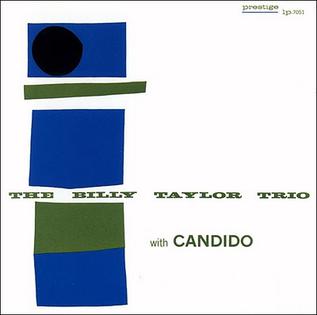
Listening to Prestige Part 120: Billy Taylor/Candido
Billy Taylor wrote the liner notes for this album, and he made its purpose clear:
Taylor gives Candido a lot of solo space here, and the conguero makes full use of it. He's a powerful presence throughout, soloing and trading with Taylor. And I could say accompanying, but that's not really it. He makes Taylor's solos into duets, and this is in no small part due to Rudy Van Gelder's engineering, keeping the levels of both instruments perfectly complementary.
The tracks are Taylor originals, plus a version of Cole Porter's "Love For Sale" which is breathtaking. Over nearly 8 minutes, Porter's melody becomes Latinized, boppified, turned into a vehicle for some adventurous Taylor improvisation and hot percussion by Candido.
Candido, who is still with us, was named an NEA Jazz Master in 2008, and his brief bio on the NEA's website describes some of his innovative drumming techniques:
I found a fascinating article on Candido at the Drum! website, taken from an article by Bobby
Sanabria (Originally Published in the Autumn 2007 issue of TRAPS) which includes the mention of a group the young Candido played with in Havana, led by Chano Pozo on congas, and including Candido on tres (a Cuban three-stringed instrument designed like either a mandolin or a guitar) and Mongo Santamaria on bongos. He also describes how he came to develop his three-drum technique:
The purpose of this album is to present a great new jazz artist. His name is Candido, and we think that he is the most exciting jazz conga and bongo player in the business.Dizzy Gillespie, of course, is one of the most important figures involved in the integration of Latin rhythms into jazz, starting with bringing Chano Pozo into his band. Even before that, Machito had one of the great jazz trumpeters, Mario Bauza, who never gets the credit he deserves--well, Latin jazz has never really gotten the acclaim it deserves. Candido played with both Machito and Gillespie before joining Billy Taylor for these sessions. Taylor, who would become one of the great educators in the jazz field, seems to have already had that mind set, as he sets out to prove that Latin jazz is real jazz, and Candido Camero is a real jazz musician.
There are, of course, many Latin American drummers who play well with jazz groups, but I have not heard anyone who even approaches the wonderful balance between the jazz and Cuban rhythmic elements that Candido so vividly demonstrates, and his technical facility is, to say the least, astounding.
Taylor gives Candido a lot of solo space here, and the conguero makes full use of it. He's a powerful presence throughout, soloing and trading with Taylor. And I could say accompanying, but that's not really it. He makes Taylor's solos into duets, and this is in no small part due to Rudy Van Gelder's engineering, keeping the levels of both instruments perfectly complementary.
The tracks are Taylor originals, plus a version of Cole Porter's "Love For Sale" which is breathtaking. Over nearly 8 minutes, Porter's melody becomes Latinized, boppified, turned into a vehicle for some adventurous Taylor improvisation and hot percussion by Candido.
Candido, who is still with us, was named an NEA Jazz Master in 2008, and his brief bio on the NEA's website describes some of his innovative drumming techniques:
...playing three congas (at a time when other congueros were playing only one) in addition to a cowbell and guiro (a fluted gourd played with strokes from a stick). He created another unique playing style by tuning his congas to specific pitches so that he could play melodies like a pianist.
I found a fascinating article on Candido at the Drum! website, taken from an article by Bobby
Sanabria (Originally Published in the Autumn 2007 issue of TRAPS) which includes the mention of a group the young Candido played with in Havana, led by Chano Pozo on congas, and including Candido on tres (a Cuban three-stringed instrument designed like either a mandolin or a guitar) and Mongo Santamaria on bongos. He also describes how he came to develop his three-drum technique:
I had seen the New York Philharmonic perform and paid attention to the timpanist. I thought to myself, ’I can do the same thing with the congas.’ I began to tune the drums to specific pitches, mostly a dominant chord, so I could play melodies in my tumbaos and solos.
"A Live One" and "Mambo Inn" were released on an EP, and, with "Love For Sale," as part of a 10-inch LP. Both of these were just credited to Billy Taylor. The 12-inch LP, with the liner notes I quoted above, had the whole session, and was titled The Billy Taylor Trio with Candido.
Subscribe to:
Posts (Atom)
:format(jpeg):mode_rgb():quality(96)/discogs-images/R-1422707-1377737230-6064.jpeg.jpg)


:format(jpeg):mode_rgb()/discogs-images/R-5932690-1406664614-9083.jpeg.jpg)