Tad Richards' odyssey through the catalog of Prestige Records:an unofficial and idiosyncratic history of jazz in the 50s and 60s. With occasional digressions.
Annisteen Allen, as she was known through most of her career, had a good run in the 1940s and early 1950s, singing with Lucky Millinder and other top rhythm and blues ensembles. She was discovered singing in a club in San Antonio one night when Duke Ellington and Louis Jordan went out clubbing, and wouldn't you like to have been along for that ride? They both dug her singing, but as neither was in the market for a girl singer, they recommended her to Lucky Millinder, who hired her without even hearing her on the strength of their recommendations. Wouldn't you?
Her recording career with Federal/King ended on an odd note, when King Records was sued by another rhythm and blues label, Apollo, for copyright infringement over one of Allen's recordings. She did have a minor hit for Capitol in 1955 with "Fujiyama Mama," outsold, as many songs were in those days, by white pop singer Eileen Barton, later covered most successfully by Wanda Jackson. Still later, the Clash would perform it live in Tokyo with a vocal by bassist Paul Simonon's wife, Pearl Harbour.
She would continue to record, for Capitol and Decca and a couple of very small independents, but in 1958 she gave up touring and performing, taking a job in a hospital office.
The session for Prestige was her first full length album session, and the first under her real name. Perhaps her career over the previous five years had been obscure enough that Prestige felt "Annisteen" no longer had any drawing power, or perhaps she simply convinced Bob Weinstock not to use a name which she had acquired from a typographical error on an early press release, and which she had never liked. In any event, this resurrection, and this album, is one more thing we can thank Prestige for.
Allen had always played with first rate musicians, so this is not a rarity for her, but her producer--perhaps Ozzie Cadena, who worked most of the Tru-Sound sessions--surrounds her with an excellent supporting cast here, starting with King Curtis, and musicians who played with him regularly: Paul Griffin on piano, guitarists Al Casey and Chauncey "Lord" Westbrook, bassist Jimmy Lewis and drummer Belton Evans.
The session was released on Tru-Sound rather than Bluesville, and that makes sense. Tru-Sound was variously described as modern R&B or Prestige's pop label. The King Curtis combo gives it rhythm and blues credentials, and while there are some blues in the mix -- her Lucky Millinder hit, "Let it Roll," the R&B standard "I Want a Little Boy" (or girl, as in the best-known versions by Big Joe Turner and Ray Charles) and an original, "Miss Allen's Blues" -- most of the selections come from Broadway and Tin Pan Alley.
We have a lot to thank Prestige Records for--being in the center of some of the most important jazz movements of the American Century in music, creating a record of the creative growth of older musicians who were not part of the bebop revolution...and mixing it up. In so many ways. Weinstock's decision to record Miles Davis with different musicians, rather than having form a regular group as he was to do later, gives us a different and important context for this giant of 20th Century music. Bringing in contemporary jazz musicians
to record with blues singers. And sessions like this one. King Curtis's band brings a new bite to some old standards. With their kicking tempo and Allen's exuberant vocal, they give a new twist to the Gershwin brothers' "The Man I Love." In the classic versions by Billie Holiday and Ella Fitzgerald, there's such yearning for an unrealizable ideal. Both of these great singers give us hope against hope--that big and strong man is never going to come along, and they know it. Allen, with Curtis and the boys, are out for a good time. She kinda likes the idea of the man she'll love coming along, but she's having a good time now, and she doesn't really care all that much if he never does.
But the remake of "Let it Roll" is where they really let it roll. And rock. And they throw in some scat. And they stretch it out to nearly seven minutes, so while this is clearly the jukebox pick from the session, they have to put it on both sides of a 45.
Let it Roll is also the title of the Tru-Sound album. It was to be her last recording, In 1986, after she retired from her hospital job, she did play a few dates with Bull Moose Jackson (as Annisteen Allen). She died in 1992.
Listening to Prestige Vol 4, 1959-60, now available from Amazon! Also on Kindle! Volumes 1-3 are also available from Amazon. The most interesting book of its kind that I have ever seen. If any of you real jazz lovers want to know about some of the classic records made by some of the legends of jazz, get this book. LOVED IT. – Terry Gibbs
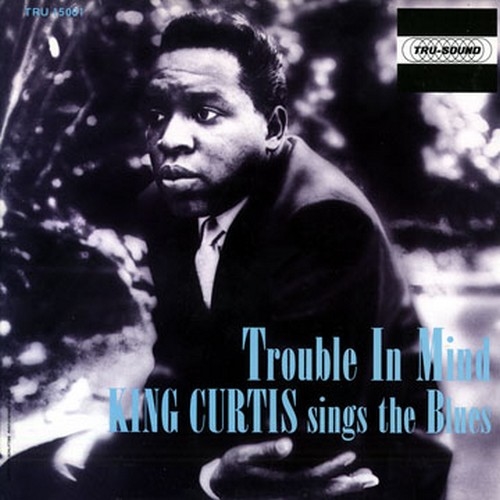
This is an extremely unusual addition to the King Curtis canon, and perhaps not the one you'd reach for first, in that it features Curtis as a singer. There's some saxophone playing, and it's good, but it definitely takes a back seat to the singing.
Which raises an interesting point. Curtis is a wonderful saxophone player, and it's great that he had the opportunity to show what he could do as a jazz musician on a number of recordings, many of them on Prestige. It's great that Prestige the 1950s-60s interregnum opened the door to an expansive definition
of jazz. Their Swingville label reminded people that there were plenty of great musicians around who had been passed over as the winds of innovation kept sweeping jazz forward. Producers led by Esmond Edwards made a particularly wise decision to let these people play creatively, not simply reproducing the sounds of the swing era. And as the soul jazz era began, Prestige had the insight to realize that there had been a previous soul jazz era, the one called rhythm and blues, and to record and release some of the musicians like Willis Jackson who had been overlooked by the jazz public.
In the late 1950s, as my passion for rhythm and blues developed, I bought a lot of records without ever having heard them first. You pretty much had to, if you lived in the country. I'd pick up records by Muddy Waters or Amos Milburn or Roy Brown. I'd pick up records because they were on Aladdin, or Checker. And I picked up a 45 by King Curtis on Atlantic -- "Just Smoochin'" b/w "Birth of the Blues." I think "Birth of the Blues" was the B side, but it was the side I wore out. I bought his first jazz album, Soul Meeting, when it came out.
But probably Curtis's most lasting impression came as the bandleader and saxophone soloist on a number of Atlantic rhythm and blues records. You listened to a record like "Saved" by LaVern Baker, you looked forward to every new release by the Coasters, partly for the outstanding vocal performances, partly for the innovative songwriting by Jerry Leiber and Mike Stoller, but also--and this was very much a part of it--because you knew there was going to be a killer solo by King Curtis.
So why isn't this the same? A vocal recording with some hot instrumentals? Well, on the Atlantic recordings, the saxophone solos were always a highlight of the record -- you knew they were coming you waited for them, and they never disappointed. They had their own identity, a song within a song.
There's nothing like that here, and though Curtis is a good singer, his vocals don't strike to the gut the way his sax solos do.
But once you accept that, and listen to the album again, there's a lot to like.
For one thing, there's a fine eclecticism to Curtis's blues choices. "Nobody Wants You When You're Down and Out" is a depression-era classic, but actually it may have been prescient. Written in 1927, it preceded the stock market crash by two years. Bessie Smith's 1929 version captured the mood of the country, but, improbably, no one else touched until the 1950s, when it became a late-blooming standard. "Ain't Nobody's Business" is even older, dating back to 1922, and it's always been a standard for blues and torch vocalists, even though modern mores would disagree with Bessie Smith's and Billie Holiday's assertion that spousal abuse is nobody's business. "Trouble in Mind" also dates back to the 1920s, and is credited to composer Richard M. Jones, but its folk roots go back much farther. It is even more ubiquitous than "Ain't Nobody's Business."
"Bad, Bad Whiskey" was a 1950 hit for Amos Milburn, and Curtis was actually the first to cover it.
"Deep Fry" and "Jivin' Time" are the album's two instrumentals, and they were recorded at the end if the day. "Deep Fry" has the tenor sax spotlight. It's eight minutes long, with solo space for all the principals, and it does leave you wishing there were more tracks like it, but this is far from Curtis's only album, and he has a right to try something different. There's some nice tenor on "Jivin' Time" too, but even more nice work by the guitars. In general, Curtis leaves most of the instrumental turns to his bandmates, and they come through. Curtis does some guitar work, but mostly it's Al Casey, formerly with Fats Waller, is his regular guitarist, but on this session he's joined by Hugh McCracken, for contractual reasons using the pseudonym of Mac Pierce for this session, although it's hard to say why, because McCracken worked with pretty nearly everyone on every label. More likely, because this is a youthful McCracken at the outset of his career, it has to do with union status.
Trouble in Mind, recorded when he was 19, was one of his first gigs. He had dropped out of school at age 16 to make music and help support his family, His mother was working as a hat check girl in a New Jersey club where Curtis had an engagement. She convinced him to listen to her son, and he hired him for the session.
He once did sessions for Aretha Franklin and Paul McCartney in different studios for different labels on the same day, and he was McCartney's first choice as guitarist for Wings, but he elected to stay home with his young children and keep doing studio work. He had an approach to studio sessions that I suspect might not go over so well today, According to his obituary in the New York Times,
He would improvise his part once he apprehended the drift of a producer’s intention, his wife said. He arrived early the day Roberta Flack was recording “Killing Me Softly With His Song” and began fooling around on his classical guitar as he waited for the session to begin. Joel Dorn, the producer, asked him to play his riff again, and it became the song’s introduction.
Jimmy Lewis is a powerful presence on the electric bass throughout the session, and it was a relatively new instrument for him, He had played a standup bass with both Count Basie and Duke Ellington, among others, but switched to the electric bass when he joined Curtis. He would go on to make a record with a group that no one would expect to use an electric bass--the Modern Jazz Quartet. It was for a 1965 album, Jazz Dialogue, which featured the MJQ with a big band.
The King Curtis combo was pianist Paul Griffin's first major engagement, but hardly his last. He's probably best remembered for his work with Bob Dylan on Highway 61 Revisited, Blonde on Blonde, and Aja; he also played piano on Don McLean's mega-hit, American Pie.
Belton Evans played with almost everyone in the blues and traditional jazz field, and with almost as many different first names, although he always stuck with Evans.
"But That's All Right" has backing vocals by the Cookies. The Cookies had a substantial career as a backup group, and had a couple of hits in their own right ("Don't Say Nothin' Bad About My Baby"). At this time, their most important credit had been as Ray Charles's backup singers, and Charles's own group, the Raelettes, was formed around Margie Hendricks, an original Cookie. They give "But That's All Right" a real Ray Charles sound.
Trouble in Mind was released on Tru-Sound, a short-lived Prestige subsidiary. Tru-Sound had two different catalogs. One was all gospel, and the other was more varied, but albums by King Curtis made up the lion's share of their list. Two 45s came from the session, both released on Tru-Sound: "Trouble in Mind" b/w "But That's All Right" and "I Have to Worry" b/w "Jivin' Time."
Al Casey's second album for the Prestige family of labels has hum shifted from Swingville to Moodsville, but he's playing the same smart, snappy swing that he learned as a teenager in Fats Waller's band, and brought up to date in a regular gig with King Curtis that began in 1957.
Necessarily in the shadow of the flamboyant Waller, Casey stepped out on his own after the Fat Man's death in 1943, switching from acoustic to electric guitar, playing with Louis Armstrong, and winning the Esquire Magazine jazz critics poll for best traditional guitarist in both 1944 and 1945. He
remained in demand, playing with a wide variety of jazz greats who were looking for a traditional guitar sound (and some who weren't--he played with Charlie Parker). He made his debut for Prestige in 1950 in a group led by Eddie "Lockjaw" Davis, and his debut as leader ten years later.
The rest of the quartet is Belton Evans, who was playing a lot of drums for Prestige's blues and swing sessions in those days; and Jimmy Lewis, who would go on to make a name for himself in soul music. Both of them had played on his first Prestige album, and knew him from the King Curtis days. It's possible that Lee Anderson is from the same pool, but there's little to be discovered about him.
The Los Angeles Times obituary for Casey says that his job with the Fats Waller band was to "keep
the band tight during Waller’s fun yelps and scats," and it's training he didn't lose when allowed to stretch out and take center stage as leader. On this session, comprising standards and one short blues number by Jimmy Lewis, he steps out and plays inventively in a style of his own, but still runs a tight ship.
The album was simply called Al Casey Quartet. It came out on Moodsville, and strangely has never been rereleased on CD as part of Concord's Original Jazz Classics.
This is Al Casey's first recording as a leader, but a long way from being his first rodeo. He started his career working with Fats Waller in 1933.
It was also a long way from being his last rodeo. In 1981 he would embark on what may have been his biggest success when he joined the Harlem Blues and Jazz Band. This was the opposite end of the spectrum from Puerto Rican boy band Menudo, whose members had to retire when they reached 16. To join the Harlem Blues and Jazz Band, you had to be at least 80. Founded in t973, it is still going--needless to say, with none of its original members. At various times, it has been graced with the presence of Doc
Cheatham, Eddie Durham, Eddie Chamblee, Peck Morrison, Jay McShann, Claude Hopkins, Cozy Cole, and many other working jazzmen and women who'd lived long enough and could still play strong enough.
Casey, in 1960, had a regular gig with King Curtis. For this session, he drew on the Curtis band for sidemen, but went back to his Fats Waller days for musical inspiration, and even for musical talent, with reed man Rudy Powell.
When Casey joined the Waller band as a wet-behind-the-ears 18-year-old, Powell was 26 and a veteran of a number of regional bands including Rex Stewart's. He would hook up with Waller and Casey in 1935. He was still in demand in the 1960s, working with Jimmy Rushing, Buddy Tate and Ray Charles. He would eventually join the Duke Ellington Orchestra.
Belton Evans was no newcomer to recording, but he may have been new to recording under the name of Belton. Previously, he had recorded as Sammy "Sticks" Evans, and every possible variation of that name: Sammy Evans, Sammie Evans, Sticks Evans, Stick Evans. So it seems that he finally decided to settle in, and use his real name?
Not exactly. Samuel Evans does appear to have been his real name; Lord knows where he came up with Belton. And his range as a drummer was as varied as his choice in names, from King Curtis and Wynonie Harris through LaVern Baker and Aretha Franklin through John Lewis, Bill Evans, Eric Dolphy and Ornette Coleman.
Jimmy Lewis was a guy who knew how to change with the times, moving from double bass with Count Basie to electric bass as that instrument became popular. Like Evans, he was on call for a wide range of recording sessions, from Wilson Pickett to the Modern Jazz
Quartet (he didn't replace Percy Heath, but added an electric bass to a session that featured the MJQ with a big band). He was a first call for gigs, too, as evidenced by some of the live albums he can be heard on: Sam Cooke Live at the Harlem Square Club, Alberta Hunter's Downhearted Blues: Live at the Cookery, and some live recordings of Otis Redding at the Apollo. This was his first Prestige session, but he would become a familiar face during the 1960s.
Herman Foster is mostly known for his work with Lou Donaldson, but he was with Casey in King Curtis ensemble at the time of this recording.
The music is just flat-out rewarding. It's always great to hear the Fats Waller classics, and of pariculat interest is "Buck Jumpin'," a tune originally written by Casey for the Fats Waller Orchestra, and here revived by the composer..
Buck Jumpin', appropriately, is the title of the album, and it was a Swingville release.
(Going back, from time to time, and finding sessions I had not been able to listen to before.)
If there's a missing link, this is it. This is bebop, and this is rhythm and blues, with Eddie "Lockjaw" Davis, a cat who could play both, and who didn't appear to see the need to make any distinction between the two. And I'm not sure anyone else much cared about the distinction, either. Bob Weinstock did make a few half-hearted attempts to establish a rhythm and blues label (half-hearted in the marketing: there was never anything half-hearted about the music). The thing was, in the 40s, everyone who played an instrument was influenced by Charlie Parker. You couldn't not be. He had changed music. And everyone who played the tenor sax was influenced by Lester Young. If you put a little more honk in the tenor and little more back in the beat, you called it rhythm and blues, and people got up to dance to it. If you took your solos a little farther off the beaten track, if as an improvisational soloist you were more than halfway to being a composer, you called it bebop and people sat and listened to it. Or maybe you didn't call it anything. You just showed up and played it, because it was your vocation and your life.
It was the intersection of some different musical lives on this session. Eddie "Lockjaw" Davis was 28 years old when he made these records. He had come to bebop as musicians of his generation did, through swing as it was played by African American bands on the chitlin circuit, the touring bands booked by TOBA, the Theater Owners' Booking Association, better known as Tough On Black Asses, best remembered by performers as low wages and flea-ridden dressing rooms, by lovers of American music as the breeding ground for some of the best. He'd played with Cootie Williams, Lucky Millinder, Andy Kirk. He would go on, in the 50s, to stints in both Louis Armstrong's and Count Basie's bands. But the first group he put together under his own name, in 1946, had a strong bebop tilt, with Fats Navarro, Gene Ramey, Al Haig and Denzil Best.
This 1950 group cut two sides with rhythm and blues shouter "Chicago" Carl Davis, not to be confused with another Chicagoan named Carl Davis, who became one of the great producers of the soul era. Davis was a rough, forceful singer, and on "If the Motif is Right" he starts out with a mock gospel sermon on which he sounds like a cross between Screamin' Jay Hawkins and Lord Buckley.
But this group wasn't just gotten together to back up a singer. The two instrumental tracks are the strongest, with Lockjaw bringing his honker and bopper sides together, with a remarkable ensemble behind him. Covering a lot of jazz history.
Representing the future, 19-year-old Wynton Kelly. I'd wondered if this was Kelly's first session, but in fact he had recorded at 16, with tenor sax star Hal Singer, on Singer's chart-topping "Cornbread." So these were his formative years, the years of small-group jazz developing from the influences of Charlie Parker and Lester Young, branching into rhythm and blues and bebop, but cross-pollinating, with the mongrel strength and innovation and intensity that makes American music what it is.
Representing a previous generation, Al Casey. 35 years old when this record was made, he had started as young as Wynton Kelly, but his beginnings were with Fats Waller, and this session was a rare foray into bebop for him. He accompanied Billie Holiday and Chuck Berry, and played into his 80s with the Harlem Blues and Jazz Band.
Drummer Lee Abrams was either 25 or 30 when he made this date, depending on which birth certificate you believe, so he fit somewhere along this timeline, and he made a lot of gigs, including some important ones later on with Wynton Kelly, after he had graduated -- and this came pretty quickly -- to leading his own groups.
These were released on 78 on the short-lived Birdland label -- the collaboration between Bob Weinstock and Mo Levy -- with the two vocals on one disc, the two instrumentals on the other. The instrumental cuts were also released, under their alternate titles, on a Prestige 78.


:format(jpeg):mode_rgb():quality(90)/discogs-images/R-4219801-1482257390-1358.jpeg.jpg)




:format(jpeg):mode_rgb():quality(40)/discogs-images/R-10097907-1491571013-3320.jpeg.jpg)


