Showing posts with label Bobby Timmons. Show all posts

Thursday, March 14, 2024

Listening to Prestige 717: Bobby Timmons


LISTEN TO ONE: Chicken & Dumplin's


Bobby Timmons is remembered largely for two things: a handful of compositions, most notably "Moanin'" and "Dat Dere," which rank among the most tuneful and popular numbers in the jazz canon; and a life sadly lost to drugs and alcohol. By the mid-1960s, things weren't good for him. His Wikipedia bio states that "Timmons' career declined quickly in the 1960s, in part because of drug abuse and alcoholism, and partly as a result of being typecast as a composer and player of seemingly simple pieces of music." The same bio notes that Timmons's live performances at this time were cited by reviewers as being undermined by his hiring of sidemen of inferior quality.


None of this seemed to affect his marketability as a jazz recording artist. His Prestige years were 1964-66, during which time he recorded seven albums (this was his fifth). But the writing was already on the wall. After leaving Prestige, there were two more albums for Milestone, and that was it. His last recording was 1968; he died in 1974.

The sidemen he's working with on this recording are not the musicians he played his club dates with, the ones who were found wanting by reviewers, and although they may not have been Prestige's A-list of supporting players, they certainly aren't chopped liver. Drummer Billy Saunders has no other recording credits that I could find. But bassist Mickey Bass had an impressive resume of gigs (Sonny Rollins, Charles Mingus, Chico Freeman, John Hicks) and his recording dates,which would mostly come in the 1970s, included Art Blakey, Philly Joe Jones, Curtis Fuller, and Hank Mobley. He also spent many years as an educator, numbering trumpeter Wallace Roney among his students. Both of them contribute on this album, giving Timmons the support he needs. 

Tinmons calls on another composer to lead off this album--Ray Bryant, best known for "Cubano Chant," "Little Susie," and his big 1960 hit, "Madison Time." Bryant's "Chicken & Dumplin's" had first been recorded by Art Blakey in 1959, when Timmons was in the group, with boppish solos by Lee Morgan and Hank Mobley, and an excellent one by Timmons. 
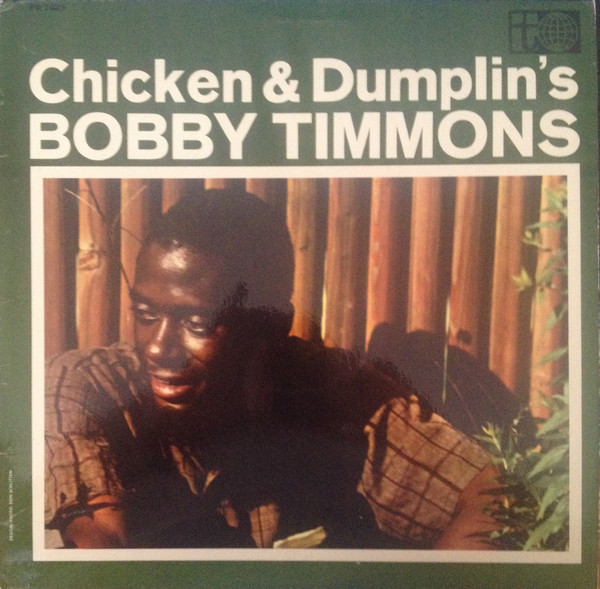

"Chicken & Dumplin's" is certainly a soul food/soul jazz title, in a tradition going back to early rhythm and blues hits like Hal Singer's "Cornbread" and Frank "Floorshow" Culley's "Cole Slaw," and continuing through the kitchen classics of Eddie "Lockjaw" Davis and Shirley Scott on Prestige. Timmons gives it the full soul jazz treatment here, eschewing his own melodic improvisations and those of Mobley and Morgan, in favor of a solid groove. 

In his own composition, "The Return of Genghis Khan," Tinmons appears to be setting out to prove that he was more than just simple melodies and basic soul jazz improvisation, and to these ears he succeeds. This is a nervous and nervy album, worth listening to.

Cal Lampley produced, and Chicken & Dumplin's was the name of the album. The title cut b/w "The Telephone Song" was the 45 RPM release.

Wednesday, October 18, 2023

Listening to Prestige 704: Bobby Timmons and Don Patterson


LISTEN TO ONE: White Christmas

LISTEN TO ONE: Rudolph the Red Nosed Reindeer


 A Christmas album! From Prestige!

Yes, it's true.

It's more than true. There are two of them. Bobby Timmons, and then Don Patterson, leading their respective trios through a more or less conventional mix of traditional carols and Christmas pop songs. Fortunately, it was 1964, so most of the really awful Christmas pop songs hadn't been written yet, and Bobby and producer Ozzie Cadena know enough to stay away from "Rudolph the Red Nosed Reindeer," "Jingle Bell Rock" and "Rockin' around the Christmas Tree," at least with Timmons. By the time Ozzie got to Patterson, on the next day, he did let "Rudolph" slip in. Both Timmons and Patterson do, however, essay "Santa Claus is Coming to Town."

There are two reasons for buying an album of Christmas songs. One, there's a choir singing the songs so you can sing along with them, a beat behind if you don't remember


the words. Two, they're all or mostly instrumental, so you can have them as background music while you're trimming the tree, wrapping presents, or trying to seduce the receptionist from the accounting department, If you're Mantovani or the Melachrino Strings, you're playing the melody pretty straight through, so that people can sing along. If you're a jazz group, you're going to be improvising, but staying close enough to the melody that people remember what it is that you're playing.

There's probably a third. You hate Christmas music, and would rather just be listening to some good jazz, but your spouse, or your boss, or somebody, insists that you pick up a Christmas album to play at the office party or the tree trimming gathering, so you get something that says "Holiday Soul" on the cover, put it on, dig it quietly until the boss says "What is this shit?" and then you show him the album cover -- "See? It says 'Holiday Soul'!" and then, if you're lucky, Bobby Timmons comes in with the melody to "Deck the Halls," and plays it pretty close to recognizably straight for the last thirty seconds of the cut. This is, of course, if you're at an office party in 1964. Today's young whippersnapper boss probably won't recognize the melody to  "Deck the Halls," and will want to know why Timmons isn't playing "Grandma Got Run Over by a Reindeer." Or "White Christmas." Oh, that was "White Christmas"? Where was the melody?

It's not quite that extreme. Well, it is for "White Christmas." For the most part, both Timmons and Patterson do at least allude to the melodies of their Christmas standards, but each allows himself plenty of room to just stretch out and play jazz, and that is something each of them does very satisfactorily.

Well, probably "Rudolph, the Red Nosed Reindeer" was a mistake if you're looking for holiday soul.


Timmons finds considerably more soul in the 16th century Welsh melody of "Deck the Halls" than Patterson does in Johnny Marks's ditty, composed during the bebop era, recorded around the time that Bob Weinstock was lining up Lennie Tristano for Prestige Records' inaugural recording session. Gene Autry didn't want to record "Rudolph," and there's a good chance Don Patterson wasn't a lot more thrilled. 

Still...hey, it's Christmas. And with some good jazz, you can make it through the season. Ozzie Cadena produced both sessions.


Friday, August 18, 2023

Listening to Prestige 700: Bobby Timmons with Johnny Lytle


LISTEN TO ONE: Lela

 Another milestone -- the 700th Listening to Prestige column. And a musician who was widely enough recorded on some significant labels during the 1960s (Jazzland, Riverside, Pacific Jazz), almost always as a leader, who was described by Lionel Hampton, according to his Wikipedia bio, as "the greatest vibes player in the world, and whom I'm sad to say I had never heard of before listening to this album and writing this blog entry.

Lytle's Wikipedia entry uses much of the same material as his AllMusic entry, whtch was written by Craig Lytle, presumably his son, and both are a little overenthusiastic in describing his career. The compositions which are called "jazz standards" in the Wiki entry don't seem to have been recorded by much of anyone else, accordeing to Second Hand


Songs. and "Selim." which Miles Davis did record, is credited by SHS to another composer. And this album, originally titled Bobby Timmons and Johnny Lytle -- Workin' Out! became, in a 1994 (the year before Lytle died) Bobby Timmons -- Workin' Out!

A quite lovely tribute to Lytle was written by local reporter Andrew McGinn in Lytle's home town newspaper, the Sprngield (OH) News-Sun. It came out in 2009, 14 years after Lytle's death. and offers some sobering insights into how the career of a fine musician can get lost.

The article begins with a story about Lytle arriving home in Springfield from playing a gig at Redd Foxx's Los Angeles  nightclub with his paymenr for the gig -- five of Foxx's suits.

That was a pretty good example of Lytle's business acumen, 

His wife, Barbara, according to McGinn, 

was OK with that.

She worked as a secretary at Wright-Patterson Air Force Base for 36 years so “Dilly” could do what he loved — recording in New York, touring Europe and playing just about anywhere with a stage or enough open floor space for his vibes and a good organ.

“He would play because he just loved playing,” Barbara Lytle said. “We weren’t rich, but we weren’t poor, either. I was happy with it.”

But almost 14 years after Lytle died suddenly — and, dare it be said, poetically, just weeks after a hard-fought solo appearance with his hometown symphony orchestra — his family has been left with really nothing more than a city street named in his honor.

And the house that they lived in on Johnny Lytle Avenue was sold in 2006 because Barbara could no longer get up and down the stairs;

 “My husband never had anything in writing,” Barbara Lytle said. “He wasn’t a man who took care of his business. If you’d tell him he had to cut a record, he’d be there. But he wasn’t a man of business, and that’s what hurt him.

“He would play because he just loved playing. We weren’t rich, but we weren’t poor, either. I was happy with it.” 

Lytle's best-selling album was The Village Caller (like so many jazzmen of that era, he never ssw a royalty check), and the title song from that album his most popular single. Second Hand Songs lists no other recordings of it, but they could be wrong.. It could be that no one just kept track of it.. 

Someone at BMI, which licenses music for broadcast, once told the family they’d need to hire a music attorney to sniff out album royalties, [daughter] Michelle Hagans said.

“Mom should be entitled to that,” she said.

But the actual hiring of an attorney is the problem.

“It costs $2,000 just to talk to him,” Barbara Lytle said.

A call to the Concord Music Group — parent company of Lytle’s Milestone, Riverside and Jazzland labels — seeking comment about royalties wasn’t returned.

Reading stories like this always makes me cry. Musicians like Johnny Lytle ought to be remembered,


and they ought to get paid in something more than suits -- although, according to Barbara, she was surpried to find that Redd's suits fit her husband so well.

So let's talk about the music Johnny Lytle made with Bobby Timmons, who did get at least some royalties from "Moanin'" and "Dat Dere." It's rapid-fire. it's soulful, it features two guys who could get on the same wavelength. Timmons wasn't always the most adventurous of piano players, but with Lytle pushing him, he's in top form.

Keter Betts had worked one other Prestige session with Timmons. He was shortly after this to embark on the most prestigious segment of his career, a long association with Ella Fitzgerald. William Hinnant made a number of recordings with Lytle, but seems to have no otjer recording credits.

The session begins with a snappy and soulful Lytle original, "Lela," followed by a Timmons original, "Trick Hips," and three standards (Lytle doesn't play on "People." Ozzie Cadena produced.

Johnny Lytle went out with a concert he had always wanted to play--as a guest artist with the Springfield Symphony Orchestra. He was in the advanced stages of liver cancer, but he played for two hours, his daughter remembers, and signed autographs for two more. He would be dead less than a month later.


Saturday, June 10, 2023

Listening to Prestige 692: Bobby Timmons


LISTEN TO ONE: Gettin' it Togetha'

 This is Bobby Timnons's third album for Prestige, with as many rhythm sections, a trend whichy was to continue throughout his tenure with the label -- and beyond, for that matter. This time around, it's Keter Betts and the artist known here as Al Heath, but surely better known by the nickname that followed him through his life -- Tootie.

Betts was, in mid-1964, best known for his work with Charlie Byrd, the Washington, DC-based guitarist who introduced the bossa nova to north-of-the-border audiences in a collaboration with Stan Getz, Jazz Samba, two years before Getz/Gilberto made a major jazz star out of housewife Astrud Gilberto, whose recent passing was much mourned. Betts was the bass player on Jazz Samba, but his work with Byrd would be eclipsed in 1964


by the start of a long association with a major jazz luminary, and I don't mean Bobby Timmons (although he would make one more album with Timmons). He was hired by Ella Fitzgerald, and remained with her, with some side trips for other gigs, until her retirement in 1993.

Albert "Tootie" Heath had done two earlier sessions with Prestige. The first, with John Coltrane in 1957, is a session of historical importance because it marked the beginning of Trane's career as an independent artist. He had been fired by Miles Davis earlier in the year, along with other members of the quintet, for heroin abuse. He had gone back to Philadelphia, pulled his life together, and returned to New York to make this album.

It was Heath's only collaboration with Coltrane, but Mal Waldron, who had played piano on the same date, called him back to Englewood Cliffs for a trio session. And over a long and storied career, he played with pretty much everyone, including his brothers.

Timmons, with the huge success of "Moanin'" and "Dat Dere," had developed a considerable following, as "soul jazz pianist," and even more as "soul jazz composer." It was a mixed blessing, as success often is. 

Certainly the success was real. "Moanin'" is, according to secondhandsongs.com, the 11th-most covered song of 1958, with 199 versions to date. That places it behind such memorable songs as "Desafinado" (number one, with 416 covers), "Rockin' Around the Christmas Tree," "Volare," and Johnny B. Goode--and ahead of "Summertime Blues," "Peter Gunn" and "The Chipmunk Song." "Dat Dere" has been recorded 109 times. Each of these songs was helped by lyrics written by two of the most talented jazz-inspired lyricists. Jon Hendricks for "Moanin'" and Oscar Brown Jr. for "Dat Dere," but the lyrics would be nothing without the melodies, and in fact both songs have been even more widely covered in their instrumental forms.


It can be tough to be pigeonholed, and some blame it for Timmons's heroin addiction and early death, but addiction has complex causes. In any case, Timmons set out prove he was more than just a writer and performer of simple, catchy tunes, and if he would ultimately be remembered as the guy who wrote "Moanin'," he left a recorded legacy much more varied, and very much worth listening to. This session was made up of two originals, two Brazilian bossa novas, and two standards.

The session begins with a song written by Betts and Charlie Byrd, "Chun King," which Byrd would also record a couple of times. It's an interesting choice. The jazz samba sound of Charlie Byrd, of Stan Getz and Joao Gilberto, is a whispery gossamer, not something you'd associate with the hard-driving block chords and gutbucket blues approach of soul jazz disciple Bobby Timmons. And indeed, Timmons doesn't neglect his funky roots--but at the same time, he respects the delicacy of the composition. And this is even more true with the second bossa nova, one of Antonio Carlos Jobim's best-known compositions, and probably second only to "The Girl from Ipanema" on the Getz/Gilberto album, "O Grande Amor" (culturally transmogrified into "O Grand Amour" for the Prestige album). Timmons does a sensitive take on it, block chords mostly left behind, to a propulsive beat by "Tootie" Heath. When Timmons does let go and make the improvisation his own, it still feels in keeping with the spirit of the piece.

He also does two ballads from the Great American Songbook, "I Could Have Danced All Night" and "Someone to Watch Over Me." These are clearly chosen because Timmons loves the melodies, and you can feel that love from all three musicians. At the same time, they're uniquely Timmons -- you can't imagine Red Garland taking this approach to standards.

And there are two Timmons originals, and why not? He was one of the significant composers of his age, and wanting to branch out did not mean completely rejecting soul jazz. Certainly, if you title a piece "Gettin' it Togetha'," that should be a clue that you're not turning your back on soul jazz. And if "Gettin' it Togetha'" did not become the standard that "Moanin'," "Dis Here" and "Dat Dere" did, it's still a solid effort, right in the Timmons wheelhouse. And if "Walking Death" isn't quite as catchy, it's still a good tune.

Chun King is an excellent showcase of Timmons's range and talent for the album buyer, but Prestige knew where his appeal to the jukebox crowd lay. The first 45 RPM single from the session had "Chun King" on the A side, because bossa nova was still riding high, with Prestige hedging its bet by backing it with a soul number, "A Little Barefoot Soul" on the flip side. The followup single was all soul jazz--  "Gettin' It Togetha' / Walkin', Wadin', Sittin', Ridin'."

Ozzie Cadena produced.  


Friday, August 12, 2022

Listening to Prestige 635: Bobby Timmons


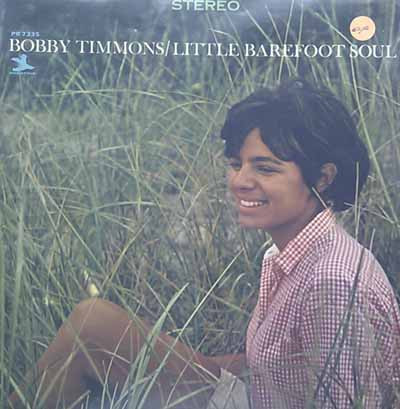
LISTEN TO ONE: A Little Barefoot Soul

In my mind, Bobby Timmons was Blue Note. But the mind can play tricks. Timmons did record extensively on Blue Note, as a member of Art Blakey's Jazz Messengers, and before that, with Kenny Dorham's Jazz Prophets, and with Lee Morgan. But to my surprise, He never recorded as a leader with Blue Note. His first record as a co-leader (with Clifford Jordan and John Jenkins) was on New Jazz. Then, starting in 1960, he recorded a series of albums for Riverside, while continuing to play and record with Blakey through 1961. This session marked his return to Prestige, the first of seven albums he would make for the label over the next two years.


Timmons has been something of a controversial figure in jazz criticism, with "underrated" being a term applied to him with surprising regularity, while other critics have suggested there wasn't much to him below the surface--that he was basically just a guy who wrote simple tunes, a few of which have clicked to become hits and jazz standards. 

His recording career is curious also. Between 1958 and 1961, from his first emergence on the New York Scene through his associations with Art Blakey and Cannonball Adderley, he was much in demand, playing on sessions with Pepper Adams, Chet Baker, Kenny Burrell, Arnett Cobb, Kenny Dorham, Art Farmer, Benny Golson, Dexter Gordon, Lee Morgan and others. Then nothing. He continued to tour with a trio and to make records under his own name through the 1960s. Perhaps it was his heroin addiction that made him too unreliable as a sideman. His substance abuse problem was a serious one, and it led him to an early grave.

But soul jazz was marketable, and Timmons was a marketable name. "Moanin'" and "Dat Dere" had become hugely popular jazz tunes, the more so because they had had lyrics attached to them by two masters, Jon Hendricks and Oscar Brown Jr., respectively. 

Certainly his labels weren't shy about pushing the soul connection. Riverside, for whom he recorded from 1960-64, gave his albums titles like This Here is Bobby Timmons (included "Moanin'," "Dis Here" and "Dat Dere"), Soul Time, Sweet and Soulful Sounds. His debut album for Prestige was, if anything, even less subtle...Little Barefoot Soul,

There is nothing on the album anywhere near as catchy as Timmons's big three, for all the catchy titles. So this may not be the place to look for Timmons, the simple soul tunesmith. 

But it might be a good place to start considering Timmons, the underrated jazz pianist. Rather than depend on the restatement of catchy riffs, he engages here in thoughtful and often daring improvisation. He's accompanied on drums by King Curtis sideman Ray Lucas, who keeps him honest, and Sam Jones, who spurs his creativity. He would work with a variety of sidemen in his two years with Prestige, probably a result of his drug-fueled unreliability, but this is an excellent pair.


The producer credit for the session is a little ambiguous: longtime Prestige producer Ozzie Cadena is credited with "supervision," producer is listed as Joel Dorn, who also wrote the liner notes. 

Dorn was an interesting guy. He knew from age 14 that he had one ambition in life--to produce records for Atlantic, and at that young age he started writing to Nesuhi Ertegun, making his case. Ertegun finally relented, telling him he could produce one album by an artist of his choice. He chose Hubert Laws, and it was the beginning of a fabulously successful career, which included discovering the Allman Brothers and the Neville Brothers, and winning a Grammy for his production of Roberta Flack's "Killing Me Softly with His Song."

He recorded Laws for Atlantic in April of 1964, the fulfillment of his lifetime ambition at age 22, so one has to wonder what he was doing in Englewood Cliffs in June of that year, working with a new Prestige artist. Perhaps Ertegun was waiting to see how The Laws of Jazz did before making a commitment. And maybe the problems Dorn enumerates in his somewhat defensive liner notes for the album might not have arisen had his head not been too swiveled toward the orange, black and green of Atlantic. The album, Dorn reports,

was supposed to have been a quintet date. But when Bobby arrived at the studio only one musician, Sam Jones, was on hand. Then came the inevitable phone calls with excuses from the sidemen for not showing up...So with practically two hours of recording time eaten away...it seemed the session would have to be cancelled. Fortunately, someone remembered that Ray Lucas was in town...and within half an hour had his drums set up and ready to record.

Dorn also refers, while declining to get into specifics, to "an air of antagonism...between the artist, the A&R man, and the engineer." It's not clear whether he's referring to himself or Cadena, but in any event, he was off to the Atlantic recording studios and Tom Dowd after this, while Timmons continued working with Cadena, Van Gelder, and a different crop of musicians. And after  two tunes that had to be thrown out because Lucas had trouble finding a groove with two musicians he'd never met before, everything clicked with "A Little Barefoot Soul" (the first word was dropped for the album title), and from there on things went smoothly. Perhaps the unexpected loss of two front men forced Timmons to improvise more than he had intended to, and the results are salutary.

The title track, with "Walkin', Wadin', Sittin', Ridin'" on the flip side, was released as a 45 RPM single.

Sunday, July 22, 2018

Listening to Prestige 341: Arnett Cobb

Two days in the studio with Arnett Cobb and a quintet, rhythm section augmented by congas, but with a different piano player and a different conguero each day, continuing the pattern he had established on his previous Party Time session for Prestige, with Ray Bryant and Ray Barretto.

The piano guys were two more of the best young players on the scene, 30-year-old Tommy Flanagan and 25-year-old Bobby Timmons. Flanagan had made his Prestige debut in 1956, newly arrived from Detroit, on an abbreviated Miles Davis session.
He would shortly thereafter be tabbed for one of the decade's most important albums, Sonny Rollins' Saxophone Colossus, and would make his debut as leader the following year with a trio: Overseas, recorded in Sweden. By the time of this recording, he was a solid regular with the label, with 15 recording dates as leader or sideman.

Flanagan's versatility could be amply illustrated right at this moment in time: just two weeks before he went to Englewood Cliffs to record with one of the veteran masters of good-time, mainstream jazz, he had seen the release of a session with young players who would be standing jazz on its year: John Coltrane's Giant Steps.

Bobby Timmons had recorded once previously for Prestige, with Clifford Jordan and John Jenkins, but he was best known for his work with Blue Note, particularly with Art Blakey's Jazz Messengers.

Danny Barrajanos took the conga chair for the first day. He was primarily known for his work with Harry Belafonte and Miriam Makeba. Buck Clarke, who came in for the second day, was more of a jazz figure, with credits that would include Freddie Hubbard, Herbie Hancock and Les McCann.

Latin percussion was still a somewhat outside-the-box idea for a modern jazz album, and one might think of Cobb as an inside-the-box kinda guy, but boy, does he know how to make it swing! Listen to the work they do on "Blue Lou," composed by Edgar Sampson, one of the few composer/arranger/ musicians of his era to move back and forth between mainstream and Latin jazz. He played with Duke Ellington, Rex Stewart, Fletcher Henderson and Chick Webb (for whom he composed "Stompin' at the Savoy" and "Don't Be That Way"); and worked as an arranger for Marcelino Guerra, Tito
Rodgriguez and Tito Puente. And raised a musical family--his daughter Grace co-wrote "Mambo Inn" with Mario Bauzá. "Blue Lou" is a killer, with Barrajanos pushing the beat throughout, getting some wild and crazy sax playing of Cobb and smoking solos from Flanagan, Taylor and himself.

"Blue Lou" was followed on the session by a Cobb original called "Blue Me." One can't help but wonder if the original title had been a mite dirtier.

The second day found the musicians in a mellower mood, but Buck Clarke shows how much a conguero can contribute there, too. Listen to "The Nitty Gritty," a Cobb original. It's interesting that Cobb didn't use any Bobby Timmons originals, as hot a composer as he was then. But Timmons adds his soul jazz piano to Cobb's already soulful playing, and his Illinois Jacquet-style honking.

The sessions became a little mixed on record. "Down by the Riverside" is Timmons and Clarke, but it Arnett Cobb--More Party Time, which otherwise comprised tunes from the first day. The traditional spiritual joined Stephen Foster's "Swanee River" as tunes you wouldn't necessarily bring to a modern party. "Fast Ride" was slipped back to Movin' Right Along to complete the trade. Both albums were released before 1960 was out.
was included on

"Lover Come Back to Me," from the Flanagan/Barrajanos session, was a two-sided 45 RPM single release. The Sigmund Romberg melody is from New Moon, the last operetta to be produced on Broadway. One tends to think of operetta as a form more likely to produce cornball chestnuts like "Stout Hearted Men," which is also from New Moon, but "Lover Come Back to Me" has proved a most satisfying challenge to many a modern jazz musician. So has another aria from New Moon, "Softly, as in a Morning Sunrise," which Cobb recorded on the second day.

"Ghost of a Chance" was the single from the second session to be released on 45 RPM, as the flip side of "Smooth Sailing," from Cobb's first Prestige album.

Esmond Edwards produced both sessions.


VERY CLOSE TO BEING READY TO TAKE ORDERS FOR LISTENING TO PRESTIGE VOL 3!

Monday, February 27, 2017

Listening to Prestige 247: John Jenkins - Clifford Jordan - Bobby Timmons

John Jenkins, Clifford Jordan and Bobby Timmons were all young in 1957; they were barely out of short pants when Dizzy Gillespie and Charlie Parker first hit 52nd Street. Jordan and Jenkins, both 26, were newly arrived in New York from Chicago, where they had been classmates at DuSable High, and part of the Windy City jazz scene with Ira Sulivan, Johnny Griffin and others. Timmons, four years younger, had been the first one to arrive in New York, in 1954. He had played gigs with Kenny Dorham and Chet Baker among others, but 1957 was his breakout year.

They were heading in very different directions. Timmons would become associated with the soul jazz movement, and write some of its greatest hits, like "Moanin'," "Dis Here" and "Dat Dere." His compositions have become jazz standards, and "Moanin'" is probably still one of the most recognizable tunes in the jazz repertoire. As with "Moody's Mood For Love," its popularity was enhanced when lyrics were set to it (by Jon Hendricks), but the melody was ubiquitous before that.

Timmons was part of Art Blakey's Jazz Messengers when he wrote "Moanin'," and he's probably mostly associated with that group, and its Blue Note recordings, but he would record several albums as a leader for Riverside, and then return to Prestige for several more in the mid-sixties. He would die young, at 34, another victim of heroin.

Jenkins would record only two more albums as a leader, both in 1957, but soon after circumstances in life forced him to the streets, where he would hustle a living as a pedlar and street musician for the next three decades.

Jordan would have a long and distinguished career, known as a musician's musician, not really associated with any one school, playing with funksters (Horace Silver), experimentalists (Eric Dolphy), funky experimentalists (Charles Mingus), touring Africa with Randy Weston. Jordan's style was strongly influenced by Lester Young, at a time when Young's influence was diminishing, but he drew from a multitude of sources, including Nobel Laureate Herman Hesse's novel The Glass Bead Game, and the songs of folk blues artist Lead Belly.

The decades after the Prestige era. the 70s and 80s, saw a different breed of independent label, and Jordan recorded for several of them. Muse was the creation of Prestige alumni Joe Fields and Don Schlitten. Many of the later small indies were formed by musicians. One such was Strata-East (Charles Tolliver and Stanley Cowell), which released a number of Jordan titles. Others like SteepleChase and Soul Note came from the European love for American jazz. Jordan would ultimately make over 40 recordings, and in 1990. he would bring John Jenkins off the streets for a final recording.

Jenkins and Jordan would go out together, dying within a couple of months of each other in 1993, DuSable High School. Their shared background shows in the intuitive closeness they bring to this session, abetted by another DuSable graduate, Wilbur Ware. Dannie Richmond, who had just begun his long association with Charles Mingus, is on drums.
just as they had come in together from Chicago in 1957. Chicago is best known today as the cauldron of the postwar electric blues sound (and both these young horn players played in rhythm and blues bands in their home town), but it has a powerful jazz history too, beginning with the New Orleans diaspora of King Oliver and Louis Armstrong, and their young white acolytes from a local high school. Bix Beiderbecke and Frankie Trumbauer. Later it was to become a hotbed of the avant-garde, with the Association for the Advancement of Creative Musicians and the Art Ensemble of Chicago. But in between, as the bebop revolution inspired musicians throughout the country, it had a music scene to be reckoned with, with many of the young cats (including Jordan) getting their start at

The album was released on New Jazz as Jenkins, Jordan, Timmons.