Showing posts with label Charlie Smith. Show all posts

Friday, June 12, 2015

Listening to Prestige Part 119: Joe Holiday/Billy Taylor

Joe Holiday is one of my new favorite musicians--a guy I had never heard of when I started this project, but who I've grown to love over the four previous sessions he recorded for Prestige, establishing himself as the king of mambo jazz.

That being said, listening to this session on the heels of the Sonny Rollins/Kenny Dorham/Elmo Hope session, Holiday is not in their league as an improviser. Where they were Movin' Out, Holiday is more like Stayin' Home. But I tell you, there's nothing wrong with stayin' home if you can roll back the rug, have a couple of rum and cokes, take a cute girl in your arms and do the mambo all night.

If Holiday's improvisations don't break any new ground, he can surely play the bejeezus out of a
melody, he can swing, he can bring Latin to bebop and vice versa.

Billy Taylor's improvisations are a lot more adventurous, but he and Holiday make a good fit. There are all sorts of different ways of being on the same page musically.

But if I were going to give an MVP for this session, I think it would be Charlie Smith. On the earlier Holiday/Taylor collaboration, they had the benefit of Machito's rhythm section. Here Smith handles it all, on traps and congas, and he keeps it going.

The cuts from this session were released as singles. The mambo was still a hot dance craze in 1954. Apparently, they only came out on 78. Perhaps the market for Latin music was still mostly 78 RPM. In the introductory chapter to Oscar Hijuelos' magnificent novel The Mambo Kings Play Songs of Love, as Cesar Castillo is dying, he stumbles and knocks over a credenza in his apartment, and dozens of 78s fall to the floor and shatter. "I Love You Much" had what seems to be a variously titled song on its flip side. The session list has it as "Chasin' the Bongo," but every 78 RPM catalog I've found lists it as "Chasin' the Boogie." Also, every catalog has an unknown flip side to "It Might As Well Be Spring," but the song was over five minutes long, so it has to have been Part 1 and Part 2. It looks as though no one in recent memory has actually seen a copy of either of these discs. Maybe they were part of Cesar Castillo's record collection.

They were included on the Holiday/Taylor Mambo Jazz 10-inch, then had to wait for years-later reissues.


Monday, June 01, 2015

Listening to Prestige Part 116: Billy Taylor


Billy Taylor meshed well with his longtime trio (there seems to be some disagreement as to whether Charlie Smith or Percy Brice was the drummer, but either knew how to play with Taylor), and knew the material he was working with, so it's not surprising that he was able to get about twice as much recording into a single session as the average leader. He did eight tunes here, three standards, a sem-standard (Gordon Jenkins' "Goodbye'), and four originals, all of which were dedicated to disc jockeys and became the theme music for their shows -- Taylor estimated that by the end of the 1950s, he had written themes for at least 15 DJs. Joseph "Tex" Gathings was on WOOK in Washington, DC--primarily a rhythm and blues station, but Tex was strictly a jazz man, although later, in the early 60s, he hosted an all-black teenage dance party on a Washington TV station. Biddy Wood was DJing a jazz show in Philadelphia when Taylor dedicated this song to him, but he was mostly known as a music promoter in Baltimore, and the husband of jazz singer Damita Jo. Eddie Newman was another Philadelphia DJ who also opened his own jazz club. Jim Mendes was perhaps the first black DJ in the Providence-Hartford area, and also hosted a public affairs show for emigres from his native Cape Verde.

As with most of Taylor's early Prestige sessions,
these are hard to find. Nothing on Spotify. "Goodbye." "Lullabye of Birdland" and "Moonlight in Vermont" are all on YouTube. Each features a lush, measured head embellished with plenty of sustain, then moving into bright and increasingly complex right-hand work on the solos.

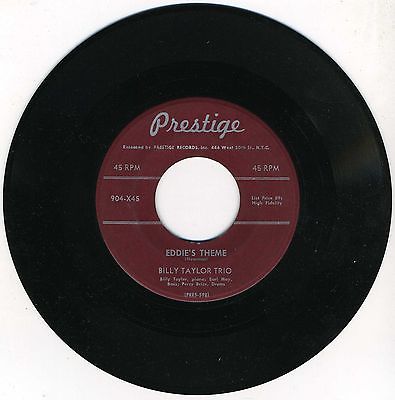
"Eddie's Tune" and "Goodbye" were the only single release, on both 78 and 45.  You'd think they would have released the others, at least regionally, for fans of the DJs. There was a 10-inch LP called Billy Taylor Plays for DJs (the standards were all used as themes by jazz DJs, as well), and the tunes were included on a 12-inch called Cross Section.


Thursday, April 09, 2015

Listening to Prestige Part 98: Joe Holiday - Billy Taylor

Billy Taylor, during this period, was developing quite a reputation for Latin rhythms, so it made sense to put him together with Joe Holiday, the king of mambo jazz. Taylor brings with him his regular rhythm section of Earl May and Charlie Smith, plus the musicians from Machito's band that he had used on his last session, including Machito himself, this time apparently under his own name.

Taylor was at the beginning of a long and distinguished career, of which Latin jazz was only a small part. Holiday would record very little after this. He would do one more session with Billy Taylor, nearly a year after this one. He made an album for Decca, Holiday for Jazz, in 1957, and played on a couple of tracks for keyboardist Larry Young's debut album on Prestige.

And there were a few singles for Federal, in 1951. Federal was an odd little label. They released some jazz recordings. They had some rhythm and blues classics, including the Midnighters' "Annie" series, and Billy Ward and the Dominoes' "Sixty Minute Man," and James Brown's "Please, Please, Please." They released a number of singles by the Platters, including a mambo and the "Beer Barrel Polka," before finally finding their romantic R&B sound with "Only You," after which the Platters moved on to bigger and better things. Federal was owned by Syd Nathan, out of Cincinnati, as a subsidiary to his King label. So it's no surprise that in 1951, the same year they recorded Joe Holiday, Marian McPartland, Red Callender and Memphis Slim, they were primarily a country and western label.

Anyway, Holiday should have been recorded much more.

Machito's men cook up a storm on this session, especially on "Sleep." I'd say they add a touch of authenticity, but I don't really think it's appropriate here. Everyone on this session is authentic. Italy-born Joe Holiday and North Carolina-born Billy Taylor play mambos that have a good beat -- you can dance to them. And you can listen to them. Holiday had the rhythmic sureness, the tonality, the musical skills and the inventiveness of Stan Getz, another gringo who would make a name for himself in later years for playing a Latin American dance rhythm.

So it all adds up to total pleasure -- and I haven't even talked about Billy Taylor's contribution yet--not his piano work, and not his organ playing on "Besame Mucho," a hoary chestnut of Latin orchestras and singers which these turn into something exciting and moving. The organ is a perfect choice for it.


 "Sleep" was released on both 78 and 45, b/w "My Funny Valentine" from the March octet session. "Besame Mucho" and "Fiesta" were a 78, and "I Don't Want to Walk Without You" also paired up with a song from the earlier session, "Martha's Harp," on 78 and 45. All four tunes, along with the later Holiday/Taylor session, were included on a 10-inch LP.


Friday, January 16, 2015

Listening to Prestige Records Part 71: Billy Taylor

I've been using Spotify as my source for these recordings, and as a place to refer anyone who's actually following me along on this Odyssey. And I've been putting up YouTube links to at least one song from each session, for the same reason. No luck with Spotify on this one, so you're on your own, but I have downloaded it, and can report on it.

We tend to think of Dr. Billy Taylor (he got his doctorate from UMass Amherst in 1975, and has more honorary degrees than most of us have college credits), jazz ambassador and educator, founder of Jazzmobile, contributor to CBS Sunday Morning. But before he was Dr. Billy, he was a young college graduate (Virginia State College) who headed straight for 52nd Street, got his first gig playing with Ben Webster, learned from Art Tatum, and was the house pianist at Birdland.

He started his recording career as leader right away, too, doing his first trio session for Savoy in 1945. By the time Weinstock brought him in, he was already a veteran, but the series of trio recordings he did for Prestige, starting with this one, were a major showcase.

Not actually his first Prestige date, though. He appeared on one of those odd Prestige vocal group sessions that never quite made it, but have become sought-after collector's items in the doowop world -- The Cabineers, with Mercer Ellington.

Earl May, who would be Taylor's bassist for 12 years, joins him for the first time on these sessions (replacing Charles Mingus). There's an immediate rapport between them. Charlie Smith is probably best known for sessions with Bird and Diz, and although he's not one of the big names in the bebop world, he's much admired by other drummers.

These are standards -- "Accent on Youth" only barely qualifies as a standard because Duke Ellington recorded it, but it was a hit record in the 30s, and the theme from a movie. It was written by Tot Seymour and Vee Lawnhurst, noted for being the first successful all-girl songwriting team, and noted for having a string of hits all of which are forgotten today, but were recorded by a dizzying variety of performers -- Louis Prima, Rudy Vallee, Fats Waller, Ozzie Nelson and Billie Holiday among them. But I digress. "Accent on Youth" was chosen by Taylor in part because

This was the very first song I heard heard the flatted fifth used. I never noticed that device in a melody before I heard this tune. I didn't know what it was, but sat down and figured it out, liked it. Many years later, it was used extensively in bebop
 Also from Taylor's website, his comment on "Lover," from the same session:

The version of Lover that we played here was one of the swingingest things we did with the Trio. A number of years later, I was talking to Earl May about this, asking he remembered how we played this song. And he said, 'I never played that fast in my life."
These are great for listening. Taylor is boisterous and introspective in turn. He plays like a man who knows what he's doing.