Showing posts with label Yusef Lateef. Show all posts

Thursday, August 17, 2023

Listening to Prestige 699: A. K. Salim


LISTEN TO ONE: Afrika (Africa)

 This album marked the finishing touch to A. K. Salim's career, though he lived to be 80 years old and died in 2003. But it was a distinguished career indeed, even if much of it was behind the scenes, and he's little remembered today, Most of his work was as an arranger and composer -- he had been forced to give up playing the alto saxophone due to a jaw injury.

Salim was born Albert Atkinson in Chattanooga, Tennessee, in 1922, but grew up in Chicago, where he attended DuSable High School, a fertile breeding ground for musicians -- his classmates included Bennie Green, Dorothy Donegan and Gene Ammons. When he embraced the Muslim faith and changed his name is unclear, but it must have been quite early -- his arrangements for a 1947 Gene Ammons session are credited to A. K. Salim.


His early work included arranements for Lucky Millinder, Cab Calloway, Jimmy Lunceford, Lionel Hampton and Count Basie as well as Ammons. He left music for the real estate business in 1949, but returned in 1956 to arrange a couple of the most important albums of that decade. Drummer Bobby Sanabria, in an interview with Marc Myers of Jazzwax, talks about those recordings:

Tito Puente had recorded Puente Goes Jazz in 1956 and Night Beat in 1957 for RCA. Both recordings featured the arrangements of A.K. Salim. Morris Levy, the head of Roulette Records, wanted to copy some of the success RCA had with these Latin-jazz albums. Since Levy used to book Machito and Tito in his club, Birdland, he asked Mario Bauza and Machito to record a Latin-jazz album using A.K. Salim to write some original tunes and arrangements.

Building on the success of those Latin jazz recordings, Salim made a series albums for Prestige under his name, as arranger/musical director. Flute Suite (1957) featured Herbie Mann and Frank Wess. Stable Mates (1957) had Salim's arrangements on one side, Yusef Lateef's on the other. Salim's side had an eight piece band featuring Johnny Griffin, Johnny Coles and Kenny Burrell. Pretty for the People, also in 1957, had another eight piece band with Griffin, Kenny Dorham, Pepper Adams and an all-star rhythm section of Wynton Kelly, Paul Chambers, Max Roach and, returning to the Latin influence, Chino Pozo. Finally, in 1958, Blues Suite utilized ten pieces, including Nat Adderley and Phil Woods. All of these fall into the general heading of straight-ahead jazz, and all are very, very good.

Afro Soul / Drum Orgy, recorded six years later, was markedly -- in fact, totally -- different. According to the liner notes by Robert Levin,

The idea for it came from A&R man Ozzie Cadena...to build the framework of the album out of African rhythms and for the music to be completely spontaneous -- no charts were used, and there were no rehearsals. All that was predetermined was the African context.

"The musicians came to the date cold," Salim says. "All the composing was done right on the date--we just talked over what we were going to do and did it--and with the exception of 'Salute to a Zulu' which was done in two takes, all the numbers were completed on the first take. The basic inspiration for the horns was drawn from whatever the drums were doing. Willie Bobo's assistance in getting us the drummers was most invaluable. For the most part I just told the drummers to get it started. Julio Callazo knew some African rhythms and helped to set patterns for the drummers. The horns were playing for sounds rather than the traditional or conventional jazz lines--their impressions of what Africa sounds like, inspired by the drums. They were really having a conversation, not just playing in a traditional jazz way.

My first thought here--you could get away with anything in the Sixties. But sometimes this top-of-the-head, Sixties-happening approach can work, and don't forget that the musical director here is A. K. Salim, veteran of the 1940s, a guy who knew a whole lot about music and a whole lot about bringing a band together. This isn't the sort of album a mainstream jazz lover is likely to return to again and again, the way Salim's Savoy albums are, but it's very interesting, it's worth a listen. As the horn soloists start to find their footing and open up to a different kind of improvisation on "Afrika (Africa)," the first tracj from the session and the first track on the album, you realize that this was an experiment very much worth undertaking.


Yusef Lateef was the perfect choice for this session, with his deep love of Middle Eastern music and hos familiarity with unusual ethnic instruments. Johnny Coles had worked with Salim before, on Stable Mates. This would be his only apprearance on Prestige, but hed a solid background in the jazz business, including work with Charles Mingus, a good grounding for work on the experimental edges of jazz. And if you wanted credentials for a genre-extending, open-improvisatory session, you could hardly do better than a decade with the Sun Ra Arkestra, which was Pat Patrick's background.

Julio "Julito" Callazo, who brought the knowledge of African rhythms to the percussion section, was a Cuban-born musician who came to the US to work Katherine Dunham's dance troupe; and later performed with  with Tito Puente, Eddie Palmieri, Mongo SantamarĂ­a, Dizzy Gillespie and Machito.  Cuban Marcelino Valdes was from a musical family. Three of his brothers, including singer-composer Vicentico Valdez, were professional musicians, as is his son Marcelino, a popular bolero singer. Osvado "Chihuahua" Martinez played with a number of Latin groups, including Ray Barretto, and around the time of this session, released a couple of highly regarded albums of Afro-Cuban jazz under his own name. Juan Cadaviejo doesn't seem to have recorded beyond this session.

Philemon Hou was an actor as well as a musician. A Zulu tribesman, he was the only African in the ensemble. He had come to New York in the cast of a short-lived Broadway play,  Sponono, and according to Robert Levin, "Salute to a Zulu" was based on a melody he was improvising on the African xylophone. Hou would become much better known for another melody, a few years later, when trumpeter Hugh Masakela, a fellow South African, was doing a recording session in Hollywood for his debut album. They needed one more tune to fill out the album, and Masakela had a rhythmic idea, but no melody. While the band was laying down the rhythm track, Hou, who happened to be in the studio at the time, composed a melody on the spot. "Grazing in the Grass" became Masakela's biggest hit, and his signature song.

Willie Bobo, enthralled with music from a young age, became a band boy for Machito's orchestra in 1947 at age 12,  and shortly thereafter began to draw attention as a dancer. He played with Mary Lou Williams, Tito Puente and George Shearing in the early 1950s, then with Cal Tjader and Mongo Santamaria, with whom he had formed a deep friendship early on. Later, as a session musician, he worked with Carlos Santana, who would record his song "Evil Ways."  He had a long and successful career as a salsa bandleader, and appeared on two other Prestige sessions, with Eddie "Lockjaw" Davi and Dave Pike. 


Wednesday, September 30, 2020

Listening to Prestige 516: Yusef Lateef


LISTEN TO ONE: Rasheed

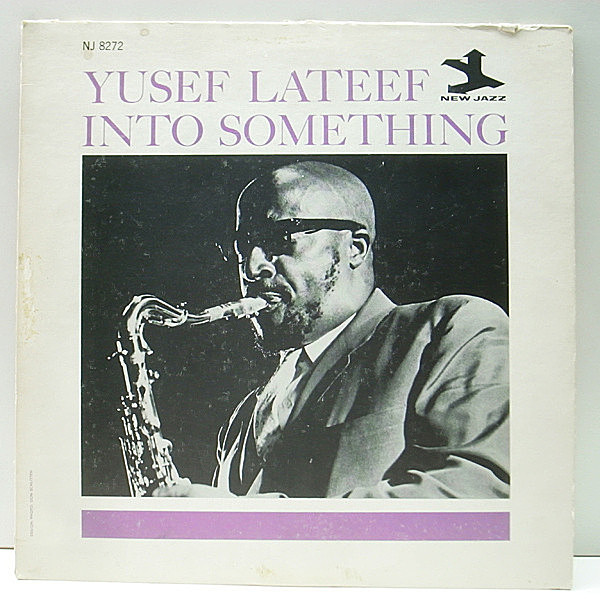
 Into Something consists of three trio and four quartet tracks, the latter featuring Barry Harris on piano. On the album, these are intermingled, starting with the quartet piece “Rasheed,” and it’s a good place to start, with some of everything that made Lateef unique — the unusual lead instrument (in this case, oboe), the Middle Eastern influence, the blues roots. But actually the recording session started with the three trio pieces, so perhaps Harris was a little late for the gig, and they had to start without him. We know that Bob Weinstock didn’t believe in rehearsals, and valued spontaneity, so why not go with what have? Barry’ll be here soon enough, what works without him? Lateef had brought along three standards to go with his four originals—tunes he chose, he told Nat Hentoff who wrote the liner notes, because he particularly liked them, for various reasons. 


The one he started the session with, “When You’re Smiling,” was a favorite of his father, who used to sing it often. It was a good memory, and he liked the message of the song. Do modern jazz musicians, whose improvisatory lines wander way outside the melody, think of the yrics of a song as they play it? Some do, some don’t. Bill Evans has said that he never did. Lateef, by his account to Hentoff, was thinking of the lyrics to “When You’re Smiling,” and thinking of them in a context. 

Written in 1928, the first recording of the song (by Seger Ellis) featured a lead-in verse, almost universally ignored in later versions, about a blind man and a legless man who take care of each other, and go through life smiling. Louis Armstrong cut what is still the classic version in 1929, and his version is illuminated by the famous Armstrong style.

Jazz musicians have recorded it: Dave Brubeck, Errol Garner and Dick Hyman, Urbie Green and Sonny Stitt, all with a lilt. Lee Konitz recorded it, and even with Billy Bauer and a quartet of Tristano acolytes, he sounds positively jaunty. Who knows if they were thinking of the words? It's hard to believe that Konitz wasn't.

But Lateef apparently was thinking of the lyrics, but maybe not so much singing or reciting the lyrics in his head as he played. He may have been thinking more about his father's voice, because his version is gentle and pensive as he states the melody, then becomes fragmented and searching.

Lateef's original tunes express the range of his passions. "Koko's Tune," as the title suggests, is in the bebop vein, though gentled down somewhat from the lightning tempo of Charlie Parker's "Ko-Ko." But if the tempo is gentled, the intonation certainly isn't, going seamlessly from gutbucket blues growls to hard-edged modernity, spurred on by the driving complexity of Elvin Jones's drumming (Jones, Harris, and bassist Herman Wright make up the all-Detroit rhythm section).

"Water Pistol" is in much the same vein, with Jones demonstrating that he really is the new face of jazz drumming. He had been working steadily and had recorded widely since his 1955 arrival in New York. He had recorded as a leader on albums for Atlantic and Riverside, and he had already joined John Coltrane's great quartet, with whom he had worked on several sessions, including the ones that made up his My Favorite Things. 


"P. Bouk" shows more of the Middle Eastern influence, and also includes an effective solo by Wright. And "Rasheed," with Lateef on oboe, shows him at full fusion strength, blending blues, bop, and the Middle East. 

Also blending Middle Eastern voicing with classic Western melody is his flute-led "I'll Remember April," the Gene dePaul-composed jazz standard that made its debut in an Abbott and Costello film. It was the 45 RPM single from the session, with "Blues for the Orient" on the flip side.

It's hard to choose a "Listen to One" from this superior session, in which every song has something particular to reommend it, from Lateef's command of the blues to blistering solos by Jones, but I'll go with "Rasheed," as perhaps being the most distinctively Lateefesque.

Esmond Edwards produced. The album was released on both New Jazz and Prestige, with "I'll Remember April" / "Blues for the Orient" as a Prestige single.


Tuesday, June 30, 2020

Listening to Prestige 497: Yusef Lateef


LISTEN TO ONE: Plum Blossom

By 1961, Yusef Lateef had completed his move from Detroit to New York. In 1960, he enrolled in the Manhattan School of Music. He would continue his studies off and on, eventually getting a BA (1969) and and MA (1970), then going on to get his Ed.D. And he was, although still playing in a jazz context, using jazz musicians and recording for a jazz label, already moving counter to a lot of what jazz was expected to do, perhaps more toward what he would come to call autophysiopsychic music --“music from one's physical, mental and spiritual self.” He was continuing to work a lot with musicians who had come with him from Detroit--in this case, Barry Harris and Ernie Farrow,
half-brother of Alice McLeod, who became Alice Coltrane--and who had become accustomed to his middle eastern influence and his often unusual instruments. But he had begun working with a New Yorker on drums--Lex Humphries, who had been with him on two previous albums for Riverside.

Lateef called this one Eastern Sounds, and that's a fitting title. Most of the compositions are his, and they reflect his love for Arabic music, but not just that. The sounds are truly eclectic. "Blues for the Orient" is a good example of this, starting with the two-worlds yoking in the title. Lateef plays the flute, and to my ear it's more Near Eastern than what we used to call "the Orient" - China, Japan, Korea, etc. But it's haunting and multicultural. And at the same time, Barry Harris, accompanying him, is playing the blues.When Harris takes an extended solo, he starts off on his own world music tangent, but then brings it around to the blues--and not the soul jazz, funk-drenched blues that were becoming so popular in the early 1960s, but very boppish, very Detroit-ish blues, earthy and cerebral at the same time. He and Lateef complement each other in unconventional but undeniable ways.

"Plum Blossom" is in a way more western, in other ways not. Harris is definitely in a boppish mood, and Lateef is not far away, but he's working with a most unusual instrument. The session notes call it a bamboo flute, but that it is not. It's sometimes called a xun, sometimes a Chinese globular flute. It looks a little like an ocarina, with it's globular shape, but it's played more like a jug from a rural jug band, by blowing into the top, but with finger holes around the ovoid shape.

It's not hard to tell why Lateef reached out of his Detroit orbit to pull in Lex Humphries. Probably best known in 1961 as the drummer on Art Farmer and Benny Golson's immensely popular and solidly hard bop Meet the Jazztet album, but he was capable of reaching outside what were usually thought of as jazz time signatures, which is what made him so valuable to Lateef and later to Sun Ra. His drumming on this session is a revelation, outside the box but always on point. 

So you have three musicians, two from Detroit and one from New York, two searching outside the normal traditions of jazz and one working creatively within those traditions. Redefining jazz, yes, but jazz is always about redefinition, so it's not so far-fetched to say that Lateef, Harris, Humphries and Farrow are working in the tradition, playing jazz, finding new ways, and the old ways, to play jazz.

Ernie Farrow contributes importantly as well, playing bass and also an instrument called, in the session log and liner notes, a rabat, but Rabat is the capital of Morocco, not a musical instrument. He seems to have been playing a rabab, an Arabic stringed instrument played with a bow. Both the xun and the rababare ancient instruments.

But the biggest splash was not made by one of Lateef's compositions, but by an unlikely selection. One of the three non-Lateef numbers was Jimmy McHugh's "Don't Blame Me," from an obscure 1932 Broadway revue called Clowns in Clover, but that's not the unlikely one. Obscure Broadway revues or obscure grade B films often produced memorable tunes (like the melody from the forgotten 
prison break movie Unchained), and "Don't Blame Me" had already entered the jazz repertoire, with recordings by Teddy Wilson, Coleman Hawkins and J. J. Johnson. No, much more unlikely for an against-the-grain jazzman with a taste for the Near East were two lush orchestral themes from big-budget movies, "Love Theme from The Robe" and "Love Theme from Spartacus."

And even more unlikely, not only did  "Love Theme from Spartacus" become the breakout hit from the album, it remained one of Lateef's most popular numbers, and a lot of other jazz musicians subsequently had a go at it, including Bill Evans, Ramsey Lewis, Gabor Szabo and Ahmad Jamal. And it's not hard to see why. It has a good groove from Harris, very full and very beautiful, and exotic flute solos from Lateef. It gets to you.

Eastern Sounds came out on Moodsville, and it certainly sets a mood. It generated three 45 RPM singles, although two of them were "Love Theme from Spartacus," once with "Snafu" from this session, and once with "Sea Breeze" from the earlier Cry! -- Tender. The other 45 was "Blues for the Orient," which was coupled with the standard "I'll Remember April," from Into Something, recorded in December of 1961. Esmond Edwards produced. 


Tuesday, December 25, 2018

Listening to Prestige 364: Doug Watkins

Doug Watkins was one of the most prolific sidemen of the 1950s. He's been on 26 Prestige albums so far (including Sonny Rollins' Saxophone Colossus) and countless more sessions on other labels. He was so respected as a bassist that when Charles Mingus took to the piano for 1961's Oh Yeah (Atlantic), he picked Watkins as his bassist.  But he almost never stepped out as a leader. He had done one album for a small label in 1956, and nothing more until this session.

What made him decide to put himself out in front?

A newfound passion. One of the most respected bassists in jazz, Watkins, like Mingus before him, turns the bass duties over to someone else, and takes on another instrument: his newfound passion, the cello.

How newfound was this passion? It's said that he picked it up three days before the recording date.

Which you can get away with if you're from Detroit, because that means you have a crew of homeboys who understand jazz, and who understand you, and who understand experimenting with different sounds, especially if one of them is Yusef Lateef, and the others are guys who've played with Lateef.

It's a shame that Detroit has come to be known as a blighted, crime-ridden city, because it has been a cultural capital.  It was a cauldron of jazz before jazz came to be recognized as America's seminal art form. And it produced the man who was arguably the greatest poet of his generation, Philip Levine.

Levine nurtured his art on the assembly lines of Detroit, just as Yusef Lateef did, and also in the jazz clubs of Detroit, where he heard the greats who made it their home. Poet T. R. Hummer, in an essay in the literary journal Blackbird, says that:

Some were classmates of his at Wayne University as it was called then: the guitarist Kenny Burrell was there, as were the pianists Tommy Flanagan and Bess Bonnier; they were close friends and peers of Levine’s then, as was the great and inimitable baritone saxophonist Pepper Adams, and the drummer Elvin Jones.

And he heard the greats who passed through, like Clifford Brown, whom he remembered as Benny Golson did:
I Remember Clifford

Wakening in a small room,
the walls high and blue, one high window
through which the morning enters,
I turn to the table beside me painted a thick white. There instead
of a clock is a tumbler of water,
clear and cold, that wasn't there
last night. Someone quietly entered, and now I see the white door
slightly ajar and around three sides
the light on fire. I remember once
twenty-seven years ago walking
the darkened streets
of my home town when up ahead
on Joy Road at the Bluebird of Happiness
I heard over the rumble of my own head
for the first time the high clear trumpet
of Clifford Brown calling us all
to the dance he shared with us
such a short time. My heart quickened
and in my long coat, breathless
and stumbling, I ran
through the swirling snow
to the familiar sequined door
knowing it would open on something new.
Shortly before he died in 2015, Levine collaborated with jazz saxophonist Benjamin Boone for a unique album of poetry and jazz. Hummer writes:


Boone said that he had suggested to Levine that it would be more efficient (as well as less taxing: it must not be forgotten that Levine was in his 80s
when this work was done) to record the music, at least the basic rhythm tracks, first and let him record his tracks after.
Levine’s response? “Why would I want to do that, Ben? I’ve sat in recording studios reading my stuff to myself plenty of times. I want to work with the musicians! That will be fun!”
And so the poet and the players convened session after session in a studio in Fresno, California, making the recordings. Another poet—especially one Levine’s age, who was also, by a certain point in the extended recording process, not in good health—might have found the lengthy, nitpicky process onerous. Levine loved it. He spent hours doing what is done in studios: sitting in a booth on a stool wearing headphones and staring at a microphone, recording take after take until everyone is satisfied, and then moving on to the next track. He stayed at it faithfully for the requisite long stretches.
The mixing of the album was not completed till after Levine died. When it came to mixing "I Remember Clifford," Boone was faced with a dilemma, according to Hummer:
For this poem, Boone composed a melody that is strongly reminiscent of, but not repetitious of, Golson’s composition. Anyone who knows Brown’s music is likely to know Golson’s composition, and so will be struck, as I was, by the extraordinarily tactful, effective work Boone did as a composer here.

But he did another excellent thing as well. Levine was always in the Fresno studio with basically the same core group of musicians. Boone is a saxophonist specializing in soprano and alto, each of which he plays wonderfully on most of these recordings (seriously, the man has deep and abiding chops; do yourself a favor and give him a listen) and he did the solo work on the original track. But as he listened to the playback of “I Remember Clifford” in the studio, and again and again at home, he found himself wondering, “Why is there a saxophone soloing in this? Clifford Brown played trumpet!”

“It was a tough decision, in terms of my own ego,” Boone told me. But in the end he contacted, through a friend of a friend, the trumpeter Tom Harrell. Harrell, now seventy-one, is a master musician who has played with just about everyone, from Stan Kenton and Woody Herman to Horace Silver on down. Who better to channel Clifford Brown?
So that's another part of Detroit. But here, for this session, the Motor City is represented by Lawson
on cello and Lateef on oboe as well as flute, so they're stepping outside of the jazz box. Detroiter Hugh Lawson is the pianist. a cat who came from Detroit with Lateef and spent many years with him before moving on to Sun Ra and others.  Detroiter Herman Wright takes the bass duties, and New Yorker Lex Humphries is the drummer, in his first session for Prestige.

They play three standards, two originals by Lateef and one ("Andre's Bag") by Watkins. The album, on New Jazz, would take its title, Soulnik, from a Lateef composition. Prestige would later rerelease it under Lateef's name as Imagination, but it's very much Watkins' session, but the creativity and versatility on display here in Watkins' pizzicato cello would get little chance to grow and blossom. This would be his second and last album as leader; in 1962 he died in an automobile accident.

Esmond Edwards produced.


It' not too late to give Listening to Prestige Vol. 3 as a Christmas gift for the jazz fan who has Volumes 1 and 2! 

And for those who haven't, the complete set makes a fabulous gift!
i


Thursday, March 22, 2018

Listening to Prestige 322: Yusef Lateef

Yusef Lateef, like many musicians who worked in this contemporary American musical form, created by African American artists, hailed as America's signal cultural achievement, did not like the word jazz. It's understandable, and I've written about it before--the lowlife origins of the word, the not always attractive associations that have grown up around it. As Lateef told Marc Myers of Jazzwax,
I feel the word is a misnomer. It has meanings and connotations that debase the art and belittle those who play it. Performing music that inspires listeners and puts them in touch with themselves is a beautiful and challenging and difficult expression. There’s communication between the artist and the listener, and hopefully both are better people and more enriched as a result.
...If you look it up, you’ll see that its synonyms include “nonsense,” “blather,” “claptrap” and other definitions that reduce the music to poppycock and skulduggery. I find that the word “jazz” is a meaningless term that too narrowly defines the music I play, and it adds a connotation that’s disrespectful to the art and those who perform it. 
I do like the word. I feel that it has been ennobled by the people who have played it. It has been elevated from the profane to the sacred, without losing a touch of the profane, by Louis Armstrong and Charlie Parker, Ben Webster and Eric Dolphy, Erskine Hawkins and Bug Jay McNeely. It has gone to college with Dave Brubeck, to the Philharmonic with Norman Granz, to high society with Louis Armstrong and Bing Crosby. It has gone into concert halls with the Modern Jazz Quartet. And if America's greatest art form had its roots in the bawdy houses of Storyville in New Orleans, the mob-controlled speakeasies of Chicago, the urban corruption of Boss Pendergast in Kansas City, then it has something in common with Hamlet, which was written by an actor, about as lowlife and raffish a profession as you could find in Elizabethan England. Great art comes from folk roots, and the folk are where you find them.

It's also difficult to find a word to replace it. Lateef, in the same interview, suggested:
autophysiopsychic music. This means music from the physical, mental and spiritual. I think it’s an adequate term.
It's hard to dispute its adequacy, and it's certainly better than the "social music" that Miles Davis put forth, but it's not likely to catch on.

The 1960s were  a time during which a lot of musicians were chafing at the name "jazz" (in Art Taylor's book Notes and Tones: Musician-to-Musician Interviews, he asks a lot of his subject what they think of the term, and they mostly don't like it), but they were also a time during which musicians were questioning what the music was, and what its boundaries were. Ornette Coleman, John Coltrane and Eric Dolphy were the most famous of these, but Lateef was one of the important figures in this jazz revolution.
Lateef, in discussing his bending of barriers, credited the spiritual element that he brought to the music, but that's hard to quantify, although there's a direct correlation to something that is quantifiable. He was one of the earliest convert to Islam among American jazz musicians, embracing the religion in Detroit in 1948, and this brought him into contact with Detroit's Islamic community. These days greater Detroit, particularly Dearborn, is home to one of America's largest Islamic communities, but even then the influence was there if one was open to it, and Lateef was. From a Syrian fellow assembly line worker at the Chrysler plant he began to learn about Middle Eastern music, and it was to have a profound effect on the music he would make.

Lateef was not the only jazz musician to turn to the Middle East for inspiration (we've heard Herbie Mann's "Tel Aviv" in a 1957 Prestige recording), but he may well have been the most profoundly influenced.  So his spiritual quest became a musical quest, and it didn't stop with the tonality and instrumentation of the Middle East. As he told Marc Myers:
When I was beginning to explore spiritual music in the mid-1950s, there was some resentment. My early albums as a leader for Savoy—Jazz for the Thinker and Prayer to the East—were different than anything else that had been recorded. I realized then that if I was going to continue, I had to change the format. I started studying [Karlheinz] Stockhausen, a classical composer who was changing music with his embrace of electronics and new theories. After listening to composers like him, I knew I had to go beyond what I already knew.
When he signed a recording contract with Prestige, Lateef was still living in Detroit. He had recorded one earlier Prestige album, and the two game-changers for Savoy, but for all of these, he would pile his musicians and instruments into a station wagon, drive all night to New York, make the record, then back to Detroit. The Motor City had one of the most vibrant and active jazz scenes in the Midwest, and had sent an all star cast of musicians to New York, but Lateef was one of the last holdouts. He would not move east until 1960, and when he made this recording for Prestige, it was sill under those conditions, so all of the musicians on this date were Detroiters.

One of them, Lonnie Hillyer, who become known in the 1960s for his long association with Charles Mingus, was the stuff of legend in Detroit for an episode he wasn't even directly involved with. When Miles Davis lived there in the early 1950s, he was deep into heroin addiction, and his trumpet was generally in a pawnshop, so when he got a gig he'd have to borrow one, and the trumpet's owner had to hope it wouldn't end up in a pawnshop at the end of the evening. On this particular night, Miles had touched up young teenage trumpet student Lonnie Hillyer. When Lonnie's mother found out, she was furious. She went straight to the club, marched up onto the stage, and snatched the horn away from Miles in mid-solo.

Hillyer was all grown up in 1959, and like the rest of his bandmates, used to playing with Lateef every night. This was a tight group of Detroiters that Lateef brought to Englewood Cliffs, and they were able to hang tight with the leader as he pushed boundaries. These were all musicians who had  grown up in the jazz cauldron of Detroit, and who were fully equipped to understand and abet the fusion between jazz and autophysiopsychic music.

Lateef brings us both: what we already knew of as jazz and what we were to discover by listening to his music, in this album, in the earlier Prestige and Savoy albums, and in recordings to come.

He has not brought any of the exotic Midde Eastern instruments that he has mastered to this session, like the arghul, which he played on his 1957 recordings for Prestige, but he does play both the flute (at this point not unusual on a jazz recording) and the oboe (still unusual) in addition to the tenor sax, and these allow him to find a range of sounds and feelings beyond the usual. He plays four of his own compositions and three standards: Jerome Kern's "Yesterdays," Tadd Dameron's "If You Could See Me Now," and "Seabreeze," a swing-era tune credited to Larry Douglas, Fred Norman, and Rommie Bearden, the last named more commonly known as Romare Bearden, one of the great painters of his generation.

Cry!-Tender was released on New Jazz. Weinstock was creating quite a renaissance for New Jazz in his tenth anniversary year -- and that in addition to the new labels he was starting. Quite a lot of diversification, presumably for tax reasons. Cry!-Tender wasn't actually released until mid-1960, but a lot of New Jazz product was shipping as 1959 wound down, some of it cut in the waning months of the year, some of if off the shelf.

Here's a quick rundown of the last quarter of the year:
  • NJLP 8224 Meet Oliver Nelson, recorded 10/30/1959
  • NJLP 8225  Kenny Dorham - Quiet Kenny, recorded 11/13/1959
  • NJLP 8226  Jerome Richardson, Roamin' with Richardson, recorded 10/21/1959
  • NJLP 8227 Ray Bryant Trio, delayed release of a 1957 recording
  • NJLP 8228 The Ray Draper Quintet Featuring John Coltrane, delayed release of a 1957 recording
  • NJLP 8229 - Johnny "Hammond" Smith - That Good Feelin', recorded 11/4/1959
Two 45 RPM singles came from the session. "Dopolous" / "Yesterdays" was released on New Jazz, "Seabreeze" came out on Prestige, paired with "Love Theme From Spartacus" from a later session, which was to become Lateef's biggest hit.


Listening to Prestige Vol. 2, 1954-1956 is here! You can order your signed copy or copies through the link above.

Tad Richards will strike a nerve with all of us who were privileged to have
lived thru the beginnings of bebop, and with those who have since
fallen under the spell of this American phenomenon…a one-of-a-kind
reference book, that will surely take its place in the history of this
music.
                                                                                                                        --Dave Grusin

An important reference book of all the Prestige recordings during the time
period. Furthermore, Each song chosen is a brilliant representation of
the artist which leaves the listener free to explore further. The
stories behind the making of each track are incredibly informative and
give a glimpse deeper into the artists at work.
                                                                                                                --Murali Coryell

Tuesday, April 18, 2017

Listening to Prestige 255: Yusef Lateef

Yusef Lateef is, among his fellow Detroiters, a late arrival on the New York scene, and not because he represented a younger generation. Not at all. He was 37 when he first came to New York in the spring of 1957 to record for Savoy and Verve, and then to make this album for Prestige. And he wouldn't actually move Eest for good until 1960.

He had not been entirely homebound. He'd started playing professionally at 18, touring with swing bands and eventually with Dizzy Gillespie, but by 1950 concerns for his wife's health brought him off the road and home to Detroit, where he became an important figure, not only for his musicianship but also his cultural leadership. He was a founder and vice president of the New Music Society, an organization that reached out to younger jazz musicians and gave them a place to grow and develop. 1950 was also the year he converted to Islam.

His late arrival on the New York scene is part of the reason why, although he'd been an active musician for over 20 years by the time the decade turned, he is more associated with the jazz of the Sixties than the Fifties. The rest of that reason is his free-flying creativity, which seem like a Sixties thing, but was part of Lateef's creative personality even back in Detroit. Pianist Terry Pollard recalls that
He sometimes had me blow into a pop bottle. He'd fill it with water...to get different sounds, to make the song sound like Yusef wanted it to be. And so I ended up blowing into these pop bottles. I didn't know how, and I would get dizzy every night.*
While he was still in Detroit, Lateef began to experiment with Middle Eastern music, turned on to it by a fellow assembly line worker at the Chrysler plant. He
realized I had to widen my canvas of expression. I spent many hours in the library...studying the music of other cultures. I met a man [at Chrysler] from Syria and he asked me if I knew about the rabat.
He would bring all of this knowledge, and all the instruments he was experimenting with, to his New
York recording sessions, along with his Detroit band from their regular gig at Klein's Showbar.
We were so tight we were able to go to New York on off nights and do two albums, easily...We got off Sunday nights and jumped in the...station wagon, and we would drive all the way to Hackensack, New Jersey, and record on Monday and we'd turn right back to Detroit and open up on Tuesday.
The October session with its twelve tunes would have been an impressive feat for a group motoring over from Weehawken, let alone five guys and their instruments packed into a station wagon and barreling in from Detroit. Impressive for the sheer amount of work, impressive for how good it was, and really impressive for its range.

"Playful Flute," the first tune laid down, was composed by brass player Wilbur Harden, but it embodies Lateef's love of Middle Eastern music, learned in the library, from his fellow Chrysler worker, and certainly also from his pilgrimages to Mecca. It incorporates the flute and the argol, or arghul, a two-tubed woodwind instrument that dates back to ancient Egypt.


"Taboo" is one of those tunes that's always used when a movie soundtrack wants something Latin and exotic. Either that or Margarita Lecuona's only other hit, "Babalu." Or one of the compositions of her cousin Ernesto, like "The Breeze and I" or "Malaguena." To refresh my memory, I listened to versions by Les Baxter (boring) and Cuban bandleader Jack Costanzo (not boring). But no one brings to it quite what Lateef does. From Oliver Jackson's arresting drum intro to Lateef's flute work, he turns what's generally an ersatz exotic into a genuine exotic. Which is no small feat.

And, of course, I'm not so much interested in a critique of the Lecuona cousins' oeuvre as I am in following my reactions to Lateef's range and the courage of his choices. "Taboo" is a tune that could easily be dismissed as kitsch. Not so here. And it's interesting to consider how it might have been chosen.

This was a quintet that Lateef held together for five years, working a regular five-night-a-week gig in a very hip jazz town. Five nights a week for five years means you work out a lot of material, and sometimes you're just goofing around. Hey, let's take a tune that's straight from Squaresville, and see how we can mess around with it. And if you're Yusef Lateef, and you're playing what some have described as "world music before there was world music," even goofing around can lead to new discoveries.

"Anastasia" might have been another one of those tunes. From an Oscar-nominated movie soundtrack by Alfred Newman, it had become a pop hit for Pat Boone, and you can't go much deeper into Squaresville than that. Here, Lateef does the really unexpected by staying quite faithful to the melody, but giving it a bit of a Middle Eastern twist, and a moody cast. Making it new.

Lateef's own compositions for this date are as eclectic as his covers. "Ecaps," in spite of its spacey title, is pretty much rooted on earth, with bop-influenced flute and tenor playing, and a very nice boppish piano solo by Hugh Lawson. Others range from boppish to proto-world music. And then there's "Love and Humor."

Most of the odd instruments listed in the session notes come into play here, including the balloons handed to Wilbur Harden and Hugh Lawson, for that unmistakeable sound of two balloons being rubbed together -- and Lawson is given Terry Pollard's 7-Up bottles. I couldn't help but think, as all of these unusual sounds wove their way into the mix, what kind of a challenge this session must have been for Rudy Van Gelder. The mood may be (sort of) Middle Eastern, with Lateef playing flute and argol, but the instrumentation is worthy of Spike Jones, who also knew something about love and humor. Lateef's humor is a little more subtle, and this is a very special cut, moving some distance away from jazz as we knew it, expanding our musical vocabulary. Lateef had used some of these instruments and sound effects on his earlier Savoy albums, but nothing quite like this.

I wonder if Bob Weinstock had entirely been expecting "Love and Humor." But he didn't shy away from it. It went onto his first Lateef release, The Sounds of Yusef, along with "Playful Flute," "Buckingham," "Meditation," and "Take the 'A' Train," and not only that, it was released as a 45 b/w "Meditation."

"Taboo," "All Alone," "Lambert's Joint," "Mahabs," "Minor Mood" and "Anastasia" all went onto the New Jazz album Other Sounds, released in 1959. "Ecaps" was held off until the 1960 New Jazz Cry!-Tender, the rest of which came from a later and much different session.


* This and all the other quotes -- in fact, much of the Detroit information -- from Lars Bjorn and Jim Gallert's amazing book, Before Motown: A History of Jazz in Detroit.