Showing posts with label Ray Lucas. Show all posts

Thursday, October 26, 2023

Listening to Prestige 707 Freddie McCoy


LISTEN TO ONE: Lonely Avenue

 It's 1965, and Prestige is fully committed to riding the wave of soul jazz, and no one exemplified that better than Freddie McCoy, who was tapped by Johnny "Hammond " Smith (later known as Johnny Hammond) on a couple of Prestige albums before getting this shot at an album under his own name--a position he was not to relinquish quickly. He would release seven albums on Prestige over a three year period, then one album on a tiny independent label in 1971, then nothing. He dropped out of sight, apparently left the music business. He died in 2009 in Morocco, where he was living under his adopted Muslim name of Dit Ahmed Sofi.


Larry, of the Funky16Corners blog, rates McCoy as "the finest, purely 'soul jazz' vibraphonist I’ve ever heard, and while others may lay claim to that distinction--and I would never tout any artist (well, except for Louis Armstrong) as the finest of anything, a strong case could be made for Freddie McCoy as the quintessential soul jazz vibist. His commitment to this signature jazz sound of the 1960s seems to have been total, and his ability to coax soul out of an instrument that does not allow much for the slurs or microtonalities of the blues. 

McCoy's first entry into ars poetica of soul jazz, his first tune of his first session, first cut (and the title cut) on his first album, was Doc Pomus's 'Lonely Avenue," originally recordeed by Ray Charles, inspired by the Pilgrim Travelers' gospel song "How Jesus Died." My first thought on seeing the set list was "What made Freddie McCoy think he could possibly do this?" Just as my first thought on hearing Ray's version was "How could he do it? This could so easily go wrong--how did he make it so right?" Surprisingly, it's had rather a lot of covers since Ray's masterpiece, including British Invasion soft rockers Peter and Gordon (mistake) and the Everly Brothers (big mistake -- the Everlys could sing almost anything, including several other Ray Charles covers, but they couldn't sing this. 

In short, I wasn't expecting much.

And it didn't take long to convince me otherwise.


If you loved the sound of the vibraphone, as Prestige's Bob Weinstock apparently did, and you were convinced that soul jazz was what was going to keep your label afloat in the 1960s, you had found your guy. With the vibraphone playing off the full sound of trumpet, baritone sax, trombone and organ, with a brilliant arrangement by trumpeter Gil Askey, it was pretty clear that Prestige had come up with another winner in the soul jazz sweepstakes.

Freddy McCoy, at 32, may have been a new face on the soul jazz scene, but soul jazz was not an entirely new sound (see my book, Jass with a Beat), and McCoy and producer Cal Lampley came up with some veteran talent to make this session work. Tate Houston, 40, made his first recordings with Billy Eckstine in 1946. He followed that up with stints with Sonny Stitt and Milt Jackson, and played at Detroit's Blue Bird Inn. He moved from bebop to rhythm and blues with Hal "Cornbread" Singer and Big John Greer. Napoleon "Snags" Allen's career goes back even further, being one of the first to introduce the electric guitar to the New York scene in the 1930s. Martin Rivera is probably best known for his work with Junior Mance in the 1980s, but his recording career goes back to the mid-1950s, and like Houston and Allen, was one of New York's reliable studio musicians. Like Ray Lucas, he has recorded on Prestige betore -- Rivera with Kenny Burrell, Lucas with Bobby Timmons and King Curtis. Organist James Thomas is almost certainly not the British classical organist and choir director of the same name, and I haven't been able to find out anything else about him.

The abum was recorded in two sessions, January 25 and February 16, and the second session was augmented with trombonist Dicky Harris, another veteran whose roots go back to Erskine Hawkins in the 1930s, and whose rhythm and blues credentials include work with Lucky Millinder, Ruth Brown and Sam Cooke.

t's unusual to see an arranger credit on an album by a small jazz combo, but Gil Askey certainly deserves it here. Askey, a 25-year veteran of the jazz scene (Dizzy Gillespie, Miles Davis, Duke Ellington, Count Basie) took on this gig on the way to a full time job that would keep him occupied for the next decade and more. He had just gotten a call earlier in the month from a young Detroit entrepreneur who was starting a new label.

Berry Gordy was to describe Askey as ""the glue that kept everything together" at Motown, and he is generally recognized as one of the important creators of the Motown sound. He was instrumental in developing the Jackson Five, and when the brothers were first booked on Ed Sullivan, little Michael was afraid to go until he was reassured by the sight of "Uncle Gil" in the wings.

Askey's musical roots go back to the Austin, Texas, Anderson High School Marching Band (Kenny Dorham was a bandmate), one of the first Black marching bands to gain prominence. He developed his skills in rhythm and blues as an arranger for Buddy Johnson, and touring with 1950s package shows as the backup band for Frankie Lymon and the Teenagers, the Platters, the Clovers, Jackie Wilson, Lloyd Price and many more.

None of these musicians played on subsequent McCoy recordings. McCoy was talented enough, and attuned enough to the zeitgeist, to build a successful career on his own talents. But these veterans, and especially the arranging genius of Gil Askey, gave him a particularly powerful debut.

Lonely Avenue became the title of the album, and also the A side of its first 45 RPM single release. The B side was "Collard Greens," continuing a rhythm and blues tradition of giving soul food titles to tunes, like Hal Singer's "Cornbread," Eddie Vinson's "Kidney Stew" and Frank Culley's "Cole Slaw" -- a tradition that had continued into the soul jazz era with Booker T's classic "Green Onions." The February 16 session yielded more soul food, and another single, with "Belly Full of Greens" (flip side the standard "Willow Weep for Me"). McCoy would continue the theme on subsequent albums Peas 'n Rice and Beans & Greens


Friday, August 12, 2022

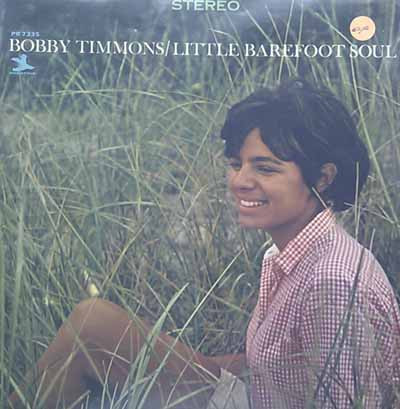
Listening to Prestige 635: Bobby Timmons


LISTEN TO ONE: A Little Barefoot Soul

In my mind, Bobby Timmons was Blue Note. But the mind can play tricks. Timmons did record extensively on Blue Note, as a member of Art Blakey's Jazz Messengers, and before that, with Kenny Dorham's Jazz Prophets, and with Lee Morgan. But to my surprise, He never recorded as a leader with Blue Note. His first record as a co-leader (with Clifford Jordan and John Jenkins) was on New Jazz. Then, starting in 1960, he recorded a series of albums for Riverside, while continuing to play and record with Blakey through 1961. This session marked his return to Prestige, the first of seven albums he would make for the label over the next two years.


Timmons has been something of a controversial figure in jazz criticism, with "underrated" being a term applied to him with surprising regularity, while other critics have suggested there wasn't much to him below the surface--that he was basically just a guy who wrote simple tunes, a few of which have clicked to become hits and jazz standards. 

His recording career is curious also. Between 1958 and 1961, from his first emergence on the New York Scene through his associations with Art Blakey and Cannonball Adderley, he was much in demand, playing on sessions with Pepper Adams, Chet Baker, Kenny Burrell, Arnett Cobb, Kenny Dorham, Art Farmer, Benny Golson, Dexter Gordon, Lee Morgan and others. Then nothing. He continued to tour with a trio and to make records under his own name through the 1960s. Perhaps it was his heroin addiction that made him too unreliable as a sideman. His substance abuse problem was a serious one, and it led him to an early grave.

But soul jazz was marketable, and Timmons was a marketable name. "Moanin'" and "Dat Dere" had become hugely popular jazz tunes, the more so because they had had lyrics attached to them by two masters, Jon Hendricks and Oscar Brown Jr., respectively. 

Certainly his labels weren't shy about pushing the soul connection. Riverside, for whom he recorded from 1960-64, gave his albums titles like This Here is Bobby Timmons (included "Moanin'," "Dis Here" and "Dat Dere"), Soul Time, Sweet and Soulful Sounds. His debut album for Prestige was, if anything, even less subtle...Little Barefoot Soul,

There is nothing on the album anywhere near as catchy as Timmons's big three, for all the catchy titles. So this may not be the place to look for Timmons, the simple soul tunesmith. 

But it might be a good place to start considering Timmons, the underrated jazz pianist. Rather than depend on the restatement of catchy riffs, he engages here in thoughtful and often daring improvisation. He's accompanied on drums by King Curtis sideman Ray Lucas, who keeps him honest, and Sam Jones, who spurs his creativity. He would work with a variety of sidemen in his two years with Prestige, probably a result of his drug-fueled unreliability, but this is an excellent pair.


The producer credit for the session is a little ambiguous: longtime Prestige producer Ozzie Cadena is credited with "supervision," producer is listed as Joel Dorn, who also wrote the liner notes. 

Dorn was an interesting guy. He knew from age 14 that he had one ambition in life--to produce records for Atlantic, and at that young age he started writing to Nesuhi Ertegun, making his case. Ertegun finally relented, telling him he could produce one album by an artist of his choice. He chose Hubert Laws, and it was the beginning of a fabulously successful career, which included discovering the Allman Brothers and the Neville Brothers, and winning a Grammy for his production of Roberta Flack's "Killing Me Softly with His Song."

He recorded Laws for Atlantic in April of 1964, the fulfillment of his lifetime ambition at age 22, so one has to wonder what he was doing in Englewood Cliffs in June of that year, working with a new Prestige artist. Perhaps Ertegun was waiting to see how The Laws of Jazz did before making a commitment. And maybe the problems Dorn enumerates in his somewhat defensive liner notes for the album might not have arisen had his head not been too swiveled toward the orange, black and green of Atlantic. The album, Dorn reports,

was supposed to have been a quintet date. But when Bobby arrived at the studio only one musician, Sam Jones, was on hand. Then came the inevitable phone calls with excuses from the sidemen for not showing up...So with practically two hours of recording time eaten away...it seemed the session would have to be cancelled. Fortunately, someone remembered that Ray Lucas was in town...and within half an hour had his drums set up and ready to record.

Dorn also refers, while declining to get into specifics, to "an air of antagonism...between the artist, the A&R man, and the engineer." It's not clear whether he's referring to himself or Cadena, but in any event, he was off to the Atlantic recording studios and Tom Dowd after this, while Timmons continued working with Cadena, Van Gelder, and a different crop of musicians. And after  two tunes that had to be thrown out because Lucas had trouble finding a groove with two musicians he'd never met before, everything clicked with "A Little Barefoot Soul" (the first word was dropped for the album title), and from there on things went smoothly. Perhaps the unexpected loss of two front men forced Timmons to improvise more than he had intended to, and the results are salutary.

The title track, with "Walkin', Wadin', Sittin', Ridin'" on the flip side, was released as a 45 RPM single.

Friday, December 18, 2020

Listening to Prestige 533: King Curtis


There's a lot to be said for the thought behind this King Curtis session, but not much to say about it. Take a collection of really familiar chestnuts and give them the King Curtis treatment: the stuttering tenor sax, the red hot rhythm and blues combo, here augmented by Ellington veteran Britt Woodman, which can't be anything but good news. Also joining the group is Carl Lynch, one of the best session guitarists in New York, with mega-credits extending from Pearl Bailey to the Fugs.

This was a gambit frequently used by 1950s rock-and-rollers. Take a song that everybody knows, because everyone sang it in their grade school music classes, and give it a Duane Eddy twangy guitar treatment, and you have "Red River Rock," by Johnny and the Hurricanes. Or take something equally familiar--a Stephen Foster song--and if you're a genius, like Ray Charles, you can turn it into "Swanee River Rock." Or if you're a gifted satirist, like Stan Freberg, you can turn it into "Rock Around Steven Foster." Fast forward to the 1970s, and they're still doing it, with equally familiar, if more classical, sources: Walter Murphy's "A Fifth of Beethoven."

King Curtis and his band are not geniuses like Ray Charles; they are, however, better musicians than Johnny and the Hurricanes, and if they aren't exactly the satirists that Stan Freberg is, they do approach these old chestnuts with a sense of humor. They did the old chestnuts about as well as you could ask for. This isn't an album that's lasted, and that's kinda too bad. It's fun to listen to.


The Tru-Sound album is called Doin' the Dixie Twist. Twist, I guess, because if you stuck "twist" on any any collection of rhythm and bluesy instrumentals, you had a chance of selling a few more copies in those days, so they were definitely not shy about getting the word out there. Dixie, I guess, because a lot of the songs are associated with the South, or because they're associated with Dixieland jazz. That crown jewel of all Dixieland chestnuts, "When the Saints Go Marchin' In," became a Tru-Sound 45, along with "Free for All," from the King's January session.


Tuesday, November 10, 2020

Listening to Prestige 526: King Curtis


LISTEN TO ONE: Low Down

 King Curtis made his reputation with his thrilling solos to recordings by Atlantic rhythm and blues and doo wop performers in the 1950s. Then, later in 1962, he made a recording, "Soul Twist," for Harlem entrepreneur Bobby Robinson's Enjoy label, which hit Number One on the Billboard R&B charts, number 17 on the pop charts, and established Curtis as a star in his own right, with several more chart singles,  culminating in the monster hit, Memphis Soul Stew, for Atlantic in 1967. 

In between, he made six albums for Prestige, three of them for the "contemporary rhythm and blues" label, Tru-Sound. He worked on a number of other sessions, including several backing up singers for Bluesville. He worked with jazz musicians like Nat Adderley, or with his own working group, as here. This is the second of two sessions to include another rhythm and blues tenor legend, Sam "the Man" Taylor.


It was his association with the twist that brought stardom to Curtis, but really, "Soul Twist" was just a rhythm and blues number, and a good one--Curtis was one of the best R&B tenormen around. You could actually do the twist to any peppy tune with a back beat--it wasn't like the samba or the rhumba or the mambo, or even the bunny hop.

And the same with the tunes on this album. "The Twist" is the most Pavlovian response-inducing cultural phenomenon in American history. Hear Chubby Checker's voice singing "Come on bab-eeee..." even today, and a roomful of people will start gyrating and moving their arms as if drying their butts with an imaginary towel. Same probably with the Isley Brothers of the Beatles singing "Shake it up baby." Not so much with King Curtis's instrumentals, although I'm sure people were twisting the night away to them back then. Now they could still be for dancing to, if you chose, or you could just sit back and listen and snap your fingers and tap your feet. It's King Curtis's regular band, tight as can be, with a second star of the rhythm and blues firmament, Sam "the Man" Taylor (on all but two tracks).


These tunes all went onto the Tru-Sound album It's Party Time, along with four tracks from July 11, 1961, which utilized the same personnel, including Taylor. "Free for All," with "When the Saints Go Marching In" from a session in February 1962, was the first 45 RPM single to come from the session, followed by "Low Down" / "I'll Wait for You."

Friday, July 03, 2020

Listening to Prestige 500 - KIng Curtis


LISTEN TO ONE: Honky Tonk

Here's the difference between your jazz critic (or your anything critic) and your average fan. Your critic has heard it all, and he rejects the tired, the trite, the overdone, the same old same old. An album of the most over-played, over-listened to songs in the history of jazz...spare me.

The fan isn't sophisticated enough for that. "Night Train"? "Fever"? "Honky Tonk"? Great shit, man!

Musicians aren't immune, either. Here's a story I've told before, but it's a great story, and it bears retelling. It's Phil Woods's story, and his words. 
I had just graduated from Juilliard in 1952 and was playing at the Nut Club on Seventh Ave. and Sheridan Square in the Village. After all of that great education, here I was playing "Harlem Nocturne" 10 times a night...I wasn’t happy with myself. I was saying to myself, “My god, I’m a Juilliard graduate, and I can play great jazz, and here I am playing "Night Train" and "Harlem Nocturne." I didn’t like my mouthpiece. I didn’t like my reed. I didn’t like my horn. I didn’t even like the strap.

...One night somebody came into the club and said, “Hey, Charlie Parker’s playing across the street. He’s jamming.” ...I was going on my break so I rushed over. When I walked in, there was this 90-year old guy playing a piano that was only three octaves long [laughs]. His father was on drums using a tiny snare and little tiny pie plates for cymbals. And there was the great Charlie Parker—playing the baritone sax. It belonged to Larry Rivers, the painter. Parker knew me. He knew all the kids who were coming up.

...I said, “Mr. Parker, perhaps you’d like to play my alto?” He said, “Phil, that would be great. This baritone’s kicking my butt.” So I ran back across the street to the Nut Club and grabbed the alto sax that I hated. I came back and got on the bandstand, which was about as big as a coffee table. I handed my horn to Bird and he played "Long Ago and Far Away."...As I’m listening to him play my horn, I’m realizing ...nothing was wrong with the reed, nothing was wrong with the mouthpiece—even the strap sounded good. Then Parker says to me, “Now you play.” I said to myself, “My God.” So I did. I played a chorus for him... When I was done, Bird leaned over and said, “Sounds real good, Phil.” This time I levitated over Seventh Avenue to the Nut Club. And when I got back on the bandstand there, I played the shit out of Harlem Nocturne. That’s when I stopped complaining and started practicing. That was quite a lesson.

This  is my 500th entry on Listening to Prestige. That's six years of listening to great jazz and writing about it. Six years of putting a theory to the test--a theory that Peter Jones and I came up with, about the recorded jazz of the 1950s, our formative years...it was all good. We were young and we were learning, and we had those aforementioned critics to go by, and we had limited resources, and we tended to buy the albums that got four and five stars in DownBeat. Can it really all have been good?

Well, I've passed through the 1950s, and I'm two years into the next decade, and I've listened to every single track recorded on a pretty representative indie label, and so far our theory is holding up.

But after 500 recording sessions, and 500 blog entries, you'd think I'd have earned my status as jaded critic, wouldn't you?

But uh-uh. I'm with the average fan on this one. I'm with the guy in the Nut Club who wanted to hear "Night Train" and "Harlem Nocturne." I'm with Phil Woods, after he got schooled by Charlie Parker. Mr. King Curtis...no "Harlem Nocturne," on the September 19th session -- how could he have forgotten it? -- but  he made up for it three days later, with a return to Englewood Cliffs. Definitely "Night Train." And "Fever," and "Tuxedo Junction," and "The Hucklebuck," and..."Honky Tonk."

Billy Butler, who co-composed "Honky Tonk" and played the guitar solo on Bill Doggett's original recording, was a part of King Curtis's band at the point, and he still knew how to wail on this timeless number. He would return to Prestige leading his own group near the end of the decade.

Also on guitar for this session was a youngster, Eric Gale, who would go to become one of the most sought-after studio musicians of the 1960s-70s, playing on over 500 sessions--jazz, funk, pop. He was a member of the funk supergroup Stuff.

Bassist Bob Bushnell was new with Curtis, and new with Prestige. His career actually stretched back to the 1940s when, fresh out of high school, he played a few gigs with Jimmy Heath, but it doesn't seem really to have taken off until the 1960s, when his resume started to fill up with what became really a wide and impressive variety of the biggest names in jazz, blues and rock.

Willie Rodriguez, whose big band credits ranged from Dizzy Gillespie to Stan Kenton to Paul Whiteman, had made his recording debut as leader with a big band of his own in 1960--an album called A Bunch of Bongos.

One of Prestige's stars, Jack McDuff, rounded out the group.

Not quite so well known are "You Came a Long Way From St. Louis," from the 1940s, and "Lean, Baby," from the 1950s.

There were only four songs on the second session, but they were all classics; "Harlem Nocturne," of course. "Soft" had been a hit for Tiny Bradshaw in 1952, "Tippin' In" for Erskine Hawkins in 1945. "So Rare,"dating back to 1937, had been a huge hit for Jimmy Dorsey in 1957, hitting Number One on the charts right after Jimmy's death. Jimmy, a great talent unjustly overshadowed in reputation by his brother, played it sweet; Curtis wails it out.

The album was released on Tru-Sound as Old Gold. A later re-release on Prestige was titled Night Train. 


Sunday, April 19, 2020

Listening to Prestige 478: King Curtis

King Curtis joins with another giant of rhythm and blues, Sam "The Man" Taylor, for the first of two blowing sessions that would ultimately make a Tru-Sound album called It's Party Time with King Curtis.

And party time it is. A solid groove for dancing, a tight arrangement, not a lot of room for improvisation, but some goose-bump-inducing solos by two masters if the art of wailing sax, and two of the most in-demand session men in New York. If your saxophone break on the hottest rocker of the moment wasn't by Curtis, it was probably by Taylor.

They were backed up by Curtis's regular group, plus a couple of extra musicians who--uncharacteristically for a Prestige session at Van Gelder Studio--weren't identified in the session log. Those were the trumpeter and the bongo player, both of whom performed on "Slow Motion."

And dig him here, with a tight band, led by a man who knew how to run a tight ship and keep it loose and swinging. Amazingly, nothing from this session was released on 45.

Paul Griffin on piano and Jimmy Lewis on bass were Curtis's regulars. Ernie Hayes played on this and the second Party Time session, and would be called on for other Prestige sessions, but Curtis didn't always use an organ, so he can't really be called a regular.

Billy Butler joined Curtis from Bill Doggett's band, where he had co-written and played the guitar solo on "Honky Tonk." Like all of the other musicians on this session and in Curtis's orbit, he was one of the session players that made the New York sound of the 1950s and early 1960s so powerful. A recent movie has shown us the incredible Detroit musicians who were the anonymous backbone of the Motown sound in the soul era, but the contributions made by the guys in the studios of the Big Apple in the rhythm and blues/rock and roll era of the 1950s were equally important. New York was the jazz center of the world in those days. It's where people came to play.

And it provided its own talent, from its own streets. Drummer Ray Lucas is a case in point.

Lucas grew up in Harlem, where music was everywhere. He recalled those early years in an interview with Jim Payne for Modern Drummer magazine.
I was still in high school when I heard “Yakety Yak” by the Coasters, with King Curtis on sax. At that time I was playing bebop and jazz. I didn’t care nothin’ about rock ’n’ roll. I was born and raised in Harlem. All I knew was New York and bebop. If you didn’t know Blue Mitchell, Miles Davis, Dexter Gordon, you weren’t in my league. But Curtis had a unique style of playing, and when I heard him on that Coasters record, I was knocked out.
A few years later, when Belton Evans was leaving and Curtis was auditioning drummers, Eric Gale arranged for Lucas to try out. When he got to the audition, he found that he was to be judged by Curtis and Roy Haynes.
Afterwards Roy looked at Curtis and said, “That’s a good kid. He’s all right.” I was nineteen or twenty at the time. I played with Curtis from 1961 to 1966, and that was the best band I was ever in.
 The artists that Lucas played for, and the records he played on, would fill a book. But here's Ron Carter, recalling one session.
I got a call to come by and do this record with a young singer named Roberta Flack playing with this New York band. Ray Lucas on drums — an incredible drummer — Bucky Pizzarelli on guitar and some wonderful arrangements. That record ["Compared to What"] put her on the map.
His resume would have to include the Beatles, for whom the King Curtis band opened on their second US tour. And here's Lucas remembering a young guitarist-singer whom Curtis hired:
 Jimi Hendrix, man, you’re talking about one of the nicest guys. He was so kind and courteous. He played with his teeth and all that, but he could play. Jimi would play Curtis’s tunes and then do some of his own. He would sing more or less down-home blues, rather than the psychedelic things he got into later. We were doing mainly contemporary tunes. He stayed with us for about six months, and then he went on his own.
Jimi and I used to play together in the studio, just me and him. He’d try all kinds of different things. He’d plug into the Leslie speaker from the organ. I’d play a backbeat or a shuffle or whatever. This went on for maybe two or three weeks. It was a studio on 54th Street. That’s how he built his recordings. I never heard any of the final versions.
One day a little later I ran into Jimi on the street downtown. He said, “Hey, Ray, what are you doing?” I said I was in between gigs. He said, “Man, I got my passport and my papers from the State Department. I’ve been trying to do my thing here, but it’s not working out that great. I just got an offer from England. If you want to do it, I can get the finances together. Do you want to come with me?” Of all the drummers he knew, he asked me. I told him I couldn’t do it, and in less than two years he was the biggest thing out there.
 And finally, here are some other musicians reminiscing about playing with Lucas:
Bernard Purdie: Ray was an absolutely phenomenal player. He had no problem doing
what he needed to do. He had great time and a superb touch. He could be the quietest person in the world and be in the groove, and when he had to be fatback, he had no problem. And he had no problem swinging either. That’s why I enjoyed him so much—he could change. Whatever the feel was, whatever the attitude needed, he had it.
Watching Ray, he was like an acrobat. So light on his feet—he danced on the pedals. He could take sticks and make them sound like brushes.
Chuck Rainey: I enjoyed playing with Ray. He had very good time, and he played jazz real well. Ray was always very amusing too. He laughed a lot and told a lot of jokes.
Cornell Dupree and Ray and I went out on the road with the Coasters—who were great—and with the Supremes and Patti LaBelle, and with Jim “Mudcat” Grant, who was a pitcher for the Cleveland Indians. He read poetry while we played.
When we opened for the Beatles, Ringo and Paul did everything they could to stay far away from all the acts from the States. John and George hung out with us on our part of the plane, though. They even came off their floor in the hotel and were very cool. We played cards, took pictures, stuff like that.
Ray played on my first record, The Chuck Rainey Coalition. I used to always get a kick out of him taking drum solos with his bare hands. He was sort of known for that. Not like congas—he played just like he had sticks in his hands. I’m proud to say that I came up with Ray Lucas.
 Charles Collins (The O’Jays, MFSB, the Salsoul Orchestra): Ray Lucas was such a sweet cat, and he had a great touch. He could make one snare drum sound like 500 different snare drums, to give the music different colors. We’d do gigs back in ’71, ’72 with Dionne Warwick. [Collins was in a band called the Continentals, which opened for Warwick.] I learned how to play in auditoriums and in concert halls by listening to Ray. I’d go all over the room. Sometimes I’d go way in the back, and I’d still hear that snare drum—bow! bow!—and just different little tasty sounds he could do. He was very creative.

You've heard Ray Lucas, many times over. With Illinois Jacquet, Mongo Santamaria, Bobby Timmons, Shirley Scott, Aretha Franklin, Dionne Warwick--with whom he toured for 12 years, then quit the business. Disco was coming in, and he just wasn't interested.