Showing posts with label Art Blakey. Show all posts

Thursday, February 15, 2018

Listening to Prestige 316: Benny Golson

This is the second of three albums Benny Golson and Curtis Fuller made for Prestige, before they linked up with Art Farmer and went off to form the Jazztet. A tightly planned sextet had been on Golson’s mind for a while, and when he approached Farmer with it, Farmer shot back a note saying he’d been thinking along the same lines, and been on the point of contacting Golson.

This one features Golson playing more standards than originals. Which is actually the balance on Meet the Jazztet, too, though that album is mostly remembered for the great Golson original compositions, “I Remember Clifford,” “Blues March,” and especially “Killer Joe,” which was the new one. The originals for this album didn’t become classics, although “The Stroller” was originally written for Lou Donaldson, and has been recorded by Italian bandleader Giorgio Azzolini.


If "The Stroller" and "My Blues House" haven't become standards, hey certainly could have. They're in competition with some pretty high-level work in the Golson catalog, but as "lines... meant to be vehicles for blowing," in Golson's words, they fill the bill quite nicely.

"The Stroller" does anything but stroll, although its name doesn't come from its tempo, but from the practice of "strolling," playing a solo without piano backing. It's a high-octane thrill ride in bebop tempo,  powered by Art Blakey, with exciting solo space for everyone, leading off with three minutes of nonstop strolling by Golson, an including Paul Chambers on his signature bowed bass. "My Blues House," same good stuff, more relaxed tempo.

It's a little unusual to see one of Blue Note's marquee performers moonlighting on a Prestige session, but Blakey is here in support of one of the mainstays of his great late 1950s version of the Jazz Messengers. In addition to playing and composing, Golson also mentored the Messengers' Bobby Timmons through writing "Moanin'."
 
"Drum Boogie" is the Roy Eldridge/Gene Krupa classic vehicle for Krupa, generally including a vocal, most famously Anita O'Day.  It's so closely associated with Krupa that it's not all that often taken on by other artists, but we have heard it before on Prestige, from a Kenny Burrell-led group featuring Cecil Payne and Elvin Jones. Interestingly, even with the presence of Blakey on the one cut and Jones on the other, two of the most expressive and individual drum soloists in jazz, both groups treat it more as an ensemble piece, with a relatively short drum solo.

Golson's gone to two of the masters, Richard Rodgers and Jerome Kern, for the rest of the session.

Golson, in Ira Gitler's liner notes, discusses the musicians he chose for this session, starting with Curtis Fuller:
If I couldn't work with Curtis...I'd probably use another instrument for a two-horn grpup. We blend together so well, and he's always listening.
Fuller does a fair amount of listening here, as this is more of  a Golson showcase than the later Jazztet albums will be, but when he does solo, you can absolutely hear what Golson means about how well they blend.

Of Ray Bryant: "His harmonics are great and he is so melodic too." Of Paul Chambers:
For his age, Paul seems to have attained maturity on his instrument that usually takes years to acquire. His melodic conception is uncanny. When you're strolling ... you can
lean on him without ever having to worry.
And about his old boss:
I consider it an asset having Art Blakey on any record date I make. He has made it very hard for me to play with most drummers because he swings so hard and so constant. He's a dynamo. And such a feeling for the drums--he can express himself like a horn player.
 A note in passing. It's been often remarked that jazz became mainstreamed into American culture during this era with jazz themes for TV shows like Henry Mancini's "Peter Gunn" and Count Basie's "M Squad, jazz soundtracks for movies like John Lewis's Odds Against Tomorrow, Duke Ellington's Anatomy of a Murder, and Elmer Bernstein's Man with the Golden Arm. Perhaps even more indicative of the mainstreaming of jazz was the way that TV and movie producers, even when they weren't looking for a marquee name for a highly promotable soundtrack or theme, still looked to jazz musicians. Benny Golson composed and arranged soundtrack music for any number of movies and TV shows, including Mannix and Mission Impossible(main themes by Dizzy Gillespie alumnus Lalo Schifrin), Ironside, M*A*S*H, and even The Partridge Family.

Groovin' with Golson was released on New Jazz. Esmond Edwards produced.


Listening to Prestige Vol. 2, 1954-1956 is here! You can order your signed copy or copies through the link above.

Tad Richards will strike a nerve with all of us who were privileged to have
lived thru the beginnings of bebop, and with those who have since
fallen under the spell of this American phenomenon…a one-of-a-kind
reference book, that will surely take its place in the history of this
music.
                                                                                                                             
--Dave Grusin

An important reference book of all the Prestige recordings during the time
period. Furthermore, Each song chosen is a brilliant representation of
the artist which leaves the listener free to explore further. The
stories behind the making of each track are incredibly informative and
give a glimpse deeper into the artists at work.
                                                                                                                --Murali Coryell


Sunday, June 21, 2015

Listening to Prestige Part 121 - Thelonious Monk

On a technical note, we just got a new car, with Bluetooth connectability to the speaker system, and I finally figured out how to play Spotify through it, so I'm back to my old pattern of driving and listening to a Prestige session. This gives me some serious listening time, as one short drive generally lets me listen to a whole session through twice, and a series of short drives over a couple of days (I live in the country and have a young teenage grandson, so this is the way most of my days go) gives me a real opportunity to spend the kind of time I like with a session.

Especially fortunate that this all got worked out in time for this session, because if you're setting aside some time to spend with these four songs, you're going to need to allow for the circumstance that at first, all you're going to want to do is listen to "Blue Monk." It's that magical.

So many of Monk's greatest compositions were introduced in his recordings of this era for Prestige and Blue Note. Don't forget what it was that inspired Bob Weinstock to start his own record label. He was a 19-year-old kid in his first business venture, running a record store next to the Metropole in Times Square. The Metropole was a home to trad jazz, and that was what Weinstock sold -- on 78, of course.  Until...
One day Alfred Lion, who ran Blue Note Records, came in and said, “I have something new: Thelonious Monk." I said, “What the hell's that?" Alfred said, “It's bebop." I listened to it and the more I listened, I realized it had a charm to it. It was interesting. I was strictly into swing at the time. Beboppers were calling people like us moldy figs. The next thing I knew, I became obsessed with bebop. I was attracted like a magnet...
I got curious as to some of the recording debuts of classic Monk tunes, so here are a few:

Blue Note 1947
  • Ruby, My Dear
  • Well, You Needn't
  • Round Midnight
  • In Walked Bud
Blue Note 1948
  • Misterioso
  • Epistrophy
Blue Note 1951
  • Straight No Chaser
Prestige 1951
  • Little Rootie Tootie
  • Bye-Ya
  • Monk's Dream
Prestige 1952
  • Trinkle Tinkle
  • Bemsha Swing
Prestige 1953
  • Think of One

Prestige 1954
  • We See
  • Blue Monk
Does that say something about (a) how important Monk was, and (b) how important these two jazz labels were?

 Anyway, I did finally start listening to the whole set, all the way through -- three Monk originals, with Percy Heath and Art Blakey, and one standard, on which Monk plays solo. "Nutty" and "Work" both have little melodic hints of what would coalesce in "Blue Monk."

Thoughts: on all of the trio tunes, there are extended bass and drum solos, which has not exactly been a hallmark of earlier Prestige sessions. Perhaps we can take this as a tribute to Rudy Van Gelder's increasing confidence in his engineering skills.

And this is all great stuff. A drum solo with a Thelonious Monk trio, on Thelonious Monk tunes, is not exactly going to be a Buddy Rich drum solo, no disrespect to Buddy. Blakey integrates his own propulsive rhythmic mastery with Monk's unique approach to rhythm -- no mean feat, in a drum solo.

When I was young and pretentious, and I went out to jazz clubs, I used to always quietly disapprove of people who applauded at the end of a solo. I wanted to hear the transition, as one soloist handed the ball off to another. I've since learned that you can never have too much applause, that the soloist deserves it, that it's part of the spontaneity of live music. And you can listen to those transitions on the record.

Which I do. I've always been fascinated, in art, in music, in writing, by what happens when something is in the process of stopping being one thing and starting to be another.

And there are some great moments here. In "Nutty," when Blakey's solo seems to rise in pitch at the end, and Monk picks it up at the apex. In "Work," the handoff from Blakey to Heath to Monk.

And all the way through, there are great moments between Monk and Percy Heath. Heath's solos, his dialogs with Monk, their duets, with both instruments threading lines around each other. Outside of the melody of "Blue Monk," these may be my favorite parts of the session.

Finally, there's Monk's short, song-length, unaccompanied take on "Just a Gigolo."

Artists strike out for the deep end in all sorts of ways. If you had been invited out to Rudy Van Gelder's studio in Hackensack to record four songs, and you'd been given Percy Heath and Art Blakey to accompany you, would you do the first three, and then say "Take the rest of the afternoon off, fellas, I'm doing this one on my own"?

Of course, it might not have happened that way. Maybe the session ran long, and Percy and Art had a gig in the city. Or maybe they showed up late, and Monk decided to start without them. But those seem less likely. Monk knew what he was doing when he recorded solo, and he was generally right.

"Blue Monk" was released on a 45 with "Bye-Ya" on the flip. All four cuts were on a 10-inch, Thelonious Monk Trio. "Blue Monk" and "Just a Gigolo" were put on a 12-inch of the same title with the 1952 trio sessions, and the same grouping was rereleased as Monk's Moods. "Work" and "Nutty" joined "Friday the Thirteenth" from Monk's November 1953 session with Sonny Rollins, and a couple of tunes from a later session with Rollins, as Thelonious Monk and Sonny Rollins, and this album was also rereleased under a different title, Work. The two earlier releases were from the 7000 series in 1957, the later rereleases from the 7100 series in 1959. And of course, there are a number of later reissues.


Tuesday, May 12, 2015

Listening to Prestige Part 109: Thelonious Monk

Perhaps the only thing better than listening to Thelonious Monk is listening to Monk play with someone who really gets him, who is in perfect harmony with Monk's moods and Monk's ideas and Monk's tempi. That's why it's such a moment of pure satisfaction to hear the tenor sax take his solo at around 2:20 of "We See," and realize that yes, yes, he's got it, and he gets Monk.

And sometimes -- as was the case this time -- you listen to the music before you read the set notes, and then you go back to check the personnel, and the identity of Monk's soulmate both surprises and delights you.

If there's any musician who is inextricably connected with one bandleader, it would be Frank Foster and Count Basie. Foster played with a variety of musicians who encompassed a variety of styles, but it's hard to think of him without thinking of Basie. He joined the Count in 1953, the year before this session with Monk, and his final bow as leader of the Count Basie Orchestra came in 1995.

But listen to him here, especially on "We See," which may be my favorite, by a close margin, of four great cuts. Foster and Ray Copeland play the head in a jaunty fashion -- swing filtered through Monk. Monk takes an extended solo, with some powerful assistance by Art Blakey and Curly Russell, and then close to two and a half minutes in, Foster hits with his solo, and there's no way to miss being struck by how right it is. Ray Copeland follows -- and he's right too -- and then Foster again.

I should say something about Copeland, too. He was one of the unsung but in-demand sidemen of this era, and later a valued jazz educator before his early death in 1984. He had played with Monk before, and was supposed to be on the earlier Prestige date with Sonny Rollins and Julius Watkins.

I love to hear Monk's originals -- he's one of the greatest jazz composers -- and I love to hear him play standards. "Smoke Gets in Your Eyes" has it all. Great work with the melody, great ensemble work, completely unexpected and always appropriate piano work from Monk, beautiful solos by the others.

"Locomotive" builds of a "Now's the Time"-reminiscent riff. "Hackensack" is a tribute to Rudy Van Gelder's hometown,  and Van Gelder comes through on this entire session, making every instrument clear and vivid (you really get a sense of how good Curly Russell is). "Hackensack" has a blistering solo by Copeland, and a wonderfully creative solo by Blakey.
But finally, the lasting impression from these four tunes is: for all Monk's deserved reputation as an eccentric genius and iconoclast, he was one hell of a bandleader. These arrangements, the unison parts, the way Monk counterpoints the unison parts, the way he sets up the others for their solos...just listen.

These were released on a 10-inch and a couple of 12-inch LPs, Monk and We See.


Sunday, May 03, 2015

Listening to Prestige Part 106: Miles Davis

Horace Silver and Percy Heath packed up from their session with one of the noblest peers of the trumpet realm and moved on to the Dark Prince himself, this time with Art Blakey on drums.

You look back at these years and you can see how often a small label like Pre stige or Blue Note, or Dial or Roost, was able to get Art Blakey or Kenny Clarke or Max Roach to anchor a session. No wonder jazz was so great back then.

Miles didn't seem to care for the Prestige studio. His early recordings tended to be somewhere else, often the WOR radio studios, but he had used Beltone, located at 1650 Broadway, across the street from the Brill Building and nearly as legendary in the music business, before. No Rudy Van Gelder, and I had imagined this whole scenario when Silver and Heath showed up for the gig.

"Say, man, you gotta check out this cat's pad in Hackensack."

"Oh, yeah? What's in Hackensack?"

"This cat. He built a recording studio in his folks' living room."
 
"Huh."

"No shit, Miles, this dude got a sweet little setup. He made Art Farmer sound better than you."

"No motherfucker sounds better than me. What'd you say this cat's name was?"

Nice bit of fancy. And it could have happened that way, except for one thing. Miles had recorded at the Van Gelder studio the previous week. So why not for this session? Who knows? Maybe Blue Note had already booked the space, or maybe the senior Van Gelders were having folks over for dinner, or maybe Rudy had optometry patients scheduled for that day (he still made his living as an optometrist, getting amazing quality of sound for the legends of jazz not exactly paying the bills).
 
This is an important session because of course it's an important session. It's Miles Davis. It's still the period of experimentation -- Bob Weinstock recording Miles in different settings, before the quintet. It's the first recording of "Four," which was to become a staple of the Davis repertoire.

"Old Devil Moon" is a lovely, moody ballad by Burton Lane and E. Y. Harburg which has been recorded by nearly every jazz singer (including, a little surprisingly, Mose Allison), and by some of the best ballad interpreters in jazz, including Sonny Rollins, Stan Getz and Chet Baker. Miles, working in a quartet setting, has ample space to explore its smoky beauty.

"Blue Haze" is another Miles composition, and while it didn't become the staple that "Four" did, it's an equally beautiful tune, and it's a showcase for the other members of the quarter, particularly Percy Heath, who opens the piece with an extended solo.

Prestige, in 1954, was still wedded to the 78 for single release. "Blue Haze" came out on one 78 as parts I and II. The 78 of "Four" was b/w "Old Devil Moon," unaccountably retitled "That Old Devil Called Love." "Old Devil Moon" also made it to 45 RPM, under its real name, b/w "You Don't Know What Love Is" from a later session. The EP continues to be the 45 format of choice, though, and the whole session did come out on an EP, and on a 10-inch LP, as well as various reissues, including Miles Davis Plays for Lovers.


ppp
wW studio in hos

Saturday, January 10, 2015

Listening to Prestige Records Part 69: Thelonious Monk

Monk was first recorded in 1941, at age 24...probably. He's listed as being on a live recording at Minton's with Charlie Christian, but some Charlie Christian sources say Monk wasn't there that night. Also on a bunch of other recordings from Minton's, all of which he certainly was on, most of them featuring Joe Guy, at least a few with Billie Holiday -- all of them only released fairly recently, as near as I can figure out.

He had a reputation for going his own way -- some say he was never exactly a bebopper -- but he worked steadily, and was recorded in 1944 with Coleman Hawkins and 1946 with Dizzy Gillespie, all not released till later.

His first sessions as leader were with Blue Note in 1947, and they were substantial. In October and November of 1947, and again in July of 1948 he recorded a total of 12 songs, including some of his greatest compositions -- Ruby, My Dear, Well, You Needn't, In Walked Bud, 'Round Midnight, Misterioso and Epistrophy. But as near as I can make out, they weren't released on 78, and didn't come out on LP until some time later - as a two-volume set called Thelonious Monk: Genius of Modern Music (two LPs because unlike Bob Weinstock, Alfred Lion of Blue Note did save alternate takes). I can't tell exactly when, but the catalog number just before the Monk sessions goes to Art Blakey and the Jazz Messengers at the Cafe Bohemia, recorded in 1955.

So it looks as though these Prestige sessions were, if not Monk's first recordings, at least his first records. Little Rootie Tootie / Monk's Dream came out on 78, Sweet And Lovely / Bye-Ya on both 78 and 45, and all four of them on a 45 RPM EP. They were also included on a 10-inch LP, and on a number of later LPs.

It's hard to say, from this perspective of time, how much of Monk's reputation was still underground. It's hard to imagine him as ever having been anything but a towering figure. But it wasn't until 1958 that he won a DownBeat critics' poll, and Oscar Peterson totally dominated the readers' poll throughout that era. Why didn't Alfred Lion release any of those sessions that Monk cut for Blue Note until nearly a decade later? He was at least as hip as Bob Weinstock -- hip enough to bring Monk into the studio. But he must have surmised, and probably correctly, that there was no demand at all for Thelonious Monk records in 1947.

I can find nothing on Gerry Mapp other than his presence on two sessions with Monk, and this never seems right to me. A guy that was good enough to be tapped for a recording session with Monk - there ought to be more about him.

Art Blakey is another story. By 1954, he would form the Jazz Messengers, and become one of the greatest bandleaders in the history of modern jazz, and a star of the Blue Note stable. In 1952, he was still one of the two go-to guys for every recording Bob Weinstock could get him on. Blakey, Max Roach and Kenny Clarke were the pioneers of bebop drumming, and it was Blakey and Roach for Prestige. Max Roach was to describe Blakey years later, in a eulogy:

Art was an original. He's the only drummer whose time I recognize immediately. And his signature style was amazing; we used to call him 'Thunder.' When I first met him on 52d Street in 1944, he already had the polyrhythmic thing down. Art was the perhaps the best at maintaining independence with all four limbs. He was doing it before anybody was. And he was a great man, which influenced everybody around him.
 Monk went on to become recognized and recorded widely. Monk's Dream  was the title track for his first album for Columbia. Bye-Ya and Little Rootie Tootie have become jazz standards. It's a thrill for me as a jazz lover to hear them in this chronological context, in their first recorded versions.

Tuesday, January 06, 2015

Listening to Prestige Records Part 66: Annie Ross

There's so much to say about this session that I scarcely know where to start.
I decided to undertake this blog project -- well, on a whim, mostly, but because Prestige Records played such an important role in my learning about. and coming to appreciate, jazz. So many of the first records upon which I built my jazz collection were from Prestige. So I first thought that this would be a way to revisit some of my favorite sounds.
It's turned out to be three different experiences:
  • Revisiting sounds I've loved.
  • Discovering sounds I've never heard.
  • Discovering artists I've never heard of, or barely heard of.
In the third category, Joe Holiday and Chubby Jackson, for sure. George Wallington, up till now only a name I vaguely knew as a sideman. Charlie Mariano.

In the second category, so much. Early Stan Getz. Tristano recordings I hadn't heard. Miles Davis and Lee Konitz. Gene Ammons and Sonny Stitt. Mulligan before he decamped for the Left Coast. Zoot Sims (there's a Zoot session for Prestige on September 8 with George Wallington on piano. Also Al Cohn, Kai Winding, Percy Heath, Art Blakey. Spotify doesn't have it, and neither does YouTube, so I couldn't write about it, more's the pity).

In the first category -- I've talked before (and even earlier) about how important the King Pleasure/Annie Ross album was to me when I first started listening to jazz.

So let's talk about this session, starting with the incredibly fortuitous chance meeting between Annie Ross and Bob Weinstock.

Annie was a show business kid, and an early talent. She played Judy Garland's sister in a movie, and age 14, she won a songwriting contest judged by Dinah Shore and Johnny Mercer, and her winning entry, "Let's Fly," was recorded by Mercer and the Pied Pipers. You can find it on YouTube, and it's a pretty darn good song by any standards -- incredible, for a 14-year-old.

She has said in a recent Downbeat interview that what she looks for in a song is "good lyrics. I can’t sing stupid words." And even at 14, she was starting to find a way with lyrics.

Let's fly away to lands strange and unknown
Where love's free and there's no such thing as a mailman, doorbell, telephone

So...Bob Weinstock had his runaway jukebox hit with "Moody's Mood," and he was looking for something similar. In the same Downbeat interview, she describes it:

I was introduced to Bob Weinstock, head of Prestige Records. He asked me if I’d ever heard of King Pleasure. And he asked if I could do the same thing he was doing: write lyrics for solos. I was desperate, so I said, “Sure.” If he’d asked me if I could learn how to fly, I would have said “Sure.” He gave me some records and said, “Pick a tune and come back when you’re ready.” I was there the next morning with the lyrics to “Twisted.”
The thing about this session is -- every decision made, all along the line, was perfect, starting with Weinstock's decision to ask Ross if she could do it. Because this was brand new -- nobody had done it except Eddie Jefferson, and King Pleasure recording Jefferson's lyric. There was no way of knowing who could do it well and who couldn't -- or even what doing it well meant.

Then there was the decision of what records to give Ross to listen to. Obviously, he gave her a stack of Prestige 78s, because who wouldn't?  If I were a record label owner/producer, and I were becoming a midwife at the birth of a new jazz form, I'd be damn sure it was happening with artists and records from my label. I'm guessing he gave her some Gene Ammons and Sonny Stitt -- and King Pleasure was later to make a classic version of Ammons's recording of the Lionel Hampton tune, "Red Top." And he gave her the Wardell Gray/Art Farmer session.

And she picked it out -- another exactly right decision. "Twisted" is a great composition, a great solo by Wardell Gray, and a title that suggested...well, as Ross put it, "the title was infinite possibilities. You could marry anything to it." And she was in analysis at the time.

I'm guessing that one listen to Annie's version of "Twisted" and Weinstock set up a recording session as fast as he could -- giving her time to write one more song, again choosing from the same session, this time Art Farmer's "Farmer's Market."

What else for the session? An Annie Ross composition, "The Time Was Right," and a wordless scat ballad, "Annie's Lament" -- improvised by Annie right in the studio? Could be. I couldn't find any information on it.

Anyway, let's get to the session itself, and some more exactly right decisions. "Twisted" and "Farmer's Market" are recorded with a group led by Teacho Wiltshire, and that turns out to have been the right decision. "Twisted" has become such an iconic song, covered by singers from Bette Midler to Joni Mitchell to Amy Winehouse, that the song, the lyric, and Annie's vocal are indelibly stamped on our memories. But listen to the whole thing. Listen to the rhythm-and-bluesy riff from Teacho that opens the track, kicked and twisted by an amazing drum pattern from Blakey. Then Teacho wisely stays outta the way. Listen to how Blakey answers Annie's rhythmic swirls and tricks all the way through. And don't forget that Weinstock didn't rehearse his sessions, and didn't do a lot of takes. And don't forget that Ross wrote these lyrics to Wardell Gray's solo, but she's singing it as a jazz musician. She's making it her solo.

The same can be said of Percy Heath  -- and there is a bass solo here, right near the end, a powerful one. I'm assuming what we're hearing on Spotify is from the album, so it may have been remastered by Rudy Van Gelder to bring out the bass more vividly, but to be honest, I don't know how much you can remaster a monaural session with one mike. Anyway, you can hear the bass, and it's Percy Heath, and 'nuff said.

And who thought of adding Roger "Ram" Ramirez to this session? Ramirez was mostly a piano player who had just recently taken up organ. He had worked with female vocalists in the past, notably Helen Humes and Ella Fitzgerald, as a pianist. Again, a dead perfect decision. Listen to what Ramirez does at the beginning, at the end, and adding emphasis and coloration all the way through.

Listen to the incredibly fast part in the middle, between the fifth of vodka part and the double decker bus part. Listen to what Annie does, and what the rhythm section does. Hell, just put the song on
repeat and listen to it straight through about four or five times. It won't stop rewarding you.

I could say all the same things about "Farmer's Market." Wonderful stuff from Ram Ramirez. Teacho getting more space here, and doing it proud. How about listening to Annie's fast-paced rhymes, which would many hip-hop wordsmith sit up and take notice? And a nice shout-out to the guy who mentored Art Farmer, and pulled everything together on the "Farmer's Market" session, when the crew-cut kid with the crazy goatee goes out on tour with Wardell Gray.

OK, then what? We have these two tunes by Annie - not the same thing as this new sound that doesn't have a name yet but pretty soon everyone will be calling vocalese. Not the same thing at all. Maybe a rhythm and blues bandleader isn't quite the right guy for the job.

Hey, I know! We'll call George Wallington. He's been doing everything for us this summer, and he's still in town.

I like to think that's how it happened. A quick call to George, and he shows up just in time to take over on piano. In any event, another exactly right decision. Wallington doesn't get outta the way here, and he and Annie complement and inspire each other.

Why isn't "The Time is Right" one of the great pop music standards? I don't know of anyone else who's recorded it. Annie Ross wrote it, and brought it to the session with her. It is a beautiful song, worthy to be put alongside Johnny Mercer or anyone else you can name.

Was "Annie's Lament" written, or improvised in the studio? It's wordless, it's haunting, it's beautiful, and again it's Annie Ross and George Wallington.

Annie must have learned something from Bob Weinstock, because here she is, more than half a century later (same Downbeat interview), talking about her most recent album, a tribute to Billie Holiday, cut with Bucky and John Pizzarelli:

 How much pre-production did you do?

None! [laughs] They’re real musicians. I made a list of songs, we looked ’em over and then we recorded ’em. With real musicians, you don’t need to rehearse. That’s where the creativity comes in. We did one or two takes, no more than that. The level of trust between musicians and singer has got to be implicit, and it was with John and Bucky. The arrangements were done as we felt them, in the moment. It was pure joy; you know when you’ve got something good. 

Annie owed her first break in New York, in a way, to Billie Holiday:

I’d been working in France with James Moody and Kenny Clarke and I’d just come back to America. The morning after I signed with Joe Glaser—who was Billie Holiday’s agent—I got a call to get up to the Apollo. Joe asked me, “Do you have a piano player? Do you have a gown? Do you have music?” I said yes to all three and he told me to get up to the Apollo by 8:30. “You’re replacing Billie Holiday.” I was 20 or 21. It was my baptism by fire. She later became a good friend.

20 or 21 would make it 1950 or '51, a year or two before meeting Bob Weinstock and writing "Twisted" in one night.

"Annie's Lament" / "Twisted" came out on 78; "Farmer's Market" / "The Time Was Right" on both 78 and 45. All four songs were collected on a 45 RPM EP. And, of course, the 1957 release of the King Pleasure/Annie Ross LP.  The records won her DownBeat's New Star award for 1952.


Monday, December 01, 2014

Listening to Prestige Records Part 55: Sonny Rollins

The good thing about this Prestige blogging project is that I always have some new and exciting recording session to look forward to. The only bad thing is leaving a session behind when you really want to keep listening to it, whether it's a new discovery like Joe Holiday or a full fledged legend like Sonny Rollins, who I've been listening to for the last two days. But I have twenty years of music ahead of me, so best to keep going.

A last note on Joe Holiday, though -- from Artie Shroeck on the Be Bop Fans Facebook page: "I knew Jordin as Jordin Fordia, he was a wonderful jazz composer. I played with Joe Holiday at Sugar Hill in Newark NJ opposite Jordin. His band included Lou Donaldson."

Artie is a fine jazzman himself -- piano, vibes, vocals. Check him out on YouTube.

Bob Weinstock packed a lot of recording sessions into the month of December, 1951. This session was booked only four days after the Joe Holiday session, and it was 21-year-old Rollins's first real session as leader -- he had been the nominal leader for one song on the Miles Davis January 17 session, when Miles gave up,the leader role he'd had for the rest of the session, and sat in on piano for a Rollins quartet session.

For Rollins' real debut as leader, he chose Kenny Drew for piano -- a reunion of sorts: the two had
first played together in a high school band. Drew was just 23, and had made his recording debut two years earlier with Howard McGhee, but since then he had been in nearly constant demand. In 1950, he recorded with Sonny Stitt, Lester Young (multiple sessions), Charlie Parker. In 1951 Oscar Pettiford, Miles Davis and Paul Quinichette, before the Rollins session. Art Blakey was already a veteran, and had become, along with Max Roach and Kenny Clarke, one of the real drum innovators of the bebop movement-- and of the most prolific drummers of his time. This would be his 9th session for Prestige. Both Blakey and Percy Heath would, of course, become associated with two of the most legendary groups of this golden age of jazz -- Blakey's own Jazz Messengers and the Modern Jazz Quartet. Drew would leave the United States in 1961 and settle in Denmark, removing himself from the mainstream of the jazz world, but continuing to make great music.

It was a tough time for Rollins. After impressing the jazz  community, including Charlie Parker, with his musicianship, he fell into the trap that claimed too many admirers of Parker in those years: heroin addiction. In 1951, as he made his way back into the recording studios, he had just been released from serving 10 months of a three year prison sentence for armed robbery, to support his habit.

So, let's look at the session --  the first of many great recording sessions for Prestige and other labels. He opens with a ballad -- one of four standards on this session, and each one of them a beauty -- inventive and lyrical. "Time on My Hands" is the one tune on this session where Sonny stays out front the whole time, and we really get to hear him develop an idea fully. Then -- did the mambo craze come home to Prestige in time for Christmas? Sonny gives his own twist to the Latin rhythm, with some significant assistance from Kenny Drew, who would continue to figure prominently throughout the session. Here we have Sonny showing the instinct for drawing on unexpected rhythmic and melodic sources that would continue through the calypso masterpieces of his later career.

And he keeps it going with "Shadrack," which is kind of a corny pop tune pastiche of a gospel number, although it's been recorded by a number of jazz masters, including Louis Armstrong (and a number of gospel groups) and turns it into a virtual bebop anthem. It would be hard to pick a favorite cut from this album, but certainly this one could be it.

He finishes with two originals, "Scoops" and "Newk's Fadeaway," both of which feature short but powerful solos by Art Blakey. Blakey had the chops and the flamboyance to dominate any session he chose to, but here he doesn't hold back on flamboyance, but the solos flow organically out of each piece as a whole.

Note -- you'll see these two songs -- and others from this session -- often attributed to Sonny Rollins and the Modern Jazz Quartet, but that's because they were part of a reissue called, misleadingly, Sonny Rollins and the Modern Jazz Quartet, but actually packaging a few different Prestige sessions together, including the one with the MJQ.

"Newk's Fadeaway" takes it's title from the nickname given to Sonny because of his resemblance to the Brooklyn Dodger pitcher Don Newcombe -- they both had the same prominent nose. It's worth mentioning because while history reminds of what an incredible role Jackie Robinson played in baseball and American society as a whole, the players who came right after him -- Larry Dobyfor the Cleveland Indians, Newcombe and Roy Campanella and Dan Bankhead for the Dodgers -- were trailblazers too, and to be linked with Don Newcombe was no small thing. Robinson was hailed in song -- Count Basie recorded "Did You See Jackie Robinson Hit That Ball?", and Chuck Berry played tribute to the brown-eyed handsome man who won the game with a high fly into the stands. Newcombe gets a nod here, though an odd one -- Big Newk was famous for his high hard one, not his fadeaway, and Sonny scarcely fades away here.

"Mambo Bounce" and "Shadrack" both became the A sides of singles -- looks like just 78 RPM, I don't find them on 45. The session was released as a 10 inch LP and on a few different 7000-series reissues.

Sunday, November 16, 2014

Listening to Prestige Records Part 51: Miles Davis Sextet

I keep finding myself drawn back to the nonet and the 1948-49 Birth of the Cool sessions, because they were so important, and because no one seemed to know it at the time. Certainly no one one in New York. The engagement at the Royal Roost had been a flop, in good part, perhaps, because Count Basie was headliner, and Basie's audience might not have been the most receptive to the cool sound. And hardly anyone had listened to, or cared much about, the 78 RPM records that came out of the studio sessions for Capitol. Gerry Mulligan took the sound as far away from New York as he could, to California, where he developed it and adapted it for smaller groups, and created West Coast jazz -- or, as many said, gave birth to a new, cool jazz sound. Gil Evans seems to have gone fairly quiet-- we do know that he was always in touch with Miles.

Miles is thought to have completely turned his back on the experimental sound of the Nonet, bitter and disillusioned by the failure of the Jazz public and critics to appreciate what he had done for them, and that's mostly true, but not completely. He did make that one very experimental recording session with Lee Konitz. And, like Mulligan, he went as far away from New York as possible, but in the other direction, to Paris. 

I knew Miles had been embittered by the nonet's reception, but I didn't realize how much. He stayed away from New York -- first Paris, then the Midwest, where the answer to how you gonna keep them down on the farm, after they've seen Paree? seemed to be, in part, a lot of heroin, but another was just that...staying out on the farm. Plenty of first class musicians came through Chicago, and we've already talked about the Detroit scene.

Bob Weinstock, in an interview, recalls tracking him down.

 Miles had vanished after he did those Capitol sides with the (Birth of the Cool) Nonet. Nobody knew where he was. Somebody had said that he may be at home in East St. Louis, so while I was in Chicago on business I tracked him down. His father was a dentist, so I knew that his number would be in the phone book. I had met Miles at a Dial session where he recorded with Bird, but he didn't remember me. Anyway, he said if I'd send him money to get to New York, he'd be happy to record. I said that I was interested in doing a series of recordings, and that I wanted to sign him to a contract. He said alright, just get him to New York and we'd talk about it then. So, our basic idea was just to make records with different people, to record with the best people around. That's what we did until the end, when he had the quintet with John Coltrane, Red Garland, Paul Chambers, and Philly Joe Jones. But everything up to that point developed from where we would sit down and talk about it. Miles would mention who was in town, who he would like to record with. I'd say who I'd like to hear him record with. We'd kick ideas around.

His first studio album for Prestige was the January session with Bennie Green, Sonny Rollins and John Lewis. 

This time it was Sonny Rollins, who, like Miles, was just hitting his stride as a major jazz figure, and who, like Miles, would become a colossus of American music. Tommy Potter and Art Blakey were veterans of bebop and of Prestige recording session. Walter Bishop, Jr., had made a couple of records, and had played at Minton's for a variety of people, idolizing Charlie Parker, learning from Bud Powell.

His bio in Allmusic.com says that he was "a valuable utility pianist on many a modern jazz session during the bebop era," which means what, exactly? A valuable utility infielder in baseball is someone who's not quite good enough to make the starting lineup, but can fill in at any position if the regular guy can't play that day. Doesn't seem to fit Bishop too well.

Jackie McLean was making his first record. He was in some impressive company--and it's said that he was more than a little nervous, because Charlie Parker was hanging out in the studio that day. So was Charles Mingus.and though he's not credited, it's generally accepted that Mingus played bass on "Conception."McLean definitely made a good impression, and not just with his alto sax playing. It's believed by many that he wrote "Dig." 

Jazz blogger Peter Spitzer asked McLean about it.

I asked him about “Dig.” He said that he had brought that tune to a recording session with Miles, in 1951. Sonny Rollins was there too, and had brought a tune called “Out of the Blue.” When the album came out, Miles was listed as the composer of both tunes. Jackie was willing to consider it an error by the recording engineer. He later talked to a lawyer about getting proper credit, but was told that the returns would not justify the cost of pursuing it, so he just let it go.

Spitzer mentions several other tunes credited to Miles that were probably written by other artists, and then he says,

Some people have pointed out that in those years, it was not unusual for leaders to take credit for the work of their sidemen. 

Now, I'm not here to defend Miles, who (a) doesn't need my defense, and (b) is guilty anyway, but I did wonder about that last statement, because it makes a certain amount of sense, because what exactly is jazz composition? Contemporary jazzman Steve Coleman has this to say about Charlie Parker:
I view Parker as a major composer, albeit primarily a spontaneous composer. His written compositions, similar to many other very strong spontaneous composers, were mainly jumping-off points for his spontaneous discussions.
Bird was noted for "spontaneous composition" -- that is, his improvised solos were actually original compositions, created on the spot. And what is a jazz composition, exactly? It's a tune, or a riff, or a series of riffs, that's played for one or two choruses at the beginning of a performance, and then played again at the end. In the interim, the musicians -- that's Davis, Rollins, McLean himself, Bishop, even Blakey -- are improvising, leaving the melody behind and creating their own musical units, in a piece that lasts for 7 1/2 minutes. The improvised solos are based on the chord structure of the opening chorus (at least until Ornette Coleman came along), and while they do follow that chord structure, it is, in many jazz compositions, the chord structure of an existing song. In the case of "Dig," it's "Sweet Georgia Brown." This is based on research -- I can't listen to "Dig" and say, "Oh, yeah, that's 'Sweet Georgia Brown.'" So maybe it's not so far-fetched for the leader to take composition credit. Or maybe it is.

That being said, "Dig" is a hell of a tune -- draws you in right away. But in spite of that,  McLean's lawyer was probably right about the returns not justifying the cost of pursuing it. I haven't been able to find any other recordings.

And yes, it's 7 1/2 minutes long. In fact, all the tunes from this session are more than five minutes -- "My Old Flame" and "Out of the Blue" came out on 78s, each split up into Part 1 and Part 2. "Only a Paper Moon" and "Dig" the same, but also on 45. "Bluing" was too long even for that, so Parts 1 and 2 were on one 78, and Part 3 on the flip side of "Conception," which at 4:02 must have been just short enough to squeeze onto a disc.They were also all released on 45 RPM EPs. and "Dig" / "It's Only a Paper Moon" also came out as Prestige 45-321, which must also have been an EP, although not labeled as such, and also must have been much later. The 300 series of 45s includes later-generation jazzers like Yusef Lateef, and even rockers like Manfred Mann, as well as a lot of blues artists like Eddie Kirkland.

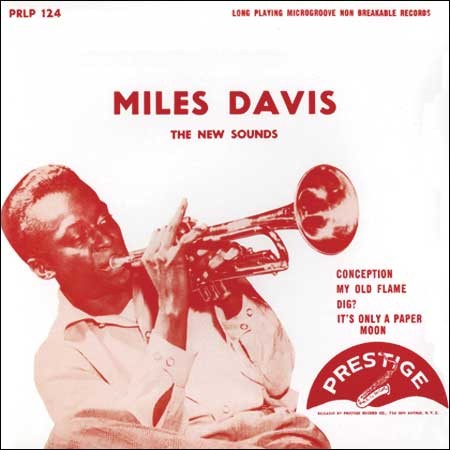
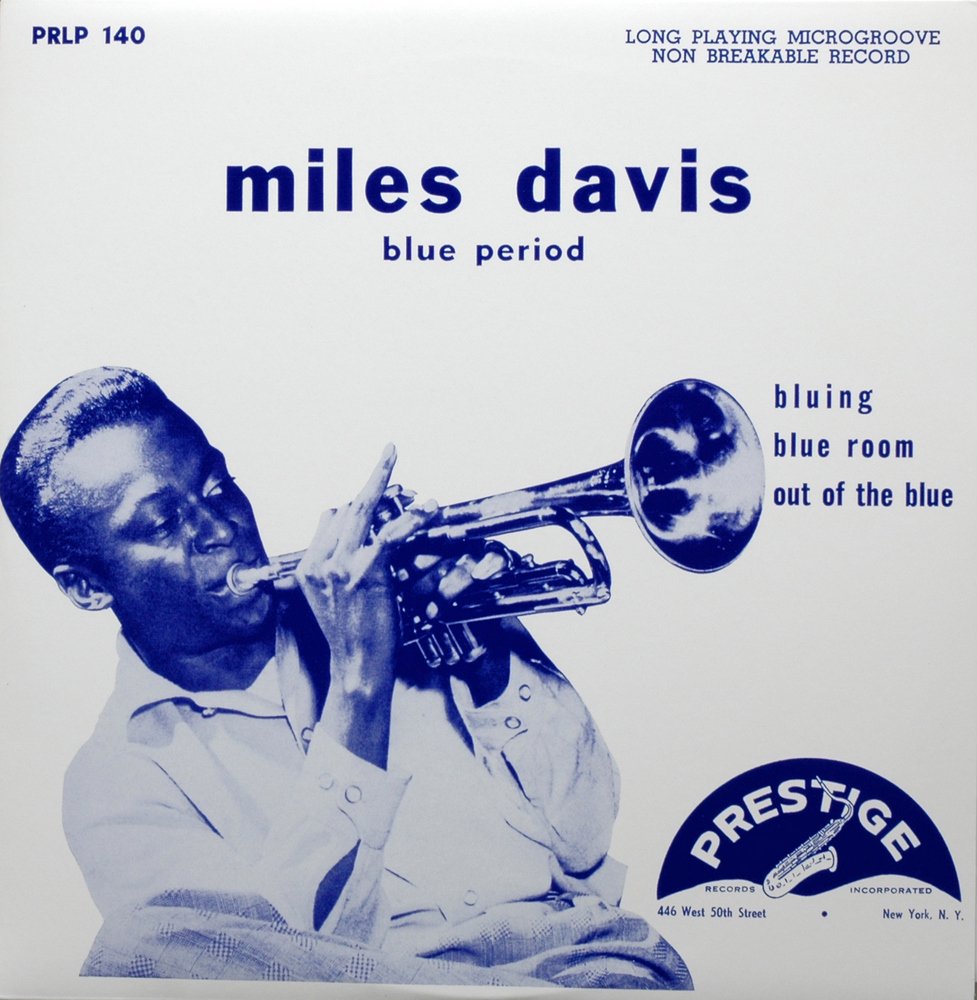
But this may have been the first Prestige session directly aimed at the LP format, and it was released in a few different formats -- as PRLP 124 - Miles Davis: The New Sounds (Conception/Dig/My Old Flame/It's Only a Paper Moon) and PRLP 140 - The Blue Period ("Bluing" and "Out of the Blue," along with the alternate take of "Blue Room" from the previous session). Ira Gitler was writing the album cover notes by that time, and here's what he had to say (liner notes thanks to the Plosin website, very complete on Miles).

THE NEW SOUNDS
When an artist is simultaneously recognized, by critics, fellow artists, and the public analogous to his art, as the foremost in his particular field, the work of the artist invariably substantiates the status given him by this audience. Such is the position of Miles Davis as the most important creative trumpeter today. Acknowledged first by musicians, Miles, soon drew the ears of discerning critics into appreciative attentiveness and finally the jazz public accorded him their appreciation in the Metronome and
Downbeat polls.
Of course, Miles is to be appreciated for bringing a new sound and conception to the trumpet but what really gives him his greatness are the intangibles he possesses, which enable him to transmit sweeping joy with his "wailing" solos and reflective beauty in the delicacy of his ballads.
This album gives Miles more freedom than he has ever had on record for time limits were not strictly enforced. There is opportunity to build ideas into a definite cumulative effect. These ideas sound much more like air-shots than studio recordings.
Upon the wonderful rhythmic foundation of Art Blakey's drums, Tommy Potter's bass, and Walter Bishop's piano, tenorman Sonny Rollins and altoman Jackie McLean are able to enjoy some of the unlimited time for their solo efforts. Rollins demonstrates the impact of the intangibles, again, with his solo on "Paper Moon". The way in which the solo is constructed and the feeling and time with which it is played, overshadow the marring reed trouble. McLean, still in his teens, is heard only on "Dig". He need not apologize for his youth after his work here. Walter Bishop appears in solo for a brief moment on "Conception" which gives only an inkling of his marvelous playing.
Here are New Sounds at greater length. Listen to them at great length.


and

MILES DAVIS - BLUE PERIOD
An album by Miles Davis represents modern jazz at its best. In this album as in Miles' PRESTIGE LP 124, the length of time for each selection is not restricted to the usual limits except in the case of BLUE ROOM, which was cut at a more conventional session. BLUING, the high spot of this set, is over nine minutes of freedom of expression on
modern blues chord changes. At the very end, Art Blakey continues playing after everyone else has stopped. If you listen closely, you will hear Miles say something like, "You know that ending man, let's do it again", but why do it again when you've captured the feeling in the solos of Walter Bishop, Miles, Sonny Rollins, Jack McLean, and the inventive drumming of Art Blakey. The advantage given by LP, of not having to make a "product" for the juke bokes, allowed us to keep this take. OUT OF THE BLUE (Miles' plea to get happy) was done at the same session and although not as lengthy as BLUING, still provided ample time for relaxed improvisation.
This album is a must to those who appreciate our modern jazzmen. I know that people who have missed hearing these musicians in person, will be especially gratified, because this is what they have been missing.

But the major release of this one came in 1956, remastered by recording genius Rudy Van Gelder, and issued as a 12-inch LP as Dig. This, with the moody, dark cover image of Miles in shadow, and the terse title, was one of the benchmarks of hip in my young life.

And here's Gitler on the reissue:

These are some of the first "longer playing" recordings made possible by the advent of the LP. Recorded on October 5, 1951, this entire session has been remastered by top engineer Rudy Van Gelder. (The two remaining selections from this date, Conception and My Old Flame, are included in CONCEPTION, PRLP 7013)
Miles Davis and Sonny Rollins form one of the most empathetic and powerfully moving duos in jazz. Although they had recorded together before (Morpheus, Down, Whispering, Blue Room) this was their first chance to "stretch out" together on records.
These recordings have much warmth. The emotions jut out of all the solos. On Paper
Moon and Bluing this is especially true, but it is in evidence on the upper tempos too. Dig is fluid. The chord changes lend themselves to the long melodic lines that the soloists employ. There is also a continuity of feeling from one soloist to another which points up the aforementioned empathy.
The group is made a sextet by altoman Jackie McLean on all numbers but Paper Moon. Jackie, in his teens when these recordings were made, was then a disciple of Charlie Parker. The Bird influence is still with him but the light of it is partly directed through the prism of Sonny Rollins.
Incidentally, Bird was present for part of this record sort of visiting with his children: Miles who gained his greatest experience and had his largest pleasures playing with him; Jackie, the young disciple; and Sonny, the reed voice who has become the foremost standard bearer and advancer of the Parker tradition.
The swinging rhythm here features the explosive drive of Art Blakey, the subtle power of Tommy Potter and the sensitive accompaniment and solos of the unduly underrated Walter Bishop.


More credit to Jackie McLean for those chord changes (even if they are the chord changes to "Sweet Georgia Brown") that lend themselves to long melodic lines. And more credit given to McLean by Gitler, who had said on the previous liner note that he only appeared on "Dig."

And by the way, a busy day for Art Blakey. He played on the Bennie Green session as well.


Wednesday, November 05, 2014

Listening to Prestige Records Part 47: Zoot Sims


A  busy day for Bob Weinstock, with this Zoot Sims set following Sonny Stitt and Gene Ammons -- and they weren't short sessions,either. This one has six songs, and at least three different versions of "Trotting" were kept -- one released on 78, and the other two saved in the vaults until they were finally released by Fantasy in one of their Prestige reissue packages.

And not these easiest session to sift through, because Zoot recorded most of these songs more than once, and while it was pretty clear that some of them -- like the 11-minute version of "Zoot Swings the Blues" -- were not from 1951. it was sometimes not so easy to figure out which ones were definitely from that session. I did finally find a couple I was sure of, on YouTube--"I Wonder Who" and "It Had to Be You," and one on Spotify -- "Trotting." Whether it's the 78 RPM original release or one of the alternate takes, I can't say.

Sims spent a lot of time in big bands, from the swing units of Benny Goodman and Artie Shaw to the modern sounds of Woody Herman and the Four Brothers to the ultra-progressive stylings of Stan Kenton, and perhaps the Goodman and Shaw experiences give him that swinging assurance, but it's his own lyricism and musical vision that allowed him to develop the extended solos that made him such a great leader of small groups over such a long period of time.

I'm interested, too, in what Weinstock was doing in the studio on August 14,1951. We're still a few years away from Rudy Van Gelder's engineering genius, but Weinstock is learning a few things. I said in my last entry that I hadn't yet heard a bass solo on a Prestige recording, and now here -- still historically on the same day -- we're finding, if not quite a lengthy solo, at least some strong bass presence.

The bassist is Clyde Lombardi -- like Sims, a swing-to-bop veteran, and a guy who could really play this kind of music. The pianist is Harry Biss, who sounds great, and has next to no biography. His Wikipedia entry states that "he performed and recorded with Georgie Auld, Billie Rogers, George Shaw, Herbie Fields, Buddy Rich, Brew Moore, Gene Roland, Zoot Sims, Terry Gibbs, Allen Eager, and Eddie Bert." That should be an impressive enough list of credentials, but the one reference listed on the Wiki page is to a 2007 Jazz Journal International article called "The Forgotten Ones," which seems to sum him up pretty well. Wiki also says that his career flourished between 1944 and 1952, and that he died in 1997, making him another one of those guys who should have been interviewed a lot more than he was.

If anyone should be irrepressible on drums,, it would be Art Blakey, but we've heard him featured on several Prestige recording sessions already, and he's been pretty repressed -- no bravura drum solos.

I know that drumming was historically hard to record. Baby Dodds was one of the great innovators on drums, but when he was recording in the Twenties, he could only use a wooden block, because the reverberations of a real drum kit would knock the stylus out of the groove of a wax cylinder recording. He was able to record his drum solos as a demonstration in the 1940s, but the issue of recording drums was far from solved.

I found this history of drum recording techniques online. In 1950, it says, there existed "very basic techniques when it comes to recording drums, most of the time positioning all instruments around one mic leaving the drums at the back as ambient sounds."

Here's a much more detailed history of the recording of drums, but what interests me right now is Bob Weinstock scheduling three recording sessions on August 14, 1951, and beginnings of new sound mixtures. Blakey doesn't take off into extended drum improvisations here, but he has his moments, just as Clyde Lombardi has his. And as we move forward into the 1950s, we'll see how this affects recorded small group jazz.

That sounds ridiculously formal. I'm not giving a lecture, I'm finding stuff out as I go along, and listening to music, and sometimes wondering and making guesses about what things were like back then.


Saturday, September 06, 2014

Listening to Prestige Records, part 29: Sonny Stitt/Gene Ammons Septet

Stitt and Ammons are back in the studio with a septet, with only a few changes. Bennie Green replaces Eph Greenlea (about whom I can find no information and no more discography), and Jo Jones is replaced by the younger and more boppish Art Blakey, who makes his presence felt immediately. The biggest change, though, is Sonny Stitt switching from tenor to baritone (he'd already, in his career, switched from alto to tenor).

I've mentioned that Gerry Mulligan, in 1950, was still better known as an arranger than an instrumentalist, and he had not yet established himself as the voice on the baritone sax. You don't hear anything in Stitt's playing to suggest he'd spent much time listening to Mulligan -- rather, that he wanted to show that he could play bebop on any saxophone. The baritone also adds a richness to the ensemble parts, and according to this jazzophile:
 He had small ensemble w/ Gene Ammons during this period where they switched on baritone-- Stitt would play bari in the section when Gene played and vice-versa.

This is an odd session. The songs are "Chabootie," "Who put the sleeping pills in Rip Van Winkle's Coffee?", "Gravy (Walkin')," and "Easy Glide." The first two are the odd ones -- the long ensemble intro in "Chabootie," longer than it probably needs to be, and the vocal, if you can call it that, on "Sleeping Pills," where it sounds as though the whole band is singing along, and they're making no attempts at harmonizing or jazz styling -- they sound like a bunch of Irishmen in a pub.

If this sounds negative, it is and it isn't. My guess is that these were aimed at jukeboxes -- the Basie-style ensemble piece and the novelty vocal. Prestige probably needed some jukebox play -- I doubt that they'd had a hit since "Moody's Mood," although they'd put out some great music.

George Benson, when he was criticized by jazz purists for his pop records, maintained he was still playing jazz -- he said that if he put strong, poppish hooks at the beginning and end, he could play anything he wanted in the middle. And that's true of both of these songs.

After the ensemble choruses on "Chabootle," Stitt enters with one of Charlie Parker's signature riffs, given a new timbre on the baritone sax, and they're off from there, with some absolutely lovely solo work, and some pepper from Blakey. The same is true on "Sleeping Pills" -- the solos on that number are definitely not the work of drunken Irishmen.

What was it with beboppers and Mrs. Murphy and her overalls? Harry "the Hipster" Gibson had a huge hit (and got himself in a lot of trouble) with "Who Put the Benzedrine in Mrs. Murphy's Ovaltine?"

OK, if these were meant for the jukebox crowd, and I'm betting they were, there was some serious bet-hedging on Bob Weinstock's part. "Chabootie" was put out on 78 and 45 on the flip side of Gene Ammons playing "Blue and Sentimental," "Sleeping Pills" on 78, on the flip side of "La Vie en Rose."

I can't find any of these cuts on YouTube or any of the other video sites, but you can get them all on Spotify.

Monday, August 18, 2014

Listening to Prestige Records, Part 21: Sonny Stitt

A gap in the timeline. Eddie "Lockjaw" Davis recorded four sides for Prestige on February 7, 1950, but while Davis is widely represented on both Spotify and YouTube, I can't find this session anywhere. Too bad. Davis was joined by Al Casey, already an oldtimer in 1950 (I heard him play in the '90s with the Harlem Blues and Jazz Band), a veteran of Fats Waller's band among others; and 19-year-old Wynton Kelly, in his first recording session. Two cuts had vocals by R&B vocalist "Chicago" Carl Davis, which makes me really sorry not to have found it -- I'm always interested in the overlap between modern jazz and rhythm and blues in this time period.

Then two European sessions, one led by French pianist Jacques Dieval, about whom even the French Wikipedia has next to nothing (but James Moody and Nat Peck played on the two-song date), and the other by a Swedish group led by vibraphonist Ulf Linde.

So the next session we have access to is Sonny Stitt again, this time with a different group of sidemen, including Art Blakey, who's most associated with Blue Note, where the Jazz Messengers recorded a lot of their albums, but who had a Prestige presence as well. Blakey, ageless and prolific, actually recorded for a lot of labels.

Without Bud Powell, most of the solo space here goes to Stitt, and the session is more ballad-oriented. Of the selections, I especially liked "Mean to Me," which is a beautiful melody, and lends itself to bluesy improvisation.

This was another of the handful of recordings originally released on the Birdland label.