Showing posts with label Bob Weinstock. Show all posts

Wednesday, October 04, 2017

Listening to Prestige 275: John Coltrane

Coltrane and Donald Byrd are a great combination, back together again after a January session, so Bob Weinstock must have really liked what he heard, and what's not to like? But it's Coltrane who really holds the interest right now. The "happy young man," in Ira Gitler's words, was on a creative tear. Just five months into the year, he was already on his sixth studio session for Prestige, and that was only part of it. He had done two dates with a group led by Wilbur Harden for Savoy, and don't forget, he still had his bread and butter gig, with Miles Davis. By May 23rd, he had recorded two studio sessions and two live sessions with Miles. And when he went out to Rudy's for his Friday Prestige date on May 23rd, he had another recording scheduled with Miles for the following Monday, in New York, at Columbia's 30th Street studio.

Turning your life around, getting off drugs, gives you energy to burn, and Coltrane was burning it. But it wasn't just energy. He was burning with musical ideas, too, which is what makes this period so exciting.

The music was exciting. What Gitler called "sheets of sound," a phrase that's become firmly implanted in the jazz lexicon. It meant Coltrane playing every note associated with every variation on a given chord, more or less at the same time. Or something. It was sort of like the rapid-fire runs through variations on chord changes that the beboppers had pioneered, except that it wasn't. But it had that same questing urgency, that sense of listening for something new, just beyond the horizon. Listening to it now in the chronological order of the music being made (this session was not released until 1964), one can really feel a part of that quest.

"Black Pearls" is a Coltrane original, "Lover Come Back" is the Sigmund Romberg melody that's

become such a favorite of jazz modernists. "Sweet Sapphire Blues" is credited to Bob Weinstock as composer, and that might raise eyebrows, since it was such common practice in those days for DJs or record company executives to put their name on songs they had not in fact written. This one was a little different. They had gone through the first two tunes, and they still had studio time, and they did not yet have enough to fill out an album. This could have been OK--Weinstock wasn't planning to release the session right away anyway, and he could always have found other ways to fill it out. Or they could have done what they so often did: what Rudy Van Gelder called the "Five O'clock Blues," an impromptu improvisation on a familiar blues riff, or a half-finished idea by one of the musicians. In this case, when Weinstock asked Trane for one more tune, Trane responded, "Why don't you write one?" As Weinstock recalled, he recoiled from the idea--one thing he was sure of, he didn't know how to write a song. But Trane kept teasing him: "How about this?" and he'd play a few notes. If Weinstock said OK, he'd play a few more: "How about this?" Before long, they had strung something together, and Trane said, "OK, you wrote it."

The result is a little like the routine Steve Allen used to do on TV. He'd call up four people from the audience, have each of them strike a note on the piano, and then do a jazz improvisation based on those four notes. A little like that, except better. The melody is jagged but interesting, and five supremely gifted musicians were able to improvise on it for 18 minutes, or one full album side.

Why "Sweet Sapphire Blues"? That's lost to history, unless they'd been watching Amos 'n Andy before the session. In any case, it wasn't likely to be the title of the album, nor was the Romberg melody. So Black Pearls it was. It was also released as a two-sided 45.


Order Listening to Prestige Vol 2

Listening to Prestige Vol. 2, 1954-1956 is here! You can order your signed copy or copies through the link above.


Tad Richards will strike a nerve with all of us who were privileged to have lived thru the beginnings of bebop, and with those who have since fallen under the spell of this American phenomenon…a one-of-a-kind reference book, that will surely take its place in the history of this music.

                                                                                                                                                --Dave Grusin

An important reference book of all the Prestige recordings during the time period. Furthermore, Each song chosen is a brilliant representation of the artist which leaves the listener free to explore further. The stories behind the making of each track are incredibly informative and give a glimpse deeper into the artists at work.
                                                                                                                --Murali Coryell


Wednesday, February 15, 2017

Listening to Prestige 245: Jackie McLean

This is around the time when Bob Weinstock stops being the hands-on guy in the studio (although his idea of hands-on was mostly hands off), and starts turning some sessions over to other producers. He's had Teddy Charles produce a few, but those were really Teddy Charles projects.

Here he gives over some of his regulars to a new guy, Don Schlitten. And this is, in fact, a session that makes up part of an album begun back in February, with Weinstock at the helm. Schlitten was a young guy -- at 24, four years younger than Weinstock, and at the beginning of a long career in jazz. Like Weinstock, he had started his own label at a young age,

but perhaps had not had the business acumen, or perhaps just hadn't found his focus yet. His label, Signal, which he formed with Ira Gitler, did some significant work, recording Duke Jordan, Gigi Gryce, Red Rodney, Cecil Payne, and a live tribute to Charlie Parker from the Five Spot. They also put out an interesting series called Jazz Laboratory, which was sort of similar to Music Minus One. It featured quartets led by pianists like Duke Jordan and Hall Overton, with one horn player. On the reverse side of the album, the horn player dropped out, and the remaining trio did the same songs.

After a couple of years, Schlitten sold the label to Savoy, and went into independent production. He would go on to form other labels, and make a major contribution to jazz.

He brings a few faces to this session in the rhythm section. Jon Mayer didn't make much of a name for himself in the 1950s (and the name he did make was not entirely his own, if this session is an indication), but that would  change several decades later. He made one other album (with Coltrane), played on gigs with Ray Draper (who may have recommended him here, as he did earlier with Webster Young), Kenny  Dorham, Tony Scott and others, and in the 60s he performed with the Thad Jones/Mel Lewis big band, and accompanied Dionne Warwick, Sarah Vaughan and the Manhattan Transfer. Then he dropped out of sight until the 1990s, when he made a series of highly regarded albums, including a couple with Mark Feldman's Reservoir Records, out of Kingston, NY. He is still active.

Bill Salter is probably best known for his years as bass player and musical director for Miriam Makeba, but he picked an odd route into jazz--his first professional job was with Pete Seeger. Salter sort of passed through jazz. It was only part of what he did. His folk music credentials included Harry Belafonte and John Prine as well as Seeger. He was in the pit for Broadway shows. He wrote hit songs for Shirley Bassey, Roberta Flack and Donny Hathaway, Grover Washington, Jr. and Rod Stewart.  But as he passed through, he left a mark: recordings with Sabu, Herbie Mann,Yusef Lateef, David "Fathead" Newman, Rahsaan Roland Kirk. He currently plays traditional black vaudeville music with his own group, the Ebony Hillbillies.

Like Gil Melle and Larry Rivers, Larry Ritchie was torn between painting and music, and over time he drifted more into painting. He would be back in Hackensack one more time in 1957, recording with Ray Draper and John Coltrane.

Draper and Webster Young make up the rest of the sextet part of the session, and Draper contributed one tune, the oddly named  "Disciples Love Affair." McLean pairs down to a quartet for the final number of the day. "Not So Strange Blues" is sort of a companion piece to "Strange Blues," from the earlier session, and it may not be strange, but it sure is the blues.

If Schlitten was looking for instant recognition from his first Prestige session, he was doomed to disappointment. Strange Blues, which included these three tracks, would not be released for another ten years. But Weinstock was satisfied enough to hand him more assignments. And this whole McLean project was pretty weird. The long February session, which included "Strange Blues," would be released in dribs and drabs on New Jazz starting in 1959.

Friday, July 22, 2016

Listening to Prestige 196: Sonny Rollins

Am I getting too much 1950s jazz? Is it all starting to sound alike?

No, and no.

Every album, every recording session, has been a unique and uniquely satisfying experience, and I continue to find this one of the most rewarding projects I have ever undertaken.

Obviously, I can't say that some sessions have been more uniquely satisfying than others, not if I have any respect for the English language. Each has been unique; each has given me something new and significant in my understanding and appreciation of jazz. But some have leapt out at me with particular force. Like the one before this, making me appreciate the richness of Tadd Dameron's compositions, made all the more special because he recorded so seldom.

On the other hand, I'm very familiar with Sonny Rollins's gifts as a composer and an improviser, and Lord knows his recording career has been prolific. But this one leapt out at me nonetheless. Why? Just because. Because his playing is so hot on this session: so creative, such high energy. Another reason could be that this is my farewell to Sonny on Prestige. He'll move on to a number of different labels: Blue Note and Riverside in New York, Contemporary on the West Coast. He'll record for RCA Victor for a while, and for various European labels. Then for Impulse, for Milestone, for lots of other folks. Anyway, I only found this out after I started reading background stuff, so it wasn't part of my immediate response.

The session contains three compositions by Sonny, and three songs by others. The Rollins compositions are the ones where the energy level really goes through the roof. "Ee-ah," in particular, combines the honking urgency of rhythm and blues with the creative daring of bop. I love it. 'B Quick" and "B Swift" are, if anything, taken at an even higher level of intensity, propelled by an unflagging and unforgiving Max Roach, over an incredible nine minutes for the first number. I like to imagine a spectator in the booth, drenched with sweat and exhausted just from listening to what these cats are doing, saying, "I betcha you can't do that again." "I betcha we can," Max retorts..."but maybe a little shorter this time." "B Swift is just as intense, but clocks in at five minutes."

And so to "Sonny Boy," which does what only jazz can do--it takes a familiar melody and turns into something entirely new. Screenwriter William Goldman, in his fascinating book, Adventures in the Screen Trade, discusses a screenplay he wrote for Gene Hackman, about a druggist who tries to break up an affair between his son and a married woman, but ends up having an affair with her himself. Goldman points out that the story is what it is because of a set of decisions that could as easily have gone in different directions. Instead of being a drama, it could have been a bedroom farce, which lovers hiding in closet s and under beds. If, instead of Gene Hackman, the producers had cast Faye Dunaway as the lead, it would have been story of a wife having to juggle not just one lover, but two, and then finding out that they were father and son. Or they could have cast John Travolta as a boy whose Oedipal problems take on a whole new twist. Or maybe they could cast Robert Duvall as the husband, a macho firefighter who loves his wife but has neglected her...

"Sonny Boy" was written by Tin Pan Alley stalwarts DaSylva, Brown and Henderson as a tearjerking vehicle for Al Jolson, and the emotional center of the song is the doting father. But in Sonny's version, we've changed the focus. Jolson as kindly, sentimental old father figure is no longer the star. Now it's Rollins as Sonny Boy, and he's not climbing up on anyone's knee. The song is completely transformed. It's macho, it swaggers...and it works. A number of jazz musicians, most notably Lester Young, have said that they always hear the words of a ballad when they play it. My guess is that Sonny pretty much tossed out the words when he did this one.

The two Earl Coleman cuts don't work quite as well, Coleman had cut loose from his Billy Eckstine roots in his last outing for Prestige, and was really beginning to develop as a contemporary jazz singer. Here, in spite of having Rollins, Drew and Roach to inspire him, he's back in the Mr. B. groove.

He's also working with not the best material. Every now and then, Prestige would give a contemporary hit ballad to one of its jazz acts, and they do that here with "Two Different Worlds," a 1956 chart hit for Don Rondo. The Great American Songbook had mostly closed by 1956, and a lot ballads from those years simply weren't that good. "Two Different Worlds," written by Al Frisch, known for not much besides this song (he did write "Broadway at Basin Street," an early Cannonball Adderley recording) and Sid Wayne, known for writing most of the really second rate songs that weighed down the Elvis movies, is one of those not very good ballads, and maybe a lush Mr. B-type approach is all you can do with it.

His second song is "My Ideal," written by Richard Whiting, one of the A-list tunesmiths. It's become a standard, and there have been some great jazz recordings, but for me the version that stands out is the one by Whiting's daughter Margaret, with the pure and lyrical innocence of a young girl yet to find her first love. That's not Mr. B., and it's not Earl Coleman.

Perhaps Bob Weinstock was looking for a cover record to Don Rondo's hit (Roger Williams / Jane Morgan and Nat "King" Cole also covered it), but if so, he must have changed his mind, because Coleman's numbers never were released on 45. "Ee-Ah" was, with "They Can't Take That Away from Me" from the Bird tribute album on the flip side. Let's hope that got some play on the rhythm and blues stations. It deserved to.

"Ee-Ah," the two "B" cuts, and the two Earl Coleman cuts were released in 1957 as Tour de Force. The same tracks plus "Sonny Boy" and minus Coleman came out as Sonny Boy" in 1961. Also on the latter album: "The House I Live In,"  written as a leftist anthem by Earl Robinson but co-opted as a patriotic ditty by Columbia and Frank Sinatra, and recorded earlier in 1956 by Rollins on the Bird session.


 Order Listening to Prestige, Vol. 1 here.

Saturday, February 06, 2016

Listening to Prestige Part 169: Gene Ammons

What does a producer of jazz records do? Probably, at best, not all that much. Bob Weinstock recalls that he and Miles Davis would sit down and kick around names -- who's in town, who would you like to record with? -- and that may have been the most of it. Weinstock had his jam session philosophy -- no rehearsal, just get 'em together and let 'em play -- and even so, Miles complained later that he (and every other producer Miles worked with) interfered too much.

So what about this session? Gene Ammons was one of Prestige's stalwarts, going back to the early days, often paired with Sonny Stitt, just as often without, generally preferring the fuller sound of a larger-than-quintet group. For a while he worked with a more or less steady group. almost always including trumpeter Bill Massey. By 1955, he had begun branching out. His three 1955 sessions for Prestige saw almost a complete turnover from session to session (Art and Addison Farmer were on one of them).

Why? Ammons had trouble keeping a group together? Seems unlikely. With his warm touch on ballads, earthy touch on blues, ability to wail with the best of the R&B saxmen, Ammons was one of the most popular jazz artists of the day.

Or perhaps, as he had done with Miles, Bob Weinstock sat down with him and said, "Hey, Gene, let's start mixing it up some. Look how well it worked with Miles. We'll kick around some names, get a bunch of guys together in the studio, see what happens."

So maybe that's what a producer of jazz records does.  And how much careful thought and planning went into choosing that bunch of guys? I'd like to think very little. Art and Addison Farmer were around -- they'd just played the Bennie Green session a week or so earlier. The others were inspired choices, but none of them would have required a lot of thought.

What about Candido? Did Bob Weinstock and Ira Gitler sit up all night, saying "We've got to find something new for the next Ammons recording. How about a French horn, like the Miles Davis nonet? Bring Earl Coleman back for some vocals? Or a pianoless group like Gerry Mulligan? Wait! I've got it! We'll bring in some Latin percussion!" Or did Candido just happen to drop by the office that day, and say "Hola - I'm looking for a gig. Got anything?"

I like to think it was the latter.

And Duke Jordan? He was certainly doing a lot of session work in the 50s, not all that much of it with Prestige. He'd played with Art and Addison on a Farmer/Gryce session the previous fall. But for whatever reason they chose him, it was an inspired choice. It goes without saying that with Candido on board, you're going to have some hot rhythms, but it's Jordan whom I keep hearing driving this session. He turns out to be the real inspired choice.

Jordan had also recently written what was to become his most famous composition, "Jor-du," and one certainly wouldn't be surprised to hear it on a date where he was playing, but not so on this one.

Which raises another "what does a producer do?" question. Who chooses the tunes that will go into a recording session, and what's behind that? Obviously, there's a few extra bucks for the composer, and especially for the publishing rights, but there weren't all that many bucks in jazz overall, in those days. Jackie McLean seems almost certainly to be the composer of "Dig," for which Miles Davis took the credit, but when McLean looked into suing over it, he was told not to bother -- even if he won, there wouldn't be any money in it.

Still, you had a couple of excellent composers on this date (in addition to Jordan) and it's no surprise that they're represented--McLean with "Madhouse," Art Farmer with "The Happy Blues."

It's also not surprising that a standard was included. Ammons was great on ballads, and Weinstock liked standards, and although not much jazz was being released on single records any more by 1956, Ammons was still a jukebox favorite. Why "Can't We Be Friends" in particular? Why not? It's a beautiful song.

The one that really interests me is "The Great Lie," a swing era song by Andy Gibson -- credited to Gibson and Cab Calloway. Perhaps there were lyrics by Calloway? I could not find a version of it that included a vocal, but I did find a reference to it in a list of WWII-era songs by Calloway that had social commentary.

Andy Gibson was an underrated composer, whose best known work is probably his brilliant rhythm-and-bluesification of Charlie Parker's "Now's the Time" -- "The Hucklebuck."

It's certainly not unusual for a big band tune to be picked up and adapted by moderns, but I decided to see how this one mutated with different versions, so I listened to four: Cab Calloway (without vocal), Charlie Barnet, Gene Ammons, and Chet Baker/Art Pepper.

I liked Calloway's version, but loved Barnet's. And it brought home to me just how much big band music was an arranger's medium. I don't know who the arranger was for this version of "The Great Lie" -- it could have been Gibson, who worked a lot with Barnet. But it's wonderful, with the shifting horn patterns and solos that weave in and out of them. Charlie Barnet, like Artie Shaw, was heir to millions, and like Shaw, he got out of the music business at a fairly young age, and is probably underrated. Certainly he was by me -- I had listened to "Cherokee," maybe nothing else. This is a terrific band, and a terrific number.

Like Woody Herman, Barnet was open to the influences of bebop, and his later bands had some of the finest modern jazz musicians. But as we move seriously into the bebop-hard bop era, you can hear, listening to Barnet and then Ammons, how much the emphasis has shifted to the soloists. Both versions are hard-swinging, and they share a lot more in common than you'd think. The swing band is fresh and innovative, the bop ensemble is melodic. With all those great soloists, the Ammons band extends the tune a lot longer than Barnet's traditional song, 78 RPM length. Ammons goes nearly nine minutes, and everyone gets solo space, and makes the most of it.

With Baker and Pepper, it's pretty much all solos, and it's cool, and mellow, and all the things you expect from West Coast jazz, and also quite cerebral, but they don't forget to swing, either. And just as I found myself caught up by Duke Jordan's contribution to the Ammons group, I found myself listening to Leroy Vinnegar here, who really propels the swing of the two cool soloists with his bass.

"Madhouse" is the Jackie McLean composition, and it's also the one where Candido really shines.

It's also the one that ended up on the jukeboxes. If Weinstock had thought about using the ballad, he would have had to think again, when the boys stretched it out to over 12 minutes. Of course, "The Happy Blues," which did become the single (as Parts 1 and 2) was also over 12 minutes, but maybe it was easier to edit down. It was also the title track for the LP.


Wednesday, December 09, 2015

Listening to Prestige Part 157: Miles Davis

I woke up this morning thinking "The one thing that this blog/book series is going to be judged on is whether I got Miles Davis right."

Well, you think a lot of strange things when you're waking up, but there's no overestimating how important Miles was in the history of American music.

We're at a crucial juncture in the Miles Davis/Prestige Records story: that is, the end of the story. Miles jumps to Columbia, has to finish his obligation to Prestige, does it in two marathon sessions that maybe should have sounded rushed and perfunctory but instead produced some of Miles's best-loved albums.

I had somehow thought that this was done all at once--two days, two marathon sessions, in and out, so long Bob. But actually, it was a little more spread out than that. One session in the summer of 1956, one in the fall. And this one, near the end of 1955.

 Why am I suddenly so self-conscious about writing about the Prince of Darkness? It's not as though I haven't covered him before. And it's not as though Miles is the central figure in this fragmented narrative. I'm just  as interested, if not more so, in learning about Lawrence Wheatley, who made a passionate commitment to live jazz, and chose never to record again. Or Freeman Lee, who left the road to become a beloved junior high school science teacher. I'm just as interested in trying to find out if the Junior Parker who recorded with Stan Getz is the same one who made "Mystery Train." Or finding out that Teddy Charles' professor at Juilliard later taught Steve Reich, and wondering if the inventive jazz musician influenced the celebrated modern composer.

I suppose it's because so much has been written about Miles, and so may people have read it. And I mostly haven't. There are biographies. There's an autobiography, There are even specialized books, like the one on the making of Birth of the Cool. I actually have read that one. I have so much better chance of being found wrong, in writing about Miles.

So I woke up this morning thinking maybe I ought to read a biography of Miles before going on. And I probably will, before I finish up with him in 1956. But not just yet. Now I want to stay in my head, and float a few hypotheses, wrong though they may be.

Miles's transition to Columbia was far from overnight. By the fall of 1955, he had signed with Columbia, and he had even made his first Columbia recording, though it wouldn't be released right away. That was the deal--he could record for Columbia, but the records could not be released until after he had completed his obligation to Prestige.

And altogether, the Prestige obligation was completed in three sessions: the two marathons in 1956 and this one mini-marathon from November, 1955.  

So the Columbia date in October was actually the first recording session for what came to be known as the First Quintet: Miles, John Coltrane, Red Garland, Paul Chambers, Philly Joe Jones. They did four songs, and the rhythm section did a fifth.

The Prestige session of November was long but not quite as grueling as the later ones. The group recorded six songs, which were released as Miles in April of 1956.

The first Columbia album, Round About Midnight, came out in 1957, and was not all that well reviewed. Critics found it wanting in comparison to the Prestige albums, though this judgment was to change over time, and Round About Midnight would become a classic and beloved jewel in the Davis crown. But the first response to it was tepid, and this strikes me as interesting.

First off, had I been George Avakian, and had I had the benefit of my own hindsight, I would have told Miles not to record his long Prestige swan song with the quintet. "Come on, Miles, do what you've always done with Bob. Put together a pickup group with whoever' around. You can use that piano player, Lawrence Yardley. He just played on an Ammons session and I bet he'd love to get more recording work. Maybe get Ammons, too, or how about James Moody?  Throw in a vocal -- Prestige has that guy King Pleasure, and they're not using him much. Save the quintet for the big Columbia unveiling."

But what really interests me here is the possibility that the passing of time may have led to a changing of tastes. Today, there's a lot more awareness of the evils of conglomerates and mega-corporations than there was in the 50s, and an indie label, or no label at all, might get a more sympathetic ear from critics, especially indie critics. But back then, I don't think this would have been an important issue. 

The 50s were marked by the advent of Rudy Van Gelder and a new era in jazz music recording. But
recording equipment continued to evolve, and big studios were able to constantly upgrade to the newest state of the art. Tape made editing simpler. So did multitracking and, eventually, digital recording. Today we have AutoTune, and you can virtually make the Singing Dogs sound like Pavarotti. 

Even in 1956 at Columbia, they were starting to push the possibilities of studio recording. "Two Bass Hit" took six takes, and the finished version splices the beginning of take two to the end of take five. Artists (including Miles) would come to take it for granted that if they missed a high note, they could come back into the studio and hit just that one note, and have it spliced in.

Today some critics, perhaps many of them born and raised in the in the era of studio perfection, are a little snarky in assessing the Prestige catalog. Ragged, they say. Bob Weinstock preferred quantity to quality, rushed his sessions, didn't allow his musicians to rehearse, never did more than a couple of takes. But maybe back then, that ragged edge was more appealing, more authentic. Maybe the critics of 1957 were put off a little by the studio-perfected sound.

Miles was the LP from this session, and it came out in April of 1956. "Sposin'" and "Just Squeeze Me" were released on 45.,

Wednesday, September 16, 2015

Listening to Prestige Part 145: Miles Davis

This is an interesting period in Miles's career. This session was recorded in June of 1955, and he was still working with Bob Weinstock's philosophy:
So, our basic idea was just to make records with different people, to record with the best people around...we would sit down and talk about it. Miles would mention who was in town, who he would like to record with. I'd say who I'd like to hear him record with.
 That was about to change. Miles was healthy by this time, free from heroin addiction, working out regularly. Although he did not mix it up with Thelonious Monk during their session of the previous December, as was rumored at the time, he was working out in the gym regularly, including sessions on the light punching bag.

In July, he played the Newport Jazz Festival with an all-star group, including Thelonious Monk, although they would never record together after the December dustup. The rest of the group was Gerry Mulligan, Zoot Sims, Percy Heath and Connie Kay, who had just joined the Modern Jazz Quartet to replace expatriate-to-be Kenny Clarke. Miles doesn't appear to have been a part of the official festival lineup, but Columbia producer George Avakian heard him and his group jamming on Monk's "Round Midnight," and immediately recruited him for Columbia. Avakian had exactly the opposite to Weinstock's philosophy. He wanted Miles to put together a regular and recognizable group. Avakian's idea turned out to be the stroke of genius that put Miles over the top, but we can only be grateful, as well, for Weinstock's "jam with Miles" sessions.

It appears that, without necessarily planning it that way, Miles was already assembling that regular group. Oscar Pettiford wouldn't remain--reportedly his personality clashed with Miles's--but Red Garland and Philly Joe Jones would.

Jones had only recorded once before with Miles, but the two had spent time on the road together during Miles's self-imposed exile from New York. Garland had played on various dates with Billy Eckstine, Roy Eldridge, Coleman Hawkins, Charlie Parker, Lester Young and Eddie "Cleanhead" Vinson (John Coltrane was also in Vinson's band), but he was pretty much unknown when Miles tapped him. They had boxing in common as well as music--Garland, as a welterweight, had actually fought Sugar Ray Robinson.

Ira Gitler, in preparing the liner notes for the Prestige album from this session, talked to Miles about musicians he admired. This must have been after Newport, so Miles must already have been thinking about who he wanted in the group he'd be forming.
I asked Miles who his current favorites were. On his own instrument he quickly named Art Farmer and Clifford Brown as the new stars and Kenny Dorham as one who has come into his own. Then he spoke lovingly of Dizzy Gillespie. "Diz is it, whenever I want to learn something I go and listen to Diz." In the piano department two Philadelphia boys, Red Garland (heard to good advantage in this LP) and Ray Bryant were mentioned along with Horace Silver, Hank Jones, and Carl Perkins, "a cat on the Coast who ploys bass notes with his elbow'. The talk shifted to saxophone and to Sonny Rollins and Hank Mobley who are carrying on the tradition of Charlie Parker. This naturally started us talking about Bird. Miles credited his most wonderful experiences in jazz to his years with Bird. He stared slowly ahead *Like Max said, New York isn't New York anymore without Bird." Max's name being mentioned directed the conversation to drummers. "Art Blakey and Philly Joe Jones; Max For brushes." Miles is very conscious of drummers. Many times he will sit down between the drummer and bass player and just listen to what the drummer is doing.
Miles did actually play with Kenny Dorham once, in a 1949 all-star big band in Paris, Le Festival International de Jazz All-Stars.

He recorded a few times with Dizzy Gillespie, first on a 1945 session with Charlie Parker, but Diz mostly played piano on that session. He was supposed to strictly play piano, but the youthful Miles was so nervous about playing with his idols that he broke down completely on "Ko-Ko," and Dizzy had to step in. He played in a trumpet session with Dizzy and Fats Navarro in 1949. Fats was gone, of course, by the 1955 conversation with Gitler. This was the 1949 edition of the Metronome Allstars, a group of Metronome Magazine's poll-winners that was gathered for a recording annually throughout most of the Forties and well into the 50s. Metronome would gather together as many of the poll winners as they could, and fill in the rest with runners-up. 1949's group was more than a little impressive: Miles Davis, Dizzy Gillespie, Fats Navarro (trumpet); J.J. Johnson, Kai Winding (trombone); Buddy DeFranco (clarinet); Charlie Parker (alto saxophone); Charlie Ventura (tenor saxophone); Ernie Caceres (baritone saxophone); Lennie Tristano (piano); Billy Bauer (guitar); Eddie Safranski (bass); Shelly Manne (drums).  There was another session with Bird in 1953, and then nothing until 1989, where they appeared as the trumpet session on a very strange Quincy Jones recording that features vocals by Ella Fitzgerald, Sarah Vaughan, and rappers Big Daddy Kane and Kool Moe Dee. I'm not certain it's an entirely successful experiment, but I'm sure as hell not certain it isn't.

But he wasn't looking for another trumpet player to round out his new quintet. He was looking for a tenor sax, and actually, Sonny Rollins was his first choice. Rollins played with the new quintet in July, right after Newport, but the arrangement wasn't to last. Sonny had his own heroin habit to kick. John Coltrane was not yet on Miles's radar. Hank Mobley would play with the quintet, but not until years later.

Miles would use Ray Bryant on piano a month later, in another one of his Prestige pickup groups, but
Red Garland was to be his man. At the time of this recording, and this interview, Garland was the least-known of the piano men that Miles admired--even including Carl Perkins, who would die too young to establish much more of a reputation, and who really did play bass notes with his elbow, his left arm having been crippled by polio. But Miles clearly had his eye on Garland already.


When you think of answer songs, you're more likely going to think of country ("It Wasn't God Who Made Honky Tonk Angels") or rock ("Sweet Home Alabama" answering Neil Young's "Southern Man," and then Warren Zevon's "Play it All Night Long" answering Lynyrd Skynyrd), or even blues (Rufus Thomas's "You Ain't Nothin' But a Bearcat"). But here's one turning up in jazz: Miles's "I Didn't" as an answer to Monk's "Well You Needn't" (a tune that Miles also recorded). "I Didn't" is sharp, crisp and sardonic. You have to be awfully good to take on the premier composer of his generation, but Miles is up to the task.

"A Night in Tunisia" is one of the most famous of all bebop standards, and "Green Haze" a Davis original that showcases Garland, his new piano discovery. The others are all odd choices that Miles puts his indelible stamp on. "Will You Still Be Mine" was written by pop singer and swing era tunesmith Matt Dennis. The other two are by composer Arthur Schwartz, and were both songs that one would not have chosen to be present at the birth of the cool, or even at its confirmation. "I See Your Face Before Me" was best known in versions by Guy Lombardo and Glen Gray. Coltrane and Brubeck would both record it later.

"I've Got a Gal in Calico," written by Schwartz and Leo Robin for a movie musical, is one of those completely cornball, white-bread numbers, like "Surrey With the Fringe on Top," that no one could consider as the basis for a hipster jazz improvisation. But Miles worked the same magic with "Surrey With the Fringe on Top," didn't he?

Both "Green Haze" and "A Night in Tunisia" were released as two-sided 45s. The Musings of Miles became Davis's first 12-inch LP, Prestige PRLP 7007. Before it were two reissues, PRLP 7004,  Lee Konitz With Tristano, Marsh And Bauer, from four sessions (1/11/49, 6/28/49, 9/27/49, 4/7/50) in 1949-50; and PRLP 7006, Mulligan Plays Mulligan (original session 8/27/51). In between was an MJQ session recorded after Miles, but released before.


Wednesday, July 01, 2015

Listening to Prestige Part 127: Kai Winding/J. J. Johnson

If you were going to put together a new quintet in 1954, your reason for doing it would be (a) they were so naturally attuned to each other, or (b) you thought two trombones would be an interesting combination, and who else would you go to?

The answer pretty much has to be (b). Johnson and Winding were not automatically thought of as musically compatible. They were both modernists, but Johnson the more unequivocally modern of the two, the man who had brought the trombone to bebop and bebop to the trumpet.

But...who else would you go to? Neither of them was considered the dominant trombonist of the day. Although by 1954 the beboppers had won the day from the moldy figs, the trombone (like the clarinet) was still mostly considered a swing era instrument. The trombone greats were Kid Ory, Tommy Dorsey, Glenn Miller. And the year-in, year-out poll winner on trombone for the last 5 years had been Bill Harris. But Harris was better known for his work with big band leaders like Benny Goodman and Charlie Ventura, although he had also been with Woody Herman, who was closer to the modern sound. The other trombonist of note at that time was Bennie Green, who had one foot in
the big band camp and one in the moderns'.

And in fact, Ozzie Cadena, a young jazz fan with aspirations to be a producer, who had thought up the two-trombone gimmick, at first wanted to pair Johnson with Green. But Winding and Johnson were the true modernists. Both had played (on different tracks) on the Miles Davis Birth of the Cool sessions. Their approach to the trombone, and to modern jazz, was very different, but each admired the other's work, and in their hands, the two-trombone quintet became much more than a gimmick.

Cadena (who would later become a producer for Prestige) brought the duo to Savoy Records. He recorded them in August of 1954, in the Van Gelder studio, with Billy Bauer, Charles Mingus and Kenny Clarke. The recording was a success, and it led to one of the most celebrated dual-led groups of that time. And it seems that they couldn't wait to do it again. By December, they were back in Hackensack, recording for Prestige, and in between, they recorded a live session at Birdland, which was not to be released until many years later. Bob Weinstock produced the December session.

The tunes here are a mixture of originals and standards. Well, "Dinner for One Please James" was something of a minor standard--it was a 1934 tune that was something of a knockoff of Cole Porter's "Miss Otis Regrets," but it was also a current pop tune, having been recorded in 1953 by Nat "King" Cole. It did have something of a career as a jazz standard, recorded by Dexter Gordon and Branford Marsalis (and, oddly, by Western Swingster Hank Thompson as a country song). "Hip Bones" and "Riviera" are Johnson originals, "Wind Bag" and "Don't Argue" are Winding's. "Bags' Groove," of course, is one of the great jazz standards.

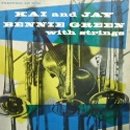
The Jay and Kai version of "Bags' Groove" was also released on 78, as the flip side of "Don't Argue." And on an 45 RPM EP, along with "Don't Argue," "We'll Be Together Again," and "How Long Has This Been Going On?" The other four tunes had their own EP. The entire set was released on a 10-inch LP, and a year later, as part of a 12-inch, 7000-series LP called Kai and Jay, Bennie Green With Strings. This time Kai got first billing, and they'd continue to swap for the time they were together, which was about two years. They parted amicably, because they felt at the time that they'd taken the two-trombone idea as far as was productive, although they would reunite from time to time.


Tuesday, March 24, 2015

Listening to Prestige Records Part 93: King Pleasure

Does it seem that every time Bob Weinstock decides to make a record with King Pleasure, he gets it all wrong, and yet it comes out so right?

In earlier sessions, he seems to have thought of Pleasure as a rhythm and blues singer. He's tossed him into recording sessions with other R&B singers, and given him R&B musicians, and come up with one of the most enduring and beloved classics of jazz vocal music, in "Moody's Mood For Love."

The success of "Moody's Mood" didn't give him the idea that he should put Pleasure in with some of the A-list jazz musicians he'd been recording; he did a second session with a rhythm and blues band, on which his tracks were sort of a throw-in -- the session was mostly about Charlie Ferguson's band, but they did include two King Pleasure vocals. On one of them, just as they'd tossed in a chick singer to the "Moody's Mood" recording who happened to be Blossom Dearie, they tossed in another chick singer, a girl who was scuffling around New York after being fired by Lionel Hampton for insisting on singing bebop instead of swing. That was Betty Carter, and the tune was "Red Top." And the other throw-in on the Charlie Ferguson session was "Jumpin' With Symphony Sid."

So this time, he brings in the creme de la creme, the A-list of A-lists, three quarters of the Modern Jazz Quartet, but you can't really hear them -- they're not given any solo time. In fact, at least on "Sometimes I'm Happy," King Pleasure takes something of a back seat to the Dave Lambert Singers.

Dave Lambert, in 1953, was 36 years old and a veteran of the music business. He was a singer and vocal arranger who seemed more at home in a group setting, although he was a pioneer of the bebop scat style that King Pleasure, Eddie Jefferson, Jackie Paris and others were to bring to fruition as solo artists, and that Lambert was ultimately to find the best expression of when he teamed with John Hendricks and then Annie Ross. He had made what many consider the first bebop vocal recording with Gene Krupa's band, as a duet with Buddy Stewart.

In September of 1953, he was coming off what was generally acknowledged to be a failure: Charlie Parker with Voices. This was the followup to the successful and popular "Charlie Parker with Strings," and it featured an orchestra under Gil Evans' direction, and a 12-voice group of Dave Lambert Singers. Marc Myers interviewed Hal McCusick, who played on the session, about what went wrong:
The voice parts were way too complicated. Gil’s charts were beautiful and complex, as always. His arrangements always could push your buttons, musically. But Dave’s vocal charts were heavy, and by the time everyone realized this, it was too late. The recording session was already underway.

JW: Was Dave aware of that?
HM: I'm sure he was. But in all fairness to Dave, he was in over his head. First, there were too many singers.  Dave could have accomplished the same goal with better results if he had used four. All of us in the woodwind section knew it at the time. Second, Dave wasn’t skilled enough as an arranger to write for so many singers. What's more, the singers weren’t polished enough as a group to pull off what Dave had in mind and had written.
This may be a little rough on Lambert, and on the session. You can hear it on YouTube and decide for yourself, but you can understand what McKusick means. He goes on to say that
Dave was terrific when singing take-offs on jazz instrumentals and writing for small-group things. But to write structured charts for so many singers behind arrangements by a guy like Gil Evans requires enormous skill. When you're writing for 10 or 12 singers, you have no choice but to double up voicings. This means two or more vocalists need to sing the same notes. It’s the only way a vocal group can be heard clearly.

But doubling up parts means greater room for intonation error, since you’re more likely to hear somebody wavering off the written notes. When a voice wavers, it throws everyone else off, or the producer catches it and calls for another take. It’s like two people walking a tightrope out of synch. Someone’s more likely to fall. That happened quite a bit that day. The vocal charts were too hard to sing. The result was false starts and re-takes.
Lambert had cut down his ensemble by September. He hasn't found the magic he would capture with LHR -- his arrangements here are more reminiscent of a group like the Four Freshmen -- but he provides a nice group sound for Pleasure to wing it from.

This session didn't provide classics like "Moody's Mood" or "Symphony Sid" or the later "Parker's Mood," but they're still good, and I love Pleasure's solo on "Sometimes I'm Happy." I don't know whose instrumental solos he's basing these on.

And again, speaking of Weinstock's mistakes in recording King Pleasure that turned out to be not so mistaken, why only two songs per session? In 1951 and 1952, no one was thinking about LPs, but a recording session was still generally four songs, so you could put out two 78s. But by 1953, the 10-inch LPs and the 45 RPM EPs were common. The upshot of it was, when it came time to put his vocalese stars on a 12-inch LP, he had not enough songs from Pleasure and even fewer from Annie Ross, so he had to put them together on one disc. And the result? King Pleasure Sings/Annie Ross Sings is one of the absolute treasures of the LP era. You couldn't ask for better.

These two songs came out on both 78 and 45, on an EP with "Red Top," and on a 10-inch LP in 1954.


Saturday, March 14, 2015

Listening to Prestige Records Part 91: Teddy Charles

I continue to wonder what was the master plan involved in sending Teddy Charles out to be Prestige's West Coast representative. Was it to find out what the evolving West Coast sound was all about, and tap into it for Prestige? Or was it to find a new group of musicians to plug into the evolving Teddy Charles sound? If the former, he might not have been the best choice. (Certainly not the worst choice. That honor goes hands down to Art Rupe of Specialty Records, who, when he lost Bumps Blackwell, who had brought him Little Richard, Lloyd Price, Larry Williams, etc,, chose as his new New Orleans talent scout and A&R man...Sonny Bono?) My guess, it was a little of the former (in Bob Weinstock's mind) and a little of the latter (in Teddy Charles's mind). Anyway, Charles didn't come back with the next Brubeck or Mulligan/Baker, but he came back with some remarkable music.

And wondering leads to Google, and Google led me to this interview with Charles, which I had not seen before, where he talks about his West Coast sojourn:

One day in late 1952 or early 1953, after I had recorded those New Directions dates, he asked if I wanted to move to the West Coast to be the A&R director out there. The West Coast was a completely new scene for East Coast labels. They didn't quite get what was happening there, but they knew they had to be in on it.

"The first thing Bob wanted me to do was record Wardell Gray, which I did. Wardell was the hot guy out there. He and I had played together in Benny Goodman's group in the late 19940s. Bob had wanted me to put together a couple of sessions and record standards. But I had other things in mind. I wanted to put different musicians in challenging musical situations to see what came of it.

You don't have to have read too many of my blog entries to know that in my opinion, bringing Wardell Gray into any project is bound to be a good idea. I've written about that session. Listening to it, and especially listening to this session, I also couldn't help wondering whether Charles completely bought into Weinstock's "get together and jam" philosophy. Well, no. There was only one Bob Weinstock, and he made it work. He had a fan's enthusiasm, and it carried over into the making of some of the greatest jazz records ever made, so you'll never hear me knocking his philosophy. But it was a fan's philosophy; a musician's is bound to be different. So from the same interview, here's Teddy Charles talking about rehearsal, and also about tapping into the emerging West Coast sound:
In most cases, I’d get guys together and we’d run through the material I wrote. If it worked, we’d go into the studio. Or we’d have a date set, and we’d be in my apartment rehearsing. I also played quite a bit at the Lighthouse down at Hermosa Beach.

When I got out on the West Coast, I didn’t want to do the West Coast cool jazz thing that was so popular then. Frankly I didn’t care for the West Coast style of playing. The music was too laid back and didn’t have the sound. Not enough urgency. Instead, I brought an East Coast sound I was experimenting with out there, and I used West Coast guys to play it.
This interview was conducted by Marc Myers for his JazzWax blog. He's one of the great interviewers, so I strongly recommend reading the whole thing...and his blog is a treasure. Charles told Myers about one session he tried to put together with Stan Getz, Chet Baker and Al Haig, which ultimately had to be abandoned, as he discovered that not all great musicians had a feel for what he wanted to do --  "Stan could play anything, of course, [but] the music wasn't happening and felt forced."

I would have thought Shorty Rogers an odd choice for a Teddy Charles session. I wasn't that familiar with his work, and thought of him as a typical West Coaster, with an ear toward the pop market. I'd heard his album of jazz takes on contemporary pop songs, Chances Are It Swings, and I knew he'd done some Hollywood stuff, like The Man With the Golden Arm. I hadn't realized he had such an interest in experimental music. When you look at some of his credits, you can see why Charles gravitated toward him. From Wikipedia:

In the 1950s, when Igor Stravinsky began experimenting with dodecaphony, one of the twelve-tone techniques originally devised by Arnold Schoenberg, Stravinsky was very impressed with Rogers's playing, which, as Robert Craft reports in his book Conversations with Stravinsky, influenced the composer's 1958 choral work Threni.
Rogers is the sole horn on the first four tracks, from the August 21 session, and he works well with Charles, understanding and developing his ideas. I think the group is even better when Jimmy Giuffre joins them on August 31 -- of course, this is also ten more days of rehearsal.

Shelley Manne was one of the most ubiquitous, and one of the most commercially successful musicians on the West Coast. His albums like My Fair Lady Loves Jazz, with Andre Previn, showed that you could satisfy the demands of art and the market at the same time. But did his comfort level stretch far enough to accomodate the seriously experimental sounds of Teddy Charles?


Oh, god, yes. Rogers and Giuffre work beautifully with Charles, but Manne does more. He brings ideas that take Charles to a new level. As I listened to these sides over a number of times, which is what I do in writing one of these entries, I found myself more and more looking forward to "what's Shelly going to do next?" Give a listen and see what I mean.

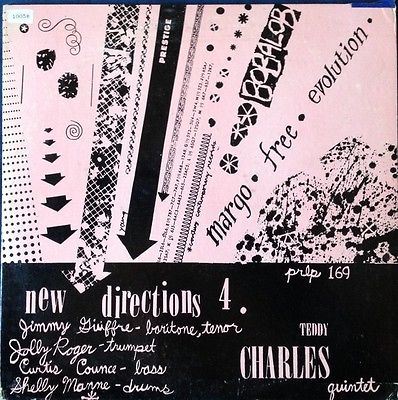
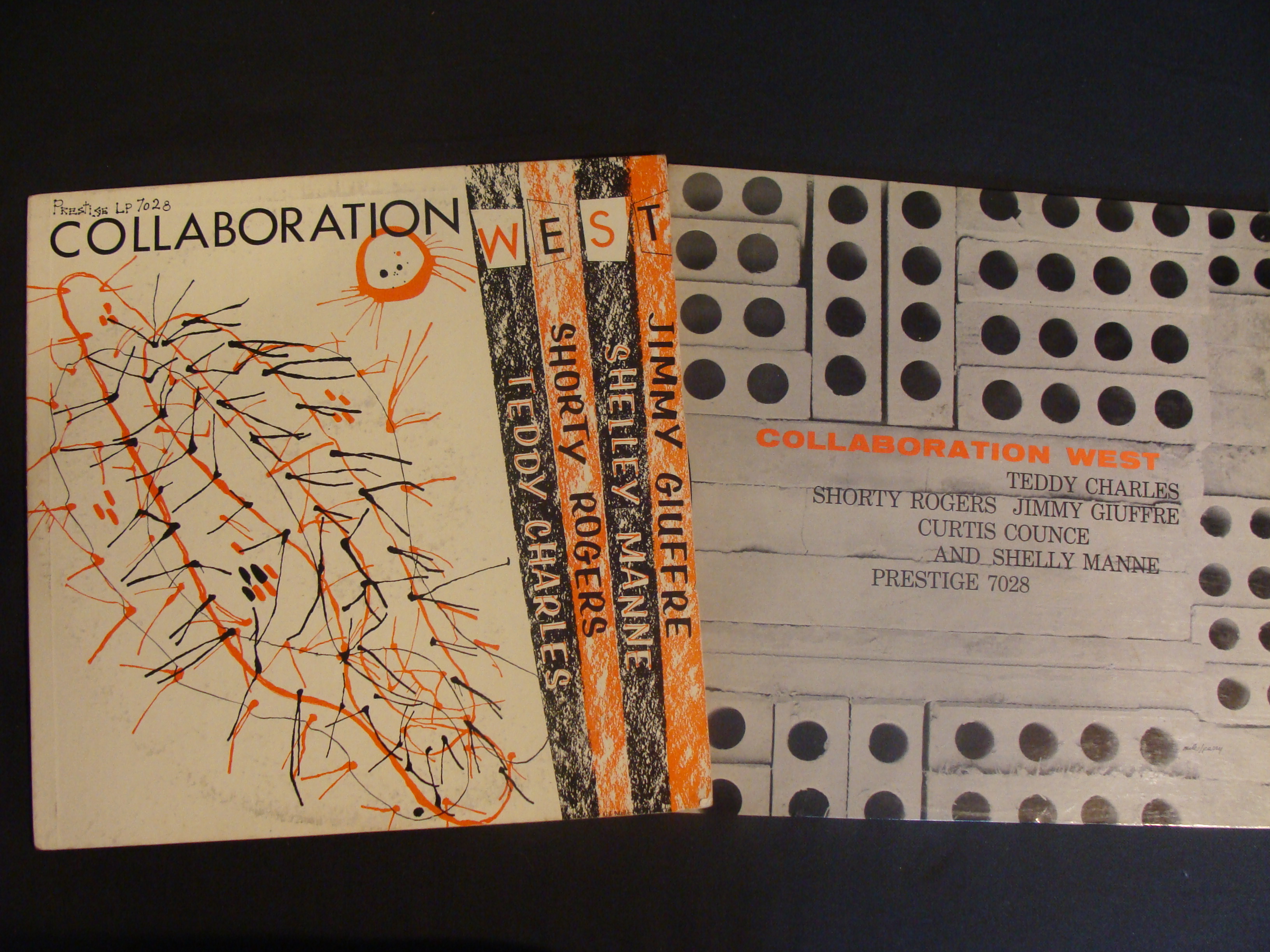
These came out on two 10-inchers, New Directions 3 and 4, and again in 1956, when Prestige had moved to the 12-inch LP standard, as Collaboration West - Teddy Charles/Shorty Rogers.


Index to Listening to Prestige Records 


Monday, February 23, 2015

Listening to Prestige Records Part 86: Miles Davis

A ballad session with Miles Davis and a group of great musicians. What more is there to say? There's a quote from Miles somewhere, which I can't find, to the effect that what he loved most was playing ballads, and he would have been happy to spend his whole life playing them. Which, of course, is why he couldn't. Miles had a restless, searching genius which was never about being happy or comfortable. 

When I lived in New York in the late 70s, WKCR, the Columbia Univeraity station, did a week-long Miles Davis marathon, in which they played everything that Miles had ever recorded, in chronological order. I made it my business to stay home and listen to all of it, so you can see that this blog isn't the first crazy jazz-related thing I've ever done. I didn't totally succeed -- I'm not that crazy -- but my girl friend at the time, who'd been out of town, came back in the middle of the week and called me, and I told her she could come over if she wanted to, but that I was preoccupied.

So...I didn't listen to all of it, but I listened to enough that I got a real sense of Miles's progression. I felt like I could understand how bebop with Bird led to the Nonet sessions to the quintet to Kind of Blue to Filles de Kilimanjaro to On the Corner to Big Fun, and I could understand how he had to do all of it, even if I wasn't going to listen to Big Fun as often as I listened to Dig or Relaxin'.

And I could listen to this session many times, which of course I have, because that's how I'm doing this blog, immersing myself in each session, but I could listen to it many times more. Miles playing ballads, a Benny Carter tune and three originals, with a group of great musicians. "Tune Up" is credited to Miles, "Miles Ahead" to Miles and Gil Evans, "Smooch" to Miles and Charles Mingus. Mingus appears on "Smooch," replacing John Lewis on piano rather than Percy Heath on bass. Lewis is on the first three cuts, Heath and Max Roach on all four.

Bob Weinstock, in an interview, talked about those early Miles sessions: 
 So, our basic idea was just to make records with different people, to record with the best people around. That's what we did until the end, when he had the quintet with John Coltrane, Red Garland, Paul Chambers, and Philly Joe Jones. But everything up to that point developed from where we would sit down and talk about it. Miles would mention who was in town, who he would like to record with. I'd say who I'd like to hear him record with. 

Yes, I would have loved to be a fly on the wall for those cpnversations. Fly on the wall? Hell, I would have loved to be a part of the,. "Hey, Miles and Bob, why don't we get..."
These were released on singles, on an EP, and as part of a 10-inch LP. And of course, in many reissue packages.

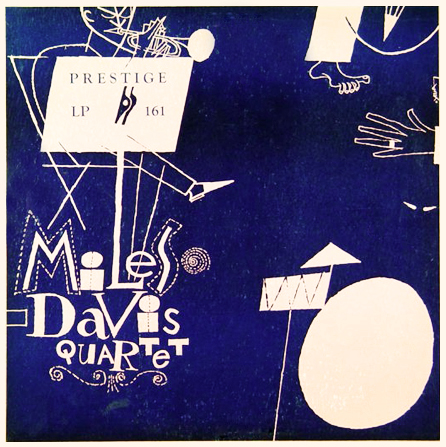
The LP cover is by David X. Young. 


Sunday, February 22, 2015

Listening to Prestige Records Part 85: Billy Taylor


Have you noticed that the fun has gone out of names in the jazz world? No more bop-punning titles like "Flight of the Bopple Bee." No more group names like "J. J. Johnson's Boppers" or "Terry Gibbs New Jazz Pirates" (oh...Terry and the Pirates. I just got it!) Now if anyone even thought of calling this group "Billy Taylor and his Mambo Maniacs" ... but no. Nobody did.

 Billy Taylor was a good choice for Prestige's latest mambo jazz entry. There's the fact that he could play anything, from bop to swing and all points in between. More to the point, much of his early background had been Latin, with Candido and Mario Bauza.

It's very hard to find any of this album to listen to on the Internet. Spotify nothing, although Taylor's later Latin work is represented. YouTube is better. I found one track -- "Early Morning Mambo" -- on a site called Office Naps, which has a whole page on Prestige and Latin jazz, and it's a very good page, although the guy does stoop to giving the inevitable backhanded compliment to Bob Weinstock (Prestige "operated on a dizzyingly prolific schedule, occasionally at the expense of quality and fidelity"). He also mildly chastises Prestige for its commercial aspirations:
Prestige Records had an eye attuned to commercial markets from the start, perhaps more than any other jazz-oriented label in its day, with many bop singles issued, a handful of them – including sides by King Pleasure (“Moody’s Mood for Love,” 1952), Stan Getz (“Four and One More,” 1949), Sonny Stitt (“All God’s Chillun Got Rhythm,” 1949) and Annie Ross (“Twisted,” 1952) – achieving some modest chart success.
Come on. In the first place, commercial success is not a bad thing. It was a healthy thing for American popular music that great jazz of the bebop era made the charts. In the second place, this
was a label for which the very first recording session was Lennie Tristano, which put Miles Davis and Lee Konitz back together, after the commercial failure of the nonet recordings, for an even more experimental session, which gave Teddy Charles his head and predated the electronic experiments of LaMonte Young and Steve Reich.

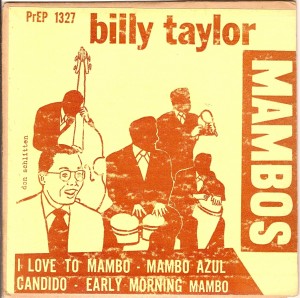
Anyway, thanks to Office Naps for some good information, and most of all for "Early Morning Mambo," and the cover art.

These four sides were released as two singles, and as an EP. Once again, all great stuff. I suppose if I were stuck on a desert island and could only take one, I'd go with "Mambo Azul" (below, from YouTube). Hard to choose, though.

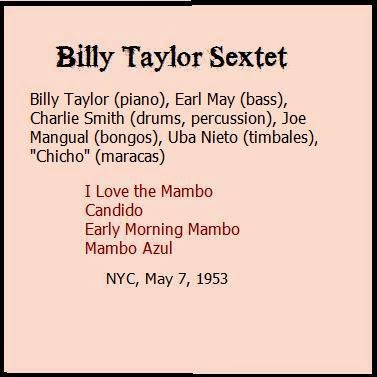
A little disagreement on the personnel. The  Japanese site jazzdisco.org, which I'm using as my Bible for this whole project, lists the three percussionists as Chico Guerrero, Jose Mangual, and Ubaldo Nieto (bongos, congas). The YouTube uploader credits the group as "Billy Taylor Trio with Machito's Rhythm Section," and lists the three percussionists as Joe Mangual (Bongos), Uba Nieto (Timbales ), Machito (Maracas ). Looks as though the YouTube guy was right. a faded 45 RPM lists Mangual Nieto, and "Chicho" on maracas (undoubtedly Chicho was a cousin of Charlie Chan and Sven Coolson). The record label and the EP cover omit both "Trio" and "Sextet" and simply go with Billy Taylor Mambos.


Sunday, January 18, 2015

Listening to Prestige Records Part 73: Thelonious Monk

Thelonious Monk back in the studio with the same instrumentation as the October 15 date, with Max Roach replacing Art Blakey on drums -- and in my previous entry, I seem to have gotten a whole bunch wrong. I rely for my discographic information on jazzdisco.org, a Japanese website that has done a fantastic job of compiling information, and I owe them a tremendous debt of gratitude -- I would never even have been able to begin this blog project without them. And I have to apologize to them -- I believe I misread or misunderstood part of their notation system. On their record label pages, they list session by session, chronogically, and every release from each session, from early 78s through 45s through 10 and 12-inch LPs to later reissues. But on their artist pages, which is where I went for the Monk/Blue Note information, they only list album releases, which is why I mistakenly said that Blue Note did not seem to have released Monk's 1947 sessions till years later.

In the jazzdisco page for Blue Note's 78 RPM releases, the information is there; it's also on the Blue Note page of another website, www.78discography.com.

Bob Weinstock, in an interview with musician James Rozzi, recalls how he got interested in modern jazz -- and how he decided to start his own label.

I had a record store before I started recording, and I carried every jazz artist you could think of. One day Alfred Lion, who ran Blue Note Records, came in and said, “I have something new: Thelonious Monk.” I said, “What the hell's that?” Alfred said, “It's bebop.” I listened to it and the more I listened, I realized it had a charm to it. It was interesting. I was strictly into swing at the time. Beboppers were calling people like us moldy figs. The next thing I knew, I became obsessed with bebop.
And a side note, from the same interview -- what was the relationship between Bob Weinstock and Alfred Lion, these two giants of jazz recording in their era?

I loved those Blue Note records. Even before I was in the business, Alfred Lion was my hero. The man was a giant. He had integrity. He made a fine product...
Anyway, Thelonious Monk is an extraordinary introduction to bebop. An extraordinary talent, and extraordinarily unlike anyone else. Which may explain why, when Weinstock arranged his first session, he chose Lennie Tristano, someone else who was unlike anyone else, but in a different way. Which, I suppose, goes without saying. If you're unlike anyone else, you're going to be unlike anyone else who's unlike anyone else. But I digress.

Weinstock, with his "let 'em play" recording philosophy, lets Monk play. With just a trio, so it's all Monk. And nearly three quarters of a century later, Monk still has the capacity to startle. This session has three originals and a standard, and it feels like just the right mix. Monk was such a brilliant composer. And listening to him create an improvisation around "These Foolish Things" gives a real insight into how he approaches a tune.

This is really a continuation of the October session, and a brilliant continuation.These Prestige sessions were the first recordings of a number of Monk classics. "Bemsha Swing" has become a jazz standard, recorded by a galaxy of jazz stars -- and even a rock group, the Red Hot Chili Peppers, in a version that's not bad. For a moment, I thought there was an even more unlikely version, when I read the name of Peter Weniger, the German tenor sax man, as "Porter Wagoner." I haven't been able to find out what "Bemsha" means, although I have found several websites where people complain that they can't find out what "Bemsha" means.

"Trinkle Tinkle" and "These Foolish Things" were released on 78, and all four cuts on the 10-inch LP that also contained the tunes from the first session.


Friday, January 16, 2015

Listening to Prestige Records Part 72: King Pleasure

Strange, but this is the session that was. You'd have thought, perhaps, that after having a hit record off of the first King Pleasure session, Weinstock would have planned a whole recording session around him, and gotten him some serious A-list musicians, led by someone better than Teacho Wiltshire. But instead, he seems to have been a sort of afterthought on a session led by someone who wasn't as good as Teacho Wiltshire--although not bad.

The Charlie Ferguson Quintet recorded eight songs that day, six of them without King Pleasure. Of those six, only two ("When Day is Done" and "Stop Talkin', Start Walkin'" were ever released, although their version of "Christmas Song," with the Mello-Moods singing pretty good backup vocals to a sort of Earl Bostic-type sax solo by Ferguson, has showed up on YouTube. Prestige had Ferguson back a few months later to record six more songs, none of which were released.

So, let's start with the band. Ferguson had some solid rhythm and blues credentials, having played with Arnett Cobb and Jimmy Liggins. Most of his work in the 50s was in the house band for Apollo Records. But he couldn't make that breakthrough, and today he's probably best known, if at all, for the two King Pleasure songs. He's also, for what it's worth, the third Ferguson to record for Prestige in 1952. I don't know if he's related to either Rudy or H-Bomb. He has an extended solo at the end of "Jumpin' With Symphony Sid," which cooks.

Ed Lewis's credentials go back to Bennie Moten in Kansas City, who played for many years with Basie, although he never soloed, and was considered by Harry "Sweets" Edison to be, along with Snooky Young, one of the two greatest first trumpets he ever played with. Ed "Schubert" Swanston actually worked extensively with the Mello-Moods, which may have been what brought him to the gig. He also had gotten around the jazz world, playing with Louis Armstrong from 1943-45, and also with such as Gene Krupa, Andy Kirk, Oran "Hot Lips" Page, Lucky Millinder, Art Blakey, Erskine Hawkins and Jimmy Rushing.

Peck Morrison would have a few turns in the Prestige studios, with Zoot Sims, J.J. and Kai, and Willis "Gator Tail" Jackson. He also recorded with Horace Silver, Gigi Gryce, and Art Farmer, and played with pretty much everyone: Gerry Mulligan, Carmen McRae, Tiny Bradshaw, Eddie Jefferson, Duke Ellington, Lou Donaldson, Mal Waldron, Randy Weston, Red Garland...I know I'm going on about these guys, when the real news about this session is King Pleasure and Betty Carter, but that's part of my pleasure in doing this blog. Jazz rode on the backs of guys like Ed Lewis and Peck Morrison...and Herbie Lovell, for many years house drummer at the Savoy Ballroom, who started with Hot Lips Page, then worked with Hal Singer, Johnny Moore's Three Blazes, Earl Hines,  Lucky Thompson, Jimmy Rushing, Arnett Cobb and pianist Teddy Wilson. Which is a lot of versatility, but there's more. He also played drums on The Freewheelin' Bob Dylan, and on albums bv John Denver, B. B. King, and...the Monkees?


King Pleasure broke through with Eddie Jefferson's magnificent treatment of "Moody's Mood," and came back this time with his own vocalese versions -- of Gene Ammons's "Red Top" (a really good start) and Lester Young's "Jumpin' With Symphony Sid" (has become a classic).

Carmen MacRae once said, "There's really only one jazz singer – only one: Betty Carter." Carter's improvisational gifts are legendary, but here on her one cut ("Red Top") she's mostly singing harmony with Pleasure, although she does get to let loose on one chorus. And again, you have to wonder. "We can get Betty Carter for this date." "OK, we'll use her for one song on the Charlie Ferguson session."

And what can you say about King Pleasure? He should have recorded more. But we have what we have, and these two are right up there with his best. And maybe it wasn't so much an afterthought to the Ferguson session -- maybe these were the only two songs Pleasure had at that time. Annie Ross may have tossed off "Twisted" in one night, but this stuff really isn't easy to write.

This may have been listed as a Charlie Ferguson session, but the records came out under King Pleasure's name (with Betty Carter given credit). "Red Top" was on three different Prestige 45 RPM releases, b/w "Don't Get Scared" (from a later session), "I'm in the Mood For Love" (from an earlier session) and "Jumpin' With Symphony Sid" (from this session). "Symphony Sid" also had a second 45 RPM release, b/w "Parker's Mood," Pleasure's masterpiece, about which more later, when we get to it.