Showing posts with label Milt Hinton. Show all posts

Thursday, December 18, 2025

Sylvia Syms

Listening to Prestige: Chronicling Its Classic Jazz Recordings, 1949–1972, my history of Prestige Records, will be published in January 2026. Order in advance from Amazon or through your local independent bookstore.


LISTEN TO ONE: More Than You Know

Sylvia Syms was in mid-career when she came to Prestige in 1965. A native New Yorker, she found the jazz clubs on 52nd Street as a teenager, and became a protégé of Billie Holiday’s. In 1941, she made her own debut on 52nd Street, performing at Kelly’s Stable. In 1948, Mae West, who was heading up a revue that played the swanky end of New York night life – the Copacabana and the Stork Club – heard Syms and signed the hard working singer for her revue. That led to future cabaret work, and an appearance on Eddie Condon’s Floor Show, believed to be the first live jazz show on network television. 

Atlantic Records signed her in 1952 and she got her first record release, a 10-inch LP with a trio led by Barbara Carroll, also just starting on Atlantic. After a couple of records with Atlantic, she moved over to Decca, where she sang with an orchestra conducted by Sy Oliver, and her one big hit. My Fair Lady’s “I Could Have Danced All Night,” which won her a gold record. But her talent was best suited to a more intimate setting – Frank Sinatra had called he “the ultimate saloon singer” and Decca next put her with a jazz quartet led by two guitars, Mundell Lowe and Barry Galbraith. 


As the decade rolled over, she recorded one-shot albums for Columbia, Kapp, and 20th Century Fox Records, the less successful arm of the entertainment conglomerate (although they were responsible for that Christmas staple, the Harry Simeon Chorale’s “The Little Drummer Boy”). Her recordings were generally praised for their intimacy and emotional honesty, though critics tended to find her improvisational skills limited. 

  Prestige signed her in 1965, and brought her to Englewood Cliffs for two sessions. The first, on August 11, matched her with a trio led by Kenny Burrell. The second, two days later, added Bucky Pizzarelli as a second guitar and Willie Rodriguez on percussion. This was an ideal setting for her, capturing the saloon-singer intimacy, and giving her the support she needed for some very satisfying improvisation. 

 The trio session featured mostly standards. “More Than You Know,” written by Vincent Youmans, lyrics by Billy Rose and Edward Eliscu, sounds as though it could have been written for Syms, although virtually every other cabaret and torch singer seems to have felt the same way about it. First recorded in 1929 by Helen Morgan, it has been taken into the studio more than 400 times. 

“I’m Afraid the Masquerade is Over” (Allie Wrubel, Herb Magidson) is another often-recorded standard, but Syms and producer Cal Lampley weren’t wrong in picking them. The yoking of a good song and a good singer is always going to be welcome, especially with the tasteful and inventive backing of Burrell, Hinton and Johnson. “God Bless the Child” is going to be a tribute to Billie Holiday no matter who sings it, even if you secularize the lyrics (“So the Bible says” becomes “so the wise man says” in Syms’s version). 


The second session, two days later, added the second guitar of Bucky Pizzarelli and the percussion of Willie Rodriguez, and song choices go a bit farther afield. The addition of Rodriguez opens the door to some Latin rhythms. “Brazil” was already a chestnut by the time Syms took it on, but the other Latin tune, “Cuando te Fuiste de Mi” (When you left me) is one that Syms, Lampley, Burrell and Rodriguez plucked from obscurity – at least, from mainstream obscurity. It had originally been recorded by Cuban singer Vicentico Valdes for the Seeco label, one of the more prominent independent New York labels specializing in Latin music (Celia Cruz was one of their artists). The bolero – romantic, melodic, gently rhythmic – is a nice fit for a cabaret singer, although not too many non-Latin artists incorporated it. Syms, with sensitive percussion work by Rodriguez, makes it work. “Cuando te Fuiste de Mi” would be rediscovered in the next decade by Charlie Palmieri, who reworked it with a salsa rhythm, and gave it new popularity, The two Prestige sessions became one album, Sylvia Is!, released in 1965 with testimonials on album cover from such notables as Woody Allen, Errol Garner, Tony Bennett – and Hollywood producer Ross Hunter, whose Wild is the Wind was the source of a song Syms included in the second session. 

This was her only Prestige album, but she continued working and recording, mostly for smaller labels, with one notable exception: a 1982 album for Reprise, backed by an orchestra conducted by Frank Sinatra and called Syms by Sinatra. She sang her last note on May 10, 1992, when she was struck down by a heart attack in mid-performance – appropriately enough, in one of New York’s most iconic supper clubs, the Oak Room at the Algonquin Hotel.


Friday, November 03, 2023

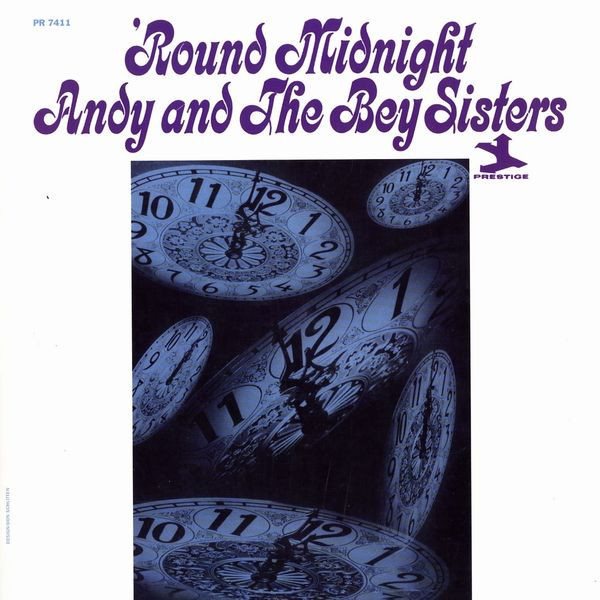
Listening to Prestige 710: Andy and the Bey Sisters


LISTEN TO ONE: Hallelujah I Love Her So

 This was the third and last album that Andy and his sisters made together, and one can't fault them for deciding to go their separate ways, career-wise. They all had artistically rewarding careers, although probably not with the recognition that they all deserved. One can certainly, however, fault the record company executives who passed up the chance to pass up recording this amazing trio -- only three albums in eleven years. 

Family harmony groups have made their mark in gospel, in country, in rhythm and blues and soul, but there has never been a family harmony group in jazz like Andy and the Bey Sisters. The Mills Brothers made their contribution to jazz as well as to


pop, but there were none that I can recall with the modern phrasing and sensibility of the three Beys. Add the close, supportive feeling of a family group to the dangerous edginess of the modern sound, and you have something unique.

They start out with "Tammy," from the folksy-corny movie of the same name with Debbie Reynolds. I should probably turn in my hipster credentials for saying this, but I love the melody of "Tammy." It was written by Hollywood jinglemasters Ray Evans and Jay Livingston, and I think it's one of the most beautiful melodies to come out of 1950s pop. But it is simple, it is a little naive, and while what the Beys do with it is edgy and interesting, it may be a little more than the melody can bear.

But then they get something they can sink their teeth into, Ray Charles's "Hallelujah, I Love Her So." With gospel's deep tradition of family harmony, Charles's sensual overlay, and their own contemporary arrangement, they come bursting out, riding Kenny Burrell's guitar and Andy's piano to a thrilling treatment of this rhythm and blues classic. Remarkably, they distance themselves from Ray by taking it almost completely out of the church, and they make it work.

"Everybody Loves My Baby" takes this Spencer Williams anthem of the Roaring Twenties and moves from a scatted intro by Andy into three-part harmony that notches another decade on the Beys' scorecard. "Round Midnight" reaches into a totally different world, that of Thelonious Monk, and drawe it too into the Beys' world, with the harmonies, the Burrell guitar, and some lovely solo parts by Andy.


And I could go on. Every track on this album is a new delight. Each of them gets a solo turn, as they prepare to launch into three solo careers--each of them tintroducing her or himself on the "Love Melody" that came from the second session but became the first track of the album -- Salome on "Love is Just Around the Corner," Geraldine on "I Love You," Andy on "Love You Madly."

Few swan song albums have done it better.

Cal Lampley produced. 'Round Midnight was the album title. There were no 45 RPM singles from either session, which is a bit of a surprise, given that Prestige always did well with vocals.

Saturday, August 19, 2023

Listening to Prestige 701: Pat Bowie


LISTEN TO ONE: Get out of Town / I've Got Your Number

Pat Bowie is primarily a stage actress, having appeared in several productions of August Wilson's plays, among numerous other credits. She has recently had recurring roles in Orange is the New Black and And Just Like That..., the reboot of Sex and the City. This, and one later album for Prestige, were her only ventures into recorded jazz singing, and from the evidence here, she certainly could have had a career as a jazz singer, although it's entirely possible that recurring roles on hit TV series pay better than singing in jazz clubs.


Certainly the Prestige brain trust must have thought highly of Bowie's singing abilities. They brought her back into the studio for three different sessions, and surrounded her with a dream team of musicians.

Bowie takes a brisk, hard-edged, no-nonsense approach to a song, cutting off Seldon Powell when she's had enough of his solo and getting through "Get Out of Town" in under two minutes, which is pretty close to unheard of for a jazz recording, Ray Bryant returns the favor by breaking right in when she threatens to hold a note on "I've Got Your Number," and taking an authoritative piano solo. It all works, and perhaps this conservation of energy is what has enabled her to have a fine career going 60 years after the making of this record.

Cal Lampley produced--a new name on the Prestige label, Lampley was starting to spread his wings and freelance in a few different places, after having spent nine years with Columbia, starting as a tape editor and working his way up to Recording Director of the Popular Albums Department, although his producing range extended farther than that: he worked with Leonard Bernstein, Victor Borge, Mahalia Jackson and Dave Brubeck, just to name a few.

The album was entitled Pat Bowie--Out of Sight!

Thursday, July 06, 2023

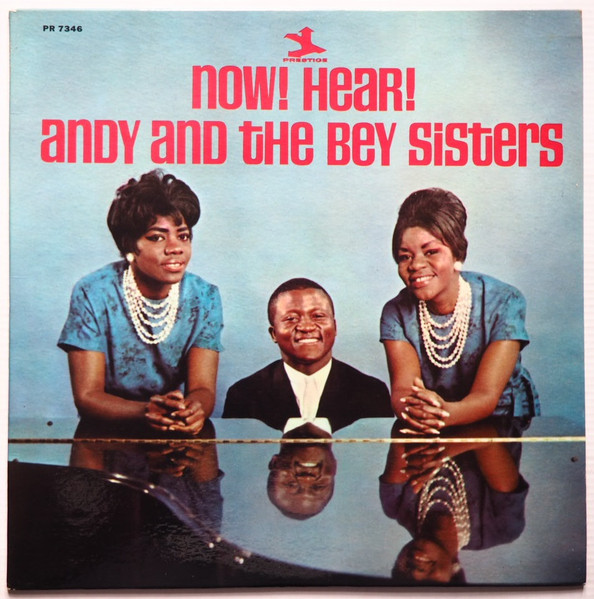
Listening to Prestige 694: Andy and the Bey Sisters


LISTEN TO ONE: Since I Fell for You

 Andy Bey's work with his sisters occupies a very small part of a long and legendary career (which is not over yet). It covers three albums, one with RCA Victor in 1961 and two with Prestige, and some television appearances, so we have some live work by the trio available on video. But it's an important part of his legacy--and that of Salome and Geraldine Bey, who also went on to have distinguished, if very different, careers.

We'll start with the sisters. Salome, born and raised in Newark, moved to Canada shortly after the trio broke up, and made a life and a career there. She came to be known as "Canada's First Lady of the Blues," and she was all that and more. She appeared on Broadway in Your Arms too Short to Box with God and received a Grammy nomination for the


original cast album; and her own show, Indigo, a celebration of the history of black music, won a Dora Mavor Moore Award, honouring theatre, dance and opera productions in Toronto. Her appearances at the Montreux Jazz Festival were captured in a live album and on video--check out this stirring performance at Montreux of Billy Taylor's "I Wish I Knew How it Would Feel to be Free." After her death in 2020, she was honored on a Canadian postage stamp.

I've written about Geraldine Bey de Haas and her husband before, but I'm going to quote it here again, because it's such a significant story in the history of jazz'

if you are from Chicago, and a jazz fan, you quite likely have heard of the deHaases, for the music and civic involvement that they gave to the City of the Big Shoulders. When they retired in 2103, because of health problems, to go and live with family in New Jersey, here's a part of the tribute columnist Howard Reich of the Chicago Tribune gave to "two artists who have been central to jazz here for nearly half a century":

It was Geraldine de Haas, after all, who led many like-minded spirits in creating the first Duke Ellington celebration concert in Grant Park, in 1974, just after the master's death. The event proved so successful that it became an annual soiree, paving the way for the emergence of the Chicago Jazz Festival in 1979 and setting the stage for all the other city-sponsored music fests that followed.

When de Haas launched her campaign to stage the aforementioned Ellington tribute in Grant Park, she faced widespread resistance, even from fellow jazz musicians.

"The South Side musicians were talking about doing (the Ellington homage) on the South Side of Chicago" in Washington Park, recalls de Haas. "My suggestion was: 'Why don't you do it in the main park (downtown)? Duke Ellington was so important to all of us.'"

"(But) the black musicians were conditioned to think one way, and the white musicians were conditioned another away. They never thought about getting everyone to participate. … I was emphatic about that.

 "They said: 'If you can get it, good luck.'"

Geraldine got it, in spite of resistance from the city parks commissioners, whom one has to assume were white. They told her there had been riots the last time they tried to hold a jazz concert. Riots? Jazz? It turned out they were talking about Sly and the Family Stone.

But if Geraldine wanted to give jazz to the whole city, "bringing jazz to a major downtown setting – and therefore bringing black, white and others together in a dramatic way that reflected both the cross-racial appeal of the music and the unifying characteristics of Ellington's art," she didn't forget the South Side either, creating a new and successful festival, "Jazz Comes Home," in 1981. In her words, again quoted by Reich,

"It was time to expose the music to the young people" where they lived, says de Haas. "The legacy left by a lot of African-American musicians – they needed to know about it. That was one of my missions in Chicago."

Andy Bey is still performing, into his eighties. After a meteoric career as a young man, with and then without his sisters, he slipped into obscurity, never stopped performing, was rediscovered, and is now a living legend, widely considered to be among the first rank of jazz singers. He and his sisters made two LP records for Prestige, so I'll have more to say about him next time. But let's get on to the music.


What became one album, Now! Hear!, was recorded in two sessions, three days apart, with Jerome Richardson the only musician to play both sessions. I don't know the reason for the change. Perhaps producer Cal Lampley, was dissatisfied with the first group (he needn't have been -- they are wonderful). Perhaps, new to Prestige, he decided he wanted a younger, hipper sound. All the musicians on the second date represent a different generation from the first group. Perhaps it was just a scheduling conflict. At any rate, it's not cause for complaints. Each group brings a distinctive and satisfying sound. And in any case, the focus is on the Beys, and their tight sound. In any musical field, from country to doo wop to jazz, there is something distinctive about a family harmony group. Andy recognized this from a vantage point of half a century, as he told Chris Slawecki in a 2020 interview for All About Jazz:

I was doing things with my sisters that I'm still doing somewhat, in terms of the tempo and in terms of the rhythmic attack we used to use. I used to sing the lower part, having the male voice. We have a family sound, we basically all sound the same. Like the Cole family, him and his brothers sound basically the same when they sang. They're not identical, but you can hear that family sound.

You can certainly hear that family sound on Buddy Johnson's "Since I Fell for You." The tune was written for his sister Ella, but the group harmony possibilities of it were quickly realized by a number of doowop groups, most notably the Harpton. Andy's Nat Cole-influenced piano anchors this one, with some wonderful guitar fills by Barry Galbraith.

"Willow Weep for Me" provides a good introduction to the second group, with particularly notable work by Richardson and drummer Osie Johnson, and again those family harmonies.

It's good that the Beys went their separate ways. Each of them had a distinctive and important career, contributing so much to American music. But it's also really good that they did this work, and recorded this work, together,

Prestige released two 45 RPM singles. each featuring one song from each session. "Willow Weep For Me" / "Quiet Nights Of Quiet Stars," and the second was "A Taste Of Honey" / "Besame Mucho."    


Tuesday, May 26, 2020

Listening to Prestige 487: Dick Wellstood's Wailerites

It's very easy, as a fan who's become a student of Prestige's history, to think Wow, everyone who is anyone has played on a Prestige record at one time or another. But of course that's not true. There are are lots of the all time greats who have never recorded for Prestige. But just as you resign yourself to that, another name from your bucket list pops up. And lo and behold, it's Zutty Singleton. The drummer who anchored Louis Armstrong's Hot Five after Baby Dodds left. The drummer on "West End Blues." And the drummer who kicks this ensemble along smartly, especially on a tune written for him, "Brush Lightly" (one of his specialties, but that's not all he does).

And he's in good company here, for a session that completes the LP project begun by Cliff Jackson's Washboard Wanderers. Wellstood and the gang also have a colorful name, if not quite as colorful: Dick Wellstood's Wailerites. For the Wailerites, Herman Autrey and Sedric are both new to Prestige, and both made their first entry into the big time with Fats Waller. And how did they get from there to Prestige? One never knows, do one? And they can play jazz, and they can play the music the way Wellstood wants it played.

And how are we to describe what that music is? Well, given what Wellstood had to say about it:
You see, there are really two musics--the one the musicians think they are playing and the one the audience thinks it is hearing.
I'm almost afraid to say anything at all.  Wellstood's Wailerites are closer to the tradition established by Coleman Hawkins and other Swingville labelmates than they are to Cliff Jackson and the other side of this record. Jackson and his bandmates could have come right out of the 1930s, or even the 1920s. Wellstood and his group are in that Swingville style--musicians who've listened to bebop, and absorbed what it has to offer, but who have chosen not to play it.

Wellstood probably couldn't go back to the music of the 1920s even if he wanted to...not that he wasn't musician enough. For one thing, when the guys in his band were busy making their mark with Fats Waller and others, Wellstood was busy being born.  Born in 1927, he was seven years younger than Charlie Parker, a full decade younger than Dizzy Gillespie. And he was living proof that bebop wasn't the only way to be inventive. As guitarist Marty Grozs described him, he “was always doing these little things that were going against the grain.”

On this album, or one side of an album, he plays three tunes, two his own compositions and one, "Yacht Club Swing," credited here to Herman Autrey, but in other places to Autrey, Fats Waller and J. C. Johnson. It was first recorded by Waller and Autrey in 1938, and there had only been a couple of other recordings before Wellstood; it has since become something of a standard for trad bands, especially ones with an international flavor.

Although Wellstood was frequently compared to Waller, and although here he uses two Waller sidemen to excellent effect, he did not particularly like the comparison. His idol had been stride pianist James P. Johnson, and he preferred to say he was playing in the style of Johnson. But the truth is, he has his own style, rooted in stride, but not bound by it. Listen to variations on stride, and the improvisations on the melody, that he runs through in "Yacht Club." The earlier musicians, bound by the limitations of 78 RPM, made brevity a virtue: Waller's recording of "Yacht Club" is three minutes of sustained brilliance. Wellstood is able to open it up to seven minutes--more room for solos all around, more room for exploration, and Wellstood's Wailerites take full advantage of it.

Wellstood played with Odetta, played with Bob Dylan, and also took a ten-month break from performing to practice law (yes, he had a law degree). But he came back to the keyboard. ''The firm liked my work, and I could have stayed there,'' he told John S. Wilson of the New York Times. ''But I realized that all those years in music had ruined me for something like the law.''

And a good thing, too.

Friday, May 22, 2020

Listening to Prestige 341a: Willis Jackson

Going back in time, to pick up a session I had not been able to find at the time: Willis Jackson with his original partners, Jack McDuff and Bill Jennings.

Conguero Buck Clarke makes an interesting addition to this version of the Jackson group. Clarke, born and raised in Washington, DC, is not a percussionist in the Latin tradition--perhaps more Afrocentric. He contributes strongly to the group's sound, particularly on the showpiece of the session, the ten-and-a-half-minute "Keep on a-Blowin'." Jackson, of course, made his reputation as a hard-blowing rhythm and
blues tenor man, with titles like "Blow, Jackson, Blow." The classic honking tenor instrumentals of rhythm and blues were cut for the 78 and later 45 RPM jukebox market, and their intensity was tailored to three minutes and generally one soloist. "Keep on a-Blowin'" is very different from that. There's enough blowin' by the Gator, with some solid fills and call-and-response by McDuff, to make for a very satisfactory two-sided 45, and in fact Prestige did release one. But there's more, and appropriately so, with two sidemen as good as McDuff and Jennings. In fact, the over ten-minute cut is more or less divided into thirds, with Jennings soloing in the middle and McDuff at the end. I don't know how the tune was edited for the 45 RPM release, but they certainly could have done it the way it was done on Bill Doggett's classic two-sided "Honky Tonk": tenor sax solo on one side and guitar on the other.

Rudy Van Gelder keeps Buck Clarke's conga beat prominent throughout the number, and it's a welcome addition. Even with Ray Barretto's work on a number of recordings for Prestige and other labels, hand-propelled drums were still a rarity in jazz, and were rarely thought of in any context other than Latin music, which is why Buck Clarke didn't get a lot of dates.

A fact acknowledged by Clarke in a 1988 interview, looking back on his career. He had fallen in love with the congas early, and had never been tempted to switch to a more popular instrument.

The interview, by James Graves, and now posted on YouTube, gives another fascinating look into a less-known life in the jazz business. Clarke, born and raised in Washington, DC, went to work as a young teenager for a man who owned a sign company, and was Duke Ellington's cousin. His boss used to play jazz records for him -- the Duke, of course. and Oscar Peterson. "Then Dizzy Gillespie, and I was hooked."

The hook was sunk in deeper when his boss played him records of Gillespie with Chano Pozo:
 and knew I wanted to play percussion. Something spiritual happened to me, as though someone had said to me “this is what you will do.” It was tough, because there was little or no interest in bongos or congas for jazz at that time [the late 1940s].
Clarke started out playing the black vaudeville circuit, known at the time as "jig shows," then started to get gigs around the DC area with dance bands who wanted to include a few rhumbas -- this was before the mambo and cha-cha craze. On one of those dance gigs, with a band called Wesley Anderson and his Washingtonians (not Duke Ellington's Washingtonians), he found that the band was to be augmented by a guest star:
I was excited to be asked because they had some great musicians in that band, including Eddie Jones who had played for several years with Count Basie. But I was really excited when I found out who else had been hired for that one gig—Charlie Parker.
Bird and I hit it off right away. There were even moments on the stage when it was no one but me and him playing. It didn’t get recorded, but it’s recorded in my head, and it will be until I leave this world. 
I never saw Bird again, but in my mind I could hear him telling me, OK, kid go for it. You got it, now go for it. So I hit the road. 

Clarke hit the road, playing his congas and bongos, playing everywhere someone would let him, still resisting the temptation to switch instruments:
And still I had people asking me, “When are you going to play a real instrument? You want to play jazz, you need to pick up a saxophone or something.” But for me, playing percussion was like touching the earth.
A highlight of those days included a gig with Arnett Cobb when he was 19 or 20, where he says he really learned how to play with a band, and finally arriving in New York, where he got a chance to play with Art Blakey and the Jazz Messengers.

Clarke made an album for the tiny Offbeat label in 1960, and two more for Argo in 1961 and 1963, but as far as getting called by name jazz musicians went, the Willis Jackson gig was pretty much of a one-off. But when a new decade rolled around, and percussion became the staple of jazz music that Clarke had always predicted it would, things changed, He recorded in the 1970s with Les McCann, Cannonball Adderley, Jimmy Smith, Herbie Hancock, Freddie Hubbard, Nina Simone, the Isley Brothers, John Mayall and others.

The session, produced by Esmond Edwards, ended up all over the place, which is probably one reason that it didn't create much of a calling card for Clarke. "Sportin'" (by Jackson and Jennings) and "Where Are You?" went to Cookin' Sherry. "Keep on a-Blowin'" (Jackson and McDuff) went on Cool "Gator." "This Nearly Was Mine" was on Blue Gator. "It Might as Well Be Spring" and "This'll Get to Ya" were on  Together Again!, which had put together leftover tracks from various sessions, and was released in 1965, after  Jackson, Jennings and McDuff had gone their separate ways. "Dancing on the Ceiling" was held off until 1966 and Together Again, Again!

"Keep on a-Blowin'" was one two-sided single, and "This'll Get to Ya" was the other.