Tad Richards' odyssey through the catalog of Prestige Records:an unofficial and idiosyncratic history of jazz in the 50s and 60s. With occasional digressions.
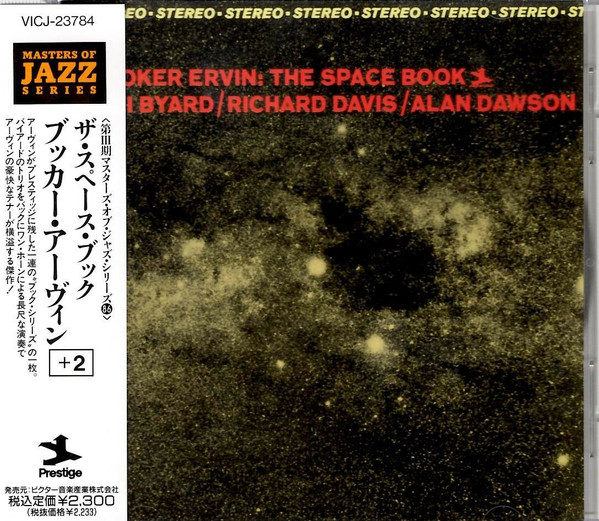
The title of this album is The Space Book, and the cover art reflects it, with what appears to be a black hole in the Milky Way. The contents live up to the packaging. With this album, Ervin crosses over the bridge to free jazz, and free jazz is the better for it. Certainly with some of the free guys -- not the best ones -- aas with some of the abstract expressionists, or the practitioners of what came to be called L*A*N*G*U*A*G*E poetry, one can't help but wonder if they're doing all this crazy stuff to cover up the fact that can't really draw, can't really play a scale, can't really write a line of poetry that will scan.
Such is not the case with Ervin. He brings all his chops with him into outer space. It's not the case with the people in his group either. Jaki Byard could play anything, and frequently did. He has as much claim as anyone you can think of to be called the greatest unsung piano player of all time. Bassist Richard Davis, Ervin's longtime collaborator, could play anything, and his discography shows it -- Eric Dolphy and Pharaoh Sanders, Louis Armstrong and Bo Diddley. Drummer Alan Dawson also worked exrensively with Ervin, after which he replaced Joe Morello in the Dave Brubeck Quartet. Outer space, Booker Ervin style, was open range for these guys, and they were home on the range. They can play as fast as any bebopper, and they always know what they're doing.
You can count on it that I don't know enough about music to tell you what's going on in free jazz, so just let me say that this is a great album. It's free, it's structured, it's melodic, it's jagged, it's rhythmic, it's somewhere beyond rhythm. It sounds as fresh and original today as it did when it was recorded. The brilliance of Ervin's solos are matched by Byard and Davis.
Ervin plays two originals and two standards, neither of which you'd expect to find on a free jazz album -- George Gershwin's swing era classic "I Can't Get Started," and "There is No Greater Love." standaed bordering on schmaltz, first recorded by composer Isham Jones in 1936, covered by Guy Lombardo and then Jimmy Dorsey, before becoming, like "I Can'r Get Started," a ubiquitous standard. For both tunes, Ervin gives you enough of the melody that you can recognize it if you're listening for it.
Don Schlitten produced. Two cuts from the session, "The Second #2" and "Bass IX," were held over and appeared on the 1966 album, Groovin' High.
This just goes to show, if you put a solid veteran horn player together with an absolutely impeccable rhythm section, you're likely to get some good jazz out of it.
Thompson had appeared on Prestige twice before. The first time was 1954, when Bob Weinstock was showcasing his newly signed Miles Davis in a variety of situation. Two April sessions were put together in one album, the first featuring Dave Schildkraut, the second Thompson and J. J. Johnson. Horace Silver, Percy Heath and Kenny Clarke anchored both dates.
Then in 1963, freshly returned from a sojourn in the wilderness which had included making his own furniture on a farm in the country and playing the expat game in Europe, he led his own quartet with Hank Jones, Wendell Marshall and Dave Bailey. The 1963 date, an examination of the Jerome Kern songbook, was notable for his introduction of the soprano saxophone to the quartet sound. John Coltrane had played soprano the previous year, in his Live at the Village Vanguard album, but it didn't really catch on until Trane's definitive "My Favorite Things" in 1966.
Ballads make up the lion's share of this session, mostly his own (Duke Ellington's "In a Sentimental Mood" and Bronislaw Kaper's "Invitation" are the exceptions), but he does explore some brisker rhythms too, particularly "Mumba Neua," which features the soprano sax and some nifty drumming by Connie Kay.
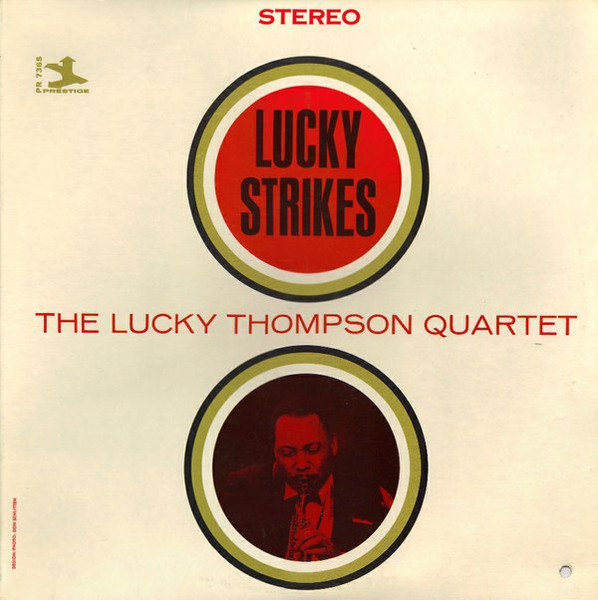
Don Schlitten produced, and the album was titled "Lucky Strikes," with a cover design modeled after the familiar cigarette package.
Andy Bey's work with his sisters occupies a very small part of a long and legendary career (which is not over yet). It covers three albums, one with RCA Victor in 1961 and two with Prestige, and some television appearances, so we have some live work by the trio available on video. But it's an important part of his legacy--and that of Salome and Geraldine Bey, who also went on to have distinguished, if very different, careers.
We'll start with the sisters. Salome, born and raised in Newark, moved to Canada shortly after the trio broke up, and made a life and a career there. She came to be known as "Canada's First Lady of the Blues," and she was all that and more. She appeared on Broadway in Your Arms too Short to Box with God and received a Grammy nomination for the
original cast album; and her own show, Indigo, a celebration of the history of black music, won a Dora Mavor Moore Award, honouring theatre, dance and opera productions in Toronto. Her appearances at the Montreux Jazz Festival were captured in a live album and on video--check out this stirring performance at Montreux of Billy Taylor's "I Wish I Knew How it Would Feel to be Free." After her death in 2020, she was honored on a Canadian postage stamp.
I've written about Geraldine Bey de Haas and her husband before, but I'm going to quote it here again, because it's such a significant story in the history of jazz'
if you are from Chicago, and a jazz fan, you quite likely have heard of the deHaases, for the music and civic involvement that they gave to the City of the Big Shoulders. When they retired in 2103, because of health problems, to go and live with family in New Jersey, here's a part of the tribute columnist Howard Reich of the Chicago Tribune gave to "two artists who have been central to jazz here for nearly half a century":
It was Geraldine de Haas, after all, who led many like-minded spirits in creating the first Duke Ellington celebration concert in Grant Park, in 1974, just after the master's death. The event proved so successful that it became an annual soiree, paving the way for the emergence of the Chicago Jazz Festival in 1979 and setting the stage for all the other city-sponsored music fests that followed.
When de Haas launched her campaign to stage the aforementioned Ellington tribute in Grant Park, she faced widespread resistance, even from fellow jazz musicians.
"The South Side musicians were talking about doing (the Ellington homage) on the South Side of Chicago" in Washington Park, recalls de Haas. "My suggestion was: 'Why don't you do it in the main park (downtown)? Duke Ellington was so important to all of us.'"
"(But) the black musicians were conditioned to think one way, and the white musicians were conditioned another away. They never thought about getting everyone to participate. … I was emphatic about that.
"They said: 'If you can get it, good luck.'"
Geraldine got it, in spite of resistance from the city parks commissioners, whom one has to assume were white. They told her there had been riots the last time they tried to hold a jazz concert. Riots? Jazz? It turned out they were talking about Sly and the Family Stone.
But if Geraldine wanted to give jazz to the whole city, "bringing jazz to a major downtown setting – and therefore bringing black, white and others together in a dramatic way that reflected both the cross-racial appeal of the music and the unifying characteristics of Ellington's art," she didn't forget the South Side either, creating a new and successful festival, "Jazz Comes Home," in 1981. In her words, again quoted by Reich,
"It was time to expose the music to the young people" where they lived, says de Haas. "The legacy left by a lot of African-American musicians – they needed to know about it. That was one of my missions in Chicago."
Andy Bey is still performing, into his eighties. After a meteoric career as a young man, with and then without his sisters, he slipped into obscurity, never stopped performing, was rediscovered, and is now a living legend, widely considered to be among the first rank of jazz singers. He and his sisters made two LP records for Prestige, so I'll have more to say about him next time. But let's get on to the music.
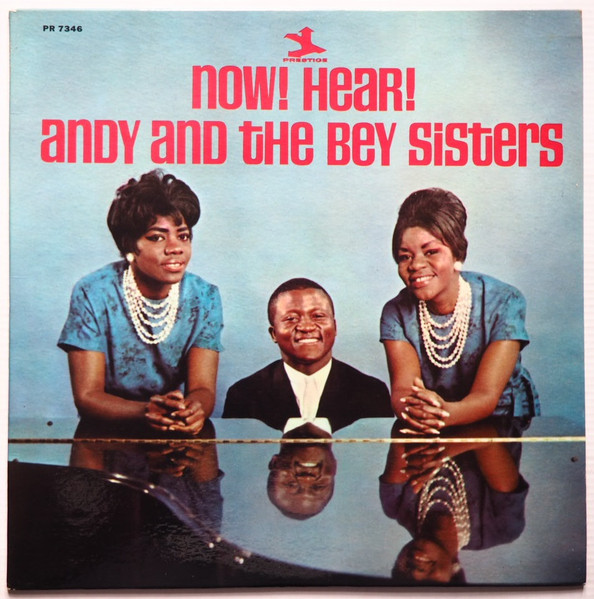
What became one album, Now! Hear!, was recorded in two sessions, three days apart, with Jerome Richardson the only musician to play both sessions. I don't know the reason for the change. Perhaps producer Cal Lampley, was dissatisfied with the first group (he needn't have been -- they are wonderful). Perhaps, new to Prestige, he decided he wanted a younger, hipper sound. All the musicians on the second date represent a different generation from the first group. Perhaps it was just a scheduling conflict. At any rate, it's not cause for complaints. Each group brings a distinctive and satisfying sound. And in any case, the focus is on the Beys, and their tight sound. In any musical field, from country to doo wop to jazz, there is something distinctive about a family harmony group. Andy recognized this from a vantage point of half a century, as he told Chris Slawecki in a 2020 interview for All About Jazz:
I was doing things with my sisters that I'm still doing somewhat, in terms of the tempo and in terms of the rhythmic attack we used to use. I used to sing the lower part, having the male voice. We have a family sound, we basically all sound the same. Like the Cole family, him and his brothers sound basically the same when they sang. They're not identical, but you can hear that family sound.
You can certainly hear that family sound on Buddy Johnson's "Since I Fell for You." The tune was written for his sister Ella, but the group harmony possibilities of it were quickly realized by a number of doowop groups, most notably the Harpton. Andy's Nat Cole-influenced piano anchors this one, with some wonderful guitar fills by Barry Galbraith.
"Willow Weep for Me" provides a good introduction to the second group, with particularly notable work by Richardson and drummer Osie Johnson, and again those family harmonies.
It's good that the Beys went their separate ways. Each of them had a distinctive and important career, contributing so much to American music. But it's also really good that they did this work, and recorded this work, together,
Prestige released two 45 RPM singles. each featuring one song from each session. "Willow Weep For Me" / "Quiet Nights Of Quiet Stars," and the second was "A Taste Of Honey" / "Besame Mucho."
Booker Ervin is still in the middle of his six-year, 13-album sojourn with Prestige. Prestige knew what they had with Ervin, in more ways than one. They recognized his outsized talent--he was one of the most important young saxophone players to come along in the early 1960s. But they also could relate to his music. The label was very much staying abreast of current trends in jazz, recording some of the best of the avant gardists and the back-to-basics soul jazz artists, but its heart was still with the mainstream bebop that excited 19-year-old Bob Weinstock to form a new label in the first place. Indeed, when another decade rolled around and Weinstock sold the label, retiring from the business, he said that it was time--the music he loved wasn't being made any more.
Booker Ervin's sound, as Ira Gitler said in his liner notes to The Blues Book, was "of the '60s. but it has not lost touch with the tap roots of jazz." Gitler, one of the great chroniclers of the golden age of jazz represented by Prestige, went on to describe Ervin's sound as only he could:
Booker's phrasing (the highly-charged flurries and the excruciating, long-toned cries), harmonic conceptions (neither pallid nor beyond the pale) and tone (a vox humana) add up to a style that is avant-garde yet evolutionary, and not one that bows to fashion or gropes unprofessionally under the guise of "freedom."
Probably the gateway album to the new avant garde was John Coltrane's Giant Steps, the first one he made after leaving Prestige for Atlantic, with new harmonic ideas but still accessible to the jazz lover raised on bebop. Ervin's "avant garde yet evolutionary" style can be said to place him in the Giant Steps generation, although Ervin's approach is nothing like Coltrane's. Like Coltrane's album of four years before, it has the thrill of the new, while still being rooted deep in solid earth--in this case, the earthy truth of the blues.
The group recorded five tunes for this session, four of which were included on The Blues Book. The fifth, "Groovin' High," would be the title cut of a later album culled from various Ervin sessions. The Blues Book has two tunes on each side of the vinyl release, one long, one short. The A side is "Eerie Dearie," checking in at 14:30, and "One for Mort," 6:24. '
"Eerie Dearie" is the whole package. It begins with a soulful piano vamp from Gildo Mahones, then a solid blues riff from the horns, opening up the door for an extended solo from Ervin. And yes, it's avant garde but evolutionary. Ervin shows just how free you can get, while still with a solid anchor in the blues. With fourteen and a half minutes to play around in, everyone gets a chance to solo, but it's Ervin you come away with.
Mahones is a solid Prestige veteran. Jones was new to the East Coast when he made this recording, and probably new to Ervin. Gitler, in his liner notes, makes a point of commending Don Schlitten as producer for putting the personnel together.
Jones had been active on the West Coast since 1961, recording with Bud Shank, Gerald Wilson, Red Mitchell, Harold Land and others, including backing Sarah Vaughan in a series of West Coast recording dates in May and June of 1963. He came east to work with Horace Silver, and he had done one live recording with Silver's quintet, but it would not be released until 20 years later, so this was his real East Coast unveiling. He did work with Silver for a while, recording with him in late 1964 and early 1965, and he was to have a couple more Prestige gigs, one with Charles McPherson and one leading his own quintet.
Although they had not met until they did The Freedom Book...and play together only in the studio on an Ervin recording, D&D are about as tightly fused a duo as you will encounter anywhere in the annals of jazz. There is no loss of rapport from one date to the next. They arrive, unpack their instruments, and they're off and flying.
They would unpack together again on Ervin's next album. Then Reggie Workman would replace Davis for a couple of sessions, and Davis would return for Ervin's last hurrah on Prestige in 1966.
This is the second of the "Books" compiled by "the Book," Booker Ervin, for Prestige, the first being The Freedom Bookof the previous December. That one had Jaki Byard on piano, with Richard Davis (bass) and Alan Dawson (drums) rounding out the quartet. Davis and Dawson would remain on board for the whole series of books, but other instrumentation would vary, and here it's Tommy Flanagan on the keyboard. Flanagan makes an excellent consort, as Ervin continues to cement his place as the hottest new sound on the tenor sax.
He starts off the session by putting his imprint on "The Lamp is Low," a old tune that may never have had quite the wakeup call Ervin gives to it. The melody was taken from a piece by Maurice Ravel, "Pavane pour une Infante Défunte" (Pavane for a Dead Child). A part of Ravel's longer work was adapted by Peter DeRose and Bert Shefter,with lyrics by Mitchell Parish. Originally recorded by Mildred Bailey in 1939, covered a week later and turned into a big hit. the song takes Ravel's solemn dirge and turns it into a dreamy torch song, with lyrics about melting into the lover's arms and dreaming while the lamp is low. It's generally done to match that dreamy mood, but not always--Sarah Vaughan made it swing, and raised a few goose bumps with a thrilling interpretation. Ervin picks up where Vaughan left off, kicking into high gear almost immediately, with soaring, daring solos that are taken up and kicked again and again by Flanagan, Davis and Dawson.
The moody, introspective tone which Ervin might have adopted in "The Lamp is Low" gets its due in "Come Sunday," the churchy section from Duke Ellington's Black, Brown and Beige suite. "Come Sunday" is also the newest song in Ervin's Song Book, dating from 1943. All the others go back to the 1930s, although "Just Friends," written in 1931, is indelibly, in every jazz fan's mind, the song newly created from the bones of the of the original by Charlie Parker in 1949. There's no nostalgia in Ervin's treatment of any of these old chestnuts -- there's no danger of this album being released on Swingville, even if that fine series had not recently been closed down by Prestige. This was a solid Booker Ervin session, a musician very much aware of tradition, very much aware of his time, and in the full maturity of his own sound.
Ervin was at the midpoint of his tenure with Prestige, which is the same as saying the midpoint of his career, since the 1960s were the summit of his achievement and his reputation, and by 1970 he would be dead of a kidney disease. He had clearly marked himself by this time as one of the most distinctive stylists of his generation--critic Gary Giddins has remarked that
you know it’s him after two notes...he is completely himself...It is not avant-garde jazz — he’s playing changes — yet it has the kind of freedom and velocity you might associate with Coltrane...though Booker didn’t sound anything like Trane. He was one of the few tenors of his generation who didn’t.
But his reputation remained mostly within the jazz community. Music producer and historian Michael Cuscuna has pointed out that his Prestige recordings
had caused a lot of excitement in New York, but New York isn't America...which meant that his triumphs were mixed with incomprehensible dry spells.
His basic quartet for the "Book" sessions was Richard Davis and Alan Dawson on all of them, Jaki Byard on two of them, and yet this tight-knit and sympathetic group was not Ervin's regular touring band--they may never have played together outside of the studio. The economics of jazz in the 1960s, at least the sort of jazz that Ervin played, didn't allow for the maintaining of a regular group.
And what was that? It wasn't free jazz (although the commercial outlets for that were limited too). It wasn't soul jazz. Hard bop may have become old hat to the critics, but it certainly still had its followers. But that wasn't what Ervin played either. As a result, it was easy for Ervin to get lost in the pack. As Giddins puts it:
Everybody was talking about Coltrane and Shorter and Rollins and the big guns, and Ervin was really something of a cult figure. Those Prestige records were hardly best sellers.
Ervin's early death meant that he didn't stay around to become an elder statesman of jazz, lionized by Jazz at Lincoln Center or the NEA Jazz Masters. To modern listmakers, he generally doesn't crack anyone's list of the 50 greatest jazz saxophonists. But he should.
This second "Book" album was called The Song Book. Don Schlitten produced.
A big band backing a soul jazz organ combo is a unique idea, but these are the guys to make it work.
I'm always interested in the guys who are part of the rich fabric of jazz, even though their names aren't in the forefront. Here's what I could find about the musicians Benny Golson gathered for this session. Jerry Kail we've seen before as a member of Oliver Nelson's orchestra for his 1961 recordings. Billy Byers was on the same session, and made an earlier Prestige date as a member of Hal McKusick's quintet in 1957. Danny Stiles was on TV with the Merv Griffin show's orchestra, and played in two of the best big bands, Woody Herman's and Gerry Mulligan's. He also stepped out of the sections to make one album as co-leader with Bill Watrous, for the Famous Door label.
Burt Collins was tabbed for inclusion--usually on trumpet-- by virtually everyone who ever put together a big band, including, surprisingly enough, Albert Ayler. In the 1970s, he formed a group with Joe Shepley, and one of their albums was a jazz tribute to Paul McCartney. He also cut albums for Music Minus One.
Tom McIntosh hardly belongs in this group of background figures. A distinguished composer as well as a trombonist, he was named and NEA Jazz Master in 2008.
Don Ashworth joined the Tonight show orchestra when Johnny Carson took over its helm in 1962 and, like Johnny, remained there for the next 30 years.
Bob Northern, after working as a session musician for many of the top names in jazz during the 1950s and 1960s, became interested in world music in the 1970s, went to Africa to study, and released several albums during that decade.
Marvin "Doc" Holliday can be heard playing and talking about his career in music on YouTube.
George Marge, on baritone sax here, played nearly every reed instrument and was in wide demand as s a session musician, not just with the jazz greats but also with pop stars like Paul Simon and John Denver.
Put them all together with McDuff's usual group, plus Mel Lewis joining Joe Dukes on drums, and Benny Golson leading the band, and one can only be surprised that no one thought of it before. Golson's arrangement and some serious professionalism from the musicians provide a rich and full-throated backing for McDuff, who is solidly equal to the task of fronting this aggregation. The classic big bands were about good time music, soul jazz is about good time music, and between them, they let the good times roll.
The session was produced by Lew Futterman and Peter Paul, who had previously given us Brother Jack live in San Francisco, and away from the friendly confines of Rudy Van Gelder's studio. The album was entitled Prelude, after the Benny Golson tune which was on the album, along with McDuff originals and standards. "Prelude" was also on one of the two 45 RPM singles, along with "Oh, Look at Me Now," composed by Joe Bushkin, made famous by Frank Sinatra. The other 45 was two McDuff tunes, "A Kettle of Fish" and "Carry Me Home."
Before free jazz became the universally agreed upon name for the music that was being pioneered in the early 1960s by Ornette Coleman, John Coltrane, Eric Dolphy and others, it had other names. Arthur Taylor, in his book Notes and Tones, a collection of interviews with fellow musicians conducted between 1968 and 1972, frequently discusses "freedom music." Musicians don't always get to decide what their albums are going to be called, but it's likely that Booker Ervin had some input into The Freedom Book the title for this one, as he edges from bop toward freedom music, paying his tuition to both schools, and establishing himself as one of the distinctive voices of this period.
The quartet Ervin assembled for this session was to stay with him throughout his career with Prestige, and the three sidemen would work as a trio under Jaki Byard's leadership on a series of Prestige albums. They were the right group for where Ervin was going, eclectic musicians who could play in any style, even styles that hadn't been invented yet, and that Ervin was maybe making up as he went along.
Jaki Byard was as wide-ranging a talent as you're likely to find, from working with Eric Dolphy to playing the music of James P. Johnson and Fats Waller. Ervin was mostly unfamiliar with Byard's work before hiring him for this session on the strong recommendation of producer Don Schlitten. Schlitten was right, as their continued association would prove.
Richard Davis's credentials range from Dolphy (the great Dolphy-Booker Little Quintet) to Frank Sinatra to Van Morrison (he was on Morrison's groundbreaking Astral Weeks album). New on the New York scene after several years on the road with Sarah Vaughan, he had been making his mark all over town when tabbed for this gig.
Alan Dawson made his Prestige debut back in 1953 when, as a member of Lionel Hampton's European touring band, he joined Quincy Jones for a session in Sweden. An educator of note (Tony Williams was a student), he was teaching at Berklee in Boston when Ervin called him for this session, explaining:
Yeah, Alan's a bitch...I played with Alan in Boston about ten years ago and it was one of the greatest experiences I've had in music...with Alan you can forget about the time, go beyond it. He's got drive but he also knows how to build a climax, then take it down to a different level where you can get yourself together and then build it back up again. Man, with Alan you can play forever!
He followed his stint with Ervin by replacing Joe Morello in the Dave Brubeck quartet, where almost certainly did not duplicate his stick work with the Booker Ervin quartet.
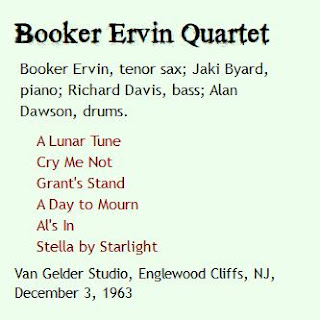
It's no accident that a musician of Ervin's gifts, and Ervin's vision, would put together a group this gifted, and it's a blessing that he was able to keep them together. This is an amazing album, that gets better every time you listen to it. I'm hard-pressed to pick a "Listen to One." The uptempo numbers, "A Lunar Tune," "Grant's Stand" and "Al's In," push the freedom envelope a little more. The ballads. especially "A Day to Mourn" have some fine ensemble playing and some remarkable individual virtuosity. You should really listen to the whole album. If the freedom sound sort of passed you by, and you think you ought to have given it more of a shot, but it was just too far out for you, you'll love this album. If you're a free jazz devotee, you'll love this album. Go out and buy it on vinyl.
Randy Weston wrote "Cry Me Not." All the others on the album are Ervin's compositions. They also recorded the standard, "Stella by Starlight," but that was held back, and appeared on a 1966 album. Groovin' High, which was the extras from all his previous sessions.
LISTEN TO ONE: Experiment in Terror Soft Summer Breeze
An abbreviated session for Jimmy Forrest: three tracks to be added to some leftovers from earlier sessions and released in 1962 as Soul Street. You wouldn't think they'd bring in Oliver Nelson and a nine-piece band for a few add-ons to an album by a less than A-list musician (in marquee recognition, not in quality), but they did, and we are the richer for it.
Maybe Weinstock and Edwards decided, "Hey, look what we did with Oliver Nelson and those songs from All American! Let's see what he can do with some even less promising material."
Maybe, and maybe not. There's only one really unlikely tune. Eddie Heywood's "Soft Summer Breeze" never became the jazz standard it might have, but it's a pretty tune, and quickly recognizable. Duke Ellington is always a good choice, and "Just a-Sittin' and a-Rockin'" is good solid Ellington.
Henry Mancini's "Experiment in Terror" is the odd choice, and liner notesmith Dan Morgenstern seems a little embarrassed by it:
Jimmy gives the rather slight melody more breadth and depth than this Mancini-made slickie really deserves.
"Experiment in Terror" hasn't made the cut as one of Mancini's major works, certainly, but it's an interesting tune, and it's had an interesting, if slight, history. Its 12 interpretations (per Secondhandsongs) suggest that this little ditty had something for everyone, or else that no one could quite decide what to make of it.
Experiment in Terror was a Hollywood thriller, and Mancini's orchestral version for the soundtrack came out as an album of music from the movie. Every cut on the album is jukebox-lengthed two to three minutes, though none of them took the jukeboxes by storm. The melody has a spooky quality, befitting the title, and it also also has a walking bass line, befitting Mancini. Subsequent renditions took it one
way or another, but Mancini had it both ways, a walking bass under swelling strings, at a stately, spooky pace.
It was next taken up by rock and roll instrumentalists the Champs, still looking for a followup to their big hit "Tequila," and in 1962 having added two young musicians named Seals and Crofts, who would go on to make their own name. The Champs went all out Peter Gunn, walking it hard and picking up the tempo.
And still in 1962, Oliver Nelson and Jimmy Forrest. Here the walking bass part is assigned to guitarist Mundell Lowe, and the rhythm starts to swing, and it's very easy to forget that one started out to do a survey of curious versions of this song, and simply get caught up in what these wonderful musicians do with it. The swelling strings are replaced by brass and reeds, and Jimmy Forrest's saxophone gives the rather slight slickie a reading that reminds you that this is Henry Mancini, and he did know how to write a melody. This is a very satisfying outing.
1963 saw terror move to the elevator with versions by Spanish orchestra leader Fernando Orteu and the Living Strings. Then dormant until the 1990s. when it was taken up by La Muerta, a Belgian band who specialized in music for "those abandoned by love or devoid of hope," unsurprisingly a version that emphasized the spooky elements. It was then taken up by surf rockers and pop rockers who also chose spooky over rhythmic. Most recently, contemporary jazzer Ted Nash gave it the Earl Bostic "Harlem Nocturne" treatment. Eclectic instrumentalists Reverend Organdrum returned it to the Peter Gunn sound (with organ and drum doing the walking part), and so did eclectic guitarist Al Caiola.
Maybe if more people had listened to the Jimmy Forrest version, the tune would have become more widely recorded. For one thing, it's the only collaboration I know of between the talents of Henry Mancini and Oliver Nelson.
And it has the guitar work of Mundell Lowe, in his only Prestige session. Lowe is associated more with the West Coast, but actually he was an Easterner until 1965, and recorded frequently for Riverside. Before that, interestingly for such a sophisticated stylist, he was a 16-year-old member of the Grand Ole Opry house band (not an easy gig to get in the city known as Guitar Town). A tour of duty in the army during WWII led to a friendship with John Hammond, who steered him toward jazz.
"Experiment in Terror" was the B side of a 45 RPM Prestige release, the popular "Soft Summer Breeze" on top. And all three tunes became part of Soul Street, a 1962 release on New Jazz.
In the 1940s, a revolution in American music took place in New York City, in the nightclubs along 52nd Street and the great after-hours clubs, Minton's and Monroe's, in Harlem. New York was the place, to such an extent that when people were looking for a name for the music that came to be known as bebop, one of the names that was used for a while was New York music. By the end of the 1950s, a new revolution was taking place in American music, and New York was still the white-hot epicenter, but the locus had shifted. Now it was downtown, along the edge of Greenwich Village, in a neighborhood that was then called the Bowery or the Lower East Side but would later be rebranded as the East Village, and specifically in one club: the Five Spot.
The Five Spot had begun its move toward the cutting edge in 1957-58, when Thelonious Monk, newly reinstated to legal status with a cabaret card, took residence with a group featuring John Coltrane. Then in 1959, it opened its stage to Ornette Coleman's quartet, a group no one wanted to book, and not everyone wanted to hear, but no one could stop talking about.
Probably the three most important figures of the new jazz, or "free jazz" as it came to be called, were Coleman, Coltrane and Eric Dolphy, and in July of 1961, Eric Dolphy brought a quintet to the Five Spot.
The quintet included drummer Ed Blackwell, who had played with Coleman. Bassist Richard Davis had most recently been working with Sarah Vaughan, but he understood what Dolphy was doing. Mal Waldron was on piano, and anyone who's followed this history of Prestige knows what I think of him, both as a player and as a composer. He has one piece here, the fire-breathing "Fire Waltz," which they had played on a Prestige session led by Waldron just a couple of weeks earlier, and which has been recorded a number of times in succeeding years by different artists.
Finally, Booker Little, the brilliant young trumpeter who had played on Dolphy's last studio album, and would be dead within three months of the Five Spot dates. Little was ten years younger than Dolphy, eight years younger than Coleman. He had grown up under the spell of Clifford Brown, and he had played for a few years and made several albums with Max Roach, but he was ready for the new sound, and ready to spread his wings with the new music Dolphy was making.
Dolphy was an interesting musician in so many ways. He was so much in the vanguard of the new music, and one of its most important innovators, but he was able to play in such a wide variety of contexts. He was very often the most advanced musician in whatever ensemble he was playing with--the Prestige albums with the Latin Jazz Quintet are a perfect example--but he left no musician behind.
This club date with Little is not master and student--Dolphy was never like that. But it is Dolphy leading the way. Little has come a long way in the six months since his studio album with Dolphy, and we can only imagine what more he would have had to offer.
The two albums, Eric Dolphy at the Five Spot Vol. 1 (New Jazz) and Eric Dolphy at the Five Spot Vol. 2 (Prestige) were both from the same night at the club, and were recorded by Rudy Van Gelder. "Fire Waltz," "Bee Vamp" and "The Prophet" were on Volume 1, with the alternate take of "Bee Vamp" included on the CD reissue. "Aggression" and "Like Someone in Love" were Volume two, with "Nunber Eight" and "Booker's Waltz" added to the CD reissues. A couple of numbers, "Status Seeking" and Dolphy's unaccompanied "God Bless the Child," were on another album, Here and There.
Esmond Edwards produced.
Listening to Prestige Vol 4, 1959-60, now available from Amazon! Also on Kindle! Volumes 1-3 are also available from Amazon. The most interesting book of its kind that I have ever seen. If any of you real jazz lovers want to know about some of the classic records made by some of the legends of jazz, get this book. LOVED IT. – Terry Gibbs








:format(webp):mode_rgb():quality(40)/discogs-images/R-6190628-1435635634-4479.jpeg.jpg)

