Showing posts with label Billy Taylor. Show all posts

Sunday, November 03, 2019

Listening to Prestige 426: Billy Taylor

Billy Taylor's piano trio albums, one of them augmented by the great percussionist Candido,  were a staple of Prestige's first half decade. He stopped back in Englewood Cliffs for a brief interlude to usher in the 1960s, and he would be back once more to bookend the decade.

The 1960s would be a busy time for Dr. Billy Taylor, who would start getting the multiple honorary degrees that earned him his honorific (he would also earn an academic PhD. from the University if Massachusetts. He would keep on making music, most often in the trio setting, but his commitment to jazz found other avenues as well. In 1958, he became music director of NBC'sThe Subject Is Jazz, the first network TV show to be devoted to America's music, and in 1964, he founded what became one of New York's cultural treasures, the Jazzmobile that brought some of America's greatest musicians to underserved neighborhoods.


He had worked for many years with a regular trio of Earl May on bass and Percy Brice (later Charlie Smith) on drums, but here is tries on a different configuration. Doug Watkins was a frequent
contributor to Prestige recordings, and one of the best (and most underappreciated) bassists of his day. Ray Mosca was a New York-born drummer who worked regularly in those years, with singers and with a wide range of jazz groups.

Taylor and his partners focus on ballads for this Moodsville session, released as Interlude. The compositions are all Taylor's except for "You're Mine." The titles sound like titles of songs with lyrics, but I haven't been able to find vocal versions of any (the often recorded "Remembering all those little things / All of a sudden my heart sings" is a different song, as is the gospel tune with the same title).


Listening to Prestige Vol. 2, 1955-56, and Vol. 3, 1957-58 now include, in the Kindle editions, links to all the "Listen to One" selections. All three volumes available from Amazon.


The most interesting book of its kind that I have ever seen. If any of you real jazz lovers want to know about some of the classic records made by some of the legends of jazz, get this book. LOVED IT.
– Terry Gibbs


Friday, September 04, 2015

Listening to Prestige Part 142: Billy Taylor

This is a landmark in Prestige history. 1955 must have been the year that Prestige made the switch to the 12-inch LP format, and began their 7000 series of recordings, and this was the first one made for that release -- Prestige PRLP 7001. From here on, the 7000 series will be a mixture of new recordings and repackagings of recordings made for 78, for 45 RPM EP, and for 10 inch LPs.

This is the classic Billy Taylor Trio, with Percy Brice handling the drum duties.

If you were building a well-rounded jazz collection, you might not include every Billy Taylor album in it. Not that they aren't all worthwhile, but if you got all of them, you might not have time to listen to all of them, while still maintaining your status as well-rounded jazzophile. But you would certainly want to have at least one representative album--maybe at least two, so that you'd have one Latin and one straight-ahead. And whichever ones you picked, you really couldn't go wrong.

Certainly you wouldn't be going wrong with this one--and it has the added historical value of being Prestige's first 12-inch LP. Taylor's playing is technically impeccable, emotionally compelling. I'd be hard pressed to pick a favorite track, but maybe "Day Dreaming" as a ballad, and "A Grand Night For Swingin'" for a livelier tempo. "Swingin'" is a Taylor original. He's a prolific composer, and one of the best. "Day Dreaming" is Jerome Kern.

The album is entitled A Touch of Taylor, and that was a formulation that seemed to appeal -- a later album for Atlantic is called The Taylor Touch.


Saturday, July 04, 2015

Listening to Prestige Part 129: Billy Taylor

I may be forgetting something, but I think this is the first live album we've seen from Prestige. There was a Wardell Gray session recorded at the Bluebird, but never released.

The Billy Taylor trio is without regular drummer Charlie Smith. Percy Brice, the drummer on this session, did do quite a bit of work with Taylor.

We're starting to see the the generation of musicians who were born in the mid-Thirties, the Depression babies like Paul Chambers, on a more and more sessions, but Percy Brice is an old-timer, born in 1923, and already a veteran of a lot of jazz. A solid professional, he can be heard in this short interview, where he talks about following Max Roach as the drummer in Benny Carter's band. He played with a wide range of musicians, from Carter to George Shearing to Herbie Mann, and vocalists including Sarah Vaughan and Carmen MacRae, and especially Harry Belafonte, who he worked with for eight years.

Jazz in a concert hall was still a relatively rare phenomenon, and this set by Taylor was part of a larger program of jazz for that evening. For Taylor, one of the best things about was that he was able to play a 9-foot concert grand piano, which was not the standard fare for his club dates.

Taylor must have known that his Town Hall audience was going to want to hear some standards, so he mostly sticks with them. His one original on this set, "Theodora," fits right in with tunes like "A Foggy Day" and "I'll Remember April." "Theodora," dedicated to his wife, was written on the day of the concert and is basically unrehearsed.

"Sweet Georgia Brown" certainly was in 1954 most closely associated with the Harlem Globetrotters, and maybe still is. It's a staple of trad jazz, not so much of modern (although Charlie Parker recorded it), but Taylor makes it fit right in here. Taylor is mellifluous but always inventive, easy to listen to but definitely not easy listening.

Actually the odd tune out here is "How High the Moon." The others are all song length, three to five minutes. "Moon" tops 13, and features an extended drum solo by Brice. "How High the Moon" is probably most famous, in progressive jazz circles, as being the set of chord changes over which Charlie Parker fashioned "Ornithology."

All but "How High the Moon" were released on a 10-inch LP. The entire set is on the 1957 12-inch release.

Thursday, June 18, 2015

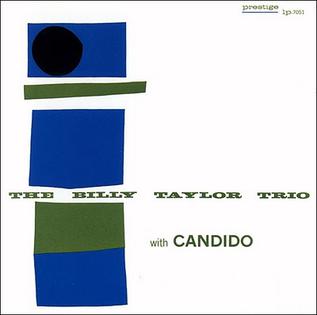
Listening to Prestige Part 120: Billy Taylor/Candido

Billy Taylor wrote the liner notes for this album, and he made its purpose clear:
The purpose of this album is to present a great new jazz artist. His name is Candido, and we think that he is the most exciting jazz conga and bongo player in the business.

There are, of course, many Latin American drummers who play well with jazz groups, but I have not heard anyone who even approaches the wonderful balance between the jazz and Cuban rhythmic elements that Candido so vividly demonstrates, and his technical facility is, to say the least, astounding.
Dizzy Gillespie, of course, is one of the most important figures involved in the integration of Latin rhythms into jazz, starting with bringing Chano Pozo into his band. Even before that, Machito had one of the great jazz trumpeters, Mario Bauza, who never gets the credit he deserves--well, Latin jazz has never really gotten the acclaim it deserves. Candido played with both Machito and Gillespie before joining Billy Taylor for these sessions. Taylor, who would become one of the great educators in the jazz field, seems to have already had that mind set, as he sets out to prove that Latin jazz is real jazz, and Candido Camero is a real jazz musician.

Taylor gives Candido a lot of solo space here, and the conguero makes full use of it. He's a powerful presence throughout, soloing and trading with Taylor. And I could say accompanying, but that's not really it. He makes Taylor's solos into duets, and this is in no small part due to Rudy Van Gelder's engineering, keeping the levels of both instruments perfectly complementary.

The tracks are Taylor originals, plus a version of Cole Porter's "Love For Sale" which is breathtaking. Over nearly 8 minutes, Porter's melody becomes Latinized, boppified, turned into a vehicle for some adventurous Taylor improvisation and hot percussion by Candido.

Candido, who is still with us, was named an NEA Jazz Master in 2008, and his brief bio on the NEA's website describes some of his innovative drumming techniques:
...playing three congas (at a time when other congueros were playing only one) in addition to a cowbell and guiro (a fluted gourd played with strokes from a stick). He created another unique playing style by tuning his congas to specific pitches so that he could play melodies like a pianist.

I found a fascinating article on Candido at the Drum! website, taken from an article by Bobby
Sanabria (Originally Published in the Autumn 2007 issue of TRAPS) which includes the mention of a group the young Candido played with in Havana, led by Chano Pozo on congas, and including Candido on tres (a Cuban three-stringed instrument designed like either a mandolin or a guitar) and Mongo Santamaria on bongos. He also describes how he came to develop his three-drum technique:
 I had seen the New York Philharmonic perform and paid attention to the timpanist. I thought to myself, ’I can do the same thing with the congas.’ I began to tune the drums to specific pitches, mostly a dominant chord, so I could play melodies in my tumbaos and solos.

"A Live One" and "Mambo Inn" were released on an EP, and, with "Love For Sale," as part of a 10-inch LP. Both of these were just credited to Billy Taylor. The 12-inch LP, with the liner notes I quoted above, had the whole session, and was titled The Billy Taylor Trio with Candido.


Friday, June 12, 2015

Listening to Prestige Part 119: Joe Holiday/Billy Taylor

Joe Holiday is one of my new favorite musicians--a guy I had never heard of when I started this project, but who I've grown to love over the four previous sessions he recorded for Prestige, establishing himself as the king of mambo jazz.

That being said, listening to this session on the heels of the Sonny Rollins/Kenny Dorham/Elmo Hope session, Holiday is not in their league as an improviser. Where they were Movin' Out, Holiday is more like Stayin' Home. But I tell you, there's nothing wrong with stayin' home if you can roll back the rug, have a couple of rum and cokes, take a cute girl in your arms and do the mambo all night.

If Holiday's improvisations don't break any new ground, he can surely play the bejeezus out of a
melody, he can swing, he can bring Latin to bebop and vice versa.

Billy Taylor's improvisations are a lot more adventurous, but he and Holiday make a good fit. There are all sorts of different ways of being on the same page musically.

But if I were going to give an MVP for this session, I think it would be Charlie Smith. On the earlier Holiday/Taylor collaboration, they had the benefit of Machito's rhythm section. Here Smith handles it all, on traps and congas, and he keeps it going.

The cuts from this session were released as singles. The mambo was still a hot dance craze in 1954. Apparently, they only came out on 78. Perhaps the market for Latin music was still mostly 78 RPM. In the introductory chapter to Oscar Hijuelos' magnificent novel The Mambo Kings Play Songs of Love, as Cesar Castillo is dying, he stumbles and knocks over a credenza in his apartment, and dozens of 78s fall to the floor and shatter. "I Love You Much" had what seems to be a variously titled song on its flip side. The session list has it as "Chasin' the Bongo," but every 78 RPM catalog I've found lists it as "Chasin' the Boogie." Also, every catalog has an unknown flip side to "It Might As Well Be Spring," but the song was over five minutes long, so it has to have been Part 1 and Part 2. It looks as though no one in recent memory has actually seen a copy of either of these discs. Maybe they were part of Cesar Castillo's record collection.

They were included on the Holiday/Taylor Mambo Jazz 10-inch, then had to wait for years-later reissues.


Monday, June 01, 2015

Listening to Prestige Part 116: Billy Taylor


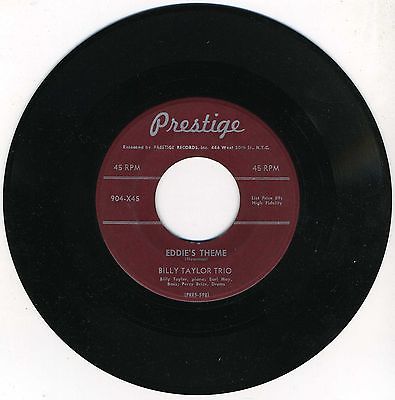
Billy Taylor meshed well with his longtime trio (there seems to be some disagreement as to whether Charlie Smith or Percy Brice was the drummer, but either knew how to play with Taylor), and knew the material he was working with, so it's not surprising that he was able to get about twice as much recording into a single session as the average leader. He did eight tunes here, three standards, a sem-standard (Gordon Jenkins' "Goodbye'), and four originals, all of which were dedicated to disc jockeys and became the theme music for their shows -- Taylor estimated that by the end of the 1950s, he had written themes for at least 15 DJs. Joseph "Tex" Gathings was on WOOK in Washington, DC--primarily a rhythm and blues station, but Tex was strictly a jazz man, although later, in the early 60s, he hosted an all-black teenage dance party on a Washington TV station. Biddy Wood was DJing a jazz show in Philadelphia when Taylor dedicated this song to him, but he was mostly known as a music promoter in Baltimore, and the husband of jazz singer Damita Jo. Eddie Newman was another Philadelphia DJ who also opened his own jazz club. Jim Mendes was perhaps the first black DJ in the Providence-Hartford area, and also hosted a public affairs show for emigres from his native Cape Verde.

As with most of Taylor's early Prestige sessions,
these are hard to find. Nothing on Spotify. "Goodbye." "Lullabye of Birdland" and "Moonlight in Vermont" are all on YouTube. Each features a lush, measured head embellished with plenty of sustain, then moving into bright and increasingly complex right-hand work on the solos.

"Eddie's Tune" and "Goodbye" were the only single release, on both 78 and 45.  You'd think they would have released the others, at least regionally, for fans of the DJs. There was a 10-inch LP called Billy Taylor Plays for DJs (the standards were all used as themes by jazz DJs, as well), and the tunes were included on a 12-inch called Cross Section.


Sunday, April 12, 2015

Listening to Prestige Part 100: Billy Taylor

My 100th blog entry in this Prestige project, and the last session of 1953. Still loving the music, still privileged to be able to write about it. The year ends with another session by Billy Taylor and his trio. Given that Prestige, or the companies that later acquired the Prestige catalog, reissued nearly everything, and given Billy Taylor's continuing popularity, these are surprisingly difficult to find, but they're worth the effort.

Taylor was going for tuneful on this set, and he succeeds. "That's All" is a melody by Bob Haymes, brother of crooner Dick Haymes, and in 1953 it was still a new song. It had been recorded by Nat "King" Cole but hadn't really become a hit. Ben Webster also did a jazz version of it in 1953, but certainly Billy Taylor was one of the first to discover its possibilities as a jazz vehicle. The Wikipedia entry on the song insists a little too stridently that it is a part of the Great American Songbook, which it really isn't. The pages were closing on that volume by 1952, and Bob Haymes didn't make much of a mark in the history of American popular music. But Alec Wilder loved the song enough to include it in his American Popular Song: The Great Innovators, 1900-1950, even though it doesn't actually make the cutoff, and he gives his reasons eloquently.

First, it is one of the last free-flowing, native, and natural melodies in the grand pop style. Second, it has had a curious career insofar as it went through no initial hit phase but became an immediate standard...“It is verseless and of conventional A-A1-B-A form. The use of octave jumps in the release should produce monotony, there are so many of them. But, due to the mysteries of creation, they don’t. ...It’s one of the warmest, most natural, and least ‘studied’ songs I know.”

 "Nice Work if You Can Get It" is a favorite of mine and of many jazz musicians. Hip and tuneful, it's a Gershwin melody introduced in 1937 by Fred Astaire, and almost immediately a standard of both pop and jazz. Teddy Wilson's was probably the first jazz recording, with Billie Holiday and Buck Clayton. Taylor gives it the respect it deserves and the swing it demands.

In a sense, any jazz rendition of "Nice Work" is an homage to Teddy Wilson, who made it his own. "The Little Things" is a Teddy Wilson tune, and on it Taylor shows that he knows where he came from, and that he knows who he is.

"The Surrey With the Fringe on Top," a homey paean to a white small-town yesteryear by Rodgers and Hammerstein, is an unlikely jazz standard. That it has become one is generally credited to Miles Davis's ultra-cool 1957 version, but Billy Taylor beat him to it by a few years, and was the first to show how the tune can swing.

The songs were released on two 78s, and under two different titles on EP -- Billy Taylor and Billy Taylor Trio, Vol. 2. Also on a 10-inch LP called Billy Taylor Trio Vol. 3 -- go figure -- and later on a 12-inch 7000-series LP called Billy Taylor Trio, Vol. 2. Since then, there have been no reissues, which is just wrong.

Thursday, April 09, 2015

Listening to Prestige Part 98: Joe Holiday - Billy Taylor

Billy Taylor, during this period, was developing quite a reputation for Latin rhythms, so it made sense to put him together with Joe Holiday, the king of mambo jazz. Taylor brings with him his regular rhythm section of Earl May and Charlie Smith, plus the musicians from Machito's band that he had used on his last session, including Machito himself, this time apparently under his own name.

Taylor was at the beginning of a long and distinguished career, of which Latin jazz was only a small part. Holiday would record very little after this. He would do one more session with Billy Taylor, nearly a year after this one. He made an album for Decca, Holiday for Jazz, in 1957, and played on a couple of tracks for keyboardist Larry Young's debut album on Prestige.

And there were a few singles for Federal, in 1951. Federal was an odd little label. They released some jazz recordings. They had some rhythm and blues classics, including the Midnighters' "Annie" series, and Billy Ward and the Dominoes' "Sixty Minute Man," and James Brown's "Please, Please, Please." They released a number of singles by the Platters, including a mambo and the "Beer Barrel Polka," before finally finding their romantic R&B sound with "Only You," after which the Platters moved on to bigger and better things. Federal was owned by Syd Nathan, out of Cincinnati, as a subsidiary to his King label. So it's no surprise that in 1951, the same year they recorded Joe Holiday, Marian McPartland, Red Callender and Memphis Slim, they were primarily a country and western label.

Anyway, Holiday should have been recorded much more.

Machito's men cook up a storm on this session, especially on "Sleep." I'd say they add a touch of authenticity, but I don't really think it's appropriate here. Everyone on this session is authentic. Italy-born Joe Holiday and North Carolina-born Billy Taylor play mambos that have a good beat -- you can dance to them. And you can listen to them. Holiday had the rhythmic sureness, the tonality, the musical skills and the inventiveness of Stan Getz, another gringo who would make a name for himself in later years for playing a Latin American dance rhythm.

So it all adds up to total pleasure -- and I haven't even talked about Billy Taylor's contribution yet--not his piano work, and not his organ playing on "Besame Mucho," a hoary chestnut of Latin orchestras and singers which these turn into something exciting and moving. The organ is a perfect choice for it.


 "Sleep" was released on both 78 and 45, b/w "My Funny Valentine" from the March octet session. "Besame Mucho" and "Fiesta" were a 78, and "I Don't Want to Walk Without You" also paired up with a song from the earlier session, "Martha's Harp," on 78 and 45. All four tunes, along with the later Holiday/Taylor session, were included on a 10-inch LP.


Sunday, March 29, 2015

Listening to Prestige Records Part 95: Billy Taylor

Billy Taylor's long and illustrious career includes a number of trio sessions for Prestige, which were released on 78, on 45 EP (Billy Taylor Trio Vols. 1-4), on 10-inch LP (Billy Taylor Trio Vols. 1-3), on 12-inch LP (Billy Taylor Trio Vols. 1-2), and even on the almost completely forgotten 16 2/3 LP format (Billy Taylor Trio--Let's Get Away From It All). And all of it is pretty close to completely unavailable online, either streaming or download. And it doesn't seem to have been reissued, ether on later Prestige or Fantasy/Prestige or Original Jazz Classics, which is strange considering Dr. Bill's popularity and the fact that P-F/P-OJC left very few stones unturned. What I was able to hear is lush, romantic and thoughtful -- beautiful piano jazz for a Sunday morning by a master.

There were eight songs on this session, which is a lot. Presumably the engineering for a piano trio is relatively simple, and Taylor, May and Smith had played together a lot, so there wouldn't have been much hesitation.

Sunday, February 22, 2015

Listening to Prestige Records Part 85: Billy Taylor


Have you noticed that the fun has gone out of names in the jazz world? No more bop-punning titles like "Flight of the Bopple Bee." No more group names like "J. J. Johnson's Boppers" or "Terry Gibbs New Jazz Pirates" (oh...Terry and the Pirates. I just got it!) Now if anyone even thought of calling this group "Billy Taylor and his Mambo Maniacs" ... but no. Nobody did.

 Billy Taylor was a good choice for Prestige's latest mambo jazz entry. There's the fact that he could play anything, from bop to swing and all points in between. More to the point, much of his early background had been Latin, with Candido and Mario Bauza.

It's very hard to find any of this album to listen to on the Internet. Spotify nothing, although Taylor's later Latin work is represented. YouTube is better. I found one track -- "Early Morning Mambo" -- on a site called Office Naps, which has a whole page on Prestige and Latin jazz, and it's a very good page, although the guy does stoop to giving the inevitable backhanded compliment to Bob Weinstock (Prestige "operated on a dizzyingly prolific schedule, occasionally at the expense of quality and fidelity"). He also mildly chastises Prestige for its commercial aspirations:
Prestige Records had an eye attuned to commercial markets from the start, perhaps more than any other jazz-oriented label in its day, with many bop singles issued, a handful of them – including sides by King Pleasure (“Moody’s Mood for Love,” 1952), Stan Getz (“Four and One More,” 1949), Sonny Stitt (“All God’s Chillun Got Rhythm,” 1949) and Annie Ross (“Twisted,” 1952) – achieving some modest chart success.
Come on. In the first place, commercial success is not a bad thing. It was a healthy thing for American popular music that great jazz of the bebop era made the charts. In the second place, this
was a label for which the very first recording session was Lennie Tristano, which put Miles Davis and Lee Konitz back together, after the commercial failure of the nonet recordings, for an even more experimental session, which gave Teddy Charles his head and predated the electronic experiments of LaMonte Young and Steve Reich.

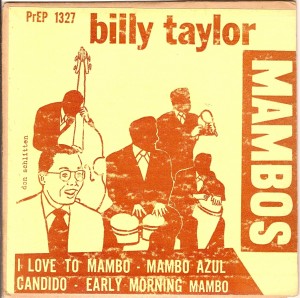
Anyway, thanks to Office Naps for some good information, and most of all for "Early Morning Mambo," and the cover art.

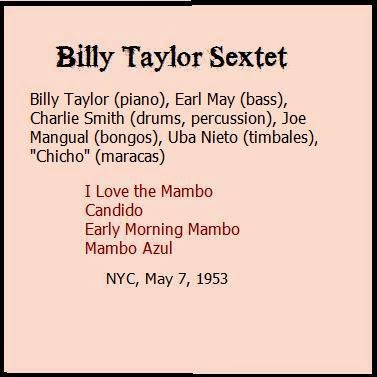
These four sides were released as two singles, and as an EP. Once again, all great stuff. I suppose if I were stuck on a desert island and could only take one, I'd go with "Mambo Azul" (below, from YouTube). Hard to choose, though.

A little disagreement on the personnel. The  Japanese site jazzdisco.org, which I'm using as my Bible for this whole project, lists the three percussionists as Chico Guerrero, Jose Mangual, and Ubaldo Nieto (bongos, congas). The YouTube uploader credits the group as "Billy Taylor Trio with Machito's Rhythm Section," and lists the three percussionists as Joe Mangual (Bongos), Uba Nieto (Timbales ), Machito (Maracas ). Looks as though the YouTube guy was right. a faded 45 RPM lists Mangual Nieto, and "Chicho" on maracas (undoubtedly Chicho was a cousin of Charlie Chan and Sven Coolson). The record label and the EP cover omit both "Trio" and "Sextet" and simply go with Billy Taylor Mambos.


Friday, January 16, 2015

Listening to Prestige Records Part 71: Billy Taylor

I've been using Spotify as my source for these recordings, and as a place to refer anyone who's actually following me along on this Odyssey. And I've been putting up YouTube links to at least one song from each session, for the same reason. No luck with Spotify on this one, so you're on your own, but I have downloaded it, and can report on it.

We tend to think of Dr. Billy Taylor (he got his doctorate from UMass Amherst in 1975, and has more honorary degrees than most of us have college credits), jazz ambassador and educator, founder of Jazzmobile, contributor to CBS Sunday Morning. But before he was Dr. Billy, he was a young college graduate (Virginia State College) who headed straight for 52nd Street, got his first gig playing with Ben Webster, learned from Art Tatum, and was the house pianist at Birdland.

He started his recording career as leader right away, too, doing his first trio session for Savoy in 1945. By the time Weinstock brought him in, he was already a veteran, but the series of trio recordings he did for Prestige, starting with this one, were a major showcase.

Not actually his first Prestige date, though. He appeared on one of those odd Prestige vocal group sessions that never quite made it, but have become sought-after collector's items in the doowop world -- The Cabineers, with Mercer Ellington.

Earl May, who would be Taylor's bassist for 12 years, joins him for the first time on these sessions (replacing Charles Mingus). There's an immediate rapport between them. Charlie Smith is probably best known for sessions with Bird and Diz, and although he's not one of the big names in the bebop world, he's much admired by other drummers.

These are standards -- "Accent on Youth" only barely qualifies as a standard because Duke Ellington recorded it, but it was a hit record in the 30s, and the theme from a movie. It was written by Tot Seymour and Vee Lawnhurst, noted for being the first successful all-girl songwriting team, and noted for having a string of hits all of which are forgotten today, but were recorded by a dizzying variety of performers -- Louis Prima, Rudy Vallee, Fats Waller, Ozzie Nelson and Billie Holiday among them. But I digress. "Accent on Youth" was chosen by Taylor in part because

This was the very first song I heard heard the flatted fifth used. I never noticed that device in a melody before I heard this tune. I didn't know what it was, but sat down and figured it out, liked it. Many years later, it was used extensively in bebop
 Also from Taylor's website, his comment on "Lover," from the same session:

The version of Lover that we played here was one of the swingingest things we did with the Trio. A number of years later, I was talking to Earl May about this, asking he remembered how we played this song. And he said, 'I never played that fast in my life."
These are great for listening. Taylor is boisterous and introspective in turn. He plays like a man who knows what he's doing.


Monday, October 27, 2014

Listening to Prestige Records Part 45: The Cabineers


I can only find the Cabineers' Prestige sessions on YouTube, but they're worth checking out there.

In 1951 Bob Weinstock announced that Prestige was starting a rhythm and blues line, and this session was its premiere offering -- unless you count the Gene Ammons session of few days before?

What's the line between bebop and rhythm and blues? But then, why draw lines at all?  The genius of American music is the way it colors outside the lines, and dances between the lines--and in a second line.Here's a  quote from an interview with Bob Weinstock that I just discovered.

JR: Tenor saxophonist Gene Ammons must have had an impact on the soul jazz market.

BW: Gene Ammons was the father of soul and funk. He started that music in 1950. I liked R&B. I heard a lot of bands play and I knew there had to be room for an update, a modernization of Rhythm and Blues with a jazz flavor. Black people needed something to relate to besides all the singers and vocal groups. Everything we did had a good rhythm section and swung. Nothing was ever phony to make sales. Even when we got heavy into the funk, with organ groups and guitar and all of that, they were like the blowing sessions we did before but with a different groove. They cooked.
Nice that Weinstock thought the same way that I did about R&B -- that it was an important part of jazz, including modern jazz. As much as bebop may have sounded strange and discordant to many listeners at the time -- including Nancy of the comic strip with her reaction to Sluggo's "beep-bop" -- it doesn't sound that way now. Jazz of the 20s may be labeled "trad" jazz, but as Arthur Blythe put it in the title to one of his postmodern albums, it's all "in the tradition."

Classic rhythm and blues instrumentals like Red Prysock's "Hand Clappin'" show the influence of Lester Young. Ray Charles' musicians like David "Fathead" Newman and Hank Crawford made important contributions to the jazz canon. Paul Williams popularized Charlie Parker's "Now's The Time" as "The Hucklebuck."

So Weinstock, who famously did not rehearse before sessions because he thought jazz should have the spontaneity of a live session, put the Cabineers together with a pretty impressive group of jazz musicians, led by Duke Ellington's son Mercer.

Billy Taylor had played with Ben Webster, Machito and Don Redman before becoming the house pianist at Birdland, and had written a book on bebop piano. He would go on to get his doctorate in music from UMass Amherst, thus shattering any myths that you can't be an academic and also swing.

Sal Salvador's birthdate is variously given as 1925 and 1928, but certainly this is early in his career -- the first mention I can find of him on a small group session, although he became part of the house band for Columbia Records and Radio City Music Hall in the late 40s. Like Dr. Taylor, he would go on to an academic career.

I could find nothing on Sam Bell -- finally, a listing for Aaron Bell, full name Samuel Aaron Bell, who must be the same guy. As Aaron Bell, he has a pretty impressive career -- here's his Wiki entry in full.

Samuel Aaron Bell (April 24, 1922, Muskogee, Oklahoma - July 28, 2003) was an American jazz double-bassist.

As a child, Bell played piano, and learned brass instruments in high school. He attended Xavier University, where he began playing bass, and graduated in 1942; following this he joined the Navy, completing his service in 1946. He was a member of Andy Kirk's band in 1946 but enrolled at NYU in 1947. After completing a master's degree he joined Lucky Millinder's band and then gigged with Teddy Wilson.

In the 1950s, Bell appeared on Billie Holiday's album Lady Sings the Blues and with Lester Young, Stan Kenton, Johnny Hodges, Cab Calloway, Carmen McRae, and Dick Haymes. In 1960 he left Hayes' band after being offered a position in the Duke Ellington Orchestra, opposite drummer Sam Woodyard. He left in 1962, spending time with Dizzy Gillespie before taking jobs on Broadway as a pit musician. He and Ellington collaborated once more in 1967, on a tribute to Billy Strayhorn.

Bell held a residence at the La MaMa Experimental Theatre Club in New York City from 1969 to 1972. He also began teaching at Essex College in Newark in 1970, remaining there until 1990. Later in the 1970s he toured with Norris Turney, Harold Ashby, and Cat Anderson; in the 1980s he returned to piano playing, and retired from active performance in 1989. He died in 2003.

I thought this was going to be a short entry -- silly me. And I haven't even gotten to the Cabineers yet. Bob Weinstock, in the interview linked to above, says that Prestige had its best sales with vocal records, and names them as one of his commercial successes. The most complete bio I could find for them is from Marv Goldberg, noted for his profiles of R&B and doowop groups. The Cabineers are one of those 1940s groups who were bluesier than the Ink Spots or Mills Brothers, but didn't last long enough to be part of the doowop scene. Their Prestige recordings were pretty much their last, and boy, do they deserve to be better known.

Jazz or rhythm and blues? Billy Taylor is playing figures that are much more inventive than the triplets that Stan Freberg mocks on his parody of "The Great Pretender," but "Each Time" (lead vocals on all the cuts except "Lost" by Maggie Furman)would be not out of place in any doowop or R&B collection. Sal Salvador contributes some great figures on "My, My, My," where the harmonies are reminiscent of The Clovers.

Of course, a lot of jazz greats played on R&B recordings, but they
weren't always given as free a hand as Weinstock allowed this group.

"Baby. Where'd You Go" is much closer to a Mills Brothers-style harmony. "Lost," which has a lead vocal by Bill Westbrook, is closer to an Ink Spots lead and a Modernaires harmony. I like Maggie's leads better, but I love all of it.

These were released on 78 and 45 by Prestige, and the label reads "Rhythm and Blues Series." The songs are attributed to "The Cabineers - vocal quartet accompanied by Mercer Ellington Quartet." Marv Goldberg offers a more complete discographical history:

 "My, My, My" and "Baby Where'd You Go" were paired for a July 1951 release. When this failed to take off, Prestige released the pretty "Each Time," backed with "Lost" on its Par Presentation subsidiary in September; it was re-issued on Prestige in early October. "Each Time" was rated "good" and "Lost" was given a "fair" the week of October 20, when other reviews went to Charles Brown's "Seven Long Days," Dinah Washington's "Be Fair To Me," and the Red Caps' "Boogie Woogie On A Saturday Night."

This is the first reference I've seen to a Par Presentation subsidiary. Jazzdisco has a brief list of Par Presentation 78s, all R&B, none of them by the Cabineers.