Tad Richards' odyssey through the catalog of Prestige Records:an unofficial and idiosyncratic history of jazz in the 50s and 60s. With occasional digressions.
Another artist wrapping up her career with Prestige in early 1963 was Etta Jones, with two sessions in February added to three songs recorded the previous November to put the final touch on this phase of her career, but Prestige would stay with her. After bouncing around a few other labels, she would reconnect in 1975 with Joe Fields, who had been Prestige's sales manager, but had now started a jazz label of his own, Muse. And after two decades and 14 albums, when Fields left Muse to start a new label, HighNote, she went with him, and recorded nine more albums.
Jones never quite hit the heights of popularity of the big four -- Sarah, Ella, Billie and Dinah -- but she maintained a loyal fan base--and the respect of the jazz community--in a career that lasted six decades, and into a seventh, as she made her final recordings in 2000. Her approach blended elements of all four of them, particularly Billie Holiday and Dinah Washington, but her voice was her own, and she never sounded derivative.
The two sessions used talents of Larry Young, about to break loose as a new and distinctive voice in jazz organ when he signed with Blue Note in 1964, and Kenny Cox, new on the scene. Cox was a Detroiter, too young to have been part of the Detroit influx that made such a huge imprint on the jazz scene of New York, and from there the world, starting in the 1950s, but still very much a product of that scene. This was his first collaboration with Jones, but he was to stay with her until 1966 as pianist and musical director. He later made two albums for Blue Note, but his roots were always in Detroit, and by the 1980s he had returned home to male the rest of his career there.
Kenny Burrell also played on both sessions. The group was anchored by two solid rhythm sections--George Tucker and Jimmie Smith on February 4th, Peck Morrison and Oliver Jackson on the 12th. "Someday My Prince Will Come" and "Old Folks" are taken without the piano and organ.
Jones takes in a nice variety of tunes over the two days, with a nod to Miles Davis, who introduced
"Someday My Prince Will Come" to the jazz lexicon, and also did a definitive version of "Old Folks," and a salute to Rodgers and Hammerstein. This last is particularly noteworthy. Jones possesses that special jazz singer's ability to take a wide range of songs and make them her own, but "Some Enchanted Evening" seems like a real stretch. From South Pacific, the song was originally written for the operatic bass voice of Ezio Pinza, and it's hard to imagine a bluesy jazz arrangement of it, with an improvisation off the melody...until you've heard Jones do it.
"Some Enchanted Evening" did not make a 45 RPM release. The two singles each featured one of the Miles borrows. "Someday My Prince Will Come" was matched with "A Gal From Joe's," from her November 28, 1962, session; "Old Folks" had "Love Walked In" on the flip.
The album was titled Love Shout. Ozzie Cadena produced.
A short session for Miss Jones--one song to fill out Hollar!, being readied for release, and three for a future project. She would be back in the studio in early 1963, and the three sessions together would make her last recording sessions for Prestige, to be issued as Love Shout, which was actually released before Hollar! Why these titles for these two albums is anyone's guess, as Jones was a singer, not a shouter. But then, a lot of the marketing decisions over the course of her long career may not have been the best ones, as her reputation has always seemed to lag behind her talent.
This is an interesting session in terms of song selection, leaning toward songs on the sweet end of the spectrum, not necessarily the first choices for most jazz singers--although other songs from not exactly hipster sources, like Sigmund Romberg and Rudolf Friml, have become jazz standards.
The session begins with Rodgers and Hammerstein's "If I Loved You," from Carousel, a much-loved standard for pop singers, bel canto and even operatic voices, not so many jazz singers. Doo wop singers of the 1950s breathed new life into a lot of standards and show tunes, but not this one--perhaps it was too resistant to a rhythm and blues spin. Dinah Washington recorded it twice, and Sarah Vaughan once. Dinah's first in 1950 with an orchestra led by drummer Teddy Stewart, and some melodramatic, almost coloratura, belting. the second a decade later with Quincy Jones. Both featured lush strings and an orchestral mood, as did Sarah's--I don't know the arranger or orchestra leader.
It goes without saying that both Dinah and Sarah can do no wrong with a song. Etta may not quite have the vocal chops of those two ladies, because no one has (except Ella, of course), but I do believe that Etta has the definitive jazz interpretation. She swings it, with a killer assist from Jerome Richardson on flute. Etta has always had the unique ability to channel other jazz singers without sacrificing her own individuality, and she does that here, starting out the way Dinah might have if she'd had Richardson, Kenny Burrell and Bucky Pizzarelli swinging her along, but then taking it to places that are pure Jones. For jazz, she owns this tune.
"Hi Lili, Hi Lo" was written for the Leslie Caron / Mel Ferrer movie Lili by composer Bronislau Kaper and Helen Deutsch, the film's screenwriter and not otherwise a lyricist. It was a 1952 hit for Dinah Shore before the movie came out, then everlastingly associated with the character of the sweet, innocent orphan who talked to puppets. It became a standard, mostly for girl singers with sweet, innocent voices, like the Lennon Sisters, the Chordettes, or Teresa Brewer--although Jimmy Durante also sang it (a weird masterpiece), as did the Everly Brothers (mistake), Manfred Mann (mistake), and Gene Vincent (oddly enough, not so bad). But jazz singing is mostly not about sweetness and innocence, although one of the great jazz vocals of all time is pure sweetness and innocence--Ella's "A-Tisket, a-Tasket," which works so well because there's no knowing wink behind it.
Jones respects the sweetness of "Hi Lili, Hi Lo." There's no knowing wink behind her rendition. But there's musical sophistication in the guitar parts especially, and if she doesn't swing it the way she does "If I Loved You," she gives it a nice bluesy touch.
Nat "King" Cole was never an innocent orphan who talked to puppets, for all his silky voice, and his
"Nature Boy" was a song about an innocent, not a song of innocence. It's a prodigiously recorded song -- nearly 600 versions, with lyrics translated into a bunch of languages including French, Italian, Portuguese, and three different Finnish translations, and yet it remains always Nat "King" Cole's. Etta Jones won't change your mind about that, but her knowing, smoky version, shorter than any of the other songs on this session, has its own very real words, not the least of them being Jerome Richardson's sax solo.
There's no question about the jazz credentials of "A Gal From Joe's" -- it was written by Duke Ellington, and his original 1938 recording features a memorable Johnny Hodges solo. And it's a good tune, but one that never caught on the way so many Ellington songs have -- in fact, Jones's 1962 recording was the first to feature a vocal. Nina Simone would record it a couple of years later, and her version is the best known. Contemporary singer Deborah J. Carter has recorded it, and that's about it. The lyric, credited to Ellington's manager Irving Mills, is odd -- is the gal leaving Joe's because she's dying? Because she's been arrested for murder? Or just because she's tired of Joe? Anyway, Jones does a fine version of a tune that deserves more attention than it's gotten, with wonderful solo and ensemble work from the musicians.
Also on this gig -- Sam Bruno, playing both organ and piano, although he's probably better known as a bassist; Ernest Hayes on bass (can't find any other credits for him, unless he's Ernie Hayes the piano player--he's certainly not Ernest Hayes the bass fisherman); and Bobby Donaldson, who's made several Prestige sessions, including a few backing up vocalists, and who brings a lot to this date.
Three of the four songs made it onto 45 RPM releases. "Nature Boy" and "Hi Lili, Hi Lo" were one entry. "A Gal from Joe's" was paired with "Some Day My Prince Will Come," from one of the later sessions. Esmond Edwards had brought Jones to Prestige, but Ozzie Cadena produced this and the later Love Shout sessions.
Etta Jones's career followed a familiar arc: Apprenticeship, a breakthrough and a pinnacle of success, a period of decline. For Jones, the toiling in the fields stage was a long one--her first recording in 1944, with Barney Bigard. Her rise was meteoric when it finally came. After recording singles off and on through the 1940s and 1950s, and one little noticed album for King in 1957, she broke out with her debut album for Prestige, 1960's Don't Go to Strangers, which sold a million copies, made Billboard's top 40 with the single, and was nominated for a Grammy. She would remain on Prestige's roster for the next five years, and record eight albums, but would never have another hit like Don't Go to Strangers, would never make a significant dent in the DownBeat and Playboy polls. So...an unusually long gestation period, a brief moment of glory (sadly, not all that unusual) and then a long period of declining popularity. But that long period was super-long, as a core of devoted listeners never went away, as her career spanned six decades, until he death in 2001, just after she had recorded her last album. After leaving Prestige, she began a collaboration with saxophonist Houston Person which lasted 29 years. And while she may never have
gotten the recognition she deserved, there was always enough demand for the music she and Person made to keep her working. Nor was she completely overlooked--there were further Grammy awards in 1981 and 1998.
Jones recorded three sessions for Prestige in April and May of 1962, the middle one of which was logged as a Gene Ammons session.
The two sessions were mingled together on the album, Lonely and Blue. The tunes from the April 13 Ammons session (Bown, Duvivier, Walter Perkins on drums) were included on a compilation album. Soul Summit No. 2, and later added to the CD reissue of Lonely and Blue.
It's a wonderful album. The songs are a mix of standards and little known tunes, ballads and blues, all of them good songs with intelligent lyrics that Jones understands and conveys from the inside out. The songs Ammons's and especially Johnson's tenor sax presage her work with Houston Person, warm, romantic, meticulously phrased and passionately delivered, voice and saxophone meshing and playing off each other.
Because her songs with saxophone and piano/guitar are each so distinctive, I have to give a Listen to Two for this album, and even then it's hard to choose. I went with two of the more obscure cuts. "Gentleman Friend" was written by Richard Lewine and Arnold B. Horwitt for a 1948 Broadway Revue called Make Mine Manhattan, which had a decent run and is best known for being the Broadway debut of Sid Caesar. It was pretty much the highlight of Lewine's an Horwitt's careers, though they both did respectable work in the music business. "You Don't Know My Mind" is by Clarence Williams, prolific tunesmith and one of the first successful Black music publishers.
Jones is featured on the three tracks of the Gene Ammons session, recorded shortly before he began his second prison term. The session was split over two compilation albums also featuring cuts by Jack
McDuff: Soul Summit and Soul Summit, Vol. 2. Among their other significant virtues, these albums showcase how good, and how underused, Patti Bown was. A second Ammons session, the next day, this one with Shaughnessy, was released on Moodsville.
Lonely and Blue was a Prestige release. Esmond Edwards produced both days, and the Ammons sessions. The Jones / Richardson session produced a 45 RPM single, "And I'll Be There" / "In the Dark." The 45 RPM single off the first Ammons session was "The Party's Over / "I Want to Be Loved;" off the second, "On the Street of Dreams" / "You'd be So Nice to Come Home To."
Etta Jones probably hit her peak of popularity with Don't Go to Strangersand Something Nice. Scott Yanow, in his review on AllMusic, describes this album as "a too-long-forgotten gem," and Jones herself could easily be described that way. She doesn't make UDiscover.com's list of the 25 greatest female jazz singers, compiled by critic Charles Waring representing a younger generation (although Etta James and Norah Jones do). The voters for Ranker.com, who I suspect are mostly younger, have her at number 24 on the day I checked (this is an ongoing vote, and can change), just ahead of Norah Jones, but considerably behind Etta James. Fortunately, she continued to work, and record companies continued to want her musical stylings, right in the mainstream of vocal jazz and always rewarding. She would do four more recording sessions with Prestige, and she would continue to tour, and perform, and record, her last session (a tribute to Billie Holiday) coming just months before her death from cancer in 2007;
Oliver Nelson was back again with her, arranging two different sessions on two days, the first with strings and the second with horns.
The rhythm section was the same for both dates. Pianist Lloyd Mayers had worked one previous Prestige session, in 1956 with Bennie Green; he would become, in 1981, the pianist and musical director for the Duke (by then Mercer) Ellington Orchestra for the Broadway musical Sophisticated Ladies. Wally Richardson had become an active Prestige participant, appearing with vocalist Betty Roché and with several instrumentalists, most recently Johnny "Hammond" Smith just a couple of weeks prior to the Jones date. Bob Bushnell brought his bass to a King Curtis session in 1961, but as the decade rolled on he would figure in many more Prestige sessions. And drummer Ed Shaughnessy played across a wide spectrum of jazz groups and styles, before settling into the solid payday of Doc Severinsen's Tonight Show Orchestra.
The string section on day one is unidentified; the horn players of the second day are all Oliver Nelson veterans.
The songs are standards, and they justify the album's title. The sardonic "Makin' Whoopee" doesn't
exactly come from the heart, and it's not Jones's most effective outing, although it's still a pleasure to listen to. "You Came a Long Way From St. Louis," by John Benson Brooks and Bob Russell, also has a wry comic touch, but the wryness is mixed with warmth, and that's more in Jones's comfort zone.
Of particular interest is listening to Oliver Nelson arranging for the same singer, on successive days, with strikingly different instrumentation. Of the songs with strings, I was particularly struck by "Just Friends," a standard that's perhaps best defined by Charlie Parker, also with strings, but has been done by many vocalists. Oliver Nelson gives it a particularly arresting arrangement, starting with a sort of "Wagon Wheels" clippety clop opening, that then gets swallowed up by lush strings.
For the larger group of songs with horns, it was hard to choose, but I think I'll go with "I'm Afraid the Masquerade is Over," a song that's been done by both Ettas, Jones and James, as well as singers from Sarah to Aretha. The definitive male version is probably George Benson's, and the Cleftones gave it a doowop spin. It's a song that allows for a lot of individuality in interpretation, and Jones and Nelson put their stamp on it, for sure.
From the Heart was a Prestige release, Esmond Edwards producing. "You Came a Long Way from St. Louis" was the 45 RPM single, with "Just Friends" on the flip side.
Esmond Edwards and Oliver Nelson put Etta Jones together with a string section over three recording sessions. The first one had been back on June 9. This one was followed by another three days later.The string sections were anonymous; the other players, except for George Duvivier on the bass, are all new from the June session. A reed section is added, and the two French horn players from June are cut down to one.
This French horn belongs to Ray Alonge, mostly a classical musician (he was first chair in the Indianapolis symphony while still in high school), but with some impressive jazz credentials too: Louis Armstrong, Miles Davis, Quincy Jones, Dizzy Gillespie, Milt Hinton. And going farther afield, he played on recordings by Elvis Presley, the Beatles and the Rolling Stones.
Female singers with strings became a thing after Billie Holiday did it, and it generally wasn't a bad thing, if not necessarily a good thing. In this case, with Oliver Nelson arranging and conducting, the results are good. Jones veers toward the Billie Holiday side of her personality, which is probably understandable, since Holiday more or less set the template for jazz singers with strings.
One song from the July 25th session, "You Better Go Now," is associated with Holiday, and Jones would record again in 2001, on her last studio album, A Tribute to Lady Day. Interestingly, the 1961 version owes a lot more to Lady Day than the later version. She also recorded it in 1994 with Benny Green, the pianist--not to be confused with Bennie Green, the great trombonist, or Benny Green, the British saxophonist. The song had originally been performed in 1936 as part of the Broadway revue New Faces of 1936 (the only new faces of note were Imogene Coca and Van Johnson), but it had not broken out as a hit, and was never recorded again until Holiday found it in 1947.
"And This is My Beloved" is another interesting choice, perhaps dictated by the orchestral instrumentation. From the Broadway show Kismet, it never achieved quite the breakout status of "Stranger in Paradise" or "Baubles, Bangles and Beads," but it's had quite a life as a vehicle for pop singers with operatic ambitions like Jim Nabors or Jackie Wilson (granted, quite a range of styles there) or opera singers with pop ambitions like Richard Tucker, but one thing hasn't particularly beem is a vehicle for jazz singers. or jazz instrumentalists (with one odd exception--Sun Ra). Jones basically sticks to the melody, but she has some nice jazz-tinged phrasing, and it makes for a satisfactory outing,
"Unchained Melody," from the July 28 session, is another unusual choice, although not so unusual when you consider how popular a choice it was, and has become, From the soundtrack of a 1955 grade B movie, it attracted twelve different reco
Dating from 1955, it is one of the most popular songs of all time,, with over 450 versions (and if you think that the mid-1950s were so rock 'n roll dominated that a ballad didn't have a chance, think again. "Unchained Melody" isn't even the most-recorded ballad of 1955; "Cry Me a River" beats it out). It's been recorded by pop singers, rockers, country singers, almost everyone except jazz singers, although one of the biggest hit versions was by Al Hibbler. Even in the hands of an Al Hibbler or an Etta Jones it's not exactly a jazz tune, but Oliver Nelson's string arrangement is one of his most interesting, and Jones works with it in inventive and creative ways. There may not be a whole lot you can do with improvisation on "Unchained Melody" with strings, although Jones makes some interesting choices, but there's a lot you can do with dynamics, and there she comes through.
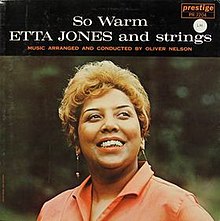
"Unchained Melody" was the 45 RPM single. On the other side was "Hurry Home," written by Buddy Bernier, Bob Emmerich and Joseph Meyer, not a well-known tune (I'd never heard it before), but a good one. It had been a hit for Kate Smith in 1938, and Ella Fitzgerald recorded it on Verve in 1957. Jones and Nelson give this one a jazz reading, and a good one--I like her version better than Ella's. The album was called So Warm.
Listening to Prestige Vol 4, 1959-60, now available from Amazon! Also on Kindle!Volumes 1-3 are also available from Amazon.The most interesting book of its kind that I have ever seen. If any of you real jazz lovers want to know about some of the classic records made by some of the legends of jazz, get this book. LOVED IT.– Terry Gibbs
This is the first of three sessions involving a collaboration between Etta Jones and Oliver Nelson. That only four songs were recorded on this session is a pretty good indication of the complexity of the project. It must have cost a lot more than Bob Weinstock was accustomed to paying for an album,what with three days of studio time and the cost of a string section. And were they able to put all this together with no rehearsal time at all? It seems unlikely. This was no jam session. Since Weinstock didn't believe in keeping alternate takes, we have no idea how many takes were discarded, but the fact that they only got through four songs, all of them fairly short (2:02 to 3:40), should tell us something.
I hope this proved to be a good investment for Weinstock. Jones had some popularity at the time--Don't Go to Strangers sold a million copies, though she never attained that level of success again. And her place in the pantheon of jazz singers, to today's jazz audience, is iffy. One internet poll of top female jazz singers places her at number 38, another (a list of the top 25) leaves her out altogether. And yet another one places her 7th, just behind the acknowledged queens of the field.
So it depends on who you ask; but she is for the most part, I would guess, only marginally remembered. And it's hard to understand why this is so. She had a long career, and in fact issued her last record, a tribute to Billie Holiday, just before her death in 2001.
And she really was that good. You can hear the influences of all the singers that she absorbed--chiefly Billie Holiday and Dinah Washington--but she's not derivative. The influences are absorbed, learned from, and channeled into a voice that is distinctively her own.
And whether or not Bob Weinstock made back his investment in this album, we're lucky to have it, both for Jones's beautiful interpretations of songs by a variety of composers, and for yet another demonstration of the range of Oliver Nelson's talents.
Working with a deliberately limited palette--a French horn section, a string section--Nelson produces a sound that's striking and unique, but always does its primary job of supporting the singer.
Classical musicians, in general, don't get the kind of recognition that jazz musicians do. Even in a big orchestra like Duke Ellington's or Count Basie's, you know the names of all the players, and if you're a serious jazz fanatic, you know what each one of them sounds like. Here, the stringed instruments, which play such an important role in Oliver Nelson's sound, are anonymous.
The French horn players do get individual credit, and while they aren't names we would recognize as readily as the reed players like Jerome Richardson and Eric Dixon, other musicians knew who they were. Richard Berg was called on for sessions by Dizzy Gillespie and Jimmy Heath in 1960-61, and a dozen years later, when Charles Mingus needed a French horn player, Berg was the one he called. John Denver and Neil Sedaka both used him, and he has a previous Prestige association, though he's not listed on the session log: he helped out Moondog on that eccentric genius's Prestige recordings. I don't find Joe Singer's name attached to any other recording sessions, though I'm sure he did many, but he is the author of the standard instructional book on developing an embouchure for French horn,
Esmond Edwards produced the session. The album, about which we will be hearing more, was called So Warm.
Etta Jones is back, with the same rhythm section that accompanied Betty Roché on her January 24 session for Prestige, and why not? These guys had demonstrated that they knew how to work with a girl singer, and Etta, I'm guessing, must have been very easy to work with, and a very professional singer, because she got a lot accomplished in a session -- a dozen songs in this one.
And she had material left over from her last session, in September, so six of the songs from this session were bundled with five songs from that one to make her next release, Something Nice. The rest of the September session had to wait until 1963 for Hollar!, when those songs were packaged with...five more songs from this session. The titles suggest
two different concept albums, one sweet and one wild, and that does seem to have been the logic. As I've said, making the decisions about what goes on what album, and gets released when, is way above my pay grade.
You can hear a lot of other singers in Jones's voice -- there's some Billie, there's some Dinah. Those are the main two, but maybe a little Sarah, and everyone was influenced by Ella. That was the style of the day, and it was a golden era for female jazz singers. So Jones makes the right choice, I believe, when she doesn't force herself to try to be different. She accepts her influences gratefully and graciously, and she uses them to create a sound that is wonderfully listenable. whether it's familiar standards or songs that don't get recorded all that often. She is, ultimately, her own singer, and why she isn't numbered among the first ladies of jazz is beyond me.
"And Maybe You'll Be There," the first song off the session to be placed on Something Nice, falls somewhere in between, on the scale of popularity. It hasn't been covered as much as, say, "Laura," but it certainly hasn't been ignored, either. Written by Rube Bloom with lyrics by Sammy Gallop, it's a good song to sing, and some good singers have done it, including Billie Holiday, Lee Wiley, June Christy, Dakota Staton. Frank Sinatra has recorded it, and a couple of marvelous and underrated doowop singers, Lee Andrews and the Five Keys' Rudy West. Even Bob Dylan.
Here's one more interesting comparison: Betty Roché recorded the same song, just couple of months earlier, with exactly the same musicians.
The musicians approach each session differently. Jimmy Neeley takes the lead for the Roché version, Wally Richardson for Jones. Roché takes a more theatrical approach, and by that I don't mean grand gestures, I mean she does more to create a persona, the forlorn lover who can't help looking for something she knows she'll never find, and so is constantly torn. The quintet gives her space for little pauses of self-doubt, finds equivalents for the restraint which that self-doubt imposes. Jones sings the song, her engagement more with the melody and the musicality, and the musicians play to that.
I'm very glad we have both versions. I spent a lot of time on this song, a lot more than I'd expected, and when I got back to Etta Jones's version again at the end, it still sounded wonderful.
Composer Rube Bloom deserves a little mention. He had his share of hits as a songwriter, including "Fools Rush In" and "Give Me the Simple Life," and he had his moments as a piano player, working with Bix Beiderbecke and Frankie Trumbauer, and leading a group called Rube Bloom and his Bayou Boys, which included such bayou denizens as Benny Goodman and Tommy Dorsey. Bloom also wrote the music for "Fools Rush In," which, with Johnny Mercer lyrics, has been a staple for pop singers, jazz singers, country singers and Elvis Presley.
"My Heart Tells Me," a Harry Warren tune with lyrics by Mack Gordon, is from a Betty Grable movie, and it can fall prey to a little over-sweetness of rendition, but not the way Jones does it. With a powerful assist from Michael Mulia and Jimmy Neeley, she swings it hard. The tune has an interesting history, in that during the war, a version was made by Glenn Miller lyrics sung in German by Johnny Desmond. This was broadcast over the American Broadcasting Station in Europe, a station set up to broadcast hopeful news to Resistance fighters and demoralizing messages to German troops. Gordon also wrote the lyrics to "Through a Long and Sleepless Night," music by Alfred Newman, also from a movie. Neither of these songs have been widely recorded, but both worth a listen from Jones. "Love is the Thing" is also pretty obscure, and also written by movie composers--Ned Washington and Victor Young-- although not, apparently, for a movie.
"Till There Was You" was the hit ballad from the hit Meredith Willson musical, The Music Man, just winding up its 4-year run on Broadway as Jones took the tune to Englewood Cliffs, so that star Robert Preston could head for Hollywood to make the movie version, which was also a hit. This was the breakout romantic ballad from the show, and it became a Top Forty hit for Anita Bryant. But its biggest success was yet to come: in 1963, when the Beatles included it on their first American album. Jones keeps the sweetness of the song, but adds just enough jazzy tartness to make it interesting. "Till There Was You" was also the 45 RPM single from the session, along with "All the Way" from her first Prestige outing.
"Give Me the Simple Life" (Rube Bloom again, with Harry Ruby) led off the March 30 session, and found its way into the groove of the uptempo swingers that make up Hollar! This kind of easy but forceful swing is most associated with Ella Fitzgerald, although she wouldn't record "Simple Life" until several years later. Jones can hold her head up proudly at a comparison with Ella--she swings it, with considerable help from Michael Mulia and a "Peter Gunn"-type walking bass.
"Looking Back" is a soulful blues from the pens of two songwriters equally at home in blues and pop, and this song has found success in both genres, and in country as well. Originally a hit for Nat "King" Cole in 1958, it was covered by country crooner Ferlin Husky in 1959, and later by Marty Robbins, Conway Twitty, and rockabilly Gene Vincent. Soul versions have been recorded by Mary Wells, Roy Hamilton, Carla Thomas, the Chambers Brothers, Otis Rush, Irma Thomas, and Johnny Adams. Jazz singers Nancy Wilson, Julie London and Ruth Brown have all recorded it. The soul singers, in particular, could have learned a lot from Jones' soulful interpretation, with great assists from Neeley and Rudy Lawless.
The songwriters were Brook Benton, no slouch as a pop and soul balladeer himself, and Clyde Otis, whose entry into the music business is one of those storybook tales. As a young marine, he became friends with fellow jarhead Bobby Troup (“Route 66”)—these
were the days after President Truman had integrated the armed forces. Troup
encouraged his songwriting, so after he’d mustered out, he moved to New York,
where he spent the better part of a decade knocking on doors, piling up
rejections, and driving a cab. One evening, he caught a fare who was going to a
party given by a well-known music publisher, and he persuaded the passenger to
give the publisher a song.
Reel to reel? There were no cassettes in those days. But anyway,
the song was “That’s All There Is to That,” and it became a Top Twenty hit for
Nat “King” Cole. Within two years, Otis was the first African American A&R
executive with Mercury Records. He is credited with over 800 published songs.
His work with Brook Benton yielded several hits for Benton singly and in duets
with Dinah Washington in addition to “Looking Back.”
“And the Angels Sing,” by Ziggy Elman and Johnny Mercer, is another
song like “Give Me the Simple Life,” made to be swung. Additionally, it has a
lot of lyrics (“Suddenly the setting is strange / I can see moonlight beaming /
silver waves that break on some undiscovered shore”) which require a very good
singer to make them make sense, carry the emotion, and keep swinging. This takes
some serious musicianship combined with some serious intelligence. And she does
it all in two and a half minutes, which includes a most satisfying solo by
Wally Richardson.
“Answer Me My Love” was originally a German song by Fred
Rauch and Gerhard Winkler. A close English translation by Carl Sigman, a prolific
lyricist, began “Answer me, my Lord,” and had the singer questioning why God
had stolen his sweetie, but even when recorded by Frankie Laine, who was no
stranger to addressing God (“I Believe”), it didn’t take off. Sigman tried again,
and Laine had better success with the new secular version, although the big hit
was Nat “King” Cole’s. Love was a good fallback theme for a song in those days.
“Let Me Go, Devil,” was a song about an individual in the clutches of
alcoholism, but when it was redone as “Let Me Go, Lover,” it became a number one
hit for Joan Weber, a top ten hit for both Patti Page and Teresa Brewer, and a
charted record for several other singers.
The tempo of “Answer Me My Love” may have been more suited
to Something Nice” than Hollar!, but it’s nice to have it
wherever.
“Reverse the Charges,” by Paul Francis Webster and Clarence
Williams, seems not to have made much of a mark in spite of the pedigree of its
composers. It was the B side of a 1946 78 RPM single by the Velvetones, a vocal
harmony group in the style of the Ink Spots or the Mills Brothers. A nice save
out of the remainder bin of pop history by Miss Jones, and a nice recording.
Prestige got behind Etta Jones, whose career had been slow in developing, putting Frank Wess and a standout group of musicians behind her for her debut recording for the label in June, and it paid off, making her an overnight success at age 32, with the better part of two decades of performing behind her. Bob Weinstock and Esmond Edwards wisely brought her right back for this session with two of their brightest new jazz stars, Lem Winchester (this was to be his next-to-last session) and Oliver Nelson,
This was a session of mostly familiar standards, and why not? If you're trying to advance the career of a singer who decidedly deserves it, why not give her a bunch of songs that people like to here. "The More I See You." by Harry Warren and Mack Gordon, was very popular with jazz chanteuses, and even some chanteurs, in those days. A 1945 hit for Dick Haymes, it received ten other renditions in 1959-60 alone, plus four instrumental versions: interpreters included Sarah Vaughan, Nancy Wilson, Julie London, Brook Benton and the Four Freshmen. Celebrities liked it too, including Tony Perkins and Maureen O'Hara. Jones is deliciously torchy on this one, with Winchester functioning as her alter ego and Nelson providing a short but moving solo near the end.
The Gershwins' wonderful "They Can't Take That Away From Me," originally recorded by Fred Astaire, is often a plaintive lament, but Jones belts it as a defiant album--nobody better try and take it away from me. This one is mostly Jones, but Winchester has an arresting, rhythmically interesting solo.
"That's All There Is to That" had been a recent hit for Nat "King" Cole, who had recorded a song called "That's All" several years earlier, and would recall another called "That's All There Is" a few years later. He sang "That's All There Is to That" for President Eisenhower at the 1956 Republican convention, but there doesn't seem to be any political message to it. It's a sensitive song of lost love and heartbreak as Cole sings it, and fatalistic in the extreme in Jones's version. No sentimentality. You love, you lose, and that's all there is to that. Richard Wyands is the instrumental star on this one. The song was written by Clyde Otis, who went on to a distinguished career as a songwriter and producer, but this was how it started for him: the Nat "King" Cole version of this song was his first hit.
"Easy Living" was written by movie composer Ralph Rainger, but it's become a jazz standard, thanks in great part to the 1937 version by Billie Holiday with Lester Young and Teddy Wilson. Jones stays close to what Lady Day did with the song--it's virtually an homage to the great singer who had died just months before.. The main solo here is Winchester, but Nelson very nearly steals the show with a much briefer one. It's interesting to compare Jones's 1960 recording with Holiday's 1937 recording, an era when the band, not the singer, was the star, and Holiday doesn't enter until more than halfway through the recording.
The Eddie Heywood "Canadian Sunset" was a big instrumental hit for Heywood in 1956, and many vocal versions followed. The lyrics by Norman Gimbel ("Killing Me Softly with His Song," English lyrics for "The Girl from Ipanema") sound a little tacked on, but not the way Jones sings them. Winchester propels her along for a snappy two and a half minutes, just the right length for a 45 RPM single, which this was.
Jones returns to Harry Warren for "I Only Have Eyes For You." a 1930s song which had been a big hit in a 1959 doowop version by the Flamingos. Jones echoes the Flamingos as she starts into the song, but soon takes it in her own direction, which is solid jazz singer. This is another 45-length cut, at just over three minutes, and I would have released it as a single. It's a great song, it's been a hit, and Jones takes it that step farther. But "That's All There Is to That" (not so short) and "Canadian Sunset" were the only singles from the album ("Canadian Sunset" would be rereleased as a single on the flip side of "Don't Go to Strangers"), and they didn't chart, so maybe Bob Weinstock decided that Jones was more an album kinda gal.
This is an interesting album in that some of 1960's finest jazz soloists (Nelson is sparingly used) are on the session, but there aren't any extended solos. And it works. Nothing wrong with tight. And when they do solo, as in Lerner and Loewe's "Almost Like Being in Love," which is about evenly divided between Jones's vocals and an instrumental break by Wyands and Winchester, the improvisation is tight, inventive, and...killer.
Much has been made of Jones's Billie Holiday influence. I didn't hear it so much in the first session--Dinah Washington came more to mind-- but it's definitely happening here, and it's all to the good.
The session would see daylight in two parcels, the 1961 release Something Nice ("That's All There Is to That," "Easy Living," "Canadian Sunset," "I Only Have Eyes for You") and 1963's Hollar.
Listening to Prestige Vol. 2, 1955-56, and Vol. 3, 1957-58 now include, in the Kindle editions, links to all the "Listen to One" selections. All three volumes available from Amazon.
The most interesting book of its kind that I have ever seen. If any of you real jazz lovers want to know about some of the classic records made by some of the legends of jazz, get this book. LOVED IT.
There are some songs--pop songs, art songs, theater songs--that don't necessarily benefit from a jazz treatment, and I would say "On the Street Where You Live" would be one of them. But nobody much agrees with me, and everyone wants to take a crack at a good song, so many jazz singers have covered this classic from My Fair Lady, even some soul singers like Ben E. King (I liked his version--maybe the right singer can make anything sound soulful). but Etta Jones took a shot at on this session, and acquits herself quite well. It does sound a little forced, or it would, except for one thing: Frank Wess.
I'll obviously be devoting a lot of space in this entry to the wonderful Etta Jones in her breakthrough album, so I'll start off with Wess and get him out of the way. Every jazz singer who ever lived should have been breaking down his door to get him to work with them, and a lot of them did: his bio lists Mel Tormé, Ernestine Anderson, Johnny Hartman, Helen Merrill, Dakota Staton. His fills enhance and inspire, and his solos...well, you can imagine.
This is Jones' breakthrough album at age 32, which is not exactly doddering, but it did take her the better part of two decades to become an overnight success. She began her professional career as a 15-year-old with Buddy Johnson. She had performed at amateur night at the Apollo -- "I did not win," she told interviewer Monk Rowe in 1998,"in fact, they almost booed me off the stage at first." But she finished her song, and afterwards the male vocalist with Buddy Johnson's band approached her and told her Buddy was looking for a girl singer--his sister Ella was off having a baby. She was terrified, sure she wasn't ready, but she went for the audition, which was right there, on the spot, backstage. Another singer was there to audition too, but she knew the lyrics to Johnson's songs, and the other woman did not, so she got the gig. Two days later she was on the road.
Ella came back, but Etta wasn't turning around. At 16, in 1944, she made her first recordings, with Barney Bigard and Georgie Auld--Leonard Feather on piano, Chuck Wayne guitar, Stan Levey drums. She was a blues singer back then, and could stand comparison with the best of them, but the era of classic blues was over, and that was the way producer Feather chose to present her. Feather, who wrote the songs as neo-classic blues, was a traditionalist who did not recognize the artistic potential of the new field of rhythm and blues, which is sort of too bad. Jones might have had more commercial success that way. Nevertheless, the early recordings are terrific. She also recorded "I Sold My Heart to the Junkman," with a band headed by J. C. Heard, as a haunting blues ballad. Gene Ammons recorded an instrumental version for Prestige in 1961, and it would become a huge R&B hit for Patti LaBelle and the Bluebells in 1962.
The singer she reminds me of most is Dinah Washington, and Washington did cover all bases--blues, pop, rhythm and blues, jazz. In fact, she covered three of the four Leonard Feather tunes from Jones' first session, and did well with them.
After the 1940s, Jones worked--she spent a few years with Earl Hines--but no more recording, until she re-emerged as a jazz singer, singing standards, on an album in 1957 for Cincinnati-based King Records. King was heavily into rhythm and blues and country, and did not really get behind its occasional jazz releases.
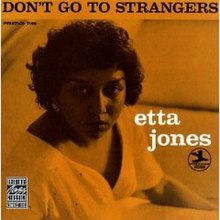
That all changed with this Prestige release. Suddenly, she was a star--an overnight success. The bestselling single from the album, "Don't Go to Strangers." went gold, something not too common for records from small jazz labels. She would record several more albums for Prestige, then for other labels with various musical accompaniments, then finally make a very successful partnership with saxophonist Houston Person, with whom she would tour and record for more than thirty years. But this would remain her best-known recording, and her greatest commercial success.
Why did it take so long for her to break through? Jones' own explanation for her late success: she wasn't ready for it earlier. Citing Billie Holiday, Thelma Carpenter and Dinah Washington as early influence, she told Billy Taylor in an interview that:
I took about twenty years to really not be afraid of what I was doing, and to know what I wanted to do and where I wanted to go.
If that was the case, the results were worth waiting for. This album was deservedly praised, and Jones, working with a premier group of musicians, proves herself ready to join the top echelon of jazz singers. I can't find a producer credit for this session, but it was most likely Esmond Edwards. I've mentioned the brilliance of Frank Wess, who takes the lion's share of the solos, but Richard Wyands' contribution is also stellar, and so is a newcomer to Prestige, the veteran guitarist Skeeter Best.
Best's career goes back to 1935. He was with Earl Hines for a few years before joining the Navy in 1942, so his stay with Hines did not overlap Jones's. But he had kept busy during three decades before being tapped for this session, evolving with the times. He had played with modernists like Sonny Stitt and Sir Charles Thompson, and he'd done the guitar part on Little Willie John's R&B hit "Fever."
Along with them are George Duvivier and Roy Haynes, for whom "always reliable" doesn't begin to do them justice.
She tackles an interesting mix of songs here. She has always said, in various interviews, that what interests her most in a song is a good lyric, and she finds them in a variety of sources, from the hot-cha-cha glitz of the Roaring Twenties to a contemporary hit, and even a new song.
The Twenties are covered by "Yes Sir, That's My Baby" and "Bye, Bye Blackbird," both songs that have had many lives. "Yes Sir" has been covered by country artists (Roy Acuff) and doowoppers (the Clovers and--one of my favorite versions, the Sensations, with the relatively unusual doowop feature
of a female lead), less often by modern jazz ensembles--this may have been the first such version, and they make it work, with some inspired playing by Frank Wess. "Blackbird" has always been more conducive to a modern approach, especially after Miles Davis blew it wide open on his first Columbia album. Peggy Lee, Julie London and Carmen McRae had all contributed versions of it before Jones picked it up, but she takes a back seat to no one, not even Frank Wess, with improvisational stylings that prove you can still find surprises in an old chestnut.
She gives us the classics--Cole Porter, Rodgers and Hart, Howard Dietz and Arthur Schwartz. With "Fine and Mellow," she starts out by channeling her idol, Billie Holiday, but then moves into territory that is pure Jones (she gets some great Wyands piano on this one, and fine solo by Best). She sings a current hit, Frank Sinatra's Top Ten hit "All the Way," and introduces a new one, "Don't Go to Strangers," that would become her biggest hit.
"Don't Go to Strangers" was released twice on 45 RPM, once with "If I Had You" on the flip side, the other time with "Canadian Sunset." "All the Way" was the B side to a song from a later session, "Till There Was You." Don't Go to Strangers was also the title of the album.
generation gap (Ammons was 36, Smith 28 at the time
of this session, but that was enough to put them in different eras--that's how fast jazz evolved). Ammons may not have been the first tenor man to record with an organ, but he certainly knew how to do it, and Wess's flute fits in perfectly too. They draw on a variety of composers (including originals by Ammons and Wess) and play some first rate jazz, wild and soft, pensive and gutsy.
This session was split over two discs, both released later, when Ammons was serving a second, and longer, prison term. Velvet Soul was the title track of a 1964 release that also featured "In Sid's Thing," and the other tunes came out on Angel Eyes in 1965. "Angel Eyes" as a two-parter saw two different 45 RPM releases, some years apart, and "Velvet Soul" came out on 45 along with "A Stranger in Town" from a later session.