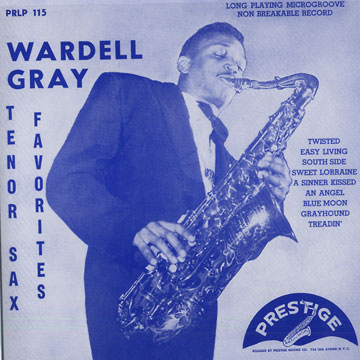
This one really shouldn't be hard to find. Who doesn't want to hear Dexter Gordon and Wardell Gray, one of the legendary tenor sax pairings of all time, in their natural element, Los Angeles, and with a great supporting cast? But they're nowhere to be found on Spotify, and only sparsely on YouTube.
Which means no quiet listening time in my car, which is part of the reason for the delay in getting this entry up. The other part is that I've been going through a fairly painful period of writer's block, during which the only thing I could really write was this blog. Now I've broken through, at least a little, so this is competing with the writing I actually have to do.
So this is a live album, which is perhaps a first for Prestige (not sure about all their European albums). Wardell Gray did a live recording in Detroit, but it seems never to have been released. Certainly the first West Coast recording -- who knows what Weinstock's deal was on this one? -- and unquestionably an all-star session. Dexter Gordon is on board for "Jazz on Sunset," not for "Kiddo."
Sonny Criss, and especially Clark Terry, are stars in the jazz firmament, although Criss arguably never got the recognition he deserved. Jazz Profiles has an excellent appreciation of him as an "overlooked giant," including this assessment from early cohort and R&B giant Big Jay McNeely:
Sonny Criss and I played together quite a while until I went to study with Joseph Cadaly [a first chair saxophonist at RKO Studies who taught reeds, harmony and solfège]. That’s when Sonny and I split up. He continued into progressive Jazz, and I went and studied.
When we split, he started going all up and down the Coast playing and going to Europe. But I don't know, it just didn't happen. He'd get records. People said he was great. They played his stuff. But it just didn't happen for him, and I think that kind of disturbed him. Especially when you put your whole soul and your whole life and just wrap up everything into something and it doesn't happen.
He was pioneering and when you're pioneering, it's kind of more difficult to get recognition …. You have to suffer when you're a pioneer. So that's what happened, really, I think, with Sonny. He was just early.
Criss stayed on the West Coast, and West Coast jazz

At the peak of his creative genius in the mid-50s, he recorded three albums for Imperial. But Imperial was mostly a rock and roll label (Fats Domino, Ricky Nelson), and secondarily a country label(SLim Whitman), and it didn't have the expertise or the inclination to do any serious marketing of modern jazz.
He did record for Prestige again, so we'll meet him again -- but much later.
In 1977, suffering from stomach cancer, he killed himself.
Jimmy Bunn, who also played piano on the famous Dexter Gordon/Wardell Gray recording of "The Chase," was arrested on drug charges, served hard time in San Quentin (where he played in the prison jazz band with Art Pepper), and was never able to restart his career.
Billy Hadnott, I find from the great rhythm and blues blog Bebop Wino, was very active on the West Coast R&B scene, playing with T-Bone Walker and Lloyd Glenn.
Chuck Thompson played in Hampton Hawes' great trio in the mid-50s.
This is wonderful music, with three great soloists (four when Gordon is added) challenging each other in the way only live recording allows. They're all individual as hell, they all surprise the listener (and, one would guess, each other) and they come together.
"Jazz on Sunset" is a reworking of Denzil Best's "Move," and "Kiddo" a version of Charlie Parker's "Scrapple from the Apple," itself deriving from a mashup of "Honeysuckle Rose" and "I Got Rhythm."
The YouTube recordings are full of surface noise, but for those of us who collected vinyl -- and collected it to play, and play again, not as an investment -- this is not really a drawback.
Here's parts one and two of "Kiddo":
And here's parts three and four of "Jazz on Sunset":