Tad Richards' odyssey through the catalog of Prestige Records:an unofficial and idiosyncratic history of jazz in the 50s and 60s. With occasional digressions.
Showing posts with label Coleman Hawkins. Show all posts
Showing posts with label Coleman Hawkins. Show all posts
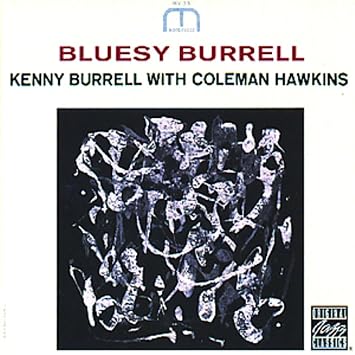
This is Coleman Hawkins' swan song to Prestige, and it's hard to imagine a better way to go than with Kenny Burrell. I've written extensively about both of them, and there's not much more to add, except that they mesh, and make beautiful musical together.
Hawkins comes in about halfway through the session, and is featured on"Montono Blues," "I Thought About You," "Las Palabras," and "It's Getting Dark."
The album is about evenly divided between standards and Burrell compositions, with one interesting choice--a tune that would become a standard of the jazz repertoire, but was only just being introduced. "Tres Palabras," by Cuban composer Osvaldo Farrés, had first been recorded in Cuba in 1943, but had never had a norteamericano rendition until 1962, when two things happened, probably unrelated.
First, Farrés and his wife left what had become Fidel Castro's island, never to return. They settled in New York, where they became known to the New York music community--Cuban-born Chico O'Farrill, long a part of the New York music scene, was already an admirer, having record "Las Palabras" in 1958. But also in 1962, on the West Coast, Nat "King" Cole was making his third album of Spanish-language songs. More Cole Español. Cole was already an admirer of Farrés--two of his songs had been featured on 1958's Cole Español.
Cole's vocal version (followed not long after by Johnny Mathis) and Burrell/Hawkins' jazz take brought "Las Palabras" to the attention of mainland artists, and it became a standard, recorded by many--Bill Perkins, Tete Montoliu, Joe Henderson and Bobby Hutcherson, to name a few. Whatever Burrell's reason for recording it. the promotions depart of Prestige knew how to promote it--if not to spell it. The album cover heralds "a new BOSSA NOVA - Tres Talbras." The liner notes on the back also give the tune as "Tres Talbas," but the label on the disc itself has the name correct.
The liner notes, by Robert Levin, also give a little plug to the Prestige philosophy of recording. After recounting how, on "Montono Blues, Hawkins
padded over to his recording position in a deceptively disinclined manner after the take was already underway, seated himself next to Burrell and, after Holley's bowed solo, got a nod from Burrell to begin his own...
Levin offers this observation:
Casual jazz sessions such as this frequently produce music of greater and more durable quality than do sessions of extensive preparation and lofty design.
Tommy Flanagan, Major Holley and Eddie Locke were Hawkins' regular group in these days. Flanagan had also been a member of teenager Burrell's first group, back in Detroit. Ray Barretto, perhaps added for the Latin numbers, is always an asset in any context.
Bluesy Burrell was a Moodsville release. "Out Of This World / Montono Blues" and "I Thought About You / It's Getting Dark" were the two 45 RPM singles. The album was re-released on Prestige in 1968 Ozzie Cadena produced.
The folks at Prestige took the rest of July and half of August off, returning with this Moodsville session.
When one thinks of the Prestige subsidiary labels of the early 1960s, one is more likely to extol the virtues and the contributions to the library of recorded jazz made by Swingville and Bluesville. But let us not forget Moodsville and its contributions. Mood music? That's generally sort of a putdown, but all music has the power to affect our moods, and as producer Chris Albertson has asserted, the music that was released on Bluesville was held to the same standards as all Prestige albums.
Coleman Hawkins made recordings for both Swingville and Moodsville, and one can only be grateful for any album made by Coleman Hawkins, still at the top of his form in 1962 and still prolific. In that year he recorded two albums for Verve (both live appearances at New York's Village Gate), three albums for Impulse!, including the widely celebrated Duke Ellington Meets Coleman Hawkins, and three albums for Moodsville, all of them Broadway show tunes.
No problem with that as a unifying theme. Most of the classic songs from the Great American Songbook were written for musical shows, either Broadway or Hollywood. and if by 1962 the greatest era of the Broadway musical was fast fading, it wasn't quite gone yet, and some very good composers were still creating music for the Great White Way. The title song is from a modestly successful musical of two years earlier (the full title of the album is Coleman Hawkins Plays Make Someone Happy from Do Re Mi), which featured music by Jule Styne, lyrics by Betty Comden and
Adolph Green. "Make Someone Happy" was the hit from the show; Hawkins and Co. include a second song from Do Re Mi, perhaps to justify the album title, perhaps because it really is an overlooked gem from a master tunesmith. And when I say overlooked, I mean overlooked--the Hawk's is the only jazz instrumental version of "Cry Like the Wind." June Christie recorded it, and so did Margaret Whiting and Mel Torme, but beyond that, not much of anything. Too bad--it deserves better. But at least we have this one.
A brand new musical, just opened in the spring of 1962, provided another song. The musical was I Can Get It for You Wholesale, music and lyrics by Harold Rome, and if Hawkins and Esmond Edwards were guessing at what might be the hit from the show, they guessed wrong with "Have I Told You Lately?" If anyone else has ever recorded it, I haven't been able to find it. In fact, there weren't really any breakout hits from I Can Get It for You Wholesale, but there was a breakout performer--teenaged Barbra Streisand, in her first Broadway role.
How to Succeed in Business Without Really Trying had opened a few months earlier, in late 1961, and "I Believe in You" had established itself as the hit song from the show.
For the rest of the album, they went back to earlier mega-hits--Oklahoma, My Fair Lady, The Sound of Music--all good stuff, all wonderfully done here, particularly "Wouldn't It Be Loverly," in which the melody is played by Major Holley on bass.
Holley, Tommy Flanagan and Eddie Locke were Hawkins's regular touring group in these days, and had backed him on the other two Broadway albums for Moodsville.
Coleman Hawkins died in 1969, and made his last recording (fittingly called The Greatest Jazz Concert in the World) in 1967, so this was pretty much the stretch run for the Hawk, but he was prodigiously productive. In 1962 alone he recorded eight albums as leader: three for Prestige, two for Verve, and three for Impulse! He also appeared on albums by Kenny Burrell and Shelly Manne. I doubt that there are many jazz musicians who can approach that level of productivity
This is the second of his Prestige outings, like the first one a Moodsville venture, and like the first focused on the Broadway musical. However, while the first (Good Old Broadway, recorded January 2)
featured familiar and beloved tunes from Broadway's storied past, this one focused on a recently opened show, No Strings, with a score by Richard Rodgers which produced no memorable songs at all.
That's a little unfair. Rodgers had not declined as a composer, but the era of Broadway show tunes becoming hit songs was over. While Broadway-to-Top-Forty had still been a common occurrence in the 1950s -- "Hernando's Hideaway," "Hey There," etc. There were crooners like Eddie Fisher and Patti Page and the Ames Brothers still regularly making the charts in those days, and even a rare Rogers and Hammerstein flop, Pipe Dream, could yield a Billboard chart hit with Fisher's version of "Everybody's Got a Home but Me."
By comparison, 1962 saw two successful musicals, No Strings and Stop the World--I Want to Get Off, and one smash hit, A Funny Thing Happened on the Way to the Forum, and the three of them together produced one song, Sammy Davis Jr.'s "What Kind of Fool Am I?" that even dented the charts.
No Strings not only produced no hits, but except for "The Sweetest Sounds," which got a boost from being recycled into the television musical Cinderella, there have been precious few recordings of any of the songs beyond original cast albums, and except for "Sweetest Sounds" and "Loads of Love," which were included on an Original Jazz Classics double CD called Coleman Hawkins -- On Broadway, none of these songs has had an afterlife in the reissue world.
Which doesn't make them bad songs. and doesn't make this any less of a musically satisfying outing from Hawkins and his musicians. It just means you're not likely to find it anywhere, except for YouTube, which seems to manage to find everything,
When you record ten albums in a year, and over two dozen in what is supposed to be your twilight years, a decade that you are supposed to be at best a footnote to, some of the music is going to get lost in the shuffle, even though it has every right to be heard and appreciated. So it's good to dust this one off, and the rewards are there for the listening.
The album was recorded in two sessions, on March 30 and again on April 3, and I suspect that might have been unintended. The March 30 session ends with a version of "Maine" that is marked in the session log as "Rejected by Prestige," and the April 3 session begins with "Maine," so something must have happened to make them cut the first session short.
No Strings was the first show for which Rodgers wrote both music and lyrics. Tommy Flanagan, Major Holley and Eddie Locke had appeared on Hawkins's previous Broadway album for Prestige Moodsville, and they were his regular working band during those days. The album, The Jazz Version of No Strings, was a Moodsville release. Esmond Edwards produced.
This Moodsville collection finds Coleman Hawkins bringing the Hawkins touch to Broadway, and a collection of show tunes plucked from, for the most part, not the most obvious of sources, but from some very good composers, and, given Hawkins's ear and chops. some very good results.
Sigmund Romberg. composer of old-fashioned operettas, seems an unlikely source for jazz inspiration, but he's proved surprisingly fertile, particularly from The New Moon, his final Broadway production, in 1928. "Lover, Come Back" has proved an enduring standard, and "Softly, as in a Morning Sunrise" has been nearly as popular an inspiration. The other best known composition from The New Moon is "Stout Hearted Men," and it would take indeed a stout
hearted jazzman to try to make something out of that one. "Wanting You" has been pretty nearly completely passed over. Roger Williams, not exactly a jazz pianist (although he did study with Lennie Tristano and Teddy Wilson) recorded it, as did Mario Lanza, who drew much of his repertoire from operetta. And no one else.
Except Coleman Hawkins, and he makes you wonder why it hasn't found more champions. It's a very good melody, and Hawkins finds all the right ways of developing it.
Another lightly recorded song from a powerful composer is Kurt Weill's "Here I'll Stay" from a 1948 musical, Love Life, which had a not-terrible run on Broadway in 1948-49, 252 performances. It sounds as though it would have been worth seeing. Book and lyrics by Alan Jay Lerner, directed by Elia Kazan (who knew he directed musicals?), choreography by Michael Kidd. And an intriguing plot: a couple get married in 1791 and stay married through 1948, during which time they never age, but undergo marital differences that reflect different times and mores.
"Here I'll Stay" was the most successful song from the show, unless you count the number that Lerner reworked, with new music by Frederick Loewe, for the 1958 movie Gigi -- "I Remember it Well." And it's had a modest but continuing life as a vehicle for pop singers, but no jazz artist had ever taken it on between its inception in 1948 and this 1962 recording. Gerry Mulligan must have liked what he heard from the Hawk, because he recorded it in 1963, after which it mostly fell back into jazz oblivion.
Most of the rest of the tunes were recognizable standards, as befits a tribute to Broadway, although one is a ringer -- the Harold Arlen/Ira Gershwin "The Man that Got Away," from the movie A Star is Born.
This was an exciting time for jazz, with Ornette Coleman and John Coltrane and Eric Dolphy--tremendously exciting to hear sounds that pushed the envelope, that took music to places it had never been before. But there's always a place for great old tunes, played by a master. Two masters, as Tommy Flanagan takes the piano chair for the date.
And we have two newcomers to Prestige, both seasoned veterans from the jazz cauldron of Detroit. Major Holley was an instrumental prodigy from a musical household and a graduate of Cass Technical High School, which bred so many jazz greats. Holley took up the bass in the Navy, then jumped right into the mainstream of jazz upon his return to
civilian life, playing with Dexter Gordon, Charlie Parker and Ella Fitzgerald, doing duets with Oscar Peterson, The 1950s were an expat time for him, but not Paris or Sweden like many others: he moved to London, where he worked at the BBC for a few years before returning to America. Though he developed a trademark sound of vocalizing along with a bowed bass (a style pioneered by Slam Stewart), he was also much in demand because he could work as an asset to any musicians in any situation. As he put it,
When I was in Duke Ellington’s band, I sounded like Duke’s bass players. I remained applicable to the circumstances of where I was - whether it was Coleman Hawkins or a Broadway show or Judy Collins.″
Eddie Locke came to New York in 1954, worked with a number of swing and trad musicians, became a protégé of Jo Jones, then joined Roy Eldridge in 1959. His associations with Eldridge and Hawkins are what he is best known for, as he, Flanagan and Holley became Hawkins's regular partners for the next several years, after which Locke returned to work again with Eldridge.
Esmond Edwards produced Good Old Broadway for Moodsville.
This is the first part of a two-session, double-album extravaganza released by Prestige as The First Annual Prestige Swing Festival, Spring 1961. The festival appears to have taken place entirely in the Van Gelder Studio in Englewood Cliffs--I can find no record of an actual festival. And it appears to have been the only annual Swing Festival.
Nevertheless, a cause for celebration. Prestige had put together various collections of All Stars over the past few years, including one other set of Swingville All Stars (in March of 1960, with Taft Jordan, Hilton
Jefferson, and Al Sears as the front line), and all of their all star sessions were worthy of the name, but this one has some solidly heavy hitters, and a bunch of them. The heyday of swing was also the heyday of the 78 RPM record, so your typical swing session recording was three and a half minutes or less--maybe a little more if they decided to split a song over two sides. And the typical swing recording was section players with one soloist.
But bebop changed some of that, and the long playing record changed the rest of it, and this aggregation includes a number of all stars who deserve solo space, and who get it, and the length of the selections reflects that. "Jammin' in Swingville" is nine and a half minutes, "Spring's Swing" eight minutes, "Love Me or Leave Me" a little over seven. "Cool Sunrise" nearly eleven.
"Love Me or Leave Me" is the standard by Gus Kahn and Walter Donaldson, first recorded by torch singer Ruth Etting in 1928, picked up by Billie Holiday in 1941, then covered a few scattered times in the late 1940s and early 1950s. It was Etting's signature song, and Etting was basically a forgotten star by the 1950s, but it turned out her life, including a disastrous marriage to a brutal gangster, was more interesting than her career. It became a movie with Doris Day and James Cagney, and "Love Me or Leave Me" became the movie's title song, and jazz musicians as well as pop singers started recognizing its potential.
"Jammin' in Swingville" and "Swing's Spring" are both credited to Vivian Hamilton, who I'm guessing was the wife of Jimmy. Her only credited compositions are on albums by Jimmy (although "Spring's Swing" was recorded in 2005 by Swiss-born, Chicago-based tenor saxophonist Sam Burckhardt), and Jimmy was the arranger for this session. "Cool Sunrise" is credited to Esmond Edwards, so important as a producer for Prestige during these years, but rarely listed as a composer. All of them provide an ample basis for joyous interpretation.
Swing, as its name suggests, is a joyful music, and extended jams like these sound like a lot of fun, like good friends getting together and producing something delightful. Let's hope this was the case, and why not? These guys were old enough, and far enough past their years of stardom, to have been able to simply enjoy getting together and making music. We continue to owe Prestige big time for recording these Swingville sessions.
Edwards produced. The title of the double album was Things Ain't What They Used to Be. When they were rereleased separately, that became the title of the record that had "Spring's Swing" and "Love Me or Leave Me" on it. The other separated LP was called Years Ago. A later rerelease as double album and CD was called Jam Session in Swingville.
On February 24, Walt Dickerson brought a quartet into the Van Gelder studio for a session which was rejected. It's not clear why. Certainly Bob Weinstock and Esmond Edwards hadn't decided that Dickerson was a horrible mistake. He would go on to record several albums for Prestige. And they didn't tell him to go away and come back with better material, because they brought him back to Englewood Cliffs two weeks later with exactly the same set list, and that became his debut album. Perhaps there was a mechanical failure in the recording the first time around.
Coleman Hawkins and Kenny Burrell had recorded together a couple of times before, both in 1958, once for Atlantic and once for Prestige, and Bob Weinstock wasn't through with them--they would be paired a few more times. It's easy to see why. they were beautiful together.
And there were some newcomers to Prestige on this session, too. Ronnell Bright had already started to make a name for himself as an accompanist to singers. He had worked with Carmen McRae and Sarah Vaughan, and he would go on to become one of the most in-demand accompanists in jazz and pop music. In addition to extensive tours of duty with Vaughan and Nancy Wilson, he worked with Lena Horne, Gloria Lynne, Anita O'Day, Doris Day and others. But his first experience working with a singer came in 1948, when he was a young naval recruit. Truman had just integrated the armed forces that year, and Bright, stationed on an aircraft carrier, was invited to join the ship's band, where he met and befriended another young sailor who was singing with the band: Julius LaRosa.
He was able to play with the band because they had sheet music, but he had been classically trained, with no experience with jazz or improvisation, or even the concept of chord changes. That education came in the navy, too. In 1950, he was in the naval reserves and was called up to active duty for the Korean War. Scheduled to be shipped out to Korea, he walked into the Navy School of Music, told them he was a musician, and asked to have his orders changed. They auditioned him, and liked his skill, but were taken aback when they asked him to play "How High the Moon" and he didn't know it. This may have been a first for them: a young African American musician who was a classical pianist and didn't know how to play jazz. They said they'd take him if he could learn the chord changes to 25 popular songs in six months.
He was able to learn, thanks to some navy buddies who taught him a few things. They did know a thing or two about jazz. Their names were Julian Adderley, Nat Adderley and Eric Dolphy.
Andrew Cyrille is thought of more as an avant-gardist, but he got his professional start working with blues singer Nellie Lutcher. He got this Coleman Hawkins gig perhaps because he was around--as Woody Allen has said, 90 percent of the secret to success in show business is showing up. Cyrille had shown up for the shelved Walt Dickerson gig four days earlier. He would be back for the second go-around with Dickerson, and stay with him for a few years and several albums, later hooking up with Cecil Taylor for an extended partnership.
Hawkins plays ballads here. You expect Hawkins to be a beautiful balladeer, but he still manages to exceed expectations. And he does it every time. One thinks of him as the titan of the 1930s, the man who made the tenor saxophone an important instrument, and as the guy who showed he wasn't quite finished yet in the early 1940s when he led a group with Dizzy Gillespie in what is considered the first bebop recording. But in the 1950s and 1960s. the era of Coltrane, folks still couldn't get enough of the Hawk. Between 1952 and his final session in 1967 (he died in 1969) there were 59 recordings. 14 of them for Prestige/Moodsville/Swingville.
He has a group that comes up to his standards for beauty, simplicity, intelligence, originality and swing. Kenny Burrell is a perfect complement, with ideas of his own that enhance and enrich. Ronell Bright is a surprise, and a pleasant one. I particularly love his lead-in to "Just a Gigolo," my favorite cut on the album. Andrew Cyrille does a fine job.
Ron Carter had already recorded with some of the best in the business, and if the Down Beat poll voters hadn't caught up with him yet, they soon would. After researching and writing the bios of Bright and Cyrille, I had sort of forgotten who the bass player on the session was, and as I settled in for some serious listening, I kept being struck by how good the bass was--rhythmic and inventive, giving the soloists a real springboard to create from.
The album was called The Hawk Relaxes, although Ron Carter's bass must have kept him from relaxing altogether. Esmond Edwards produced, and it was released on Moodsville.
Listening to Prestige Vol. 2, 1955-56, and Vol. 3, 1957-58 now include, in the Kindle editions, links to all the "Listen to One" selections. All three volumes available from Amazon. And Volume 4 in preparation! The most interesting book of its kind that I have ever seen. If any of you real jazz lovers want to know about some of the classic records made by some of the legends of jazz, get this book. LOVED IT. – Terry Gibbs
The brain trust behind Swingville, primarily Bob Weinstock and Coleman Hawkins, had a lot of good ideas, and surely pairing Coleman Hawkins and Eddie "Lockjaw" Davis was one of the best. Davis cited Hawkins as one of his chief influences, which is no surprise, since Hawkins influenced everyone who came after him.
This was 1960, and stereo was still a novelty. In 1958, people had bought, and listened awestruck to, the sound of a locomotive passing from one channel to another (You can hear it! Going across the
room!) Ornette Coleman made more creative use of the new technology with his double quartet, one quartet playing over one channel and the other over the other. Hawkins and Davis may not be as adventurous as Ornette, but they had their go at stereo separation, with one tenor saxophone in each channel.
Technology, these days, has moved in a different direction, and someone listening to a streaming service over their iPad speaker is not going to get the full effect available to the 1960 stereo buff, with his speakers placed exactly such and such many feet and inches apart, exactly so many inches off the ground, exactly at such and such an angle, standing exactly so many inches away. stooping if you were over six feet tall, getting up on a stepstool if you were...but that was rarer. Not many women were as likely to make fools of themselves over technology in those days.
And it's kinda too bad. The stereo separation of tenors was sort of a gimmick, but it was a nice one, especially on "In a Mellow Tone," which they start out with a channel-combining unison on the head, then proceed to battle stations on the right and the left for their solos. The master and the disciple, now a full-fledged star in his own right, trading solos with love and respect and lot of competitive fire.
Tommy Flanagan, at 30, was already a veteran of countless recording sessions--this made his 24th appearance on Prestige alone, playing with everyone, but especially the swing-to-bop veterans. (Certainly not exclusively--he had been the piano player on John Coltrane's groundbreaking Giant Steps.) He could always be counted on to do everything well, Ron Carter was still at the beginning of his jazz Odyssey. Gus Johnson, for Prestige, had played the blues with Memphis Slim and Willie Dixon, swing with the Swingville All Stars, and modern with Lem Winchester. He was a decade younger than Hawkins and at least that much older than everyone else in the group, and a perfect fit.
The album was released on Swingville (and later on Prestige, with "Lover," left off the original package, added in) as Night Hawk, after its only Hawkins original. Esmond Edwards produced.
Listening to Prestige Vol. 2, 1955-56, and Vol. 3, 1957-58 now include, in the Kindle editions, links to all the "Listen to One" selections. All three volumes available from Amazon. The most interesting book of its kind that I have ever seen. If any of you real jazz lovers want to know about some of the classic records made by some of the legends of jazz, get this book. LOVED IT. – Terry Gibbs EXPECT VOLUME 4, 1959-60, BY THE END OF THIS YEAR.
This is a Moodsville session, and it can legitimately be described as mood music: Coleman Hawkins and a rhythm section, a selection of well-chosen ballads, all of them familiar, none of them over-familiar. Two of them ("While We're Young" and "Trouble is a Man") were composed by Alec Wilder, who, if he didn't coin the phrase "Great American Songbook," can certainly be accorded credit for popularizing the concept with his 1972 book American Popular Song: The Great Innovators 1900-1950.
The cover art for the Moodsville series makes it clear what they're selling: the mood. But the musicians don't go into the studio to make mood music, and with Coleman Hawkins, you know you're getting a lot more.
And that's not to put down mood music. Music as background is sometimes unfairly derided. It's part of our lives when we don't necessarily want it to be, in elevators or supermarkets or when we're on hold. But it's the background to our lives when we choose it, to read, to work out or make love, to paint or sculpt or clean out the garage. But that background has to be foregroundable. It has to be music that you can stop sculpting for a few minutes, wipe your brow, take a breath, and shift your attention to what you're listening to. It needs to be something good, something that's every bit as challenging and absorbing as it is relaxing and soothing.
Hawkins fits all of those requirements. So does Tommy Flanagan, who is a very good match for Hawkins.
The album is called At Ease With Coleman Hawkins. Esmond Edwards produced.
Not much new to say about Coleman Hawkins by this time. It seems almost beside the point to write anything. Better to turn the volume to just the right level (not all the way up to eleven), sit back, and enjoy sound that is so smooth you could spread it on Wonder Bread without ripping up big hunks.
Except you would never spread it on Wonder Bread. This is the real thing, the blues, the real America, three-dimensional and full-toned and flavored like Huck Finn's stew. Unlike the Widow Douglas's white-bread cuisine where "everything was cooked by itself," you have "a barrel of odds and ends," where "things get mixed up, and the juice kind of swaps around, and the things go better."
So this is music for pure enjoyment, but isn't that what it's all for? As Hawkins and his group were in Englewood Cliffs cutting this session, Ornette Coleman was at the Five Spot making music that hurt the ears of many, but to my 19-year-old ears it was pure bliss, thrilling new, complex and simple, challenging and direct. And that's what you look for from art. The doors open where you find them, sometimes where you were looking, sometimes where you least expected, and each door that you go through broadens your range of appreciation, so that your capacity for enjoyment keeps expanding.
Hawkins has brought some old friends to this session, Osie Johnson has some swing credentials, having spent three years with Earl Hines, Tommy Flanagan and Wendell Marshall have young hands and timeless ears. But his horn players have the kind of time-tested chops that the Hawk himself brings.
Vic Dickenson kept a fairly high profile for a traditional player during the modern jazz era. A Down Beat International Critics Poll in 1963 placed him third among trombonists, tied with Lawrence Brown. And there were still plenty of great trombonists around. J. J. Johnson was still leader of the pack, Curtis Fuller and Slide Hampton were at the peak of their careers, Kai Winding was making hit records, Urbie Green and Bennie Green were still active, and Dickenson was pushing 60. But he kept busy throughout the 1950s and 1960s, recording with Hawkins, Johnny Hodges, Dicky Wells, Buster Bailey, Budd Johnson and, interestingly, Langston Hughes. He was a member of the outfit called The World's Greatest Jazz Band, which played the style of traditional jazz somewhat uncomfortably referred to as Dixieland, and which had a good enough lineup to justify the name.
Much less well-known, but regarded with reverence by those familiar with him, was trumpeter Joe Thomas. One such is Michael Steinman of the Jazz Lives blog, who has said of Thomas:
Joe knew how to structure a solo through space, to make his phrases ring by leaving breathing room between them. Like Bix or Basie, Joe embodied restraint while everyone around him was being urgent. His pure dark sound is as important as the notes he plays — or chooses to omit...
A simple phrase, in Thomas’s world, is a beautifully burnished object. And one phrase flows into another, so at the end of the solo, one has embraced a new melody, resonant in three dimensions, that wasn’t there before, full of shadings, deep and logically constructed.
And more:
Joe’s tone, dark and shining, makes the simple playing of a written line something to marvel at, and each of his notes seems a careful choice yet all is fresh, never by rote: someone speaking words that have become true because he has just discovered they are the right ones for the moment.
I've commented on this before, but it's worth repeating: What Coleman Hawkins, and other artists who recorded for Bob Weinstock's Swingville label, played was not traditional swing (as opposed, for example to The World's Greatest Jazz Band, which essentially did play traditional Dixieland). Swing was big band jazz, essentially an arranger's art form, and what followed it was a small group music with emphasis on the soloist. Of course, there had always been small groups. Louis Armstrong's Hot Five was one of the most important, and they preceded swing.
Hawkins played his own kind of music. He had virtually invented the modern improvised solo with his 1939 recording of "Body and Soul," and though his music at this stage of his career had a mellow nostalgic feeling to it, it was definitely the music of the guy who had recorded "Body and Soul" and had played on the first bebop recording.
And his traditionalist partners, Thomas and Dickenson, were right there with him. They could play traditional Dixieland when it was called for, but they could play with Hawkins, doing what Hawkins did, as well. As Dickenson once said:
I like to play the melody, and I want it still to be heard, but I like to rephrase it and bring out something fresh in it, as though I were talking or singing to someone. I don't want to play it as written, because there's usually something square in it.
Of course, the center of the Kansas City swing that Hawkins grew up with, and the center of bebop as well, is the blues, and all of these cats know how to play the blues, and it infuses even their Tin Pan Alley pop standards like "I'm Beginning to See the Light." It's part of what knits them together. The rest is a shared musical understanding that allows for solo to build on solo, in a most satisfying way.
The Swingville release was entitled Coleman Hawkins All Stars .
There's never a time when you're not going to enjoy listening to Coleman Hawkins. The rich tone, thr the beautiful phrasing, the easy swing, the improvisational flights, the sheer beauty. And this session with Red Garland and a new trio is more to enjoy, more to sit back, listen, and not think of anything but how good it sounds.
So let's look in a different direction. Although we've had sessions with Coleman Hawkins before, and other sessions with musicians from that era that would come out on Prestige or New Jazz rereleased on Prestige's Swingville subsidiary, this is the first session specifically recorded for the new label, and it would be the first Swingville release.
I've often wondered what it must have been like to be the 19-year-old Bob Weinstock, suddenly finding yourself the guy who is recording some of the greatest musicians in the world, suddenly the guy who has to get records pressed and distributed, get them noticed in Down Beat and Billboard, get them shelf space in record stores and space on jukeboxes (which were largely mob controlled, as were many of the record pressing plants), get air play with the tiny handful of radio stations that programmed modern jazz (probably not much payola, because there wasn't enough money in jazz).
He had come along at the right time--social and technological changes
made the 1940s and 1950s a fertile time for independent record labels. It was still a business, with all the headaches of starting and running a small business...but the business was that you got to make records with these great musicians.
Weinstock started Prestige because he had fallen under the spell of bebop, but before that he had been a traditional jazz lover and record collector, and now here he was, able to make records with pretty nearly anyone he wanted to. So there were the occasional swing musicians--even Dixieland, with Jimmy McPartland--and some rhythm and blues, and even some folk blues.
Those had been hit-or-miss, and probably not as well promoted or distributed as the modern jazz recordings on which he was building his label's image. But they showed that he still had eclectic tastes.
Now, Prestige was celebrating its tenth anniversary, and Weinstock wasn't a kid any more. He had the experience, and apparently the talent, for making smart business decisions, and he still had the passion for music.
The new labels may have been born out of a little of both. Some have commented that it was probably a smart bookkeeping and tax strategy to have diversified record labels. And probably the older musicians didn't have record companies clamoring around their doors, so they came relatively cheap. But also, there must have been a sincere desire to present these older guys who were not only still around but still healthy and creative and productive, to an audience that remembered them, and to a new audience.
I've described this music as "post-swing." Weinstock wasn't trying to recreate what had been done in the 1920s and 1930s, and with a musician like Coleman Hawkins, who never stood still, it would have been impossible anyway. Here, he puts Hawkins together with Red Garland, a musician probably best known for his work with Miles Davis and John Coltrane, certainly a modern.
The Red Garland trio assembled for this session is not quite the group one thinks of as "Red Garland Trio"--Paul Chambers and Art Taylor. That classic trio would not record together again. Here it's Doug Watkins, the bass mainstay of many a Prestige session, and Charles "Specs" Wright, who often played with Ray Bryant, and had made one Prestige recording with him. For material, they gathered together originals by Hawkins, Garland and Watkins, a song that was a hit for rhythm and blues star Savannah Churchill, and a number called "It's a Blue World," that could hardly have less to do with the blues. It was written by George Forrest and Robert Wright, best known for Kismet, the Broadway musical borrowed from Russian composer Alexander Borodin, originally performed by Glenn Miller, and sung by Tony Martin in a movie musical. When Hawkins and Garland get through with it, it's bluesy enough.
Hawkins' alternate nickname was "Bean," supposedly in reference to either the shape of his head or the considerable quality of what was inside it, and it's a nickname that features prominently in tunes of his own composition or tunes dedicated to him. So it is here, and there's an interesting contrast between his "Bean's Blues" and Garland's "Red Beans."
"Bean's Blues" begins with 30 seconds of unaccompanied traditionalist tenor sax, at which point Red Garland enters with some block chords, and finds his place. "Red Beans" begins with about two and a half minutes of modernist piano solo before Hawkins steps up. Basically, what this shows is that there are more ways to the woods than one, and if Coleman Hawkins and Red Garland are setting out the paths, they're all good.
Garland, Watkins and Wright stuck around for a few more after Hawkins packed up his horn, playing some originals and some standards, although “Mr. Wonderful” had a short shelf life for a standard. It was recorded often while Sammy Davis Jr. was still wowing them on the Broadway stage, but rarely after that. The trio played enough of a session to fill out an album, but it didn’t end up that way. “Satin Doll,” “The Man I Love” and “A Little Bit of Basie,” along with a few cuts from a live recording a couple of months later, were on the album titled Satin Doll, which was not released until 1971, when Bob Weinstock was winding up his association with Prestige. The others would have to wait to become bonus cuts on later CDs.
Coleman Hawkins with the Red Garland Trio became the first Swingville album, and Swingville almost could have been the album’s title. Weinstock announced the name of his new label in huge type, which took up more than half the cover.
Orrin Keepnews made a guest appearance producing these two sessions for Prestige. Keepnews was the man at the helm of another of New York’s great independent jazz labels, Riverside.
Listening to Prestige Vol. 2, 1954-1956 is here! You can order your signed copy or copies through the link above.
Tad Richards will strike a nerve with all of us who were privileged to have
lived thru the beginnings of bebop, and with those who have since
fallen under the spell of this American phenomenon…a one-of-a-kind
reference book, that will surely take its place in the history of this
music.
--Dave Grusin
An important reference book of all the Prestige recordings during the time
period. Furthermore, Each song chosen is a brilliant representation of
the artist which leaves the listener free to explore further. The
stories behind the making of each track are incredibly informative and
give a glimpse deeper into the artists at work.
There are a lot of fields of entertainment and the arts in which one can speak of “an embarrassment of riches,” where too much of a good thing starts to weigh it down or actually diffuse it. An NBA All Star Game is never going to be as good as a game between two closely matched teams. You probably wouldn’t really want to have Leonardo and Raphael working on the same canvas, although it might be fun for a minute.
Fortunately, this is rarely the case in jazz. In jazz, the more great players you pull together on one bandstand, the more excitement, the more richness you’re going to have. That’s why there isn’t a jazz fan alive who wouldn’t give his left arm to have been at that speakeasy in Kansas City where Coleman Hawkins and Lester Young dueled it out, toe to toe. That’s why Norman Granz’s Jazz at the Philharmonic jams with, say, Charlie Parker and Lester Young, are so prized today.
That’s why if you take Eddie “Lockjaw” Davis and Shirley Scott, already a dynamic aggregation, and tell a jazz fan you’re adding Coleman Hawkins to the group, he or she is going to whoop for joy. Then if you announce that you’re not stopping there, you’re going throw in Arnett Cobb (Yeah, yeah!) and Buddy Tate (Yeah, yeah, yeah!)
So what happens when you get four tenor sax greats together for a session? Well, first of all, you have some great section playing. Then, you have four guys loving what their peers are doing, and encouraging each other to one hot solo after another. And then...wait a second. It’s not just four great tenormen, is it?
It’s not just tenors.
And it’s not just men.
I’ve talked before about how the small group Shirley Scott is different from the organ trio Shirley, but maybe not so different. In the trio she is constantly exploring the different ways that an organ can sound. With a small group, she is constantly finding new ways to be a part of that group, to push and cajole the sax guys into new places. I’ve talked before about how good she is, but I have to come back to it because I think I’m just realizing, in this set, just how good she is. Maybe it’s working with those different voices.
In “Light and Lovely,” she and George Duvivier have an extended duet that leaves one wondering, if they are the title, which is which?
What is this kind of music? Davis and Clark are certainly in the vanguard of the soul jazz movement, but these other guys aren’t. In recent years, we hear a lot about “mainstream jazz” and “straight-ahead jazz,” and both terms have very precise, if not always clear, definitions which one is not to stray from (or to confuse the two) by musicians who were not really a part of bebop, but who did live on this planet and were aware of its power and importance. So these are guys who are not living in the past, or particularly looking toward the future, but are playing the kind of music they like, and playing it sweetly and completely.
This is listed as an All Stars date, which means it was released with no leader given for the session, but the names of all the participants (in this case, all four tenormen) on the cover. It would be rereleased later as a Davis/Scott session.
Listening to Prestige Vol. 2, 1954-1956 is here! You can order your signed copy or copies through the link above.
Tad Richards will strike a nerve with all of us who were privileged to have
lived thru the beginnings of bebop, and with those who have since
fallen under the spell of this American phenomenon…a one-of-a-kind
reference book, that will surely take its place in the history of this
music.
--Dave Grusin
An important reference book of all the Prestige recordings during the time
period. Furthermore, Each song chosen is a brilliant representation of
the artist which leaves the listener free to explore further. The
stories behind the making of each track are incredibly informative and
give a glimpse deeper into the artists at work.
As Prestige roars into its tenth anniversary year, new ideas are taking shape, and everything old is new again. The 19-year-old who as a youngster had gone out with his father collecting traditional jazz 78s by the bushel, who had experienced the epiphany of Thelonious Monk and begun a new label to become an apostle of bebop, was 29 now, and looking around at the music scene on the cusp of a new decade.
Ten years as president of a record label will also give you new ideas about marketing, and as 1959 rolled on, Bob Weinstock was preparing to unleash three new subsidiary labels, Moodsville, Swingville and Bluesville.
These were not the "budget" labels that a lot of record labels put out in those days: LPs that were repackagings of earlier recordings, or masters that had been bought up from defunct labels. The budget labels were cheaply pressed and cheaply packaged, and were a way that companies tried to squeeze a few last nickels out of music that they probably weren't going to see a payday any other way. It's not widely known, but in 1977 RCA Victor was planning a massive budget rerelease of the music of one of its declining stars, Elvis Presley. That, of course, was the year that Elvis achieved true immortality by dying, and RCA changed its plans in a hurry.
New Jazz was sort of a budget label for Prestige, although its catalog feature some of Prestige's best artist doing some of their best work. The London Jazz Collector notes that some New Jazz titles:
are sometimes marred by “hissy vinyl”, due to the raw vinylite being bulked up with recycled vinyl (containing minute detritus and fragments of paper label, which the stylus picks up as a continuous hiss) . Some pressings are ok, others have the dreaded hiss throughout, sometimes minor, on other copies quite prominent. There is no consistency – even the same title can be found with hissy copies and not hissy copies. Perhaps it all depended on whether the vinylite stock delivered to the XYZ pressing plant that week had been bulked up with recycled vinyl or not. I have not encountered the problem with any other labels than Prestige, and does not occur with pre-Bergenfield [Prestige moved from New York City to Bergenfield, NJ, in the mid-1960s] label pressings or those from Abbey Manufacturing, so the finger points to reckless cost-cutting or dubious quality at some plants.
But for the most part, New Jazz records had pretty good quality control. Status was the real budget label, and even there, according to the London Jazz Collector, it's
difficult to see what was budget apart from saving on ink, providing minimal information saved nothing, but made it look budget. Working in Marketing in the Seventies, the big fear was always “cannibalisation”. You wanted all the sales you could get at the premium price, and extra sales at the budget price, without losing the one to the other. Extra effort was incurred to make things look less attractive. More marketing genius from Weinstock.
Swingville, Bluesville and Moodsville do not appear to have been budget labels at all. There's a lengthy discussion of this question online at the Organissimo jazz forum, and Chris Albertson, jazz historian and producer of many a Prestige session, weighs in with this:
I really don't think there was any serious marketing decision involved in the creation of the Bluesville, Swingville, Moodsville, etc. series. Remember, these were not stand-alone subsidiary labels--it was always Prestige Moodsville, Prestige Swingville, etc. I don't recall if the pricing was different--if so, that may have been a factor. As a dj when these first came out, and later as a Prestige employee, I never thought of them as anything but Prestige albums with a series name.
Sometimes I think that consumers/collectors make more out of such details than the facts call for. When I produced a session, it was a Prestige session--whether it came out on Prestige, Prestige Bluesville or Prestige Swingville, made no difference.
If Bob Weinstock was, as the London Jazz Collector suggests, a marketing genius, perhaps he was also by this time pretty savvy about accounting, and maybe there was a tax advantage to these subsidiary labels.
Or maybe it was just about the music. I'll deal with Bluesville and Moodsville later, but Weinstock, who had grown up on swing, and whose Times Square offices were still within hailing distance of the Metropole, was already assembling quite a collection swing era veterans, to the extent that he could have created a whole new line of Prestige All Stars or Prestige Blues Swingers. Because All Stars these gents certainly were, starting with one of the all stars of all of jazz history, Coleman Hawkins, who is gracing the ten-year-anniversary halls of Prestige and the Van Gelder Studio with his larger than life presence. And here, joined by:
Charlie Shavers, 42 years old, first recruited by Prestige for the February 20 Hal Singer session. Swing credentials include Tommy Dorsey, Billie Holiday, Benny Goodman, Jazz at the Philharmonic, Count Basie, Gene Krupa and Buddy Rich, Budd Johnson, and his own band with Terry Gibbs and Louis Bellson. He is the composer of "Undecided," which had its origin in a tune that Shavers liked enough to send off to his publishers. They liked it too, and asked for a title. Shavers was trying to decide between a couple of catchy titles, but hadn't made up his mind yet, so he wrote "Undecided." The publishers immediately sent it off to lyricist Leo Robin, and the rest is history--and some 200 recordings.
Ray Bryant, the kid of the group at 28, but a kid who felt perfectly at home sitting in with the old guys at the Metropole in the afternoon, then heading downtown to play with the moderns in the evening.
Tiny Grimes, 43, veteran of three earlier Prestige sessions, including a swinging soirée with J. C. Higginbotham, would be a Swingville staple. Played with Slam Stewart, Art Tatum, Billie Holiday. He had a hit with a swing version of the Scottish folk song "Loch Lomond." On the strength of that, he organized Tiny Grimes and his Rocking Highlanders, which featured Red Prysock until Red quit because he refused to wear a kilt.
George Duvivier, 39, made his mark with the Shirley Scott and Eddie “Lockjaw” Davis sessions, but his first Prestige gig had been two years earlier, with Gil Melle, of all people. He played with Lucky Millinder, Cab Calloway, Louis Bellson, Count Basie, Benny Carter, Anita O’Day, and lots of moderns too. Pretty nearly everyone.
Osie Johnson, 36, played with Earl Hines, Zoot Sims, Dinah Washington, Paul Gonsalves. He first hit Prestige in 1955 with Bennie Green, and stuck around over the next four years to back up Barbara Lea, Tiny Grimes and J. C. Higginbotham,
Coleman Hawkins was 55 when he stepped the studio with this aggregation and in the middle of yet another career renaissance.
So what are these Swingville all stars playing? It’s nothing that you would have heard from a Benny Goodman radio broadcast on a Saturday night high atop the Rainbow Room. It’s nothing like the jump, jive and wail you would have heard from an old Louis Prima record or from a contemporary group like the Stray Cats when swing music and swing dancing had a renaissance among the kids in the 1990s. This is small group jazz from New York musicians in the 1950s, guys who have been around long enough to remember when jazz was dance music, but who know that today’s listeners want to hear inventive solos that’ll take them someplace new. You’d go to a Swingville album, as the label established itself, to hear music that would give you a certain traditional feel, but would also give you the modern jazz you’d come to expect from Prestige.
Coleman Hawkins, the architect of the saxophone sound in jazz, the guy who played with Fletcher Henderson, who gave new meaning to the improvised jazz solo with “Body and Soul,” who played with Dizzy on 52nd Street, who was still playing, the amalgam of everything he ever knew, was the perfect choice to build a new label around. In fact, it’s not hard to imagine that signing the Hawk to Prestige was what gave Weinstock the idea for Swingville.
Hawk Eyes' first release was on Prestige, but it soon became one of Swingville's early releases.
Listening to Prestige Vol. 2, 1954-1956 is here! You can order your signed copy or copies through the link above.
Tad Richards will strike a nerve with all of us who were privileged to have
lived thru the beginnings of bebop, and with those who have since
fallen under the spell of this American phenomenon…a one-of-a-kind
reference book, that will surely take its place in the history of this
music.
--Dave Grusin
An
important reference book of all the Prestige recordings during the time
period. Furthermore, Each song chosen is a brilliant representation of
the artist which leaves the listener free to explore further. The
stories behind the making of each track are incredibly informative and
give a glimpse deeper into the artists at work.
This is mostly a new edition of the Prestige Blues-Swingers from the previous August. Jerome Richardson, Pepper Adams and Ray Bryant are back, and perhaps most importantly arranger Jerry Valentine, the central figure behind both dates. This time, Valentine is given Coleman Hawkins to work with, which has to be a good thing.
One would think Hawkins would be most closely associated with the 1920s, when he changed jazz irrevocably by making the tenor saxophone a jazz instrument, or the 1930s when he changed improvisation irrevocably with his 1939 recording of “Body and Soul.”
But then you’d have to take into account the 1940s, when a new revolution swept jazz, leaving earlier innovators like Hawkins in its wake, except that it didn’t. Hawk led a group on 52nd Street with Monk, Miles Davis, Oscar Pettiford and Max Roach, and led a group with Dizzy Gillespie in what many consider to be the first bebop recording, in 1944.
But Hawk never slowed down, and the 1950s were probably his most prolific recording decade. It’s hard to keep track, but in 1958 and 1959 alone he appeared on close to twenty albums as leader, and several more as sideman. Everyone wanted to play with Hawkins. And a couple of lesser known names are getting their chance here.
The LA Times obituary for Walter Bolden, who died in 2002, was entitled “Drummer Played With Jazz Greats,” and there are certainly worse ways to be remembered.
Here’s how that started. Sometimes a touring musician will go it on his own, generally for economic reasons, and work a date with local musicians. That was the case in 1950 when Stan Getz played a club date in Hartford, which was home to the Hartt School of Music, so Getz could count on getting some competent guys. But if Getz was planning on saving money by not hiring a band, economy gave way to the chance to snatch up some very good players. He left town with a drummer, Walter Bolden, and a piano player, Horace Silver. When he got back to New York, he used them on a couple of recording sessions for Roost.
Bolden may not have gone on to have the impact that Horace Silver did, but he stayed in New York and became a solid go-to drummer, recording with Gerry Mulligan, J. J. Johnson, Junior Mande, Howard McGhee and others. He toured with Lambert, Hendricks and Ross, and ultimately returned home, where he took a place on the faculty of the University of Hartford.
23-year-old Roy Gaines’s is strangely omitted from the session log as posted on the always-reliable jazzdisco web page. But there's definitely a guitar on the session, and it's definitely Gaines. He's listed on a couple of other sources. And a German reissue of the album gives leader credit to Hawkins-Bryant-Gaines.
Gaines had been playing professionally since his mid-teens, When admiration for T-Bone Walker had led him to leave Texas for the West Coast, where he found work in the touring bands of Roy Milton and Chuck Willis, and some gigs with his idol, Walker. He probably played on Willis's 1952 recording of "Loud Mouth Lucy," because he would cover the song on his own in 1956.
The thirty years between the early 1950s and the early 1980s are the history of the unsung working musician, which is to say no history at all, but he apparently did spend some time up and down the East Coast. "Loud Mouth Lucy" was recorded for Miami-based Chart Records, and 1958 seems to have found him in New York recording for "Skippy is a Sissy" for RCA Victor, which had some minor success. His later blues albums are terrific, but so are the 50s R&B records, and must have played a gig somewhere to catch the ear of Jerry Valentine, who was certainly looking for a blues sound for this session. In 1982 the one-nighters and smoky rooms finally paid off for him, as he got a recording contract for a traditional blues album, and he went on to record several more through the end of the millennium and into the next, winning a W. C. Handy Award and the Living Blues Comeback of the Year Award. One of his albums, fittingly, was a tribute to T-Bone Walker.
Valentine has chosen an interesting group of tunes for the session. There are two of his own, “Stasch” and “Skrouk.”
There are three blues tunes, each generally associated a vocalist, and three very different sorts of vocalists. Well, “Since I Fell For You,” with its sweet, bluesy, romantic melody, has proved a natural for almost every kind of vocalist. Originally written by bandleader Buddy Johnson for his sister Ella, it’s been recorded by jazz singers (Nina Simone, Dinah Washington, Morgana King, Arthur Prysock, Shirley Horn), pop singers (Doris Day, Jack Jones, Eydie Gorme), doowoppers (the Harptones, the Spaniels, the Dells), rhythm and blues singers (Lloyd Price, Wilbert Harrison), soul singers (the Righteous Brothers, Fontella Bass, Barbara Lewis, Barbara George, Aaron Neville), country singers (Ketty Lester, Con Hunley, Willie Nelson). It’s been recorded over 200 times.
“Roll ‘em Pete” and “My Babe” are each associated with only one version: The former with Big Joe Turner’s vocal over Pete Johnson's boogie woogie piano, and the latter Little Walter's harmonica-and-vocal treatment of a song by Willie Dixon, one of the great blues songwriters, for Chess Records.
Hawkins gives the crooner treatment to “Since I Fell For You,” and it’s beautiful. Valentine gives a little more bite to the ensemble sections, and there are brief solos by all concerned. They’re all good, and all can’t help but remind one that in a really important sense, all modern improvisation comes from Coleman Hawkins and “Body and Soul.” This is still true in 1959, and will be until the free boys take over, which they're starting to.
Nobody is going to do what Big Joe Turner did with “Roll ‘em Pete,” but Jerry Valentine takes it back to Kansas City. Hawkins knows how to do that: he was there. And Valentine was close: his first important arranging gig was with Earl Hines. The Hawk shows everything he learned back then, and everything he’s learned since. And we can stop to appreciate what a perfect choice Ray Bryant is for this session. He can play anything, including an updated but pulsing take on Pete Johnson’s riffs.
Roy Gaines’s web page concentrates on his post-1980s work, and this session isn’t mentioned. You’d think he’d be prouder of it, but probably his web page was built by young guys. At any rate, he delivers a solo on “Roll ‘em Pete” that should, yet again one more once, clinch the argument as to whether rhythm and blues is jazz.
And Gaines’s solo on “Roll ‘em Pete” is his strongest and most personal, although you’d think that “My Babe,” from the guitar-dominated Chess Records library, might have been the one. But Valentine writes a real big band arrangement for “My Babe,” and Gaines plays a Charlie Christian-influenced solo.
Valentine’s own two tunes are big band swing, as well. If you name your compositions “Stasch” and “Skrouk,”you’re probably not expecting them to have a long shelf life, but they’re good tunes.
"Trust in Me," the one tune from the standards repertoire, was written by Jean Schwartz, already a veteran ("Trust in Me" would be one of his last) and Ned Wever. It was originally recorded in 1937 by Wayne King, the Waltz King (although a fox trot), and almost immediately covered by Mildred Bailey, setting up a schmaltz-hip dichotomy that would endure, with the likes of Eddie Fisher in one camp, and Louis Jordan, Clyde McPhatter and Thelonious Monk in the other, not to mention Beyoncé and Rolling Stone Bill Wyman.
Wever was better known as an actor than a composer, starring on radio as Dick Tracy and Bulldog Drummond. Jerome Richardson walks right down that street like Bulldog Drummond in thie recording, and so does Ray Bryant.
Bob Weinstock was gearing up to start his Moodsville and Swingville subsidiary labels by the end of the year, and Stasch, credited to the Prestige Blues Swingers featuring Coleman Hawkins, was one of their first Swingville releases, in 1960. It would later be released as part of a Prestige CD package (Prestige as a subsidiary of Concord) called Coleman Hawkins--Bean and the Boys.
Listening to Prestige Vol. 2, 1954-1956 is here! You can order your signed copy or copies through the link above.
Tad Richards will strike a nerve
with all of us who were privileged to have lived thru the beginnings of
bebop, and with those who have since fallen under the spell of this
American phenomenon…a one-of-a-kind reference book, that will surely
take its place in the history of this music.
--Dave Grusin
An important reference book of
all the Prestige recordings during the time period. Furthermore, Each
song chosen is a brilliant representation of the artist which leaves the
listener free to explore further. The stories behind the making of each
track are incredibly informative and give a glimpse deeper into the
artists at work.



:format(jpeg):mode_rgb():quality(90)/discogs-images/R-10185885-1592981884-7062.jpeg.jpg)


.jpg)

:format(jpeg):mode_rgb():quality(40)/discogs-images/R-3002153-1311186025.jpeg.jpg)


.jpg/220px-Night_Hawk_(album).jpg)

:format(jpeg):mode_rgb():quality(40)/discogs-images/R-5963164-1407516983-6891.jpeg.jpg)


:format(jpeg):mode_rgb():quality(90)/discogs-images/R-3510421-1367880767-7458.jpeg.jpg)


:format(jpeg):mode_rgb():quality(90)/discogs-images/R-3994398-1351709445-8958.jpeg.jpg)


