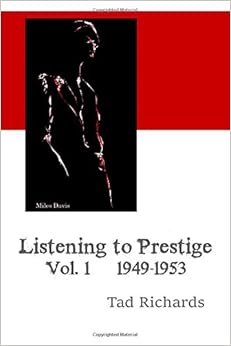
Tad Richards' odyssey through the catalog of Prestige Records:an unofficial and idiosyncratic history of jazz in the 50s and 60s. With occasional digressions.
Jackie McLean was known, especially early in his career, as Bird's foremost acolyte, and starting off the session with a Parker tune shows that he's not quite ready to shake off that mantle. "Bird Feathers," as it turns out, did not make the cut for the album that emanated from this session (though it did eventually see vinyl), but it does set the tone.
On this session, McLean is paired with another Bird acolyte, John Jenkins, and two altos, plus LP technology (hardly a new development at this point) mean that they can do something that Bird was not able to do on his original waxing of this tune, and that's go on twice as long. More, actually. The original Parker/Miles Davis cut came in at under three minutes, 78 RPM dimensions, and McLean and Jenkins take it to nearly ten minutes. In fact, all the cuts from this session are extended, which is why they weren't able to fit them all on one album.
Even in Bird's late recordings, he didn't go much beyond five minutes, the exception being the live Jazz at Massey Hall. So length is one of the interesting features of this session. Not to say this gives us an insight into what Bird would have done with ten minutes or more to develop an individual piece in the recording studio, since no one can tell what Bird might have done with anything had he lived long enough to develop his genius further. And it goes without saying, not to say it gives us an insight into what if there had been two Charlie Parkers. Still, it's interesting.
The session shapes up much like a Parker session too, with one original ("Bird Feathers") and two standards, one ballad tempo ("Easy Living") and one uptempo ("The Lady is a Tramp"). The other two cuts are both John Jenkins originals, and he brings something of value to the party. In fact, his "Windy City" is probably my favorite cut. Art Taylor contributes a blazing drum solo to "Windy City," and Wade Legge is equally powerful.
We've heard Legge once before--on another Charlie Parker tribute session, that one led by Sonny Rollins. Legge himself was too young ever to have played with Bird, but he did tour and record extensively with Dizzy Gillespie. This session and two with Charles Mingus were his last on record. He would shortly return to his native Buffalo, and die a few years later at the age of 29, perhaps by his own hand.
Alto Madness was the title of this album, and "Bird Feathers" became the title cut of the New Jazz compilation album it eventually found its way to, with cuts from the March Phil Woods/Gene Quill session, and a later date with Hal McCusick and Billy Byers--which was not, oddly enough, devoted to Parker compositions.
Everything that every jazz musician plays is, at root, a tribute to Bird. Today, those tributes are most often paid by musicians who were not yet born when Bird died, but they're nonetheless sincere, and those younger musicians still feel that closeness to Bird. But this session was recorded in 1956, when Bird was only one year and a few months dead, and he was still very much a living presence to every jazz musician, and much more profoundly than the ubiquitous "Bird Lives" graffiti of those days (my favorite legend is the one that said at the moment of Bird's death, a single feather fell from the rafters of Carnegie Hall.
Sonny Rollins had played with Charlie Parker on the 1953 Miles Davis session which would ultimately be part of the Collector's Items album, not to be released until December of 1956. He remembered Parker's powerful personal influence when interviewed by Art Taylor, for Taylor's powerful book Notes and Tones: Musician-to-Musician Interviews:
Bird was not only great to me as far as music goes; he also befriended me at a very important time in my life. You know that Bird helped me get off drugs when I was younger. When I made Collector's Items...Bird found out that I had been indulging. He really didn't like it. I saw for the first time that he didn't dig my doing that. I realized I must be doing the wrong thing. Up until that time I had thought it was all fun and games and that it was okay to use drugs. I subsequently got myself off drugs, when he showed me that wasn't the way to go. Unfortunately, when I did get myself straight, I was anxious to let him see I had dug his message, but as life would have it, he passed away before I was able to meet him again,
Rollins entered the federal drug treatment center in Lexington, Kentucky in 1955. Charlie Parker died in March of 1955, probably while Rollins was still at Lexington, so one can only imagine the extent that Parker was still on his mind.
Max Roach played on a number of Parker sessions, including his first Savoy recordings in 1945, and the legendary Massey Hall concert. He would record his own Parker tribute album a year later, for EmArcy.
Kenny Dorham must have had Parker very much on his mind. He had played with Bird on the great altoist's last gig, on March 5, 1955, at Birdland. Bird would be dead only a week later.
George Morrow never recorded with Bird, but he did play with him, on a number of gigs during Bird's 1946 California sojourn. Morrow, who was 30 at the time of this session, had played with the Roach-Clifford Brown quintet on all their recordings.
Wade Legge, at 22, was the youngest musician to be tabbed for this session, and though he had never
played with Bird, he had gotten his start in Dizzy Gillespie's orchestra. Dizzy, recognizing his talent, originally hired him as a bassist, but then heard him suggesting some innovative changes to the piano player. The bebop great liked what he heard, and immediately installed Legge on piano, the instrument he would play for the rest of his short career. He was highly sought after in the late 1950s, appearing on more than 50 recording sessions, and making one album under his own name (for French Vogue, reissued on Blue Note). By 1959 he had retired back to his native Buffalo, probably for reasons of health. He died at 29 of a bleeding ulcer.
The Bird medley begins with the classic "Parker's Mood" opening riff, then goes into standards closely associated with Parker, and original Parker compositions. "I Remember You" (written by Victor Scherzinger as a vehicle for Dorothy Lamour) is from a 1948 Savoy recording (with Max Roach on drums) and features Rollins as chief soloist. The musicians take turns as leader in each part of the medley. Kenny Dorham is up next on "My Melancholy Baby," recorded in 1950 for the Clef album Bird and Diz, the last studio Parker/Gillespie collaboration, a recording which rescued the 1912 melody from the provenance of weepy drunks in late night piano bars.
"Melancholy Baby" has an odd story, which I'll digress to share. From Wikipedia:
Ernie Burnett, who composed the music, was wounded fighting in the First World War, and he lost his memory together with his identity dog-tags. While recuperating in hospital, a pianist entertained the patients with popular tunes including "Melancholy Baby". Burnett rose from his sickbed and exclaimed: "That's my song!" He had regained his memory.
"Old Folks" is sweetly sentimental, and it comes from the ill-fated Charlie Parker with Voices collaboration with Dave Lambert. The criticism of this session is not unfair, but Bird's solo has a lot of feeling, and it's not hard to see why the guys picked it to be part of this tribute. The medley is not so much an attempt to play like Bird as it is an expression of how musicians felt about Bird, and this one goes to Wade Legge, both horns sitting out. "They Can't Take That Away From Me" is the gorgeous Gershwin melody, recorded by Bird on the Charlie Parker with Strings album, controversial at the time, now pretty universally beloved. Rollins takes the lead. Dorham comes back for "Just Friends."
"My Little Suede Shoes" is one of the catchiest of Bird's original compositions, originally recorded with a Latin percussion, which would seem to make it a natural for Rollins, but Legge takes the lead, and listen to this if you want to appreciated just how good this largely forgotten pianist was. The whole ensemble comes in for the finale. "Star Eyes."
The rest of the album is less Bird-oriented. "Kids Know" is a Rollins original, and one might wonder if a title like "Kids Know" in 1956 was a suggestion that Sonny was going to try rock and roll, but no. Sonny did try rock and roll years later, with the Rolling Stones. When he played a concert at SUNY New Paltz one time, it was promoted as "Sonny Rollins (from the Rolling Stones' Tattoo You album)," so maybe kids don't know everything. My Fair Lady opened on Broadway in 1956, so Bird would never have heard "I've Grown Accustomed to Her Face." "The House I Live In" was written as a leftist anthem by Earl Robinson, became a patriotic anthem when recorded by Frank Sinatra, and here serves as a reminder of Rollins's far-ranging ears. It's one of those tunes you can't hear without having the lyrics run through your head, so you can take it as leftist or patriotic, or both.
"They Can't Take That Away From Me" was plucked out of the medley for release as one side of a 45.
Prestige is generally considered to lag behind Blue Note in the artistry of its album covers, but this is often unfair. The cover for Rollins Plays for Bird, by Reid Miles. is stunning. It's only fair to note, however, that Miles was a Blue Note artist.
 and Jenkins take it to nearly ten minutes. In fact, all the cuts from this session are extended, which is why they weren't able to fit them all on one album.
:format(jpeg):mode_rgb():quality(90)/discogs-images/R-4222831-1479236998-6540.jpeg.jpg)