Showing posts with label Lem Winchester. Show all posts

Monday, July 08, 2019

Listening to Prestige 403: Johnny "Hammond" Smith

The trouble with putting a label on a form of music is that it creates the temptation not to listen to it too closely. "Oh, yeah, that's [fill in the blank -- trad, bebop, hard bop, soul jazz], with all the clichés of the genre." What clichés? "Oh, you, know...just listen." But if you really just listen, without burdening yourself with a label, maybe they aren't clichés. Maybe every time a group of talented musicians go into a recording studio, they're there to find something that makes their getting together, and getting it down on wax or vinyl or tape or digital, worth the doing. That's why Cannonball Adderley so firmly resisted having his music called "soul jazz," for all the good it did him. Or, for that matter, why so many musicians resist having their music called "jazz."

Johnny "Hammond" Smith plays soul jazz. It's gotta be. For a start, it's got that organ, right? Like Jimmy Smith. He even has Jimmy Smith's guitar player. And he's got that bluesy-gospely feeling like Ray Charles, right? He even does a jazzy version of "Swanee River," just like Ray.

Well, yeah, except no. As the new decade found its voice, the organ was a large part of that voice, and jazz labels were signing up organists because people wanted to hear them, but they no more sounded alike or played the same clichés than did tenor saxophone players in the 1940s and 1950s.

And OK, the label is not so bad. If someone came to you and said they wanted to start a soul jazz collection, and who are some of the musicians they should collect, you'd certainly include Johnny "Hammond" Smith. But hopefully you would tell the neophyte collector, "Once you've started to pull your collection together, sit down and listen to each record separately." Just as, if you listen closely to a boxed set of Tito Puente, you'll quickly realize that no two rhythms are alike, in your soul jazz collection you'll hear some virtuosi of the Hammond organ, each of them finding his or her own way to explore it. And there are a lot of possibilities in that organ.

All but "Swanee River," on this album, are Smith originals, and "Swanee River" might as well be, in its unique deviations from anything that Stephen Foster or Ray Charles had in mind. Smith can do it as a composer, from catchy melodic hooks to intriguing development, to opening up avenues for his bandmates to explore, to finding, like Jimmy Smith, Shirley Scott and other premiere organists of the day, his own intricacies of tonality and percussive experimentation.

Smith worked for the first time here with Eddie McFadden, who had come from working with Jimmy Smith, and had come from the soul jazz cauldron of Philadelphia, where, like Thornel Schwartz, he had developed a great sense of what a guitar and organ could do together. And he worked for the only time with Lem Winchester, who came from just a hop and a jump south of Philadelphia. How much Winchester might have continued to explore the soul jazz idiom we'll never know.

Smith tosses him right into the cauldron with "Dementia," giving
him the first chorus, then following him with a McFadden solo, before entering with his own. Jazz is many things, but always it's hospitable to soloists, and with "Dementia," the first tune of the day although not the first on the album, Smith serves notice that a range of solo voices, and the flexibility to play off each other, will be what he's looking for. I liked "Dementia" a lot--the way it developed, and the part that each musician played in that development. And I found the same thing happening, in different ways, through each tune on the album.

Yes, original. Yes, unique voices finding ways to challenge and blend with each other. And...soul jazz to the bone, and to the marrow in the bone. That seductive sound that tells you you're gonna dig this. You're gonna tap your feet, you're gonna get up and dance, you're gonna--in Charles Mingus's phrase--git it in your soul.

Esmond Edwards produced. The album was called Gettin' the Message and the 45 off it was "Swanee River Parts 1 and 2."


Thursday, June 27, 2019

Listening to Prestige 402: Lem Winchester

Reliving these jazz years through Prestige recording sessions is living in a dual reality. Part of you knows full well that you're looking back in time through the lens of age and distance, remembering your youthful excitement, appreciating the artists, and the recordings, that a perspective only brought by time and experience. But  part of you is back then, 20 again, hearing the new sound from Symphony Sid or Ed Beach or Speed Anderson or Chuck Niles, buying the new album at Sam Goody's (or the 45 at Sam Goody's Annex), thinking that was solid, Jackson...what comes next?


But that flight of imagination comes to a crashing halt with Lem Winchester. Because you've known, from the moment he burst on the scene the year before, that this was going to happen. Each of his sessions feels, to the contemporary listener following this chronology, like sands through a very small hourglass. It feels that way when we listen to Eric Dolphy, who's also just arrived on the scene with Prestige, and Booker Little, who would make his Prestige debut shortly. And with Lem Winchester, for whom the sands are running out. This was his last session as leader; he would appear in a week with Johnny "Hammond" Smith, and then no more.  In January the ex-cop would be dead of a self-inflicted gunshot wound, reportedly showing off a trick where you pretend to play Russian Roulette.

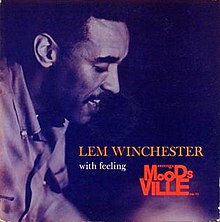
Winchester went out casual but tasty. No fireworks here. instead a quartet session of ballads intended for the Moodsville label. But they're all good tunes, and each one of them gets a swinging treatment, with lots of improvisational delights, and especially the pleasure of hearing some wonderful interplay between Winchester and Richard Wyands, where ideas are begun on piano and brought to fruition on vibes, or vice versa. This is Wyands' only recording gig in a group led by Winchester (he had joined Lem on an Oliver Nelson session), but they have a strong connection.

There's one Winchester original ("The Kids"). The rest are a mix of standards and current pop tunes. "Why Don't They Understand" was a 1957 hit, recorded by country singers as well as pop. Winchester's is the only known jazz interpretation. "To Love and Be Loved" is the Academy Award-nominated theme song from the 1958 movie Some Came Running, again not widely added to the repertoire of jazz musicians. It's a good mix. We may not have the same recognition for late 1950s pop hits that they received at the time (had they only thought of posterity, they might have taken on "Blue Suede Shoes" and "Sh-Boom" instead). but they still make for some very tasty jazz in the hands of Winchester and cohorts. And it's always a pleasure to hear a great jazz group's interpretation of beloved standards.

Esmond Edwards produced the session. The Moodsville release was titled Lem Winchester with Feeling.

Winchester got his start when a young trio, John Chowning's Collegiates, added him for a record date arranged by Chowning's father. The group planned to send the record to Leonard Feather as an audition for the 1958 Newport Jazz Festival. Feather passed on the group, but invited Winchester, then a Wilmington, Delaware police officer. Fifty years later, the three Collegiates reminisced about their sometme bandmate for the Current Research in Jazz website. Here's Chowning:

One can speculate whether Lem’s extraordinary talent would ever have been “noticed” at the level where it mattered if the recording had not been made. Perhaps not. Lem impressed us a man whose first love in music was the playing of it, not being a “name” in it. He had, we thought, more ambition for his notes than for himself.
At the time of the recording Lem was a successful officer in the Wilmington, Delaware, police force, assigned to what we now can call the African American community, where he was beloved by its inhabitants. The options for a smart and intelligent African American then were limited, especially one with a wife and young children. It was Lem’s mother, knowing that a police officer was at the pinnacle of power in her community, who persuaded him to join the police force in the first place. And she later was able to convince him to remain with the force, rather than joining his teenage friend and trumpet player, Clifford Brown, in the professional jazz scene.
...
To all of us Lem seemed content in a rewarding and stable career as a policeman — enriched by his stunning music on the side. He was revered by his community both as a police officer and by those who knew his music: he was welcomed into every musical setting he encountered.
In the spring or summer of 1958 my father, always our most unabashed supporter and spokesman, sent the LP to Leonard Feather... He was disappointed, I am sure, when the invitation came to Lem alone, but the three of us were not surprised. We were good enough players to recognize that Lem was a truly great jazz talent.
To my father’s credit, he maintained contact with Lem during the transition from police officer to professional jazz musician, and it was through him that the three of us learned of Lem’s tragic death in 1961.

George Lindamood
[I remember the first time Lem jammed with us. He] wore a gray sports jacket over his uniform so it would not be obvious that he was a policeman, but we kidded him about his regulation shirt, a shade of blue considerably darker than what was fashionable for business dress in those days. And then there was the bulge on his right hip that we knew to be his service revolver.
...a few weeks later...Lem had just finished one of his energetic solos and had lathered up a pretty good sweat in the process. When he took off his “plain clothes” jacket his police badge winked gold in the spotlight and the audience gasped in surprise... Without missing a beat, he laid the jacket on the piano top, unstrapped his holster and revolver, and dived back in for another chorus. The applause was at least fifty percent louder than before.
 It often took me a couple hours to come down after a gig, so it was pointless to try to sleep. Often I borrowed John’s car, a well-worn brown Kaiser, and tracked Lem down where he was walking his midnight-to-dawn beat in one of the poorer sections of Wilmington. Lem did not seem to mind having a scrawny not-quite-19-year-old white kid tagging along in that all-black neighborhood, although occasionally he had me wait at a distance while he handled a difficult situation. Most of the time we just walked and talked, with him providing stories and advice from his perspective as a black man ten years older. It was a wonderful education for me.

And David Arnold:

 The summer of 1957, our summer with Lem, was one of those years when the nation was in the throes of determining whether social tolerance would follow from the strengthening decisions that there must be legal tolerance. 
It is within that context that I most easily place Lem. I remember his music, of course, but he comes striding with it out of that dark part of Wilmington, that dark part of national history, carrying the bright light of refutation. He was a good man. An unforgettable man.
As George has recalled above, we — who were the John Chowning Collegiates — had thrown open the doors of Marshalls Restaurants for Monday night jam sessions.
The Collegiates, a musically literate trio learning new things with every performance, played what we hoped was jazz — and very often it was. But with Lem and his group there was no question. Marshalls lit up like fireworks. We were hearing what jazz was all about. He might call his style “down home” (another bit of modesty in a way) but it swung with a rhythmic curl and driving force that threatened the walls of the place. On top of it all was Lem’s intricate cascade of notes, at times more than could possibly come from just two mallets, and at other times simply and quietly a delicate, laid-back, slightly off-the-beat sounding of simple melody played in octaves. Push hard and pull back.
Lem was uncommonly gentle and forgiving. And he had that best thing of the best in music: the desire to teach, to pass it on.
It is that last thing I remember most — that and his matter-of-fact and unforced tolerance. Of all the musicians in Marshalls on those nights, I was by far the most unaccomplished... Yet Lem took the time to help, to give me some ideas. He might have seen promise. Or he might have been kind.
...certainly we could see his gift to us: the benefit, like a windfall, of being fronted by a genius on the vibes. He was among the very best, had friends among the very best — Clifford Brown for one — and so how did we deserve him? I have never stopped wondering.
The recording tells the story. On Lem’s cuts his playing transforms us into a different group. He lifts and drives, lightens the load, inspires. There is promise for us all....
In the end we Collegiates had graduations and careers to think about. But for Lem the recording made all the difference. We were both disappointed and relieved when Leonard Feather’s Newport nod went to Lem and not the rest of us but, as John says, we knew who the star was.
... In January of 1961 Lem was on the road, a professional musician, commercial recordings to his credit. But he carried with him a relic of his policeman days: a trick with a revolver in which all bullets but one were removed from their chambers. Gun to his head, bar-sitters watching, he would pull the trigger and the hammer would click as the cylinder rotated to an empty chamber. But that night in Indianapolis he used a different gun. The cylinder rotated in the opposite direction.

John Chowning went on to an unheralded but significant career in music. He studied composition with Nadia Boulanger in Paris. Later, he discovered FM synthesis, "a very simple yet elegant way of creating time-varying spectra. Licensed by Stanford to Yamaha, FM synthesis led to a family of synthesizers (DX7) that became the most successful of all time."


Lem Winchester left a small but significant body of work. He touched lives both as a policeman and a musician.

Tuesday, May 07, 2019

Listening to Prestige 395: Etta Jones

Prestige got behind Etta Jones, whose career had been slow in developing, putting Frank Wess and a standout group of musicians behind her for her debut recording for the label in June, and it paid off, making her an overnight success at age 32, with the better part of two decades of performing behind her. Bob Weinstock and Esmond Edwards wisely brought her right back for this session with two of their brightest new jazz stars, Lem Winchester (this was to be his next-to-last session) and Oliver Nelson,

This was a session of mostly familiar standards, and why not? If you're trying to advance the career of a singer who decidedly deserves it, why not give her a bunch of songs that people like to here. "The More I See You." by Harry Warren and Mack Gordon, was very popular with jazz chanteuses, and even some chanteurs, in those days. A 1945 hit for Dick Haymes, it received ten other renditions in 1959-60 alone, plus four instrumental versions: interpreters included Sarah Vaughan, Nancy Wilson, Julie London, Brook Benton and the Four Freshmen. Celebrities liked it too, including Tony Perkins and Maureen O'Hara.  Jones is deliciously torchy on this one, with Winchester functioning as her alter ego and Nelson providing a short but moving solo near the end.

The Gershwins' wonderful "They Can't Take That Away From Me," originally recorded by Fred Astaire, is often a plaintive lament, but Jones belts it as a defiant album--nobody better try and take it away from me. This one is mostly Jones, but Winchester has an arresting, rhythmically interesting solo.

"That's All There Is to That" had been a recent hit for Nat "King" Cole, who had recorded a song called "That's All" several years earlier, and would recall another called "That's All There Is" a few years later. He sang "That's All There Is to That" for President Eisenhower at the 1956 Republican convention, but there doesn't seem to be any political message to it. It's a sensitive song of lost love and heartbreak as Cole sings it, and fatalistic in the extreme in Jones's version. No sentimentality. You love, you lose, and that's all there is to that. Richard Wyands is the instrumental star on this one. The song was written by Clyde Otis, who went on to a distinguished career as a songwriter and producer, but this was how it started for him: the Nat "King" Cole version of this song was his first hit.

"Easy Living" was written by movie composer Ralph Rainger, but it's become a jazz standard, thanks in great part to the 1937 version by Billie Holiday with Lester Young and Teddy Wilson. Jones stays close to what Lady Day did with the song--it's virtually an homage to the great singer who had died just months before.. The main solo here is Winchester, but Nelson very nearly steals the show with a much briefer one. It's interesting to compare Jones's 1960 recording with Holiday's 1937 recording, an era when the band, not the singer, was the star, and Holiday doesn't enter until more than halfway through the recording.

The Eddie Heywood "Canadian Sunset" was a big instrumental hit for Heywood in 1956, and many vocal versions followed. The lyrics by Norman Gimbel ("Killing Me Softly with His Song," English lyrics for "The Girl from Ipanema") sound a little tacked on, but not the way Jones sings them. Winchester propels her along for a snappy two and a half minutes, just the right length for a 45 RPM single, which this was.

Jones returns to Harry Warren for "I Only Have Eyes For You." a 1930s song which had been a big hit in a 1959 doowop version by the Flamingos. Jones echoes the Flamingos as she starts into the song, but soon takes it in her own direction, which is solid jazz singer. This is another 45-length cut, at just over three minutes, and I would have released it as a single. It's a great song, it's been a hit, and Jones takes it that step farther. But "That's All There Is to That" (not so short) and "Canadian Sunset" were the only singles from the album ("Canadian Sunset" would be rereleased as a single on the flip side of "Don't Go to Strangers"), and they didn't chart, so maybe Bob Weinstock decided that Jones was more an album kinda gal.

This is an interesting album in that some of 1960's finest jazz soloists (Nelson is sparingly used) are on the session, but there aren't any extended solos. And it works. Nothing wrong with tight. And when they do solo, as in Lerner and Loewe's "Almost Like Being in Love," which is about evenly divided between Jones's vocals and an instrumental break by Wyands and Winchester, the improvisation is tight, inventive, and...killer.

Much has been made of Jones's Billie Holiday influence. I didn't hear it so much in the first session--Dinah Washington came more to mind-- but it's definitely happening here, and it's all to the good.

The session would see daylight in two parcels, the 1961 release Something Nice ("That's All There Is to That," "Easy Living," "Canadian Sunset," "I Only Have Eyes for You") and 1963's Hollar.


Listening to Prestige Vol. 2, 1955-56, and Vol. 3, 1957-58 now include, in the Kindle editions, links to all the "Listen to One" selections. All three volumes available from Amazon.

The most interesting book of its kind that I have ever seen. If any of you real jazz lovers want to know about some of the classic records made by some of the legends of jazz, get this book. LOVED IT.
                       – Terry Gibbs

Sunday, April 07, 2019

Listening to Prestige 388: Oliver Nelson - Lem Winchester

You may start listening to this album thinking of the poignancy of two young lives. Lem Winchester would be dead a few months after this session. Oliver Nelson was at the beginning of a career that would last into the next decade and include many recordings, but he would die of a heart attack at age 45.

But however you started listening to it, you  would very quickly be in the thrall of the music. Nelson and Winchester are both brilliant soloists, and so is the underrated Richard Wyands. But the real show-stopper here is Nelson as composer.

Nelson began to be recognized as a composer for his Impulse! album, Blues and the Poetic Truth, and he went on to have considerable commercial success composing and arranging music for movies and TV, and he composed several symphonic works. But his greatness as a composer didn't start with Blues and the Poetic Truth. Listen to any of his originals on this album: "Nocturne," "Early Morning," or particularly "Bob's Blues."

It surprised me to discover, as highly regarded as Nelson is in jazz circles, how few recordings of the tunes from Blues and the Poetic Truth have been made by others. It absolutely shocked me to discover that none of his other compositions have even been recorded. I defy any jazz musician reading this blog to listen to "Bob's Blues" and say that he or she wouldn't like to make their own interpretation of it.

The album is called Nocturne. Esmond Edwards produced. It was released on Moodsville after Winchester's death, as we see in this four-star review from the April 24, 1961 issue of Billboard:
One of the newer jazz names is spotlighted in this moody compilation of torch ballads. Oliver Nelson plays both tenor and alto on the date with a genuine regard for the ballad form. He is caught, along with the late vibes player Lem Winchester, on seven feelingful tracks playing some beautiful melodic material.
The Billboard reviewer goes on to single out "In a Sentimental Mood" (Duke Ellington),"Time After Time" (Jule Styne) and "Man with a Horn" (Jenney, Lake, deLange) for mention, but none of Nelson's originals, so recognition of his composing skills was a little slow in coming. Granted, these are all first-rate tunes, but so are Nelson's.


Listening to Prestige Vol. 2, 1955-56, and Vol. 3, 1957-58 now include, in the Kindle editions, links to all the "Listen to One" selections. Available from Amazon.


Thursday, February 14, 2019

Listening to Prestige 379: Jack McDuff

Jack McDuff's second outing as a leader for Prestige takes him out of the Willis Jackson-Bill Jennings orbit, and playing with an ad hoc group featuring veteran Jimmy Forrest and relative newcomer Lem Winchester (who has done an organ-sax-vibes session before, with Oliver Nelson and Johnny "Hammond" Smith), with a youngater, Bill Elliott, rounding out the quartet on drums. It's a good amalgam. The solosists are able to find common ground--a couple of common grounds,in fact. On the standards--"Mean to Me" and "Autumn Leaves," they're melodic. On a McDuff original like "Yeah Baby," they know how to let loose and blow.

Both "Mean to Me" and "Autumn Leaves" are taken at sprightlier tempos than one is used to hearing, and why not? The falling leaves of autumn don't always have to be an occasion for wistful sighing. You can play in them too, rake them up into a big pile and jump into them. Forrest takes the main job of the melody in this one, and does some very nice things with it, particularly at the end, where brings some wonderful smeary bluesy sounds to a melody not previously known for its affinity to the blues. "Mean to Me" is slyly playful, and again, why not? "You're so mean to me" can be a tease as well as a plaint. Winchester does some particularly strong solo work on this one.

"Yeah Baby" is nine minutes long, and gives each of them, including drummer Bill Elliott, a chance to shine. This is Elliott's recording debut, the start of a career that was always interesting, but only rarely in the field of jazz  drumming. For a while he led a soul group, which is remembered chiefly as the
launching pad for one of its backup singers, Dionne Warwick. During the 1970s, she and Elliott were married, divorced, married again, and finally divorced again. Elliott also had some success as an actor, debuting on TV with a featured role in Dragnet,  and then appearing as a recurring character in Bridget Loves Bernie. He also made a few movies, including Elvis Presley's Change of Habit.

The quartet is unusual in that it doesn't include a bass. The line that would normally be played by the bass is handled by McDuff himself on the Hammond,

The album, a 1960 release, was called Tough 'Duff. "Yeah Baby" was a two-sided single.


Listening to Prestige Vol. 3, 1957-58 is now available!


and also:

Listening to Prestige, Vol. 2, 1954-56


Listening to Prestige, Vol. 1 1949-53

Wednesday, January 23, 2019

Listening to Prestige 374: Shirley Scott

It may have seemed like a leap of imagination to put organ and vibes together in a quartet, or it may have seemed like the most obvious of ideas--let's take two of our hottest young stars and put them together and see what happens. Either way, Shirley Scott and Lem Winchester made an inspired pairing.

We've been following Scott through a series of albums, as she was both prolific and popular. We've heard her with a trio, with Eddie "Lockjaw" Davis, and accompanying a singer, and we've heard how she's always changing, always developing, always trying something new which is at the same time perfectly apropos to the setting she's in.

That's true again here, matched in quartet setting with a vibraphonist. She's mellower than she was when playing with a tenor saxophone, more restrained than the wild experimentation she gets into on her own, more assertive than when she's backing up a vocalist. And in every setting, she has something to say. I did not enter into this project having an opinion one way or another about Shirley Scott. I'd never really listened to her, and I could probably easily have gotten her confused with Hazel Scott, jazz pianist, actress, and wife for 15 years to Adam Clayton Powell. No more. Now I am a confirmed Shirley Scott fan, and I look forward to her every recording as I follow the Prestige story.

Here they take on some interesting material, starting with Andre Previn's "Like Young." Previn had had a hit with his own version of the song the year before, in a recording credited to "The Piano Magic of Andre Previn Combined with the Lush Strings of David Rose," which I guess signaled that the recording was being aimed at the Jackie Gleason market, and maybe explains why the song has never quite achieved jazz standard status. But Previn was a first rate jazz pianist before he went on to other things, including fame as a symphony orchestra conductor and notoriety as an adulterer back in the days when you could still be notorious for that. His notoriety was helped along by dumped wife Dory (dumped for Mia Farrow) who wrote a bittersweet song cycle about the experience, Beware of Young Girls. Farrow, of course, would have her own young girl to beware of later in life, when her adopted daughter Soon-Yi Previn took up with then-husband Woody Allen.

But I digress. Scott and Winchester were the first jazz musicians to take on "Like Young," and there have been a few more since, but it's never really caught on, although it is the most frequently recorded of any of Previn's compositions in the jazz-pop field. Henry Mancini, Neal Hefti and Martin Denny would all do orchestral versions of it, but only Illinois Jacquet and Dave Pell seem to have given it further jazz treatments.

Scott plays the head, and lays down a solid base for Winchester to improvise over. Scott herself will come back with a delicious upper register improv, leaving one to wonder why more jazz musicians haven't gone to this composer for inspiration.

"Sonnymoon for Two" is of course a Sonny Rollins tune, in this case a first date rather than a honeymoon, and like a good squire, Winchester lets Scott do much of the talking. This is definitely not speed dating. The two take time to get to know each other, and they each clearly like what they hear.

As originally recorded by Rollins at his 1957 live recording from the Village Vanguard, it was really a Sonnymoon for one, just the tenor great and a rhythm section. It was first covered by Jimmy Smith, and has since become a widely recorded jazz standard, with a wide variety of recordings including a smokin' one by rock guitar hero Danny Gatton and pedal steel guitar virtuoso Buddy Emmons.

The other standards are Bronislaw Kaper's "On Green Dolphin Street,"  Mack Gordon and Harry Warren's "The More I See You," and Lerner and Loewe's "Get Me to the Church on Time," the last of these a tune that's boisterous fun in its original context, and sly fun here, as they stay right around the melody, with deft variations. "Now's the Time" is one of Charlie Parker's best-known compositions, both in its own right and as the melody for the rhythm and blues hit, "The Hucklebuck" (no composer credit to Bird). Winchester had previously recorded "Now's the Time" on the album New Faces at Newport; this version with Scott stays much closer to Bird's original arrangement (and to "The Hucklebuck").

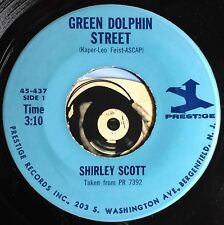
Finally, there's Scott's own composition, "Blues for Tyrone," which is largely a showcase for her bravura organ style, although Winchester handles his solo part near the end adroitly, "Blues for Tyrone" made the B side of the 45 to be released from this session. "On Green Dolphin Street," probably the most familiar tune to jazz aficionados, made the A side. We can see from the image of the 45 that the time is 3:10, cut down from the original 4:11 of the album cut. Which is interesting, I guess they were used to editing down album cuts for 45 RPM release, but 4:11 is really not too long to fit on a 45.

The album, not released until 1966, after Winchester's death, was called Soul Sister, shifting attention to the surviving star, and hopping onto  what was by then a steamroller of a soul bandwagon. "Now's the Time" was left off this release, and became the title track of an album released the following year, and made up of leftovers from several sessions.

Esmond Edwards produced.


Listening to Prestige Vol. 3, 1957-58 is now available!


and also:

Listening to Prestige, Vol. 2, 1954-56


Listening to Prestige, Vol. 1 1949-53


Tuesday, January 08, 2019

Listening to Prestige 370: Lem Winchester

Bob Weinstock's philosophy of the best jazz being from a spontaneous jam session hasn't found many adherents in recent years, with perfection being the goal. perfection achieved by multi-tracks and multi-takes, and laying in patches. But it made for some great jazz.

Part of that spontaneity came from Weinstock's commitment to fooling around with combinations of musicians. You'll recall that he deliberately did not set Miles Davis up with a regular group. That happened when Miles moved to Columbia.
It was a marketing move that brought him wealth and glory, and resulted in some great music, but he made some great music with Prestige too, and we have a legacy of Miles in different settings which is priceless.

Weinstock wouldn't mess around with an artist like Yusef Lateef, who had his familiar group that he brought in with him from Detroit. But Lem Winchester had already outgrown his Wilimington bandmates, and Weinstock set him up with a series of different partners: Benny Golson on his debut album, then Oliver Nelson and Johnny "Hammond" Smith, then Nelson again with Curtis Peagler. And for this, his third album as leader, Frank Wess came aboard, and this was another solid choice. Golson and Nelson were sax players; Wess is a tenorman, too, but here he concentrates on the flute, and to good advantage.

This album cover is a striking piece of art, and it's offered for 
sale as a print at a number of sites (including Walmart!), but
nowhere is the artist credited. There's a signature running
along the lower left, and it's Esmond Edwards'. He did a lot
of photography for Prestige album covers even before he 
began producing, so it's quite likely the art work is his. 
Talented guy.
Winchester has a new rhythm section, too. Hank Jones had lent his piano mastery to a variety of different Prestige settings: with Jerome Richardson, Curtis Fuller and vocalist Earl Coleman. And this, of course, barely scratched the surface of the catalog of this jazz master. Eddie Jones was not one of his brothers, but a heckuva bassist anyway. He worked with Count Basie for years, and was frequently on call for sessions with Countsmen like Frank Wess. He would go on, like so many jazzmen before him, to become vice president of an insurance agency. Gus Johnson also played briefly with Basie; his previous Prestige work had been a swing session and a blues session (with Willie Dixon).

The menu on this album features three tunes by Winchester, one by Oliver Nelson, and one standard. My two favorites on the set are Winchester tunes. "Another Opus" opens with a bass vamp by Eddie Jones turns into a moody Jones-Wess duet, a mood that's picked up and carried by Winchester, who never loses it even
as his playing gets more intricate. It's easy to kid around with the title of my other favorite--Lem and Frank let you have it with both barrels--but given that Winchester was to die far too soon from a self-inflicted gunshot wound, maybe not. This one is much more experimental, and much faster. Eddie Jones, whose bass is very much on display throughout this set, whips into steeplechase speed for this one, and Wess and Winchester both step outside the comfort zone. Listening from the perspective of 1960, you'd come away wanting to hear a lot more from Lem Winchester. Listening from the perspective of the new millenium, one can only grieve that there was to be precious little more.

Another Opus came out on New Jazz, Esmond Edwards producing. 

Tuesday, November 06, 2018

Listening to Prestige 355 - Lem Winchester

Just when I had despaired of ever seeing another bad pun in a jazz composition, Lem Winchester comes to my rescue with "Lem 'n Aide" from this session, and better than that, we have the album's title, Lem's Beat, a sly reference to Winchester's previous career as a police officer in Wilmington, Delaware.

Lem's aide on this session is Oliver Nelson, who wrote three of the tracks, played saxophone and is credited as arranger. Both Nelson and Winchester were to have lives cut short, and not attained the kind of reputation that longer lives might have afforded them. It's good they found each other for this session.

Curtis Peagler of the short-lived but interesting Modern Jazz Disciples rounds out the front line. Peagler mostly faded into obscurity with the rest of the disciples, but the little that he did put on record is worth attending to. He's joined on two tracks by a fellow Disciple, Billy Brown. The piano duties on the other tracks are handled by Roy Johnson, about whom I can find no other information. Perhaps he was someone Winchester knew from his early days in Delaware. The rest of the rhythm section is Wendell Marshall, ubiquitous, and Art Taylor, not heard from in a couple of months, both more than welcome.

Oliver Nelson, already recognized as one of the finest composers of his era, contributes three tunes, the melodic "Eddy's Dilemma," the riffy "Lem & Aide," and "Your Last Chance," which combines the best of both worlds. Nelson becomes the dominant voice on these, but Winchester is a strong partner, and Peagler proves to be an excellent choice as second saxophone, falling right in with Nelson's ideas and bringing his own voice to them.

Roy Johnson's contribution is "Lady Day," the shortest cut of the day at 2:51, haunting and moving, with Winchester and Peagler taking center stage.

"Just Friends" is back, and it's good to hear such a different take on it. And let's trust that they were all friends, and needed no persuasion to be so, since the other outside composition is the movie theme "Friendly Persuasion." My guess...Roy Johnson was a friend of Lem's from the old days? And from the compatibility of Nelson and Curtis Peagler, and the fact that piano duties were shared between Johnson and Billy Brown, maybe the disciples were old friends of Oliver's? And by this time, producer Esmond Edwards had to be pretty tight with Wendell Marshall and Art Taylor. "Friendly Persuasion" is a sentimental ballad by Dmitri Tiomkin that Winchester deals with by not trying to avoid the sentimentality, and it's a good choice. A nice number for friends to pitch in on.

Lem's Beat was a New Jazz release.


Sunday, September 23, 2018

Listening to Prestige 345: Oliver Nelson

I am sadly unable to find anything on the next Prestige session, a septet led by Rex Stewart and featuring kazoos, among other instruments for an album called Happy Jazz. So instead of a visit back to the happy land of trad jazz, we move into the not necessarily happy, but certainly adventurous future with the modernism of another musician who, like Gigi Gryce played the alto sax (also tenor) and who, also like Gryce, became better known as a composer.

This would be the second in a string of albums that Nelson would make for Prestige, and taken together, they make a strong case for not being taken together. Nelson uses different combinations of musicians on each, different sets of powerful individual voices. And if you could say that taken together, they show Nelson's remarkable range as a composer and arranger, you could actually say that about the compositions that make up each separate album. Certainly Taking Care of Business is adventurous enough, and certainly it's an Oliver Nelson album. He uses the skills of gifted improvisers, but the way their solos are stacked against each other adds up to an adventurous, unexpected and satisfying whole.

On his first Prestige outing, he used the archetypal bebop saxophone-trumpet quintet, but with the
unique voice of Kenny Dorham on trumpet. This time he ventures farther afield. Saxophone and Hammond organ have become a recognizable turn-of-the-decade sound thanks to Eddie Davis and Shirley Scott, but what Nelson and Johnny "Hammond" Smith do with them takes that sound in a whole new direction -- and then, he adds the vibraphone of Lem Winchester to make it a truly unique front line. Winchester had made his Prestige debut a few months earlier with Benny Golson.

At nearly ten minutes, "Trane Whistle" shows all of this: the bold composition, the juxtaposed solos, some bacchanalian duet work, dynamic range, and an overall feeling that manages to be both tight and discursive.

The two non-Nelson originals are Sonny Rollins' "Doxy" and the Cahn-Van Heusen standard "All the Way."

Esmond Edwards produced, and Taking Care of Business came out on New Jazz. "Trane Whistle" became a two-sided 45, also on New Jazz. I'm not sure it was your typical 45 RPM fare, but it must have turned a few heads when it was slipped on the record changer.


Friday, March 16, 2018

Listening to Prestige 320: Lem Winchester

The year 1959 was to yield Prestige one more major modern jazz talent, and his career was to be horribly short. That would be Lem Winchester, the vibes-playing cop from Wilmington, Delaware, who was introduced as a Leonard Feather discovery at Newport in 1958, made an album with Ramsey Lewis for Argo Records, and then settle with Prestige, for whom he would cut four sessions over the next two years, and then die of a self-inflicted gunshot wound in 1961--apparently an accident, although some rumors suggest Russian Roulette.

In 1957, Winchester was a young veteran police officer. He had a wife and family, and at his mother's insistence he had opted for job security and a steady salary rather than falling prey to the temptation to join his teenage friend Clifford Brown in decamping Wilimington for Philadelphia and the uncertain life of a jazz musician. But he had been gigging around his home town, and a local trio called John Chowning's Collegiates had dreams of glory, and of the Newport Jazz Festival. They decided to make a recording and sent it to Leonard Feather, and they figured they would have a better chance of being listened to if they added Winchester to their group.

They were partly right. Winchester made Feather sit up and take notice--but only of him, not the Collegiates. Feather put Winchester together with a somewhat more professional trio and presented him at Newport in 1958. This would also be Winchester's recording debut, as one side of a Feather-produced disk called New Faces at Newport (Randy Weston was the other new face). Winchester was backed by three fine musicians from Boston, Ray Santisi, John Neves and Jimmy Zitano. All three were stars of the vibrant Boston club scene, and had worked with major jazz stars like Charlie Parker and Stan Getz.

Winchester's group was billed on the album as the Patrolman Lem Winchester Quartet (he's in uniform on the album cover), and in fact he had not given up his day job. He still walked a beat in Wilimington, but now his moonlighting gigs ranged a little farther afield, including Chicago, where he made a record in 1958 with the Ramsey Lewis Trio. After that he signed with Prestige.

Pairing Benny Golson with Winchester was an excellent idea, although they don't avail themselves of Golson's compositional skills. The album is two Winchester originals (including "Down Fuzz," which has to be an allusion to his other profession), three standards, and one tune, the first recorded, by Len Foster, who seems to have no other credits as composer, musician or anything else. But it must have been a song both Golson and Winchester knew, leading me to guess that Foster must have been a part of the Philadelphia scene, because it's the tune they open their set with. Which means it's where we first hear Golson shape the sound of his tenor so that it becomes the perfect pairing with Winchester's vibes.

For the last tune of the day, Frank Loesser's "If I Were a Bell," Golson sits it out and lets Winchester show what he can do, which is a lot.

Signing up Lem Winchester must have been one of the highlights of what was already a banner tenth anniversary for Bob Weinstock. I bet he'd thought he'd be making records with him for years to come.