I'm reading The Green Mile, by Stephen King. I haven't read a lot
of Stephen King, but I've liked what I've read. I'm reading this one
because it was originally published as a serial, and that's something
I've been thinking about a lot.
Anyway, one always talks about
books and movies, how the book is almost always better, but of course
that's not true. As Howard Hawks said, often a good book will make a bad
movie, but a bad book can make a great movie. High Noon came from a Saturday Evening Post story which no one remembers. Shane is
from a Western novel that no one reads any more. Maybe genre fiction
has a better chance at becoming better on film. I read somewhere that
Clint Eastwood acquired The Bridges of Madison County specifically
because he wanted the challenge of turning a perfectly awful book into a
good movie. Maybe he succeeded...I spared myself reading the book, and
the movie was watchable. David R. Slavitt, poet and translator (his
version of Ovid's Metamorphosis was not loved by some critics, but
they were wrong -- it's brilliant), translated The Fables of Avianus
from Latin. Are they an overlooked masterpiece? I asked him. No, he
said. Avianus was a terrible writer. That's why I chose him -- so all
the literary credit for the translation can go to me.
The Wizard of Oz
is regarded by many as one of the greatest movies of all time, and
although the books are beloved, it's hard to imagine anyone putting them
on the best books of all time list. Still, I can imagine someone
saying, "The book was better."
What about movies that are pretty nearly exactly as good as the book? I'd put The Green Mile on that list.
Lots
of novels are written these days with the idea that they'll be made
into movies, and the novels are written almost like screen treatments.
They generally make serviceable novels, and serviceable movies --
neither is likely to stand out.
An odd exception to this
generalization: Grahame Greene's The Tenth Man. Quoting from Wikipedia:
"In the introduction to the First edition of his novel,
Graham Greene states that he had forgotten about this story until
receiving a letter about it from a stranger in 1983. Greene had first
suggested it as an idea for a film script in 1937, and later developed
it whilst working for MGMduring the 1940s. Nothing came of it and the rights were offered for sale by MGM in 1983. The buyer allowed Greene to revise and subsequently publish the work."
So The Tenth Man
was actually written as a screen treatment, but it made a wonderful
short novel. Interestingly, when it was eventually filmed with Anthony
Hopkins, it wasn't a very good movie.
But back to The Green Mile.
The book basically is the movie. The prose is straightforward, the
story is the same in both versions. The one literary device that King
uses, which is interesting and unobtrusive, is the moving back and forth
in time by the first person narrator. The narrator places himself in a
nursing home, maybe 40 or 50 years after the action of the novel, which
is in the 1930s. So although he's essentially narrating the story as it
happens, he's narrating a story that he knows the ending of, so he can
jump forward in time and tell you what's going to happen.
Showing posts with label Movies. Show all posts
Showing posts with label Movies. Show all posts
Thursday, February 21, 2013


Monday, September 22, 2008
Who Has Websites?
The brilliant (and under recognized in this country) French filmmaker Pascal Aubier has his own website -- unfortunately for his American and British and Canadian and Australian fans whose French may not be up to snuff, it's only in French. This also means, I've discovered, that if you don't have your Google search engine set to "Search for pages written in any language" (under Preferences) his website won't be listed.
At least he has a website. Francois Truffaut, as near as I can make out, doesn't. Neither does Jean-Luc Godard, although he does appear to have a MySpace page. Nor Eric Rohmer. Nor Bernard Tavernier. Has the idea of individual websites not occurred to French filmmakers yet? Or anywhere in Europe? There's an Ingmar Bergman website, but it seems to exist only in English -- and I have reset my preferences to "Search in any language."
The Bergman site is a fan site.
Do filmmakers not have their own sites? Individual movies do -- you can see them included in all trailers these days. Martin Scorcese doesn't, though there are several Scorcese fan sites. The Coen brothers do. Neil LaBute doesn't. Jon Avnet doesn't. There are a bunch of Tarantino fan sites, but he doesn't have his own.
Why not?
So Aubier is in the vanguard. But not in English.
At least he has a website. Francois Truffaut, as near as I can make out, doesn't. Neither does Jean-Luc Godard, although he does appear to have a MySpace page. Nor Eric Rohmer. Nor Bernard Tavernier. Has the idea of individual websites not occurred to French filmmakers yet? Or anywhere in Europe? There's an Ingmar Bergman website, but it seems to exist only in English -- and I have reset my preferences to "Search in any language."
The Bergman site is a fan site.
Do filmmakers not have their own sites? Individual movies do -- you can see them included in all trailers these days. Martin Scorcese doesn't, though there are several Scorcese fan sites. The Coen brothers do. Neil LaBute doesn't. Jon Avnet doesn't. There are a bunch of Tarantino fan sites, but he doesn't have his own.
Why not?
So Aubier is in the vanguard. But not in English.
Sunday, August 24, 2008
Woodstock Museum's Free Festival
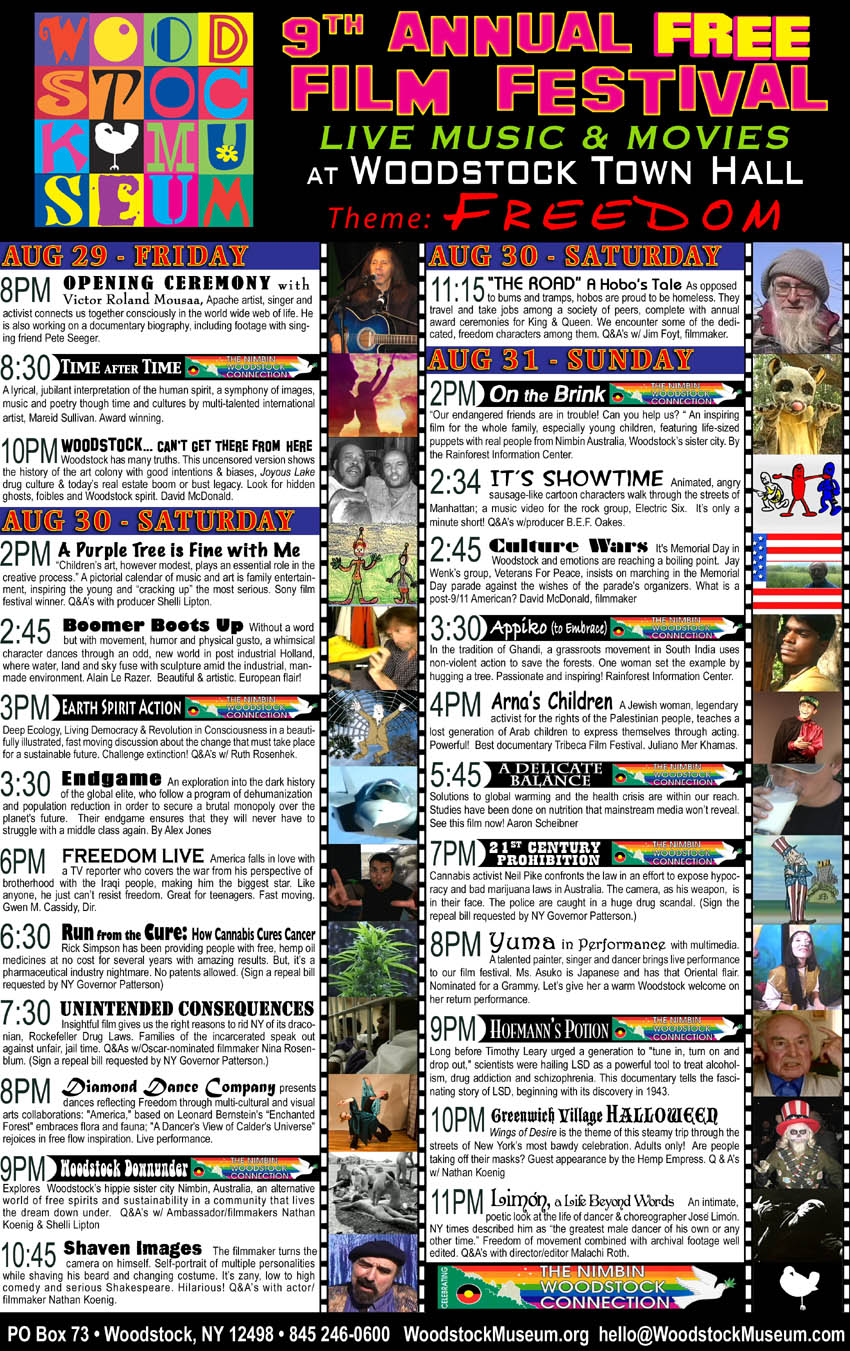
The 9th annual Woodstock Museum Free Fim Festival gets underway August 29, at Woodstock's Town Hall. That first Friday night, at 10 pm. there'll be a showing of Woodstock: Can't Get There From Here, David McDonald's excellent documentary, which features me talking about Opus 4o, and about the death of Dick Stillwell.
Much else of interest, including a film by WM's Nathan Koenig and Shelli Lipton, Woodstock Downunder, about Nimbin, Australia, "the village that was founded on the values of Woodstock Nation" -- Saturday, August 30, at 9 pm.
Sunday, July 29, 2007
John R. Tunis, Leadbelly, Howard Koch
What authors or books influenced you most? People are discussing this on the NewPo list, and I sat down to write about my biggest influences. Pretty soon, I realized this was getting too long for a post to a listserv, in spite of the fact that there are only three names on it. It's also probably irrelevant to a poetry list, since none of these are poets. I'll think about poet-influences next. Here are the three.
1. The baseball novels of John R. Tunis. In Tunis' novels, like The Kid From Tomkinsville, I first became aware of a writer behind the words -- I could feel someone writing it, injecting his own passion and personality into the story. I remember telling my mother one day when I was maybe 11 or 12, and had never particularly thought about growing up to be a writer, "When I grow up to be a writer, and people ask me about the greatest influence on my writin

I realized how deep Tunis was still ingrained in me when I started to write a children's sports book for my grandson Josh, in which he and his friend go back in time and meet Pele. And I realized I was beiong drawn to do what Tunis did -- tell an exciting sports story, but never forget that it's also about something more.
2. Leadbelly, for the reasons mentioned in my last post. He first taught me about compression of words, about the power of what's left out, about saying more with less. I found Leadbelly when Probably "In the Pines" was the first song to hit me that way -- the girl whos
 e tragedy we only glimpse, but we feel the immensity of it behind the stark, sparse words. It was only years later, when I began teaching Leadbelly's lyrics, that an important part of her tragedy hit me -- why she's lost her home, why she had to sleep in the pines. She lives in company housing in a company town, and the company takes back the house when her husband is killed in an on-the-job accident.
It was when I started teaching him, all those years later, when I put together my Literature of the Blues course, that I realized how powerful his influence still was, and had been for all of my writing life. Ashbery only provided a continuation of that influence, but more on that when I get to the list of poet-influences.
3. Howard Koch. Howard died in 1995, and I was honored to be asked to give one of the eulogies for him. Because Howard had been mentor and role model to all of those of my generation who grew up in the 50s and 60s, I made myself their voice, and collected stories and reminiscences from them. Here's one from my brother Jonathan, who recalled hearing
 the name of producer Howard W. Koch in connection with some current movie or other, and asking Noelle Gillmor (a name for another reminiscence), "Is Howard W. Koch the same as our Howard Koch?" Noelle replied, "The relationship between our Howard Koch and Howard W. Koch is roughly the same as the relationship between Jesus Christ and Jesus H. Christ."
But I digress, not for the first time. What I did say, for myself, at Howard's memorial, was that I knew Howard was a great man before I knew he was a great writer. I knew him for his kindness, his intelligence, his integrity, his keen and piercing insights into politics, society, and hypocrisy. So those were my first lessons in writing from Howard, and they're still among the most important that I've ever learned.
Later, I found out about Casablanca, and Sergeant York, and The Sea Hawk. And then I was probably 18, or maybe older, and already serious about becoming a writer. That's when I learned my other lesson from Howard -- that truth can have a heart, and a soul. That if something is romantic, and wonderful, and uplifting, that doesn't negate its truth -- it creates its own special kind of truth.
And there you have it.
Thursday, April 19, 2007
The Ten Percent Solution
For my subtext, or the hidden 90 percent, assignment, I put together a few teaching aids that I'd used separately, and it made for a pretty effective unit.
I started with a unit I've used in the past, the soap/Bogie unit. I play a short segment from a soap opera, and when it's over, I ask the class what they know as a result of watching it. And what they know is that the Wheelchair Bitch (as they dubbed her) is in a wheelchair because Babe ran her over, that Babe's boyfriend is a rich boy, that the boyfriend thinks she's lying, that in fact she is lying, etc., etc. How do they know all this? They know all of it because the characters tell them. It's all in the dialog. In a soap opera, everything is. There's no subtext to speak of...it's all laid flat out for you. This is one way of presenting a scene, and it works in a soap, because they have to bring the viewer up to speed who maybe only gets to watch once a week, and they have to play to the viewer who's half paying attention while putting the clothes in the dryer.
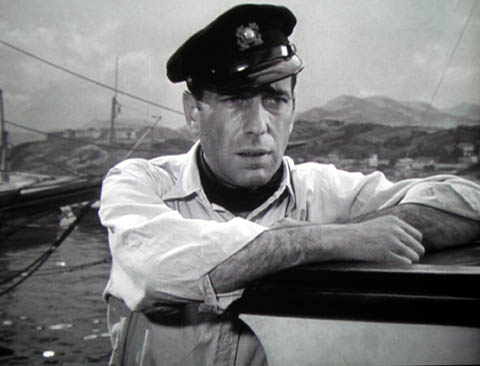 Then I use a scene from the Hawks/Bogart/Bacall classic, To Have and Have Not -- a scene which has virtually no dialog -- and ask the same questions. What do you know, and how do you know it? It's the scene where Bogart (Morgan) and Bacall (Slim)'s eyes meet across the nightclub, when she gets up to sing "Am I Blue" with Hoagy Carmichael (Cricket). What do we know? We know she's being ironic and mocking about the lyrics to the song, but she means them, too. We know that there's something happening between the two of them, but we don't know what. We know that she doesn't want to be with the man she's with (Johnson). We suspect there may be a business connection between Morgan and Johnson. We know Johnson drinks too much. And more. The scene opens with a black waitress moving through a cordon of men, some of them in uniform. We know it's an exotic Caribbean setting, and maybe wartime, maybe a dangerous setting. We know it's a mostly male setting, and a woman has to know how to negotiate her way through it. Then, as the camera catches sight of Morgan over the waitress's shoulder, it seeks him out and comes to rest on him, first in a two shot with a waiter, then quickly to a medium closeup. We know he's a loner, and we know he's a figure of authority. His eyes look up, and we know that everything we see thereafter will be from his point of view. He lights a match, and Cricket's piano starts at the same moment -- Morgan is setting the scene into motion.
There's a shot of the drummer in Cricket's band reading a newspaper. He puts down the newspaper, picks up his brushes, and starts to play. What's it doing there? What do we know from it? We know what the whole scene is about. It's about what Hemingway writes about, and Hawks makes movies about. It's about being in synch, about being hip, about being one of us. The drummer is in synch, Cricket is, Slim and Morgan are. Drunken, pawing Johnson is not. Frenchy, who enters to the new, nervous, ricky-tick tune Cricket starts playing after "Am I Blue," is not, but he's OK anyway. He comes to tell Morgan that the men who want to rent his boat are there - the men who are in danger. He makes the camera shift slightly, so he can share the space with Morgan, but the camera doesn't like it. It's glad when Frenchy leaves, and it can put Morgan back in the center of the frame.
 What I added to the unit this time -- I've used it before, but in a different context -- is the Moe Green scene from The Godfather. Michael arrives in Las Vegas to buy the casino from Moe Green. Green doesn't want to sell. Fredo is obviously on Moe's side. What's the scene really about? It's about power, control...and loyalty. Moe makes the first power play, by not being there when Michael arrives -- letting Fredo greet him with temptation, girls and a band. Michael makes his first test of loyalty, when he tells Johnny Fontane, the Sinatra character, that he'll be buying the Hotel from Moe, and he wants a signed commitment from Johnny to appear at the club five times a year, and convince some of his Hollywood friends to appear as well. Fredo hovers in the background, giving Johnny an out with his protestation that he's sure Moe doesn't want to sell out. Johnny hesitates. It's a tough spot. Is Michael bluffing, playing from weakness? Should he take the safe route, and say "Let's wait and see what Moe says"? But he comes through. "Sure, Mike, you know I'll do anything for my godfather." Maybe it's not as total an expression of support as "Sure, Mike, you know I'm with you." But it's the best Michael can expect.
What would the scene be like, if it had been written like the soap opera? If at the end of the scene, Michael had gone over to Tom Hagen and said, "Well, Johnny's with us, and Fredo isn't." "That's true, Mike, but maybe you should give Fredo a pass because he's your brother." "No, I can't do that, because with my father's illness, I have to show more ruthlessness than I would have otherwise." As one of my students said, "We've come a long way from the soap opera."
And in fact, Moe does talk a little like the soap opera characters, when he tells Michael that the Corleone family doesn't have that kind of power any more, the Godfather is ill, and he can get a better deal from Barzini. His dialog is better -- "I buy you out -- you don't buy me out!" but he's leaving his whole game on the table. He's like Johnson, the lecherous drunk.
Like writer, like character. Morgan and Michael both reveal their strength by what they don't reveal, what they hold back.
I started with a unit I've used in the past, the soap/Bogie unit. I play a short segment from a soap opera, and when it's over, I ask the class what they know as a result of watching it. And what they know is that the Wheelchair Bitch (as they dubbed her) is in a wheelchair because Babe ran her over, that Babe's boyfriend is a rich boy, that the boyfriend thinks she's lying, that in fact she is lying, etc., etc. How do they know all this? They know all of it because the characters tell them. It's all in the dialog. In a soap opera, everything is. There's no subtext to speak of...it's all laid flat out for you. This is one way of presenting a scene, and it works in a soap, because they have to bring the viewer up to speed who maybe only gets to watch once a week, and they have to play to the viewer who's half paying attention while putting the clothes in the dryer.
Then I use a scene from the Hawks/Bogart/Bacall classic, To Have and Have Not -- a scene which has virtually no dialog -- and ask the same questions. What do you know, and how do you know it? It's the scene where Bogart (Morgan) and Bacall (Slim)'s eyes meet across the nightclub, when she gets up to sing "Am I Blue" with Hoagy Carmichael (Cricket). What do we know? We know she's being ironic and mocking about the lyrics to the song, but she means them, too. We know that there's something happening between the two of them, but we don't know what. We know that she doesn't want to be with the man she's with (Johnson). We suspect there may be a business connection between Morgan and Johnson. We know Johnson drinks too much. And more. The scene opens with a black waitress moving through a cordon of men, some of them in uniform. We know it's an exotic Caribbean setting, and maybe wartime, maybe a dangerous setting. We know it's a mostly male setting, and a woman has to know how to negotiate her way through it. Then, as the camera catches sight of Morgan over the waitress's shoulder, it seeks him out and comes to rest on him, first in a two shot with a waiter, then quickly to a medium closeup. We know he's a loner, and we know he's a figure of authority. His eyes look up, and we know that everything we see thereafter will be from his point of view. He lights a match, and Cricket's piano starts at the same moment -- Morgan is setting the scene into motion.There's a shot of the drummer in Cricket's band reading a newspaper. He puts down the newspaper, picks up his brushes, and starts to play. What's it doing there? What do we know from it? We know what the whole scene is about. It's about what Hemingway writes about, and Hawks makes movies about. It's about being in synch, about being hip, about being one of us. The drummer is in synch, Cricket is, Slim and Morgan are. Drunken, pawing Johnson is not. Frenchy, who enters to the new, nervous, ricky-tick tune Cricket starts playing after "Am I Blue," is not, but he's OK anyway. He comes to tell Morgan that the men who want to rent his boat are there - the men who are in danger. He makes the camera shift slightly, so he can share the space with Morgan, but the camera doesn't like it. It's glad when Frenchy leaves, and it can put Morgan back in the center of the frame.
What I added to the unit this time -- I've used it before, but in a different context -- is the Moe Green scene from The Godfather. Michael arrives in Las Vegas to buy the casino from Moe Green. Green doesn't want to sell. Fredo is obviously on Moe's side. What's the scene really about? It's about power, control...and loyalty. Moe makes the first power play, by not being there when Michael arrives -- letting Fredo greet him with temptation, girls and a band. Michael makes his first test of loyalty, when he tells Johnny Fontane, the Sinatra character, that he'll be buying the Hotel from Moe, and he wants a signed commitment from Johnny to appear at the club five times a year, and convince some of his Hollywood friends to appear as well. Fredo hovers in the background, giving Johnny an out with his protestation that he's sure Moe doesn't want to sell out. Johnny hesitates. It's a tough spot. Is Michael bluffing, playing from weakness? Should he take the safe route, and say "Let's wait and see what Moe says"? But he comes through. "Sure, Mike, you know I'll do anything for my godfather." Maybe it's not as total an expression of support as "Sure, Mike, you know I'm with you." But it's the best Michael can expect.What would the scene be like, if it had been written like the soap opera? If at the end of the scene, Michael had gone over to Tom Hagen and said, "Well, Johnny's with us, and Fredo isn't." "That's true, Mike, but maybe you should give Fredo a pass because he's your brother." "No, I can't do that, because with my father's illness, I have to show more ruthlessness than I would have otherwise." As one of my students said, "We've come a long way from the soap opera."
And in fact, Moe does talk a little like the soap opera characters, when he tells Michael that the Corleone family doesn't have that kind of power any more, the Godfather is ill, and he can get a better deal from Barzini. His dialog is better -- "I buy you out -- you don't buy me out!" but he's leaving his whole game on the table. He's like Johnson, the lecherous drunk.
Like writer, like character. Morgan and Michael both reveal their strength by what they don't reveal, what they hold back.
Friday, February 23, 2007
Tagged for Ten
I am, apparently, part of a tag-team blogroll. I have been tagged by the redoubtable Anny Ballardini, as follows:
So, here is Anny's list:
As it happens, I just did this exercise about a year ago for a website called The Cinematheque, so although Anny is quite right, and one's lists are subject to change at a moment's notice, I'll reprise that list here:
And extras. Anything by Kurosawa, but especially Dersu Uzala: The Hunter and the underrated Dreams. Anything with Errol Flynn, but special mention to Robin Hood, which I'm re-watching now with my 6-year-old grandson, and The Sea Hawk, where Michael Curtiz once again had the benefit of a wonderful screenplay by Howard Koch. Some Hollywood B movies that achieved a level of greatness: Abbott and Costello Meet Frankenstein, Tarzan and his Mate, The Incredible Shrinking Man. Rosselini directing De Sica in Generale Della Rovere. Cagney in Yankee Doodle Dandy. And on that note...my mother thanks you, my father thanks you, my sister thanks you, and I thank you.
I can't think of anyone to pass it along to. Who do I know who has a blog, whom Anny doesn't know? I'm sure I'm forgetting someone. But I'll post this anyway.
Okay, I have been tagged by our Great Tom Beckett who was tagged by Richard Lopez (who by the way mentions The Hitcher - movie I also wanted to quote) to name 10 favorite movies, not too bad, indeed. Difficult, though, these are just the first I was able to dig up, I am sure there are plenty more and will come out in the next few hours with a comment, how could I forget that one?
So, here is Anny's list:
1. La vita è bella (Life is beautiful) Benigni
2. Apocalypse now (Redux is all right) Francis Ford Coppola (loosely based on Heart of Darkness by Joseph Conrad)
3. A Beautiful Mind by Ron Howard
4. American Beauty by Sam Mendes with Kevin Spacey and Annette Bening
5. Catch Me If You Can by Steven Spielberg, I even liked Leonardo Di Caprio in this perfomance besides the usual Tom Hanks (see Philadelphia, Save Private Ryan, The Da Vinci Code, There is mail for you,
6. Dogville by Lars von Trier (not exceptional but I can forgive much to a movie that features Nicole Kidman)
7. The Experiment (a must see) by Oliver Hirschbiegel (based on the 1971 Stanford University simulation study of the psychology of imprisonment)
8. Girlfight by Karyn Kusama with Diana Guzman
9. The Lord of the Rings (3) by Peter Jackson and Harry Potter (the entire series)
10. Eyes Wide Shut by Stanley Kubrick with Nicole Kidman and Tom Cruise
10. The Matrix + The Matrix Reloaded by Andy Wachowski with Keanu Reeves and Carrie Ann Moss, originally taken from William Gibson’s homonymous novel.
As it happens, I just did this exercise about a year ago for a website called The Cinematheque, so although Anny is quite right, and one's lists are subject to change at a moment's notice, I'll reprise that list here:
1. Casablanca (Michael Curtiz, 1943)
It's customary to list a movie by director, so I've followed that custom, and Michael Curtiz was a Hollywood giant, with a career that stretched from the slient era to the 60s. He directed some of Errol Flynn's classics (which means some of my favorite movies) like Captain Blood and Charge of the Light Brigade; he directed Yankee Doodle Dandy and Young Man With a Horn and We're No Angels, a movie I had occasion to quote to my Honors English class last week. And he directed The Sea Hawk, also with Errol Flynn, but I'll get to that.
But for me, Casablanca is not Curtiz's movie, or even Bogart's. It belongs to Howard Koch, beloved friend and mentor, who co-wrote the screenplay. Here's looking at you, Howard.
2. The Seventh Seal (Ingmar Bergman, 1957)
Your most formative experiences are, unsurprisingly enough, come in your most formative years. I was seventeen when I first saw The Seventh Seal, and I can't count the number of times I've seen it since then. And every time, I get that same rush of awe that I felt the first time I saw it.
3. The Bicycle Thief (Vittorio De Sica, 1948)
I have an Italian film too, Anny -- not at the top of the list, but high up. I used to tell my screenwriting students, "Any one of you could make this movie. You could raise the kind of budget he had. You could go out in the streets of Poughkeepsie with a hand held camera, as he did in Rome. You could use amateur actors, as he did. All you'd need would be genius."
4. Ran (Akira Kurosawa, 1985)
Anything by Kurosawa. Throne of Blood did Shakespeare (a Samurai Macbeth) almost as well, but Ran, his Samurai King Lear, benefits from Kurosawa's masterful use of color and the big screen. And why you should still go out to the movies: There's a scene in Ran where the king and the fool are sitting on top of a hill, talking. At the foot of the hill, in the lower right hand corner of the screen, is a dappled white horse. And I thought as I watched it, "On TV or vCR that horse won't even be on the screen."
5. Red River (Howard Hawks, 1948)
The classic Oedipal Western, worth the price of admission just for the closeups of the cowboys' faces yelling as the trail drive begins. If you wondered whether John Wayne could act, watch his disintegrating personality in this movie.
6. A Night at the Opera (Sam Wood, 1935)
You could pick any Marx Brothers movie. I picked this one.
7. Cabin in the Sky (Vincente Minnelli, 1943) -– the best Louis Armstrong showcase on film, and no ten best list of anything that has an opportunity to include Louis Armstrong should leave him out. I almost picked High Society for the same reason – I know most people don’t even think it’s the best version of this story, but it is, because of Satch, Bing and Frank.
8. Scaramouche (George Sidney, 1952) -- I am pleased to report that two movies on my list -- Scaramouche and Cabin in the Sky -- didn't even make the NY Times list of the 1000 best movies (three if you count my honorable mention for High Society). I take this as a tribute to my unerring good taste. Swashbuckling is one of the things the movies do best, how can you pass up a guy who was born with the gift of laughter and a sense that the world was mad?
9. War and Peace (Sergei Bondarchuk, 1968) -- It would be easy to make a ten best list entirely from movies that did not make the NY Times 1000 Best List (Modern Times, Ivan the Terrible Parts I and II, Rio Bravo, just to name a few). I had put Lawrence of Arabia on my listoriginally, and it's a great spectacle, but I had forgotten the greatest spectacle of all time (so did the NY Times, but I'm making amends for my error). Featuring the entire Russian army, and wonderful acting, and not a slack moment in nearly seven hours of running time.
10. The Last Waltz (Martin Scorsese, 1978)
Best concert film ever.
And extras. Anything by Kurosawa, but especially Dersu Uzala: The Hunter and the underrated Dreams. Anything with Errol Flynn, but special mention to Robin Hood, which I'm re-watching now with my 6-year-old grandson, and The Sea Hawk, where Michael Curtiz once again had the benefit of a wonderful screenplay by Howard Koch. Some Hollywood B movies that achieved a level of greatness: Abbott and Costello Meet Frankenstein, Tarzan and his Mate, The Incredible Shrinking Man. Rosselini directing De Sica in Generale Della Rovere. Cagney in Yankee Doodle Dandy. And on that note...my mother thanks you, my father thanks you, my sister thanks you, and I thank you.
I can't think of anyone to pass it along to. Who do I know who has a blog, whom Anny doesn't know? I'm sure I'm forgetting someone. But I'll post this anyway.
Subscribe to:
Posts (Atom)