Showing posts with label Kenny Dorham. Show all posts

Wednesday, April 04, 2018

Listening to Prestige 326: Kenny Dorham

Kenny Dorham is mostly associated with Blue Note, largely because of what has become his signature album, 'Roud About Midnight at the Cafe Bohemia. But as prolific as he was, he actually recorded for a wide variety of labels, both as leader and sideman, going back to the beginning of the bebop era--and even earlier: his first recordings, in 1945 were with swing-era bandleaders Mercer Ellington and Frank Humphries. Though he's probably most remembered for his work in the late 1950s and 1960s, he was literally present at the creation, replacing Dizzy Gillespie in Billy Eckstine's band in 1945 and joining Dizzy's big band in 1946. In that same year, he recorded with Sonny Stitt (they were the Bebop
Boys), Kenny Clarke, and Fats Navarro. An auspicious beginning. He would go on to record with Lionel Hampton, Mary Lou Williams, Max Roach, J J. Johnson, and Thelonious Monk before making his debut as a leader: two songs for a 78 (he also sang) that went unreleased for 40 years, so it doesn't really count.

What does count, from this same late 1940s period: he replaced Miles Davis in the Charlie Parker Quintet, and made a series of mostly live recordings that were released on Savoy and Verve.

In the early 1950s, he was a charter member of the Jazz Messengers (Horace Silver edition) and played in groups led by Sonny Rollins and Lou Donaldson, and finally got to make his real debut as a leader, for Charles Mingus's Debut Records, a label that produced some great music but did not get great distribution. He continued to record for Blue Note with the Jazz Messengers, which was a solid gig, and made two albums as a leader for Blue Note in 1955, and one for ABC-Paramount, this last as Kenny Dorham and the Jazz Prophets.

He was still "and the Jazz Prophets" when he hit the Cafe Bohemia for a tentative recording in April of 1956, and then a big evening, with three sets recorded, on May 31st.

So, a major career. But not quite a major reputation as he prepared to make his first album as a leader on Prestige, after having assisted Oliver Nelson on his debut album two weeks earlier. His legendary 'Round About Midnight at the Cafe Bohemia was a slow-developing legend. 'Round About Midnight t at the Cafe Bohemia was still the whole title of the LP. It did not become Volume 1, and and there were no Volumes 2 and 3, until many, many years later.

His most recent showing on the Down Beat had placed him 13th, with 72 votes from jazz aficionados (Miles Davis led the pack with close to 2500).

So this session for Prestige is still an audition for the brass ring that he was never quite able to grab with his Blue Note recordings, and in fact, he was never quite able to grab.

He is joined by a dream team rhythm section of Tommy Flanagan, Paul Chambers and Art Taylor, for an album of ballads, both standards and originals. Hey, Prestige had pretty good luck with a jazz trumpeter playing ballads.

Dorham, of course, does not remotely try to emulate Miles Davis and his Harmon mute. Nor does he pull out any bells and whistles born of desperation. Like many another even more unsung jazzman than himself, he goes into the studio to make music, to explore the possibilities of a very nice group of tunes, to develop ideas with his bandmates, to improvise and create.

Today, Dorham is rated among the greatest jazz trumpeters of all time, and today, listening back, what does this album sound like?

It sounds great. A jazz master, who's paid his dues and then some, who's held his own at the highest reaches of jazz, playing what he knows, with the best people. Especially Paul Chambers, who's been absent from Prestige for a few months, I think my favorite cut here is "Blue Spring Shuffle," with some particularly nice Chambers/Dorham interplay.


Listening to Prestige Vol. 2, 1954-1956 is here! You can order your signed copy or copies through the link above.

Tad Richards will strike a nerve with all of us who were privileged to have
lived thru the beginnings of bebop, and with those who have since
fallen under the spell of this American phenomenon…a one-of-a-kind
reference book, that will surely take its place in the history of this
music.
                                                                                                                        --Dave Grusin

An important reference book of all the Prestige recordings during the time
period. Furthermore, Each song chosen is a brilliant representation of
the artist which leaves the listener free to explore further. The
stories behind the making of each track are incredibly informative and


Friday, March 23, 2018

Listening to Prestige 323: Oliver Nelson

There's a gap here. I can't find anything streaming online from Jerome Richardson's October 21 session, which produced the album Roamin' with Richardson. And I don't have it in my vinyl collection. So unless someone would like to digitize it and send it to me, it'll have to wait till I get a book contract and can afford to go back and buy the missing albums at whatever collector prices I can find.

Prestige presents the debut album of another major talent who would help to define the jazz of the 1960s, as a musician and even more as a composer--and whose life would be cut short. Not like Lem Winchester's, shorter than it should have been. He would die of a heart attack at age 43.

Nelson woke up to an awareness of music that was beyond what he had grown up with--a musical education that included an older brother who was in Cootie Williams's orchestra, and his own stint playing with Louis Jordan's Tympani Five--when he joined the Army during the Korean War, and found himself overseas in Japan and Korea. But it wasn't the music of Asia that turned his head. He had to go all the way to Japan to discover the music of the West: a Tokyo Philharmonic Orchestra performance of t he music of Ravel and Hindemith. Before that, he told Ebony reporter Phyl Garland, "I hadn't even known that Negroes were allowed to go to concerts."

He was still committed to jazz, but his way to it went through a classical education. After the Army, he enrolled at Washington University in St, Louis, where jazz was a word not even mentioned in the music department, but he studied with important composers like Elliot Carter and got a grounding in composition that would stand him in good stead later--for example, when the Eastman Orchestra of Rochester, New York, premiered one of his pieces, "and the reviewers didn’t know where it belongs. You can’t tell where the jazz stops and where the classical music begins" (from an interview with John Cobley). And in 1966, he would be asked to come back to St. Louis and start a jazz program at Washington U.

He continued his postgraduate education playing in the bands of Erskine Hawkins, Wild Bill Davis, and Louie Bellson, and honed his composer/arranger chops as the house arranger at the Apollo Theater, which must have been an interesting job.

For his first album as a leader, producer Esmond Edwards has given him some of Prestige's finest for a rhythm section, plus trumpeter Kenny Dorham, not quite a regular, but here making his eighth appearance on a Prestige recording.  They've chosen four original Nelson compositions, plus one by Billy Strayhorn ("Passion Flower") and one by Bob Haggard ("What's New?") All of his own work has both immediacy and sublety, and shows a composer who will go on to become justly celebrated.  I particularly liked "Jams and Jellies," which has a catchy blues melody, and opens itself up to terrific solos by Nelson, Ray Bryant and Kenny Dorham. And in this case, I sincerely believe it must be jelly, 'cause jam don't shake like that.

 "Ostinato" is particularly interesting. "Ostinato" is an Italian word meaning obstinate or stubborn, and in music it describes a musical phrase that keeps repeating, that won't go away. Ravel's "Bolero" is frequently used as an example, but in the world of rock and roll, rhythm and blues and even jazz, it's pretty common. Think "Tequila," or Doc Pomus's "Lonely Avenue," best known in the recording by Ray Charles. Nelson's "Ostinato" is the work of composer seriously grounded in music theory, and of a guy who knows how to have fun.

Esmond Edwards produced. The New Jazz recording was called, appropriately, Meet Oliver Nelson.


Listening to Prestige Vol. 2, 1954-1956 is here! You can order your signed copy or copies through the link above.

Tad Richards will strike a nerve with all of us who were privileged to have
lived thru the beginnings of bebop, and with those who have since
fallen under the spell of this American phenomenon…a one-of-a-kind
reference book, that will surely take its place in the history of this
music.
                                                                                                                        --Dave Grusin

An important reference book of all the Prestige recordings during the time
period. Furthermore, Each song chosen is a brilliant representation of
the artist which leaves the listener free to explore further. The
stories behind the making of each track are incredibly informative and
give a glimpse deeper into the artists at work.
                                                                                                                --Murali Coryell

Friday, June 17, 2016

Listening to Prestige Part 189 - Sonny Rollins

Everything that every jazz musician plays is, at root, a tribute to Bird. Today, those tributes are most often paid by musicians who were not yet born when Bird died, but they're nonetheless sincere, and those younger musicians still feel that closeness to Bird. But this session was recorded in 1956, when Bird was only one year and a few months dead, and he was still very much a living presence to every jazz musician, and much more profoundly than the ubiquitous "Bird Lives" graffiti of those days (my favorite legend is the one that said at the moment of Bird's death, a single feather fell from the rafters of Carnegie Hall.

Sonny Rollins had played with Charlie Parker on the 1953 Miles Davis session which would ultimately be part of the Collector's Items  album, not to be released until December of 1956. He remembered Parker's powerful personal influence when interviewed by Art Taylor, for Taylor's powerful book Notes and Tones: Musician-to-Musician Interviews:
Bird was not only great to me as far as music goes; he also befriended me at a very important time in my life.  You know that Bird helped me get off drugs when I was younger. When I made Collector's Items...Bird found out that I had been indulging. He really didn't like it. I saw for the first time that he didn't dig my doing that. I realized I must be doing the wrong thing. Up until that time I had thought it was all fun and games and that it was okay to use drugs. I subsequently got myself off drugs, when he showed me that wasn't the way to go. Unfortunately, when I did get myself straight, I was anxious to let him see I had dug his message, but as life would have it, he passed away before I was able to meet him again,
Rollins entered the federal drug treatment center in Lexington, Kentucky in 1955. Charlie Parker died in March of 1955, probably while Rollins was still at Lexington, so one can only imagine the extent that Parker was still on his mind.

Max Roach played on a number of Parker sessions, including his first Savoy recordings in 1945, and the legendary Massey Hall concert. He would record his own Parker tribute album a year later, for EmArcy.

Kenny Dorham must have had Parker very much on his mind. He had played with Bird on the great altoist's last gig, on March 5, 1955, at Birdland. Bird would be dead only a week later.

George Morrow never recorded with Bird, but he did play with him, on a number of gigs during Bird's 1946 California sojourn. Morrow, who was 30 at the time of this session, had played with the Roach-Clifford Brown quintet on all their recordings.


Wade Legge, at 22, was the youngest musician to be tabbed for this session, and though he had never
played with Bird, he had gotten his start in Dizzy Gillespie's orchestra. Dizzy, recognizing his talent, originally hired him as a bassist, but then heard him suggesting some innovative changes to the piano player. The bebop great liked what he heard, and immediately installed Legge on piano, the instrument he would play for the rest of his short career. He was highly sought after in the late 1950s, appearing on more than 50 recording sessions, and making one album under his own name (for French Vogue, reissued on Blue Note). By 1959 he had retired back to his native Buffalo, probably for reasons of health. He died at 29 of a bleeding ulcer.

The Bird medley begins with the classic "Parker's Mood" opening riff, then goes into standards closely associated with Parker, and original Parker compositions. "I Remember You" (written by Victor Scherzinger as a vehicle for Dorothy Lamour) is from a 1948 Savoy recording (with Max Roach on drums) and features Rollins as chief soloist. The musicians take turns as leader in each part of the medley. Kenny Dorham is up next on "My Melancholy Baby," recorded in 1950 for the Clef album Bird and Diz, the last studio Parker/Gillespie collaboration, a recording which rescued the 1912 melody from the provenance of weepy drunks in late night piano bars.

"Melancholy Baby" has an odd story, which I'll digress to share. From Wikipedia:
Ernie Burnett, who composed the music, was wounded fighting in the First World War, and he lost his memory together with his identity dog-tags. While recuperating in hospital, a pianist entertained the patients with popular tunes including "Melancholy Baby". Burnett rose from his sickbed and exclaimed: "That's my song!" He had regained his memory.
"Old Folks" is sweetly sentimental, and it comes from the ill-fated Charlie Parker with Voices collaboration with Dave Lambert. The criticism of this session is not unfair, but Bird's solo has a lot of feeling, and it's not hard to see why the guys picked it to be part of this tribute. The medley is not so much an attempt to play like Bird as it is an expression of how musicians felt about Bird, and this one goes to Wade Legge, both horns sitting out. "They Can't Take That Away From Me" is the gorgeous Gershwin melody, recorded by Bird on the Charlie Parker with Strings album, controversial at the time, now pretty universally beloved. Rollins takes the lead. Dorham comes back for "Just Friends."

"My Little Suede Shoes" is one of the catchiest of Bird's original compositions, originally recorded with a Latin percussion, which would seem to make it a natural for Rollins, but Legge takes the lead, and listen to this if you want to appreciated just how good this largely forgotten pianist was. The whole ensemble comes in for the finale. "Star Eyes."

The rest of the album is less Bird-oriented. "Kids Know" is a Rollins original, and one might wonder if a title like "Kids Know" in 1956 was a suggestion that Sonny was going to try rock and roll, but no. Sonny did try rock and roll years later, with the Rolling Stones. When he played a concert at SUNY New Paltz one time, it was promoted as "Sonny Rollins (from the Rolling Stones' Tattoo You album)," so maybe kids don't know everything. My Fair Lady opened on Broadway in 1956, so Bird would never have heard "I've Grown Accustomed to Her Face." "The House I Live In" was written as a leftist anthem by Earl Robinson, became a patriotic anthem when recorded by Frank Sinatra, and here serves as a reminder of Rollins's far-ranging ears. It's one of those tunes you can't hear without having the lyrics run through your head, so you can take it as leftist or patriotic, or both.

"They Can't Take That Away From Me" was plucked out of the medley for release as one side of a 45.

Prestige is generally considered to lag behind Blue Note in the artistry of its album covers, but this is often unfair. The cover for Rollins Plays for Bird, by Reid Miles. is stunning. It's only fair to note, however, that Miles was a Blue Note artist.


Order Listening to Prestige Vol 1 here.

Tuesday, May 17, 2016

Listening to Prestige Part 185: Gil Melle

Gil Melle is back in Hackensack two Fridays later, once again trying the experiment of adding three horns to his quartet. The added personnel is a little different this time, perhaps because Art Farmer and Julius Watkins were tied up, perhaps because he still wanted to tinker with the septet sound. Certainly he seems to have had no problems with Farmer, because he brought him back for a 1957 session.

Hal McKusick is back, but Kenny Dorham has replaced Farmer, and Don Butterfield's tuba is in for Watkins's French horn. The result is weirder, and arguably better. Art Farmer brought his own brand of magic to the ensemble, and when he soloed, it became an Art Farmer session. And Lord knows, there's nothing wrong with that. But Kenny Dorham seems to grasp Melle's unique sensibility right away. McKusick has really learned it by this time, and the two of them move from ensemble parts to solos with a full grasp that this is going in a different direction: not a bebop session, or even a hard bop session. That perhaps it's more akin to something that doesn't exist yet: the electronic music that Melle will go on to create.

Don Butterfield for Julius Watkins, tuba for French horn, is an interesting choice, and an inspired one.
Melle had set a deep bottom with his baritone sax, but Butterworth goes deeper and fuller, and in his solos takes Melle's ideas even farther than Melle does.

Butterfield, by 1956, had made the transformation from classical orchestras (and the orchestrated cocktail music to which Jackie Gleason put his name, but not much of anything else) to jazz, and he became a solid part of the jazz scene throughout the 50s and 60s, with beboppers like Dizzy Gillespie, Art Farmer and Jimmy Heath, with funksters like Jimmy Smith, with experimenters like Charles Mingus, Teddy Charles and Rahsaan Roland Kirk, with one-foot-in jazz composers like David Amram -- and I suppose Gil Melle could be included in that last category. In any event, his contribution to this album is inestimable.

All three compositions are unique. Each finds its own direction, and the musicians all find their way along each path. "Sixpence" has actually a sort of head-solo-solo-head structure, but it's not exactly your Uncle Charlie's head-solo-solo-head structure, nor do the musicians treat it as such.

This session completed the tracks for what became the Gil's Guests album. He would record one more album for Prestige, again in two separate sessions, one with guests and one without, and the session with guests was added to the later CD reissue.


Order Listening to Prestige Vol 1: 1949-1963 from Amazon.

Sunday, April 24, 2016

Listening to Prestige Part 181: Hank Mobley

For the rest of the summer, Fridays at Rudy's is scaled back to one session a week, and Hank Mobley is back for this one, with partly changed supporting cast -- Doug Watkins and Art Taylor are still there, and still showing why they're there--Art Taylor's playing on "Message From the Border" is one of the major highlights of this session.

Kenny Dorham was an active presence on Prestige recordings in 1956—with Tadd Dameron in March and Phil Woods in June. He would be back again with Gil Melle in August.

Barry Harris had perhaps decamped for Detroit, because Walter Bishop, Jr., is here on piano. I had wondered if Harris might have left a couple of songs to remembered by, since two of the cuts fro this session are credited to "Harris" as composer, but it turns out to have been two other guys. "These Are the Things I Love" has lyrics by Lewis Harris, and for all I can discover this may have been the only song he ever wrote. The lyrics actually aren't much, but the melody is what counts to a jazz player,
and the melody is a nice one. It's by Harold Barlow, who parlayed his music knowledge into a second career as a consultant on plagiarism. Since one of his clients was George Harrison, you have to wonder how good at it he was.

The other Harris was Benny Harris, who wrote "Crazyology." He has some excellent jazz credentials, including being the guy who convinced Dizzy Gillespie to partner up with Charlie Parker. As a composer, he was favored by Parker, and as a composer, he seemed drawn to the "ology" suffixes. He also wrote "Ornithology" (who knew what wasn't a Bird original?)

So let's get back to Walter Bishop, Jr., whose father. Walter Bishop, Sr., was no slouch as a composer either, with tunes including "Jack, You're Dead," a number one hit for Louis Jordan in 1947, the year that his son got out of the army and into his first gig with Art Blakey. Bishop survived heroin addiction to become an important educator as well as a significant jazz musician. He studied at Juilliard with Hall Overton in the 1960s, taught music theory at several colleges, and wrote a book on jaazz improvisation, A Study in Fourths. He can be seen explaining his theory of fourths in some excellent videos, available on YouTube.

This was Mobley's second Prestige album as leader, and was titled Mobley's 2nd Message (somewhat more formally, on rerelease, as Hank Mobley's Second Message).

Here's something I wrote a few years ago. It's from a series of poems about a young woman, the daughter of an obscure jazz musician, who has left her husband and is trying to understand who she is, finding much of that understanding in jazz.

THE WEATHER CHANNEL

A front of warm air reached our region 
around noon today. During
the afternoon, it will ooze on in,
probe with sticky, eighty degree fingers,
so that, she supposes, she could drive
in and out between yesterday’s clammy cold
and the oozing certainty of muggy heat,
like a county with local option on daylight saving,
or the sound from her rain-drenched speakers,
a few bars of Hank Mobley’s reassuring bebop,
then silence. She imagines the missing solo,
how Walter Bishop might have picked it up,
brought it to where the sound kicks in again.
Kenny Dorham is a harder read. Lost,
she moves inside to the weather channel.
The front is squatting now, threatening
impossibly heavy storms – or did he say
possibly heavy storms? A guy calls,
she met him last week. He just wants
to make sure she has candles on hand.
Hurricane lanterns are better. She asks him if
he could fill in the missing parts of a Hank Mobley solo.
Sure, he says. How about Kenny Dorham?
Sure, he says. Him too.

No, you couldn’t, she says.


Order Listening to Prestige, Vol. 1 from Amazon.

Saturday, March 05, 2016

Listening to Prestige Part 174: Phil Woods

All right, it's mid-1956, which means we are smack dab in the middle of the hard bop era, and I haven't really talked about hard bop, or what makes it different from bebop, or where one leaves off and the other starts, and actually don't really intend to, because I don't know and don't care. There are two pretty standard definitions of hard bop. One is "what the Miles Davis Quintet played," and that obviously isn't much of a definition, but it more or less means the 1955-56 sessions for Prestige, which makes Prestige the quintessential hard bop label. The other definition has to do with getting funky, and mostly centers around Horace Silver and Art Blakey, which makes Blue Note the quintessential hard bop label, which is probably closer to the target.

One definition of the distinction is that bebop is more of a player-centric music, and hard bop a more listener-centric: "players like Diz, Bird, and Monk would play through a tune without playing the "head" first. They approached the music thinking that the listener had already digested the standards of the day and would recognize them by their chord structure. Hard Bop is based more around the melody in that you usually hear the melody at least one time, then the performer(s) will start in on a (usually) technically challenging solo."

And there may be something to be said for that, although musicians of the bebop era who were trying to pull away from it, like John Lewis, were specifically trying to move away from the head-solo-solo-solo-head template, and in a way the hard boppers, or neo-beboppers,were actually coming back to it. But the idea of hard bop being a more listener-friendly music makes sense.

It's a truism of jazz history that jazz went from being America's popular music, in the 30s, to being an art form that was not especially popular in the 40s. And like many truisms, it's mostly true. The musically and intellectually challenging concepts of the beboppers were not likely to go to the top of anyone's hit parade. It's even harder to imagine Snooky Lanson or Dorothy Collins singing "Scrapple from the Apple" or "Moody's Mood for Love" than it was to hear them singing "Sh-Boom" or "Heartbreak Hotel."

But it's less commented on that jazz made something of a commercial comeback in the 50s. It still wasn't challenging Elvis and Fats Domino, or even Eddie Fisher and Connie Stevens, for top 40 ascendancy, but it wasn't scaring people away in droves.

Jazz was still a hipster's music, but as the Eisenhower era moved on, the hipster (not today's gourmet chocolate makers in Brooklyn, but the real hipster) became a more approachable outlaw.  Jack Kerouac became the Errol Flynn of a new generation, the buccaneer with a twinkle in his eye, living outside the mainstream, and Charlie Parker and Miles Davis were the Erich Korngold and Bernard Hermann of the Beat Generation soundtrack.

Jazz came to television with Peter Gunn, to Hollywood with Anatomy of a Murder. Steve Allen featured jazz musicians on his popular network show.

Playboy played a big part in bringing modern jazz into the mainstream. Playboy in the 50s offered its readers a shortcut to sophistication, and jazz was a part of that sophistication.

And it worked, for one reason or another. George Wein opened up a new audience by bringing jazz to Newport, Dave Brubeck by bringing jazz to college. Did it make a difference that a lot of white people were playing jazz? Probably. It certainly made a difference to the popularity of what had once been called rhythm and blues. But there weren't any Fabians in jazz. It was essentially a meritocracy. Was Brubeck really better than Oscar Peterson? It's a fair question, and the answer is no, and that's an important answer. The economic story of American music is inextricably tied up with racism. But in another way, it's the wrong question. Here's another one: was Brubeck deserving of the accolades and rewards he got? Yeah, he was. I applaud every dollar that went into Dave Brubeck's pocket as opposed to Dick Cheney's, and people aren't going to forget his music in a hurry.

Brubeck, Playboy, Peter Gunn, the Beats, Steve Allen. In 1955, Billboard reported that jazz was loud at the cash register. And a 1959 album, Miles Davis's Kind of Blue, is by most accountings considered to be the biggest selling album of all time, although it's also considered to be a break from all things bop, although that's a bit of an overstatement.

So, the difference between bebop and hard bop? Maybe it's a generational thing? The beboppers grew up playing big band swing, and for them modern jazz was a revolution...for a younger generation, it was just what they played. Which doesn't explain Art Blakey.,

Or how about this? If it made money, it's hard bop. If it didn't, it's bebop. Or free jazz.

Or how about this? It mox nix. It's all music.

This Phil Woods septet is made up of musicians from either side of the divide. Woods, Kenny Dorham, Gene Quill and Philly Joe Jones on the older side, Donald Byrd and Tommy Flanagan on the younger. So is their music bebop or hard bop?

Two answers. (a) I don't care, and (b) this is the last time I will ever raise that question.

I'm more interested in comparing this session to two others we've listened to recently -- the Sonny Rollins/John Coltrane duet of May 24, and the Elmo Hope Sextet session of May 7. Coltrane stayed around from that session to record with Miles and then with Sonny; Donald Byrd didn't stray far either. And Philly Joe Jones virtually never left the studio.

But it's the horns that mostly hold my interest here. Three of them on the Hope session, four of them here with Woods. You'd think that would require some serious arranging, especially here, with mini-reed and mini-brass sections, but the casualness of the Hope session seems to be the order of the day here, too. Maybe there's something about getting a bunch of musicians together that inspires a sort of collective camaraderie. There's a brotherhood in the Coltrane-Rollins collaboration, but at the same time a competitive edge. They each know what the other is doing, and neither is going to be left behind. Here, as in the Hope session, there's that fluidity. And perhaps as a result, though there's great virtuoso playing, and I mean great virtuoso playing, by all concerned, you're not really going to walk away whistling any one of the horn parts in particular. You might, instead...all right, you can't walk away whistling a drum solo, but Philly Joe Jones gets the real bravura parts.
Cover design by Harry Peck, who did some very nice work for the
British Esquire label releases of Prestige product.

Three of the tunes are Phil Woods compositions. They're vehicles for jamming: none of them has seen much recording by other artists. So it's worth noting how good some of these composed-on-the-spot vehicles for jamming in the modern jazz era were. Each of these has an arresting melody, and each provides a framework for inspired soloing by seven different guys,

'Suddenly It's Spring" is the one standard here, and if you were doing a blindfold test, and were asked to pick out the standard, you might not guess it. The guys here do all the things that give Chuck Berry his kick against modern jazz: they play it pretty darn fast, and they don't worry much about the beauty of the Jimmy Van Heusen melody. They come into it jamming, horns blazing, maybe more than on any of the spur-of-the moment compositions. There's none of the yearning romanticism that you get from the vocal versions, and it's not missed.

"Pairing Off" is the tune that gave the album its title, appropriately referencing the instrumentation.


Tuesday, January 26, 2016

Listening to Prestige Part 165: Tadd Dameron

How do you make a modern jazz sound with a full group after Miles Davis's nonet, with its tubas and French horns and world-changing arrangements? If you're Tadd Dameron, you assemble an octet of mainstream instrumentation: trumpet, trombone, three saxophones, rhythm section. You get extraordinary musicians, with an emphasis on a great trumpet player just coming into the full flowering of his greatness -- Clifford Brown on Dameron's first Prestige album, Kenny Dorham on this one. And do what Dameron said was most important to him, and what he did so well: you make it beautiful.

All the tunes here are Dameron's compositions, as well they should be. He was one of the important composers of his era.

Let's start with "Fontainebleau." How do you make a new modern jazz sound with an octet? Well, you can start by not worrying all that much about whether it's modern. "Fontainebleu" is a beautifyl melody that became a tone poem in the hands of Benny Goodman, and (with lyrics by Milt Gabler), a bouncy ballad (with no crying) for Johnnie Ray. In Dameron's own version, it has beauty enough to melt the heart of a romantic, and innovation enough to get the blood of a modernist racing. It's mostly ensemble work, with the ensemble voices doing counterpoint, call-and-response, and fascinating rhythmic shifts. Most of all, they keep it melodic. And I love the closing riffs.

"Delirium" is wilder, with a lot of back and forth between the horns, leading into some powerful solos, particularly by Dorham. It's a great change of pace from the first cut. There are so many tunes named "Delirium" I can't really track the discography for this one.

"The Scene Is Clean" gives Dameron his first extended solo space, and he turns it into what feels like a succession of different solos, each of them remarkable, one of them a dialog with bassist John Simmons. Simmons and drummer Shadow Wilson are both mostly associated with pre-bopmusicians. Simmons played with Teddy Wilson, Nat "King" Cole, Benny Goodman and Louis Armstrong among others. Wilson was a swing-to-bop guy, playing with  Lucky Millinder, Benny Carter, Tiny Bradshaw, Lionel Hampton, Earl Hines, Count Basie, and Woody Herman, and later with Erroll Garner, Thelonious Monk, Sonny Stitt and Phil Woods.

Dameron was certainly a modernist, one of the great composers of the bebop era, but for this session his choice of two veterans could not have been better. This would be Wilson's second Prestige session within the week--he had backed up Earl Coleman as well..

"The Scene is Cleean" has been widely recorded: by Brown and Roach, by Kenny Barron, Zoot Sims, Ronnie Cuber, Joe Lovano, Archie Shepp and others.

"Flossie Lou" has the melody, the Dameron solo work, but more than anything Kenny Dorham. This was another that was most famously recorded by Clifford Brown and Max Roach.

"Bula Beige" has all of the above, and with 11-plus minute to work with, it has even more of the above, and some great ensemble and solo work from the entire horn section. "Bula-Beige" is another Dameron tune that was picked up by a great pre-modernist, in this case Jimmy Dorsey.

Speaking of the horn section, the one who recorded the least, but was certainly not least in talent, was Joe Alexander. He was another one of those guys who mostly eschewed the big recording centers of New York and LA, but he became a legend in his adopted home town of Cleveland--so much so that one tavern where he played regularly issued a challenge -- $500 to anyone who could outblow Joe Alexander.

Prestige issued this LP as Fontainebleau. It was also scheduled to be a New Jazz release under the title Dameronia, but somehow that never happened. Dameronia did become the title of a later reissue. The session, minus "Bula-Beige," also became part of an album entitled Gil Evans/Tadd Dameron--The Arranger's Touch, and these were two arrangers who were touched by the angels.


Wednesday, June 10, 2015

Listening to Prestige Part 118: Sonny Rollins

When it comes to ballads as a vehicle for modern jazz, it's hard to beat the standards from the Great American Songbook, and maybe not advisable to try. That's why Sonny Rollins's original composition, "Silk 'n' Satin," on this session, is so stirring. It has the passion and the melodic beauty to stand comparison to Kern or Porter or Gershwin, and given that it's the work of one of our great improvisers, it leaves room for some beautiful improvisation by Rollins, Kenny Dorham, and Elmo Hope.

All of the cuts from this session are Rollins originals, and they cover a lot of territory. "Movin' Out" and "Swinging for Bumsy" are blistering bebop excursions, then the beautiful ballad, and finally the midtempo "Solid."

Dorham and Hope are right with Rollins all the way through, and that takes some doing, because all of the solos are seriously inventive throughout. "Movin' Out" is a succession of rapid-tempo solos, starting with Sonny, and these guys aren't just answering each other, they're answering themselves, playing off their own ideas and finding new directions within each solo. Elmo Hope is the perfect piano player to keep pace and create his own complex improvisations.

In "Swinging for Bumsy," they keep the fire going, ratcheting up the tempo another notch, and this time using short unison bursts to transition from one solo to the next. Art Blakey, due to an equipment malfunction, was playing without his high-hat cymbals that day, which for a bebop drummer is like a spitball pitcher being cut off from his slippery elm, but it doesn't slow him down, and he contributes a powerful solo on "Swinging for Bumsy."

Hope is deep and expressive on his ballad solo, and it's one of the emotional highlights of the session.

Rollins and Dorham only play one extended unison part, on the "Solid" head, but they're never far apart. They would come together again two years later as part of the revamped Max Roach Quintet, after the death of Clifford Brown.

Dorham and Hope both died young. Hope, one of the most adventurous and experimental players and composers of the bebop era, survived (particularly worthy of mention with today's headlines being what they are) being shot by a cop as a teenager. Throughout much of his life he battled heroin addiction, and it finally beat him. Dorham died of a kidney disease.

I had thought of both Dorham and Hope as sort of second generation beboppers, coming along in the 50s and 60s, but in fact they were both there from the beginning. Dorham joined Mercer Ellington's band in 1945, at age 21, then followed Dizzy Gillespie as the lead trumpeter in Billy Eckstine's famous band, and from there moved on to Gillespie's band. By the time he made these recordings with Sonny Rollins, he had played with Sonny Stitt, Fats Navarro, Lionel Hampton, Mary Lou Williams and J. J.
Johnson, and had had an extended stint with Charlie Parker.

J. R. Monterose, who played with Dorham on his classic 'Round about Midnight at the Cafe Bohemia album, told me that Dorham was the best leader he had ever played with.

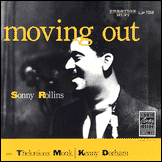
These were released on a 10-inch LP titled Sonny Rollins Quintet featuring Kenny Dorham, and on a 12-inch titled Moving Out, which added the "g" to the first word, and added an extended jam featuring Thelonious Monk.


Thursday, July 17, 2014

Listening to Prestige Records project - Part 7

We're still early in 1949, but at least we're in Paris in the Spring. Well, almost. There have always been expatriate jazz musicians. One of the first was Sidney Bechet, who originally came over to France as part of a revue with Josephine Baker. Baker stayed on to become one of France's mist celebrated entertainers, while Bechet went back and forth, and did not permanently settle in France until 1951. By that time, a postwar community of jazz expatriates was developing, and a French jazz label, Vogue, was formed.

Jazz musicians went to Europe for a variety of reasons. Jazz was waning as a popular music in the USA in the 1940s and 50s, while not yet being accepted as a serious art form. Europe offered both popular and artistic recognition. Stan Getz moved to Denmark to try to kick a drug habit. But a lot of black musicians chose Europe to get away from the racism which had not ameliorated after World War II.

James Moody was one of those. He lived in Europe for three years, and recorded there. His two
sessions in the spring of 1949 were April 30 in Lausanne, Switzerland, with a group of expatriates, and two weeks later on May 15 in Paris with an all-star group of beboppers led by Max Roach.

I can't find any tunes from the Roach session, either on YouTube or Spotify. Amazon has an album called Pleyel Jazz Concert 1948/Quintet 1949, the second part of which is the Roach session, but the tracks on it aren't available for download. The group, in addition to Roach and Moody, was Kenny Dorham (trumpet), Al Haig (piano), Tommy Potter (bass). Recorded for French Vogue, various cuts of it made their way to both Blue Note and Prestige. Prestige included one number on one of their first LPs,  PRLP 113, under Kenny Dorham's name.

The Lausanne session is easier to find, on Spotify as part of a collection called "James Moody 1948-49," and I found one cut on YouTub, but when I came back to link to it, couldn't find it again. His all-expatriate combo consisted of Art Simmons (piano) Alvin "Buddy" Banks (bass) Clarence Terry (drums) Al Edwards (vocals). None of them familiar names to me, probably because their careers were almost entirely expatriate. Art Simmons (who contributes some superb piano here, solo and comp), however, belongs to yet another thread on this blog. A few years ago Peter Jones and I decided to try to make a list of every living musician who had played with Charlie Parker. Many of them are gone now, of course, but here are the names we came up with.

One we missed was Art Simmons. Here, from Wikipedia:
Simmons played in a band while serving in the U.S. military in 1946. He remained in Germany after the war, studying music, and moved to Paris in 1949. There he studied at the Paris Conservatory and the Ecole Normale de Musique, playing with Charlie Parker and Kenny Clarke at the Paris Jazz Festival; he also played with Aaron Bridgers, Don Byas, Robert Mavounzy, and Nelson Williams. He led his own group at the Ringside Club in 1951. In the early 1950s he played with Dizzy Gillespie and Quincy Jones, and toured London with singers such as Bertice Reading. As resident pianist at the Mars Club, he worked with Michel Gaudry, Pierre Cullaz, and Elek Bacsik, and accompanied touring singers such as Carmen McRae and Billie Holiday (1958). In the early 1960s he played in a duo with Art Taylor.

Simmons also did arranging work for Barclay Records. In 1971 he played in Spain; following this he returned to the United States and retired.
So unless someone has newer information, Art Simmons is still alive. Is no one interviewing him, getting his life story?


Moody is solid on the session, and the trio of expatriates (Banks played regularly with Smmons; I couldn't find anything on Terry) provide solid backup, with Simmons (and Banks to a lesser extent) taking some nice solos. Moody does that bebopper's trick of interpolating well-known phrases ("Yankee Doodle") into the middle of a solo, and he plays a couple of figures that suggest ideas he'll develop later in the year, in "Moody's Mood."