Showing posts with label 1949 recordings. Show all posts

Tuesday, August 12, 2014

Listening to Prestige Records, Part 18: Coleman Hawkins

This finishes off 1949, Prestige's first year of operation, and a year that saw them still releasing exclusively on 78, though these early cuts would be re-released as they moved into the still-new LP field - and some on 45 RPM EPs. Many of these early records were originally recorded for European labels, then licensed to the fledgling Prestige for American distribution, giving Bob Weinstock the beginnings of a substantial catalog, and one hit: James Moody's "I'm in the Mood for Love."

December 21, 1949, saw Coleman Hawkins in Paris, with a group of ex-pats and French players, cutting a bunch of songs that never seem to have been released on any European label -- at least according to jazzdiscoorg -- and seem never to have received any exposure at all until years later, when they were finally released as part of the Prestige 7000 series. It may have originally been a radio broadcast.
Coleman Hawkins


Hawkins had lived the ex-pat life in Europe during the late 1930s, and throughout the 40s made several trips back across the Atlantic. Most notably with him on this date was Kenny Clarke, the bebop drumming pioneer who at this stage of his life was still back and forth to Paris, but would eventually (after a stint as the original drummer for the Modern Jazz Quartet) settle in Paris permanently. The other ex-pat was trombonist Nat Peck, who according to Wikipedia is still alive -- and someone should be interviewing him! He could almost have made my "living artists who played with Bird" series -- he did play with Dizzy Gillespie in 1953.
Of the French artists, Hubert Fol's bio can only be found on the German Wikipedia, but he played a lot with Django Reinhardt, as well as working with Hawkins, Dizzy Gillespie and Howard McGhee on European tours. Pierre Michelot, who died in 2005, has an impressive resume with American ex-pats and touring musicians, but these two stand out for me. He was the bass player in a regular trio with Bud Powell and Kenny Clarke. And he worked with Miles Davis in creating the score for Ascenseur pour l'echafaud.

The session included six songs -- "Sih-Sah," "It's Only A Paper Moon," "Bean's Talking Again," "Bay-U-Bah," "I Surrender Dear," and "Sophisticated Lady." I only found "Sih-Sah" and "Bean's Talking Again"on Spotify, so those were the two I listened to most closely. They're billed as sextet records, but the other two horns play on very short opening and closing choruses, then stay out of the way. Which is a wise choice. Hawkins is strong, mellow, lyrical, beautiful. Both are ballads -- in fact. they're very similar.

You can find all or most of the cuts on YouTube thanks to a channel created by Heinz Becker. Here's "Sih-Sah":


Thursday, August 07, 2014

Listening to Prestige Records - Part 17: Sonny Stitt/Bud Powell

Interesting exchange of notes on Jazz Collector's blog:

Something I’ve long wondered is — if an artist without a regular working band came in to record, how were the sidemen chosen? At Blue Note, for example, did Alfred and Frank assemble the players, or would a guy with some pull like Dexter Gordon say, “Hey this is who I want to play with?” Could a name artist veto a sideman? Maybe the leader would come in with a couple of guys and then Lion would fill in the holes? It’s pretty clear that a lot of artists tended to record together, but overall it’s just something I’ve always wondered about.

First response:
My understanding from numerous jazz biographies, liner notes, etc is that the choice of sidemen was a combination of who the label knew; who the leader knew; and, often most importantly, who was in town on the days set for recording. Aside from steady bands (or pre-planned dates with written material), it was just catch-as-catch-can with the limited number of top guys who lived in town (or who happened to be in town for a while). I’m sure some folks with experience in the industry can provide more color (or correct my impression).


And another:
I would also bet that the label would pick sidemen that might bring some new tunes to the session, and that the label in turn might be able to extract publishing rights from those tunes. (Not that this ever happened of course)

And a third:

The sidemen story makes a lot of the great recordings seem like a stroke of dumb luck. Similarly, could some records have achieved legendary status in jazz history if so-and-so had been in town to play bass that day?


In the sixties, when three pretty good (all right, very good) guitarists got together, they were called a supergroup, and the recording was called a super session. In the jazz of the 40s and 50s, that happened all the time.

On December 11, 1949, Sonny Stitt came into the Prestige studios to record four tunes with a quartet, and the other members of the quartet were Curly Russell, Max Roach, and Bud Powell. Why these four, on that day? Hard to say. Bob Weinstock started Prestige because he had access to a lot of jazz players, because they hung out at his record store. Were they playing gigs in town? No way to find out that I've discovered. The New Yorker's Goings on About Town listings for that week include trad jazz clubs like Eddie Condon's and Jimmy Ryan's, but no club that featured modern jazz. Snobbery?
Racism? They just didn't get it? Lord knows, modern jazz was being played in New York. Bird land opened in 1949. 52nd Street had passed its prime, but there were still clubs there besides Jimmy Ryan's. Miles Davis had his Birth of the Cool nonet at the Royal Roost. The Famous Door was still around, although the Onyx had traded in jazz for strippers.

But for whatever reason, talk about a supergroup! And yes, this sort of thing happened all the time.

The four tunes are "All God's Chillun Got Rhythm," "Sonny Side," "Bud's Blues," and "Sunset." All are available on Spotify, either as the Sonny Stitt Quartet or the Bud Powell Quartet.

Sonny Stitt was 25 in 1949. He had met Charlie Parker six years earlier, and he was considered by many to be the player stylistically closest to Bird. It would be interesting -- for someone with a better than mine, and more musical knowledge -- to compare the
styles of the beboppers who spent their formative years playing in swing or rhythm and blues bands, and those who were virtually weaned on bebop.

These are four amazing cuts. If I had to pick a favorite moment, perhaps it's the trading back and forth of riffs between Stitt and Powell at the beginning of "Bud's Blues,"and the way Stitt takes it off from there, but all of it is wonderful. The composition of "Bud's Blues" is variously attributed to Bud Powell and Sonny Stitt - probably they both had a hand in it. It's become a jazz standard.

I suppose this could be considered, to use an Internet cliche, "I listen to the Prestige catalog so you don't have to," but you do have to. Listen to at least one cut from this session. "Bud's Blues" is a good one, but they're all good.


These sides were released on 78, on a 1951 10-inch release entitled Sonny Stitt and Bud Powell, and on a couple of different 7000-series LPs. including one called Sonny Stitt with Bud Powell and J. J. Johnson, incorporating the earlier J. J. Johnson's Boppers session.

Monday, August 04, 2014

Listening to Prestige Records -- Part 16: Wardell Gray

Wardell Gray is known to aficionados of American literature as being one of the jazz musicians mentioned in Jack Kerouac's On The Road, along with George Shearing, Slim Gaillard, and Dexter Gordon, with whom Gray's name is forever linked as one of the great tenor sax pairings in jazz history.
He was known to younger musicians on the West Coast as a role model for music...and more:
 After Bird, the skinny tenor man from the Billy Eckstine band was the musician most admired and respected by the younger players. He spoke quietly and articulately, admired the philosophy of Jean-Paul Sartre and the politics of Henry Wallace, boosted the NAACP and advised fledgling jazzmen on music and life, particularly in regard to the futility of messing with drugs.
 But he is most importantly known as a musician's musician, a man who could--and did--play with mastery in any style, from swing to rhythm and blues to be bebop. Benny Goodman, who at first rejected the new music, had his opinion changed by one man:
If Wardell Gray plays bop, it’s great. Because he’s wonderful.
And when Goodman experimentally formed a bebop group (they played good music, but no one wanted to hear
Goodman play bebop, and he abandoned the experiment), Wardell Gray was the first person he hired. In fact, Gray is most likely the only musician to have recorded with Benny Goodman, Count Basie and Charlie Parker.

Most famously, as a West Coast tenor player energized by Charlie Parker's ill-fated California tour, he engaged in a series of tenor battles that were captured on wax in "The Chase."

And perhaps second most famously, from his first session for Prestige, "Twisted," which became another vocalese hit, this one for Annie Ross, and later Bette Midler.

Gray was mostly known as a West Coast musician, but he did spend enough time in New York to cut a few sessions for Prestige. This first one, with as classic a bebop rhythm section as one could wish for, includes "Sweet Lorraine," "Southside," "Twisted," and "Easy Living." They capture everything that was great about Grey: lyricism, edginess, tone, inventiveness. And this is the sort of album that I started this blog looking forward to finding: brilliant musicians, a tight group, inspired blowing, spontaneity.

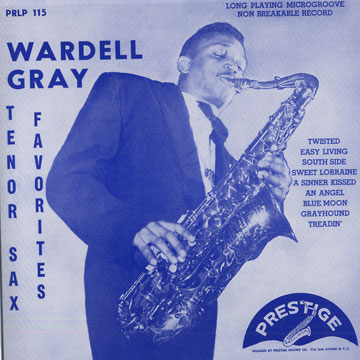
These four tunes were originally released by Prestige on their New Jazz 78 RPM series (817 and 828). and Southside/Sweet Lorraine also on a Prestige 78 (711). They were part of a 100-series 10-inch LP (Prestige PRLP 115--Wardell Gray Tenor Sax) and later on a couple of 7000-series albums, including the very complete Wardell Gray Memorial Album (PR 7343). All of Gray's work can be found on Spotify, and he's well represented on YouTube. Here's "Twisted."


And here is a segment from the documentary on Gray, Forgotten Tenor.


Sunday, August 03, 2014

Listening to Prestige Records - Part 15: James Moody

 Well, it seems that for the nonce, we can't get away from Scandinavia. I'm moving on today from a Danish expat in New York to a New York expat in Sweden: James Moody.

But we're not leaving behind the bad bop puns -- or, for that matter, the boppified classics. One of Moody's cuts here is "Flight of the Bopple Bee."

Stan Getz is forever linked with "Desafinado" and "Girl From Ipanema." Louis Armstrong? If you don't know anything else, you know "Hello Dolly" and "Wonderful World." Kai Winding may be most often remembered for his minor hit recording of "More (Theme from Mondo Cane)."

But possibly no other jazz musician, at least no other jazz musician with a lengthy and distinguished career, is as inextricably linked with one recording as James Moody and his classic  "Moody's Mood for Love."

And that's interesting for a couple of reasons. First, his inextricable linkedness is not even due to his own recording, as good as it is -- it comes from the vocalese version by King Pleasure and Blossom Dearie (also on Prestige, so we'll get to that later). And for that matter, Moody passed up the pun on his name that would become iconic.

Second, and I hadn't realized this, the recording was made with an all-Swedish band of sidemen.

James Moody entered the studio in Stockholm on October 7, with a group he called James Moody's Swedish Crowns: Leppe Sundevall (tpt), Arne Domnerus (as), James Moody (ts), Per-Arne Croona (bar), Gosta Theselius (p), Yngve Akerberg (b), Anders Burman (d). They cut two songs -- "These Foolish Things" and "Out of Nowhere." "These Foolish Things" is a ballad, showcasing Moody's lyricism, and trying out a lot of ideas that would be developed and used again in "I'm in the Mood for Love."

On October 12, jazzdisco.com credits him with three different recording sessions, so either someone got the dates wrong, or quite possibly, it was a heavy work day for Mr. Moody. The first session is the James Moody Quintet, with Sundevall, Thore Swanerud (p). Yngve Akerberg (b), Jack Noren (d), and the numbers are "Flight of the Bopple Bee" and "I'm in the Mood for Bop" -- not the pun you were expecting, and not the song you were expecting, either. That comes later. "I'm in the Mood For Bop" is bebop, uptempo and bracing.

Then, still October 12, another session with the Swedish Crowns - same front line, Swanerud, Akerberg and Berman as rhythm section, and one with the James Moody Sextet (same without Theselius on tenor), and the songs are "Body and Soul," "I'm in the Mood for Love" (yes, that version), and "Lester Leaps In." All of this is a listening delight, but on "Lester Leaps In" you can hear the Swedes trying to be the Basie horn section and falling a little short.

A word on improvisation. It's not "just making it up as you go along," unless maybe you're Keith Jarrett. and it's not going to be entirely new every time. If Lester Young is playing a series of one-nighters with Count Basie, and he gets to the point where he stands up to play his solo on "Lester Leaps In," it's going to be more or less the same solo, with variations. So it's interesting to compare two totally different versions of the same song, done in the same recording session. "These Foolish Things" is closer to "I'm in the Mood for Love" than is "I'm in the Mood for Bop." Check it out. All are available on Spotify, as is yet another version from the same time period, "Moody's Mode."

"I'm in the Mood" became "Moody's Mood" when Eddie Jefferson wrote lyrics to it, and most famously when King Pleasure recorded it.

In an essay on rhyme, the poet Donald Justice points out that while rhyme is a great mnemonic, it's not enough to make something rhyme to make it memorable. It has to be true, too. "Red sky at night / Sailor's delight / Red sky at morning / Sailors take warning" has a catchy rhyme, but no one would remember it if it weren't also useful meteorological advice to sailors.

And such is also true for "Moody's Mood." Just setting lyrics to a jazz improvisation is no guarantee of immortality, It has to be the right tune, and "Moody's Mood" is. It is so lyrical, so melodic, so inventive. More about it later, since King Pleasure's version was also recorded for Prestige, but I will add that Moody himself did the vocal version many times later, including this -- one of my favorites -- with Tito Puente:


Here's James Moody talking about the famous "There I go, there I go, there I go..." opening -- just trying to learn how to find the notes on an unfamiliar alto sax.


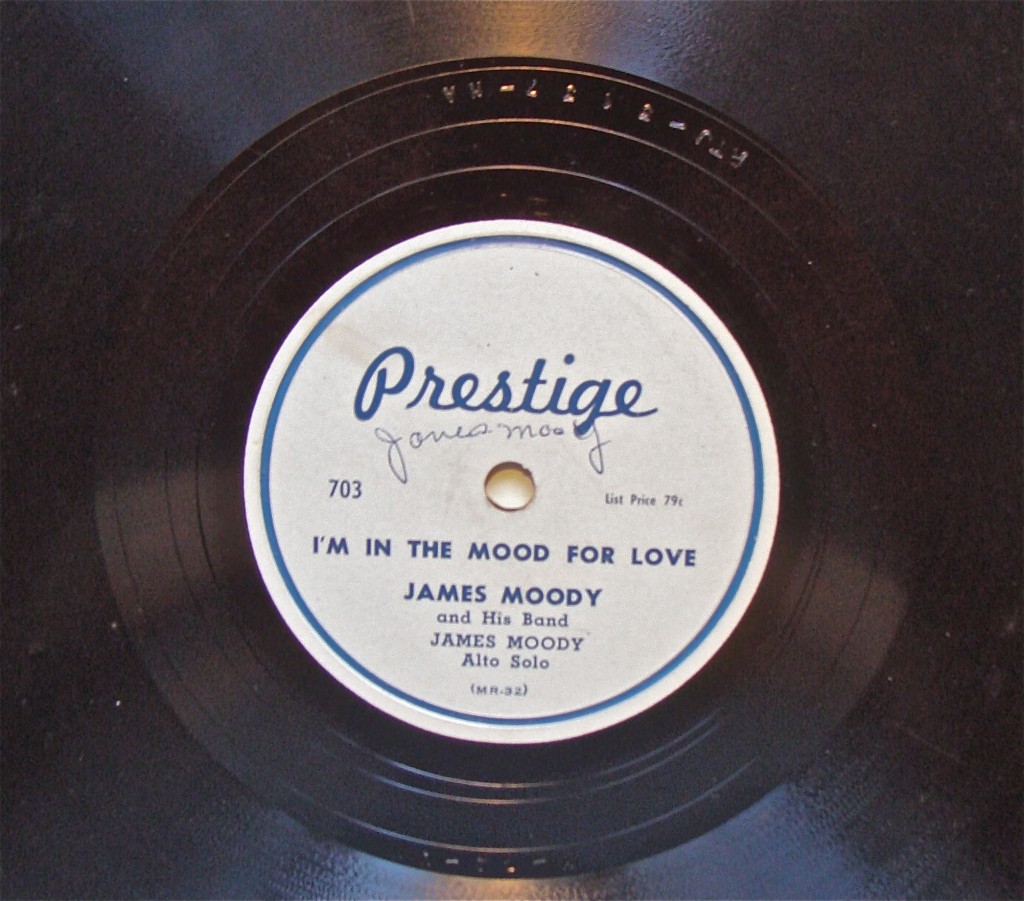
And finally, just because it's so cool: From jazzcollector's website, an autographed copy of the original 78, which jazzcollector has no recollection of actually collecting, but there it is:


A week later, Moody came back and recorded two more sides with a quartet billed as James Moody and his Cool Cats: "Over the Rainbow" and "Blue and Moody."


Originally issued on the Swedish Metronome label, these sides were brought out by Prestige on 78 RPM, 45 RPM EP, and in various LP collections.

Saturday, August 02, 2014

Listening to Prestige Records - Part 14: Kai Winding

Some jazz musicians object to the word "jazz" as a name for their music, arguing that its origins as a slang word for sex trivialize the music it's attached to.  But that same delicate sensibility doesn't seem to have extended to beboppers, if their propensity for making "bop" puns is any indication. 
 
Take this Kai Winding session, for example, and "A Night on Bop Mountain." I'm not complaining, you understand. I love all these bad bop puns, and the bad puns on the names of the performers. And I love this boppified version of "A Night on Bald Mountain."

File this under Stuff I've never heard before. I really only knew Kai Winding from the J.J. and Kai recordings, so this is a chance to catch up on him earlier in his career. And file this under I Thought I Was Getting Away From Scandinavians For a While: Winding was Danish. Family emigrated to America when he was 12.

As noted before, this is a music lover blog, not a music critic blog and certainly not a music educator blog, but I'm always willing to learn something new, so here, from Barbara (BJBear) Major's Kai Winding site, a little music education:

Kai was an "upstream" player and a form of Type IV in the Pivot System (mouthpiece low on the embouchure and airstream directed upwards into the mouthpiece). This produces a totally different tonal quality on the instrument than someone who is a "downstream" player.


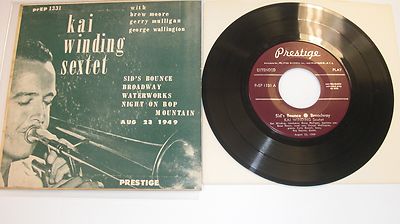
 The group here is the Kai Winding Sextette, featuring Brew Moore (ts), Gerry Mulligan (bs), George Wallington (p),Curly Russell (b), Max Roach (d), and the recording date is August 23, 1949. They may not have made a lot of waves - most Winding bios seem to skip over this part of his career, mentioning his work with big bands and then jumping to the J.J. and Kai group, but they made some impressive music.
 
In 1949, Gerry Mulligan had yet to lead his own group, and he was better known as an arranger, but this session doesn't sound Mulligan-arranged. It's a little harsher than I'd expect from Mulligan arrangements.
 
And this is interesting: a Gerry Mulligan discography  lists a few 1949 sessions led by. Kai Winding and featuring Mulligan. One in April, which featured the same front line of Winding, Moore and Mulligan, and two thirds of the same rhythm section* -- Wallington and Russell, but with Kenny Clarke on drums, lists Mulligan as both baritone sax and arranger.The April recordings included "Godchild," later to be a part of the iconic Miles Davis Birth of the Cool sessions, also featuring Winding on trombone and Mulligan's arrangements.

However, the August recording lists him only as baritone sax player. His playing has a little harsher tone than the mellow sound he developed -- almost Lester Young on the baritone sax, which sounds pretty close to impossible when you say it, but because of Mulligan we take it for granted that a baritone sax can do that. On this set, in some places, his sax sounds more like the rhythm instrument that a baritone sax had mostly been -- and brilliant even at that -- but in a few solos he really stretches out.

Mulligan is certainly in the Jazz Hall of Fame. Kai Winding is probably in the fall of Jazz Lovers Know Who He Is, and Brew Moore in the hall of Really Serious Jazz Lovers Know Who He Is, but they all complement each other on these recordings.


"Sid's Bounce" and "A Night on Bop Mountain" were one New Jazz 78; "Broadway" and "Waterworks" were the other. Alternate takes of  Broadway" and "Waterworks" made it onto the 45 RPM EP of the session, and onto PRLP 109, which brought Winding and J. J. Johnson together but separate.


* These guys seem to have played together a lot in 1949. Essentially  the same group also recorded as the George Wallington Septet and the Brew Moore Septet.

Wednesday, July 30, 2014

Listening to Prestige Records - Part 13: Swedes

A lot of American expats ended up in Sweden in the late 40s and early 50s, and a lot of Swedes were playing jazz too. Arne Domnerus (also sax and clarinet) recorded with a quintet in Stockholm in August, September and October of 1949, for the Sedish jazz label Metronome, and the sides were released in the US, in the Prestige 100 series of 10 inch LPs, PRLP 134, as New Sounds From Sweden, Volume 4. Bob Weinstock must have made quite a deal with Metronome Records, because there were also volumes 1 - 3: PRLP 119, 121 and 133, mostly led by Domnerus or Lars Gullin. Another Swedish jazzman, Reinhold Svensson, had PRLP 106 and 129. The Domnerus sessions were recorded earliest, though not released earliest. I listened to "Body and Soul" from the first session, and it's not bad at all. He seems to have been a versatile little devil. His catalog, which is extensive on Spotify, includes standards, Dixieland tunes, modern compositions, and a lot of songs with Swedish names, in which you can pick out word like "tango" and "Polska."

Lars Gullin could and did hold his own with some of the best American jazz musicians, and was the 1954 winner of DownBeat's Most Promising Newcomer award for 1954.

Other Swedes who had records released by Prestige: Bengt Hallberg, Ulf Linde, Rolf Blomquist, and Leonard Feather's Swingin' Swedes. I mention all this now because as daunting a task as this is, I may decide to stick to American musicians.

Tuesday, July 29, 2014

Listening to Prestige 12a: Harry Lim Records

There are certainly a lot of record producers who drink a lot of Java, but only one who was from Java -- Harry Lim, who produced a number of jazz records for Keynote Records in the mid-40s, and then started his own short-lived label in 1949--Harry Lim Records. Their initial release was the Al Haig all-star session introducing a young Blossom Dearie. I'm not sure how many more there were, but not many. The Prestige re-release was considerably later, well into their 7000 series, along with other early Al Haig / Stan Getz waxings. I'm still looking for the Blossom Dearie cuts.

Listening to Prestige Records Part 12: Missing Al Haig/Blossom Dearie

The first time I've struck out, and it's a shame. The session was July 28, 1949, and the group was billed as the Al Haig Sextet. Personnel Kai Winding (trombone), Stan Getz (tenor saxophone), Al Haig (piano), Jimmy Raney (guitar -1,2, guitar, vocals -3,4),Tommy Potter (bass) Roy Haynes (drums). All of which would be enough to make it interesting, but here's the kicker: Blossom Dearie (vocals -3,4).

Is this Blossom Dearie's first recording? It could be. She sang in vocal groups with Woody Herman and Alvino Rey in the 40s, but her career didn't really start until she went to Paris and formed the Blue Stars, and that was 1952. Her classic "Lullabye of Birdland" wasn't recorded till 1954.

And I can't find these cuts anywhere except British iTunes, which I can't access. The two Blossom Dearie cuts are on album called "Little Jazz Bird," which is only available in England. The titles are distinctive - the two instrumentals are "Pinch Bottle" and "Earless Engineering." The two with Blossom are "Be Still, TV" and "Short P not LP." You can find a brief clip of "Be Still, TV" on Allmusic.com (with the added info that it was written by Jimmy Raney), but it cuts out before the vocal.

If anyone has this on mp3 and would like to send it to me, I'd be delighted.

Sunday, July 27, 2014

Listening to Prestige Records - Part 11: Don Lanphere

Here's the first artist I know nothing about. Don Lanphere brought a quartet in to record on July 2, 1949 - Lanphere on tenor,  Duke Jordan (piano), Tubby Phillips (bass), Roy Hall (drums). A jazz great on piano, and two other guys I've never heard of on bass and drums. I was able to find a reference to Phillips in Charlie Spivak's orchestra, no references to Hall at all. He co-led a quintet with Fats Navarro on September 20, 1949, with a real major league rhythm section -- Al Haig (piano), Tommy Potter (bass), Max Roach (drums)


Lanphere was on the scene in the late 40s, by 1951 a total casualty of the drug epidemic. He spent some hellish years, then went back to the Pacific Northwest, where he became a local legend (much like J. R. Monterose in upstate New York), and starting in 1982, recorded quite prolifically for regional labels, with some pretty good people -- Bud Shank on one CD, Larry Coryell on another. And by that I don't mean to denigrate the local guys who never made it big in the jazz world. There are a lot of superb musicians most people, including me, have never heard of. From right around my area, Joe McPhee is an amazing talent. Hugh Brodie. Jeff Otis, who just passed away. In Boston, Stan Strickland is a legend, and he's the best musician I ever heard who didn't have a major breakout.

The Prestige sessions with Fats Navarro are on Spotify in the "Fats Navarro 1947-49" collection, and this one is on YouTube.  Several of the later sessions are on Spotify. Don Lanphere is a good one. He deserved his legendary status in the Pacific Northwest.


Some of the Charlie Parker basement sessions are on YouTube, but my ear isn't good enough to pick out Lanphere.

But here's a fun bit of gossip, from his obituary on a website called The Last Post, which is a collection of jazz obituaries. By Todd S. Jenkins:

A native son of the Pacific Northwest, saxophonist Don Lanphere was one of the region's jazz icons. He learned to play at home on his father's alto sax. As a teenager he idolized Coleman Hawkins and gigged with name touring bands whenever they came to Washington. Lanphere began his music studies at Northwestern University in Illinois and played with local bandleader Johnny Bothwell. At the age of nineteen Lanphere and the band answered the Big Apple's beckon-call and headed for New York.

After a short time in the city, Lanphere was fired for stealing Bothwell's girl, Chan Richardson. He secured a job with Fats Navarro and recorded some excellent sides, then explored the big-band and swing scene. He played Carnegie Hall with Woody Herman's Second Herd, moved on to Artie Shaw's Gramercy Five, and gigged with the bands of Claude Thornhill, Charlie Barnet and Billy May. Lanphere also made friends with Charlie Parker and recorded the altoist at home with some friends. Those legendary tapes became known as "The Basement Sessions"... and Lanphere's girl, Chan, later became Mrs. Charlie Parker.


Listening to Prestige Records project - Part 10: Lee Konitz

Lee Konitz took a quintet into the studio on June 28, 1949, and recorded four sides, but only two of them were ever released. Of the other two, jazzdisco.org only says Untitled...rejected.

The quintet was Konitz (alto saxophone), Warne Marsh (tenor saxophone), Sal Mosca (piano), Arnold Fishkin (bass), Denzil Best (drums). All but Best were members of Lennie Tristano's inner circle, and Best, who could and did play with artists of nearly every jazz genre, had recorded with Tristano.

Of Tristano's two horn players, Konitz is the one who made the more significant name for himself in jazz, and maybe there's a reason for that. I've had a Warne Marsh LP for a long time, and every now and then I used to take it out and try to listen to it, but I never made it all the way through. 

But he understood what Tristano was doing, and here, he understands what Konitz is doing. The pianist on the date is Sal Mosca, Tristano's most notable student and disciple, but he doesn't take the lead. This is Konitz's session, and he is very much the dominant figure, but Marsh supports him throughout. The opening chorus on "Marshmallow," a Marsh composition (those bebop-era composers did love their puns, didn't they?) is a heady, pretzel-like interplay between the two saxes that's breathtaking. Here it is on YouTube:


And you can find both tunes (the other is "Fishin' Around") on Spotify.

Prestige released the two cuts they accepted as a 78 RPM single, and they later became part of the labels very first 10-inch LP, Lennie Tristano and Lee Konitz (PRLP 101), along with two more cuts recorded on September 27th with the same lineup, but with Jeff Morton replacing Denzil Best.

I recommend listening along with me on this journey through a particular slice of jazz. I can't begin to express how rewarding it's turning out to be. And I wouldn't at all mind seeing a few comments.

Saturday, July 26, 2014

Listening to Prestige Records project - Part 9


This is all really about listening, not music criticism, not even music history, although that comes into it a little. It's about reliving a moment in history that I was not actually a part of. Everyone's played that game of "if you could go back in time, what period would you go to?" Woody Allen's character in "Midnight in Paris" wants to go back to Paris in the Twenties, and the girl he meets in that era wants to go back to La Belle Epoque. Some choose the Renaissance, or Shakespeare's London. I'd like to go back just a short distance in time -- to be a young man in an era where I was in fact a toddler. I'd like to go to 52nd Street and Minton's Playhouse and Monroe's Uptown House, to be there when bebop was being born. To me, "bebop," as a couple of nonsense syllables given meaning, has a romance that "hip-hop" will never have.

 I was nine years old in 1949. I didn't know anything about any kind of music then. I didn't listen to Paul Williams' R&B breakout hit, "The Hucklebuck," much less the Charlie Parker riff on which it was based. I listened to a few 78 RPM record albums my parents had:  Songs of the Veldt by Marais and Miranda, Ballad for Americans by Paul Robeson, the songs from Pinocchio, all of which I could listen to again with pleasure. Later on, when I became an avid collector of rock and roll, my mother tried to distract me from destroying civilization 89 cents at a time by trying to give me some 78s of the popular music of her day (looking back, I’m amazed that she’d kept them, since was passionate about neither music nor her youth). The only one I remember is “The Broken Record” by Freddy Martin and his orchestra. You can find “The Broken Record” on Spotify, but not the Freddy Martin version. It didn’t dissuade me from my own musical odyssey.

Bob Weinstock, at age nine, was already not just a jazz lover but a jazz collector, buying "'armfuls of records' at nine cents each," according to his obituary in the Washington Post, quoted in Wikipedia.
Stan Getz was just 22, and just starting his career as a leader, and trying out various formats. We’ve listened to him with an octet on a session in April. Now here it’s June 21, and he’s back in the studio with a quartet.

The quintessential bebop combo-- the sound that defined small group jazz, as the big band era came to an end--was the quintet. And with very good reason--that was the formulation created by Charlie Parker and Dizzy Gillespie. So everything else is in a sense a variation on that theme, although variations were common enough – J. J. Johnson adding a trombone to the quintet, or simply substituting a trombone for the trumpet. Stan Getz with five saxophones and no trumpet. And here, Stan Getz with one saxophone and no trumpet, which means less swapping of ideas, more time to stretch out as a soloist, more possibilities for invention. Which is a good thing, if you’re Stan Getz.
The session is June 21, 1949, in NYC. With Getz,  Al Haig (p), Gene Ramey (b), Stan Levey (d). The group is billed as Stan Getz Bop Stars.When you think of bebop piano stars, you think of Bud Powell and Thelonious Monk (with an asterisk – he played on many of the great bebop sessions, but was always his own man). But Al Haig may have been the most ubiquitous. Between 1948 and 1954, the bebop years, he played on 90 recording sessions (thanks to the amazing jazzdisco.org for that, and all my recording info), including a huge number with Charlie Parker and/or Dizzy Gillespie.

Frighteningly enough, when you look up Al Haig on Wikipedia, the first person you get is this guy --the one who said "I'm in control here" the day Ronald Reagan was shot.

But when you do get to the right Al Haig, his Wiki entry has the interesting bit of information that as closely associated as he was with bebop, he was not primarily a jazz musician. The entry doesn't go on to explain that, but we'll be coming back to Al Haig often enough. I try to keep these blog entries succinct. So far, I haven't come close to succeeding.


The four tunes cut on this day are “Long Island Sound," "Indian Summer," "Prezervation," "Mar-Cia," and "Crazy Chords." This is begging for a response, and I'm too much of a gentleman not to give it: Dig those crazy chords!

They're all great, and they all show Getz's ability to handle the tricky rhythms and chord changes of bebop while at the same time playing with warmth and lyricism -- Lester Young meets Charlie Parker, prezervation of crazy chords.

They also show that at this stage, Prestige's engineering was a little slapdash. "Long Island Sound" ends rather abruptly. The others are better, but still leave you wondering if the musicians might not have taken it out a little longer.

They're all on Spotify. All but "Prezervation" are on "Stan Getz Quartets," all but "Mar-Cia" on "Cool Bebop." Less easy to find on YouTube, but here's "Long Island Sound":


"Indian Summer" was released on a Prestige 78(PR 740)  b/w "What's New" from a later session. The others were New Jazz 78s - "Long Island Sound" and "Mar-Cia" NJ 805, "Prezervation" made it to 78 (NJ 818) as the flip side of "Battleground" from the Five Brothers session, "Crazy Chords" as the flip of NJ 811, "Speedway" from Five Brothers again. All but "Prezervation" were on PREP 1310 - it was pretty much a 4-song format. "Prezervation" came out on PREP 1340 along with Terry Gibbs - people who were in the process of moving to the West Coast?

"Indian Summer" and "Crazy Chords" were on Prestige 108, showcasing Getz and Lee Konitz (thanks to the Hot Beat Jazz Blog, written in Portuguese, for these great images of the Prestige 10-inch 100 series,) along with two cuts from a 1950 Getz session."Mar-Cia" and "Long Island Sound" were added to the Five Brothers LP, all were re-released in the 7000 series.

Wednesday, July 23, 2014

Listening to Prestige Records project - Part 8

Kenny Dorham and Max Roach must not have spent a lot of time in Paris, because here they are back in New York two weeks later, playing in a group put together by J. J. Johnson as J. J. Johnson's Boppers.

And what a group! Of the six of them, only bassist Leonard Gaskin did not go on to achieve legendary status, and he had a distinguished career, playing with all the major beboppers, including Charlie Parker and Dizzy Gillespie (he replaced Oscar Pettiford in Gillespie's band), then moving back to trad jazz in the 50s with the likes of Eddie Condon, Ruby Braff and Cootie Williams. Interesting to me -- he apparently spent at least some of the last part of his life in my home area. His Wikipedia bio says that in 2003 he worked with grade school kids at the Woodstock Elementary School in Woodstock, NY. He died in 2009.

Kenny Dorham died young, but not as young as I would have thought -- he died at 48, in 1972, of a kidney disease. His reputation is such an underground one (every serious jazz aficionado knows him, the casual listener maybe not. No albums with Dorham as leader make The New Yorker's list of 100 Essential Jazz Albums), that I had sort of assumed he'd died very young, maybe not long after his classic Round About Midnight at the Cafe Bohemia. As his Wikipedia entry puts it, "he never received the kind of attention or public recognition from the jazz establishment that many of his peers did. For this reason, writer Gary Giddins said that Dorham's name has become 'virtually synonymous with underrated.'" My old friend J. R. Monterose said that Dorham was the best leader he ever played with.

Max Roach, of course, along with Kenny Clarke (another expatriate), revolutionized the art of jazz drumming, creating the style that propelled bebop.

The other two players on this date: John Lewis on piano, Sonny Rollins on tenor.

J. J. Johnson was 25 when he led this all-star group, and he had already become not just the premiere jazz trombonist, but the guy who did what had been thought impossible -- made the slide trombone into a solo instrument in the lightning fast, rhythmically tricky form of bebop.

Johnson has been the subject of a book-length study, The Musical World of J. J. Johnson, by Joshua Barrett and Louis G. Bourgois III. I don't know if it sells too widely -- the hardcover is a hundred bucks, and even the Kindle edition is nearly fifty. But a review by Victor L. Schermer on the AllAboutJazz website notes that when Dizzy Gillespie first heard Johnson play, in 1946, he told him, "I've always known that the trombone could be played different, that somebody'd catch on one of
these days. Man, you're elected."

This is pure bebop, played by some of its noblest practitioners. Roach cuts loose with some solos he kept in check on his Paris date. Dorham and Johnson challenge each other, and respond to the challenge. Rollins can beep and bop with the best of them, and he already has the tone that he will perfect under the Williamsburg Bridge and ride into the 21st century, becoming universally acknowledged as one of the greatest of all time.

John Lewis is in the bebop world, but not of it. He contributes greatly to this session, but you can also hear where he's going. And, in a sense, where he's been, which was (like Dorham and Roach) Paris. He contributes the composition "Elysee" to the session, and for the followup session on October 17, his classic-to-be, "Afternoon in Paris."

Dorham, Gaskin and Rollins are gone, replaced by Sonny Stitt on alto, Nelson Boyd on bass. Still bebop. and still wonderful. Of all the nonsense syllables that have come to define art movements, from dada to hip-hop, none of them, for me, have the romance of "bebop." This listening project is to revisit old friends, pick up on music I missed. These two J. J. Johnson albums fall into the latter category. For each blog entry, I download whatever I can find from Spotify onto a Prestige playlist on my phone, and play it over my Jambox Mini while driving. This has been a wonderful couple of days.

The May session numbers were released on 78 by both New Jazz and Prestige, and reissued in 1952 when Weinstock began his 10-inch LP line, as PRLP 109, along with a Kai Winding session, although the classic J.J. and Kai pairing would not come about till 1954. In 1953, Prestige started releasing 45 RPM EPs, which meant another way to buy J. J. Johnson's boppers.
And yet another way -- the short-lived 16 2/3 RPM record, suited to
play on Chrysler's Highway Hi-Fi system (thanks to Bloggerhythms for this info), but not really so great for music. This time, Prestige tossed in Bennie Green and made it three
trombonists. The session with Sonny Stitt also came out in all three formats, the 100-series LP this time backed with a Bennie Green session. All later found their way to Prestige's great 7000 series.


All of these tracks can be found on Spotify.

Here's "Afternoon in Paris," from the October session, on YouTube. You have to dig a little for these -- I found this one by searching under "J. J. Johnson John Lewis."

Thursday, July 17, 2014

Listening to Prestige Records project - Part 7

We're still early in 1949, but at least we're in Paris in the Spring. Well, almost. There have always been expatriate jazz musicians. One of the first was Sidney Bechet, who originally came over to France as part of a revue with Josephine Baker. Baker stayed on to become one of France's mist celebrated entertainers, while Bechet went back and forth, and did not permanently settle in France until 1951. By that time, a postwar community of jazz expatriates was developing, and a French jazz label, Vogue, was formed.

Jazz musicians went to Europe for a variety of reasons. Jazz was waning as a popular music in the USA in the 1940s and 50s, while not yet being accepted as a serious art form. Europe offered both popular and artistic recognition. Stan Getz moved to Denmark to try to kick a drug habit. But a lot of black musicians chose Europe to get away from the racism which had not ameliorated after World War II.

James Moody was one of those. He lived in Europe for three years, and recorded there. His two
sessions in the spring of 1949 were April 30 in Lausanne, Switzerland, with a group of expatriates, and two weeks later on May 15 in Paris with an all-star group of beboppers led by Max Roach.

I can't find any tunes from the Roach session, either on YouTube or Spotify. Amazon has an album called Pleyel Jazz Concert 1948/Quintet 1949, the second part of which is the Roach session, but the tracks on it aren't available for download. The group, in addition to Roach and Moody, was Kenny Dorham (trumpet), Al Haig (piano), Tommy Potter (bass). Recorded for French Vogue, various cuts of it made their way to both Blue Note and Prestige. Prestige included one number on one of their first LPs,  PRLP 113, under Kenny Dorham's name.

The Lausanne session is easier to find, on Spotify as part of a collection called "James Moody 1948-49," and I found one cut on YouTub, but when I came back to link to it, couldn't find it again. His all-expatriate combo consisted of Art Simmons (piano) Alvin "Buddy" Banks (bass) Clarence Terry (drums) Al Edwards (vocals). None of them familiar names to me, probably because their careers were almost entirely expatriate. Art Simmons (who contributes some superb piano here, solo and comp), however, belongs to yet another thread on this blog. A few years ago Peter Jones and I decided to try to make a list of every living musician who had played with Charlie Parker. Many of them are gone now, of course, but here are the names we came up with.

One we missed was Art Simmons. Here, from Wikipedia:
Simmons played in a band while serving in the U.S. military in 1946. He remained in Germany after the war, studying music, and moved to Paris in 1949. There he studied at the Paris Conservatory and the Ecole Normale de Musique, playing with Charlie Parker and Kenny Clarke at the Paris Jazz Festival; he also played with Aaron Bridgers, Don Byas, Robert Mavounzy, and Nelson Williams. He led his own group at the Ringside Club in 1951. In the early 1950s he played with Dizzy Gillespie and Quincy Jones, and toured London with singers such as Bertice Reading. As resident pianist at the Mars Club, he worked with Michel Gaudry, Pierre Cullaz, and Elek Bacsik, and accompanied touring singers such as Carmen McRae and Billie Holiday (1958). In the early 1960s he played in a duo with Art Taylor.

Simmons also did arranging work for Barclay Records. In 1971 he played in Spain; following this he returned to the United States and retired.
So unless someone has newer information, Art Simmons is still alive. Is no one interviewing him, getting his life story?


Moody is solid on the session, and the trio of expatriates (Banks played regularly with Smmons; I couldn't find anything on Terry) provide solid backup, with Simmons (and Banks to a lesser extent) taking some nice solos. Moody does that bebopper's trick of interpolating well-known phrases ("Yankee Doodle") into the middle of a solo, and he plays a couple of figures that suggest ideas he'll develop later in the year, in "Moody's Mood."

Monday, July 14, 2014

Listening to Prestige Records Project - Part 6

Part of the springboard for starting this project was a series of conversations I'd had over time with my Peter Jones, about growing up in love with jazz in the 50s. Peter turned to jazz as an early teen. I came to it later, in college. I remember the night vividly. My dorm room in the World War II barracks that still served as dorms at Bard College then, no roommates around, a little too much to drink (probably - this was something else I'd just learned to do.) AM radio, middle of the night, those odd clear channel stations from all over. Twisting the dial, looking for some late night rhythm and blues. Suddenly hearing the sound I'd been waiting to hear all my life, without knowing it. Standing there, looking at the radio (we did that in those days) transfixed. It was John Coltrane with the Red Garland Trio -- Paul Chambers and Art Taylor. It was the first jazz record I bought, and it was on Prestige -- as were three of my first four jazz records. The other two were Mose Allison's Back Country Suite, and King Pleasure Sings - Annie Ross Sings. The outlier was Gerry Mulligan and Chet Baker on World Pacific.

That night with Trane and Red many years later became a poem, although with poetic license Trane became Miles, and I created a scene that never happened with an older brother I never had. But the poem is true to the heart of experience.


I'M NOT SO OLD

I was just fifteen when Charlie Parker died
My older brother took me aside
And said, Kid, it's a bad day
It's a sad day
Well, I didn't know why and I had to be told
Hey, but I grew up
And I learned my stuff
And I learned enough
And I'm not so old

When I was a kid just starting to move
I filled my soul with that rhythm and blues
And I listened to the Clovers
And the Coasters
And I couldn't get enough of that rock and roll
I was growing up
And the beat was mine
And it still sounds fine
And I'm not so old

Then one night I turned on the radio
Looking for some of that rock and roll
And I heard some bebop
Brought me to a full stop
Didn't know what it was but it moved my soul
I was almost grown
And they said it was Miles
I still dig his style
And I'm not so old

I saw Monk dance around the Five Spot floor
And a cat from Texas made the Five Spot roar
His sax was plastic
His sound fantastic
And I went back again to hear Ornette blow
I was all grown up
And he made jazz free
Still sounds good to me
And I'm not so old

Once they said that jazz had passed away
But I go down to hear the young cats play
They play in the tradition
They've got a mission
They play sweet and strong and free and bold
Well, I may be grown
But the cats blow on
And the music's young
And I'm not so old
Anyway, that's my particular love affair with Prestige. Shared by everyone? I'm not sure. Prestige, as I've noted before, has been somewhat the forgotten stepbrother to Blue Note. The New York Times' obituary for Bob Weinstock was a little backhanded -- " Prestige releases...weren't known for perfection. Mr. Weinstock generally set up recording sessions with no rehearsal time."

Well, perfection is overrated. And Peter Jones and I, talking about those days, have commented on what we remember as the incredible level of quality of those independent jazz labels -- it was all good.

Was it? I guess that's what I'll be finding out with this blog project. Next up, April 8, 1949, the Stan Getz Octet, including Five Brothers.

We think of the guys like Getz who became such giants in their field as having been born leading a group, playing "Desafinado" on TV, but Stan was 22 and newly graduated from the Woody Herman band, in one of his first sessions as a leader. Even at 22, he was a veteran - he'd joined the Jack Teagarden band at 16, when he was so young that Teagarden made him his ward.

An octet is big for a small jazz group, small for a big band, and this album is not big band jazz, certainly -- it's the combo format,a stated theme followed by virtuosic soloing, that was the hallmark of the bebop era. The most famous large small combo of the era -- or what came to be the most famous, since it was pretty much ahead of its time, was the Miles Davis "Birth of the Cool" nonet. Getz's octet was more straight-ahead -- I guess in the Prestige tradition of getting a bunch of guys together to blow with no rehearsal (although actually alternate takes don't seem to be so rare).

Getz was best known at this time as one of the Herman Herd's "four brothers," the four-saxophone section of Getz, Serge Chaloff, Zoot Sims and Herbie Steward -- and later Al Cohn. Sims and Cohn are the carryovers from those brothers, joined now by Alan Eager (a Herman alum but not a brother) and Brew Moore -- four tenor players, with Getz choosing baritone for this session. There's actually a sixth saxophone-playing brother involved, and this one makes them stepbrothers, in a way, to Miles' nonet -- Gerry Mulligan is listed as arranger.

I am writing this blog as a fan, as an archivist, not as a music critic or musicologist. I'm not that good. I can't tell you who's soloing when. I'd be a washout on a Leonard Feather blindfold test. In his allmusic.com bio of Brew Moore, critic Scott Yanow suggests that as a quintet of Lester Young acolytes, they all pretty much sounded the same on that session, so maybe I'm not the only one.

I can tell you that this is real Prestige jazz, the kind that makes you glad you're a jazz fan, and you get to sit still and listen to it, or snap your fingers to it, or stand still in the middle of the night and stare at whatever your contemporary equivalent to an old AM radio is. YouTube and Spotify both have this
session completely represented, including the alternate takes.
Both takes of "Battleground" were actually released on 78, one as Prestige release and the other as a New Jazz. So I was able to listen to all of it.

All the brothers were young. Al Cohn and Zoot Sims were 24,  Brew Moore was 25, Alan Eager like Getz a junior member at 22. But all were seasoned veterans. And all the brothers were valiant. Having five brothers in a small combo means succinct solos, and they make it work brilliantly. Generally a string of solos means a cutting contest. Here it's brotherly love, and wonderful cooperation to make a unified sequence.

In "Battle of the Saxes" (the only one without an alternate take) one gets the feeling that if they'd had just a little rehearsal time, they might have learned the tune, but once they start soloing, it could matter less.

With all those horns, there's not a lot of space for solos from the rhythm section, but Walter Bishop, Jr. has a few nice moments on piano. The others are Gene Ramey (bass) and Charlie Perry (drums). I wasn't at all familiar with Perry, but research reveals he's considered one of the great teachers of drumming technique, and one of his books on jazz drumming (co-authored with Jack deJohnette) is available (excerpted) online.