Showing posts with label Rhythm and Blues. Show all posts

Monday, January 12, 2015

Listening to Prestige Records Part 70: Forgotten Rhythm and Blues

Bob Weinstock may not have been all that deeply invested in rhythm and blues, but to the extent that he was, he didn't have the track record of betting winners the way he did in jazz. Maybe he didn't have the song plugger necessary to get a record out to black radio. But I suspect that he had pretty damn good taste. And to some extent this is speculation, because a lot of these R&B recordings deserved better than they got.

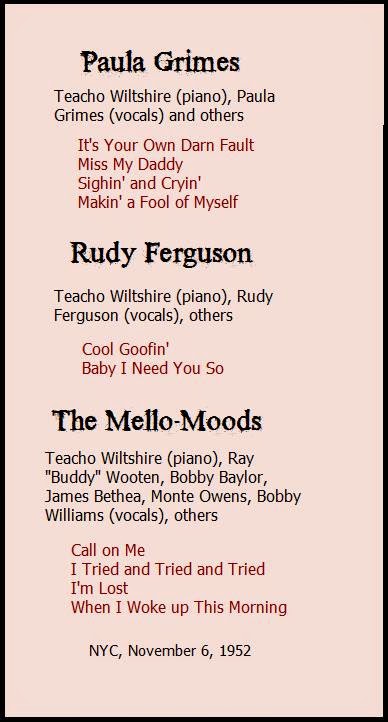
On November 6, he had Teacho Wiltshire (with unidentified musicians) in the studio with two singers -- one male, one female -- and a vocal group. The woman was Paula Grimes. She recorded four songs, and I can find none of them anywhere, but there is one 45 RPM record by her on YouTube -- You Move Me So / It's Happenin' Baby on Turf Records. It is great stuff -- Paula Grimes deserves to be much better known than she is. In the comments section for one of the YouTube cuts, someone pleads to have the Prestige sides posted, but the comment is four years old, so I guess that's not happening any time soon. I tried to find out more about the label, but when I Google "Turf Records" I get links to Secretariat and Seabiscuit.

Rudy Ferguson cut four songs, and only two of them were released -- Cool Goofin' / Baby, I Need You So. The titles of the other two may give some hint as to why they weren't released: Goofin' and Jivin' and Goofin' in a Goofball Way. Followups to Cool Goofin' if it became a hit, but it didn't.

It had some competition. In the week of its release, February 14, 1953, Billboard has it listed as number 5 in their pick rhythm and blues selections, behind records by Roy Brown, Amos Milburn, Fats Domino and Nat "King" Cole.

And it is on YouTube. And it's a really nice song...I like it a lot. It's in the jump blues/swing tradition that Lionel Hampton and Louis Jordan developed, and that Count Basie and Joe Williams were to bring to perfection. It has some of the King Pleasure/Eddie Jefferson feel to it, except that it's not following a jazz soloist -- except for one place in the middle, where he interpolates "There I go there I go there I go..."


The third act to be stuck in front of Teacho that day was a group of young teenagers singing the sort of music that had begun to be popularized by groups like Sonny Til and the Orioles, and would much, much later come to be known as doo-wop. I'm going to spend a little time on the Mello-Moods, because I love this kind of music, and because their story has an unexpected jazz connection.

A few years after the Mello-Moods, Frankie Lymon and the Teenagers would take the pop music world by storm, and they would dress in high school letter sweaters and sing about teenage love and not being a juvenile delinquent, but the Mello-Moods, led by Ray "Buddy" Wooten, were competing with the Orioles, the Cardinals, the Clovers -- the early harmony groups that were taking African-American harmony away from the smooth pop sound of the Ink Spots and the Mills Brothers, and more in the direction of rhythm and blues. The Mello-Moods had had a regional hit for Robin Records, one of the very few black-owned record labels, started by Harlem record store owner Bobby Robinson.

Doowop chronicler Marv Goldberg has a nice story about their early days:
They entered the Apollo amateur show. They were in the basement practicing, and a little guy came over to listen to them. After hearing them, he said that they were so good he wouldn't even bother to appear on the same show with them. However, he somehow got over his nervousness and went on to "tear the stage up" and win first prize that night. His name? Otis Blackwell. The Mello-Moods had to settle for second place.
They had a hit record for Bobby Robinson, one of their songs, How Could You, reaching the Rhythm and Blues top ten.

But, they were young. And they lived in a world that didn't worship youth. Marv Goldberg again:

With a hit record to their credit, you'd think that the Mello-Moods would have been swamped with personal appearances. However, remember that they were young and their parents watched them like hawks. School was the most important thing, and anything that stood in its way was to be squashed. Also, they couldn't appear at any place that sold alcohol. As James says, "Our parents wouldn't let us out of their sight. They fought tooth and nail with [manager] Joel Turnero and Bobby Robinson."
Good for the parents. Education matters. And very few of the doowoppers were able to make lifelong careers in music.

In the fall of 1952, they left Robinson and signed with Prestige, making this first recording with Teacho Wiltshire's band. There's a YouTube underground of doowop fanatics, so you can hear all of these songs there -- and also the one song that they did in a second session on December 12, which was never released -- a version of Mel Torme's The Christmas Song, can be found on YouTube.


Again, this shows a certain measure of disappointment. You don't have a group record a Christmas song unless you're expecting them to have a certain measure of popularity, and you don't not release it unless that popularity hasn't happened.

Or it could be that the recording was too late for Christmas 1952, and by Christmas 1953, the group had pretty much broken up. Marv Goldberg again:

 Says James [Bethea], "We had the feeling that Joel [Turnero] was trying to hold us back...None of us were happy with the music we were singing; we wanted real R&B. We enjoyed our singing, but there was a personality conflict. We were doing his tunes and we wanted to do other stuff. He was trying to make a Mills Brothers act out of us. Joel wouldn't release us. We realized that the group was going to break up; we had to stop singing in order to break the contract with Joel."

Also, the Christmas Song cut is not exactly a Mello-Moods song. They're on it, but basically they're just singing background vocals for an extended solo by sax player and session leader Charlie Ferguson (Rudy's brother? No information here).

We'll get to the December 12 Prestige session shortly, but one last mention of the Mello-Moods' role in it. Sadly, not even the doo-wop freaks of YouTube have been able to find these. They sang backup on early takes -- not the ones that were ultimately used -- of King Pleasure's "Red Top" and "Jumpin' With Symphony Sid."

Monday, December 08, 2014

Listening to Prestige Records Part 57: Blues


Sometime in late 1951 (no exact dates are given)  Prestige recorded a few blues singers. Much, much later, in 1959, Bob Weinstock would launch a separate Bluesville imprint, but in this early postwar era there wasn't much of a blues scene in New York. The Great Migration, which started after World War I, brought many blues singers north, but mostly not to New York. Bluesmen from the Delta tended to go straight north, to Chicago and Detroit; from Texas and Oklahoma, they mostly gravitated toward the West Coast, most often to Los Angeles. Many New Orleans jazzmen, inspired by King Oliver, went to Chicago, and from there some -- most notably Louis Armstrong -- came to New York. But jazz was a different species. 
The postwar blues scene in Chicago coalesced around Chess Records, mostly. In California a lot of blues singers recorded for the Bihari brothers' Modern/RPM labels. In New York, in 1948, the Ertegun brothers and Jerry Wexler went to Washington, DC, to try to sign Ruth Brown to a new blues label they were starting. Brown was a jazz singer, whose repertoire was mostly standards. "Why me?" She is said to have asked. "I don't sing the blues. I hate the blues."
"Don't worry," they said. "We're going to be doing a whole new kind of blues."

And they did sign her, and they did create a new kind of blues, and she was as good as they thought she'd be, and Atlantic became known as "the House that Ruth built."
Wexler and the Erteguns and Cliffie Stone and the other folks who crafted the Atlantic sound had to create a new kind of blues, because they didn't have a native sound to build on, the way the Chess brothers did in Chicago, bringing the music of the streets and the small clubs into their studio. New York was a jazz town. It became a doowop town, as that style came up from the streets. But blues, not so much.
The blues singers who came to New York, like Brownie McGhee and Sonny Terry, like Lead Belly, were mostly presented as folk singers, not blues singers, which meant that their main audiences were white leftists, and also that they were frequently recorded with white folk singers like Woody Guthrie. One of Sonny Terry's first gigs in New York was in the Broadway musical "Finian's Rainbow." When Leadbelly appeared at the Apollo, audiences didn't like him much. This made for an interesting dynamic. The blues is a music of hard realism -- its message is essentially that life is tough and it's going to stay that way. Urban white leftists tended to believe, and wanted their music to reflect it, that the world could be made a better place. The job of a professional musician is basically to give the public what it wants, so blues singers started writing songs --and they were great songs -- about Washington being a bourgeois town, and how we need to get together and break up the old Jim Crow.

So when Bob Weinstock ventured outside of the jazz realm he knew best to record blues and R&B, it was a little bit of a hit-or-miss proposition. In jazz he had the finest musicians in the world to choose from; in blues, things were a little less clear-cut. Which is not to say the choices weren't good ones, because they were very good.
H-Bomb Ferguson came out of a tradition that was essentially Midwestern, urban blues but not the Chicago urban blues of electric guitars and harmonicas. This was the jazz-based urban blues that was built on piano and horns, preeminently the tenor sax, and went back to Bessie Smith and the so-called classic blues singers. More specifically, it had its roots in the Kansas City of Big Joe Turner (who was soon to record for Atlantic) and Jimmy Rushing, and was carried on into the rhythm and blues era by performers like Wynonie Harris and Amos Miburn. 
Ferguson came to New York with Joe Liggins' Honeydrippers (West Coast R&B). He stayed for a while, was a protege of Nipsey Russell, then the MC at the Baby Grand, a legendary Harlem jazz club. He stayed long enough to make this one record for Prestige, and a few for Savoy, another jazz label that was dipping a toe into rhythm and blues, though Savoy would dip much more than a toe, becoming one of the important R&B labels. He didn't stay in New York, building most of his career in the Midwest. He never had the career of Harris or Milburn, but he made some good records, and this is one of them.
They generally didn't give a complete band list for blues and R&B records, and this one is no exception. The band was led by Jack "the Bear" Parker, a jazz drummer and R& bandleader, about whom I couldn't get much in the way of biographical info, although he was a solid player and got a lot of work.
They recorded ten tunes for Prestige that day, but only released two of them -- too bad, but I guess they'd decided they were t going to get behind Ferguson - and in fact in the same week that Prestige released its H-Bomb Ferguson single, Billboard's R&B page had another Ferguson release, on Atlas, as one of its picks.
The other Prestige blues sessions of December 1951 featured Brownie McGhee and Ralph Willis.
Eleven songs were recorded, of which four were released under McGhee's name, four under Willis's name, and three never released. Today on Spotify, all can be found by searching under Ralph Willis.
These are the folk blues of acoustic instruments--guitar and harmonica, like the Chess bluesmen, but we know, from the famous reception given to Bob Dylan at Newport, what East Coast folkies thought of electric amplification.

Brownie McGhee and Ralph Willis both were practitioners of what came to be known as Piedmont
blues, a style pioneered by Blind Boy Fuller. McGhee and Sonny Terry actually tried their hand at rhythm and blues when they first came to New York -- and McGhee's brother, Stick, made an R&B classic for Atlantic, "Drinkin' Wine Spo-de-o-dee"-- but the folk blues were where the market was. Later, in the 60s, when rural blues were rediscovered, it was the Delta blues of Charley Patton, Robert Johnson and Son House that drew the attention, and except for McGhee and Terry, who had attained legendary status, other Piedmont blues singers like Willis and Alec Seward (Stewart) saw their reputations eclipsed.

All four of the Willis sides were released on two 78s. McGhee cut seven altogether, three of which went unreleased. Of the others, "Cold Chills" and "Amen" came out on Prestige, "It's Too Late" and "I'll Never Love Again" on the short-lived Par Presentation label.


Sunday, February 06, 2011

Music blogs

I've always been remiss about keeping up my links list, but I'm making a stab at it today by adding a list of some of the music blogs and websites that I love, inspired by discovering a new one, JazzWax, which describes itself as "Marc Myers blogs daily on jazz legends and legendary jazz recordings."

I found it through a random web surf that led me to this interview with Jackie Cain, best known for her Jackie and Roy duets.


So...this entry, and this list, starting with my two favorite music blogs.

Bebop Wino Done Gone
is devoted to finding and offering for download some great and forgotten rhythm and blues wax, and this one goes straight to my heart, which beats to the rhythm and blues of the 40s and 50s.


And The Old Weird America, which may just be the best blog in all of the Internet. This guy is blogging his way through the entire Harry Smith anthology, with explorations taking off from each entry, including links and downloads. He's currently at #50, “John The Baptist” by Rev. Moses Mason.