Showing posts with label Tadd Dameron. Show all posts

Monday, July 18, 2016

Listening to Prestige 195: Tadd Dameron

I spent some time in my just-finished entry on Art Farmer talking about the considerable composing talents of Farmer, Hank Mobley, Gigi Gryce and Kenny Drew. Then I turn around and run smack into one of the great composers of American music: Tadd Dameron.

Dameron is sufficiently highly regarded in the jazz world to have merited a tribute band (Dameronia, formed by Philly Joe Jones, which released three albums of Dameron's compositions during the 1980s), but nowhere near as well known to the general public as he should be. He has said his greatest influences were George Gershwin and Duke Ellington, both of whom are household names. And maybe Dameron isn't quite in that pantheon because maybe no one is, but certainly he deserves to be named among the elite.

 Part of the reason Dameron isn't better known is that his own output is very slim. 1956 may have been his banner year, with this and another album for Prestige. They were very close to his last recordings. There would be one more for Riverside in 1962, making his total output five albums, one of which was released postunously, plus isolated tracks on a few other albums released after his death.

Dameron wrote and arranged for a number of big bands, including those of Count Basie, Artie Shaw, Jimmie Lunceford, Dizzy Gillespie, Billy Eckstine, and Sarah Vaughan, and he liked that big sound. Most of his recordings are with eight to ten pieces, which makes this quartet album all the more unusual.

But with John Coltrane's tenor and Dameron's compositions, what more do you really need? This is a great album, one that I couldn't listen to enough.  "Mating Call" and "Soultrane" may be the ones that grab a listener first, but if I were a practitioner of vocalese, and were looking for a piece to write lyrics to, I might choose "Gnid." It is so melodic. I'd probably have to change the title, if I were looking for a catchy lyric.

Coltrane is as good a choice as you could make to round out this quintet: because he's Coltrane, and a brilliant improviser, but also because he has great respect for Dameron's melodies, and lets them shine through at all times.

Dameron contributes some great solos too, giving his own interpretation to his compositions. Philly Joe Jones contributes some brilliant solos. John Simmons was a frequent contributor to Dameron's music, and if his solos here suggest that the art of bass soloing has gone a little beyond him by the mid-1950s, he's still a strong anchor to a rhythm section.

The session was booked as the Tadd Dameron Quartet, but the initial prestige release calls it Tadd Dameron with John Coltrane, which becomes, on subsequent releases, John Coltrane with Tadd Dameron, and some cuts are included on other Coltrane repackagings.

Dameron's tunes have been widely recorded. On Chet Baker's 1964 comeback album, he included a number of Dameron compositions, including "Mating Call," "Soultrane" and "Gnid."


 Order Listening to Prestige, Vol. 1 here.

Tuesday, January 26, 2016

Listening to Prestige Part 165: Tadd Dameron

How do you make a modern jazz sound with a full group after Miles Davis's nonet, with its tubas and French horns and world-changing arrangements? If you're Tadd Dameron, you assemble an octet of mainstream instrumentation: trumpet, trombone, three saxophones, rhythm section. You get extraordinary musicians, with an emphasis on a great trumpet player just coming into the full flowering of his greatness -- Clifford Brown on Dameron's first Prestige album, Kenny Dorham on this one. And do what Dameron said was most important to him, and what he did so well: you make it beautiful.

All the tunes here are Dameron's compositions, as well they should be. He was one of the important composers of his era.

Let's start with "Fontainebleau." How do you make a new modern jazz sound with an octet? Well, you can start by not worrying all that much about whether it's modern. "Fontainebleu" is a beautifyl melody that became a tone poem in the hands of Benny Goodman, and (with lyrics by Milt Gabler), a bouncy ballad (with no crying) for Johnnie Ray. In Dameron's own version, it has beauty enough to melt the heart of a romantic, and innovation enough to get the blood of a modernist racing. It's mostly ensemble work, with the ensemble voices doing counterpoint, call-and-response, and fascinating rhythmic shifts. Most of all, they keep it melodic. And I love the closing riffs.

"Delirium" is wilder, with a lot of back and forth between the horns, leading into some powerful solos, particularly by Dorham. It's a great change of pace from the first cut. There are so many tunes named "Delirium" I can't really track the discography for this one.

"The Scene Is Clean" gives Dameron his first extended solo space, and he turns it into what feels like a succession of different solos, each of them remarkable, one of them a dialog with bassist John Simmons. Simmons and drummer Shadow Wilson are both mostly associated with pre-bopmusicians. Simmons played with Teddy Wilson, Nat "King" Cole, Benny Goodman and Louis Armstrong among others. Wilson was a swing-to-bop guy, playing with  Lucky Millinder, Benny Carter, Tiny Bradshaw, Lionel Hampton, Earl Hines, Count Basie, and Woody Herman, and later with Erroll Garner, Thelonious Monk, Sonny Stitt and Phil Woods.

Dameron was certainly a modernist, one of the great composers of the bebop era, but for this session his choice of two veterans could not have been better. This would be Wilson's second Prestige session within the week--he had backed up Earl Coleman as well..

"The Scene is Cleean" has been widely recorded: by Brown and Roach, by Kenny Barron, Zoot Sims, Ronnie Cuber, Joe Lovano, Archie Shepp and others.

"Flossie Lou" has the melody, the Dameron solo work, but more than anything Kenny Dorham. This was another that was most famously recorded by Clifford Brown and Max Roach.

"Bula Beige" has all of the above, and with 11-plus minute to work with, it has even more of the above, and some great ensemble and solo work from the entire horn section. "Bula-Beige" is another Dameron tune that was picked up by a great pre-modernist, in this case Jimmy Dorsey.

Speaking of the horn section, the one who recorded the least, but was certainly not least in talent, was Joe Alexander. He was another one of those guys who mostly eschewed the big recording centers of New York and LA, but he became a legend in his adopted home town of Cleveland--so much so that one tavern where he played regularly issued a challenge -- $500 to anyone who could outblow Joe Alexander.

Prestige issued this LP as Fontainebleau. It was also scheduled to be a New Jazz release under the title Dameronia, but somehow that never happened. Dameronia did become the title of a later reissue. The session, minus "Bula-Beige," also became part of an album entitled Gil Evans/Tadd Dameron--The Arranger's Touch, and these were two arrangers who were touched by the angels.


Friday, March 06, 2015

Listening to Prestige Records Part 89: Modern Jazz Quartet

The 1956 12-inch LP that contained this session, Django, was in my collection and on turntable a lot. I don't remember when I bought it -- certainly not 1956, because I wasn't listening to jazz that early. Probably 1959 or so. By that time, the Django LP had been out long enough to become a classic, and the original releases on 10-inch, 45 and 78 had been out even longer, so I don't know what the first critical reaction was. I'm guessing they hadn't heard anything quite like "The Queen's Fancy" before.

But they had, really. It's still Dizzy Gillespie's rhythm section, guys who'd been around since the birth of bebop, guys who were present at the creation of modern jazz and were playing modern jazz--who had, in fact, even named themselves after modern jazz. And if "The Queen's Fancy" starts out with a fugue that could have been written by Bach, why not? The musical tradition that these great musicians came out of was everything that came before them, the music they were looking to make was everything that lay ahead. Dale Turner, the fictional jazzman played by Dexter Gordon, surprises his French host when he acknowledges his debt to Debussy, but there should be no surprise there, either, any more than a debt to Louis Armstrong, Russian Jewish immigrant composers, or the blues. Duke Ellington was exactly right when he said that there are only two kinds of music, good and bad.

So these beboppers developed something beautiful. Tadd Dameron said it always has to be beautiful, and Lewis, Jackson, Heath and Clarke knew that too. They made beauty out of a fugue, and out of a bebopper's tribute to the hot jazz of the Hot Club of Paris, and out of compositions by Vernon Duke and George Gershwin -- transforming beauty into beauty, which may not sound alchemical, but it surely is.

You take what you know, and take it somewhere new. If you're like John Lewis and his cohorts, you know a lot, and you can see the road ahead with clarity and excitement. I interviewed the poet Billy Collins some years ago, and he described what he did as “a kind of travel writing, a genre in which the poet can take the reader on vicarious trips to places that may be otherwise inaccessible...[I find] a common ground that the reader and I can both stand on...and try to deliver pleasure by taking the reader into a state of suspended animation, where the subject matter is left behind, and other explorations begin." The Modern Jazz Quartet does something very similar, and for that experience to be happening for the reader/listener, it has to be happening for the artist as well, whether that artist be a poet like Collins, a composer like Lewis, a master improviser like Milt Jackson.


This comes from a total involvement with your art. Larry Audette, himself a fine jazzman, told me of a conversation he recently had with Tootie Heath about his brother. Percy, on his deathbed, was still listening to music through headphones. Finally, when it was time, his wife took the headphones off, and he slipped quietly away.

"The Queen's Fancy" and "Autumn in New York" were released as a 45 RPM single. The other two songs weren't, although all were released on 78, in a different configuration -- "The Queen's Fancy" b/w "But Not For Me," and "Delaunay's Dilemma" b/w "Autumn in New York." Odd to think that in 1953 the 78 was still the dominant format, but 78s lasted well into the 50s. According to the Yale Library's guide to music cataloging, the 78 was pretty much phased out by 1955, although there's no exact record of the last 78 to be issued -- in fact, according to Yale, some children's records came out on 78 as late as the 70s. I bought my first record in 1954. I was 14, and it was rock and roll -- "Bazoom," by the Cheers, the first rock and roll hit by Jerry Leiber and Mike Stoller, whose songs I would come to worship with a passion. I think that by the end of that summer, I was buying more 45s than 78s, and by the next year nothing but 45s, so my personal history pretty much tracks the Yale Library, The four songs also came out on a 45RPM EP, which seems to have been a form favored early by Prestige, before they'd really embraced the 45 RPM single. There was a 10-inch LP, and then the classic Django in 1956, and many later repackagings and reissues.


Tuesday, March 03, 2015

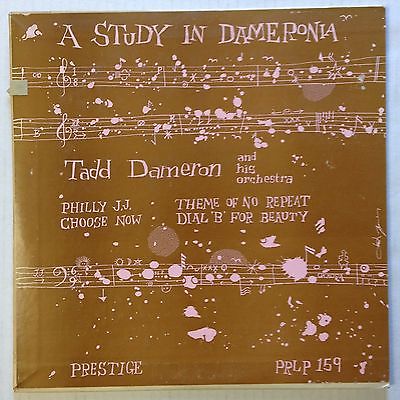
Listening to Prestige Records Part 88: Tadd Dameron / Clifford Brown


Here we have a powerful ten-piece band, with an all-star amalgam of musicians, but two of them stand out for special mention: Tadd Dameron, who was one of the most influential composer-arrangers of the bebop and hard bop eras, and whose name is legend to other musicians, but who remains a cult figure to the general listening public; and Clifford Brown, whose star blazed brightly for a very short time, bookended by terrible auto accidents, the second of which took his life.

June of 1953 was the time when Brown  made his first powerful mark on the jazz recording scene. He had made a few records  the year before, some rhythm and blues in Chicago with a group led by Chris Powell (no relation to beboppers Bud and Richie Powell), and a session of bebop standards, including "A Night in Tunisia" and "Donna Lee," recorded live at a club in Philadelphia, where Brown spent some important early years. Because his career was so short, and his recorded output so much less than it might have been, all of his work, including these early sessions, has been reissued. You can find the R&B sides, which are striking, and the Philadelphia club tapes, which are amazing, on a Columbia reissue album called Clifford Brown: The Beginning and the End. Brown was 22 when he made these recordings, which is young, but his career had actually been held back by a debilitating injury suffered in an auto accident in 1950.

He hit the recording studios of New York in June of 1953, with a prodigious series of sessions. On June 9, he recorded with Lou Donaldson, Elmo Hope, Percy Heath and Philly Joe Jones for Blue Note, and two days later he was back in the studio with the Tadd Dameron group. Later in the month, he was back for another Blue Note session with J. J. Johnson, Jimmy Heath, John Lewis, Percy Heath and Kenny Clarke.
Tadd Dameron arranged for  arranged for Count Basie, Artie Shaw, Jimmie Lunceford, Dizzy Gillespie, Billy Eckstine, Milt Jackson and Sarah Vaughan, among others, and he composed some of bebop's most enduring standards. He did record several albums as a leader, but they haven't all survived. This one can't be found on Spotify or YouTube with a search under Dameron. Spotify has it as part of a collection called Clifford Brown Memorial.

And Clifford Brown deserves to be remembered as vividly as he is, for a blazing career that lasted only until 1956. But Tadd Dameron deserves to be remembered also, and this session shows why. He knew how to showcase Clifford Brown's amazing talent, but he knew how to write and arrange for a jazz orchestra, too, as well as anyone ever did. Count Basie, similarly, could make a great soloist like Lester Young simultaneously part of and separate from an ensemble.

Bebop was a soloist's art form. Gerry Mulligan was in demand as an arranger in jazz circles, but he didn't emerge as a star until he stepped out front as a soloist. Conversely, Count Basie almost never soloed, but he came from an era, and a musical genre, in which the bandleader was king. Dameron actually takes some solo space here, and he sounds great -- but not a lot.

All the compositions here are Dameron's. Of his composing style he has said (quoted by Ira Gitler in his liner notes), "When I write something it's with beauty in mind. It has to swing, sure, but it has to be beautiful."

These were released as a 10-inch LP entitled A Study in Dameronia (cover art by David X. Young), and on an EP as Clifford Brown with Tadd Dameron's Band. There was a later reissue called The Arranger's Touch that featured work by Dameron and Gil Evans, but mostly the reissues have been under Brown's name.