Showing posts with label George Syran. Show all posts

Sunday, December 11, 2016

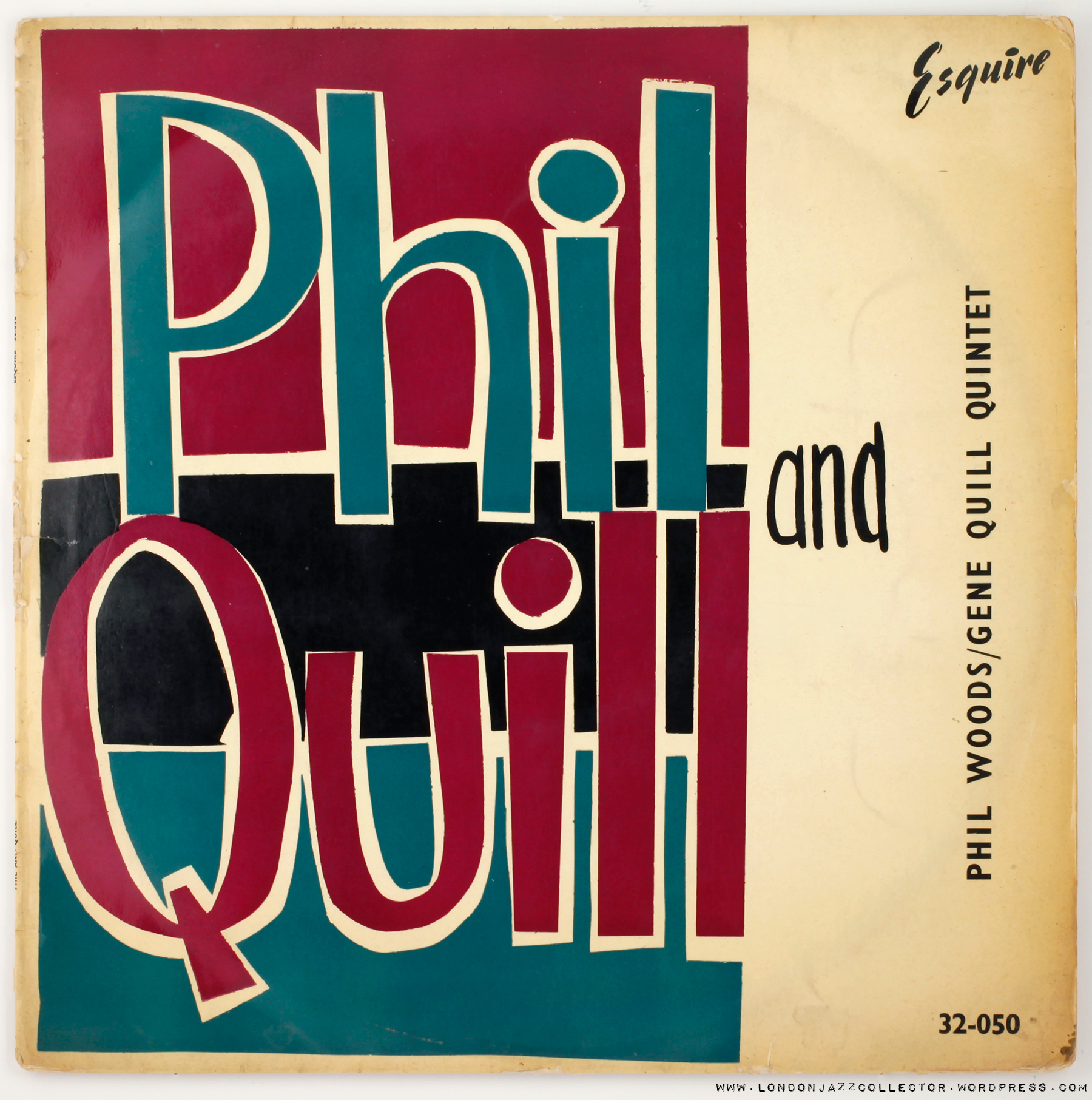
Listening to Prestige 220: Phil Woods and Gene Quill

Phil Woods is a jazz icon today, and Bobby Jaspar is pretty much forgotten, so there's a lot to be said for longevity. There are some careers that were pretty short, but they burned with such a brilliant flame that they'll never be forgotten. Charlie Parker is the obvious one. Bud Powell. There were some whose careers were very short, and they may not be remembered by the casual fan, but they are revered by the serious aficionados. Charlie Christian, Chano Pozo. There are some who had brief, blazing careers and are remembered vividly, some with much the same brief blazing careers and not so vivid: Clifford Brown and Fats Navarro.

Gene Quill had a long and productive life, but except for these recordings with Phil Woods, he mostly settled for the job security and relative anonymity of studio and section work, playing with some of the great jazz orchestras.

All of these, remembered or semi-forgotten, wrote their names in the Book of Jazz, and deserve to be remembered..deserve to be cherished.

These musings come at a time when Bob Dylan has just been awarded the Nobel Prize, and many are saying, "Aren't there other singer-songwriters who deserved it more?" And that's a foolish question. There is no "deserved it more." You either deserve it, whether it's the Nobel Prize or the respect of your peers, or you don't deserve it. Bobby Jaspar, Gene Quill, Fats Navarro, Elmo Hope, Wardell Gray, J. R. Monterose...they all deserve it.

And Phil Woods absolutely deserves it.

For this session, Woods brings back the rhythm section he used for his 1954 Prestige session with Jon Eardley (another not-so-remembered player, for a common reason: because he moved to Europe early on and spent the rest of he career there): George Syran, Teddy Kotick and Nick Stabulas. But this is 1957, and things are different. Certainly they're different for bass players. Teddy Kotick is a veteran of the birth of bebop days, one of Charlie Parker's favorite bassists. Like others of his generation, he was valued for his ability to handle the tricky tempos and improvisational leaps of the great bebop soloists, but was not expected to solo much, partly because in the pre-Rudy Van Gelder era it was hard to mike the bass in such a way as to feature it as a solo instrument. Players like Charles Mingus and Paul Chambers changed all that, and some of the standout bebop bassists like Curly Russell essentially called it a career. In this session, Kotick steps up for some serious bass solos, and he delivers.

This is very much a bebop session. You don't name a tune "Altology" unless Charlie ("Ornithology") Parker is very much on your mind.

Woods and Quill feature a couple of modern jazz standards: "Solar," attributed to Miles Davis or perhaps Chuck Wayne, and "Airegin," written by Sonny Rollins and originally recorded by Sonny with Miles. "Airegin" came from a time when it became fashionable to name tunes with words spelled backwards, a trend that I don't miss nearly as much as I miss titles with bop puns, like "A Night on Bop Mountain" or "Flight of the Bopple Bee."

Speaking of titles, two of the originals on this session are "Creme de Funk" and "Nothing but Soul," and they are fine bebop cuts, but not especially characterized by funk or soul, neither looking backward to the rhythm and blues/bop fusion of the late 40s and early 50s, or the funk/soul jazz that was trending in the late 50s and would become ubiqiitous in the 60s. This style would become linked with Blue Note, and its stars like Art Blakey (whose pianist Bobby Timmons would write the classics of the genre, "Moanin'" and "Dat Dere"), and Horace Silver (who would use Teddy Kotick on two Blue Note albums in 1957/58).

But the real progenitor of the movement was probably someone who is now revered as a jazz immortal, but was back then rejected by jazz snobs: Ray Charles. Rhythm and blues and bebop may have been soul brothers, but the exploding popularity of rock and

roll, and especially white rock and roll, had led jazz purists to build a wall even solider than the one Donald Trump plans for Mexico. But that didn't mean musicians weren't listening, and Charles' fusion of blues and gospel resulted in a whole new definition of the blues that changed both jazz and popular music irrevocably.

But I digress. Phil Woods and Gene Quill made a successful pairing because of their musical compatibility, and also because of the marketing gimmick suggested by their names. This album came out as Phil and Quill with Prestige, later released under Woods's name as his reputation continued to grow. There were only two Phil-and-Quill labeled recordings, the other for Epic, although they performed often as a quintet in clubs during this era.


 Order Listening to Prestige, Vol. 1 here.

Saturday, January 09, 2016

Listening to Prestige part 162: Jon Eardley

The thing to remember about mainstream or straight ahead jazz is that it's never really mainstream, and never really straight ahead. I'd always usd the terms pretty much imterchangeably, to refer to,the music of the time period I'm writing about. Wikipedia says there's a difference, "Mainstream" refers to players like Buck Clayton who continued to perform and record after the big bands broke up, but never  embraced bebop. "Straight ahead" refers to,the music made after the Charlie Parker era and before the Dolphy-Coltrane-Coleman era. Music such as was made by guys like Jon Eardley. I suspect I'll comtinue to use them interchangeably.

You can put it on as background music because, let's face, any kind of music can be background music. You put on something you like, even if it's Charlie Parker or Ornette Coleman or Igor Stravinsky or Gustav Mahler, and you're doing something else, whether it's an architectural rendering or washing the dishes, it's background music. If you're writing a blog about jazz, and your whole point is that this music is important, and you should set yourself down in a quiet room with no distractions and listen to it, and you're writing this at the same time the music is playing, then it's background music.

But mainstream or straight ahead are words that seem to describe music that can easily fade into the background as you concentrate on your rendering or dishwashing or jazz blogging, and it never can. With the kind of player that Bob Weinstock brought into the studio, and Rudy Van Gelder recorded, it never gets predictable, These guys played jazz because they came, consciously or not, out of modernism, out of Pound's dictum to "make it new." They came out of Louis Armstrong, who made it new, and Charlie Parker, who made it new, and they were inspired to keep building on that, to keep searching for the new.

John Eardley was to pretty much fade into oblivion after this album, and in fact, when it was rereleased in the 60s, it would be under Zoot's name.. He wouldn't record again as a leader until some sides for European labels in the late 70s. He'd be remembered, if at all, as one of those guys who played hard bop, just as if "one of those guys" was a phrase that had any meaning at all. As if those guys were minnows swimming straight ahead down a main stream. This album is none of that. It's full of surprises, full of inventiveness, full,of musical ideas and inventiveness, of phrasing, of time, of creative flight. And you don't get guys like Phil Woods and Zoot Sims for a session unless you're well respected.

"Koo Koo" is an Eardley composition (as are "On the Minute" and "Ladders"), and it's the gem of an excellent lot. It became the title track for the Zoot Sims reissue, and I'm surprised that it hasn't become more of a standard. Maybe because there are so many songs named "Koo Koo." "Eard's Word," interestingly, is a Zoot composition.

Milt Gold played with Kenton, and later in a three-trombone ensemble led by Bill Harris. When you're playing in a group with Eardley, Sims and Woods. you're not going to get a lot of solo time, but Gold sounds great when he does get a horn in edgewise.
There are so many great Zoot Sims stories, it's hard to resist putting them in every chance I get. This is David Amram reminiscing about the old Five Spot.

One time Larry Rivers was playing. Larry loved to play as much as anybody in the world
and he had a great band with Freddie Redd and Elvin Jones and all these tremendous musicians. But Larry was so busy painting, I don’t think he ever practiced in 30 years. He was blasting away, hitting a lot of clinkers. Zoot Sims was sitting at the bar and Zoot was the most big-hearted person. As Larry was playing more and more clinkers, Zoot was quietly sinking down in his bar stool, waiting for it to be over. I said, “Zoot, wasn’t that something?” He looked up very quietly and said, “Man, I think I’m gonna take up painting.”

The Jon Eardley Seven was released on 12-inch LP. which was now the standard.


Tuesday, June 23, 2015

Listening to Prestige Part 122 - Phil Woods

When I started this project, my goal was to listen to at least one cut from every Prestige album in chronological order. That went out the window pretty quickly when I realized that to do a proper chronology, I'd have to do it session by session, not album by album. And it really went out the window when I discovered that one cut was nowhere near enough. It might take a substantial chunk of time, but what better to do with my time than listen to jazz on Prestige? I was going to listen to every recording ever made for Bob Weinstock's label.

When possible. Some things I just haven't been able to find, and that would include most of this session. "Open Door" has been put up on YouTube, and that's it.

Still, every limitation has its compensations. In this case, instead of listening to four songs in rotation, I've focused on just the one, appreciating that if two guys were ever made to play together, it's Phil Woods and Jon Eardley. Of course, Phil Woods played with so many different musicians, and sounded great with all of them.

This was his first session as a leader, and maybe only his second recording session. I haven't found anything else besides the Jimmy Raney session just two months earlier. He was only 23 when he made these recordings.

George Syran seems only to have recorded on a handful of sessions with either Woods or Eardley, but his obituary (2005) offers this:
 Mr. Syrianoudis played with Billy May, Hal McIntyre, Jimmy Dorsey, Richard Maltby, Cannonball Adderley, Al Cohn, Phil Woods, Lester Lanin, Dick Meldonian, Hal Prince and many others.

 He was the personal accompanist for Buddy Greco, Don Rondo and Morgana King.

That's a pro's pro who can fit in anywhere, but he definitely knew how to play jazz. He has a strong solo here.

Nick Stabulas is a powerful presence throughout.

These were released on New Jazz, and the New Jazz releases seem in general to be less reissued and harder to find. "Pot Pie" and "Mad About the Girl" were also on a Prestige EP.