Tad Richards' odyssey through the catalog of Prestige Records:an unofficial and idiosyncratic history of jazz in the 50s and 60s. With occasional digressions.
This just goes to show, if you put a solid veteran horn player together with an absolutely impeccable rhythm section, you're likely to get some good jazz out of it.
Thompson had appeared on Prestige twice before. The first time was 1954, when Bob Weinstock was showcasing his newly signed Miles Davis in a variety of situation. Two April sessions were put together in one album, the first featuring Dave Schildkraut, the second Thompson and J. J. Johnson. Horace Silver, Percy Heath and Kenny Clarke anchored both dates.
Then in 1963, freshly returned from a sojourn in the wilderness which had included making his own furniture on a farm in the country and playing the expat game in Europe, he led his own quartet with Hank Jones, Wendell Marshall and Dave Bailey. The 1963 date, an examination of the Jerome Kern songbook, was notable for his introduction of the soprano saxophone to the quartet sound. John Coltrane had played soprano the previous year, in his Live at the Village Vanguard album, but it didn't really catch on until Trane's definitive "My Favorite Things" in 1966.
Ballads make up the lion's share of this session, mostly his own (Duke Ellington's "In a Sentimental Mood" and Bronislaw Kaper's "Invitation" are the exceptions), but he does explore some brisker rhythms too, particularly "Mumba Neua," which features the soprano sax and some nifty drumming by Connie Kay.
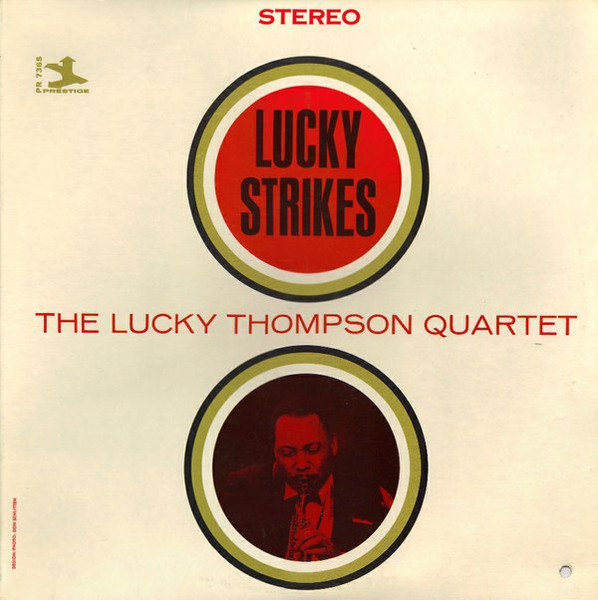
Don Schlitten produced, and the album was titled "Lucky Strikes," with a cover design modeled after the familiar cigarette package.
Lucky Thompson was associated with an earlier era of jazz (although he was only 39 at the time of this recording): he'd played with Lionel Hampton, Don Redman, Billy Eckstine, Lucky Millinder and Count Basie. His time with Eckstine coincided with that of Charlie Parker and Dizzy Gillespie, and like so many of that era and that influence, he moved into bebop. He had recorded once for Prestige, a 1954 session with Miles Davis.
Also like many of that era, who grew increasingly frustrated with the racism of American society and the avarice of the music industry, and moved to Paris in the mid-1950s. His debut with Prestige (he would record three albums altogether) came shortly after his return to the States.
His association with the jazz of earlier times (just a few years earlier was already being thought of as earlier times) may have been what prompted Prestige to suggest an album of Jerome Kern, and to release it on Moodsville.
There's nothing wrong with devoting an album to Jerome Kern, one of our greatest and most subtle composers. And nothing wrong with a Moodsville release, either--the subsidiary label was home to some great albums by major artists. But I'm not sure that this really a Moodsville album. Thompson was a true bebopper, and this album is in the tradition--fast tempi, bravura solos. Somewhat outside of the bebop mainstream was his choice of the soprano saxophone as a lead instrument -- perhaps the Paris influence of Sidney Bechet.
Anyway, Moodsville or no, it's great that Thompson is back in the States (he would leave again in a few years), playing with some wonderful musicians.These years of Moodsville and Swingville led to the recording of musicians who might not otherwise have been recorded in this era, by an important independent label with good distribution. Dave Bailey is the new face here, and this was to be his only Prestige session. Best known for his work with Gerry Mulligan, Bailey is another of those jazzers with an interesting day job. In 1969 he retired from music to become a flight instructor.
The album is called Lucky Thompson Plays Jerome Kern and No More because, in fact, there was one more -- a Thompson original entitled "No More." "Who?" and "Lovely to Look At" became a 45 RPM single on Prestige. Don Schlitten produced.
Gene Ammons jumps on the bossa nova bandwagon, which may sound like a putdown but is not, because any wagon Ammons jumps on is a cause for celebration, especially if you're following the progression of Prestige recordings and putting yourself back into 1962, in which case, you've been listening with the dark foreboding awareness that each session is drawing him closer to cruel incarceration for drug possession, and seven years in prison for a sickness, not a crime. And we have now reached that point. This would be his final recording session for seven years.
And if you're starting to feel that Ammons' swan song was a gimmicky commercial album, don't. The bossa nova is not a bad bandwagon to be on. The Brazilian samba provides a great framework for jazz improvisation, and no one went into Rudy Van Gelder's studio, with one of Prestige's producers, to make anything less than a real jazz album.
Don't forget, also, that secret to Ammons' enduring critical and popular success was twofold: the serious jazz community loved him because he was a real musician's musician, and the public loved him because he played music that people loved to listen to. So if the public wanted the bossa nova, Ammons would have had no problem giving them--in the company of some stellar musicians--the bossa nova.
This is pretty much a new crowd. Hank Jones and Oliver Jackson, no strangers to Prestige, are matched with Ammons for the first time. Kenny Burrell, even less of a stranger, made one Ammons session back in 1957.
Bucky Pizzarelli is new to Prestige with this session, and he would hang around for a few more during the decade. At the time of this recording he was a still relatively obscure, though respected, session guitarist, often called upon for recordings across a range of genres. When you move away from jazz, musicians on a session are frequently uncredited, so it's impossible to even come close to listing his credits. He worked with Benny Goodman, and was part of Johnny Carson's Tonight show orchestra. In 1972, when Carson left for the west coast, Pizzarelli elected to stay behind, and his reputation blossomed. Performing solo or duet in New York clubs, he started garnering rave reviews, and began to be in even more demand. Around 1980, he started playing regular duets with his son John.
The session was produced by Ozzie Cadena, who had just taken over for the departing Esmond Edwards as head of A&R for Prestige, having filled the same role at Savoy. Between Cadena and Ammons, they came up with an interesting selection of tunes for the bossa nova treatment--I'd guess mostly Cadena, because Ammons, severely heroin-addicted, overworked to pay for his habit, and headed for a lengthy prison sentence, was not likely to be reaching so far out of the jazzman's standard repertoire.
The result is a very different route from Dave Pike's exploration of the work of one contemporary composer. There's one Ammons original ("Molto Mato Grosso"), but the rest are a curious and
fascinating collection--and with the Ammons touch, they all fit together.
"Pagan Love Song" was written in 1929 by Hollywood tunesmiths Nacio Herb Brown and Arthur Freed for a silent film, The Pagan, starring Ramon Navarro. It later became the title song for a 1950 film with Esther Williams and Howard Keel. It became something of a staple for pop singers and exotic ethnic bands (The Hawaiian Islanders), but did not much make it over to the jazz repertoire.
Anna was a 1951 Italian film starring Silvana Mangano. Its title song, also known as "El Negro Zumbon," was written by Armando Trovajoli, a well-known composer, under the pseudonym R. Vatro. The movie was released in the US in 1953, and the song--although written by an Italian, with lyrics in Spanish by another Italian, Francisco Giordano-- is credited by some as igniting the first spark of interest in Brazilian rhythms. It was covered by Tito Puente with Abbe Lane, and by Xavier Cugat. It may have been brought to this session by Pizzarelli, as it had been recorded a year earlier by his frequent guitar partner George Barnes.
"Ca' Purange (Jungle Soul)" was composed by Natalicio Moreira Lima. He and his brother, performing as a duo, had been popular in Latin America since the early 1940s. As Los Indios Tabarajos, they would finally find success in the US and worldwide in the mid-1960s, with a gold record for 1963's "Maria Elena."
"Cae, Cae" was probably known to Cadena from Carmen Miranda's rendition of it in 1941's That Night in Rio, but the song had already been a hit in Brazil. Its composer, Roberto Martins, was (according to biographer Alvaro Neder on the Allmusic web site), "the composer of several classics of the Golden Age of the Brazilian song, recorded by many of the best interpreters of the period"--the period being the 1930s. "Cae, Cae," written for the 1940 carnival in Rio, "having been included in 12 foreign films, [became] an all-time carnival classic, even if it only achieved third place in the annual municipal contest of that year." It hasn't really caught on with recording artists, which is surprising, since it's hard to imagine a catchier tune.
"Yellow Bird" is of an earlier vintage altogether--a 19th-century poem, "Choucoune," by Haitian Oswald Durand, set to music in 18923 by Haitian composer by Michel Mauléart Monton. Katharine Dunham recorded it in 1946, and folk trio The Tarriers (featuring Alan Arkin) sang it in a 1957 movie, Calypso Heat Wave. They sang the original French lyric, but in the same year, Hollywood songwriters Alan and Marilyn Bergman put English lyrics to the melody. As "Yellow Bird," and rebranded as a calypso, it would have a new life, most successfully for Arthur Lyman on the newly invented Billboard Easy Listening charts in 1961. Ammons and co. make it something more than Easy Listening.
Bad! Bossa Nova was a Prestige release. It would be rereleased as Jungle Soul! and later as Jungle Soul, without the exclamation point. There were four 45 RPM singles. "Pagan Love Song" and "Anna" were on one of them. The others were all two-sided: "Ca' Purange" Parts 1 and 2, "Molto Mato Grosso" Parts 1 and 2, and "Jungle Soul" (which was, of course, deja vu all over again on "Ca' Purange") Parts 1 and 2.
And after this, silence for seven years. That wound is still raw.
Jimmy Grissom is not the first name that springs to mind when one thinks of jazz vocalists, but he had an active career that spanned a good decade and a half from the late 1940s to the early 1960s, and even included -- sort of -- one of the most important live performances of the era to be captured on record -- Duke Ellington's 1956 performance at the Newport Jazz Festival.
Sort of, because of course Grissom is not on the famous Ellington at Newport LP. But, as we now know, that LP wasn't exactly Ellington at Newport. The Duke was not completely satisfied with the Festival suite, and elected to redo it in the studio. The actual live concert was pieced together from various tapes and issued as a 1999 CD release, and Grissom is on that version, singing the Rube Bloom / Johnny Mercer standard, "Day In, Day Out."
Duke Ellington was not known for working with the A-list vocalists of his day. Although he wrote some of the greatest songs in the Great American Songbook, his focus was always on his orchestra and its extraordinary soloists, and the singers were secondary. Nonetheless, you didn't get hired by Ellington without being very good.
Grissom, the nephew of Jimmie Lunceford vocalist Dan Grissom, performed and recorded around the Los Angeles area starting in the late 1940s, appearing on various independent rhythm and blues labels. He had a minor hit with "Once There Lived a Fool," written by Jessie Mae Robinson, an underappreciated (but widely recorded) songwriter. "Once There Lived a Fool" was covered by Jimmy Witherspoon, Charles Brown, Savannah Churchill, and later Tony Bennett and Dakota Staton.
He joined Ellington in 1953, and was with him through the Newport concert. He only made a few recordings after that, and his Prestige association was a brief one. It would seem that Bob Weinstock and Co. had initial high hopes for him, putting him together with Oliver Nelson, and it would also seem that they changed their minds rather quickly. They only cut four songs on this date. Two of them were released as a 45 RPM single, the other two were shelved, which seems a shame. One of the shelved songs, "Get Yourself Another Fool." is a lovely blues ballad, recorded by a number of first rate performers, including Charles Brown, Sam Cooke, and even Paul McCartney.
Nelson brought along Hank Jones, Wendell Marshall and Ed Shaughnessy, all of whom he had worked with often, and a string section, and organist Dick Hyman, an unusual choice. Hyman was a keyboard wizard who could play in nearly any style, but one that he was rarely accustomed to was the trendy soul jazz style of the moment, and in fact he stays away from that genre here, working in a more mainstream style, providing fills and swirls around the complex rhythmic patterns laid down by Marshall and Shaughnessy. All of this takes just over two minutes, backing up Grissom's rhythm and bluesy ballad vocal. It's on the short side even for a pop single, and it's hard not to wonder if there wasn't a more extended LP-intended version somewhere, edited down for 45 RPM release. Why else call in Oliver Nelson and a rhythm section as gifted as Jones, Marshall and Shaughnessy, and strings, and especially why else bring in Dick Hyman? Weinstock and Esmond Edwards (I'm guessing -- no producer credit here) must have had something different in mind, and maybe they decided it was too different (why put an organ on a record in 1962 if you're not going for the soul sound?) or not different enough. Grissom's delivery is excellent, but maybe they decided it was too 1950s, and it wasn't going to make a dent in the new market of the Kennedy era. If only they had known. Within a year, the Kennedy era was over, and a group of rock and rollers from England were going to change everything about what music was listened to, and how it was listened to.
So there's just this one single. And it's good. And worth a listen.
Dizzy Reece took a long way around to New York and Rudy Van Gelder's studio and the jazz kitchens of Blue Note and Prestige, and the music once known as New York music, later to be given to an unsuspecting and at first unwelcoming world as bebop. By the time that Reece recorded this session for Prestige, other strains of jazz were mixed into his broth, but bebop was always at the center of it.
And it was not exactly his birthrigh at, as it was for his New York and Detroit-born contemporaries. Reece was born and raised in Jamaica. His father was a musician who played piano accompaniment for silent movies. His biographies point out that he took up the trumpet at age 14, switching over from
the baritone saxophone, which is remarkable in itself--a 12 or 13-year old boy would not have been much bigger than than that unwieldy instrument. But the trumpet was where he found himself, and by age 16 he was playing professionally in a swing band. At 17, in 1948, he was ready to expand his musical horizons. and he set sail -- not for New York, but for London.
His first bookings did not take that far from home musically. On his passage across the Atlantic, he made the acquaintance of a calypso band, also England bound, and since they had gigs lined up in Liverpool, he joined up with them. He did not make it to London until the following year, where he first discovered bebop, and was completely won over by the new music on a trip to Paris and the first International Jazz Festival, where he heard Charlie Parker and Miles Davis.
He made his first recordings in London in 1955, and, while still in England in 1958, recorded an album for Blue Note (Donald Byrd played on the session). The following year, with the encouragement of Miles Davis, whom he had met in Paris, he came to New York. He made three more albums for Blue Note before being dropped from the label. He did this one session for Prestige, then pretty much disappeared from the recording scene. He joined Dizzy Gillespie's big band in 1968, and made a few records for small labels in Europe and New York in the 1970s. He remained active, if mostly unacclaimed, into the 21st century, and not only as a musician. He's had exhibitions of his paintings, he's made documentary films. and he told an interviewer in 2019 that he was just putting the finishing touches on a 750-page autobiography.
Asia Minor is solidly grounded in bebop, but it incorporates some of the newer ideas of the jazz
experimentalists of the era, and--as the title suggests--some of the sounds of the Near East and North Africa which were being explored most prominently by Yusef Lateef. All of these influences can be heard on "Spiritus Parkus (Parker's Spirit)," a Cecil Payne composition.
Baritone saxophonist Payne was no stranger to Prestige, having played on a John Coltrane-led Prestige All Stars session, and with Kenny Burrell, Tadd Dameron, Gene Ammons, and mambo jazzer Joe Holiday, in sessions going back to 1953.
Joe Farrell, just 24 when these recordings were made, had recorded with Maynard Ferguson, but was really just embarking on a career that would blossom in subsequent decades, most notably with Chick Corea's Return to Forever. He died young, of myelodysplastic syndrome, in 1986. One his compositions, "Upon This Rock," has been the subject of a series of lawsuits by his daughter against a number of hip-hop artists for unauthorized sampling.
Perhaps Reece's Jamaican background made him particularly conscious of rhythms, a subject that he frequently came back to in interviews -- "Charlie Parker played drums on the saxophone." he told one interviewer, and he prided himself on always working with great rhythm sections, which he certainly has here, with Hank Jones, Ron Carter, and especially Charlie Persip, whose rhythmic inventions go way beyond bebop here. Persip, who worked with swing, bop, and free jazz groups over his long career, was really coming into his own as a distinctive and innovative drummer in these years, as he became one of the most sought-after jazz drummers.
New York proved to be not all that hospitable to Reece. He never quite broke through to major recognition, and his marriage suffered from a resistance to an interracial couple that he had not experienced in England. His wife ultimately left him and took their daughters back home to England. Reece, too, would return to England and Europe for many years, though New York ultimately beckoned him home, mostly to anonymity. When an interviewer found him in 2019, he was greated with, "I'm surprised you didn't think I was dead!"
Asia Minor was a New Jazz release. Jules Colomby produced.
It's hard to listen to this one directly after the Joe Newman-Oliver Nelson-Shirley Scott session and not miss Shirley, but of course, that's not the way anyone would have listened, especially since the album with Scott wouldn't actually be released for another five years. And once you shake your head free and listen to this one for its own sake, it has much to offer. A great deal to offer.
It has Newman and Nelson, of course. But it also has Ray Barretto, who brings a certain something to every session he plays on. And it has Hank Jones.
This is Jones's sixth session for Prestige, but he had been on the scene since the mid-1940s, when he joined Hot Lips Page at the Onyx Club on 52nd Street. Like Newman, he was of the swing-to-bop school, a style of music that may not have been cutting edge in 1961, but was, and is, timeless. Nelson could play straight-ahead jazz too, and write for a straight-ahead group. but his abilities as a composer always kept him around the cutting edge.
Nelson composed four of the six tunes on this album ("Main Stem" is Ellington; "Tangerine" is Johnny Mercer and Hollywood composer Victor Schertzinger), and they're very much tailored to this group. "Tipsy" is my favorite, tuneful and inventive, with room for solos by Oliver, Newman and Jones, with propulsive backing by George Duvivier, Charlie Persip and Barretto (with an inventive solo bt Duvivier).
I've written about Joe Newman's later work as an educator with Jazz Interactions. But here's a little about where he came from: New Orleans, where "I thought that jazz had been here ever since the world began." In an interview for the national jazz archive, he talks about his father, who he knew as a chauffeur, until he suddenly discovered he was also a musician, and the music his father brought into the house, and how he became part of it.
started playing trumpet when I was six years old, and I learned to play it within two years, by myself. At eight, I had my first formal lesson.
That came about when some musicians were having a band rehearsal at my house with my father; I was out on the back step, blowing along with them. They heard me, and they stopped, but I was still out there blowing. I didn’t see them standing there at the screen door; next thing I heard was: “Why don’t you give that kid some lessons?” That’s really how I got started.
Before that, I’d wanted to play tenor saxophone. I used to have a lead pipe plumbing fixture, and it was sort of shaped like a saxophone; I blew that and made music with it.
Another kid played a banjo, my brother had a trumpet made from some tubing and a funnel, and we used to play little parties. Then one of my playmates stole my lead pipe; so I had another one made, that looked more like a saxophone.
At eight years old, I could play some songs, and I started to do gigs with some of the same men my father had worked with. My mother would let me go if they’d come get me and bring me home. These were three and four piece bands; then after a while I started working with some bigger bands around New Orleans—about thirteen pieces, something like that. Such as Henry Hart, Bill Phillips. Richard Gray and his Society Syncopators—that was one of the first bands that operated in the Carlton area, what they called Uptown in New Orleans.
All that was just part of his life, just part of growing up in New Orleans.
It wasn’t until recently, when I started to put together lectures on Louis Armstrong, for colleges and different places, and I was reading books to gather material, that I saw these names of so many guys that I grew up around—playing with my father, friends of our family. These guys were creating it then, man, and I didn’t know it. Some of the earlier history was being made.
The album was called Main Stem, and the 45 RPM single that came from the album was the title track, split over two sides. Esmond Edwards produced for Prestige.
Bob Weinstock's philosophy of the best jazz being from a spontaneous jam session hasn't found many adherents in recent years, with perfection being the goal. perfection achieved by multi-tracks and multi-takes, and laying in patches. But it made for some great jazz.
Part of that spontaneity came from Weinstock's commitment to fooling around with combinations of musicians. You'll recall that he deliberately did not set Miles Davis up with a regular group. That happened when Miles moved to Columbia.
It was a marketing move that brought him wealth and glory, and resulted in some great music, but he made some great music with Prestige too, and we have a legacy of Miles in different settings which is priceless.
Weinstock wouldn't mess around with an artist like Yusef Lateef, who had his familiar group that he brought in with him from Detroit. But Lem Winchester had already outgrown his Wilimington bandmates, and Weinstock set him up with a series of different partners: Benny Golson on his debut album, then Oliver Nelson and Johnny "Hammond" Smith, then Nelson again with Curtis Peagler. And for this, his third album as leader, Frank Wess came aboard, and this was another solid choice. Golson and Nelson were sax players; Wess is a tenorman, too, but here he concentrates on the flute, and to good advantage.
This album cover is a striking piece of art, and it's offered for
sale as a print at a number of sites (including Walmart!), but
nowhere is the artist credited. There's a signature running
along the lower left, and it's Esmond Edwards'. He did a lot
of photography for Prestige album covers even before he
began producing, so it's quite likely the art work is his.
Talented guy.
Winchester has a new rhythm section, too. Hank Jones had lent his piano mastery to a variety of different Prestige settings: with Jerome Richardson, Curtis Fuller and vocalist Earl Coleman. And this, of course, barely scratched the surface of the catalog of this jazz master. Eddie Jones was not one of his brothers, but a heckuva bassist anyway. He worked with Count Basie for years, and was frequently on call for sessions with Countsmen like Frank Wess. He would go on, like so many jazzmen before him, to become vice president of an insurance agency. Gus Johnson also played briefly with Basie; his previous Prestige work had been a swing session and a blues session (with Willie Dixon).
The menu on this album features three tunes by Winchester, one by Oliver Nelson, and one standard. My two favorites on the set are Winchester tunes. "Another Opus" opens with a bass vamp by Eddie Jones turns into a moody Jones-Wess duet, a mood that's picked up and carried by Winchester, who never loses it even
as his playing gets more intricate. It's easy to kid around with the title of my other favorite--Lem and Frank let you have it with both barrels--but given that Winchester was to die far too soon from a self-inflicted gunshot wound, maybe not. This one is much more experimental, and much faster. Eddie Jones, whose bass is very much on display throughout this set, whips into steeplechase speed for this one, and Wess and Winchester both step outside the comfort zone. Listening from the perspective of 1960, you'd come away wanting to hear a lot more from Lem Winchester. Listening from the perspective of the new millenium, one can only grieve that there was to be precious little more.
Another Opus came out on New Jazz, Esmond Edwards producing.
The fullness and power of orchestral music, with its sections and soloists, is undeniable, as is the energy and vitality of big band music. But there's something uniquely entrancing about music made by a small ensemble, where each instrument has its own kind of clarity, and the melds are shifting and subtle. This is true of chamber music, but it's perhaps especially true of small group jazz, for all kinds of reasons, some of them obvious, some less so.
I've talked before about getting my first hi-fi, and suddenly realizing that there was more going on than just Gerry Mulligan and Chet Baker. I could suddenly hear Larry Bunker, and especially Chico Hamilton, and I suddenly had a whole new appreciation of the complexity of the music I was starting to love.
In a jazz ensemble, the instruments are so different from each other, and they have so many ways of interacting. Improvisation opens up the possibilities exponentially, and because the different members of the group are given space to improvise, the time it takes to play a given piece is variable, as Miles Davis found out when John Coltrane started playing his extended solos. This makes it strikingly different from a composed piece. Terry Riley's In C plays with that boundary. It is entirely composed. There are 53 separate musical phrases, and each instrument--it's written for an indeterminate number of instruments--is instructed to play each figure, in order, from beginning to end, but they don't have to start together, and each one can repeat each figure as many times as he or she chooses before going on to the next one. Still, duration is not much of a variable in most composed pieces. Even John Cage's 4'33", which involves silence, is written to last four minutes and 33 seconds.
So I'm in the car alone, my favorite way of listening to Prestige, and I've lined up the Jerome Richardson session, and "Caravan" comes on, the Duke Ellington-Juan Tizol warhorse, which has been recorded over 350 times, not always by jazzgroups--sometimes just for its exotic melody. That makes it, like "Taboo" which we've recently heard recorded by both Yusef Lateef and Dorothy Ashby, just a little bit suspect: will it fall into the clichés of exotica? Which makes me particularly interested in listening to it. And this being the car, with me driving, I can't refer to the session notes, and I haven't really looked at them. I know that Richardson has Jimmy Cleveland on trombone, since brass always comes first in the personnel listing, but that's all.
It starts with a faint, exotic but not at all clichéd rhythm on the ride cymbal, but then the bass enters with the first strong voice, and it's a repeated but unnerving figure, no less unnerving when the piano joins in. Richardson enters, playing the melody, but he's distant, behind the bass and piano. So the first all-out solo goes to Jimmy Cleveland, improvising, and then it's Richardson again, out front this time, playing the melody again, sort of haunting, sort of mocking, sort of appreciative, and then they're off into uncharted territory, with Richardson beginning an extended solo, and now we're about three minutes into the piece, and we're just getting started, so this will be, yes, of indeterminate length, and the melody will be left in the desert dust. A lengthy Cleveland solo is next, followed by...what's this? Kenny Burrell? He's on this session too?
Well, yeah, since this is the Jerome Richardson Sextet, I should have remembered that there would be a third front line instrument. So we have flute, trombone guitar. not your everyday lineup, which brings me back to what I was saying about the different permutations of sound in a small jazz ensemble. The standard Bird-and-Diz quintet lineup of trumpet and saxophone is endlessly varied enough in the hands of jazz masters, but this group is very hip, and it's an instrumental lineup you don't hear that often--and it's varied even more when Richardson switches to tenor sax.. Which brings me back to duration as a unique function of jazz's uniqueness, especially in the LP era. With room for six different soloists to stretch out and create their own take on not only the melody and chord structure, but also the solos that have come before them, this version runs close to eleven minutes. A 1950s rock and roll version by steel guitar duo Santo and Johnny basically plays the melody, and clocks in and two and a half minutes. A pop instrumental by Gordon Jenkins, strictly playing the melody, is even shorter.
The rest of the group is Hank Jones on piano, Joe Benjamin on bass, and Charlie Persip on drums. Benjamin, never very far from the front, comes back after Kenny Burrell, and then there's an extended drum solo that captures the exotica of...well, of exotica, the complexity of bebop, and the excitement of a great drummer doing an extended drum solo.
We've heard Jimmy Cleveland before, with Art Farmer septets a couple of times, and as part of Gil Evans' tentet. Here he gets a more featured role, which is all to the good, particularly on "Way In Blues." Which reminds me to give a tip of the hat to another Prestige alumnus, Bennie Green, a great trombone bluesman, who would record through the 1960s on various labels, then settle in Las Vegas and hotel bands. Cleveland was one of those guys who could play with everyone, from blues (Ruth Brown) to soul (James Brown) to soul jazz (Cannonball Adderley) to big bands to bop.
Hank Jones accompanied vocalist Earl Coleman on a couple of Prestige albums, and played with Curtis Fuller on another. He'd be back for several more appearances on the label, but that was a tiny part of his prodigious output as leader and sideman over seven decades, with multiple honors including the National Medal of Arts two years before his death in 2010. He also has a unique credit for a jazzman: he accompanied Marilyn Monroe on her legendary performance of "Happy Birthday, Mr. President."
Joe Benjamin makes his Prestige debut, but his name is forever imprinted on my brain because he's one of the musicians Sarah Vaughan introduces in her live recording of "Shulie-a-Bop," arguably the greatest bebop vocal ever, made for Mercury Records in 1954, the same year that Mercury had her record "Make Yourself Comfortable," with a syrupy orchestra led by Hugo Peretti. This was the beginning of Mercury's project to make Vaughan into a commercial success by recording insipid pop songs with insipid arrangements. "Make Yourself Comfortable" is a clever song, and she sings it wonderfully, but come on. Is this really the best way to utilize Sarah Vaughan? It worked, for what they were trying to do. "Broken Hearted Melody," in 1959, which Vaughan regarded as the worst record she had ever made, was her biggest seller. Fortunately, they did also let her record for EmArcy, their jazz subsidiary, where she did the great Clifford Brown sessions, and the ones with Joe Benjamin. But I digress. This is actually the second member of Sarah's trio to appear on a Prestige session in the fall of 1958. Roy (drumroll) Haynes (drumroll) had been on the Dorothy Ashby date just three weeks earlier. I wonder when John Malachi will show up? But I continue to digress.
Artie Shaw's "Lyric" joins Ellington's "Caravan," and the other three tunes are Richardson originals. I've commented before that I miss the bad puns and other plays on words in the early bebop recordings, like "Ice Cream Konitz" and "Flight of the Bopple Bee." Richardson brings the word play back with rather more sophistication on "Minorally" and "Delirious Trimmings," which I hope is not a reference to anything that anyone in the band is going through.
The album was released on New Jazz as Midnight Oil.
Listening to Prestige Vol. 2, 1954-1956 is here! You can order your signed copy or copies through the link above.
Tad Richards will strike a nerve with all of us who were privileged to have lived thru the beginnings of bebop, and with those who have since fallen under the spell of this American phenomenon…a one-of-a-kind reference book, that will surely take its place in the history of this music.
--Dave Grusin
An important reference book of all the Prestige recordings during the time period. Furthermore, Each song chosen is a brilliant representation of the artist which leaves the listener free to explore further. The stories behind the making of each track are incredibly informative and give a glimpse deeper into the artists at work.
In an interview in later years (from an article published in 2010), Curtis Fuller describes John Coltrane's seminal Blue Train recording for Blue Note as his first recording. And Lord knows it was important. Trane has described it as his favorite album. And it's impossible to overstate the importance of John Coltrane to the young Fuller In the same interview, he says "meeting Trane was the greatest thing that ever happened to me. It was Miles Davis who took me to New York, and Coltrane was in the band, as well as Paul Chambers, Philly Jo Jones. Trane took me aside...he had confidence that I didn’t have; he saw something that I didn’t see. A great man."
But actually, Blue Train wasn't recorded until September of 1957-- well after the Paul Quinichette session, and after this session, a day later.
As important as Blue Train was in young Fuller's development, this early couple of days in May, a Fridays with Rudy session that spilled over into Saturday, with Fuller as sideman and then leader, should not be overlooked.
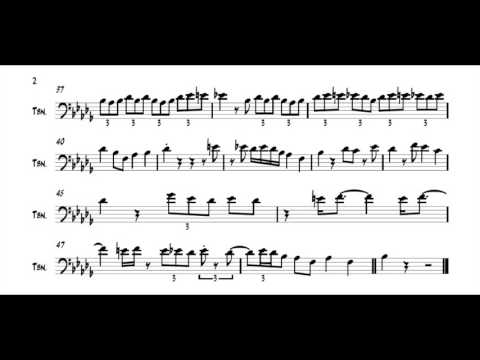
So, about Curtis Fuller...but it's so easy to get sidetracked, isn't it? Hank Jones is on this session, too, and he did a number of sessions for Prestige over the years, but wasn't really one of their regulars. Before this session, he had only been on board for two dates supporting vocalist Earl Coleman. And just listen to him on "Blue Lawson." His vamp leading into the head is enough to draw you in, and his solo coming out of it would melt the resistance of Doris Day on a blind date with Rock Hudson. Oh, heck, just keep on listening to "Blue Lawson," and you'll come right back to thinking about Curtis Fuller again, whose trombone solo has been studied by succeeding generations of trombone players. And Sonny Red. And Doug Watkins.
Transcription of Curtis Fuller's solo on "Blue Lawg.
Fuller is yet another musician to have had his initial training in the jazz cauldron of Detroit. His Jamaican-born parents died when he was very young, and he was raised in an orphanage, but went to school with Paul Chambers and Donald Byrd, and later, at Wayne State University, roomed with Joe Henderson. Everyone in Detroit in those days must have fallen under the jazz spell, because young Curtis had his life turned around when a nun at the orphanage took him to hear J. J. Johnson (in a theater--it's too much to ask, to imagine a nun at the Blue Bird). Fuller told interviewer Jon Solomon,
He was coming out the side of the theater. He stopped and squeezed my hand, and he gave me that look — the J.J. Johnson look. And throughout the years, he never forgot me. And as I got older and went to school, and then went to the service and came out, I saw him again with Kai Winding, and he remembered me. When I got to New York, he told Miles [Davis] about me and about my progress.
Fuller would study with both Johnson and Frank Rosolino, and many years later (1980), he would team up with Kai Winding in a reprise of the famous J. J. and Kai pairing. Now a jazz legend himself (and still with us), Fuller has some serious legends as mileposts in his career. Coltrane and Winding are two, but just as important was Lester Young. "I remember talking to Billie Holiday about being surprised that Lester wanted me," Fuller told Solomon. "She said, 'Well, he asked for you. He must've wanted you.'"
And then there was the legend that got away. He auditioned to replace Trummy Young in Louis Armstrong's All Stars, and he really wanted this gig -- for one thing, Young was getting $1500 a week, which was about three times what he had ever earned. But his sound was too modern for Armstrong.
Hank Jones was another Michigan native, but not so much a part of that Detroit scene. He played in territorial bands around Michigan and Ohio, and he left for New York in 1944, before the Blue Bird Inn had really become a bebop mecca.
Sonny Red was known by that name pretty much throughout his career, starting with Two Altos, released in 1959 but recorded in 1957, and his 1960 debut as leader on Blue Note, but on these early Prestige albums he's billed as Red Kyner, and although most of his composer credits are as Sonny Red, there's at least one tune credited to Sylvester Kyner. He was another Detroiter, whose early work in the Motor City included gigs with Barry Harris and Doug Watkins. He came to New York with Fuller, and they started out together, sharing digs and gigs. Before Motown: A History of Jazz in Detroit 1920-60, by Lars Bjorn, includes a reminiscence about Sonny from a fellow musician*:
So me and my friends, we go down to the Craftsman's Club one night and there is Sonny Red playing alto and it floored me because I didn't know he had that kind of talent. I said "Wow!" because he sounded like Charlie Parker to me. And I went up to him and said, "Red, I didn't know that you could do this." He said, "Yeah, man." I said, "How long have you been playing? Tell me!" He said, "You just do it!" So he became a motivator to me. I said if he can do it, I can do it. You know, he was with Barry Harris, Doug Watkins on bass, Sid Roman on drums and Claire Roquemore on trumpet. Man, you can hardly believe what these guys were blowing. And the thing about it, no matter how much they played, we could still dance.
Swing-to-bop. Like Paul Quinichette. In New York, the virtuoso soloist became king because dancing was not allowed in the small clubs. In Detroit, a guy could be playing like Charlie Parker and they were still dancing.
Louis Hayes also came out of Detroit, where he was leading groups in clubs before he was 16, and where he first played with Yusef Lateef.
Completing the all-Detroit tenor of this session, "Blue Lawson" is a tribute to Detroit piano man Hugh Lawson, who came to New York with Lateef and worked in his group.
When people talk about "if you could go back in time, where would you go?" The Globe Theater in Shakespeare's day? The Renaissance? Conservative political theorists want to go back to McKinley's presidency. Woody Allen, in Midnight in Paris, wanted to go back to Paris in the Twenties, and one of the characters in that movie thought the Twenties were boring, and wanted to go back to La Belle Epoque. I've always said I want to go back to New York in the 1940s, to 52nd Street and Minton's and Monroe's. Now I think I'd like to make a side trip in that time travel, and go to Detroit as well. I would have heard some bad cats I could never hear anywhere else. Who was Claire Roquemore? Again from Lars Bjorn's book (no Google references to Roquemore anywhere else):
Claire Roquemore was by many accounts a very promising young trumpeter who never fulfilled his promise. Frank Gant's assessment: "Claire had technical fluidity: I saw him wipe Miles out many a time. He seemed like he had that breath control where he can play forever.
All of the cuts from this session except "Alicia" were included on the album Curtis Fuller - New Trombone. "Alicia" was ultimately put into a Status budget album called Body and Soul.
* This is taken from the excerpt in Google Books, and the name of the musician who provided this oral history is cut out. You can get a hardcover copy of Before Motown from Amazon for $350, but I also found a used paperback for ten bucks, including shipping, so I've ordered it and will be able to fill in this information later.
This is the second half of the Earl Coleman Returns session, with Art Farmer and Hank Jones returning along with Earl. Gigi Gryce is absent, and there are a new bass and drums.
The more I listen to Earl Coleman, the more I like him. I'm hearing a much more modern sound than I did before, and I expect that has to do with me more than Earl. The Mr. B. and Al Hibbler influences are still there, as is probably appropriate from a singer returning from the Forties, but I'm hearing a little Jon Hendricks as well, and maybe a little Joe Williams, Mostly, I'm hearing a distinctive singer.
Gigi Gryce hasn't left the building completely. "Social Call," probably the gem of the session, is a Gryce composition. And there's perhaps a reason for the Hendricks echo. He wrote the lyrics. "Social Call" has become a favorite of jazz instrumentalists and singers alike.
This version of "Social Call" also has beautiful solos by Art Farmer and Hank Jones, and that, I would say, tells you something about Coleman's musicianship.
Wendell Marshall was a veteran of the Ellington band, but I hadn't known his other Ellington connection -- he was the second member of his family to play bass for the Duke. His cousin was Jimmy Blanton. He had steady work as a Broadway pit musician, and was also one of the most sought-after session bassists.
Wilbur Hogan, also known as Wilbert Hogan and G. T. Hogan. like Marshall, could play both bop and R&B, and did a lot of work in the 50s and 60s, until health issues slowed him down..
Nothing from this album on YouTube, but I found "Social Call" here. It is very much deserving of a listen. This is a singer who should not be forgotten.
This is the first of two sessions that would be released by Prestige as Earl Coleman Returns, though what he was returning from, it's hard to say. Probably not the two Gene Ammons sessions that he appeared on, both of which were pretty much buried by Prestige. Perhaps a long-postponed return from his one big success--the 1947 session with Charlie Parker and Errol Garner that brought him his one hit record?
Actually, Earl Coleman never quite returned, never quite went away. His singing style, the rich Mr. B-type baritone, faded in popularity, but he hung on, singing in what one presumes were smaller venues, but always called upon to sing in some pretty distinguished musical settings. When he died in 1995, he received a featured obituary in the New York Times, which is something not given to every veteran jazz musician. including some who one might think of as having made more of a musical impact.
Coleman broke in in 1939, singing with Ernie Fields (he could only have been 14 at the time). The '40s saw him with Jay McShann, Earl Hines, and, interestingly, the Billy Eckstine orchestra, before his 1947 recording debut with Bird, and his one hit, "This is Always." He would also record with Howard McGhee and Fats Navarro.
In the 50s, he also recorded with Sonny Rollins and Elmo Hope, in the 60s with Don Byas (in Paris). with Gerald Wilson, and with Billy Taylor and Frank Foster. In the 8os, he worked and recorded for several years with Shirley Scott.
So what kept him, maybe on the fringes of jazz royalty, but still never far from those fringes, for a lot longer than a lot of the other Eckstine acolytes?
He was very good. And I really started to appreciate how good he was, listening to this session with some much younger musicians (and a veteran rhythm section composed of considerably older musicians--a very interesting group). His sound is very much influenced by Al Hibbler, as well as by Mr. B., and what's probably most important about him is that he works very well with musicians. He doesn't improvise a lot, but he listens to what they're doing, and he gives them a solid ground to solo from. This is true for Farmer and Gryce, and especially true for Jones.
Earl Coleman Returns was made up of this session and another later in 1956, with a smaller group.
No one has posted any of the Earl Coleman Returns tunes on YouTube, so to give you a sample, here he is with Billy Taylor;



:format(jpeg):mode_rgb():quality(90)/discogs-images/R-2941299-1310511138.jpeg.jpg)


:format(jpeg):mode_rgb():quality(90)/discogs-images/R-9006076-1473149580-5385.jpeg.jpg)



:format(jpeg):mode_rgb():quality(90)/discogs-images/R-3421233-1329752073.jpeg.jpg)


