Tad Richards' odyssey through the catalog of Prestige Records:an unofficial and idiosyncratic history of jazz in the 50s and 60s. With occasional digressions.
Newark's Key Club was a home base for Rhoda Scott, Joe Thomas and Bill Elliot, who were from Newark and had gotten their start there. Scott was destined to make her home, and her career, and her major reputation far from Newark, when she moved to France in 1969 and began a series of performances that would go on for decades and make her one of the most popular entertainers in Europe. But in 1963 she was still one of the most popular entertainers in Newark, and Newark was still a city with a jazz tradition, and her fans were packing the place, ready for that all-systems-go sound that Scott, Thomas and Elliot always delivered.
Scott and her trio were signed to Tru-Sound, Bob Weinstock's "modern rhythm and blues" label, and they delivered--raucous, jarring, uptempo, not necessarily what you'd think of a jazz and not necessarily what you'd think of as rhythm and blues, but Newark was never known for genteel manners, and this trio delivered a solid home town sound--all the more so for being live. Prestige rarely went into live recordings, but it's not hard to see why this one seemed like a good idea.
The Tru-Sound album was called, of course, Live at the Key Club, and the single from it was "I-Yi-Yi-Yi," parts 1 and 2. Ozzie Cadena produced.
This is the continuation of Rhoda Scott's June 29th session, filling out her first Prestige album. We don't know if she kicked off her shoes when she sat down at the Hammond B3 in Rudy Van Gelder's Englewood Cliffs cathedral of recorded sound, but we can assume that she did, as that was the only way she felt comfortable at the organ. That was true when she was a barefoot kid first sitting down at the organ in her father's church--or any one of several churches, as the African Methodist Episcopal Church sent him where he was needed. It may have been true when she was getting her Master of Music degree from Manhattan School of Music, although they may have cracked down harder on the formality. It was certainly true in Europe, where she built a career of international stardom,
and where she continues to play to acclaim at festivals, theaters and arts venues, as "l'organiste aux pieds nus."
She started playing professionally when, as she told Marc Myers of JazzWax,
a guy in my church choir asked me to fill in for the piano player in his band. I told him that I didn’t know how to play that kind of music. He said it didn’t matter, he just needed someone...It turned out I knew all of the songs in their book from listening to the radio, so I had no problem.
When she started her own group in Newark, it was with Joe Thomas and Bill Elliott. The trio quickly caught on, and caught the ear of Ozzie Cadena. She also caught the ear of Count Basie, who hired to play at his Harlem night club. Stardom was beckoning, but so were her studies at the Manhattan School of Music, and the Masters degree won out. Stardom would have to wait until she arrived in Europe--at first also to study, with Nadia Boulanger.
Leonard Gaskin, usually a bassist, takes over on guitar for this session, but otherwise her group is the same Joe Thomas on tenor sax, Bill Elliott on drums. Scott favors a more straight-ahead style than the all-out funk of Brother Jack McDuff, and the contrast is enjoyable.
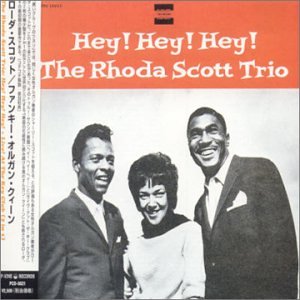
Hey! Hey! Hey! was released on Tru-Sound, as were the two 45 RPM singles, "Fly Me to the Moon" / "In My Little Corner of the World," and "Sha-Bazz," parts 1 and 2. Ozzie Cadena produced.
Rhoda Scott does not have the same name recognition as other soul jazz organists of her generation, but that's only true if you confine your attention to this side of the Atlantic. Shortly after recording two Prestige sessions, she set sail for France, where she has lived and performed ever since, and where she has become a major star.
This first date in Englewood Cliffs was a brief one, so I'll make this brief, and treat Scott at greater length later on. She recorded four songs with a quartet and vocal group. The second session was just the quartet. Two of the songs from June made
the album that was completed in October; two were released separately on a 45 RPM single. Both the LP and the 45 are credited to the Rhoda Scott Trio, never mind the number of musicians who actually played, and the album is titled Hey! Hey! Hey!, although that song is only on the 45.
The Shouters are presumably the same Buddy Lucas vocal group that recorded for Prestige in April, but augmented here with a male voice (perhaps Lucas; the individual singers are not identified here). If it's an entirely different group called the Shouters, then we have a really odd coincidence, because the combo that recorded with Lucas for Prestige in April, included trumpeter Joe Thomas, not to be confused with tenor saxophonist Joe Thomas who played on this set, although both were born in the same year (1909). had solid careers as swing era musicians, and died within a couple of years of each other in the 1980s.
"Hey! Hey! Hey!" and "If You're Lonely" were the 45, released on Tru-Sound, as was the album.
Willis, Jack, and Bill, back again, and proving once more that they know how to play the music folks want to hear.
And proving once again what a blessing it was that Bob Weinstock decided to sign up musicians like Jackson and Hal Singer, bringing what had been marginalized as rhythm and blues into the main stream of jazz, into the recording cathedral of Rudy Van Gelder, and onto the long playing record.
The main difference between jazz and rhythm and blues, as I've said before, is basically the difference between the jukebox and the jazz radio broadcast, between the 45 RPM record and the LP. Give musicians like Willis Jackson, Jack McDuff and Bill Jennings eight minutes instead of three to play a tune like "Cookin' Sherry," and you get the full potential of rhythm and blues--room for three great soloists to open up, stretch out, and develop their solos without sacrificing any of that rhythm and blues intensity. You can dance your ass off to "Cookin' Sherry," or you can snap your fingers and listen to what the soloists are doing, what the two other principals are doing behind the solo, what Wendell Marshall and Bill Elliott are doing--all the things that make jazz the twentieth century's answer to chamber music, only hotter. Or any combination of the above.
"Cookin' Sherry," "Blue Gator" and "Tu'gether" are the three Jackson originals from the session, with composer credit for "Mellow Blues" given to the three of them. But this trio, although they would go their separate ways, made such tight, inventive and listenable music together that you wouldn't go far wrong in thinking of them as the MJQ of gutbucket. On all of these numbers they each have solos that complement the others as though they shared one mind or set of guts, while still expressing irrepressible individualism.
They do right by other people's compositions, too. Jackson shows his ballad side on "Try a Little Tenderness," which comes in at just under six minutes and is mostly him, although Jennings contributes a sensitive and unusual guitar solo. Jimmy Dorsey's "Contrasts" brings rhythm and blues to swing, or vice versa, and why not?
Esmond Edwards produced. The session was split up and sprinkled over three albums. "Blue Gator" was on its eponymous album along with "Try a Little Tenderness." "Cookin' Sherry" was also eponymous, joined by "Contrasts" and "Mellow Blues." "Tu'gether" didn't quite manage eponymity, but close. It was on the album called Together Again. Three two-sided 45s came out of the session: "Cookin' Sherry," "Blue Gator" and "Tu'gether."
Listening to Prestige Vol. 3, 1957-58 now includes, in its Kindle edition, links to all the "Listen to One" selections. Available from Amazon.
Jack McDuff's second outing as a leader for Prestige takes him out of the Willis Jackson-Bill Jennings orbit, and playing with an ad hoc group featuring veteran Jimmy Forrest and relative newcomer Lem Winchester (who has done an organ-sax-vibes session before, with Oliver Nelson and Johnny "Hammond" Smith), with a youngater, Bill Elliott, rounding out the quartet on drums. It's a good amalgam. The solosists are able to find common ground--a couple of common grounds,in fact. On the standards--"Mean to Me" and "Autumn Leaves," they're melodic. On a McDuff original like "Yeah Baby," they know how to let loose and blow.
Both "Mean to Me" and "Autumn Leaves" are taken at sprightlier tempos than one is used to hearing, and why not? The falling leaves of autumn don't always have to be an occasion for wistful sighing. You can play in them too, rake them up into a big pile and jump into them. Forrest takes the main job of the melody in this one, and does some very nice things with it, particularly at the end, where brings some wonderful smeary bluesy sounds to a melody not previously known for its affinity to the blues. "Mean to Me" is slyly playful, and again, why not? "You're so mean to me" can be a tease as well as a plaint. Winchester does some particularly strong solo work on this one.
"Yeah Baby" is nine minutes long, and gives each of them, including drummer Bill Elliott, a chance to shine. This is Elliott's recording debut, the start of a career that was always interesting, but only rarely in the field of jazz drumming. For a while he led a soul group, which is remembered chiefly as the
launching pad for one of its backup singers, Dionne Warwick. During the 1970s, she and Elliott were married, divorced, married again, and finally divorced again. Elliott also had some success as an actor, debuting on TV with a featured role in Dragnet, and then appearing as a recurring character in Bridget Loves Bernie. He also made a few movies, including Elvis Presley's Change of Habit.
The quartet is unusual in that it doesn't include a bass. The line that would normally be played by the bass is handled by McDuff himself on the Hammond,
The album, a 1960 release, was called Tough 'Duff. "Yeah Baby" was a two-sided single.




:format(jpeg):mode_rgb():quality(90)/discogs-images/R-1117504-1406556023-9665.jpeg.jpg)

