Tad Richards' odyssey through the catalog of Prestige Records:an unofficial and idiosyncratic history of jazz in the 50s and 60s. With occasional digressions.
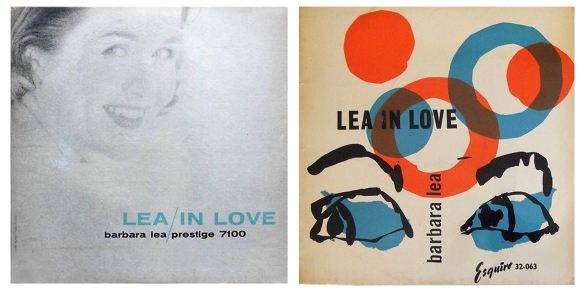
This is the last Barbara Lea session, three more songs to fill out the Lea in Love album, with her backing group changed just a little. Trumpeter Johnny Windhurst, who worked with Lea a lot, and was on her first Prestige sessions, is back. Dick Cary stays on alto horn here, and Jimmy Lyon on piano. This time they go without a drummer.
New to the mix is harpist Adele Girard. There aren't all that many jazz harpists, and most of them are women, although the first person to use the harp as a jazz solo instrument was a man, Casper Reardon, and probably the most famous American harpist was a man, too: Harpo Marx. There aren't all that many jazz harpists because it's not always easy to see how a harp fits into a jazz context. Corky Hale and Alice Coltrane are probably the best known. Adele Girard probably should be. Her "Harp Boogie" may be the best jazz harp tour de force ever. She doesn't do that kind of soloing on this session, but she adds nice stuff to the mix.
Lea did four songs on this day three of which made the album, and the fourth was not only unissued, but there's no record of what it was. Two that did make the cut are by Cole Porter. "You'd Be So Nice To Come Home To" has become a jazz standard, beloved by vocalists and instrumentalists alike.
"True Love" was written for the movie High Society, where Bing Crosby sings it to Grace Kelly, and she chimes in a little on the last chorus. This was enough to put her name on the label, and it became Princess Grace's only gold record. There really aren't any other jazz recordings of it (although there's a very weird one by Beatle George Harrison). Is there something about it that says Pop, not jazz? Lord knows Cole Porter has provided many many highlights of the jazz repertoire. But there's not much that says Jazz in the Barbara Lea version, either, although it's a beautiful pop song, and Lea, as always, understands the lyric and delivers it sensitively.
"A Straw Hat Full of Lilacs" is the real show stopper here, partly because it's so obscure. I can't find any other recording of it. The lyric was written by Peggy Lee (who as a 17-year-old appeared on a radio show called Hayloft Jamboree as "Freckle-faced Gertie," wearing a trademark straw hat), but there's no record of Lee ever recording it. The music was by Willard Robison, known for the hauntingly sad "A Cottage For Sale," and this song has some of the same haunting melancholy. If I were a contemporary jazz singer (Teri Roiger, are you listening?), I would take this song and Annie Ross's "The Time Was Right," another neglected gem, and add them to my repertoire.
"Straw Hat Full of Lilacs" was the flip side of a 45, with "Mountain Greenery" as the A side, as well as being on Lea in Love.
What's important about these growth years for Prestige? The first great Miles Davis quintet albums. The Modern Jazz Quartet forming and making the records, like Django, that they're still remembered for. The early John Coltrane, playing with Bobby Jaspar or Kenny Burrell or Jackie McLean, or matched against two baritone saxes, finding and growing his genius.
Hell, yeah. But no. The answer is it's all important. Musicians coming into the record store of a 19-year-old kid who loved jazz and was inspired by a Thelonious Monk record played for him by Alfred Lion to start his own record company. Hey kids...we've got a barn...we've got all this talent...let's put on a show!
A girl from Detroit who grew up listening to the French light operas composed by her great-uncle, who sang with dance bands until she got a music scholarship to Wellesley, graduated, came to New York, made a 78 for a tiny label with some very good trad jazzmen -- Cutty Cutshall, Eddie Barefield, Peewee Erwin -- then found herself on two of the hottest modern jazz labels in New York, first Riverside, then Prestige, for whom she went out to Hackensack and Rudy Van Gelder's studio twice in 1956 (winning Down Beat's best new singer award), then four more times in 1957. Then a long hiatus, during which she worked as an actress and a teacher, until the late 1970s, when people started remembering that here was a singer who cared deeply about the best American popular songs, and could interpret a great lyric like no one else.
And, as always, every session is different, and the story of the leader on the date is only part of the story. Barbara Lea had recorded five days earlier with a trio. On April 24th and 26th she was back in the studio with a seven piece band. It included Dick Cary, who played on all of her sessions, and Prestige veteran Jimmy Raney.
It included some of the finest accompanists of jazz and popular singers. Jimmy Lyon was best known as Mabel Mercer's accompanist, but also worked with June Christy, Polly Bergen and Connie Haines. Beverly Peer began his career with Ella Fitzgerald in the Chick Webb orchestra, and also worked with Sarah Vaughan, Lena Horne, Johnny Mathis, and Barbra Streisand. Osie Johnson played on a session with Dinah Washington.
And it also included a musician with a truly remarkable career, one that began before some of the musicians on this session were born, and continued into the modern jazz, and even the free jazz era. Garvin Bushell recorded with some impressive female vocalists too: Mamie Smith, who recorded the first blues record ever made, and Ethel Waters. He was a member of the Louisiana Sugar Babies with Jabbo Smith, Fats Waller, and James P. Johnson. He worked
with Fletcher Henderson, Cab Calloway and Bunk Johnson. And, jumping ahead, he recorded with Miles Davis, John Coltrane and Eric Dolphy. His autobiograpy, Jazz From the Beginning, is must reading for every jazz fan. And here's a video of an interview with him, talking about those early days.
Lea called upon the services of some of the greatest songwriters in that American Songbook. Cole Porter, Rodgers and Hart, Harold Arlen and Johnny Mercer (for the obscure and wonderfully titled "Sleep Peaceful, Mr. Used-to-be") and others. She had the services of some wonderful musicians and some very interesting arrangements. And she delivered.
All of these were issued on the Lea in Love album. "Mountain Greenery" became a 45, along with "A Straw Hat Full of Lilace" from a subsequent session.
April 19 was a busy day at the Van Gelder studio. After Mal Waldron's sextet had finished up, Barbara Lea came in with a trio and recorded four songs, only two of which ever made it to vinyl. Had to say why. The unissued two were "Aren't You Glad You're You?" and "Ain't Misbehavin'," and a good singer, two good songs...what could have gone wrong?
She was back a week later to record a bunch more, this time with a septet. The link between the two dates, besides Lea, was Dick Cary, who had also played on her first two Prestige sessions. Not so surprising: you get a good accompanist, like Cary, and you want to keep him at the keyboards where he knows what you want and how to give it to you. A little more surprising: Cary played the piano on this session, but a very different instrument on the others.
Her sessions of the previous fall covered two days, and on the first one he played the little heard (and not very imaginatively named) alto horn. The piano player was the not very imaginatively pseudonymed Richard Lowman, otherwise known as Dick Hyman, who certainly would not be the low man on anyone's totem pole, but for whatever reason was not back the next day, so Cary doubled on alto horn and piano. And for Lea's final Prestige outing, a week after this one, Jimmy Lyons took over on piano and Cary went back to the alto horn. Barbara Lea's Prestige albums were also released in England on the Esquire label, where they might have identified Cary's instrument by its British name, the tenor horn.
Lea was riding high in 1957. She had won the Down Beat International Critics' award for Best New Singer in 1956. She was a little off the beaten path for Prestige, leaning more toward traditional than modern, but she was always worth listening to.
Both of these songs were included on the Lea in Love album. She sings "Autumn Leaves" in both the original French and the later English version, honoring two writers of distinction: the French poet Jacques Prevert (also the author of the screenplay for Les Enfant du Paradis) and Johnny Mercer.
A poem by Prevert was the inspiration for a poem of mine which was also set to music, by Fred Koller, so I'll toss that in here too.
I was sitting with Margaret Whiting one day when she got a call from the organizers of the Kool Jazz Festival, asking her if she'd perform.
"But I'm not a jazz singer," she said. "I only sing the melody."
"We know," the festival guy said, "and do you know how hard it is to find someone who can really do that?"
What is a jazz singer, exactly? Someone who improvises around the melody? What about Frank Sinatra? Some would call him one of the greatest of all jazz singers, and he pretty much sang the melody, although he did improvise around the beat.
Some people, most notably Mel Tormé, have said that "jazz singer" is an oxymoron, there's no such thing as a jazz singer.
But if there is, what makes a jazz singer? Why is June Christy a jazz singer and Jo Stafford not? Why is Peggy Lee sometimes a jazz singer and sometimes not? How about Eartha Kitt? Why was Rosemary Clooney not a jazz singer until she was one? It was said of Sarah Vaughan, whose jazz credentials even Mel Tormé would have a hard time denying, that she used her voice like a horn, but what does that mean, exactly? Annie Ross sang dizzyingly difficult jazz solos, but in a way she was singing the melody -- a melodic line established by an instrumentalist like Wardell Gray. Her famous version of "Twisted," a jazz classic, has been covered by non-jazz singers like Bette Midler, or does singing "Twisted" make Midler a jazz singer? Edie Hart was a jazz singer, but she only sang the last few bars of songs, and then only when Peter Gunn was in the room.
It doesn't get any easier if move into the contemporary postmodern world, where you can probably be everything if you set your mind to it, like Amy Winehouse or Cassandra Wilson or Esperanza Spalding.
Google "what makes a jazz singer a jazz singer," and you get not much of any definitions at all, but you do get advice to aspiring jazz singers, and that advice boils down to: listen to a lotta jazz.
So is a jazz singer someone who sings and listens to a lotta jazz? That's hard to quantify.
So I'll offer this as a definition: a jazz singer is a singer who sings with jazz musicians.
And even that isn't enough. Connie Kay played drums on most of Atlantic's rock and roll sessions, but that didn't make those performers jazz singers. Margaret Whiting is a self-described non-jazz singer (although she did play that Kool Jazz Festival, and knocked 'em dead), but her greatest hit and signature song, "Moonlight in Vermont," was recorded with Billy Butterfield.
So I'll revise my definition. Taking off from the "listen to a lotta jazz" advice, I'll say that a jazz singer is someone who sings with a lotta jazz musicians.
I suppose even that is dodgy. Margaret Whiting recorded "Moonlight in Vermont" with Billy Butterfield and his orchestra, but not really. It was Les Brown's dance band, but for contractual reasons they couldn't use Brown's name.
Which brings us to Barbara Lea, who came into Rudy Van Gelder's studio for two consecutive days
to record a group of songs with a jazz group led by Johnny Windhurst, although the supporting personnel changed between one day and the next. And what makes her a jazz singer, and a very good one, is that she sings with jazz musicians, and connects with them. You can feel the chemistry. This comes through on every song, but if you really want to hear her interacting with jazz musicians, listen to "My Honey's Loving Arms" or "I'm Coming Virginia."
The session is a little unusual for Prestige, especially in the mid-50s, in that the musicians are essentially old school, which was generally Lea's choice. And if it wasn't to Bob Weinstock's mainstream taste, it was an inspired detour. The album was critically acclaimed, and Lea was named Best New Vocalist of the year by Down Beat, which tended to be more than a little snobbish about what was jazz and what wasn't.
Her first New York recording session was two songs released on the Cadillac label (not the Chicago label that later became Chess) in 1954, with a band led by Eddie Barefield, Pee Wee Erwin, and Cutty Cutshall. In 1955 he recorded for Riverside, with a band that included Billy Taylor regulars Earl May and Percy Brice. The songs were included on an album that threw together a hodgepodge of groups,
and came out under Mundell Lowe's name.
Then the Prestige sessions, and she would record for them through 1957, after which her recording career would come to a standstill until the late 1970s, when she made a number of records for Audiophile over the next decade, and Whitney Baillett declared in The New Yorker that "Barbara Lea has no superior among popular singers."
The groups on both of the October sessions are led by trumpeter Johnny Windhurst, with whom Lea worked frequently. Windhurst's career went back to 1944, when Sidney Bechet tapped him to replace Bunk Johnson in his group. Trad jazz giant Ruby Braff has listed him as his major influence. He's little remembered today, partly because he was a trad jazzer after trad jazz had mostly faded into critical irrelevance, partly because he seemed not to have wanted the spotlight. He left New York and moved upstate to Poughkeepsie, in my native Hudson Valley, where he lived with his mother and played in the house band at Frivolous Sal's Last Chance Saloon. Frivolous Sal's, which later became The Chance, one of the Hudson Valley's major music venues, was a place where they played Dixieland jazz and the waiters wore ersatz Gay Nineties outfits. In short, the kind of place that I would not have been caught dead at, which means I missed hearing a great trumpet player. The moral
of this story -- don't turn up your nose at any place that plays live music, especially with musicians who are a little older.
The October 18th session featured Richard Lowman on piano. "Richard Lowman" was a pseudonym -- if you think about it for a minute, you can probably figure out for whom. Ready? Thinking?
.......
Dick Hyman.
Only four songs were recorded the first day: "Baltimore Oriole," "I Had Myself A True Love," "Nobody Else But Me" and "Thursday's Child."`Perhaps Van Gelder had to spend some adjusting for the presence of a vocalist, because the next day they came back and did eight more.
On the 19th, Lowman/Hyman had bowed out, and Dick Cary, who had played alto horn (not to be confused with alto sax) the first day, doubled on horn and piano. He was equally adept at both instruments. He had made his first mark as a pianist in 1947, when a promoter wanted to present Louis Armstrong, who had been leading a big orchestra for years, in a small group setting, including Jack Teagarden and Bobby Hackett. Cary was the rehearsal pianist. Armstrong didn't actually show up for any of the rehearsals, and on the night of the first performance at Town Hall, there was no one else, and Cary stayed on piano. That turned out to be the beginning of the Louis Armstrong All-Stars, and when they began booking regular gigs, Armstrong remembered "the kid who did the concert," and Cary became the All-Stars' first piano player. His first recordings on alto horn were with Billy Butterfield, and he also played trumpet at Eddie Condon's. According to his obituary,
Unlike the Dixielanders, he was a progressive musician and his apartment became the centre for jam sessions with players like Zoot Sims, Bob Brookmeyer, Bill Evans and Jimmy Raney. From 1956 he worked in the progressive band led by Bobby Hackett.
Al Hall and Osie Johnson were the rhythm section on both sessions, and both were respected music veterans who could play bebop as well as older styles. Hall is best known for his work with Errol Garner, but he also played bebop with Bud Powell, swing with Teddy Wilson, and rock and roll with Frankie Lymon and the Teenagers. Johnson also moved deftly between swing and bebop, no mean feat for a drummer since the demands were so different, and he was a favorite of jazz singers (whatever that means) like Carmen McRae and Dinah Washington.
The second session adds Al Casamenti on guitar, and he had, if anything, an even wider range, from easy listening (Enoch Light) to rhythm and blues (King Curtis) to rock and roll (Screamin' Jay Hawkins) to jazz (Billy Taylor, Wes Montgomery) to Latin (Tito Puente) to pop (Johnnie Ray, Frankie Laine -- including "Rawhide") to jazz singers (Ella Fitzgerald). His lead-in to "My Honey's Loving Arms" is particularly tasty.
The Prestige album is self-titled.
I've had to skip over an album recorded by Herbie Mann in Sweden because I can't find it anywhere.
 see how a harp fits into a jazz context. Corky Hale and Alice Coltrane are probably the best known. Adele Girard probably should be. Her "Harp Boogie" may be the best jazz harp tour de force ever. She doesn't do that kind of soloing on this session, but she adds nice stuff to the mix.
 "True Love" was written for the movie High Society, where Bing Crosby sings it to Grace Kelly, and she chimes in a little on the last chorus. This was enough to put her name on the label, and it became Princess Grace's only gold record. There really aren't any other jazz recordings of it (although there's a very weird one by Beatle George Harrison). Is there something about it that says Pop, not jazz? Lord knows Cole Porter has provided many many highlights of the jazz repertoire. But there's not much that says Jazz in the Barbara Lea version, either, although it's a beautiful pop song, and Lea, as always, understands the lyric and delivers it sensitively.