Tad Richards' odyssey through the catalog of Prestige Records:an unofficial and idiosyncratic history of jazz in the 50s and 60s. With occasional digressions.
Bluesville is gone, but Prestige is not quite done with the blues, so here is Lightnin' Hopkins back in the studio for two days, and two albums' worth of songs.
The details of many early blues recordings under hastily thrown-together conditions and often for obscure fly-by-night labels are shrouded in mystery, but this is hardly an early recording or a fly-by-night label, and a certain amount of confusion abides.
Wikipedia's entry for for the first-released album,
Down Home Blues, lists it as a Bluesville release, and gives a catalog number, BVLP 1086. Stefan Wirz, the German blues discographer, lists it in his Bluesville discography, with a catalog number of 1086. Jazzdisco, the Japanese jazz discographical site, lists it as a Prestige release, catalog number PR 1086.
Wirz's illustrated discography shows the album cover, and the same album cover can be found on the Wikipedia site and the Discogs site, so it would seem to be the only album cover. All of these covers bear the Prestige logo and not the Bluesville logo. Further, the Discogs site also shows the back cover, with the Prestige logo and the words Prestige 1086. Which should settle the matter...except...
Prestige has no PR 1000 line. And Prestige Bluesville did, and BVLP 1086, were it anywhere on the label or the packaging, would fit quite nicely into it, as the last Bluesville recording (save only BVLP 1089, the belated release of a 1961 session with Scrapper Blackwell protégé Shirley Griffith).
The rest of it is fairly straightforward. Well, maybe not. The sessions were recorded in New York City (Jazzdisco) or Englewood Cliffs (Wikipedia) with Ozzie Cadena producing (Discogs) or Sam Charters (Wikipedia). The sleeve of Soul Blues lists Ozzie as producer.
Chris Albertson, a frequent Prestige producer who wrote the liner notes to both albums, says that:
The rhythmic accompaniment is supplied by bassist Leonard Gaskin who has recorded with Hopkins before but whose wide range of musical associations also include Miles Davis, Dizzy Gillespie, Charlie Parker and Eddie Condon, and drummer Herbie Lovell who counts Earl Hines, Arnett Cobb, Teddy Wilson and Buck Clayton among his past associates.
Which would seem to suggest that Gaskin and Lovell are once again recording with Hopkins. But The Penguin Guide to Blues Recordings posits that "Gaskin and Lovelle's parts were probably added at overdub sessions." That would not have been Prestige's normal way of doing things.
The recording took place over two days, with all of the songs that would appear on Down Hone Blues and some that were destined for Soul Blues recorded on May 4, and the rest on May 5 -- Monday and Tuesday.
Hopkins was probably the most-recorded of all the country blues singers, under his own name and a variety of others. He has appeared on seven earlier Prestige recordings -- as a solo, with other Houston bluesmen, with New York jazz musicians. One would have to be awfully dedicated to collect everything he ever recorded. But if one wanted to start listening to Hopkins, or add a little to an ongoing collection, any of these Prestige recordings would be good. These two albums, or the Double Blues reissue put out by Fantasy on LP or CD, with Rudy Van Gelder's sound engineering, would be excellent.
Two 45 RPM singles came from this session: "Let's Go Sit On The Lawn" / "I Like To Boogie" and "I'm Going To Build Me A Heaven Of My Own," Parts 1 & 2.
Sonny Stitt had recorded a soul jazz album (with Jack McDuff) for Prestige in September of 1963, and then moved over to Latin in November with an album for Verve, featuring a young Chick Corea in at the beginning of his career (he had made one earlier recording with Mongo Santamaria) and Latin percussionists. For this New Year's Eve celebration of an album, whoever decided on the the title--Primitivo Soul!--seems to have been trying to bring the two together, which is legitimate. The Latin element is once again in the ascendent here, but Stitt is always soulful. And most of the tunes here are his, and while the percussionists give them a delicious Latin rhythm, Stitt can hardly be described as a Latin composer.
Stitt comes by his soul credentials organically. Regarded by many as the quintessential bebopper and heir to the mantle of Charlie Parker, Stitt cut his blues teeth with Tiny Bradshaw, and the blues was always at the heart of his playing. And in a era marked by the startling experimentalism of the free jazz players, Stitt preferred to stay close to the source. "I don't like strange music." he told a Down Beat interviewer (quoted on the liner notes to Prmitivo Soul!):
I'm not on "Cloud Nine." Music should be a flowing melodic thing. I think you should always be around the basic melody. Improvise, but stick to the basic melody. Bird was always 85% to 90% around the melody.
Stitt had been one of Prestige's mainstay recording artists throughout the 1950s, most frequently paired with Gene Ammons, another bebopper who loved the melody, and played the blues. But outside of his long association with Ammons, he preferred to keep moving, and to play with a wide variety of musicians. Here he links up with newcomer Ronnie Mathews, fresh from his debut as leader, and the veteran rhythm tandem of Leonard Gaskin and Herbie Lovelle. To that basic group are added two percussionists, Marcelino Valdez on congas and Osvaldo "Chihuahua" Martinez on bongos.
At this point in jazz history, Latin percussionists were still pretty anonymous to the jazz listening public as a whole--Down Beat had still to recognize "percussion" as a separate category in its annual jazz polls--but these two were certainly known to the Latin community, having worked with Ray Barretto, Willie Bobo and Mongo Santamaria, among others. Martinez, who also appeared on Stitt's Verve album, was featured on Santamaria's classic "Watermelon Man."
The two non-Stitt compositions on the date are "Slave Maidens," by Nato Lima, writing under the pseudonym Mussapere, and "Estrellita," by Manuel Ponce.
It's hard to imagine an instrumental composition being entitled "Slave Maidens" today (just as it's hard to imagine an album of any form of world music being labeled "primitivo"), but the choice of tune is certainly a good one. Nato Lima was one of the two brothers, both guitar virtuosos, who formed the Brazilian folk/classical duo Los Indios Tabajaras, and had a huge stateside hit with their arrangement of a Brazilian folk tune, "Maria Elena." Manuel Ponce was was a composer primarily in the classical field, educated in Europe at the École Normale de Musique. Like his fellow student, Brazilian Hector Villa-Lobos, he was a pioneer in creating a composed music based on the indigenous folk traditions of his country. "Estrellita" has not become ubiquitous in the jazz repertoire, but it has won the attention of some major figures, with recordings by Benny Goodman, Charlie Parker, Dave Brubeck and others. Stitt had also recorded it the previous June for Impulse!
The rest of the session is devoted to tunes written by Stitt for the date, and blending bebop, blues and Latin. Ronnie Mathews contributes some fine solos. Sonny Stitt was one of the most prolific of the major jazz soloists, and his explorations, and his collaborations, cover a wide range. We can only be grateful that these sojourns south of the border were included.
Jimmy Witherspoon was the most eclectic of blues singers. In that, he reminds me of Jerry Lee Lewis, who could and did take songs from every genre of American popular music, and -- without perverting their essence--turn them into Jerry Lee Lewis songs. 'Spoon did much the same, taking schmalzy pop, Delta blues, urban rhythm and blues, Kansas City Blues (he had four years with Jay McShann to internalize that genre), and making them into Witherspoon blues. When he joined McSha, early in his career, he replaced the hugely popular Walter Brown. McShann, Witherspoon would reminisce, told him there were three songs that had become signature songs for Brown: "Confessin' the Blues," "Hootie Blues" and "Lonely Boy." Audiences would
expect to hear them the way Brown sang them, and Witherspoon was to sing them just the Brown had. Beyond that, he was on his own, and he could find his own interpretation. Which is what he did with McShann, and what he did for the rest of his career.
This session shows the full range of Witherspoon's eclecticism. He starts out with Big Bill Broonzy's "I Had a Dream." Broonzy was from the Delta, but had built a career as a jazz guitarist in Chicago during the 1930s-40s. Then when folk music became popular in the 1950s, Broonzy reinvented himself as a "folk blues" artist. "Folk blues" was a term with wandering definitions. Sometimes it was synonymous with "country blues," which referred to the acoustic, primarily guitar-based blues of the Mississippi Delta and other rural regions, distinct from the "classic blues" of Bessie Smith and other jazz-based performers. In the 1950s it meant, more or less, the blues singers who played the folk festival and coffee house circuit, to largely white audiences. In the 1960s, as the rhythm and blues musicians from Chicago and Detroit, largely centered around Chess Records, began to decline in popularity with black audiences, while at the same time the sound they had pioneered was sweeping the globe as interpreted by young British musicians, the Chess brothers made a move to market their electric blues sound to a new audience by issuing a series of records by Muddy Waters, Howlin' Wolf and others entitled The Real Folk Blues.
Big Bill Broonzy reached his peak of popularity as a folk blues performer and composer. His best-known composition, "Black, Brown and White," took on racial prejudice, but "I Had a Dream," also known as "Just a Dream," ran it a close second, with shifting lyrics in different performances, but the same song at root. Witherspoon had recorded it earlier with Ben Webster, for Frank Sinatra's Hollywood-based Reprise Records; here he gives a straight, pretty much folk blues reading, albeit with some first rate jazz musicians following his lead.
It's jazz all the way with Count Basie's "Goin' to Chicago," brought into the 1960s and organ-based soul jazz by King Curtis organist Paul Griffin.
"You Made Me Love You" is a music hall tune from 1913, written by James Monaco and Joseph McCarthy and popularized by Al Jolson, later to become a beloved classic when sung by Judy Garland in Meet Me in St, Louis. Witherspoon gives it his best blues crooner rendition.
"My Babe" and "Around the Clock" are from two of the leading figures of the golden age of rhythm and blues in the 1940s and 1950s, Little Walter Jacobs and Wynonie Harris. "My Babe" was a huge hit and Little Walter's signature song, "Around the Clock" lesser known but still tasty. 'Spoon knows how to sing that rhythm and blues.
"S.K. Blues" is from 1942, the beginning of that golden age, when it was a hit on the Race Records charts for Saunders King. There have been a lot of blues singers named King, and Saunders may not have been as well known as B. B., Albert or Freddie, but he deserves to be. "S. K. Blues" became a hit again in 1945, in perhaps the definitive version by Big Joe Turner, with a band including Pete Johnson, Don Byas and Frankie Newton, and it became a favorite of Witherspoon's, who first recorded in 1959, and was to record it for a third time in 1967 with Brother Jack McDuff. "S. K. Blues" is a singer's song--you can put your individual stamp on it without distorting it, and Witherspoon does just that.
"Goin' Down Slow" is from the same era. Like Saunders King, St. Louis Jimmy Oden is not remembered as well as he should be. And as with King, if he's not quite remembered, his most famous song certainly is. "Goin' Down Slow" has been recorded by nearly everyone who ever sang the blues
(including a reprise on Prestige by St. Louis Jimmy in 1960), and it's had instrumental jazz treatments by Hank Crawford and Archie Shepp. This is just a great song. Singers love to sing it, audiences love to hear it, and Witherspoon does it justice. It's another one that he has recorded a number of times: with Eric Burdon, with Ben Webster, with Robben Ford, and with Duke Robillard.
Finally, the session included three originals by Witherspoon, himself no slouch as a blues composer,
Ozzie Cadena produced the session. The Prestige LP was entitled Blues Around the Clock. It spun off two 45 RPM singles, "I Had a Dream" / "S. K. Blues" and "You Made Me Love You" / "Goin' to Chicago Blues."
Back in February of 1962, Prestige put Sonny Stitt and Jack McDuff together, that time along with Gene Ammons. Stitt was already considered one of the legends of jazz, going back to Charlie Parker and bebop's golden days in the 1940s. Ammons was probably Prestige's most consistent seller, and McDuff one of its hottest new stars. In a way, they represented three generations of jazz styles, although they were very close to the same age.
When Stitt and McDuff got together again in September, Ammons was already in prison on drug charges; but, as with the previous session, the
legend was the center, the hot new guy the support. McDuff had his own tight-knit group, with drummer Joe Dukes, considered by many to be the pulse of soul jazz, and a young George Benson, a future supernova in the jazz world. Instead, the quartet was filled out with two solid professionals--the versatile Leonard Gaskin, and the perhaps even more versatile Herbie Lovelle. Lovelle was becoming one of the drummers Prestige liked to call, with six previous sessions for the label. But calls for his sticks and brushes were far-flung, and by the time he was finished, he had played drums for everyone from Hot Lips Page to Teddy Wilson to Bob Dylan to the Monkees.
So this is essentially a Sonny Stitt album. Stitt is everything one looks for in a jazz legend--swinging, melodic, inventive, endlessly listenable. McDuff, even in his solos, is a part of that sound--tasteful, not overpowering, yet still individualistic.
And soulful. We can't forget soulful. The name of the album is Soul Shack, and the title track, composed by Stitt but certainly with McDuff in mind, is the soul highlight of the session, with the two of them getting free to get down, and never let up.
Three of the tunes chosen for the album are much-recorded standards dating back to the 1920s-30s, played by this group with fond familiarity, but given their own stamp. "Sunday" was written by Chester Conn in 1926, and has had 500-odd recordings, most often by vocalists, but with many pure jazz variations, from the original version by Jean Goldkette through Benny Carter, Gerry Mulligan and Ben Webster, Tommy Flanagan and Jaki Byard. "For You" comes from a Mack Sennett movie in 1930 and has also entered the lexicon of American song, from jazz vocalists to Ricky Nelson, as well as a few jazz interpretations. "Love Nest" also dates back to 1930, and as Dan Morgenstern comments in his liner notes, "most modernists race through this as though it were an establishment built for rabbits, but not so Sonny...he sets a calm yet springy pace...Jack McDuff waxes lyrical."
"Hairy" and "Shadows" were also written by Stitt, and "Shadows" is a blues and pure beauty, with lyrical playing by both Stitt and McDuff.
Soul Shack was a Prestige release, Ozzie Cadena producing. I can find no record of A 45 RPM single, unusual for a McDuff session of the time, but YouTube has a three minute edit of the track, so maybe there was a single.
Red Holloway first came to Prestige as part of a large ensemble put together by Oliver Nelson for a Gene Ammons session, then appeared on a session with Brother Jack McDuff, with whom he was to remain for several years. But Bob Weinstock liked his stuff, both musically and commercially, enough that he was to bring out four albums with Holloway as leader over the next few years, with an emphasis on "jazz with a beat" -- the liner notes to this album emphasize, a touch melodramatically, that this music has a good beat and you can dance to it.
Although he was born in Arkansas, Holloway was a true musical son of Chicago, where his family moved when he was still in school. He attended DeSable High School, that cradle of jazz education, where one of his classmates was Johnny Griffin. He left Chicago for the army, but returned to
spend his formative years there, playing with a wide range of musicians. He was active in Chicago's blues and rhythm and blues scene, joining Roosevelt Sykes's band, and playing with Chuck Berry, Willie Dixon, Junior Parker, Lloyd Price, and Bobby Bland. He accompanied a range of visiting jazz stars, including Dexter Gordon, Yusef Lateef, Ben Webster, Sonny Rollins, Wardell Gray, and many more. He worked with vocalists -- Billie Holiday, Dakota Staton, Joe Williams, Aretha Franklin. He toured with Sonny Stitt, Memphis Slim, and Lionel Hampton.
And all of this -- the rhythm and blues, the modern jazz, the entertainers, the soul jazz -- can be heard in Holloway's own sound, making him a good fit for Jack McDuff, and a good bet for recordings under his own name. To quote the teenage record reviewers on Dick Clark's American Bandstand, Holloway's records had a good beat. You could dance to them.
Holloway first brought a group to Rudy Van Gelder's studio on August 27. It was a quiet time (for Prestige, not for Rudy, who rarely had down time) between the two Gildo Mahones sessions, but even so, they did not spend much time with Red. He recorded two tunes, one a standard "Moonlight in Vermont") and one an original ("Miss Judie May").
Some of the musicians on this date shared a Chicago connection. Thomas "Tiaz" Palmer worked with a number of Chicago doowop and rhythm and blues groups as well as jazz groups, and in the 1980s would reunite with another ex-Chicagoan, Amina Claudine Myers, for a recording. He also toured and recorded with the Coasters frequently. Trumpeter Hobart Dotson was a music veteran, having been a member of Billy Eckstine's big band in the 1940s. He had also been a stalwart on the Chicago jazz scene, recordint with a number of groups.
Bob Durham also had his start in doowop, working with the Orioles at 16, He went on to a long and distinguished jazz career, highlighted by an an association with Norman Granz that found him playing with many of Granz's artists, including Oscar Peterson, whose regular drummer he was through much of the 1960s.
But two sides were all that this group cut, and only one of them was used. "Miss Judie May" was shelved, to be recorded again when Holloway convened a completely different group on October 10.
This one was anchored by two Prestige mainstays, Leonard Gaskin on bass and Herbie Lovelle on drums. The other players were all new--and again, relying on his Chicago connections.
Paul Serrano made his mark on the Chicago music scene not only as a trumpeter but also as a recording engineer. After playing with Woody Herman, and appearing on hundreds of recordings for Chess and other Chicago-based record labels, Serrano opened his own South Side P. S. Recording Studios in 1966. In 1992, as he began to suffer from Parkinson's disease, he closed his studio and went to work for Delmark Records as their head engineer. Ramsey Lewis, who recorded frequently with Serrano, remembered that "being a musician, he knew what the instruments were supposed to sound like." Lewis also recalled Serrano's generosity with musicians who couldn't afford to pay.
Big John Patton, like many organists, started on piano, accompanying Lloyd Price as a teenager. Switching to organ in the 1960s, he cut two records with Lou Donaldson, then served an apprenticeship of sorts with Jimmy Smith, playing tambourine on an early session by the soulmaster. By the middle of the year he was fronting his own group for Blue Note. He became one of their soul jazz stalwarts throughout the decade, then had a resurgence of his career in the 1980s with avant-gardist John Zorn.
This is a very early session for guitarist Eric Gale (he had made his Prestige debut on a King Curtis session), who wouldn't really hit his stride until the 1970s, when he became one of the most sought-after session guitarists around. His recordings with supergroup Stuff are some of the best examples of 1970s jazz-funk.
The album was released on Prestige as The Burner. "Monkey Sho' Can Talk" and "Crib Theme" were the 45 RPM single, the latter a rare composition credit for Ozzie Cadena, who produced both sessions.
Sam "Lightnin'" Hopkins recorded any time, anywhere, with any musicians, for any label, and for that matter, under any name. Throw in all the nom de session recordings, and the total is anyone's guess, but he may well have been the most recorded of all blues singers. His last time out for Prestige, he was recorded in Texas with local musicians, some of them his road band at the time, and produced by folklorist Mack McCormick. This time he's in New York -- Englewood Cliffs, New Jersey, to be precise -- with Rudy Van Gelder manning the controls, Ozzie Cadena producing, and two first rate jazzmen, Leonard Gaskin and Herbie Lovelle, backing him up.
Both were versatile musicians, at home in a variety of styles. Closest to Gaskin's heart was probably trad jazz, and Lovelle possibly rhythm and blues, but both had played across the board (they'd played together once before, on Gaskin's Prestige All Stars outing). Hopkins's last session had featured Texas drummer Spider Kilpatrick, who was praised in the liner notes to an Arhoolie album:
Finally here was a musician who could follow Hopkins wherever he went, plus one providing a snappier beat that the guitarist could hang phrases of a bit more aggressive nature than usual on.
That was not going to be the case with Gaskin and Lovelle. The Penguin Guide to Blues Recordings describes their accompaniment thus:
they are propulsive rather than responsive and never allow the music to drag.
Either way, it's still Lightnin' Hopkins: clever, wry, passionate, deep in the tradition, and an inexhaustible source of material, much of it made up on the spot, all of it deeply personal, and yet touching on universal themes.
Hopkins, of course, recorded so prolifically that listening to everything he ever recorded would be a Herculean labor. But just listening to the Bluesville recordings reveals a lot. The musical standards of jazz are exacting in the extreme. The cutting sessions in Kansas City speakeasies, at Minton's Playhouse, were designed to weed out all but the most technically adept. The story of a young Charlie Parker being forced off a Kansas City bandstand by Jo Jones throwing a cymbal at him is one of jazz's most enduring legends. So it's understandable that a jazz critic, praising the work of Gaskin and Lovelle, would comment on their ability to "follow his ramshackle, instinctual sense of rhythm quite dexterously, giving Hopkins' skeletal guitar playing some muscle." Hopkins's guitar playing had plenty of muscle, as the instrumentals on this session and the previous Houston session show. More to the point, Hopkins's professionalism is shown in his ability to adapt to the seat-of-the-pants accompaniment of his Texas cronies and the exacting standards of New York jazzmen.
Naturally, pros like Gaskin and Lovelle are going to set the tempo, "propulsive rather than responsive" in the Penguin Guide's wonderfully descriptive phrase. As Elvin Jones put it,
The greatest contribution jazz has made in music has been to replace the role of the conductor with a member of the ensemble who, instead of waving his arms to keep time and convey mood, is an active member of the musical statement. That person is the drummer.
But like the conductor, the drummer is there to serve the music, and the soloist. If you want Lightnin', it's wonderful to hear him in two such different settings. But essentially, if you want Lightnin', you get Lightnin'.
Goin' Away was a Bluesville release, and the two 45 RPM singles that came out of the session were also on Bluesville: "Business You're Doin'" / "Wake Up Old Lady" and "Goin' Away" / "You Better Stop Her." Jazzdisco, my main discographical source, began with its 1963 listings to include release dates, so I know that both the singles were released in 1963, and apparently quite close together: their serial numbers are Bluesville 45-823 and -824.
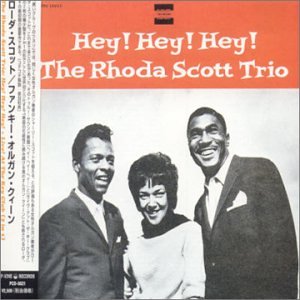
This is the continuation of Rhoda Scott's June 29th session, filling out her first Prestige album. We don't know if she kicked off her shoes when she sat down at the Hammond B3 in Rudy Van Gelder's Englewood Cliffs cathedral of recorded sound, but we can assume that she did, as that was the only way she felt comfortable at the organ. That was true when she was a barefoot kid first sitting down at the organ in her father's church--or any one of several churches, as the African Methodist Episcopal Church sent him where he was needed. It may have been true when she was getting her Master of Music degree from Manhattan School of Music, although they may have cracked down harder on the formality. It was certainly true in Europe, where she built a career of international stardom,
and where she continues to play to acclaim at festivals, theaters and arts venues, as "l'organiste aux pieds nus."
She started playing professionally when, as she told Marc Myers of JazzWax,
a guy in my church choir asked me to fill in for the piano player in his band. I told him that I didn’t know how to play that kind of music. He said it didn’t matter, he just needed someone...It turned out I knew all of the songs in their book from listening to the radio, so I had no problem.
When she started her own group in Newark, it was with Joe Thomas and Bill Elliott. The trio quickly caught on, and caught the ear of Ozzie Cadena. She also caught the ear of Count Basie, who hired to play at his Harlem night club. Stardom was beckoning, but so were her studies at the Manhattan School of Music, and the Masters degree won out. Stardom would have to wait until she arrived in Europe--at first also to study, with Nadia Boulanger.
Leonard Gaskin, usually a bassist, takes over on guitar for this session, but otherwise her group is the same Joe Thomas on tenor sax, Bill Elliott on drums. Scott favors a more straight-ahead style than the all-out funk of Brother Jack McDuff, and the contrast is enjoyable.
Hey! Hey! Hey! was released on Tru-Sound, as were the two 45 RPM singles, "Fly Me to the Moon" / "In My Little Corner of the World," and "Sha-Bazz," parts 1 and 2. Ozzie Cadena produced.
Leonard Gaskin, New York City born and bred, found his way to Minton's and Monroe's early in the bebop era, and at age 24 followed Oscar Pettiford as bassist in Dizzy Gillespie's quintet. He played on some of Miles Davis's first recordings as a leader, recorded with Charlie Parker and Stan Getz. But as time went on he seemed to gravitate toward an earlier form of jazz, and his only two recordings as leader, both for Swingville, reflect that.
Jazz and its different forms have been known by a variety of names, not all of which caught on, not all of which are particularly endorsed by their practitioners. "Jazz" itself is rejected by many of the finest players of
this American music, while others guard the name against presumed barbarians at the gate, like Louis Armstrong castigating bebop as "Chinese music," or Eddie Condon, dismissing the beboppers with "We don't flat our fifths, we drink 'em." One well-known and well-esteemed jazz musician said of Ornette Coleman, "Whatever it is, that ain't jazz."
Or sometimes maybe it isn't used at all. In The Benny Goodman Story, the word "jazz" is never used once. Nor is the word "swing," for that matter. Steve Allen, as Benny, talks about wanting to play "hot music" and have his "hot music accepted.
Other apellations just didn't stick. For a time, the music that came to be known as bebop was called "New York music," and I've always thought it was kind of a shame that that didn't catch on. Afro-Cuban jazz was also called Cu-bop, and maybe that was too cute by half.
And then there's Dixieland, a name used by the white ensemble who cut the first jazz record, back in 1917. A number of Black musicians from New Orleans had joined the Great Migration northward to Chicago, the most famous among them being King Oliver and Louis Armstrong. A number of white musicians were to make that same trek, because there was an audience for the music. They played on their New Orleans roots by calling their ensembles Brown's Band from Dixieland, or Stein's Dixie Jass Band, or -- the group that traveled from Chicago to New York, and ended up making that first record--the Original Dixieland Jass Band, later to become the Original Dixieland Jazz Band.
So it was this group that first popularized jazz beyond the nightclub audience in a few major cities, and who really brought the name into common parlance--and who also struck the first salvo in the ongoing culture war over the proposition that American music -- blues, jazz, and all their descendants -- are an African American art that has been stolen by whites.
And this is mostly true. I don't know how true it is on the musician level. Real musicians play music, and jazz musicians are consummate crafters who devote their lives to getting good enough, and remaining good enough, to be allowed into the colloquy that is jazz music. Louis Armstrong cited cornetist Nick LaRocca of the ODJB as one of his inspirations. But it is absolutely true on the business end. It's no accident that the ODJB, and not King Oliver or Fate Marable, was signed to make the first commercial jazz recording.
But if the white musicians who named their bands after a term which glorified the old South of slavery were not being consciously racist, they didn't have to be. Racism was such a part of their era that it was accepted without much conscious thought. In any event, the term, like the music it described, declined until the 1940s, and the revival of traditional jazz which began when journalist and music lover Heywood Hale Broun went down to New Orleans to record the still-active keepers of that tradition, and New Orleans musicians such as Bunk Johnson came to New York and recorded. This neo-traditional music, based on New Orleans and Chicago styles of the early decades of the 20th century, took the name of the ODJB and began to coalesce under the name Dixieland jazz. By then, there was at least somewhat more social awareness, and there were some who found the name offensive (and the music bland and uninteresting), but the most popular purveyors of this faux-nostalgic music called themselves the Dukes of Dixieland.
The Dukes were never very highly regarded in jazz circles, although Pete Fountain, Jim Hall and Herb Ellis played with them at one time or another. And they were pretty solidly white, although Louis Armstrong did sit in with them on a couple of occasions. And their musical imitators, who wore straw hats and striped blazers and conjured up images of a mythic and genteel Old South, were also all white.
But the musical tradition of New Orleans and Chicago was real, and though "Dixieland" had pretty much been relegated to football halftime shows, county fairs and Kentucky Derby festivities, there were real musicians, both black and white, who still honored those traditions, and it was just such a group of musicians that were gathered by Leonard Gaskin for this session.
It was very much Gaskin's session, and he is listed as "leader" in the session log, although that's not normally noted. Immersion in the tradition is emphasized by the selection of material, even including one tune ("At the Jazz Band Ball") from the ODJB's original sessions.
As the free jazz revolution started to take hold, it was good to be reminded of where jazz had come from--and to be reminded that jazz's evolution had been so rapid, that these still-vital, still-creative oldtimers were playing side by side with the Cecil Taylors and Albert Aylers. Sometimes literally side by side--Garvin Bushell, who had played with Bunk Johnson and Fletcher Henderson, would also play with Eric Dolphy,
Doc Cheatham, Vic Dickenson, Buster Bailey,Dick Wellstood, Herbie Lovelle and Gaskin have all appeared on Prestige sessions before, the first four on earlier Swingville releases. Lovelle backed up King Pleasure on a 1952 session. Gaskin was very active for Bluesville, working with a wide variety of blues singers, but he had also played on two of Prestige's earliest bebop sessions, one with J. J. Johnson and the other with Miles Davis.
Trumpeter Yank Lawson was one of those who continued to embrace the Dixieland moniker, and created, with bassist Bob Haggart, an ensemble that managed to achieve popularity on the Dixieland/nostalgia circuit while still playing music a jazz fan could take pleasure in. He began his career with Ben Pollack's orchestra in 1933, then worked with Bob Crosby, Benny Goodman, and Tommy Dorsey. He and Haggart formed the Lawson-Haggart band in the 1950s, disbanded, and then rejoined forces in 1968 to create the modestly named World's Greatest Jazz Band, which had a solid decade's run of popularity, and included Cutshall, Dickenson and Wellstood at various times.
Trombonist Cutty Cutshall played with Benny Goodman, Billy Butterfield and Louis Armstrong, but his longest association was with Eddie Condon, with whom he was still touring when he died in 1968.
Clarinetist Edmond Hall came by the tradition naturally, being from a family of New Orleans musicians. His most important association was with Louis Armstrong, but he had a pretty strong pedigree before joining Armstrong, starting with his first recording session, in 1937, with Billie Holiday and Lester Young. He played with Claude Hopkins, Lucky Millinder, Zutty Singleton, Joe Sullivan, Henry "Red" Allen, Teddy Wilson, and Eddie Condon, among others, and was co-leader of the house band at the original Cafe Society in New York.
The recording date began with Lawson,Cheatham, Cutshall and Hall joining the rhythm section for "Tin Roof Blues," a tune that goes back to 1923 and the New Orleans Rhythm Kings, a white group of New Orleans-to-Chicago musicians, and "Muskrat Ramble," written in 1926 and first performed by Louis Armstrong.
"At the Jazz Band Ball" is the ODJB tune, written by Nick LaRocca and other members of the group in 1917, and featuring the entire nine-piece band. The whole album is a pleasure to listen to, but on this tune in particular they really let rip, its 6:19 length giving everyone a chance to shine.
After that, Lawson, Cheatham, Cutshall and Hall pack it in, and Dickenson and Bailey take over for "Mack the Knife," the one modern tune, but it fits right in with the mood; "Hindustan," written in 1918 by Oliver Wallace, who a quarter century later would win an Academy Award for Dumbo; and "Keepin' Out of Mischief Now," a Fats Waller tune that's almost modern, having been first performed by Louis Armstrong in 1932. It really does sound from a different era and mind set than the other tunes on the album, even "Mack the Knife."
Swingville released the album as At the Jazz Band Ball by the Leonard Gaskin All Stars, but actually all it says on the front cover is the title and subtitle: A Dixieland Sound Spectacular, so Dixieland as a label was not dead yet. A later CD rerelease on a different label kept the title but named the group the Swingville All Stars.
Jimmy Oden wasn't St. Louis's most famous blues export to Chicago--that would be Chuck Berry--but he was the one whose name identified him with the city, although he had actually been born in Nashville. Moving to the Gateway City in the 1920s, he entered a musical partnership with Roosevelt Sykes, and they dominated the St, Louis blues scene for a decade, sufficiently that when the two of them moved to Chicago, he brought the city's name with him, and kept it for the rest of his career. He had begun as a piano player, but perhaps because of his association with the piano virtuoso Sykes, he came to concentrate on vocal performance and songwriting. He
wrote a couple for Muddy Waters, and Waters and Sunnyland Slim backed him up on some of his early recordings.
Like another songwriter/vocalist, Percy Mayfield, he is mostly remembered for his songs, especially "Goin' Down Slow," a hit for him on the race records charts in 1941 which went on to become one of the most widely recorded of blues standards. It has been recorded by Chicago blues royalty--Little Walter, Howlin' Wolf, James Cotton, and by acoustic folk blues singers like Mance Lipscomb , Sonny Terry/Brownie McGhee, and Memphis Slim. Ray Charles recorded it twice, once in his early West Coast days and once in the 1960s on a blues album for ABC-Paramount. Jazz versions included Jimmy Witherspoon with Ben Webster. Rhythm and blues stars like Little Junior Parker, Bobby "Blue" Bland and B. B. King recorded. Across the Atlantic, it was picked up by Alexis Korner, the Animals, ex-Animal Alan Price, Procol Harum and others. Movie stars have recorded it (Danny Glover). And new versions are still being recorded, most recently by Dee Dee Bridgewater (jazz) and Peter Frampton (rock).
Also like Percy Mayfield, his career had been spiked by a serious auto accident, in 1957. So this, his first album session, was also his first since recuperating from the accident.
Oden's voice had the rawness we associate with Chicago blues, but it also had a bit of a silken quality--again like Percy Mayfield, but still more Chicago raw than West Coast smooth. And he was used to working with the aggressive, take no prisoners style of the best Chicago bluesmen.
He had one of them on this session--Jimmie Lee Robinson, who had worked the Shakey Jake Harris date for Ozzie Cadena and Prestige just two days earlier. Pianist Robert Banks also comes over from the Shakey Jake session, and plays a much more featured role than he did with Harris. That had been full steam ahead electric guitar and mouth harp blues, this features a more sophisticated
arrangement, built mostly around Banks's piano--similar to the original 1941 version on Bluebird, although Oden's voice has also developed in sophistication over the years.
Listening to Prestige Vol. 2, 1955-56, and Vol. 3, 1957-58 now include, in the Kindle editions, links to all the "Listen to One" selections. All three volumes available from Amazon. The most interesting book of its kind that I have ever seen. If any of you real jazz lovers want to know about some of the classic records made by some of the legends of jazz, get this book. LOVED IT. – Terry Gibbs And Listening to Prestige Vol. 4 is not far off!
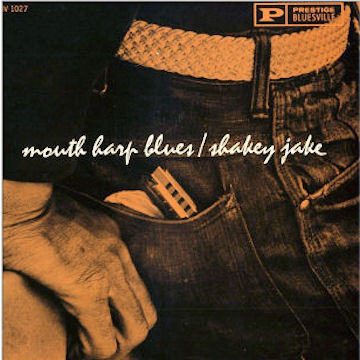
Shakey Jake Harris's first Prestige outing put him together with two of the label's soul jazz all stars, Jack McDuff and Bill Jennings. This time he's given Robert Banks, who has played keyboards on a wide variety of blues recordings for Prestige, and Leonard Gaskin, one of the label's most reliable bassists. But the real sound here is pure Chicago, with Harris's harmonica and vocals, Jimmie Lee Robinson's guitar, and John "Junior" Blackmon's drums.
Prestige had used Robinson once before, on Al Smith's first album, where he also worked with Robert Banks, but this is his real wheelhouse. He was a Chicago bluesman, playing with Freddie King, Little Walter, Howlin' Wolf and Harris's nephew Magic Sam, before retiring to a certainly blues-traditioned career: running a Chicago neighborhood candy store. Blackmon was also from Chicago, and considered a reliable session man for blues recordings. Between the three of them, they bring pure Chicago to Englewood Cliffs, in the style of Magic Sam or Jimmy Reed, but very much his own man.
The songs are mostly by Harris. There's one by Armand "Jump" Jackson ("Angry Lover"), another Chicagoan, and one by producer Ozzie Cadena ("Things Are Different Baby"). There's an unusual instrumental ("Jake's Cha Cha"), a slower and soulful instrumental
("Mouth Harp Blues," which is Robinson's even more than Harris's, and has some nice piano by Banks), and a lot of solid Chicago blues, the sound that had fired up the rhythm and blues charts in the 1950s, and would rule the world as it began to be discovered by a younger generation in far-off England. Shakey Jake would never cash in on the popularity of Chicago blues the way some of his contemporaries did, but he would have a solid career, as musician, nightclub owner and crapshooter.
Mouth Harp Blues is the title of the album.
Listening to Prestige Vol. 2, 1955-56, and Vol. 3, 1957-58 now include, in the Kindle editions, links to all the "Listen to One" selections. All three volumes available from Amazon. The most interesting book of its kind that I have ever seen. If any of you real jazz lovers want to know about some of the classic records made by some of the legends of jazz, get this book. LOVED IT. – Terry Gibbs And Listening to Prestige Vol. 4 is not far off!
Curtis Jones was another blues veteran who had a career in the 1930s, recording for Bluebird, Vocalion and Okeh, all of them budget labels (cheaply pressed, cheaply sold) specializing in race record, then faded from the recording scene sometime in the early 1940s, then resurrected a career in the Chicago folk music coffee houses in the 1950s. He was a little unusual for the folkie coffee house scene in that the tended to favor guys who played portable instruments like guitars, and Jones was a piano man, although he had started out on guitar, and could certainly have returned to it if that was where his bread and butter lay. A working musician does what he has to.
But Chicago had always had a blues piano scene, starting with Leroy Carr and including the likes of Memphis Slim and Champion Jack Dupree. And it was a good town for finding the kind of bluesmen that Bob Weinstock wanted to bring to New York--traditional blues with a touch of jazz thrown in--although Jones didn't stay long. He recorded the one album for Prestige Bluesville, then one back in Chicago in 1962 for Delmark, a latecomer to the jazz and blues independent label scene. Then he headed east again, but didn't stop until he got to Europe, where he would spend the rest of his life, dividing his time between the continent and Morocco.
Bluesville's producer Ozzie Cadena put Jones together with organist Robert Banks, veteran of several Prestige blues sessions, and Johnny "Moose" Walker, a Chicagoan and another fine blues piano player/organist. Organ and piano are pretty well covered for this session, though, so Walker, who also played bass for Muddy Waters. is heard on guitar. The primary instrumental voice, however, belongs to Jones's piano, and he really is one of the top notch blues stylists on the instrument.
Jones's biggest hit in the 1930s was "Lonesome Bedroom Blues," a 1937 recording for Vocalion. He reprises it here, and it would become the title cut for his Delmark album. The title cut for this one is "Trouble Blues," co-writing credit given to Jones and Cadena. Cadena is credited as sole composer for "Please Say Yes," which breaks away from the traditional 12-bar-blues structure often favored by Jones, and uses verse-chorus in a manner reminiscent of Ray Charles. He goes to Armand "Jump" Jackson for two songs, and to Pinetop Smith for "Pinetop's Boogie" (left off the original album, included on the CD reissue). The rest are all his own. Jazzdisco only has "NYC" as the location of the recording studio, while Wikipedia puts it at the Van Gelder studio in Englewood Cliffs.
Listening to Prestige Vol. 2, 1955-56, and Vol. 3, 1957-58 now include, in the Kindle editions, links to all the "Listen to One" selections. All three volumes available from Amazon. The most interesting book of its kind that I have ever seen. If any of you real jazz lovers want to know about some of the classic records made by some of the legends of jazz, get this book. LOVED IT. – Terry Gibbs
Lightnin' Hopkins is back, this time without Sonny Terry, although again with the rhythm section of Leonard Gaskin and Belton Evans is still there;
With Ozzie Cadena producing the session and Rudy Van Gelder at the controls, this is one of the best of the myriad recordings Hopkins produced in his lifetime. The material is familiar--songs by Hopkins, and three blues standards by others which Hopkins had performed often and recorded not infrequently--but here they're heard to their best advantage, and the reason why Hopkins lasted so long, and recorded so often, is that he was very good. This is the blues the way you want to hear it.
The originals are all good. The covers are songs that have become blues standards. "Mean Old Frisco" was written by Arthur "Big Boy" Crudup, and first recorded by him in 1942. It was covered in the 1940s by Brownie McGhee and Champion Jack Dupree, in the 1950s by Snooks Eaglin and B. B. King (both in 1959). Since then, it's become not only a blues standard, but a jazz tune, recorded by both Richard "Groove" Holmes and Junior Mance.
The others have more confused provenances. "Come Back Baby" was written and first performed in 1940 by Walter Davis. It was hit for him on the race records charts, and then became a hit again in 1950 with Lowell Fulson's version. That began its ascent to standard status, but it was really locked into the consciousness of the blues audience and blues performers with the Ray Charles version in 1954, the flip side of his big hit "I Got a Woman." Charles' version was brilliant, inspired, and...with composer credit somehow slid over to Charles.
Since then it's had a double life. It's been recorded by B. B. King, Mance Lipscomb, Snooks Eaglin, James Cotton and others as a straight ahead blues. By white blues revivalists like Dave Van Ronk, Danny Kalb and Charlie Musselwhite. By folkies like Carolyn Hester (with Bob Dylan on
Harmonica), Bert Jansch and Fred Neil. By rockers like Hot Tuna and Jefferson Airplane. Even by present-day rockers like the Lords of Altamont and the Black Sorrows...all as "Come Back Baby" by Walter Davis. It has also been recorded by Stevie Wonder, Junior Parker, Aretha Franklin, Eric Clapton, Etta James,and many others, with jazz versions by Les McCann and George Benson...all as "Come Back" by Ray Charles.
"Back to New Orleans" is credited on Hopkins' Bluesville disc to Sonny Terry and Brownie McGhee, who were Bluesville artists at the time, but where it comes from is anyone's guess. It's more often called "Baby Please Don't Go," and was probably first recorded in 1934 by Big Joe Williams. Hiw often it's been recorded since, and under what titles...pretty close to impossible to guess. French blues historian Gérard Herzhaft (quoted in Wikipedia) reckons that it is "one of the most played, arranged, and rearranged pieces in blues history." It's essentially a traditional blues with origins lost in the past. Williams gets composer credit on his original Bluebird release.
Taken all together, this is a seriously satisfying immersion in the blues. The Bluesville release was called Lightnin', and a Prestige re-release was The Blues of Lightnin' Hopkins.One 45 was released on Prestige -- Mojo Hand" / "Automobile Blues," and three more on Bluesville:
Arbee Stidham was commencing a second career with this album, and although he was only 43, it was three decades after the start of his first career. From a musical family -- his father played with Jimmie Lunceford and his uncle with the Memphis Jug Band -- he had started his own band, the Southern Syncopators, by the time he was thirteen. Not too many 13-year-olds start there own band; fewer still get booked to tour with Bessie Smith, but Stidham did.
As a jazz musician, he toured with his own band, first in the south and then in Chicago, and played with Lucky Millinder in the 1930s-40s, . A recording contract in 1947 yielded a hit recording, "My Heart Belongs to You," which went to number one on the Billboard Race Records chart (later to become the Rhythm and Blues chart) in 1948.
Stidham was a tenor saxophone player as well as a vocalist, and thought of himself primarily as a jazz musician until injuries suffered in an auto accident left him unable to play the saxophone.
But, determined to persevere in music, he took up the guitar and became a bluesman. He was aided in this by fellow Chicagoan Big Bill Broonzy, who had undergone a metamorphosis of his own. Originally a jazz guitarist, Broonzy had discovered the newly emerging folk music circuit, and had reinvented himself as a folk blues singer, and as a songwriter of major importance. Following Lead Belly's example of tailoring the blues to appeal to a new audience of white leftists, he wrote a number of protest songs, from the ironic "WPA Blues" to the anthemic "Black, Brown and White."
Stidham learned his new instrument well, and added to his gifts as a blues singer and songwriter, it created new opportunities: a couple of singles for Atlantic subsidiary Abco in 1956, and then this album debut for Prestige Bluesville, followed by a 1961 album for Folkways, and a Folkways collaboration with Jazz Gillum and Memphis Slim that came out under Gillum's name. Then another recording drought until the early 1970s and two more albums, one for Mainstream, primarily a jazz label, and the other for Folkways. The 1970s also saw him venture into the academic world, as a lecturer on the blues at Cleveland State University.
There's plenty on this session to delight a blues lover who may not have heard Arbee Stidham before, and much for a jazz lover to appreciate. King Curtis sits in on saxophone, and on piano, the South Side soul of Chicagoan John Wright, who first recorded for Prestige in August, and would do four more sessions.
Wright is a dominant payer on a seven-minute version of Brownie McGhee's "Pawn Shop Blues," where his piano improvisation stretches out a normally song-length 12-bar blues into something else altogether. Stidham does mostly originals here, but features a few from other composers--why, it's hard to say. "Pawn Shop Blues" is a very good song, and favorite part of McGhee's repertoire, but melodically it's an interchangeable 12-bar blues. I guess it's a nice piece of change in Brownie's pocket, except that nobody ever made any money from having a jazz composition recorded, as Jackie McLean found out when he looked into suing Miles Davis for the composer credit to "Dig."
Two Big Joe Turner songs, the familiar "Wee Baby Blues" and the less familiar "Last Goodbye Blues" are also included, as is a song by drummer Armand "Jump" Jackson, "Teenage Kiss," which sounds more as though it would be given to Frankie Lymon than a fortyish blues singer, and in fact it does give King Curtis room for some hot rhythm and blues honking on the tenor. All in all, it's a fine outing for Stidham, especially if you don't listen to the words too closely, and you really don't have to. I once had a friend who told me that she loved the blues, but she really never listened to the words. I said. "That's like loving Rubens but not noticing the nudes." She said, "I do that too."
The others are all Stidham originals, including a remake of "My Heart Belongs to You," here retitled
"My Heart Will Always Belong to You." Stidham, for a latecomer to the guitar, sure knows how to play the blues on it. And as a veteran jazzman, he knows how to coordinate his blues with a couple of jazz greats. I've picked "You Can't Live in this World by Yourself" as my "Listen to One" because it shows off all of the above -- Stidham as songwriter, guitar player and blues singer, some nice ensemble work by Wright and Curtis.
And for a bonus, if you click through to the YouTube video, it's accompanied by some amazing street photographs -- by whom, I don't know.
Ozzie Cadena produced. The album came out on Bluesville, titled Tired of Wandering.
Listening to Prestige Vol. 2, 1955-56, and Vol. 3, 1957-58 now include, in the Kindle editions, links to all the "Listen to One" selections. All three volumes available from Amazon. The most interesting book of its kind that I have ever seen. If any of you real jazz lovers want to know about some of the classic records made by some of the legends of jazz, get this book. LOVED IT. – Terry Gibbs
Sonny Terry is sprung loose from his usual partnership with Brownie McGhee, and paired with a different blues guitar man. Lightnin' Hopkins was an altogether different proposition. From Texas, he was not at all of the Piedmont school of Blind Boy Fuller-influenced finger picking. He got something from serving as an on-and-off lead boy for Blind Lemon Jefferson on the streets of Houston, and by playing on the streets. He bounced back and forth between playing music, picking cotton, and working on the railroad, until in 1946 he was offered a recording contract by Aladdin Records in Los Angeles (one of his songs on that session was "Rocky Mountain Blues," which he would record again for Prestige). That began a long, strange recording Odyssey for
Hopkins, which made him, by the time he was finished, the most recorded blues musician of all time. Nobody knows how many records he made, or for how many labels? Eight hundred? A thousand? More? You pays your money and you takes your choice.
The first heyday of his recording career lasted from 1946 to 1956, the rhythm and blues years, and the small independent record label years. with a style that was loose, rough, not too overly concerned with time signatures or even staying in tune, but always powerful and authoritative. He was limited in developing a name for himself in that he didn't much like to travel and he didn't much like to leave Houston, but he left a remarkable legacy of recorded music. And he wasn't through yet.
In 1959, he was discovered by Samuel Charters, the first of the
white scholars to take a serious interest in the blues. Charters, who was married to literature professor and Beat Generation scholar Ann Charters, was particularly interested in the richness of blues lyrics. As he put it, "I really got bored with all those damn guitar solos. To me, they all sounded like B.B. King, and what I really wanted to hear was great text."
Hopkins was a perfect choice for Charters. At a time when the blues was going electric, and guitar solos were starting to dominate, Hopkins still played acoustic, and with all those recordings he made, often of the same songs over and over, he would find subtle and improvised variations on the lyrics. Filmmaker Les Blank recalls one such improvised lyric:
You make your bed hard, baby,
and calls it ease.
The blues is just a funny feelin’,
yet some folks calls it a mighty bad disease.
This line was composed late one night while I was filming what started out to be an ordinary interview. I had asked him to tell me what the blues meant to him. He picked up his guitar and started to sing about a woman named Mary who had left him. Earlier that evening his wife had left him after a nasty argument that caused her cousin to attempt to shoot Lightnin’. While the song was being sung, the cousin was lurking outside the apartment door with a loaded pistol. Lightnin’ also had a large loaded gun stuck down the front of his pants. Hardly a situation in which to delve into an academic and linear exploration of the nature of truth and the blues, but I came away feeling I knew a lot more about it than before, but I couldn’t exactly put it in words.
Charters was one of the first to ignite the new interest in the blues that would grow into the blues
explosion of the 1960s, with blues festivals and new recordings. His interest in Hopkins led to a second career for the old bluesman, one that Hopkins himself was reluctant to enter. He had played all his life for black audiences, and was almost completely unknown to whites (not completely--I had his 45 RPM recording of "Good Old Woman" on the Harlem label). But this was suddenly to change. His first appearance, on a bill with young white urban folkies to the Houston Folklore and Folk Music Society, was a huge success, and before long he was appearing in New York on a bill with Pete Seeger and Joan Baez. and recording for new record companies that made LPs and marketed them to white audiences.
Like Bluesville, where he was teamed up with Sonny Terry, a bluesman who had thrived for some years in New York, playing for whites, and put under the supervision of a white producer, Ozzie
Cadena. It was an odd pairing. Terry, no less authentic a bluesman, was technically more organized, and was used to playing with musicians like Brownie McGhee who were similarly more structured. An odd pairing, but not a bad one. Each knew enough to let the other do his thing, so although the same musicians--Terry, Hopkins, bassist Leonard Gaskin and drummer Belton Evans--were there for the whole date, it was really two separate sessions, with Terry front and center for the first one, and Hopkins taking center stage for the second.
There were similarities between the two, beyond a deep familiarity with the blues. While it's probable that no bluesman has ever been as prolifically recorded as Hopkins, Terry was no stranger to the recording studio. And he, too, had often recorded variations on the same material.
Terry begins his session with "One Monkey Don't Stop the Show," one of many songs to have been written under that title. The first recorded version was by Brownie's brother Sticks McGhee, with whom Terry had also recorded, including a Prestige session just two weeks previous. McGhee's "One Monkey Don't Stop No Show" bears no relation to Terry's. His is actually a reworking of a song he and Brownie McGhee performed regularly, and recorded more than once, called "Better Day." Both songs had the same verse-chorus structure, the same melody, and the same theme--things are bad, but that's all right, because they'll get better.
To the early blues musicians, authorship of lyrics was not that important, which is why there are so many "traveling lyrics," verses that pop up in one blues after another -- and part of the reason why their descendants in the 1950s were often a little too casual about nailing down lyricist credit for a song, leading to later lawsuits over the ownership of hits like "Earth Angel" and "Why Do Fools Fall in Love." Guitar styles were a different story. Charley Patton was way ahead of Jimi Hendrix with flamboyant tricks like tossing his guitar in the air, playing with his teeth, playing behind his back. Partly it was showmanship, partly it was so that no would would quite be able to figure out what he was doing. Something not dissimilar was done with Fats Domino's recordings, which were ever so slightly speeded up -- partly to make them faster and livelier for the rock 'n roll crowd, but also so that they were not quite in any key, and couldn't exactly be duplicated.
So both of these blues masters knew a million songs, which were inexhaustible variations on a hundred or so songs, and both of them bring their mastery to this session. And if they weren't exactly made for each other, it would be hard to prove it by either Sonny is King or Last Night Blues. They are two very different sessions, each of them rewarding in its own way.
One unusual cut that showcases both of them is "Lightnin's Stroke," from the Hopkins album, a mostly instrumental number that features guitar, harmonica, and a little lick from "When the Saints Go Marching In."
Sonny is King featured songs from this session and a later one, produced by folklorist Kenneth S. Goldstein. Last Night Blues had a couple of rereleases, as Gotta Move Your Baby on Bluesville and Got to Move Your Baby on Prestige. The Prestige 45, b/w "Sinner's Prayer" (not the Lowell Fulson song also covered by Ray Charles), was "Got to Move Your Baby," Other 45 RPM releases from this session, also combined with tracks from other sessions and released on Bluesville, were "The Walkin' Blues" / "Last Night Blues" and "Hard To Love A Woman" / "Back To New Orleans."
Listening to Prestige Vol. 2, 1955-56, and Vol. 3, 1957-58 now include, in the Kindle editions, links to all the "Listen to One" selections. All three volumes available from Amazon. The most interesting book of its kind that I have ever seen. If any of you real jazz lovers want to know about some of the classic records made by some of the legends of jazz, get this book. LOVED IT. – Terry Gibbs
This was Mildred Anderson's second and last album for Prestige, and after that...nothing. Nothing at all. Never recorded again for another label. There is virtually no record of her existence after this session, not even an obituary. I can find no record of where or when she was born. There is only a small handful of recordings, best documented by the French novelist and blues scholar Gerard Herzhaft in his blog, Blue Eye. A 78 RPM single with Albert Ammons, another one with Hot Lips Page and one with Bill Doggett, that last one in 153. Then nothing till the two Prestige sessions, and then nothing. Herzhaft offers this
further information sent to him by blues scholar Bob Eagle:
Post-recording info re Mildred Anderson: Mildred and Hortense worked together at the Key Club, 1325 Washington Street, Minneapolis, Minnesota during April 1961, backed by Gene (Bowlegs) Miller and his band. Mildred married Philadelphia-based businessman Bob Freeman in about September 1961. Hortense Allen was also involved with Rufus Rockhead at Montreal, Quebec, Canada, during July 1962, also featuring Mildred Anderson. Mildred almost lost her voice in the 1960s. In November 1970, having recovered her voice, she substituted for Candy Rae at Cyrus Scott’s Sahara Supper Club, Philadelphia.
And that's it. Of the people named by Eagle: Gene (Bowlegs) Miller was a trumpeter whose resumé stretches back as far as working with Ma Rainey, but his biggest success as a bandleader came in the 1960s. He is credited with discovering and launching the careers of Peabo Bryson and Ann Peebles. But his whole career seems to have been centered in Memphis, so what he was doing in Minneapolis it's hard to say. Rufus Rockhead opened his jazz club, Rockhead's, in Montreal in 1928, and until it closed in 1980, it was the jazz club in Montreal. Everyone who was anyone played there, so if he booked Mildred, it shows that someone was still paying attention. The only Hortense Allen I could find was Hortense Allen Jordan (married Mr. Jordan in 1955), a choreographer who created and worked with an African-American chorus line, so she might have brought Mildred from Minneapolis to Montreal. The Sahara Club in Philadelphia featured local jazz talent, of which there was an abundance, but I can find nothing on Candy Rae. So maybe she was settled in Philadelphia, happily married to Bob Freeman, and singing the occasional night when called upon to sub for a friend.
The Ammons recording, "Doin' the Boogie Woogie," was a minor hit. Her own composition, "No More in Life," a torchy ballad, was one of the Bill Doggett cuts, and is the title track for this album.
And it's impossible to say why. As a showcase for her talents, you couldn't ask for better than these two Prestige albums. The first, with Eddie "Lockjaw" Davis and Shirley Scott, was amazing, with two jazz musicians who were unparalleled in their approach to working with singer. And this one is pure gold. I love everything about it.
Her backing band is led by Al Sears, the tenorman who replaced Johnny Hodges with Chick Webb and Ben Webster with Ellington. and who led Alan Freed's stage bands for his all star rock and roll shows. His one earlier Prestige date was with the Swingville Allstars, co-led with Taft Jordan and Hilton Jefferson, and he would be back for a couple more Swingville dates.
Organist Robert Banks would do a lot of Prestige blues sessions. He was best known for his work in the 1960s with Solomon Burke. Guitarist Chauncey "Lord" Westbrook made his Prestige debut here. He was an active session man across the spectrum of jazz, pop and rhythm and blues.
Mildred Anderson takes on a broad spectrum of songs and handles them all in a way that is both direct and artful. Her first obligation is always to the song, and that means that simplicity and directness can take different forms, depending on the demands of the song. Her musicians do the same.
Her musicians? She was a nobody, with a career that had been not much of anywhere and was destined to go absolutely nowhere after this late summer day in 1960. Prestige had given her its A list of musicians for her debut album; for this one, musicians with not quite the same marquee value, although of undeniable quality, brought in for a gig. But yes, her musicians is what it feels like, because you get the sense of dedication to the song from all of them.
Here's a look at each, in the order in which they appear on the album.
She starts with a tune of her own composition, one of two on the album. Her first session, Person to Person, had also included two originals, which seems to suggest that Prestige was taking her seriously as an all-around talent, which once again makes you wonder what happened. "Everybody's Got Somebody But Me" is a torchy 12-bar blues with a bridge, a good, satisfying lament. It starts with a lengthy opening vamp by Banks with a solid backbeat by Gaskin and Donaldson that sets a modern, 1960 feel for a more traditional, 1940s-style vocal, all of which fits together. Al Sears comes in for a searing instrumental break in which he interacts with Banks's organ in much the same way Anderson has been interacting with it, and then she comes back with powerhouse final verse to tell the world in no uncertain terms that it's a lowdown dirty shame the way her lover treats her.
"I Ain't Mad at You," credited Count Basie, Freddie Greene, and Milton Ebbins, a music business professional who was Basie's manager, and whose own musical background suggests that he was a lot more than just one of those guys who slaps his name on someone else's work. He was highly respected in the industry, and he was also the guy who escorted Marilyn Monroe onstage at Madison Square Garden to sing "Happy Birthday, Mr. President," and how many of us can make that statement? This is a classic riff and vocal line, put together in a song first by Dwight "Gatemouth" Moore in 1943, then by Jesse Price in 1946. Basie, Ebbins and Greene take a songwriting--and given that Ebbins was involved, almost certainly a publishing credit. Well, why not? It's one of those traveling blues that comes up different every time someone does it, and credit was fluid back in that more innocent era. In any event, the riff pops up all over. It's interpolated into Sarah Vaughan's scat classic, "Shulie a Bop." It's the basis of Huey "Piano" Smith's "Roberta," also recorded by the Animals. And it becomes the refrain of a very strange patter song by Frances Faye, a daisy chain of unrequited lust, LGBTQS-style (that's Lesbian-Gay-Bi-Trans-Queer-Straight). In other words, it's about fun, even though the guy is every bit as rotten as the one in the previous song ("Just as soon as my back was turned / Another chick stepped in") and if anything, even worse. He takes out insurance on her, hoping that she'll soon die. Anderson and her boys know that a no-good, mistreating man can be funny as well as tragic, and they hit it, Basie-style.
Lord Westbrook steps forward on "Hard Times," another 12-bar blues, and Anderson gets into into it, answering the elaborate guitar-blues improvisations with some straightforward blues wailing. The song is credited to Esmond Edwards, so he must have been around, even though he does not take producer credit for the session, and it shows that you can have hard times even without a no-good man ("My rent is overdue, landlord is gonna put a padlock on my door / But it don't make no difference nohow, 'cause I ain't got no clothes no more").
So, the picture is starting to become clear. Anyone can take a straightforward approach to a song about a foggy day in which even the British museum has lost its charm, trusting in the musical and lyric genius of the Gershwins to carry the day. Anderson and her cohorts are finding the simple truth in songs where you have to look for it. Good songs. But not ones where half the work is done for you.
"No More in Life" is the other Anderson original, and she does seem to gravitate toward songs of lost love, this one with an "I Will Survive" vibe. It's short (2:42), showcasing the vocal, and it builds up to a belting finish.
"Roll 'em Pete" was written by boogie-woogie pianist Pete Johnson and blues shouter Big Joe Turner, and it's inextricably tied to them, although in latter years it's become a blues standard. Not so in 1960. It had been recorded twice more, once (superbly) by Count Basie and Joe Williams, once by Jimmy Witherspoon with Gerry Mulligan and Ben Webster. In other words, plenty macho stuff from some of the best male blues shouters. Anderson takes them on and comes out unscathed, using the new sound of the soul jazz organ instead of the Kansas City piano of Johnson or Basie. She takes the leering seduction invitation of "You're so beautiful but you've got to die some day / Gimme a little lovin' before you pass away" straight on--with a sliding note along "die" which will stop you in your tracks. Turner's happiness comes from his baby buying him a brand new choo-choo toy, which i s undeniably salacious. Williams--and Anderson follows his lyric--gets, instead, a Hydramatic kiddie car, which certainly must be salacious, because this is the blues, after all, and anything can be a metaphor for sex, but it's less clear how, exactly. Al Sears has an appropriately dirty solo, and this is one of the highlights of the album.
"What More Can a Woman Do? was written by Peggy Lee and her husband, guitarist Dave Barbour, so you might think Lord Westbrook would be stepping more out in front, but it's primarily Banks. Lee's version does feature Barbour's guitar, and it's cool where Anderson is hot, but both of them tell the story.
"That Old Devil Called Love" is by the songwriting team of Allan Roberts and Doris Fisher, who had a string of hits in the 1940s, most notably "You Always Hurt the One You Love." This one has the lilting arrangement of a 1930s collaboration between the young Billie Holiday and Lester Young, with Anderson capturing some of the vulnerable yet plucky spirit Billie had. "Mistreated"is the third Anderson original, and it has a nice blues vocal part, but it's mostly the showcase for Lord Westbrook that "Old Devil" turned out not to be. And the title alone should tell you that it's another reworking of Anderson's favorite theme.
"I'm Lost" was a hit for Nat "King" Cole. It was written by Otis René, best known for "When It's Sleepy Time Down South," and founder, with his brother Leon, of one of the first West Coast rhythm and blues labels. They were also one of the first independents to purchase their own record pressing plant, which turned out to be a spot of bad luck for them. Their plant pressed 78s, and they coudn't afford to have it retooled for 45s, so when the new format took over, they went broke. "I'm Lost" is a sweet torch song. Cole did it with his trio in 1944, the Mello-Moods in 1953 for Prestige (one of the label's rare forays into group harmony) and Sarah Vaughan with strings in 1958. Anderson does it as essentially a duet with Robert Banks. He takes a very short solo, but it's mostly the two of them back and forth.
Ozzie Cadena produced No More in Life, and it was released on Bluesville. Most Prestige releases got recycled in one way or another, but neither of the Mildred Anderson releases did. Person to Person did yield one 45 RPM single; none from this session. Maybe stepping away from Davis and Scott meant that Weinstock had already decided not to extend a two-record deal. Concord's Original Blues Classics line has released both of them on CD, but my guess is they'd be hard to find. So goodbye, Mildred Anderson, and I hope you found joy in your anonymous life. Those who find your recordings will be rewarded.
Listening to Prestige Vol. 2, 1955-56, and Vol. 3, 1957-58 now include, in the Kindle editions, links to all the "Listen to One" selections. All three volumes available from Amazon. The most interesting book of its kind that I have ever seen. If any of you real jazz lovers want to know about some of the classic records made by some of the legends of jazz, get this book. LOVED IT. – Terry Gibbs

.jpg)


:format(jpeg):mode_rgb():quality(90)/discogs-images/R-12554352-1537521871-8684.jpeg.jpg)


:format(jpeg):mode_rgb():quality(40)/discogs-images/R-4211948-1358683649-7148.png.jpg)

:format(jpeg):mode_rgb():quality(40)/discogs-images/R-1826232-1483381543-4956.jpeg.jpg)



:format(jpeg):mode_rgb():quality(40)/discogs-images/R-4618738-1530585718-8243.jpeg.jpg)



:format(jpeg):mode_rgb():quality(40)/discogs-images/R-6956841-1430380315-6447.jpeg.jpg)


:format(jpeg):mode_rgb():quality(90)/discogs-images/R-11364066-1516045515-2606.jpeg.jpg)