Showing posts with label John Lewis. Show all posts

Wednesday, October 07, 2015

Listening to Prestige Part 149: Modern Jazz Quartet

This is the first MJQ album with Connie Kay, and the last for Prestige, before they decamped for their long and fruitful association with Atlantic.

Kenny Clarke was beginning to feel a little claustrophobic within the strict confines of the MJQ. One of the pioneers, and one of the most prolific drummers of the bebop era,  He was the original house drummer at Minton's, which means he played with everyone -- and as the modern jazz decade progressed, everyone wanted him, or Max Roach or Art Blakey, to play with them.

In 1955, after severing his ties with the MJQ, Clarke made fouralbums for Savoy as leader of co-leader:a septet session with Ernie Wilkins;  The Trio, in which all three players--Clarke, Wendell Marshall and Hank Jones--go co-credit; Telefunken Blues, for which he enlisted MJQ-mates Jackson and Heath, along with a front line of Henry Coker, Frank Morgan and Frank Wess; and a third album featuring a rhythm section of Horace Silver (Hank Jones on one track) and Paul Chambers, and a front line of Donald Byrd on trumpet and Jerome Richardson on tenor sax and flute. He also gave two young brothers their first exposure on record: a trumpeter and alto sax player named Nat and Julian Adderley. It's safe to say that Cannonball made an impressive debut--impressive enough that Bohemia After Dark has often been re-released under his name.The session was successful enough that two weeks later the same two brothers and the same rhythm section recorded under Cannonball's name, and two weeks after that under Nat's name, with Jerome Richardson replacing Nat's brother.

He also recorded with Gene Ammons (Prestige), Eddie Bert (Savoy), Donald Byrd (Savoy),Milt Jackson (three albums on Savoy), Hank Jones (two more on Savoy in addition to The Trio), Duke Jordan and Gigi Gryce (Savoy),  Lee Konitz and Warne Marsh (Atlantic), Charles Mingus (Savoy), Thelonious Monk (Riverside), and Little Jimmy Scott (Savoy).

And that's just the tip of the iceberg. He also  recorded with:

  • Johnny Mehegan, best remembered for his seminal books on jazz improvisation. 
  • Wally Cirillo (Cirillo's album, also featuring Mingus and Teo Macero, included what is probably the first recorded jazz composition written in a 12-tone scale).
  • Johnny Costa, whom Art Tatum dubbed "the white Art Tatum" and who later became musical director of Mr. Rogers' Neighborhood. It's nice to remember, in this day of disappearing live music, that Fred Rogers employed a live jazz trio, which played (per Wikipedia), "the show's main theme, the trolley whistle, Mr. McFeely's frenetic Speedy Delivery piano plonks, the vibraphone flute-toots as Fred fed his fish, dreamy celesta lines, and Rogers' entrance and exit tunes."
  • Chuz Alfred, who made two albums as leader in 1955, then gave up jazz to play with Ralph Marterie's dance orchestra, then returned to Columbus, Ohio, where he became a charter member of the Columbus Musicians' Hall of Fame. And you thought the only musicians' hall of fame in Ohio was the one in Cleveland.
  • Johnny Coates, who as Jazz King of the Poconos, employed the young Keith Jarrett as a drummer.
  • Mike Cuozzo, described by Marc Myers of Jazzwax as "a gifted player... a Lester Young sound with a Lennie Tristano vibe." He gave up music to become a building contractor in New Jersey, but not before making an album with Mort Herbert, who would become deputy district attorney of Los Angeles,
  • Al Caiola, who branched out from jazz to record hit versions of the themes from The Magnificent Seven and Bonanza, and who recorded with  Elvis Presley, Frank Sinatra, Percy Faith, Buddy Holly, Mitch Miller, and Tony Bennett, among others.
Not only is that just 1955, that's just Savoy.

Clarke might have been able to keep up this prodigious schedule and still make dates with the MJQ, but he was also feeling claustrophobic about America, By 1956, he was a full-time resident of France, where he could make more money and deal with less racism. He played many sessions with visiting American musicians, and led the Clarke-Boland Big Band with Belgian pianist Francy Boland.

Connie Kay had followed Kenny Clarke before he followed him into the Modern Jazz Quartet. He became the house drummer at Minton's.

Before that, as a teenager, he had worked at a club called Ann's Red Rose in his Bronx neighborhood, getting the gig a week after he had bought his first drum kit. The house drummer for the Red Rose had quit suddenly, and someone at the bar said "Well, there's a drummer around the corner because I hear him practicing every night as I come home from work." So he played for comedians, singers, tap-dancers and chorus girls (from the NY Times obituary and a NY Times profile).

He moved from there into the jazz world, playing behind every major figure at Minton's, and also in Lester Young's band for several years. He was also putting his Ann's Red Rose experience to good use as the drummer for various rhythm and blues ensembles, including that of Frank (Floorshow) Culley, who had had a hit for Atlantic Records with "Cole Slaw." Culley brought him in to Atlantic in early 1951 to record a demo for The Clovers, who had just signed with the label. The song was "Don't You Know I Love You," and the bass player didn't show up for the session, so Kay had to double his part on the bass drum. He got paid for the gig, and thought no more about until a couple of weeks later, when "I'm driving my car and hear the tune and I say, 'Wait a minute, that sounds like the tune we made a demo of.' A week later I went to Atlantic and I went into Ahmet Ertegun's office and he said: 'Man, I'm glad to see you. We've been trying to find you. I like the beat you used on that record.' From that time on they kept calling me for record dates. When I couldn't make record dates, they'd postpone them.''

Supposedly, the "concept album" began with Sergeant Pepper's Lonely Hearts Club Band, which began with a vague idea by the Beatles to make an album that would represent a collection of songs by a fictitious village band, an idea which got discarded pretty quickly, but floated around the album sufficiently that "concept album" became the goal of mostly some pretty pretentious rock groups. If you wanted a real concept album, what about My Fair Lady Loves Jazz or Dave Digs Disney, or for that matter any Broadway show original cast album? Or Louis and the Angels? Or Birth of the Cool, which wasn't even made as an album but is still one of the greatest concept albums of all time?

Anyway, Concord is a concept album in that the concept was that it would be an album. It was the third recording session scheduled by Prestige to produce a full 12-inch LP's worth of music: in this case, six selections, and over 36 minutes worth of music.
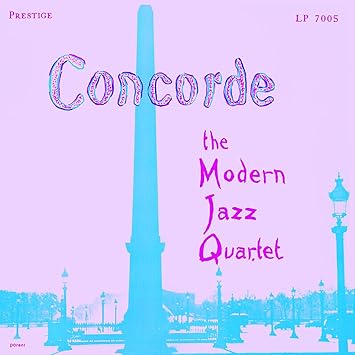
It's an album that's mostly standards. Perhaps in Lewis's mind, the group already had one foot out the door, so they were saving original material for Atlantic--although in fairness, the MJQ tended to be standard-friendly until later in its career, and the first Atlantic album only had three originals. The originals are Jackson's "Ralph's New Blues" and Lewis's title track. I'd wondered if "Ralph's New Blues" was a tribute to Ralph Ellison -- I'd sort of hoped it was -- but appears to be for jazz critic Ralph J. Gleason, which is pretty good too. It's built on an irresistibly bluesy riff, and is the catchiest number on the record.  "Concorde" is another Francophile nod from Lewis, and inspired the Eiffel Tower cover of the album. It has a richness of tone, a catchy melody, and an uptempo swing.

Lewis and Jackson know how to sustain a note for dramatic effect, and they know how to let loose a torrent of notes. But as always, the the MJQ is a quartet, not a leader and sidemen, and you're always aware of the contribution each member is making to the sound.

"Softly as a Morning Sunrise" was released as a two-sided 45. The album's initial release, as noted, was the 12-inch LP.


Friday, July 31, 2015

Listening to Prestige Part 135: Modern Jazz Quartet

I've mentioned that the MJQ was formed in part out of John Lewis's dissatisfaction with the head-solos-head format that had become ubiquitous in bebop, and this recording session, in its own unique way, is a break from that format, in that it's solo-solo-solo-solo.

Well, not exactly. But perhaps Lewis, in his own way, is simultaneously playing tribute to the classic bebop form and standing it on its ear.  "La Ronde" in a shorter version was part of an earlier MJQ session. The shorter version was a reworking of an earlier Lewis composition, "Two Bass Hit,"originally composed for the Dizzy Gillespie orchestra. The newly Europeanized title -- La Ronde is a fin de siecle play by the Viennese playwright Arthur Schnitzler -- is in keeping with the European classical -- and particularly Francophile -- overlay that Lewis was putting on American bebop. Under either title, it's a good piece, and as "Two Bass Hit" it's become a jazz standard.

As "La Ronde," it makes more sense in its extended suite version. The Schnitzler play is a tag team
series of sexual encounters, and "La Ronde Suite" is a sort of tag team, as well. It's in four sections, with each section featuring a different member of the group in an extended solo.

Kenny Clarke is the drummer for the "La Ronde Suite," and it was his last recording with the group. By their next session, in July, Connie Kay had replaced him.

Most people think of Kay as the quintessential MJQ drummer, and with good reason. He was with them for 40 years. He was a perfect ensemble drummer, in a group that emphasized the ensemble sound. Clarke was one of the innovators of bebop drumming, and like his fellow pioneers Max Roach and Art Blakey, he was much more of a soloist. "La Ronde Suite" would have been different without him.

"La Ronde Suite" was first issued on a 10-inch, The Modern Jazz Quartet Vol. 2, but it's most famous as part of the MJQ's Django album.


Wednesday, July 08, 2015

Listening to Prestige Part 130: Modern Jazz Quartet

Given the long and illustrious career of the Modern Jazz Quartet, the many amazing recordings they made, and the fact that most people consider the real MJQ to date with the installation of Connie Kay as drummer, it would be hard to point to any one album as their best.

But Django, the album that includes this session, and which has Kenny Clarke on drums, is the one that frequently makes lists of the hundred best jazz albums.

Perhaps it's because this is an almost mythic era in modern jazz. The late 40s (mostly because of Charlie Parker) and especially the 1950s were the time that really defined it.

Or that's one theory. I decided to put it to a test, so I looked at the New Yorker's list of 100 essential jazz albums, and found that 29 of them were recorded in the 50s, or partly in the 50s. There were a few more that I could have counted because they were released in 1960, and so were probably recorded in 1959, but they were albums like My Favorite Things that really belong to the 60s. Actually, a lot of the albums recorded in the 50s were by artists we don't really associate with the 50s, but what can you do? If I left them out, it would mess up my theory. Anyway, here's the list: Armstrong, Ellington, Basie, Benny Carter, Parker, Monk and Coltrane, Tristano, Davis 2, Powell, Mulligan, MJQ, Tatum, Brown/Roach, Vaughan/Brown, Mingus 2, Fitzgerald, Rollins 2, Puente, Sun Ra, Abbey Lincoln, Blakey, Jamal, Brubeck, Witherspoon, Coleman, Dinah Washington, Betty Carter, Sinatra.

Not every great jazz classic is a great composition. Some of the best -- best performances, best improvisations, best damn records -- are based on simple riffs. Look at Dexter Gordon and Wardell Gray's unforgettable "The Chase." Look at "One Bass Hit," from this session. It was written by Dizzy Gillespie for Ray Brown, and it's a showpiece for bass virtuosity -- one that allows a bass to become the lead instrument for an entire piece of music. Here, it allows Percy Heath to show what he can do, and it's delicious.

But "Django" is a great composition. It's one of the most haunting melodies I've ever heard. It carries a touch of the Eurojazz of Django Reinhardt, a touch of the blues, a touch of...well, here's guitarist Jim Hall describing it:
This tune has a beautifully constructed melody. It starts out with a kind of a simple motive in F-minor. Kind of a slightly sad idea for a melody, and then so it's this, and then there's a sequence, which is up a second, except that goes up instead of down. So first, it's this perfect answer and then it continues. It's going into the relative major key, if anybody cares, now it has some surprises. It has a great arrival point, that high G, and then it winds its way down. Almost sounds like he's saying Django's name here. And then the same thing an octave lower. So that's the tune anyway. It has kind of simple chords, but beautiful.
 "Milano" is the third tune on the session. Another beautiful melody, but there's a reason "Django" became the title cut for the album, and a reason why it's the one that's most remembered. They also recorded "I'll Remember April" that day, and it was never released. It's hard to imagine the MJQ screwing up "I'll Remember April" and maybe they didn't -- maybe it was a technical flaw of some sort. In any event, they re-recorded it successfully the following July.


 "Django" was released as a two-sided 45, and the three tunes made an EP, and were included (with "La Ronde") on a 10-inch LP, before the release of the classic 12-inch album which has made so many top 100 lists.

Friday, April 10, 2015

Listening to Prestige Part 99: King Pleasure

King Pleasure's version of "Parker's Mood" is one of my favorite records of all time. I've let it be known that it's the song I want played at my memorial service, assuming anyone wants to organize one for me. It is so close to my heart that it's difficult to write about it.

And right up there alongside it is Charlie Parker's recording of his own mood. It's one of the few--perhaps the only one of Bird's original compositions that he only recorded once, so that one recording stands as the perfect, the Platonic ideal representation of this tune. And deservedly so.

Other musicians have recorded "Parker's Mood." There's an odd but enjoyable swing version by Jimmie Lunceford, a respectful tribute by Roy Hargrove and Christian McBride, a somewhat less respectful but eminently listenable version by James Moody on a 70th birthday live album. Supersax was a strange and fascinating Parker tribute band that played note-for-note replications of Parker's recordings with five saxophones and brass.

But the two recordings that count are Bird and King Pleasure. Bird emotionally searing, technically a wizard, and it is possible to accomplish both at the same time. Novelist John Barth said "“In art as in lovemaking, heartfelt ineptitude has its appeal and so does heartless skill, but what you want is passionate virtuosity.” And that's what you got, one recording after another, from Charlie Parker.

King Pleasure puts words to what needed no words, and it turns out that the words really do add something. His voice is smooth but passionate, his words familiar but memorable. He creates an elegy by pulling lyrics, magpie-like, from a variety of sources including "Going to Chicago Blues" and "Careless Love," adding words of his own, and leaving us with the unforgettable reminder that "through thick and thin / On up to the end / Parker's been your friend."

One artist played the same role on both of these recordings: John Lewis. Lewis headed a trio with beboppers par excellence Curley Russell and Max Roach on the 1948 Savoy recording with Parker, and led his MJQ-mates Percy Heath and Kenny Clarke in 1953 for Prestige. He's masterful in both, with his reflective little figure following the opening cadenza, his solo that fully captures Parker's and Pleasure's moods, and his laconic but heartfelt summing-up figure at the end.

"Parker's Mood" stayed with Lewis as it did for everyone else who's heard it and opened up to -- probably more so for the great pianist. Some five decades later, at age 80, he revisited again with his "One of Parker's Moods," as he faced his own mortality - he would go to his own Kansas City less than a year later.

Prestige released "Parker's Mood" and "What Can I Say Dear" on 78 and 45. I don't mean to give such short shrift to "What Can I Say Dear," which is a fine recording, but "Parker's Mood" is special. It came out on a second 45 b/w "Jumpin' With Symphony Sid," on the 10-inch LP, and on the great King Pleasure Sings/Annie Ross Sings 12-inch LP.


Friday, March 27, 2015

Listening to Prestige Records Part 94: Sonny Rollins / Modern Jazz Quartet

The Modern Jazz Quartet were a fairly rare phenomenon in jazz in the 50s -- a stable group that had a collective name, as opposed to, say the Gene Ammons Septet or the Stan Getz Quartet, which would be Gene or Stan and whoever else was in town for the recording or club date. The musicians had come together as Dizzy Gillespie's rhythm section, and then had become the MJQ -- that is, the Milt Jackson Quartet. As the MJQ1, they were, as far as anyone knew, three guys whom Milt Jackson had gotten together for a gig. As the MJQ2, they were a different entity, but no one knew what. Certainly, no one knew that they would, with one change, be together for the next 40 years, thus becoming not just rare but unique.

So what had Prestige done with them to date?

John Lewis had done a number of sessions for Prestige, starting in 1949 with J. J. Johnson's
Boppers, when he was 29 and already a veteran of the New York jazz world, from his days newly out of the army with Dizzy Gillespie through his work as one of the major contributors to the Miles Davis nonet. He worked with Zoot Sims, with Miles and Sonny. And even after the first MJQ session--it was pretty clear how good these tunes were, and it had always been clear how good these musicians were, but there was no hint that they were to become. probably rivaled only by the Dave Brubeck Quartet, the most legendary sustained unit in the history of jazz. Yes, there have been other legendary units, like the Miles Davis quintet of the 50s, but that group was only a small part of Miles's career, and only a small part of Coltrane's. So they went on working. Lewis and Kenny Clarke worked on one Prestige recording date with Miles, Lewis and Percy Heath on another. Heath also played on the Miles and Bird (Charlie Chan) session. And they did sound good together, no doubt about it. The three of them were brought in to back up King Pleasure and the Dave Lambert Singers, and the quartet was brought in for a session with Sonny Rollins, and although Rollins was the featured performer on the gig, the Modern Jazz Quartet was credited as such. This would change, a few years later, when Atlantic would bring out The Modern Jazz Quartet at Music Inn, Vol 2 -- guest artist, Sonny Rollins.

The Atlantic album has been in my collection since the 50s, but I'd never heard this earlier collaboration before. It's a fascinating one. This is definitely a Sonny Rollins session, but it's definitely MJQ, too. This is probably the first time all four of them had worked as the MJQ with another artist, and it's an experiment worth listening to.These guys knew how to play together as a rhythm section, and they show that here. But they also knew who they were, and they show that here, too. And all five of
them make a pretty convincing argument that bebop is not dead.

They would go on to make enough tunes for Prestige to fill  two 12-inch albums which are no strangers to Greatest Jazz Albums of All Time lists. But before they were legends, they were working musicians playing the gigs that they got -- sort of unlike the Brubeck Quartet, who pretty much made it clear that they were legends to begin with. And working musicians like these are always worth listening to. 

These came out on 78, 45, EP, 10-inch and ultimately 12-inch LP.


Friday, March 06, 2015

Listening to Prestige Records Part 89: Modern Jazz Quartet

The 1956 12-inch LP that contained this session, Django, was in my collection and on turntable a lot. I don't remember when I bought it -- certainly not 1956, because I wasn't listening to jazz that early. Probably 1959 or so. By that time, the Django LP had been out long enough to become a classic, and the original releases on 10-inch, 45 and 78 had been out even longer, so I don't know what the first critical reaction was. I'm guessing they hadn't heard anything quite like "The Queen's Fancy" before.

But they had, really. It's still Dizzy Gillespie's rhythm section, guys who'd been around since the birth of bebop, guys who were present at the creation of modern jazz and were playing modern jazz--who had, in fact, even named themselves after modern jazz. And if "The Queen's Fancy" starts out with a fugue that could have been written by Bach, why not? The musical tradition that these great musicians came out of was everything that came before them, the music they were looking to make was everything that lay ahead. Dale Turner, the fictional jazzman played by Dexter Gordon, surprises his French host when he acknowledges his debt to Debussy, but there should be no surprise there, either, any more than a debt to Louis Armstrong, Russian Jewish immigrant composers, or the blues. Duke Ellington was exactly right when he said that there are only two kinds of music, good and bad.

So these beboppers developed something beautiful. Tadd Dameron said it always has to be beautiful, and Lewis, Jackson, Heath and Clarke knew that too. They made beauty out of a fugue, and out of a bebopper's tribute to the hot jazz of the Hot Club of Paris, and out of compositions by Vernon Duke and George Gershwin -- transforming beauty into beauty, which may not sound alchemical, but it surely is.

You take what you know, and take it somewhere new. If you're like John Lewis and his cohorts, you know a lot, and you can see the road ahead with clarity and excitement. I interviewed the poet Billy Collins some years ago, and he described what he did as “a kind of travel writing, a genre in which the poet can take the reader on vicarious trips to places that may be otherwise inaccessible...[I find] a common ground that the reader and I can both stand on...and try to deliver pleasure by taking the reader into a state of suspended animation, where the subject matter is left behind, and other explorations begin." The Modern Jazz Quartet does something very similar, and for that experience to be happening for the reader/listener, it has to be happening for the artist as well, whether that artist be a poet like Collins, a composer like Lewis, a master improviser like Milt Jackson.


This comes from a total involvement with your art. Larry Audette, himself a fine jazzman, told me of a conversation he recently had with Tootie Heath about his brother. Percy, on his deathbed, was still listening to music through headphones. Finally, when it was time, his wife took the headphones off, and he slipped quietly away.

"The Queen's Fancy" and "Autumn in New York" were released as a 45 RPM single. The other two songs weren't, although all were released on 78, in a different configuration -- "The Queen's Fancy" b/w "But Not For Me," and "Delaunay's Dilemma" b/w "Autumn in New York." Odd to think that in 1953 the 78 was still the dominant format, but 78s lasted well into the 50s. According to the Yale Library's guide to music cataloging, the 78 was pretty much phased out by 1955, although there's no exact record of the last 78 to be issued -- in fact, according to Yale, some children's records came out on 78 as late as the 70s. I bought my first record in 1954. I was 14, and it was rock and roll -- "Bazoom," by the Cheers, the first rock and roll hit by Jerry Leiber and Mike Stoller, whose songs I would come to worship with a passion. I think that by the end of that summer, I was buying more 45s than 78s, and by the next year nothing but 45s, so my personal history pretty much tracks the Yale Library, The four songs also came out on a 45RPM EP, which seems to have been a form favored early by Prestige, before they'd really embraced the 45 RPM single. There was a 10-inch LP, and then the classic Django in 1956, and many later repackagings and reissues.


Monday, February 23, 2015

Listening to Prestige Records Part 86: Miles Davis

A ballad session with Miles Davis and a group of great musicians. What more is there to say? There's a quote from Miles somewhere, which I can't find, to the effect that what he loved most was playing ballads, and he would have been happy to spend his whole life playing them. Which, of course, is why he couldn't. Miles had a restless, searching genius which was never about being happy or comfortable. 

When I lived in New York in the late 70s, WKCR, the Columbia Univeraity station, did a week-long Miles Davis marathon, in which they played everything that Miles had ever recorded, in chronological order. I made it my business to stay home and listen to all of it, so you can see that this blog isn't the first crazy jazz-related thing I've ever done. I didn't totally succeed -- I'm not that crazy -- but my girl friend at the time, who'd been out of town, came back in the middle of the week and called me, and I told her she could come over if she wanted to, but that I was preoccupied.

So...I didn't listen to all of it, but I listened to enough that I got a real sense of Miles's progression. I felt like I could understand how bebop with Bird led to the Nonet sessions to the quintet to Kind of Blue to Filles de Kilimanjaro to On the Corner to Big Fun, and I could understand how he had to do all of it, even if I wasn't going to listen to Big Fun as often as I listened to Dig or Relaxin'.

And I could listen to this session many times, which of course I have, because that's how I'm doing this blog, immersing myself in each session, but I could listen to it many times more. Miles playing ballads, a Benny Carter tune and three originals, with a group of great musicians. "Tune Up" is credited to Miles, "Miles Ahead" to Miles and Gil Evans, "Smooch" to Miles and Charles Mingus. Mingus appears on "Smooch," replacing John Lewis on piano rather than Percy Heath on bass. Lewis is on the first three cuts, Heath and Max Roach on all four.

Bob Weinstock, in an interview, talked about those early Miles sessions: 
 So, our basic idea was just to make records with different people, to record with the best people around. That's what we did until the end, when he had the quintet with John Coltrane, Red Garland, Paul Chambers, and Philly Joe Jones. But everything up to that point developed from where we would sit down and talk about it. Miles would mention who was in town, who he would like to record with. I'd say who I'd like to hear him record with. 

Yes, I would have loved to be a fly on the wall for those cpnversations. Fly on the wall? Hell, I would have loved to be a part of the,. "Hey, Miles and Bob, why don't we get..."
These were released on singles, on an EP, and as part of a 10-inch LP. And of course, in many reissue packages.

The LP cover is by David X. Young. 


Sunday, February 08, 2015

Listening to Prestige Records Part 80: Miles Davis

There's a session in between these two very different Miles Davis sessions. Bob Weinstock never had much luck with rhythm and blues, and maybe it's just as well. He might have yielded to the temptation to become another rhythm and blues label, and while there were many labels putting out great R&B, there were very few who can boast the jazz catalog Prestige put together.
Billy Valentine cut four sides on February 6—Valentine on piano and vocals, Mickey Baker on guitar. Two were issued on PAR Presentation, two never issued. Of the two that were issued, I can't find a trace. Too bad. I'm a huge Mickey Baker fan, although I wasn't familiar with Billy Valentine. A little research turns up one cut with Johnny Moore's Three Blazers. He must have replaced Charles Brown, because Valentine's "Walking Blues" is a direct remake of Brown's hit "Drifting Blues." Valentine is no Charles Brown, but he's pretty good.
So on to Miles, and an unusual lineup, and an unusual--but very good--record. John Lewis and Kenny Clarke are on board. They'd just made one record with a new group, but hey, who knows if a new group will stay together? Best get work while you can.  
Sonny Truitt is another one of those unsung pros who can be counted on to do the job. The only bio I can find for him says he's mostly known for his work with Miles.
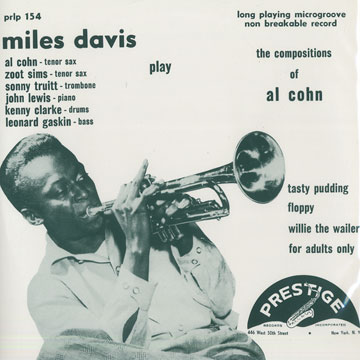
Al Cohn and Zoot Sims, separately and together, but most famously together, had a major impact on the jazz of the 40s and 50s. Davis brought them into this gig together, but it's Cohn who made the major contribution. These tunes were released by Prestige in various configurations, but one of them was a 10-inch LP called Miles Davis Plays the Compositions of Al Cohn. All four were written by Cohn, and all except "Tasty Pudding" specifically for this group.
Why is this session, in all its LP configurations, not better known? I think the answer may lie to some degree in the liner notes by Ira Gitler to the Compositions of Al Cohn release (Gitler by this time was regularly producing for Prestige, as well as writing the liner notes):
Since the "records heard 'round the world," GODCHILD, JERU, MOVE et al, Miles Davis has made many other fine recordings to enhance his position as top modern trumpeter, but in the main they have been three horn groups (including himself) with an emphasis on solo work. After the original melody, usually stated in tight unison, each hornman played again only when his solo turn came. The soloists had to be good to sustain interest, and they were, but it was felt Miles needed a change of pace for his next recording date: compositions and arrangements which would suit him and result in a happy composition of arranged music and solo work.


With all due respect to Gitler, whose liner notes for Prestige. as well as his work for Down Beat, Metronome and other jazz publications, provide an invaluable and insightful narrative of some of jazz's greatest years, this is mostly bullshit.
Let's leave aside "each hornman played again only when his solo turn came." That's an oversimplfication--it leaves out trading fours, interpolated notes, and even concurrent solos, but it's a short piece, and the oversimplication is still more or less accurate.
But why was everyone who wrote about it, in that era, so eager to put down, and put to rest, the classic bebop formulation? Gitler is better than most. The New Yorker, in every "Goings On About Town" mention of jazz, gives the back of the hand do bebop's death throes. John Lewis and Miles Davis are both described as being frustrated by the confines of the theme-solos-theme format. But made for so much great jazz, and not just in the Forties.
OK, it's not mostly bullshit. He's not really wrong about anything. And I'm nitpicking way too much about a far greater jazz writer than myself. But what about the "records heard 'round the world"? That's a problem. The Birth of the Cool sessions are among the most important in jazz, and Gitler was perceptive enough to realize it, but at the time he was writing this, they were only the records heard 'round the world to a discerning few. Probably most musicians, probably not that much of the public. The Royal Roost sessions had not drawn fans, the 78s hadn't sold well. So maybe as good as this session is, and as good as the Lee Konitz session was,. there wasn't an audience for it yet, and even over time it hasn't gotten the traction to pull it even with the other Davis LPs on Prestige.
The Konitz session was probably more experimental than the Birth of the Cool sessions, this probably less. But it's beautifully played, and brilliantly written. I'm not sure one would immediately think of Miles Davis and Al Cohn as the most likely of musical partners, but whoever thought this one up was inspired. Miles himself? Bob Weinstock? Ira Gitler? Cohn?: Some combination of all four?
Maybe Gil Evans had a hand in it? He's not credited with any part of the Davis oeuvre from Birth of the Cool to Miles Ahead, but Evans didn't take credit for a lot of things he was involved in, and he and Miles were always close.
In any event, this is a terrific album, and one that deserves a higher spot in the Davis canon than it probably has.
"For Adults Only" has a very familiar melody. Is it also called something else? Or is it just really catchy?
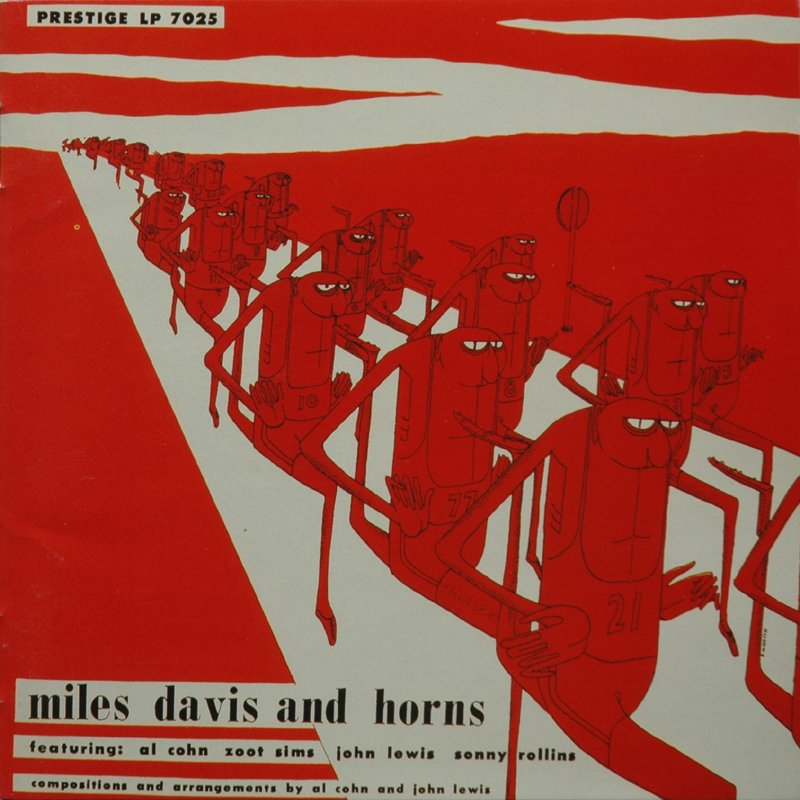
"Tasty Pudding" was released as 78; Miles Davis Plays the Compositions of Al Cohn was the 10-inch. A later reissue was on a 12-inch 7000-series as Early Miles 1951 & 1953, and on a 1955 reissue called Miles Davis and Horns, which is interesting not only for its music but for its cover art, by Don Martin, of Mad fame. Mad and Miles seem an odd combination, but Martin did several covers for Prestige.
  I don't comment on the post-1972 reissues for the most part, but there is a reissue called Dig - Miles Davis and Sonny Rollins, which includes the sides from the Al Cohn session, which is a good thing, but has what may be the world's worst cover art, replacing the dark, atmospheric, supercool young Miles with a bad photo of heavy equipment at a construction site.


Sunday, January 25, 2015

Listening to Prestige Records Part 75: Teddy Charles

By the end of 1952, Teddy Charles Cohen had heeded his booking agent's warning that he couldn't book a jazz act with a Jewish name, and had become Teddy Charles full time.

This didn't exactly mean that he was going all out for popular approval. You don't name your latest tune "Composition for Four Pieces" if you're looking to compete on the jukeboxes with "Open the Door, Richard." And if you title another tune "Edging Out." you aren't sending a message that you intend to place yourself square in the center.

On two consecutive days, Bob Weinstock went into the studio with vibraphonists, and for the second straight day, with musicians who were edging out of the bebop orbit, but in different directions. Teddy Charles was lighting out for a territory close to that staked out by Lennie Tristano -- cool, cerebral, imaginative, the work of a serious and innovative composer. Wait a second -- that does sound like John Lewis, doesn't it? And in fact Charles's biographer, Noal Cohen, describes his approach to jazz very much the way Percy Heath described John Lewis's -- "he had developed a compositional approach to jazz performance that attempted to transcend the standard theme statement/solos/theme restatement format." But it's different.

A lot of people were ready to bury bebop by the closing days of 1952, but it was still more than just the musical innovation that had transformed American culture: it was still a vibrant and vital force, deeply influencing even those who were edging out of it. There's no John Lewis, no Teddy Charles, without bebop, and there's still plenty of bebop in what they're playing -- in Charles's case, the lightning fast tempi. As Chuck Berry was to say, "I have no kick against modern jazz / Except they try to play it too darn fast." But speed is exciting, especially when it's executed with the virtuoso precision of a Teddy Charles.

There are three originals here (two by Charles and one, "Composition for Four Pieces" by Jimmy Raney), and one standard -- a bebop standard, that is: Dizzy Gillespie's "A Night in Tunisia." As with the recent Monk outing and the very recent MJQ outing, the mixture of the familiar with originals by three of the most original composers in jazz serves to ground the session, and give new insight into the compositional abilities of each.

The interplay between Charles and Raney is wonderful, with Charles edging Raney further out, and
Raney keeping Charles in touch with his inner bebopper. Dick Nivison seems to have no other recording credits besides those with Teddy Charles, but Charles must have really liked him, because when Bob Weinstock, in 1953, sent Charles out to La-la-land to be his West Coast A&R man, he seems to have taken Nivison with him.

Ed Shaughnessy might have been the kind of drummer that everyone in the business wants, but no one outside of the business remembers. He did a lot of anonymous studio work for TV personalities like Steve Allen and Garry Moore. But then one of those TV studio gigs became 30 years as perhaps the most visible drummer on television, when Doc Severinsen hired him for the Tonight Show orchestra.

The tunes for this session were released on the appropriately named 10-inch LP New Directions, Vol 1, and also on a 45 RPM EP with the same title.

No selections from this session have been posted on YouTube.

Wednesday, January 21, 2015

Listening to Prestige Records Part 74 --: The Modern Jazz Quartet

The first sound you hear, on the first tune of the first recording session by the Modern Jazz Quartet, is the driving walking bass of Percy Heath, punctuated explosively by  Kenny Clarke's drums. And there's a surprise, not just because Clarke was the only musician to leave the group, but because you don't exactly think of the MJQ as a drum-dominated group. But here's Clarke, front and center on "All The Things You Are" - and perhaps, even more so on "La Ronde," the second tune to be recorded that historic day. Does that mean that the MJQ didn't start out as the ensemble-driven sound that we associate with them? Not at all. But they were, first and always, an ensemble of individuals. A lot of critics of the MJQ in later years, those who,complained that the group was too stodgy, too careful, too polite, tended to except Milt Jackson from this criticism, and say that he was a real individual, and what was he doing letting himself be tied down? Let's Bags be Bags! But they were all individuals, all powerful players all creators and improvisers and strong personalities.

Percy Heath, in an interview by Mike Zwerin in Paris in 2003, recalled the founding of the Modern Jazz Quartet from four musicians who had come together as the rhythm section of Dizzy Gillespie's big band. Gillespie had featured them separate from the band, and they had also started playing club gigs as the Milt Jackson Quartet (originally with Ray Brown on bass).

In 1951 the Milt Jackson Quartet - Heath, John Lewis and Kenny Clarke (soon replaced by Connie Kay) - was driving home to New York after performing in some sad and disagreeable outlying club. All four of them - they were big men - were squeezed into Milt Jackson's tired old gilded Cadillac, which they had named the "golden dragon." Lewis said he was weary of this kind of life, and of the same old head-solos-head rhythm section format that went with it. He wanted to form a band that would be like a chamber group with four independent contrapuntal lines going simultaneously and be accepted in theaters and concert halls where jazz had never before been heard. The Modern Jazz Quartet was named then and there in the golden dragon.
So this was a powerful zeitgeist as the 40s turned into the 50s. Miles Davis, who had been a protege of Charlie Parker, was feeling it. John Lewis, playing in the Dizzy Gillespie big band, was feeling it. There had to be more than just the same old head-solos-head formula. It was time to break out of bebop.

As it turned out, bebop had a lot more life, and a lot more creativity, to share with the world, but these questing musicians were right too. John Lewis had been an integral part of the music that came out of those all-night sessions at Gil Evans's apartment, had played on the Birth of the Cool sessions and contributed three tunes. The nonet had failed commercially, but the idea that jazz could move in new directions was still a vivid one.

The quartet recorded two standards and two Lewis originals on that first session, both of which were to become staples of their repertoire. "La Ronde" was expanded into "La Ronde Suite," about which more later. "Vendome" is perhaps the most representative of the direction the group would become famous for, classical in structure and tightly arranged.

All four songs were released on 78 RPM and on a 10-inch LP -- one of the first Prestige LPs to take cover art seriously.The cover was designed by David X. Wilson, noted not only for his jazz album art, but for jam sessions at his illegal loft. From his obituary in the New York Times:

The loft, in an industrial building at 821 Avenue of the Americas, near 28th Street, became a gathering place for the greats of jazz, including Miles Davis, Charles Mingus, Thelonious Monk and Dizzy Gillespie, as well as for utter unknowns who simply yearned to play.
Known simply as ''the Sixth Avenue loft,'' it was one of maybe a half-dozen places where musicians gathered at a time when various strains of jazz -- mainstream, bebop and cool, among others -- were percolating. Situated in the heart of the flower district, it was the epicenter of what became known as loft jazz.
''By most accounts, it drew the biggest names, showcased the latest talent and lasted the longest,'' said an article in the fall 1999 issue of Double Take magazine.
''Guys played with people they'd never seen before,'' Bob Brookmeyer, a trombone player, said in the article. ''Whites, blacks, old guys, young guys. Nobody cared about that stuff. We were all outlaws. Our profession wasn't considered respectable. There was a sense we were all in it together.''
There was no lock on the loft's front door, and it was considered bad form to arrive before 11 p.m. There always seemed to be many pretty young women present, and ample bourbon and marijuana. It was a spot where Salvador Dali, Norman Mailer or Willem de Kooning might show up, entourage in tow. ''The locus of mad freedoms,'' Mr. Young once called the scene that his rent bargain made possible.


Thursday, November 06, 2014

Listening to Prestige Records Part 48: Gerry Mulligan New Stars

What do you do when it's 1951, and you've already made the most important record of the decade, but no one knows it yet, and in fact you made it last decade with a group that's since been disbanded, and no one paid it much attention at the time?

For some of the key members of the Birth of the Cool nonet, it seems to have meant taking a step backward, and that's not meant as a criticism.

An important part of the impetus to forming the nonet was a dissatisfaction, especially on the part of Gil Evans and Gerry Mulligan, to the overemphasis on the flamboyant virtuoso soloist that was bebop. They came from big bands, particularly the Claude Thornhill band, which played dance music but encouraged some experimentation, and brought from some important jazz musicians...and arrangers.

And in fact the Miles Davis nonet, in its historic Royal Roost engagement, included its arrangers on the marquee -- Gil Evans, Gerry Mulligan, John Lewis. Mulligan and Lewis were also featured musicians, but giving marquee prominence to Evans may have been a first -- and was certainly deserved.

So what do you do? Lewis would move in a new direction with the Modern Jazz Quartet, but not for a couple of years. During this period, he continued to work as a sideman with boppers. Davis was to retrench, sort of, in his Prestige and Columbia albums of the 50s, playing bebop with a difference, creating the style called hard bop that became the most significant jazz style of the 50s. Konitz stayed out in left field, but then he really had no mainstream to go back to -- he'd come from left field, with Tristano.

Mulligan, in this session for Prestige, goes a certain way toward the bebop mainstream -- there are some powerful improvisatory and virtuoso solos -- but his retrenchment is more in a Thornhill direction, with some big band arrangements and full sound that touches back to swing in the way Thornhill and Herman did, while still staying decidedly modern.

Mulligan's New Stars didn't quite manage to become stars. Allan Eager and George Wallington are the only two whose names have remained with some resonance in jazz history.

I found this mention of two of Mulligan's men in an online essay called "Names of the Forgotten":

Where are Jerry' Lloyd, George Syran, and Phil Raphael and Phil Leshin? Jerry Lloyd was around in the 1940s and 1950s and recorded with Gerry Mulligan, Zoot Sims, and George Wallington, though he never became well-known and worked as a cab-driver even when he was featured on records with such artists... [Phil Leshin] worked with Red Rodney in 1951, but what else?

Nick Travis, according to this essay, played on 350 jazz recording sessions, so if he never quite broke through to serious name recognition, he clearly made a name as a guy you could count on. Here's Hal McKusick on Travis:


"Nick was a great player and a great  guy. He was so busy in the 1950s. He'd get done with work at 2 a.m., head off to his home in New Jersey and be back the next day in a New York studio at 8 a.m. Zoot told me a funny story. Nick was so tired one day that he slept in. His phone rang early that morning. Nick sleepily answered: "Hello?" "Hi Nick, it's Zoot." Nick paused and said, groggily, "Zoot who?"
"I remember Nick as being quiet and intelligent. He spent a lot of time with his instrument. When you’re working the way we did, you didn't have a lot of time to practice, so work was practice. He was a great lead horn player and quite a soloist. Nick was always there on a date in every way. Efficient, on time and he never hit a bad note.
"Ultimately, Nick probably had too much work. We all did. Nick was in such great demand by so many different orchestrators and contractors at the time that he probably had a hard time handling the stress internally. He kept a lot of it bottled up, I guess. I didn't realize he had passed from ulcer troubles.
"As sounds go, Nick's was down the middle. You'd hear his horn and if you didn't know who was playing you'd say, 'Wow, who is that? That sure sounds good.' He caught your attention. Nick also was a wonderful reader, which was why he was in such demand. Nick played caringly."


There's less on Ollie Wilson and Mac McElroy. Wilson was in Woody Herman's Second Herd, and highly regarded. Mulligan used McElroy on at least one other recording.

I found this on Gail Madden, from a reminiscence by Bill Crow in a book called Fifties Jazz Talk: An Oral Retrospective by Jack Gordon.

I began by asking him if he knew a lady named Gail Madden, who had been a pianist and a model in California before becoming active in New York jazz circles in the early fifties. She appeared on Mulligan’s first album as a leader in September 1951, playing maracas on some numbers, and Gerry has credited her with suggesting the idea of a pianoless rhythm section to him before they left New York for California later that year.  When they arrived in Los Angeles, it was thanks to Gail and her previous relationship with Bob Graettinger that Mulligan was introduced to Stan Kenton, who very soon bought some of Gerry’s arrangements. She also suggested hiring Chico Hamilton for Mulligan’s first quartet, so Gail Madden was clearly a significant, if unseen, influence on his early career.

"I met Gail before I knew Gerry very well, thanks to a drummer friend of mine by the name of Buzzy Bridgford. He introduced us at an apartment in Greenwich Village owned by a lady named Margo, who was apparently a $100 a night hooker and was bankrolling Gail, who wanted to be a therapist and save all the junky jazz musicians in New York. Charlie Parker had agreed to go along with all this and was first on her list. Gail’s plan was that, with Margo’s money, she would buy a brownstone and start a clinic and all the guys would come and live there so she could straighten them out and get them off junk. Buzzy, who knew all the inside jazz gossip, claimed that Joe Albany, Serge Chaloff, J. J. Johnson, Stan Levey, and Gerry were also going to be involved, but unfortunately for Gail, she had an argument with Margo over money and the whole idea collapsed. Soon after, she and Gerry became a “couple,” so we figured that if she couldn’t save everyone on her list, she would concentrate on him. She started turning up on his gigs out at Queens, playing maracas, and I remember her being there when Gerry was rehearsing a band in Central Park on the shore of the 72nd Street lake. Around that time they both disappeared from the New York scene, and the next thing we heard was that they were on the road, hitching to California, and we all laughed because that was exactly the sort of wild thing they would do. They made it, all right, and then those wonderful records that Gerry made with Chet Baker started coming out."  

So this was Mulligan's first session as a leader. One other interesting thing about this recording
session, The first six songs are standard song length, about three minutes, and all of them were released on 78 and 45 -- "Mullenium" is pushing it at 4:05, but they managed to get it onto one side of a single. "Mulligan's Too" is over 17 and a half minutes long -- who recorded anything that long in those days? And it's Mulligan's first session as a leader, but he was able to talk Weinstock into it. It became a 10-inch LP, which you can now buy on eBay for $250.


Friday, October 10, 2014

Listening to Prestige Records Part 39: Miles Davis / Sonny Rollins

There's a reason why Ken Burns followed up his Civil War documentary with documentaries about baseball and jazz, even though he was an authority on neither subject, and he pissed off a lot of aficionados on both subjects because he made rookie mistakes, but there was a reason why he chose baseball and jazz to follow the Civil War, because his real subject was always race.

And even if your subject is purely music, as mine is, you can't talk for very long about jazz without talking about race. I put up a litle quiz on Facebook a few days ago, asking anyone interested to take a guess as to the Down Beat Readers Poll winners for 1950, the year we've just finished listening to.It was an interesting time for jazz. Bebop was solidly established, but there were still plenty of moldy figs who didn't dig it. A lot of the players we think of as titans of modern jazz were just starting to establish themselves -- or had yet to establish themselves. Anyway, the winners:

Big Band - Stan Kenton
Trumpet -- Maynard Ferguson
Alto - Charlie Parker
Tenor -- Stan Getz
Baritone-- Serge Chaloff
Trombone -- Bill Harris
Clarinet -- Buddy deFranco
Piano -- Oscar Peterson
Bass -- Eddie Safranski
Drums -- Shelley Manne
Vibes -- Terry Gibbs
Guitar -- Billy Bauer

One interesting thing about that list is how white it is. And this is not just by chance. According to the book Race Music: Black Cultures From Bebop to Hip-Hop,by Guthrie P. Ramsay, Esquire Magazine created something of a firestorm in 1943, when it began its Critics' Poll, because it made the unusual move of including black critics on its panel. Their winners included Louis Armstrong, Coleman Hawkins, Art Tatum, Billie Holiday and Cootie Williams. They had a fair selection of white winners too, but even so, they were attacked. One publication, Jazz Record, accused them of practicing reverse Jim Crow,and added that "the top men for small hot-jazz band work today are predominantly white men!" And Stan Kenton, of all people -- he who won far more polls than he probably deserved to -- complained that the 1956 Down Beat critics' poll had created "a new minority group, white jazz musicians."

The 1956 Readers' Poll was still heavily white, although Kenton was no longer winning. One example of the difference -- Critics' sax section Benny Carter, Lester Young, Harry Carney. Readers' section Paul Desmond, Stan Getz, Gerry Mulligan. No argument at all with either set of selections, but one can't help but note the difference, At least it's not the Playboy jazz poll, where Doc Severinsen regularly beat out Miles and Dizzy.

Back to January of 1951. Last I looked at the New Yorker's jazz listings in their Goings On About Town section, They only listed Eddie Condon's and Jimmy Ryan's. Now they include Birdland, but none of the other modern jazz spots like the Royal Roost. They do include the Village Vanguard,but it was not an exclusively jazz spot in those days. Their feature that week was arty-folky tenor Richard Dyer-Bennett. Birdland was featuring a Dizzy Gillespie Sextet, a Lester Young quartet, and Dinah Washington, in what their commentator described as "what may be the death throes of bebop" It's hard to figure out exactly what he meant by that, but I'm guessing this was not a forward-looking jazz savant who had heard the Miles Davis Nonet and seen the future. More likely the wishful thinking of a moldy fig who would really rather have been in the company of Jimmy Ryan or Eddie Condon, who famously said, referring to one of bebop's more adventurous chordal variations, "We don't flat our fifths -- we drink 'em."

And in the Apex Studios in New York - not Prestige's home studio - two groups, mostly the same musicians, one with Miles Davis as leader and one with Sonny Rollins.

As bebop was bopping its last throes at Birdland, Miles Davis was in the studio, doing his bit to help
it along. Now, it is not my intention to draw a series of lines in the sand -- bebop here, hard bop here, cool school here. I couldn't if I wanted to, and I wouldn't want to anyway. My belief is that the great strength of the American Century in music lay in its blurred lines. The dialog was ongoing and insistent, the voices sometimes clashing, sometimes harmonizing, but always in the family. That's why Paul Williams was able to take Bird's "Now's the Time" riff and interpret it as the rhythm and blues classic "The Hucklebuck," why Ornette Coleman would learn his trade playing rhythm and blues, why the subtle drum master of the MJQ, Connie Kay, was able to propel the rock 'n roll sessions at Atlantic Records, why Charlie Parker could play with Machito, Danny Barker could play with everyone from Eubie Blake to Charlie Parker and Garvin Bushell from Fletcher Henderson to Eric Dolphy, In this session, Rollins is playing solidly within the bebop tradition -- and so are the others, even John Lewis, who had been with Miles for Birth of the Cool and was shortly to chart his own independent course. But Miles, particularly on "Morpheus," is going very much in the direction he had started to chart with the nonet.
And this doesn't make for a mismatch. All these musicians are on the same page, albeit with sometimes different calligraphy. That's the beauty of a small group framework with strong individual soloists -- each can add a different voice. And one would be remiss not to comment on the work of  yet another important hand on Morpheus -- Roy Haynes.

Even in jazz, where the melody gets left behind quickly for the uncharted roads of improvisation, a good melody matters a whole lot. "The Blue Room" is a 1926 composition by Rodgers and Hart, most notably recorded before this by the Dorsey Brothers, Benny Goodman and Perry Como, is given a new look by Miles (no Rollins on these two cuts), and he makes it achingly beautiful on both takes. He goes back even farther in time for "Whispering," a 1920 composition by Vincent Rose (best known for "Avalon" and "Blueberry Hill"), and brings it beautifully into the modern era, too.

The last cut on the January 17th session (at Apex Studios rather than Prestige's home base, where Tom Dowd was an engineer, though it's not known if he did this session) featured Sonny Rollins as leader of a quartet with Heath and Haynes, and Miles Davis on piano. A side thought -- who else has recorded on both trumpet and piano? Mose Allison comes to mind...any others?

It seems to have just been tossed in, although it's a terrific recording. Prestige never released it as a single, but included it later on a 10-inch LP, PRLP 137, which is basically an entirely different session which we'll get to later.

The Davis tunes were released on two 78s,734 and 742; on an EP, PREP 1320, on a couple of 10-inch LPs, one a trumpet compilation and one called Miles Davis Blue Period. All of these cuts appeared later on 7000-series LPs, including "The Blue Room" on an LP called Miles Davis and John Coltrane Play Richard Rodgers.


Thursday, September 25, 2014

Listening to Prestige Records Part 34: Zoot Sims Quartet

We're coming to a bit of a dark night of my Prestige soul, where I'm starting not to be able to find things. The very next session listed on Jazzdisco.org's discography is Oscar Pettiford with his Cello and Quartet, featuring Duke Ellington, Billy Strayhorn, Lloyd Trotman and Jo Jones, so I guess that means Oscar Pettiford plus a quartet. It's one of those not-really-Prestige sessions, only released on their 24000 series reissues. But I listened to it anyway, because I'd be crazy not to.

The next real Prestige session is this one with Zoot Sims. Four tracks -- "My Silent Love," "Jane-O," "Dancing in the Dark" and "Memories of You." Only "Jane-O" is on Spotify, and that's because it was included on the soundtrack of a short film called Bottle Rocket. YouTube has both "Jane-O" and "Memories of You." They're both pure delight -- Zoot at his lyrical best.

Lewis was still two years away from forming the Modern Jazz Quartet, although he was already working a lot with Ray Brown and original MJQ drummer Kenny Clarke. He does some nice but limited soloing here.


Wednesday, July 23, 2014

Listening to Prestige Records project - Part 8

Kenny Dorham and Max Roach must not have spent a lot of time in Paris, because here they are back in New York two weeks later, playing in a group put together by J. J. Johnson as J. J. Johnson's Boppers.

And what a group! Of the six of them, only bassist Leonard Gaskin did not go on to achieve legendary status, and he had a distinguished career, playing with all the major beboppers, including Charlie Parker and Dizzy Gillespie (he replaced Oscar Pettiford in Gillespie's band), then moving back to trad jazz in the 50s with the likes of Eddie Condon, Ruby Braff and Cootie Williams. Interesting to me -- he apparently spent at least some of the last part of his life in my home area. His Wikipedia bio says that in 2003 he worked with grade school kids at the Woodstock Elementary School in Woodstock, NY. He died in 2009.

Kenny Dorham died young, but not as young as I would have thought -- he died at 48, in 1972, of a kidney disease. His reputation is such an underground one (every serious jazz aficionado knows him, the casual listener maybe not. No albums with Dorham as leader make The New Yorker's list of 100 Essential Jazz Albums), that I had sort of assumed he'd died very young, maybe not long after his classic Round About Midnight at the Cafe Bohemia. As his Wikipedia entry puts it, "he never received the kind of attention or public recognition from the jazz establishment that many of his peers did. For this reason, writer Gary Giddins said that Dorham's name has become 'virtually synonymous with underrated.'" My old friend J. R. Monterose said that Dorham was the best leader he ever played with.

Max Roach, of course, along with Kenny Clarke (another expatriate), revolutionized the art of jazz drumming, creating the style that propelled bebop.

The other two players on this date: John Lewis on piano, Sonny Rollins on tenor.

J. J. Johnson was 25 when he led this all-star group, and he had already become not just the premiere jazz trombonist, but the guy who did what had been thought impossible -- made the slide trombone into a solo instrument in the lightning fast, rhythmically tricky form of bebop.

Johnson has been the subject of a book-length study, The Musical World of J. J. Johnson, by Joshua Barrett and Louis G. Bourgois III. I don't know if it sells too widely -- the hardcover is a hundred bucks, and even the Kindle edition is nearly fifty. But a review by Victor L. Schermer on the AllAboutJazz website notes that when Dizzy Gillespie first heard Johnson play, in 1946, he told him, "I've always known that the trombone could be played different, that somebody'd catch on one of
these days. Man, you're elected."

This is pure bebop, played by some of its noblest practitioners. Roach cuts loose with some solos he kept in check on his Paris date. Dorham and Johnson challenge each other, and respond to the challenge. Rollins can beep and bop with the best of them, and he already has the tone that he will perfect under the Williamsburg Bridge and ride into the 21st century, becoming universally acknowledged as one of the greatest of all time.

John Lewis is in the bebop world, but not of it. He contributes greatly to this session, but you can also hear where he's going. And, in a sense, where he's been, which was (like Dorham and Roach) Paris. He contributes the composition "Elysee" to the session, and for the followup session on October 17, his classic-to-be, "Afternoon in Paris."

Dorham, Gaskin and Rollins are gone, replaced by Sonny Stitt on alto, Nelson Boyd on bass. Still bebop. and still wonderful. Of all the nonsense syllables that have come to define art movements, from dada to hip-hop, none of them, for me, have the romance of "bebop." This listening project is to revisit old friends, pick up on music I missed. These two J. J. Johnson albums fall into the latter category. For each blog entry, I download whatever I can find from Spotify onto a Prestige playlist on my phone, and play it over my Jambox Mini while driving. This has been a wonderful couple of days.

The May session numbers were released on 78 by both New Jazz and Prestige, and reissued in 1952 when Weinstock began his 10-inch LP line, as PRLP 109, along with a Kai Winding session, although the classic J.J. and Kai pairing would not come about till 1954. In 1953, Prestige started releasing 45 RPM EPs, which meant another way to buy J. J. Johnson's boppers.
And yet another way -- the short-lived 16 2/3 RPM record, suited to
play on Chrysler's Highway Hi-Fi system (thanks to Bloggerhythms for this info), but not really so great for music. This time, Prestige tossed in Bennie Green and made it three
trombonists. The session with Sonny Stitt also came out in all three formats, the 100-series LP this time backed with a Bennie Green session. All later found their way to Prestige's great 7000 series.


All of these tracks can be found on Spotify.

Here's "Afternoon in Paris," from the October session, on YouTube. You have to dig a little for these -- I found this one by searching under "J. J. Johnson John Lewis."