Showing posts with label Grant Green. Show all posts

Saturday, May 02, 2020

Listening to Prestige 482 - Jack McDuff

Grant Green was already hitting it big with Blue Note when he showed up for this, his second session with Jack McDuff, and as busy as Blue Note kept him, he was lucky to have time for lunch, let alone doing any more sideman gigs for Prestige. After his February debut with McDuff, he did a live date at Minton's with Stanley Turrentine (four sets that became two Blue Note albums), a session with Dave Bailey for the short-lived Canadian label Jazztime, Blue Note sessions with Kenny Dorham (unissued) and Hank Mobley (issued), before getting his first Blue Note date as leader of his own group in April. Then an organ trio led by Baby Face Willette in May,
another leader date and a date with Horace Parlan in June, before reconnecting with McDuff in July. Then back to Blue Note for two sessions in August, resulting in two albums; two sessions in September (Stanley Turrentine and Lou Donaldson), and another session as leader in October. He had November off for Thanksgiving, then back to business in December with a Sonny Red session for Riverside's Jazzland subsidiary, and two Blue Note sessions with Ike Quebec, one under Quebec's name and the other under his own. And he was off to the races, well on his way to becoming the most recorded artist in Blue Note's catalog.

As Green was exiting, Harold Vick was entering, and he would spend five years--and eleven albums, nine for Prestige--with McDuff.

So this would be the only album the three of them played together on, and you might well think "Wow, just the one session, and they're as tight as any three guys I ever heard," until you remembered all those sessions with McDuff, Willis "Gator Tail" Jackson, and Bill Jennings. So perhaps it's time to give McDuff credit for being able to fit right in the pockets of the cats he played with. Maybe that's partly the blues-based simplicity of McDuff's music -- and Vick, also, had a background in rhythm and blues -- but it's not all that simple, and it is all that tight,

The boys go for a simple melody when they reach into the rhythm and blues catalog for the album's title cut, "Goodnight, It's Time to Go." Originally recorded as "Goodnight, Sweetheart, Goodnight" by the Chicago doowop group The Spaniels, it has become standard for pop, rock and even country vocalists, but this is probably the only jazz treatment. But with some sweet swing, and especially some inventive solos by Green, they make it a satisfying six minute performance, They also take on a Tin Pan Alley standard ("I'll Be Seeing You," by Sammy Fain and Irving Kahal) and some Benny Goodman swing ("A Smooth One"). But for me, the highlight of the album is the McDuff composition "Sanctified Waltz," where McDuff and Vick are two hearts beating as one through a barn burner of a tune.

"Godiva Brown" was held back, and eventually surfaced on a later album, Steppin' Out.

Joe Dukes spent much of his career with McDuff, although he was in demand as a session drummer for both soul jazz and soul music. He would be the drummer when McDuff put together another tighter-than-tight organ-guitar-tenor group with Red Holloway and George Benson. That one impressed Prestige president Bob Weinstock so much that he offered each of the sideman an album as leader. Benson, of course, was well on his way to a mega-career, but that would be Dukes's only album as leader.

Esmond Edwards produced, and Goodnight, It's Time to Go came out on the Prestige label. "Sanctified Waltz" and "Goodnight, It's Time to Go" were the 45 RPM single.

Friday, December 06, 2019

Listening to Prestige 434: Jack McDuff

Jack McDuff's second session as leader for Prestige, in July of 1960, put him with veteran tenor man Jimmy Forrest and young Lem Winchester, who had died in a freak gunshot accident just a couple of weeks before this session. Whether they had intended to keep the McDuff-Winchester pairing, it's impossible to say. But as it was, the went back to a lineup which had been hugely successful in the past. McDuff had come to Prestige as part of a quartet led by Willis "Gator Tail" Jackson, with Bill Jennings on guitar. They were putting McDuff forward for stardom now, but the sound was still a good one. Forrest, like Jackson, was a veteran tenor player with roots in rhythm and blues. For a guitarist, they
chose a young man whose career had just begun but who already had the promise of stardom--a promise on which he would richly deliver, though mostly not for Prestige.

Grant Green was 25 when this album was made. His earliest musical models were saxophonists -- Charlie Parker, Lester Young -- along with the seminal jazz guitarist Charlie Christian; as a result, he favored a single-string approach to playing. A St. Louis native, he started playing in that city with Jimmy Forrest. Lou Donaldson discovered him there, brought him to New York, and introduced him to Alfred Lion, who immediately set him up to record as a leader with Wynton Kelly, Paul Chambers and Philly Joe Jones. The album went on the shelf, not to be released until the new millenium, but Green stayed with Blue Note, where he would quickly achieve stardom. He had made his second Blue Note album (guitar, organ, drums) just the week before this Prestige session. It would become Grant's First Stand, his first album released, and he would cut five more before the year was out.

McDuff and Forrest are the central figures for this session, but Green and Ben Dixon contribute too. Dixon had recorded once before for Prestige, on the 1957 Ray Draper album  that marked the debut of trumpeter Webster Young. Young and Dixon had moved to New York from South Carolina together, and Young insisted that Dixon be included on the gig. Perhaps much the same thing happened here, since he had played with Green the week before on the Grant's First Session album. He would continue to work with Green throughout the 1960s.

We are starting to hear, more and more, the development of  the soul jazz sound, and we're learning a couple of things. First, it really is a new sound. It comes from bebop and hard bop and rhythm and blues, but it's not any of them. And although it would, in time, wear out its welcome and its capacity for originality,  that certainly had not happened yet in 1961. And although everyone wanted that organ sound for their soul jazz recordings, that wasn't falling into a rut, either. A lot of very talented musicians were playing soul organ, and each was carving out her or his own stylistic niche.

McDuff also draws his music from some interesting sources. Three of the tunes on the album ("Dink's Blues" (a traditional blues here credited to McDuff),  "Blues and Tonic," "Whap!") are McDuff originals. Of the other three:

  • Henry Mancini was becoming one of the hottest composers around, having brought jazz to network TV with Peter Gunn. His theme for another TV show featuring a suave crime-solver, Mr. Lucky, never quite achieved the ubiquity of the Peter Gunn theme, but it was Mancini, and it got its share of interpretations, from the Dixieland of Jimmy and Marian McPartland, to the Latin rhythms of Jack Costanzo (mambo) and Laurindo Almeida and Mancini himself (Mr. Lucky Goes Latin), to the hard bop of Donald Byrd and Pepper Adams (with a young Herbie Hancock). It fits nicely into the soul jazz idiom too, though with the typical organ combo lineup of no bass it's hard to exactly duplicate the Mancini walking bass.
  • "The Honeydripper" was written and performed by rhythm and blues pioneer Joe Liggins. It
    was a huge hit for him on the race charts in 1945-46,  and it spawned a number of first-rate covers, mostly by blues and rhythm and blues artists. Not so much in the jazz field, although you'd think it would have been a natural for soul jazz artists. But Cab Calloway did record it in 1946, and Oscar Peterson in 1963. On this one, McDuff really does carry the walking bass part on his organ.
  • "I Want a Little Girl" was first recorded in 1930 by McKinney's Cotton Pickers. It was written by Murray Mencher and Billy Moll, two gentlemen with whom you really would not associate the authorship of a blues standard. Mencher is best known for "Merrily We Roll Along," the theme music for the Merrie Melodies cartoons, and Moll for "I Scream, You Scream, We All Scream for Ice Cream."  The song lay dormant for a decade, had a couple of covers in the 1940s, including one by Jay McShann. In 1955 it was picked up as "I Want a Little Boy" by Kay Starr, a big band singer trying her best to stay relevant in the rock and roll era.  That wouldn't seem to be an auspicious comeback for a song with ambitions to be a blues classic, but then in 1956 and 1957 it was recorded by two of Atlantic's greatest blues singers, Joe Turner and Ray Charles, and those gave it thoroughly hip credentials. McDuff's was actually not the first jazz organ version of the tune: rhythm and blues bandleader Doc Bagby had done it in 1955.  McDuff, Forrest, Green and Dixon do a great rendition, probably my favorite cut on the album.
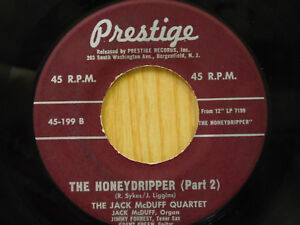
Esmond Edwards produced. The Honeydripper was the title of the album, and given how huge a hit the title song had once been on 78 RPM, it was chosen as a two-sided 45 RPM single.