Showing posts with label Fridays with Rudy. Show all posts

Wednesday, April 13, 2016

Listening to Prestige Part 179: Jackie McLean

A recent study has found that listening to jazz makes you smarter and more creative. Makes sense to me.

But then...do they seem to be saying that jazz is an undemanding sort of music, so you can put it on as background while you're studying, and that makes you smarter? I couldn't exactly swear to it. I didn't quite read the article all the way through. Maybe I'm not smart enough. So I should listen to more jazz.

And more creative? Absolutely. I always listen to jazz when I write this blog. But maybe I'm not a representative sample. As Etta Place told Butch Cassidy and the Sundance Kid, "your line of work requires a specialized vocabulary."

But I am listening to jazz at the moment, and I am writing, and it's another Friday at Rudy's, and once again the day begins with Breakfast with Jackie, and the same quartet: Mal Waldron, Doug Watkins, Art Taylor.

And once again with a ballad. "When I Fall In Love" was written by Victor Young, who is best known for writing lush movie scores like Around the World in Eighty Days, but who actually had something of a jazz connection, which probably shouldn't be surprising, considering the wonderfully tangled family tree of American music, and which leads me to a convoluted digression, which also shouldn't be surprising, because listening to jazz has made me creative. Young's first big break was something of a reverse spin on jazz, when he was hired by bandleader Isham Jones to take an uptempo jazz number and rearrange it as dreamy ballad. The tune was Hoagy Carmichael's "Stardust," and one would have to say the rearrangement was a success.

It led to Young's being signed by Brunswick records to record more dance music. The recordings were strictly for squares, featuring waltzes and semi-classics, but he was able to give employment to up-and-coming jazz musicians like Bunny Berigan, Tommy Dorsey, Joe Venuti and Eddle Lang. His Wikipedia  entry mentions that one of his most interesting recordings of this period was "Goopy Geer (He Plays the Piano and He Plays By Ear," composed and performed by Herman Hupfeld, who also wrote "When Yuba Plays the Rhumba on the Tuba." Oh, and a little thing called "As Time Goes By."

Back to "When I Fall in Love," which has the syrupy quality one might expect from the composer of "Around the World in Eighty Days," but also seems to have the jazz possibilities one could expect from the employer of Berigan, Dorsey, Venuti and Lang, not to mention the Boswell Sisters and Lee Wiley. At any rate, it has a remarkable jazz pedigree, with recordings by any number of the giants. Here it's given a rendition that's less reverent than McLean's "Sentimental Journey," and hits just the right tone for the material. Great stuff.

"Abstractions" is one of Mal Waldron's first recorded compositions, and he would go on to establisn himself as a significant jazz composer, best known for John Coltrane's "Soul Eyes."

As with the previous Friday, McLean roped in a couple of the cats who were on tap for the next session: Donald Byrd, who had sat in with them the previous week as well, and Hank Mobley, new to the Fridays with Rudy gang. So what do you play if you're getting together for a jam session? How about Charlie Parker? With musicians like this, and a tune by Bird, you can't miss.

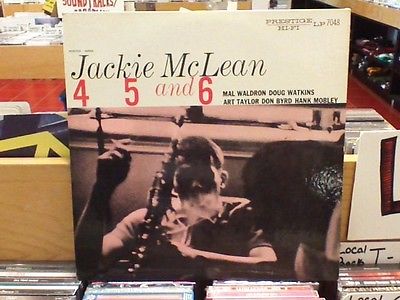
This is billed in the discography as a sextet session, even though only one track features the sextet. That track is also the "6" in the title of the album that conjoined the two Fridays: Jackie McLean -- 4, 5 and 6. It was released on both Prestige and New Jazz.


Monday, April 04, 2016

Listening to Prestige Part 178: Gene Ammons

Art always involves a series of contracts or promises between artist and audience, and that is particularly true in the narrative arts like literature or music, when one momentary experience follows another in time. The reader of a poem is always going to read the first line first, then the second, then the third, and so on.  If a poet writes a line in iambic pentameter, he's making a promise to the reader that the next line will also be ten syllables long, with an accent on every other syllable. If someone strikes a bluesy chord on the guitar and sings a line, he's promising that he'll sing the same line over again, and follow it with a line that rhymes. If someone starts playing a blues in B-flat, the promise is that the notes that follow will be consonant with the key of B-flat.

Sometimes these promises are strictly kept. Boudleaux Bryant, who wrote (with wife Felice) most of the Everly Brothers' hits, believed in whole rhymes, and obvious rhymes, because, he said, them made the listener a sort of co-composer. If you listen to

There goes my baby, with someone new,
She sure looks happy, I sure am...
 ...you can sing the end of the line before you even hear it.

Other times--and this is what makes art so exciting--the promise is broken. T. S. Eliot famously broke one at the beginning of "The Love Song of J. Alfred Prufrock," when he promised the reader a tetrameter line, rhymed couplets, and a dreamy romanticism with
Let us go then, you and I,
When the evening is spread out against the sky
and then he breaks all three of those promises with
Like a patient etherized upon a table.
If you break a promise, you have to break it with purpose. not like the young saxophone player who jumped up on the Jazzmobile stage in New York and wanted to jam with Frank Foster. Foster graciously welcomed him, and called for a blues in B-flat.  The young guy burst into a cacophony of yawps and screeches.

"What are you doing?" Foster asked.

"I'm just playing what I feel."

"Well, feel something in B-flat, motherfucker."

The beboppers would famously promise a romantic ballad from the Great Americam Songbook, then break that promise by upping the tempo as they began to improvise, playing it, in Chuck Berry's words, "too darn fast," and "changi[ing] the beauty of the melody until it sounds just like a symphony."

And that broken promise became the promise, one that the fan who really had no kick against modern jazz came to expect.

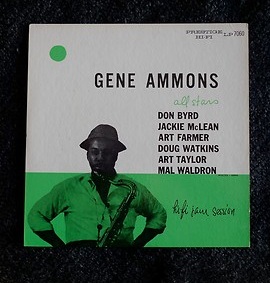
And so it is with Gene Ammons, on the second session of this Friday at Rudy's. Jackie McLean is still there, and so is Donald Byrd, and so is the rhythm section. Art Farmer has joined the merry crew.

And on the second song of the session, which is "We'll Be Together Again," Ammons knows that you know he's going to keep the promise to break the promise, so he teases a bit, drawing out notes almost to the breaking point. The song was written by an unlikely contributor to the Great American Songbook: Frankie Laine, with music by his pianist and music director Carl T. Fischer. It's a beautiful melody, one that found its way into the repertoires of some of our finest singers. Ammons, a great ballad player, gives us the beauty of the melody, but the tease is there too. And with McLean, Byrd and Farmer along for the ride, there's plenty of adventure ahead, enough to make ten minutes of wonderful music, coming back in the end to the melody, and Ammons' drawn-out notes.

The session also has "Jammin' with Gene," a version of "Red Top" that allows for fourteen minutes of jammin', and "Not Really the Blues," another Ammons tease, because anything he plays is really the blues. One odd choice: Donald Byrd is identified on the album's front cover (though not the back) as Don Byrd.


Saturday, April 02, 2016

Listening to Prestige Part 177: Jackie McLean

This was the beginning of a very busy summer in Mr. and Mrs. Van Gelder's living room. Let's hope they'd gone to Grossinger's for a summer vacation.A core group of musicians was constantly in and out of the studio in shifting combinations--Friday at Rudy's.

The festivities started on Friday the 13th--July 13, 1956--with two separate sessions. Jackie McLean was the nominal leader on the first one, though he played on both.

McLean starts the session with "Sentimental Journey," an interesting choice in that bebop's journeys were rarely sentimental. And it was a tough one to unsentimentalize. Written by dance band leader Les Brown and his arranger Ben Homer, recorded by Brown and Doris Day, it had been a huge hit in 1945, as ir became a sort of unofficial theme song for returning GIs. Only a decade later, as veterans were still having a painful time readjusting to civilian life (and this was not really recognized back then), the painful, bittersweet (at best) nature of that sentimental journey was still very real.

McLean's take on the song isn't sentimental, but it isn't exactly unsentimental, either. He plays it with a feeling for the melody that's not ironic. The improvisations are a little more hard-edged, but still in keeping with the feeling. McLean would have been 14 when the war ended, an age when boys are romantics and secretly hope the war will go on a little longer, so that they can get into it. You outgrow those feelings, but they're always part of you.

Two members of the rhythm section were to become no strangers to the Prestige studios. Art Taylor
already wasn't, having made his label debut in 1954, and having played on nine sessions already. Mal Waldron was making his Prestige debut. Both would go on to appear on a plethora of Prestige albums. In recent biographical material, they are often referred to, respectively, as the"house drummer" and "house piano player" for the label. It's not altogether clear what this means. Alan Dawson has been described as the house drummer for Prestige during part of the 60s, but he says this is nonsense -- they called him for a lot of gigs, but he was never the house anything.

Doug Watkins rounded out the rhythm section, and he was very much a presence on Prestige recordings in those days, too.

Bebop altered the concept of the rhythm session, as drummers like Max Roach, Kenny Clarke and Art Blakey took the beat away from the bass drum and shifted it to the lighter ride cymbal. The bass took over the principal responsibility for keeping the beat, and jazz singers learned to listen to the bass, not the drums, as their guide for keeping the beat. As drummers became virtuosi, bass players like Curly Russell and Tommy Potter, who could provide a solid foundation for the shifting intricacies of bebop, were in demand.

By the 1950s, bass players, though still anchoring the rhythm section, were becoming virtuosi too.
Players like Charles Mingus, Paul Chambers and Oscar Pettiford soloed as Russell and Potter never did.

How much could you do with a bass solo? Listen to Doug Watkins on "Sentimental Journey" and
you'll hear just how much. Watkins's career was cut short by the auto accident that claimed his life in 1962, but he made a lasting mark.

Donald Byrd joined the group for "Contour" (and stuck around for the afternoon session with Gene Ammons, and changed the mood dramatically. "Contour" is full-out bop, with the two horn almost percussive as they chop away at notes.

This session would be part of a McLean album called Jackie McLean -- 4, 5, and 6, covering both the 4 and 5 parts. It was issued on both Prestige and New Jazz.