Showing posts with label Wardell Gray. Show all posts

Saturday, March 14, 2015

Listening to Prestige Records Part 91: Teddy Charles

I continue to wonder what was the master plan involved in sending Teddy Charles out to be Prestige's West Coast representative. Was it to find out what the evolving West Coast sound was all about, and tap into it for Prestige? Or was it to find a new group of musicians to plug into the evolving Teddy Charles sound? If the former, he might not have been the best choice. (Certainly not the worst choice. That honor goes hands down to Art Rupe of Specialty Records, who, when he lost Bumps Blackwell, who had brought him Little Richard, Lloyd Price, Larry Williams, etc,, chose as his new New Orleans talent scout and A&R man...Sonny Bono?) My guess, it was a little of the former (in Bob Weinstock's mind) and a little of the latter (in Teddy Charles's mind). Anyway, Charles didn't come back with the next Brubeck or Mulligan/Baker, but he came back with some remarkable music.

And wondering leads to Google, and Google led me to this interview with Charles, which I had not seen before, where he talks about his West Coast sojourn:

One day in late 1952 or early 1953, after I had recorded those New Directions dates, he asked if I wanted to move to the West Coast to be the A&R director out there. The West Coast was a completely new scene for East Coast labels. They didn't quite get what was happening there, but they knew they had to be in on it.

"The first thing Bob wanted me to do was record Wardell Gray, which I did. Wardell was the hot guy out there. He and I had played together in Benny Goodman's group in the late 19940s. Bob had wanted me to put together a couple of sessions and record standards. But I had other things in mind. I wanted to put different musicians in challenging musical situations to see what came of it.

You don't have to have read too many of my blog entries to know that in my opinion, bringing Wardell Gray into any project is bound to be a good idea. I've written about that session. Listening to it, and especially listening to this session, I also couldn't help wondering whether Charles completely bought into Weinstock's "get together and jam" philosophy. Well, no. There was only one Bob Weinstock, and he made it work. He had a fan's enthusiasm, and it carried over into the making of some of the greatest jazz records ever made, so you'll never hear me knocking his philosophy. But it was a fan's philosophy; a musician's is bound to be different. So from the same interview, here's Teddy Charles talking about rehearsal, and also about tapping into the emerging West Coast sound:
In most cases, I’d get guys together and we’d run through the material I wrote. If it worked, we’d go into the studio. Or we’d have a date set, and we’d be in my apartment rehearsing. I also played quite a bit at the Lighthouse down at Hermosa Beach.

When I got out on the West Coast, I didn’t want to do the West Coast cool jazz thing that was so popular then. Frankly I didn’t care for the West Coast style of playing. The music was too laid back and didn’t have the sound. Not enough urgency. Instead, I brought an East Coast sound I was experimenting with out there, and I used West Coast guys to play it.
This interview was conducted by Marc Myers for his JazzWax blog. He's one of the great interviewers, so I strongly recommend reading the whole thing...and his blog is a treasure. Charles told Myers about one session he tried to put together with Stan Getz, Chet Baker and Al Haig, which ultimately had to be abandoned, as he discovered that not all great musicians had a feel for what he wanted to do --  "Stan could play anything, of course, [but] the music wasn't happening and felt forced."

I would have thought Shorty Rogers an odd choice for a Teddy Charles session. I wasn't that familiar with his work, and thought of him as a typical West Coaster, with an ear toward the pop market. I'd heard his album of jazz takes on contemporary pop songs, Chances Are It Swings, and I knew he'd done some Hollywood stuff, like The Man With the Golden Arm. I hadn't realized he had such an interest in experimental music. When you look at some of his credits, you can see why Charles gravitated toward him. From Wikipedia:

In the 1950s, when Igor Stravinsky began experimenting with dodecaphony, one of the twelve-tone techniques originally devised by Arnold Schoenberg, Stravinsky was very impressed with Rogers's playing, which, as Robert Craft reports in his book Conversations with Stravinsky, influenced the composer's 1958 choral work Threni.
Rogers is the sole horn on the first four tracks, from the August 21 session, and he works well with Charles, understanding and developing his ideas. I think the group is even better when Jimmy Giuffre joins them on August 31 -- of course, this is also ten more days of rehearsal.
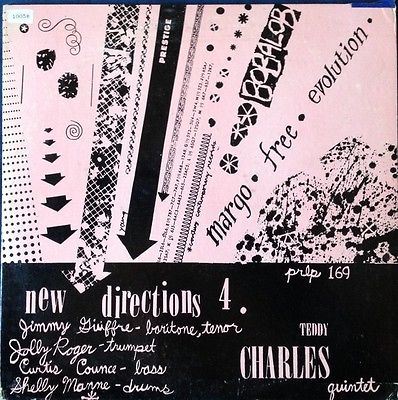
Shelley Manne was one of the most ubiquitous, and one of the most commercially successful musicians on the West Coast. His albums like My Fair Lady Loves Jazz, with Andre Previn, showed that you could satisfy the demands of art and the market at the same time. But did his comfort level stretch far enough to accomodate the seriously experimental sounds of Teddy Charles?
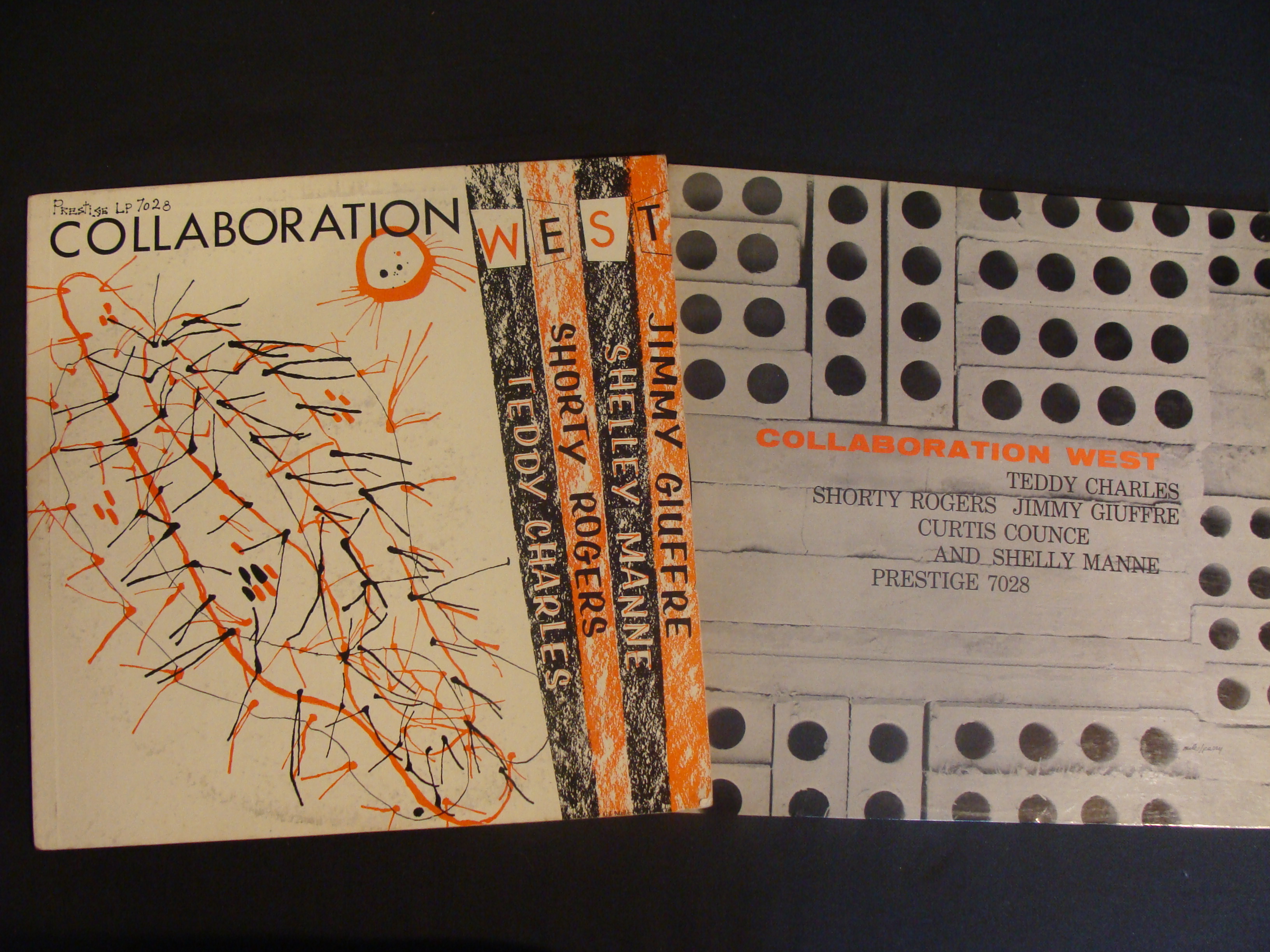

Oh, god, yes. Rogers and Giuffre work beautifully with Charles, but Manne does more. He brings ideas that take Charles to a new level. As I listened to these sides over a number of times, which is what I do in writing one of these entries, I found myself more and more looking forward to "what's Shelly going to do next?" Give a listen and see what I mean.

These came out on two 10-inchers, New Directions 3 and 4, and again in 1956, when Prestige had moved to the 12-inch LP standard, as Collaboration West - Teddy Charles/Shorty Rogers.


Index to Listening to Prestige Records 


Thursday, February 12, 2015

Listening to Prestige Records Part 82: Teddy Charles / Wardell Gray

Teddy Charles arrived on the West Coast in February of 1953 as Bob Weinstock's emissary, and immediately started putting together some extraordinary musicians.

Why Teddy Charles? Why expand to the West Coast? Probably because the jazz world was small and close-knit, and people did things because it seemed like a good idea at the time. Probably because Weinstock liked Charles, and Charles had mentioned that he'd love to go out to California. The other alternative is that Weinstock thought it through carefully, and said to himself, "I know! I'll take the most avant-garde musician I can find, and send him out to California! After all, look how well that worked seven years ago, the last time the most advanced musician of his day went out to California!"

In this case, unlike Charlie Parker's ill-fated West Coast debut at Billy Berg's, the world was probably ready for this incarnation of Teddy Charles, and Charles could hardly have put together a better group of West Coasters--including one musician who'd recorded with Bird during that West Coast sojourn, after Parker had relaxed at Camarillo.

This would be Wardell Gray's last recording session for Prestige. Two years later he was dead, his body found alongside a highway several miles outside of Las Vegas. It's quite possible -- probable -- that he was murdered, but the viciously racist Vegas of the 50s, no one cared. There was no investigation.

But this was an active period in Gray's life, and since we're saying goodbye in this blog to one of my favorite jazz artists, let's look at some of the recording gigs he made in the last part of '52 and '53, for an idea of his range and versatility.


  • A gig with Dexter Gordon, his partner on the famous "The Chase" recording.
  • A live recording at The Haig with Art Farmer, Hampton Hawes and Shelley Manne,
  • A  Shorty Rogers big band concert at the Rendezvous Ballroom in Balboa Beach, with June Christy on vocals, and a band that included Chet Baker, Art Pepper, Gerry Mulligan, and Hampton Hawes. 21 songs were recorded on an Ampex reel to reel by Rogers's wife, and according to the Wardell Gray web page, they have only recently been released on 2 CDs available only to members of the Los Angeles Jazz Institute. A couple more dates with Baker, Pepper, Mulligan and Hawes were recorded during the fall. One has been issued but is, according to the website, of poor quality; the other unissued. It would have been a treat to follow that band around.
  •  A four-song date for Norman Granz with a Louis Bellson big band, including Harry "Sweets" Edison, Maynard Ferguson, Benny Carter and Barney Kessel.
  • A Norman Granz jam session which included Benny Carter, Sweets Edison, Buddy DeFranco, Stan Getz, Count Basie, Freddie Green and Buddy Rich.
  • A Little Willie Littlefield R&B date for Federal.
  • A Billy Eckstine session for MGM, with an orchestra that included Gray and Harry "Sweets" Edison.
A line that has stuck in my head for years: Annie Ross, in her vocalese rendition of Art Farmer-composed, Wardell Gray-influenced "Farmer's Market," sends her heroine from the sticks and her crew-cut cat with the crazy goatee off "touring the country with Wardell Gray." Somewhere, in some better place, they are still touring.


Back to Teddy Charles. 

This was Frank Morgan's first recording session. 

Most of Morgan's career took place late in his life, after he had finally overcome more than 30 years of addiction, Between his first arrest in 1955 and his final release from prison in 1986, he spent much of his time behind bars, and pretty much all of it in the clutches of heroin. And his late career was such a productive one, it's pretty much overshadowed his brief early days, including his very early days.

I had known that Morgan, like every alto player of his generation, was deeply influenced by Charlie Parker, but I hadn't known that he was actually a protege of Bird's. At age seven, his guitar playing father (sometime accompanist for the Ink Spots) had already started him on guitar, but when they went to hear Jay McShann's orchestra play in Detroit, and he heard Charlie Parker play the alto, that was all he wanted to do in life.

Not many 7-year-olds have that kind of epiphany, but even fewer have the followup. As a musician with some reputation, Stanley Morgan was able to go backstage with his son, where little Frank was introduced to Charlie Parker, and where Bird took an immediate interest in the boy. He arranged to meet him at a music store the next day, and picked out an instrument for him--a clarinet, as better suited to develop a 7-year-old's embouchure. He and Parker remained in touch.

Morgan was precocious in more ways than one. When he was 14, and living with his grandmother in Milwaukee, he was caught smoking pot,and sent to live with his father in Los Angeles -- presumably because his grandmother felt she couldn't handle him, not because LA was thought to be a more drug-free environment. There, he immediately was thrown into jam sessions with the likes of Wardell Gray and Dexter Gordon, and age 15 was offered Johnny Hodges's spot in Duke Ellington's Orchestra, but his father decided he was too young to be touring with a band, For the next several years, his credentials are stellar. And in 1955, the same year Charlie Parker died, the 22-year-old's career was shut down.

This may have been a tough session for Teddy Charles to put together. Wardell Gray was sinking into addiction, after resisting it for a long time. 20-year-old Frank Morgan and 22-year-old Sonny Clark were already addicted. Morgan finally overcame it; Clark never did. Ten years later he was dead. The Paris Review, in 2011, ran a two-part profile of Clark which is beautiful, devastating, and complete, so I'll refer you to it.

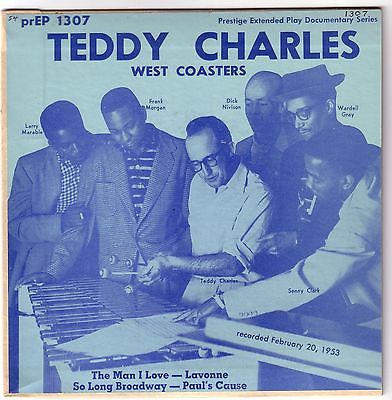
And move on to the music, which is inspired. Who knows what Bob Weinstock had in mind when he sent Teddy Charles out to Los Angeles, but what he got was a meld of talent and style between New York's most intellectual and avant-garde stylist this side of Lennie Tristano, and the West Coast's equally intellectual but earthy and crowd-pleasing giant of the tenor sax. The cover of their 45 RPM EP is posed, of course, but the way it shows all of them gathered around Charles, discussing a point of music, rings true.

I love all the songs on this session, but let me linger for a bit on "The Man I Love." I have a special weakness for bebop treatments of ballads from the Great American Songbook, and this one is no exception. Sonny Clark starts it off with a dense and moody piano intro, heavy on the sustain pedal, Wardell Gray comes in on top with an emotional statement of the melody, and then Teddy Charles comes in, under the piano at first, then above the piano but under the sax, then the two of them, Gray and Charles, improvising in tandem, one or the other of them taking the lead, or neither of them, with the tempo increasing, until it's time for a very young alto player, his head and heart full of Charlie Parker, to come an joyously take us into heart of Bebop Nation. There's no restatement of theme at the end--the tempo and the mood have gone too far beyond the aching plea for Mr. Right to come along. These guys are Mr. Right.

I could listen to this all day. In fact, I did. For the last couple of days.

It's more difficult than it should be to find composer credits for jazz compositions. AllMusic used to be good on this score, but they changed their format. "Lavonne"was pretty definitely written by Sonny Clark. I've seen "Paul's Cause" and "So Long Broadway" credited to both Charles and Gray, but the site that credited Charles also gave composer credit for the Gershwin classic "The Man I Love" to Davis, Sherman and Ramirez, who actually wrote "Lover Man." Still, Charles was the one who had recently said so long to Broadway, so there's a good chance it's his. Sonny Clark, much later, deeply in the throes of addiction, stole a tune from Thelonious Monk and recorded it as his own, but that was much, much later.

"So Long Broadway" was released as a single b/w a tune from a later West Coast session. All four tunes came out on a 45 RPM EP, and later on the Wardell Gray Memorial LP, Much later -- 2006 -- all the Teddy Charles California sessions were gathered on an CD, Adventures in California, but not issued by Prestige.


Monday, December 15, 2014

Listening to Prestige Records Part 60: Wardell Gray

I've written about Wardell Gray here, here, and here, and I don't know that there's a lot I can add, so maybe I'll just dedicate this blog entry/appreciation to my recent Facebook friend, Anita Gray, Wardell's daughter. Listening to any Wardell Gray recording session is a special experience, whether he's playing swing or bop or blues or R&B, in a big band like Basie's, as part of Benny Goodman's experimental bebop group, backing up singers as diverse as Dinah Washington, Billy Eckstine and Little Willie Littlefield, engaging in legendary tenor sax battles with Dexter Gordon, or leading his own group, as in this session for Prestige.

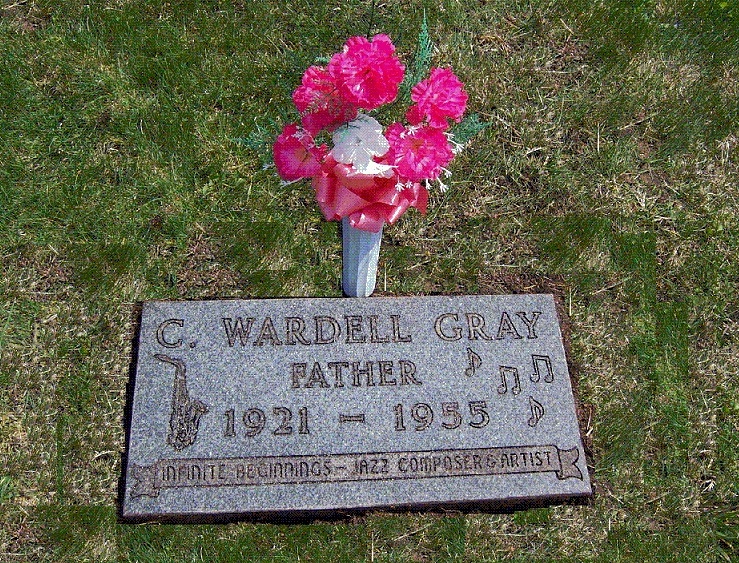
By 1952, Gray was beginning the decline that marked the last years of his life. He had settled on the West Coast, but West Coast gigs were few and far between. And it was probably about this time that this brilliant, educated man, role model for many younger musicians, great musician in his own right, began to slip into the heroin addiction that was so much the scourge of that era. He would only record sporadically after this, and he died in 1955, in Las Vegas, under circumstances that will never be fully known -- never, because Las Vegas was as racist as any town in Mississippi in those days, and the police were not going to be bothered investigating the death of a black man. I'm including here a photo of his headstone, designed by Anita Gray.


This is a wonderful session, his last for Prestige as a leader, although he did make one more for the label, in a group led by Teddy Charles. He is still at the top of his form here, swinging throughout, making every note the right one.

Also on this session is 23-year-old Art Farmer, making his recording debut. Farmer has said of Gray

Wardell was one of the nicest people I ever have known and he was like a big brother to me. He never hesitated to tell me what he felt I needed to know. I can't think of anything about this man as a man or as a musician to find fault with. It's just too bad that he didn't live long enough for the rest of the world to hear him.  
As a young jazz snob, when I went out to a club, I would snootily resent audience applause at the end of a solo, wanting to listen to how one soloist picked up on what the previous soloist had done. I've since learned that there can never be such a thing as too much applause, and a brilliant solo deserves it, but I still like listening to those moments, and I love, in this session, the passion and immediacy with which Farmer picks up Gray's ideas.

Farmer was contributing ideas of his own, too. "Farmers Market" is his composition (and unlike Miles Davis, Gray allows him full credit for it).

Also represented as composer is pianist Hampton Hawes. with "Jackie." Hawes was also 23, but
already a seasoned veteran, having played with major jazz artists (including Charlie Parker) since he was 19.  His playing on this session is a revelation. He's really unlike anyone else -- so percussive, so cutting, so inventive, and yet so melodic.

All of these were released on 78 -- I/m not sure about 45 -- and on LP.


Tuesday, September 30, 2014

Listening to Prestige Records Part 37: Wrapping up 1950

This winds up the second year of Prestige's prestigious history. Only 20 more to go, and I'm already starting to get the feeling they're going too fast -- that's the grandparent syndrome.


 The last two albums of the year are Sonny Stitt (December 17) with Junior Mance, Gene Wright and Art Blakey, and Jimmy McPartland (December 21) with a sextet including Vic Dickenson and Marian McPartland, so they closed out the year with a rising bebop star and a tip of the hat back to an older jazz style. The McPartland sides were issued on 78 as part of Prestige's 300 series, which appears to consist entirely of four 78 RPM records, all of them by Jimmy McPartland, one session in early 1949 and the other at the end of 1950 -- apparently Bob Weinstock's entire foray into trad jazz. Neither the Stitt nor the McPartland sessions can be found on Spotify, but you can get the Stitt session on Grooveshark --"Nevertheless" and "Jeepers Creepers here  and "Cherokee" here. "Nevertheless" is not exactly a bebop staple -- this is the only recording of it by a modern jazz group that I've found -- but listening to Stitt's version, one can't help but think that maybe it should be.

Prestige was certainly starting to make its mark in 1950. The scorecard: recording sessions with Stan Getz (2), Sonny Stitt and Gene Ammons (9), Eddie "Lockjaw" Davis,  Al Haig, Chubby Jackson, Lee Konitz,  Zoot Sims (4), Wardell Gray (2, one with Dexter Gordon), Leo Parker, Dizzy Gillespie, James Moody (recorded in France, released later as a 7000-series LP), and Jimmy McPartland. 


The major labels actually had the two most important jazz releases of 1950 -- one looking ahead, the other backward. Capitol put out eight songs from the Miles Davis Birth of the Cool sessions on 78. The LP wouldn't be released until 1957, although some songs from it came out on various Capitol 10 inch LPs. Nobody realized quite how important these sessions were at the time -- Miles wasn't able to make a commercial success of his nonet, and had to disband it. However, pretty much everyone knew how important the other recording was -- the recently rediscovered originals of the Benny Goodman 1938 Carnegie Hall concert, released by Columbia as a 12-inch LP -- in fact, their first double LP set.

Charlie Parker recorded with strings.

Fats Navarro died in 1950. Thelonious Monk was arrested on drug charges, lost his cabaret card, and couldn't play again in New York for six years.

Birdland, which actually opened its doors in late December of 1949, was in its first full year of operation.

On to 1951.

Saturday, September 20, 2014

Listening to Prestige Records Part 33: Wardell Gray - Dexter Gordon


This one really shouldn't be hard to find. Who doesn't want to hear Dexter Gordon and Wardell Gray, one of the legendary tenor sax pairings of all time, in their natural element, Los Angeles, and with a great supporting cast? But they're nowhere to be found on Spotify, and only sparsely on YouTube.

Which means no quiet listening time in my car, which is part of the reason for the delay in getting this entry up. The other part is that I've been going through a fairly painful period of writer's block, during which the only thing I could really write was this blog. Now I've broken through, at least a little, so this is competing with the writing I actually have to do.

So this is a live album, which is perhaps a first for Prestige (not sure about all their European albums). Wardell Gray did a live recording in Detroit, but it seems never to have been released. Certainly the first West Coast recording -- who knows what Weinstock's deal was on this one? -- and unquestionably an all-star session. Dexter Gordon is on board for "Jazz on Sunset," not for "Kiddo."

Sonny Criss, and especially Clark Terry, are stars in the jazz firmament, although Criss arguably never got the recognition he deserved. Jazz Profiles has an excellent appreciation of him as an "overlooked giant," including this assessment from early cohort and R&B giant Big Jay McNeely:

 Sonny Criss and I played together quite a while until I went to study with Joseph Cadaly [a first chair saxophonist at RKO Studies who taught reeds, harmony and solfège]. That’s when Sonny and I split up. He continued into progressive Jazz, and I went and studied.

When we split, he started going all up and down the Coast playing and going to Europe. But I don't know, it just didn't happen. He'd get records. People said he was great. They played his stuff. But it just didn't happen for him, and I think that kind of disturbed him. Especially when you put your whole soul and your whole life and just wrap up everything into something and it doesn't happen.

He was pioneering and when you're pioneering, it's kind of more difficult to get recognition …. You have to suffer when you're a pioneer. So that's what hap­pened, really, I think, with Sonny. He was just early.

Criss stayed on the West Coast, and West Coast jazz
was not a scene he fit into. It had moved away from bebop to the explorations of Gerry Mulligan and Dave Brubeck, the orchestrations of Henry Mancini and Andre Previn. And it was mostly white.

At the peak of his creative genius in the mid-50s, he recorded three albums for Imperial. But Imperial was mostly a rock and roll label (Fats Domino, Ricky Nelson), and secondarily a country label(SLim Whitman), and it didn't have the expertise or the inclination to do any serious marketing of modern jazz.

He did record for Prestige again, so we'll meet him again -- but much later.

In 1977, suffering from stomach cancer, he killed himself.

Jimmy Bunn, who also played piano on the famous Dexter Gordon/Wardell Gray recording of "The Chase," was arrested on drug charges, served hard time in San Quentin (where he played in the prison jazz band with Art Pepper), and was never able to restart his career.

Billy Hadnott, I find from the great rhythm and blues blog Bebop Wino, was very active on the West Coast R&B scene, playing with T-Bone Walker and Lloyd Glenn.

Chuck Thompson played in Hampton Hawes' great trio in the mid-50s.

This is wonderful music, with three great soloists (four when Gordon is added) challenging each other in the way only live recording allows. They're all individual as hell, they all surprise the listener (and, one would guess, each other) and they come together.

"Jazz on Sunset" is a reworking of Denzil Best's "Move," and "Kiddo" a version of Charlie Parker's "Scrapple from the Apple," itself deriving from a mashup of "Honeysuckle Rose" and "I Got Rhythm."

The YouTube recordings are full of surface noise, but for those of us who collected vinyl -- and collected it to play, and play again, not as an investment -- this is not really a drawback.


Here's parts one and two of "Kiddo":


And here's parts three and four of "Jazz on Sunset":


Thursday, September 04, 2014

Listening to Prestige Records, part 28: Wardell Gray

Benny Goodman was right about Wardell Gray. He was wonderful. He gets better every time I listen to him, and this session, recorded in Detroit, is a treasure -- because of the music, and because of the story behind it. There is much to say about Wardell Gray, and I'll say more as he comes up again in the Prestige story, but the story is Detroit, and the rhythm section that backed Wardell on this session, and the Bluebird Inn, where they were the house band.

J. R. Monterose was born in Detroit. So was Pepper Adams, who said of those heady days when bebop was young,
In Detroit, the standards were so high that to compete for local gigs you had to really play awful goddamn good! If you were good enough to be competitive in Detroit, you were ahead of what the rest of the world’s standards were.
And there were more. Here's Wikipedia's list of jazz musicians from Detroit (perhaps incomplete -- I know that J. R. had been omitted, so I added him:  Elvin Jones, Hank Jones, Thad Jones, Howard McGhee, Tommy Flanagan, Lucky Thompson, Louis Hayes, Barry Harris, Paul Chambers, Yusef Lateef, Marcus Belgrave, Milt Jackson, Kenny Burrell, Ron Carter, Curtis Fuller, Julius Watkins, Hugh Lawson, Frank Foster, J. R. Monterose, Doug Watkins, Sir Roland Hanna, Donald Byrd, Kenn Cox, George "Sax" Benson, Sonny Stitt, Alice Coltrane, Dorothy Ashby, Roy Brooks, Phil Ranelin, Faruq Z. Bey, Jaribu Shahid, Hakim Jami, Pepper Adams, Tani Tabal, Charles McPherson, Frank Gant, Billy Mitchell, Kirk Lightsey, Lonnie Hillyer, James Carter, Geri Allen, Ralph Armstrong, Ali Jackson Jr., Rick Margitza, Kenny Garrett, Betty Carter, Sippie Wallace, Robert Hurst, Geri Allen, Rodney Whitaker, Clarence Penn, Karriem Riggins, Harold McKinney, Ray McKinney, and Carlos McKinney.

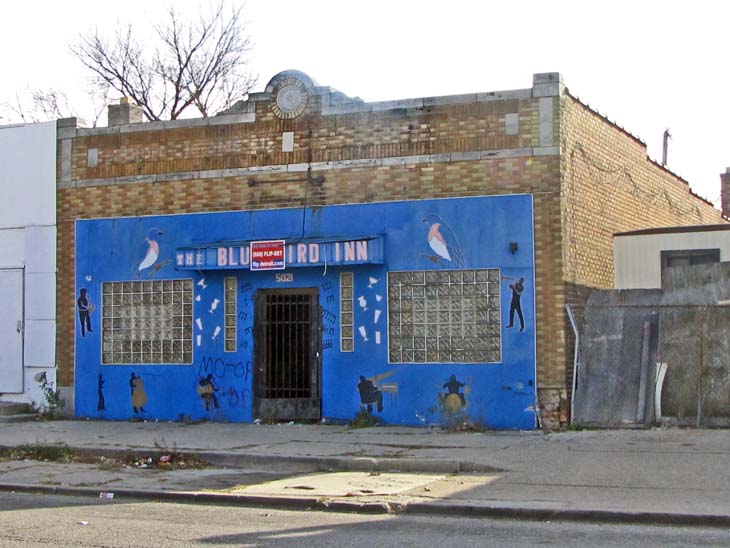
Jazz at the Blue Bird Inn in Detroit "started in 1948 when the Blue Bird hired pianist Phil Hill and told him to assemble a house band specializing in the newest thing from New York City - bebop." Here's the full story, from Lars Bjorn and Jim Gallert.

Here's a photo of the Blue Bird from 2010, with a history of the building, and a sad story at the end of it:
Use in 2010:  Vacant building ready for sale
City of Detroit Designated Historic District: Not listed
State of Michigan Registry of Historic Sites: Not listed
National Register of Historic Places: Not listed


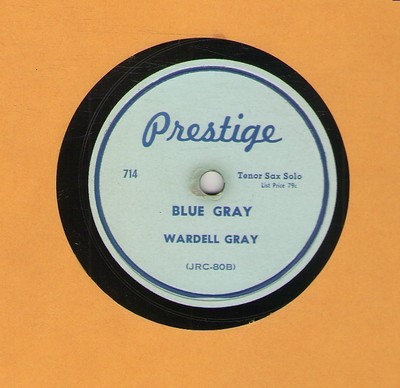
The songs on this session are "A Sinner Kissed an Angel," "Blue-Gray," "Grayhound," and "Treadin' with Treadwell." "Treadin'" is Wardell's tribute to jazz DJ and historian Oscar Treadwell, also celebrated by Charlie Parker in "An Oscar for Treadwell" and Thelonious Monk in "Oska T."

Phil Hill is a jazz legend who seems to have almost never recorded. I can only find two listings -- this album. and a live session with Wardell Gray the previous year, which may never have been released. The bassist on the Prestige session is listed as John Richardson. On the unreleased live recording, it's James "Beans" Richardson, who has to be the Jimmy Richardson of the Blue Bird poster (subsequent house bands at the Blue Bird included Elvin Jones, Frank Foster and Yusef Lateef). I can't tell whether the John and Beans are the same person, but it seems likely -- a mistake on the Prestige session notes. In any event, here's a nice tribute to Beans by his niece. Art Mardigan played with Woody Herman, Pete Rugolo and Stan Getz after his Blue Bird days, ultimately returning to Detroit and the Detroit music scene.

Here's a nice tribute to the Blue Bird:


And here's Wardell Gray with his Detroit trio:


And this beautiful ballad:


Monday, August 04, 2014

Listening to Prestige Records -- Part 16: Wardell Gray

Wardell Gray is known to aficionados of American literature as being one of the jazz musicians mentioned in Jack Kerouac's On The Road, along with George Shearing, Slim Gaillard, and Dexter Gordon, with whom Gray's name is forever linked as one of the great tenor sax pairings in jazz history.
He was known to younger musicians on the West Coast as a role model for music...and more:
 After Bird, the skinny tenor man from the Billy Eckstine band was the musician most admired and respected by the younger players. He spoke quietly and articulately, admired the philosophy of Jean-Paul Sartre and the politics of Henry Wallace, boosted the NAACP and advised fledgling jazzmen on music and life, particularly in regard to the futility of messing with drugs.
 But he is most importantly known as a musician's musician, a man who could--and did--play with mastery in any style, from swing to rhythm and blues to be bebop. Benny Goodman, who at first rejected the new music, had his opinion changed by one man:
If Wardell Gray plays bop, it’s great. Because he’s wonderful.
And when Goodman experimentally formed a bebop group (they played good music, but no one wanted to hear
Goodman play bebop, and he abandoned the experiment), Wardell Gray was the first person he hired. In fact, Gray is most likely the only musician to have recorded with Benny Goodman, Count Basie and Charlie Parker.

Most famously, as a West Coast tenor player energized by Charlie Parker's ill-fated California tour, he engaged in a series of tenor battles that were captured on wax in "The Chase."

And perhaps second most famously, from his first session for Prestige, "Twisted," which became another vocalese hit, this one for Annie Ross, and later Bette Midler.

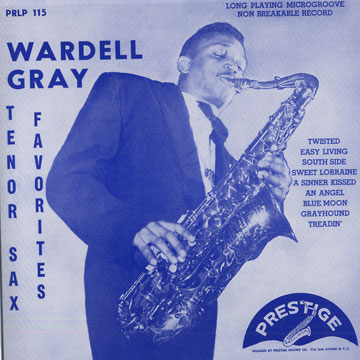
Gray was mostly known as a West Coast musician, but he did spend enough time in New York to cut a few sessions for Prestige. This first one, with as classic a bebop rhythm section as one could wish for, includes "Sweet Lorraine," "Southside," "Twisted," and "Easy Living." They capture everything that was great about Grey: lyricism, edginess, tone, inventiveness. And this is the sort of album that I started this blog looking forward to finding: brilliant musicians, a tight group, inspired blowing, spontaneity.

These four tunes were originally released by Prestige on their New Jazz 78 RPM series (817 and 828). and Southside/Sweet Lorraine also on a Prestige 78 (711). They were part of a 100-series 10-inch LP (Prestige PRLP 115--Wardell Gray Tenor Sax) and later on a couple of 7000-series albums, including the very complete Wardell Gray Memorial Album (PR 7343). All of Gray's work can be found on Spotify, and he's well represented on YouTube. Here's "Twisted."


And here is a segment from the documentary on Gray, Forgotten Tenor.