Showing posts with label Arthur Edgehill. Show all posts

Friday, June 14, 2019

Listening to Prestige 399: Shirley Scott

Shirley Scott is back with her trio and some timeless standards from the best: Rodgers and Hart, Cole Porter, Johnny Mercer. In other words, more Moodsville than soul jazz, and this was in fact a Moodsville release.

Of course, just because it's on Moodsville, that doesn't make it easy listening. Producer Chris Albertson has said that when you went in to the studio, you weren't thinking Moodsville, Swingville or Bluesville, you were making a jazz album for Prestige, and that's what Esmond Edwards and Scott are doing here. The album leads off with a Scott original, "Like Cozy," and while George Duvivier and Arthur
Edgehill lay down a solid groove, Scott gets off some of the swooping experimental voicings that she's so fond of, before settling into a soulful melody.

"Little Girl Blue" was already a solid standard by 1960. Written by Rodgers and Hart for a 1935 musical, it really entered the pop/jazz lexicon when Margaret Whiting recorded it in 1947. It was the title song from Nina Simone's 1958 album on Bethlehem, and while "I Loves You Porgy" was the hit single off that album, "Little Girl Blue" was also released as a single, got a lot of air play, and became the definitive vocal version for many. Bud Shank made the first jazz instrumental version in 1954, and after that the floodgates opened. in 1955 alone it was recorded by Dave Brubeck, Tal Farlow, Johnny Smith and Gerry Mulligan, and it's still being brought into the studio by vocalists and instrumentalists alike. Scott gives us a smoky piano veraion here, very much suggesting that she'd absorbed a lot of what Simone was doing, but still very much Shirley.

Johnny Mercer's "Laura," from the movie of the same name, is one of the most widely recorded songs in the canon--in 1960 alone, there were at least a dozen versions. So if you're going to play it, you've got a double task. First, if you put "Laura" on your album, your audience is going to want to hear "Laura," because it's a beautiful, haunting melody, and second, you've got to distinguish your version from the others. Scott manages to meet both demands, with every note sustained virtually forever, giving the haunting melody a haunted quality, and changing the tone from the wistful single notes of "Little Girl Blue" into something rich and strange.

Then she snaps that mood again with Cole Porter's "You Do Something to Me" - piano again, upbeat and percussive, lotsa improvisatory flights, lotsa room for Edgehill and Duvivier, with some very nic stuff by Duvivier.

And that's how the album goes--some organ, some piano, some experimental, some reassuring, a variety of moods, and all Shirley. Good stuff for her fans, good stuff to listen to years later, when the organ trios have faded into history. No single releases from this session, I guess on the theory that Moodsville fans were album fans. The album was released as "Like Cozy."


Listening to Prestige Vol. 2, 1955-56, and Vol. 3, 1957-58 now include, in the Kindle editions, links to all the "Listen to One" selections. All three volumes available from Amazon.

The most interesting book of its kind that I have ever seen. If any of you real jazz lovers want to know about some of the classic records made by some of the legends of jazz, get this book. LOVED IT.
– Terry Gibbs


Wednesday, January 23, 2019

Listening to Prestige 374: Shirley Scott

It may have seemed like a leap of imagination to put organ and vibes together in a quartet, or it may have seemed like the most obvious of ideas--let's take two of our hottest young stars and put them together and see what happens. Either way, Shirley Scott and Lem Winchester made an inspired pairing.

We've been following Scott through a series of albums, as she was both prolific and popular. We've heard her with a trio, with Eddie "Lockjaw" Davis, and accompanying a singer, and we've heard how she's always changing, always developing, always trying something new which is at the same time perfectly apropos to the setting she's in.

That's true again here, matched in quartet setting with a vibraphonist. She's mellower than she was when playing with a tenor saxophone, more restrained than the wild experimentation she gets into on her own, more assertive than when she's backing up a vocalist. And in every setting, she has something to say. I did not enter into this project having an opinion one way or another about Shirley Scott. I'd never really listened to her, and I could probably easily have gotten her confused with Hazel Scott, jazz pianist, actress, and wife for 15 years to Adam Clayton Powell. No more. Now I am a confirmed Shirley Scott fan, and I look forward to her every recording as I follow the Prestige story.

Here they take on some interesting material, starting with Andre Previn's "Like Young." Previn had had a hit with his own version of the song the year before, in a recording credited to "The Piano Magic of Andre Previn Combined with the Lush Strings of David Rose," which I guess signaled that the recording was being aimed at the Jackie Gleason market, and maybe explains why the song has never quite achieved jazz standard status. But Previn was a first rate jazz pianist before he went on to other things, including fame as a symphony orchestra conductor and notoriety as an adulterer back in the days when you could still be notorious for that. His notoriety was helped along by dumped wife Dory (dumped for Mia Farrow) who wrote a bittersweet song cycle about the experience, Beware of Young Girls. Farrow, of course, would have her own young girl to beware of later in life, when her adopted daughter Soon-Yi Previn took up with then-husband Woody Allen.

But I digress. Scott and Winchester were the first jazz musicians to take on "Like Young," and there have been a few more since, but it's never really caught on, although it is the most frequently recorded of any of Previn's compositions in the jazz-pop field. Henry Mancini, Neal Hefti and Martin Denny would all do orchestral versions of it, but only Illinois Jacquet and Dave Pell seem to have given it further jazz treatments.

Scott plays the head, and lays down a solid base for Winchester to improvise over. Scott herself will come back with a delicious upper register improv, leaving one to wonder why more jazz musicians haven't gone to this composer for inspiration.

"Sonnymoon for Two" is of course a Sonny Rollins tune, in this case a first date rather than a honeymoon, and like a good squire, Winchester lets Scott do much of the talking. This is definitely not speed dating. The two take time to get to know each other, and they each clearly like what they hear.

As originally recorded by Rollins at his 1957 live recording from the Village Vanguard, it was really a Sonnymoon for one, just the tenor great and a rhythm section. It was first covered by Jimmy Smith, and has since become a widely recorded jazz standard, with a wide variety of recordings including a smokin' one by rock guitar hero Danny Gatton and pedal steel guitar virtuoso Buddy Emmons.

The other standards are Bronislaw Kaper's "On Green Dolphin Street,"  Mack Gordon and Harry Warren's "The More I See You," and Lerner and Loewe's "Get Me to the Church on Time," the last of these a tune that's boisterous fun in its original context, and sly fun here, as they stay right around the melody, with deft variations. "Now's the Time" is one of Charlie Parker's best-known compositions, both in its own right and as the melody for the rhythm and blues hit, "The Hucklebuck" (no composer credit to Bird). Winchester had previously recorded "Now's the Time" on the album New Faces at Newport; this version with Scott stays much closer to Bird's original arrangement (and to "The Hucklebuck").

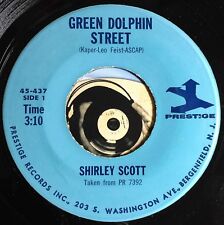
Finally, there's Scott's own composition, "Blues for Tyrone," which is largely a showcase for her bravura organ style, although Winchester handles his solo part near the end adroitly, "Blues for Tyrone" made the B side of the 45 to be released from this session. "On Green Dolphin Street," probably the most familiar tune to jazz aficionados, made the A side. We can see from the image of the 45 that the time is 3:10, cut down from the original 4:11 of the album cut. Which is interesting, I guess they were used to editing down album cuts for 45 RPM release, but 4:11 is really not too long to fit on a 45.

The album, not released until 1966, after Winchester's death, was called Soul Sister, shifting attention to the surviving star, and hopping onto  what was by then a steamroller of a soul bandwagon. "Now's the Time" was left off this release, and became the title track of an album released the following year, and made up of leftovers from several sessions.

Esmond Edwards produced.


Listening to Prestige Vol. 3, 1957-58 is now available!


and also:

Listening to Prestige, Vol. 2, 1954-56


Listening to Prestige, Vol. 1 1949-53


Friday, November 02, 2018

Listening to Prestige 354 - Eddie "Lockjaw" Davis and Shirley Scott

What a difference Ray Barretto makes to a session!

Of course, it's not just him. Davis and Scott blow the cathedral ceilings off Rudy Van Gelder's Englewood Cliffs shrine, and if you ever wondered if Moodsville meant "you can sneak this record on for your Jackie Gleason fans, and maybe they won't notice it's jazz," you can forget that right now. This is a session that left me thinking two things, and two things only. One, I'm so glad I'm a jazz fan and I get to experience music like this, and two, How is it possible that I never heard this before?

So pardon me if I'm speechless for a while, as I just listen to the music a few more times, all the way through.

OK, I'm back. Still amazed. Eddie Davis plays right on that sweet spot at the cusp of bebop and rhythm and blues. Ray Barretto is the musician's musician on congas, equally adept at playing Latin or bebop, but sensitive as he is to the boppish tempos of Mr. Jaws, this one has that Latin edge all the way through. And Shirley Scott is the perfect accompanist to Davis's bebop and the perfect spur to send the music into the next decade. My God, she could play! And she was so inventive.

The Moodsville album which uses the bulk of this session's material begins with two numbers from an earlier trio session. Then it starts afresh with "Give Me a Goodnight Kiss," by Lee Morse, a singer of whom I was previously unaware, but she was a big deal in the 1920s, matched only by Ruth Etting for record sales.

Curious, I listened to Lee Morse's recording of "Give Me a Goodnight Kiss."  She's a very nice singer, and in those days she had her own band, which included Eddie Lang and a couple of new kids named Tommy and Jimmy Dorsey. She puts a twist of yearning into the song, Davis hears it a bit differently.

It's interesting that he hears it at all. Morse kept performing through the late 1940s, but by the end or th3 1920s alcohol had pretty much destroyed her. Her jump to superstardom was supposed to come in 1927 with the starring role in a Zeigfield musical, but on opening night she was too drunk to go on, and her place was taken...by Ruth Etting. Etting's signature songs, like "Love Me or Leave Me" and "Ten Cents a Dance" (should have been Morse's; it was from that musical) have become standards, but I can find no other version of "Give Me a Goodnight Kiss."

Davis takes the first solos at a good but not breakneck tempo, abetted by some tasty work from Wendell Marshall and Ray Barretto, nicely completing each other's thoughts, and some always ingenious comping from Scott. When she comes in about two thirds of the way through for her solo, you realize that as good as Davis has been, this is what you've been waiting for. She builds up to a series of crescendos, and then Davis comes back for a final version of the head, again with Barretto and Marshall, and with a sweet, yearning quality that's reminiscent of Lee Morse.

This is the beginning of an eclectic set. They follow with Frank Loesser's "Moon of Manakoora," originally sung by Dorothy Lamour in a movie (and yes, she was wearing a sarong). It's had a number of pop recordings, and a few jazz interpretations, starting with Benny Carter and also including Wayne Shorter and Jimmy Rowles. Davis, Scott and Barretto get pretty seriously into it, eleven minutes worth, Barretto starting the game with a challenging and seductive rhythm.

"Just Friends" was composed by John Klenner, who is not known for much else, but pretty nearly
everyone has recorded "Just Friends," with the honors probably going to Charlie Parker with strings. This version would have to be right up there, though, with the three principals spurring each other to new heights. "Speak Low" has a haunting melody by Kurt Weill, sensitively handled by Davis with Barretto providing a rhythmic counterpoint. Davis gets wilder as the number progresses, and by the time Scott joins in all bets are off, although Davis comes home to the melody at the end.

"I Wished on the Moon" was written by Ralph Rainger, who had an impressive career before dying young in a plane crash. It finishes up the album, but was the first tune to be recorded that day.

The Moodsville release was entitled Misty. and hit the shelves in 1963. The odd tune out for the day was Cole Porter's "From This Moment On." It was added to a 1967 release, Stompin'.


Thursday, November 01, 2018

Listening to Prestige 353 - Shirley Scott

Most of this session went on a Moodsville album, along with four songs held back from an earlier date.

She had a new bass player for the date in George Tucker. Tucker had some experience accompanying organs, having played on Johnny "Hammond" Smith's two Prestige albums. She continued with Arthur Edgehill on drums.

She is perhaps a little more subdued for Moodsville. Musically, she continues to reward the listener, but with a more limited palette of sound. Rather than
seeking out new possibilities of electronic sound, she stays close to the sound of a piano, the percussive individual notes stretched just a little by the electronic sustain of the Hammond. So it is in its own way an experiment with the different possibilities of her instrument. As one of the most popular jazz musicians of the decade, she recorded a lot, both with Prestige and Blue Note, and later Impulse and Atlantic, and she was always going to find a way to make it interesting.

For the four Moodsville songs, she picked two Rodgers and Hart standards, "Spring is Here" and "I Didn't Know What Time it Was," and you can't go wrong with Rodgers and Hart. The other two are also ballads, and equally romantic, but from composers with interesting stories. "I Thought I'd Let You Know" was composed by Scott's fellow Philadelphian Cal Massey in an uncharacteristically romantic mood; Massey was to become best known for his uncompromising political stance on civil rights, which caused him to be blacklisted by some of the large corporate record labels.

Jimmy Davis (not the Louisiana governor who wrote "You Are My Sunshine") is best known for written for Billie Holiday which has become a classic, but his story is more than that, and worth remembering. Drafted in 1942, he refused to report to a segregated army and demanded that either be exempted or seconded to the Canadian army, which was integrated. When both demands were rejected, he chose prison over a segregated armed forces. He did eventually agree to join the army, and was sent to France in 1945 with a musical unit. He fell in love with the country, and eventually, like many other African-American musicians, became an expatriate.
"Lover Man," a song

"Bye Bye Blackbird" was held for a 1961 release, Shirley's Sounds; "Autumn Leaves" and her own composition, "Bridge Blue," had  wait until 1966 and Workin'..

She also cut two tunes, "Crazy Rhythm" and "The Things You Are," with Earl Coleman. They were never released. Too bad. Coleman really never got his due.

Esmond Edwards produced.


Friday, July 20, 2018

Listening to Prestige 340: Eddie "Lockjaw" Davis - Shirley Scott

Ballads, standards, moods for Moodsville, and a couple of novelties for a 45 RPM release and the Christmas trade.

This is mostly Eddie Davis's album. Shirley Scott plays a supporting role, and a lot of it,  session log to the contrary, is on piano. Her piano solos show that if she had chosen to stay on that instrument, she would have had a very fine jazz career.

"It Could Happen to You" was written by Jimmy Van Heusen and Johnny Burke. First recorded in 1943 by Jo Stafford, it moved into the jazz repertoire in 1951 when both Errol Garner and Bud Powell cut it, and since then, it has been beloved by jazz musicians. Burke also co-wrote "What's New" with Bob Haggard for a 1938 Bing Crosby recording, and it became a jazz standard in the early 1950s with recordings by Milt Jackson and Errol Garner before it really became a pop standard. Although both of these entered the jazz repertoire as piano pieces, Davis dominates here, and he is a fine ballad player, sensitive and atmospheric, Scott's solos are shorter, but she packs a lot into them, Jerome Kern's "Smoke Gets In Your Eyes" has never wanted for performers, either vocal or instrumental, to take on its subtle loveliness. This track is Davis's throughout, with Scott providing support. The Gershwins are responsible for "The Man I Love," and it's even older, going back to the 1920s and Adele Astaire, and if anything even more popular, with over 300 recorded versions.

"The Very Thought of You" (Ray Noble), "Serenade in Blue" (Harry Warren) and "I Cover the Waterfront" (Johnny Green) can't quite match Kern and Gershwin, but they're also well-loved standards.

"Man With the Horn" was written by Bonnie Lake, one of the most successful woman songwriters of her era, and dedicated to her husband and co-composer, Jack Jenney, a trombone player who would die not long after. It became a staple for horn players, although Jenney may have been its only trombonist, and Davis recorded it more than once.

Scott goes back to the organ for the two Christmas songs. I think I prefer "Santa Claus is Coming to Town," which is sprightly and doesn't take itself too seriously, to Mel Tormé's "The Christmas Song," which has always thought of itself as a better song than it probably is. Scott does some very clever organ fills on it, though.

The Moodsville album is simply and eponymously title Eddie "Lockjaw" Davis and Shirley Scott, because at this point "Moodsville" was the prominent feature on the new label's covers. The Christmas songs were not included. They had their own niche as a seasonal 45.

VERY CLOSE TO BEING READY TO TAKE ORDERS FOR LISTENING TO PRESTIGE VOL 3!


Saturday, June 09, 2018

Listening to Prestige 337: Mildred Anderson

Bob Weinstock continues his streak here: finding wonderful blues singers, putting them together with first rate musicians, and not really achieving the kind of success one would hope for.

Mildred Anderson had recorded a couple of sides in the 1940s and a couple more in the 1950s. This session, and a followup for Prestige, are generally considered to be her best work, but they didn't bring her much fame. She faded into obscurity--in fact, into oblivion. There appears not even to be a record of her death. Or her birth, for that matter.


Anderson had worked with first rate musicians before. She'd had a minor hit with Albert Ammons ("Doin' the Boogie Woogie"), and had recorded with Hot Lips Page and Bill Doggett. But "Doin' the Boogie Woogie" really wasn't a very good song, although it had a nice solo by Ammons. And on the Prestige session, she gets the label's stars, plus Esmond Edwards' producing talents, and, of course, Rudy Van Gelder engineering the session.

She has a full day of studio time. And she has an interesting collection of songs.

Here again, we've moved into a new era. Edwards and Anderson, or whoever picked out the songs for this session, are not looking back at the composers who compiled the Great American Songbook, now closed, gift-wrapped, and sent to Ella Fitzgerald. Those songs aren't necessarily appropriate for a contemporary blues singer, anyway. This is a different and a motley bunch, but professionals with some interesting hits to their resumes.

"I'm Gettin' 'Long Alright" and "Connections" were written by Charles Singleton (who also wrote "I'm Free" and Bobby Sharp. Sharp, who grew up in a two-room Harlem flat where his parents entertained the likes of Roy Wilkins, Thurgood Marshall, Langston Hughes and Duke Ellington, wrote "Unchain My Heart." Singleton wrote "Strangers in the Night."

Rhythm and blues great Chuck Willis wrote "Don't Deceive Me (Please Don't Go)." Anderson herself wrote the two blues numbers, "Hello Little Boy" and "Cool Kind of Poppa," and they're both solid songs, well suited to her style. Another blues legend, Eddie "Cleanhead" Vinson, wrote "Kidney Stew Blues," along with Leona Blackman, who wrote a number of R&B tunes for artists like Big Maybelle, but "Kidney Stew," as originally performed by Vinson, was her biggest hit.

"Person to Person," which became the title song of the album, was written by Wally Gold, who had a bunch of hits, including  "It's Now or Never" and "Good Luck Charm" for Elvis Presley, and a song he was called in on to finish up for a part time songwriter, who had been inspired by a tantrum thrown by his teenage daughter, when informed she had to invite her grandparents to her Sweet Sixteen. When he tried to calm her down, she retorted "It's my party, and I'll cry if I want to."

Mildred Anderson is a terrific singer who deserved more recognition than she got. The musicians backing her up, Scott and Davis and their regular rhythm section, George Duvivier and Arthur Edgehill, are amazing. I commented before, regarding their session with Al Smith, that "Shirley Scott's understated but impassioned organ work, on every cut, really pulls the album together. It makes you wish she'd done a lot more work with singers." That's as true, and more, on this session, but if I singled out Scott that time, I might not be able to do it this time. She and Davis are equally impressive. They do wonderful work backing up the singer, accenting her and bringing out the best in her, and they move from that into solos that take on their own importance, yet never stop being part of the song. I can't say more than that, because every time I try to single out one of them, and one cut off the album, so many others jump out and demand equal time.

Maybe Davis and Scott were born out of their time. In the 1930s, the bandleaders were the stars, and the singers were just part of the show. By the 1950s, that only worked for Johnny Otis. But if Davis and Scott could have added a vocalist and put together a package like Tommy Dorsey or Glenn Miller...

"Person to Person," b/w "Connections," is the 45 RPM single. "Connections" was not included on the album. Nor was "Ebb Tide," and neither of them are listed on the CD reissue, either, although you can find "Connections" on YouTube, which is all to the good. It's a nice raunchy song. Unfortunately, the single didn't make much of a dent. Maybe if they could have gotten a different Wally Gold song, like It's My Party." Well, maybe not.

Friday, April 20, 2018

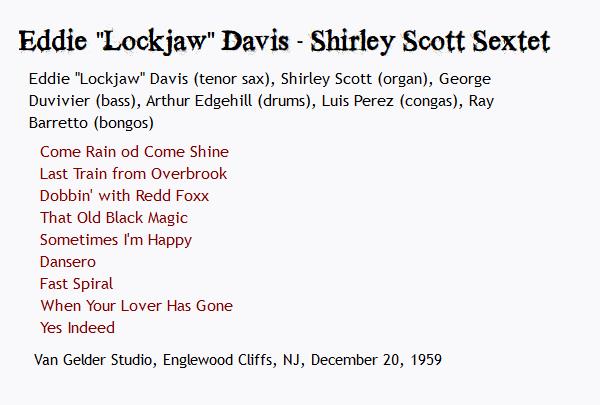
Listening to Prestige 331: Eddie "Lockjaw" Davis and Shirley Scott

Ray Barretto makes a welcome return to the Van Gelder studio, this time bringing with him a fellow conguero, Luis Perez. Barretto moves over to bongos for the session.

The bongo drums were a kind of fad instrument in 1959, associated with the media stereotype of the Beat Generation. Comic beatnik Maynard G. Krebs of the Dobie Gillis TV show, a character who embodied every beatnik cliché, played the bongos. So did real-life Hollywood rebels James Dean and Marlon Brando. Brando was actually quite good, and not only that, he patented an electronic device for tuning the head of a bongo or conga drum. Bet you didn't
know that. Contemporary star Matthew McConaughey has gained some notoriety for playing the bongo drums naked, but that's getting too irrelevant.

Ray Barretto needed no electronic devices. He was as much a master of the bongos as he was of the conga, and adding a second Latino percussion instrument to the traditional small jazz group (by this time the organ-tenor sax combo was fast becoming traditional) made a huge difference.

The hand-played percussion instruments are not restricted to Latino music, not that that's a restriction. But Barretto, in particular, grew up playing both swing and Latin rhythms, and he was hugely influential in bringing swing rhythms to the traditionally Latin percussion instruments, as can be heard here. But there's always a special excitement that a great percussionist brings to any recording, and that goes double here.

It's interesting that Shirley Scott lays out much more than she does on other recordings. The intros to the tunes are mostly Barretto and Perez, and she generally stays outta the way when Davis is soloing. This has the effect of giving a powerful prominence to Barretto and Perez, not only when they're taking the lead, but when they're playing behind Davis.

This gives Scott a whole new role in the combo. When she solos, she's not stepping into the limelight, continuing and extending moods and ideas she's begun while comping for the tenor sax. Instead, she's making an entrance. It's dramatic, it's different. Of course, as new as the organ still was to jazz prominence, and as inventive as Scott was, everything she did in these recordings was different.

The session includes a nice complement of standards--"Sometimes I'm Happy" "That Old Black Magic," "Come Rain or Come Shine," "When Your Lover Has Gone." The Latin-tinged "Dansero" was originally a hit for its composer, Richard Hayman, in one of the decade's more unusual arrangements--harmonica and full symphony orchestra.

They turned to James Moody for two tunes. "Last Train From Overbrook" had been recorded by Moody as an instrumental for Argo in 1958, and also with Eddie Jefferson singing his own vocalese lyrics."Dobbin' with Redd Foxx" may have been something Davis heard Moody play on a package tour, because Moody himself had only just recorded it a couple of months earlier, again for Argo, and it surely had not been released yet. And if you're wondering what "dobbin'" is, don't ask Moody. When he recorded it. the title was the even more enigmatic "Darben the Redd Foxx." In any case, it's nice to see a 1959 tribute to Redd Foxx, when he was at his guttermouthed raunchy peak. Later on, with Sanford and Son, he was still a comic genius, but considerably reined in.

Davis is the composer of "Fast Spiral," and I am quite sure there was never a temptation to call it "Slow Spiral." This is an uptempo rampage.

The album was produced by Esmond Edwards. It was released on Prestige as Bacalao,


Listening to Prestige Vol. 2, 1954-1956 is here! You can order your signed copy or copies through the link above.

Tad Richards will strike a nerve with all of us who were privileged to have
lived thru the beginnings of bebop, and with those who have since
fallen under the spell of this American phenomenon…a one-of-a-kind
reference book, that will surely take its place in the history of this
music.
                                                                                                                                   --Dave Grusin

An important reference book of all the Prestige recordings during the time
period. Furthermore, Each song chosen is a brilliant representation of
the artist which leaves the listener free to explore further. The
stories behind the making of each track are incredibly informative and
give a glimpse deeper into the artists at work.
                                                                                                                --Murali Coryell

Thursday, April 12, 2018

Listening to Prestige 328: Shirley Scott

A new side of Shirley Scott here, as she really steps forward as a composer, and delivers some solid stuff.

I think composing on a organ must be an entirely different experience from composing on a piano--or anything else, for that matter. But piano is the preferred instrument of composers, unless you're composing for voice -- writing a song -- in which case a guitar will do just as well. But these pieces sound different, even when they're doing more or less the same thing, like the classic catchy riff end-punctuated by a two-note fanfare. Miles Davis' "So What," from Kind of Blue, is a familiar example. Scott uses the same pattern on "Duck and Rock," but it sounds different. It is different. It's not just the difference in hearing the two-note  response played on the organ. She does that on Bobby Timmons' "Moanin'" (Every mornin' finds me moanin' -- oh,
yeah!) "Duck and Rock" is different. Different fanfare. Different way of getting there. Different places to go to from there.

It's altogether a fascinating listening experience, through four originals: "Duck and Rock," "Boss," "Plunk, Plunk, Plunk," and "Soul Searchin'." You wouldn't automatically assume from its title that "Plunk. Plunk, Plunk" is an organ tune. The title makes it sound more like a banjo tune, but Scott plunks away at that organ and comes up with something that's a lot more great organ jazz than it is plunkety plunk. "Boss" changes the pace by changing the tempo. You don't necessarily think of an organ, with its great capacity for sustained notes, as being the perfect vehicle for a wild uptempo number, but Scott, as we know, is a great believer in trying to discover everything an organ can do.

"Soul Searchin'" is the title cut, and it's anchored by the soulful bass of Wendell Marshall. "Soul" is gaining in popularity as a music-related word. Charles Mingus's Mingus Ah Um, released earlier in the year, had included "Better Git It in Your Soul." Ray Charles' Genius + Soul = Jazz was still just beyond the horizon, as was self-described original soul artist Solomon Burke. So put Scott up near the head of the line.

As for the tunes by other composers, it's hard to beat Bobby Timmons' "Moanin'" for soulfulness. Scott does flammable things with dynamics on it, and uses the whole keyboard, with sacrificing its simple tunefulness. She tears up Sy Oliver's "Yes Indeed," not so soulful when it was originally recorded in 1941 by Bing Crosby (although Connee brings some soul), much more so when it was revived by Ray Charles in 1958.  Don Redman ("Gee, Baby, Ain't I Good to You") and Buddy Johnson ("You Won't Let Me Go") are both good sources in the search for soul.

They added a "g" for the album title: Soul Searchin'. "Duck and Rock" b/w "Ebb Tide" was the first single off the album, followed by "Gee, Baby, Ain't I Good to You?" / "Moanin'."

"Uh-Oh" and "Misty" are both on the set list for this session, but they were Scott-Eddie "Lockjaw" Davis  collaborations, and he's not listed as being part of the mix. But the two made a 45, with "Misty" as the A side, under Davis's name, and "Misty" would be released again on 45 some years later, with "In the Kitchen" as the B side. Both would also appear on a later Davis-Scott album.


Listening to Prestige Vol. 2, 1954-1956 is here! You can order your signed copy or copies through the link above.

Tad Richards will strike a nerve with all of us who were privileged to have
lived thru the beginnings of bebop, and with those who have since
fallen under the spell of this American phenomenon…a one-of-a-kind
reference book, that will surely take its place in the history of this
music.
                                                                                                                        --Dave Grusin

An important reference book of all the Prestige recordings during the time
period. Furthermore, Each song chosen is a brilliant representation of
the artist which leaves the listener free to explore further. The
stories behind the making of each track are incredibly informative and
give a glimpse deeper into the artists at work.
                                                                                                                --Murali Coryell

Tuesday, March 13, 2018

Listening to Prestige 319: Al Smith

Bob Weinstock's early experiments with blues and R&B singers were marked by two near-constants. Joe "Bebop" Carroll,They were (a) very good, and (b) commercially unsuccessful. As with jazz, Bob Weinstock had the ear. But he didn't seem to have the marketing touch that he had with jazz.


Remember The Cabineers, Ralph Willis, John Bennings,  H-Bomb Ferguson, Bobby Harris, Paula Grimes, Rudy Ferguson, The Mello-Moods, Joe "Bebop" Carroll, Bob Kent,Piney Brown, Billy Valentine,  James "Deacon" Ware? If you're a pretty serious blues collector, you might remember  H-Bomb Ferguson, Joe "Bebop" Carroll or Piney Brown. You might actually remember the wrong Piney Brown--the more famous one was the Kansas City saloonkeeper who inspired Big Joe Turner's "Piney Brown Blues."  Anyway, those three had decent recording careers, if not comparable to Big Joe Turner or Sonny Boy Williamson or Wynonie Harris or Larry Darnell or Varetta Dillard, to name a few contemporaries.

Prestige did record a couple of well-known blues singers like Brownie McGhee, but they weren't known for their work on Prestige. And if you want to count King Pleasure as a blues singer, there's one unqualified success. 

But most of the other Prestige blues singers have disappeared into almost total obscurity, for mostly no good reason. You can find a couple of cuts by Paula Grimes on YouTube, maybe, and she's wonderful, but she never quite made it.

Weinstock briefly had a blues subsidiary, Par Presentation Records, in the early 1950s, but it only put out a few unsuccessful titles and was quickly shuttered.

But this was 1959, the tenth anniversary year of what was by now a very successful independent record label, run by a guy who had learned more than a few tricks about successful marketing. Weinstock had staked his claim to the jazz nostalgia niche with Swingville, and he was about to do the same for the blues market with Bluesville.

And still, at least with his first attempt, he couldn't bring it off. Al Smith is almost totally forgotten today, his two albums for Prestige/Bluesville the only record of his ever having existed. He's easier to find and listen to, in today's streaming wonderland, than Paula Grimes, but I'd guess that very few still have a copy of the vinyl record, although you can actually buy it from collectors' sites.

And if there's ever a record that deserves to have been heard, and to become a classic, it's this one. Smith is a remarkable singer. How remarkable? Well, take his cover of a Ray Charles tune.

Ray Charles was a wonderful songwriter, and his songs have been widely covered: "I Got a Woman," "This Little Girl of Mine," "What'd I Say?" But nobody else that I've been able to find has covered "Night Time is the Right Time," and with good reason: the distinctive raw, pleading response vocals of Margie Hendrix make it virtually uncoverable.

But Smith makes it work. His gospel-tinged blues singing is sufficiently different from Charles's to make his approach unique--and while it's equally different, it has enough of Hendrix's fervor to power his singing of both parts.

He also Eddie "Lockjaw" Davis's tenor sax solo adding yet another gospel-tinged declamation to the mix.

Davis stands out on "Night Time," but Shirley Scott's understated but impassioned organ work, on every cut, really pulls the album together. It makes you wish she'd done a lot more work with singers (she and Davis did back up Mildred Anderson on another Bluesville release).

Smith does two other covers, both associated with Johnny Ace: "Never Let Me Go," written by prolific tunesmith Joe Scott, and Ace's mega-hit, "Pledging My Love," credited to Ferdinand Washington and Don Robey, although the flamboyant label-owner Robey was better at putting his name on songs than actually writing them. His version of "Pledging my Love," with Scott's sensitive organ, is one of the best covers of this song.

His originals are all good songs. I'm not sure any of them has "hit" emblazoned on it the way "Pledging My Love" does, but they're good. Two of them, "Tears in My Eyes" and "Come On Pretty Baby" became the first 45 RPM single off the album. The two covers, "Night Time is the Right Time" and "Pledging My Love" were a second single."Tears in My Eyes"/"Come on Pretty Baby" was the first 45 RPM release on Bluesville, and Hear My Blues was the first Bluesville album. While it may have made only a faint dent at most, Bluesville would go on to achieve some success.


Listening to Prestige Vol. 2, 1954-1956 is here! You can order your signed copy or copies through the link above.

Tad Richards will strike a nerve with all of us who were privileged to have
lived thru the beginnings of bebop, and with those who have since
fallen under the spell of this American phenomenon…a one-of-a-kind
reference book, that will surely take its place in the history of this
music.
                                                                                                                          
--Dave Grusin

An important reference book of all the Prestige recordings during the time
period. Furthermore, Each song chosen is a brilliant representation of
the artist which leaves the listener free to explore further. The
stories behind the making of each track are incredibly informative and
give a glimpse deeper into the artists at work.
                                                                                                                --Murali Coryell


Thursday, January 25, 2018

Listening to Prestige 308: Eddie “Lockjaw” Davis - Shirley Scott

This must have been a good year for Prestige’s bottom line. Look at who they’ve recorded so far. Davis and Scott. Scott with a trio. Arnett Cobb. Coleman Hawkins. Hal Singer. Due in a couple of weeks, Willis “Gator Tail” Jackson.

Davis and Scott are new stars, and very hot, and young and raring to go, and they’ll come back into the studio and make exciting music over and over again. Coleman Hawkins is a legend riding the cusp of a new popularity, Cobb and Singer and Jackson are rhythm and blues hitmakers.

So can we say that 1959 was, in general, a year of place-holding, of playing it safe while the music percolates, and new directions take time to sort themselves out?

No. Not hardly. The AllAboutJazz web site calls this “the most creative year in all of jazz history, and they make a persuasive case. Miles Davis recorded Kind of Blue. John Coltrane recorded Giant Steps. Ornette Coleman recorded The Shape of Jazz to Come. Dave Brubeck recorded Time Out.

You really don’t need any more evidence, but AllAboutJazz rounds out its list of ten albums with:
  • Bill Evans’ Portrait in Jazz (Riverside): “A defining piano trio set: Evans on piano, Scott LaFaro on bass, and Paul Motian on drums. The empathy within this album is outrageous, like all three musicians are connected by the same brain...A major influence onpiano trios to come such as the Keith Jarrett Trio and the Brad Mehldau Trio, and the epitome of a great jazz piano trio. 
  • Mingus Ah Um (Columbia). “Essential to Mingus fans and jazz aficianados everywhere.”
  • Duke Ellington, Anatomy of a Murder (Columbia). “This Ellington / Strayhorn collaboration is one of the hippest soundtracks of all time. Ellington and Strayhorn were writing original compositions for use in a major motion picture, a wonderful development for jazz."
  • Horace Silver, Blowin' the Blues Away (Blue Note). "Another side of things: The hard bop side with bluesy, soulful overtones...it's not modal jazz, its not free jazz, it's even in 4/4 time, but it's essential." 
I'd raise my hand and put in a quiet vote here for Eddie Davis and Shirley Scott, but the AllAboutJazz guy;s assessment is fair. Horace Silver is recognized as the godfather of soul jazz. And Jimmy Smith (who made Home Cookin' in 1959) is the titan of the Hammond B-3.
Somebody is always going to be the poll winner, and the name associated with a new movement. But in the world of music, as opposed to music journalism, those hierarchies don’t matter.
  • Ella Fitzgerald Sings the George and Ira Gershwin Song Book (Verve).
  • Miles Davis, Sketches of Spain (Columbia). "The combination of two genius minds at work: Miles Davis and Gil Evans in probably the most celebrated meeting of the two ...Integral to the history of jazz for combining classical music styles with jazz improvisation, thus pushing the 'third stream' movement...another gargantuan contribution to the evolution and diversity in jazz."
So Prestige wasn't exactly out in front in terms of creative innovation. They had been, from their first Tristano release through their introduction of the Modern Jazz Quartet to the world, through the Coltrane albums that immediately led up to Giant Steps. And they would continue to introduce new and exciting jazz innovators. So what are we to make of this chill-out period of soul jazz and post-swing and rhythm and blues?

As I said,  a good cash flow situation. The sales figures for these albums aren’t going to match Kind of Blue or Time Out, but on the other hand, it didn't cost anywhere near as much to make a Hal Singer album as it did to make Kind of Blue. And the folks who'll plunk down $4.98 for an LP record just because they like to listen to it, and play it at parties, and dance to it, can sometimes outnumber the ones who want to be the first to own the album that Down Beat and The Jazz Review are raving about.

Esmond Edwards produced this string of albums. He was that rarity in the 1950s, an African American producer of the music that was African America’s gift to world culture, and he knew what they were dancing to at a Harlem house party on Saturday night.

And a half century later, what does this mean?

It means the discovery of some wonderful music. Our generation (and the two or three following us) own Giant Steps and Kind of Blue and Time Out and Sketches of Spain. We bought them on vinyl when they came out, and we paid the ripoff prices to buy them again as we began our CD collections. Now the vinyls are still lovingly in a rack in our music rooms, the CDs are somewhere or other, or we gave them to the church for their annual flea market, and we listen to music over a streaming service, or Sirius-XM in our cars, which plays the music you want to hear: Davis and Brubeck, Coltrane and Coleman.

Or you go a little off the beaten track, and you listen to music that was old when they made it, but is new again now. Music that offers nothing except you'll love it, and isn't that kind of what music is for? And if it made a few bucks for Bob Weinstock back in 1959, good for him.

And as for any of these Davis-Scott albums, they’re not even close to getting overexposed. The perspective of fifty years in the future isn’t all that different from the perspective of listening to each of these sessions as they were released. Either way, you’re hearing two artists learn more and more about working together, finding new and exciting ways to blend that tenor saxophone and Hammond organ sound, especially when they add a Latin beat to soul jazz, as in Ary Barosso’s “Bahia” (previously heard by John Coltrane in one of his last Prestige sessions).

Although Davis and Scott are always the main event, they like working in the quintet format, and on this album, they are augmented by trombonist Steve Pulliam, a veteran of the Buddy Johnson orchestra, who adds substance and a few very tasty solos. An article in Jet, about Pulliam being hit with a paternity suit, describes him as a prominent Harlem bandleader.

The album was Jaws in Orbit. No singles came off this session.


Listening to Prestige Vol. 2, 1954-1956 is here! You can order your signed copy or copies through the link above.

Tad Richards will strike a nerve with all of us who were privileged to have
lived thru the beginnings of bebop, and with those who have since
fallen under the spell of this American phenomenon…a one-of-a-kind
reference book, that will surely take its place in the history of this
music.
                                                                                                                                      
--Dave Grusin

An important reference book of all the Prestige recordings during the time
period. Furthermore, Each song chosen is a brilliant representation of
the artist which leaves the listener free to explore further. The
stories behind the making of each track are incredibly informative and
give a glimpse deeper into the artists at work.
                                                                                                                --Murali Coryell

Wednesday, January 24, 2018

Listening to Prestige 307: The Prestige All Stars

There are a lot of fields of entertainment and the arts in which one can speak of “an embarrassment of riches,” where too much of a good thing starts to weigh it down or actually diffuse it. An NBA All Star Game is never going to be as good as a game between two closely matched teams. You probably wouldn’t really want to have Leonardo and Raphael working on the same canvas, although it might be fun for a minute.

Fortunately, this is rarely the case in jazz. In jazz, the more great players you pull together on one bandstand, the more excitement, the more richness you’re going to have. That’s why there isn’t a jazz fan alive who wouldn’t give his left arm to have been at that speakeasy in Kansas City where Coleman Hawkins and Lester Young dueled it out, toe to toe. That’s why Norman Granz’s Jazz at the Philharmonic jams with, say, Charlie Parker and Lester Young, are so prized today.

That’s why if you take Eddie “Lockjaw” Davis and Shirley Scott, already a dynamic aggregation, and tell a jazz fan you’re adding Coleman Hawkins to the group, he or she is going to whoop for joy. Then if you announce that you’re not stopping there, you’re going throw in Arnett Cobb (Yeah, yeah!) and Buddy Tate (Yeah, yeah, yeah!)

So what happens when you get four tenor sax greats together for a session? Well, first of all, you have some great section playing. Then, you have four guys loving what their peers are doing, and encouraging each other to one hot solo after another. And then...wait a second. It’s not just four great tenormen, is it?

It’s not just tenors.

And it’s not just men.

I’ve talked before about how the small group Shirley Scott is different from the organ trio Shirley, but maybe not so different. In the trio she is constantly exploring the different ways that an organ can sound. With a small group, she is constantly finding new ways to be a part of that group, to push and cajole the sax guys into new places. I’ve talked before about how good she is, but I have to come back to it because I think I’m just realizing, in this set, just how good she is. Maybe it’s working with those different voices.

In “Light and Lovely,” she and George Duvivier have an extended duet that leaves one wondering, if they are the title, which is which?

What is this kind of music? Davis and Clark are certainly in the vanguard of the soul jazz movement, but these other guys aren’t. In recent years, we hear a lot about “mainstream jazz” and “straight-ahead jazz,” and both terms have very precise, if not always clear, definitions which one is not to stray from (or to confuse the two) by musicians who were not really a part of bebop, but who did live on this planet and were aware of its power and importance. So these are guys who are not living in the past, or particularly looking toward the future, but are playing the kind of music they like, and playing it sweetly and completely.

This is listed as an All Stars date, which means it was released with no leader given for the session, but the names of all the participants (in this case, all four tenormen) on the cover. It would be rereleased later as a Davis/Scott session.


Listening to Prestige Vol. 2, 1954-1956 is here! You can order your signed copy or copies through the link above.

Tad Richards will strike a nerve with all of us who were privileged to have
lived thru the beginnings of bebop, and with those who have since
fallen under the spell of this American phenomenon…a one-of-a-kind
reference book, that will surely take its place in the history of this
music.
                                                                                                                                      
--Dave Grusin

An important reference book of all the Prestige recordings during the time
period. Furthermore, Each song chosen is a brilliant representation of
the artist which leaves the listener free to explore further. The
stories behind the making of each track are incredibly informative and
give a glimpse deeper into the artists at work.
                                                                                                                --Murali Coryell