Showing posts with label Bill English. Show all posts

Monday, April 18, 2022

Listening to Prestige 624: Kenny Burrell


LISTEN TO ONE: Soul Call

Kenny Burrell was certainly no stranger to Prestige's album shelf, but it had been a while since the label had given him the leader's baton -- seven years. He had recently worked with Jack McDuff, Shirley Scott, Gildo Mahones, Jimmy Witherspoon.

This a slightly unusual lineup in that it's a quintet with no horns. The basic rhythm section, and Burrell's guitar, are augmented by the always-welcome Ray Barretto. The other musicians on the date are less well-known. Bill English played on a few Prestige sessions; the other two are newcomers to Prestige, but members of Burrell's working group.


Will Davis, new to Prestige, had seniority in the jazz world. Born in 1926, he joined Howard McGhee's early West Coast bebop ensemble and recorded with McGhee in 1948. Then relocating to Detroit, he became a part of that city's high-flying jazz scene. As the house pianist at the Crystal Bar, he worked with many of bebop's royalty, including Charlie Parker and Miles Davis. After his move to New York in the late 1950s, he worked often with Burrell, although this was their only recording together. 

If Davis represented the Old Guard of modern jazz, Martin Rivera had something of a different background, making his first recordings with Les Jazz Modes, the experimental group organized by Julius Watkins and Charlie Rouse. He also worked frequently with Junior Mance, recording with him as a duo, and made a few albums with Burrell, although this would be the only one on Prestige.

So it's fair to say that Burrell was looking for a flexible sound--not the trendy sound of soul jazz, although the album's title, Soul Call, would seem to suggest otherwise. But any casual jazz fancier, picking up the 45 RPM single for a jolt of the popular soul jazz of the day, might have been sorely disappointed.


Any real jazz fan, not so. "Soul Call," over a rock solid (but not aggressively funky) riff from the rhythm section, is a is a wonderful rhythmic/melodic/improvisational interplay between two masters, Burrell and Barretto.

It's a Burrell composition, as is "Kenny's Theme," which is the flip side of the 45, and another opportunity for Burrell and Barretto to interweave their talents, with rhythmic delights by Bill English and Martin Rivera thrown in.

"Mark I" was written by Will Davis, and there's room for some piano-guitar interaction, but mostly it's a vehicle for some bravura work by Burrell.

Standards comprise the rest of the album, and one not-quite-standard: "Oh Henry," written by Gil Fuller and Ernie Henry. Henry was a talented saxophone player whose promising career was cut short by heroin overdose in 1957. Fuller, though his name is not quite a household word, was a gifted composer and arranger particularly known for his work with Dizzy Gillespie. He was co-composer and arranger on "Manteca," "Tin Tin Deo" and "One Bass Hit." He gives Burrell and company a spirited beboppish romp here, to cap off an album of much originality, much virtuosity, and if the group doesn't entirely answer the soul call, they provide a refreshing change of pace.

Ozzie Cadena produced.

Thursday, March 26, 2020

Listening to Prestige 467: Gene Ammons - Oliver Nelson

As with Miles Davis and John Coltrane, Bob Weinstock seemed, as 1961 wound on, to be trying to get as much as possible out of Oliver Nelson before he moved on, and in as many combinations as possible. Here, four days apart, he goes from arranging strings and French horns for Etta Jones, to arranging a full jazz orchestra to support headliner Gene Ammons, Prestige's most prolific performer--this is his third session in 1961 alone. Ammons was a victim of the heroin plague, and this activity in 1961 was sandwiched between two prison sentences, one from 1958-60 and one from 1962-69.

We're hearing some musicians for the first time. Nelson was looking for a sound, not soloists, so he picked experienced section men: guys who could read music, who could follow a conductor's lead and get it right the first time, who would show up on time and ready to play.

Trumpeter Hobart Dotson had a lot of experience in big bands. He was in the dance bands of Gerald Wilson and Dan Belloc--and not all dance bands are alike. Wilson, who came up with Jimmy Lunceford (he replaced Sy Oliver), and played in the ensembles of Basie, Ellington, Dizzy Gillespie and Benny Carter, was in the tradition of black dance bands; Belloc, who owned and operated a ballroom in Chicago, and worked with some rock and roll groups (including the Buckinghams, later), catered essentially to white audiences. Dotson also worked with edgier jazz orchestras, including Charles Mingus, Slide Hampton, and (edgier still) Sun Ra.

Red Holloway would also find plenty of work for Prestige in the 1960s, particularly with Jack McDuff. Chicago was his home base for most of his career, where he worked with blues, rhythm and blues, rock and roll and jazz artists, recording with them and backing up touring artists.

Bob Ashton (baritone sax here; he also played tenor) made his Prestige debut in a 1960 recording of a big band led by Eddie "Lockjaw" Davis, which also marked Oliver Nelson's debut as an arranger. He would also find his way onto a number of Prestige sessions during the 1960s.

George Barrow is in the tenor sax section for this session, but he was better known for his work on the baritone sax, which he played on Nelson's arranging debut with Davis, and on The Blues and the Abstract Truth. With the ensemble of jazz superstars (Eric Dolphy, Freddie Hubbard, Bill Evans) that Nelson put together for that recording, he was to single out Barrow for praise: "His baritone parts were executed with such precision and devotion that I find it necessary to make special mention of his fine work." Barrow would become a fixture on a number of Prestige recordings over the next few years.

Ammons has always liked the well-loved standards, and he does his share of them here, in front of Nelson's arrangements, along with some surprises from outside of the Great American Songbook catalog, like Savannah Churchill's rhythm and blues hit, "I Want to Be Loved." It's always worthwhile to hear a good song get the Ammons treatment, and even more so in this context,

"Too Marvelous for Words" is a good example. Written by Richard A. Whiting and Johnny Mercer in the 1930s, it was always popular with both vocalists and instrumentalists, but reached a zenith in the late 1950s with Frank Sinatra's vocal and Nelson Riddle's arrangement. Ammons sings this one on his saxophone, with a lovely brief solo from Richard Wyands. Nelson's arrangement satisfies--it does all the things one wants from a big band supporting a soloist--and it also surprises.

Esmond Edwards produced. As with Coltrane, Prestige did not release all its Oliver Nelson product all at once, and this session in particular was sliced and diced, as they also had to parcel out Gene Ammons's recordings after he was sent back to prison.

"Love, I've Found You" (another rhythm and blues ballad written by Gwen and Harvey Fuqua) and "Too Marvelous for Words" were first to appear, on a 1963 compilation album, Soul Summit, Vol. 2, which also included tracks from an Etta Jones session with Ammons and two Jack McDuff sessions, one with Ammons and one without.

"Things Ain't What They Used to Be," "I Want to Be Loved," "Makin' Whoopee" and "Lullabye of the Leaves" were all on 1964's Late Hour Special.

Jerome Kern's "The Song is You" waited until later in 1964, and was released on Velvet Soul.

"I Want to Be Loved" and "Love, I've Found You" were released on 45 RPM, though it would be a stretch to think that the Ammons-Nelson versions could be aimed at the rhythm and blues market, especially since by 1964 there was no rhythm and blues market.


Listening to Prestige Vol 4, 1959-60, now available from Amazon! Also on Kindle!
Volumes 1-3 are also available from Amazon.
The most interesting book of its kind that I have ever seen. If any of you real jazz lovers want to know about some of the classic records made by some of the legends of jazz, get this book. LOVED IT.
– Terry Gibbs


Tuesday, March 24, 2020

Listening to Prestige 466: Etta Jones

This is the first of three sessions involving a collaboration between Etta Jones and Oliver Nelson. That only four songs were recorded on this session is a pretty good indication of the complexity of the project. It must have cost a lot more than Bob Weinstock was accustomed to paying for an album,what with three days of studio time and the cost of a string section. And were they able to put all this together with no rehearsal time at all? It seems unlikely. This was no jam session. Since Weinstock didn't believe in keeping alternate takes, we have no idea how many takes were discarded, but the fact that they only got through four songs, all of them fairly short (2:02 to 3:40), should tell us something.

I hope this proved to be a good investment for Weinstock. Jones had some popularity at the time--Don't Go to Strangers sold a million copies, though she never attained that level of success again. And her place in the pantheon of jazz singers, to today's jazz  audience, is iffy. One internet poll of top female jazz singers places her at number 38, another (a list of the top 25) leaves her out altogether. And yet another one places her 7th, just behind the acknowledged queens of the field.

So it depends on who you ask; but she is for the most part, I would guess, only marginally remembered. And it's hard to understand why this is so. She had a long career, and in fact issued her last record, a tribute to Billie Holiday, just before her death in 2001.

And she really was that good. You can hear the influences of all the singers that she absorbed--chiefly Billie Holiday and Dinah Washington--but she's not derivative. The influences are absorbed, learned from, and channeled into a voice that is distinctively her own.

And whether or not Bob Weinstock made back his investment in this album, we're lucky to have it, both for Jones's beautiful interpretations of songs by a variety of composers, and for yet another demonstration of the range of Oliver Nelson's talents.

Working with a deliberately limited palette--a French horn section, a string section--Nelson produces a sound that's striking and unique, but always does its primary job of supporting the singer.

Classical musicians, in general, don't get the kind of recognition that jazz musicians do. Even in a big orchestra like Duke Ellington's or Count Basie's, you know the names of all the players, and if you're a serious jazz fanatic, you know what each one of them sounds like. Here, the stringed instruments, which play such an important role in Oliver Nelson's sound, are anonymous.

The French horn players do get individual credit, and while they aren't names we would recognize as readily as the reed players like Jerome Richardson and Eric Dixon, other musicians knew who they were. Richard Berg was called on for sessions by Dizzy Gillespie and Jimmy Heath in 1960-61, and a dozen years later, when Charles Mingus needed a French horn player, Berg was the one he called. John Denver and Neil Sedaka both used him, and he has a previous Prestige association, though he's not listed on the session log: he helped out Moondog on that eccentric genius's Prestige recordings. I don't find Joe Singer's name attached to any other recording sessions, though I'm sure he did many, but he is the author of the standard instructional book on developing an embouchure for French horn,

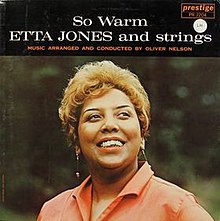
Esmond Edwards produced the session. The album, about which we will be hearing more, was called So Warm.


Tuesday, December 31, 2019

Listening to Prestige 443: Joe Newman

Joe Newman is back for his second of three Swingville sessions, and it's very much like the first: Musicians drawn from the Basie extended family, solid swinging arrangements, Tommy Flanagan taking the Count's chair at the piano, Basie bassist Eddie Jones on board. This time instead of Frank Wess it's Frank Foster on tenor sax.  Non-Basie drummer Bill English replaces non-Basie-ite Oliver Jackson on the drums, but like Jackson, English can swing it. We've heard him before, in 1956, with Bennie Green.

A big difference here is the choice of material, which leaned heavily on Basie the last time out. This time, although he includes one Basie staple (Neil Hefti's "Li'l Darlin') and one Ellington number ("Just Squeeze Me"), the rest are all Newman compositions.

A small group is always going to be different from a big band. The most famous attempt to recreate a big band sound with a small combo was that of ex-Chick Webb alto saxophonist Louis Jordan--and he succeeded, instead, in creating a sound that virtually defined the rhythm and blues of the 1940s.

Newman doesn't achieve quite so revolutionary a transformation. But it's interesting to compare Basie done by Basie and Basie done by a small group of Basie-ites. "Li'l Darlin'" was first recorded in 1957, by a Basie orchestra that included Newman, Foster and Jones.

Neil Hefti went from high school to playing the triumpet with various dance bands, and starting to write arrangements. Shelley Manne was the drummer for one of them, and he recalled in an interview with Ira Gitler (quoted in Wikipedia):
We roomed together. And at night we didn't have nothing to do, and we were up at this place — Budd Lake. He said, "What are we going to do tonight?" I said, "Why don't you write a chart for tomorrow?" Neal was so great that he'd just take out the music paper, no score, [hums] — trumpet part, [hums] — trumpet part, [hums] — trombone part, [hums], and you'd play it the next day. It was the end. Cooking charts. I never forget, I couldn't believe it. I kept watching him. It was fantastic.
In 1944 he joined Woody'Herman's band, a period he describes as "the first time I sort of got into
jazz." It also brought him to New York, where he went to 52nd Street and started listening to what Dizzy Gillespie was doing on the trumpet. He loved it and was intrigued by it, but at heart he was probably always a dance band guy. In an interview with Forrest Patton, he recalls going as a boy to hear Duke Ellington, Jimmie Lunceford, Count Basie, Artie Shaw and others when they played in Omaha, but the bandleader who really won his heart was Britisher Ray Noble, later to gain fame as the orchestra conductor for the Edgar Bergen/Charlie McCarthy radio show. His reaction to Noble:
After attending the show, I said to myself that if I ever became an orchestra leader, that's the kind of orchestra, I would want.
When Count Basie hired Hefti in 1950, he had built a strong reputation in the jazz world, first with Herman, then as a freelance arranger for Buddy Rich, Georgie Shaw, and others. He also led and arranged for studio bands for the various New York record labels, and this was in large part what drew Basie to him. In a changing economic world, Basie was intrigued by the idea of becoming the kind of band that would be booked regularly on shows like Ed Sullivan, perhaps even becoming a house band. His arrangements for this era, with Hefti as one of his chief arrangers, came to define the Basie sound, as described in the Patten interview:
Patten: Over the years, I've heard "the Neal Hefti format" to a number of pieces, especially those that were written during the Basie years. It usually starts with a musical phrase, then goes into a percussive break and returns to the melody again. I've heard this style imitated by a number of composers.
Hefti: Basie told me himself that when he had people writing for his band, he'd tell them to "write like Neal."
Basie's "Li'l Darlin'" is just such an ensemble piece. Not so much the percussive break. Because it's Basie, it rewards the listener, but it rewards the dancer even more--a slow, dreamy, late night melody for melting in each other's arms, and since I'm writing this on New Year's Eve, I hope and trust many couples will be doing just that.

Newman's version is more about the emotional constructs of the soloists. First Newman, then Foster, creates his li'l darlin' in sound, gives you something to think about, gives you something to feel, and yes, gives you something to tap a toe to.

The 45 RPM single from this session is one of Newman's own compositions. "Mo-lasses" has a delightfully retro title, harking back to rhythm and blues instrumental jukebox hits like "Corn Bread." It has some of that same rhythm and blues urgency, some modern virtuoso soloing, and, in fact, more of a Basie feel than "Li'l Darlin'." It has been recorded by others, most notably Woody Herman and Ray Bryant.

The album came out on Swingville as Good n' Groovy. Newman had a prolific career. In addition to his work with Basie, this was his 16th album as leader, and his second of three for Swingville. Esmond Edwards produced.

Listening to Prestige Vol. 2, 1955-56, and Vol. 3, 1957-58 now include, in the Kindle editions, links to all the "Listen to One" selections. All three volumes available from Amazon. 

And Volume 4 in preparation!

The most interesting book of its kind that I have ever seen. If any of you real jazz lovers want to know about some of the classic records made by some of the legends of jazz, get this book. LOVED IT.
– Terry Gibbs


Wednesday, March 30, 2016

Listening to Prestige Part 176: Bennie Green

I'm guessing that not all that many jazz fans have this record in their collections, and those that do not are missing out on a treat.

Maybe Bennie Green never got his due. One website that makes lists and rankings puts him at #31 on its list of greatest jazz trombonists of all time (Bill Harris, who won several DownBeat polls in the early 50s, is #32). A site called The Trombone Forum has a discussion of the greatest jazz trombone recordings of all time, and Bennie Green is not mentioned by anyone.

This is just wrong. But even so, if you were inspired by my earlier praise, and decided to pick up a Bennie Green album. you probably wouldn't choose this one. You might go for the earlier 1956 session with Art Farmer and Philly Joe Jones. Or the one from 1955 with Charlie Rouse and Paul Chambers, or the one that added Candido to that mix. Or you might go back to 1951 and the session with Eddie "Lockjaw" Davis, Art Blakey and Tommy Potter.

In short, faced with a blind choice of which record to take a chance on, you'd go with the chalk--the sidemen you've heard of.

Don't do it. Well, do it. Those are all terrific albums. But don't overlook this one with the sidemen you've probably never heard of.

Look at it this way. For Blakey or Farmer or even a brand new cat on the scene, 19-year-old Paul Chambers, this was another gig. For these guys, it may well have seemed the opportunity of a lifetime--a small group session on Prestige!

I don't mean that these weren't highly respected professionals. Green didn't pull them out of thin air.

Eric Dixon was 26 when this session went down, and he had a long and productive career ahead of him. He went on to appear, by some counts, on over 200 recordings, including some other small group sessions for Prestige/New Jazz in the 60s: Ahmed Abdul-Malik, Kenny Burrell, Etta Jones and Mal Waldron. But his main gig starting around the turn of the decade and going on for two more decades, including many recordings, was with the Count Basie orchestra. His one record as leader came in 1974, for the Master Jazz Recordings label, and featured both Lloyd Mayers and Bill English.

Lloyd Mayers recorded in the 60s, with Lou Donaldson, Betty Carter, Ray Barretto and others. but his big break didn't come until 1974--and no, it wasn't the Eric Dixon album. Mercer Ellington tapped him to fill the Duke's shoes in the Ellington orchestra. He was musical director for the 1981 Broadway production of Sophisticated Ladies, the musical based on Duke's music.

Sonny Wellesley and Bill English don't have the same extensive pedigrees. Wellesley played on a Blue Note session with Ike Quebec, recorded in 1959, a couple of the tunes released on 45, not released in album form till until 2000. He seems to have played in 1961 with Sir Charles Thompson, but they may not have recorded. I can't find any reference to a record.

Bill English (not be confused with Willie Nelson's drummer Billy English) made one record as leader, for Vanguard, which was primarily a folk label, and probably didn't do much to promote its occasional jazz titles. The jazz collectibles website popsike.com lists it for sale under the heading "Obscure jazz drummer Bill English." Lloyd Mayers played on this one, too. Obscure or no, you can find it on both YouTube and Spotify, and it's good stuff.

So perhaps these guys were playing together when Green tapped them, since they certainly seem to have stayed in touch afterwards. They're tight and simpatico on this session.

So if this was an audition for a big time career, they all passed with flying colors--even if, as with today's law school grads and creative writing MFA's, they didn't all get much professional advancement out of it.

The session starts with "Walkin' (Down)," which is better known without the "(Down)" as the Miles Davis classic. "Walkin'" is credited to Richard Carpenter--not the songwriter with the talented sister. This Richard Carpenter was a gonef perhaps rivaled only by Mo Levy, best known for buying songs from hard-up musicians for 25 or 50 dollars and slapping his own name on them. Sometimes he didn't even buy them. When composer-arranger Jimmy Mundy, best known for his work with the Goodman and Basie bands, died in 1983, a copyright certificate was found at the Library of Congress for a tune called "Gravey." The title, and Mundy's name, had been incompletely erased, and "Walkin'" by Richard Carpenter written over them. Junior Mance, who was with him at the time, has also confirmed that Mundy wrote the song and titled it "Gravey."

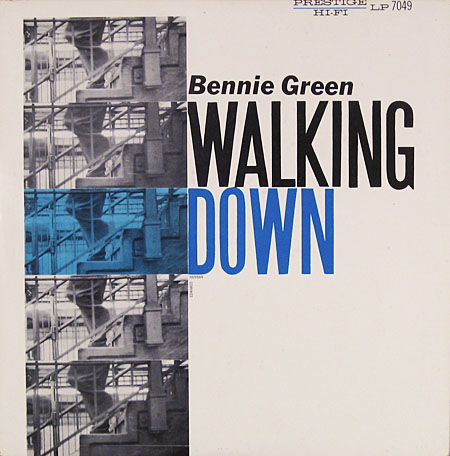
Cover design by Tom Hannan, an abstract expressionist painter
who doubled as a jazz album cover designer.
And this is a good introduction to the session. It begins with a strong drum figure by English,  then a short statement  of the head by Green, then an extended solo by Mayers. Green is generous throughout with solo space: everyone gets an opportunity to show what he can do. "Walking (Down) is also interesting in that about 3 1/2 minutes into it, the two horns seem to be about to come back to the head and wrap it up, but that doesn't happen. Instead, everything changes slightly, and the piece goes on for over 12 minutes. These shifts of tempo and mood happen a few times during the album. It keeps you on your toes.

There's one Green original on the album, the curiously named "East of the Little Big Horn," which seems never to have been picked up by anyone else. Too bad, good tune. And three standards. A favorite cut? It would be hard to choose. "Walkin' (Down) is a contender: it's always a treat to hear Bennie play the blues. But it's hard not to get caught up in the firestorm of traded licks between Green and Dixon on "It's You or No One."

The album takes away the parentheses, puts back the missing "g," and is called Walking Down.