Tad Richards' odyssey through the catalog of Prestige Records:an unofficial and idiosyncratic history of jazz in the 50s and 60s. With occasional digressions.
(Still filling in gaps from 1952. This incredible session just showed up on YouTube).
Al Cohn and Zoot Sims had played together a lot, starting with Woody Herman, and they would go on to be one of the most satisfying saxophone pairings in jazz history, but this was their first session together in a group led by one of them, and they hit the ground running. Having Kai Winding along doesn't hurt either.
"Tangerine" is a beautiful melody by movie composer Victor Schertzinger. It was given its most popular treatment in 1942 by Jimmy Dorsey, around the time that Zoot was joining the Benny Goodman orchestra as a teenager. It gets a swing to bop treatment here, starting with some amazing counterpointing by Cohn and Winding behind a Sims lead on the head, and then giving plenty of solo room to all three of them.
"Zootcase" begins with a complex lead-in by George Wallington to a simple but catchy unison riff by the three horns, terrific solo work by each of them, with the continued strong presence of Wallington, culminating in a piano solo, then a Blakey solo, after which the ensemble riffs it out.
"The Red Door" is a composition by Gerry Mulligan and Zoot Sims. As with "Tangerine," it starts with an intricate interplay between solo and ensemble, leading into a beautiful, lyrical solo by Zoot, followed by Kai and Al. One expects Al and Zoot to know just how to play together, and how to bring out the best in each other, but Kai adds one more piece of complete understanding to the mix.
"Morning Fun" is an Al and Zoot composition, played by the quintet after Kai Winding had packed up for the day, and it's more of a blowing session, starting with vivid, uptempo cadenza leading into a two-horn riff, leading into lots more good stuff. George Wallington only takes a brief solo at the end, but his presence is felt throughout.
"Tangerine" and "Zootcase" were released on an eponymous EP. All four tunes came out on a ten-inch entitled Zoot Sims All Stars, and again packaged with a Stan Getz session (and continuing to trade on the Woody Herman classic) as The Brothers. Modern jazz did have a sense of humor--witness Dizzy Gillespie and Slim Gaillard, among others--but modern jazz packaging was not generally noted for much of a sense of humor, so it's interesting that Prestige had Don Martin as one of its album cover artists. Martin only did about a half dozen covers for them, and I don't know if the association ended because it turned out there was no room in jazz packaging for a sense of humor, or just because he went to work full time for Mad.
These days on Sirius/XM they have five channels in their jazz/standards section, one of which is devoted to the 1940s (defined rather loosely), one to the blues, two to some forms of smooth jazz or new age or something--I can't tell you exactly what because I don't listen to them--and one called "real jazz."
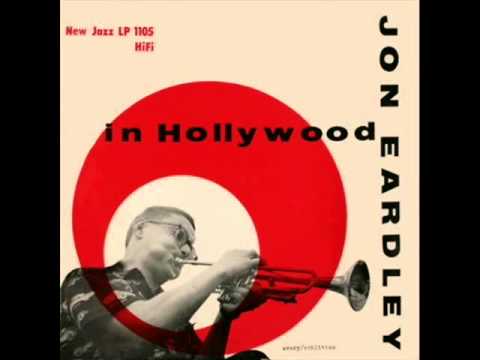
Jon Eardley is real jazz. He didn't make the mark that some of his trumpet contemporaries did, but he's still for real. As Marc Myers says in a JazzWax blog entry on Eardley,
Jazz was so crowded with talent in the 1950s that it's easy for great artists from the decade to slip into obscurity today. This is especially true of trumpet players. We fixate on Miles Davis, Chet Baker, Kenny Dorham and Clifford Brown, not to mention Dizzy Gillespie, Harry "Sweets" Edison and Roy Eldridge. Rightfully so, but there were plenty of others. One who deserves much more recognition than he has received thus far is Jon Eardley.
Eardley did one earlier Prestige session, with Phil Woods, about which I said "if two guys were ever made to play together, it's Phil Woods and Jon Eardley."
Eardley most frequently played in a quintet-or-more setting, but here he's the only horn, which means he has a lot to carry, and he's up to it. I don't really have the language to describe what's unique about his style, so I'll go to Marc Myers again:
What made Eardley special during the '50s was his ability to blow hot but with laid-back distinction. The faster the tempo, the more harmoniously rich he would become, taking on a rolling, punctuating style.
I can say that his style is distinctive, with a beautiful tone that takes advantage of what a trumpet can do, the same thing I hear in Art Farmer.
Eardley had left the New York jazz scene by the end of the 50s, and by the mid-60s he had moved to Europe, where he lived the rest of his life, raised a family, and put his family first, not every jazz musician's choice. He explained to British interviewer Les Tomkins:
I live in Cologne now, together with my wife and two children. I work with what they call the Westdeutscher Rundfunk, which is the German radio in Cologne. This has been the case for practically nine years, and now it’s come to the point that they’ve decided they want the orchestra I work with to be full–time. In other words, when I can’t play the trumpet any more they’ll still pay me. Because of the fact that I am married and have children, I don’t like to travel too much. You can understand that—I like to be around my children while they’re growing up
These tunes were cut in Los Angeles, where Eardley had gone to play with Gerry Mulligan. One has to guess at a couple of the titles -- jazzdisco.com has them as "Lute Leader" and "Cross," Spotify as "Late Leader" and "Gloss," Discogs as "Late Leader" and "Cross." Eardley didn't record often in a quartet setting, so here he has the opportunity and the challenge of stretching out, and he delivers.
These tunes were released on New Jazz and Prestige 10-inchers as Jon Eardley In Hollywood.
This is an all-star's all-star session, and one might wonder why they didn't do it more often, but the wonder seems to be, instead, how
they got through it at all. In terms of personality clash, it's one of
the great disasters in jazz history. In terms of music, it's
magnificent.
The big story that came out of the session was Miles and Monk almost coming to blows. Or so some say. Miles says no. Actually, everyone says no, as far as actual blows being landed.
Monk says no: "Miles'd got killed if he it me."
Miles agrees: Monk "was too big and strong for me to even be thinking about fighting."
But there was an argument. You can hear part of it on take one of "The Man I Love," at which point Miles may have been a little fed up with Monk. Monk can be heard asking when he should start playing, and Miles breaks in, telling Rudy Van Gelder, "Hey Rudy, put this on the record, man – all of it!"
So all of it is there.
If Monk's question seems a little odd, it's because Miles had told him, earlier in the session, to lay out -- to stop playing during Miles's solo -- and Monk had not taken kindly to the suggestion.
But no fisticuffs. Ira Gitler, who was there for part of the session but did not produce it, writes,
things were not serene when I left towards the dinner hour (the session had started somewhere between two and three in the afternoon). Later that night, at Minton's, I saw Kenny Clarke who answered my "How did it go?" with "Miles sure is a beautiful cat," which was his way of saying that despite the obstacles Miles had seen it through and produced something extraordinary and lasting.
One of those obstacles is described by drummer Charli Persip in a video
interview. Persip had been invited to the session by his mentor, Kenny
Clarke, and as he tells it,
I'm sitting there in heaven. Here I am in the same room with Thelonious Monk and Miles Davis. And Monk...there's one spot on one tune where Monk's solo -- he started playing ding-da-ding-ding-ding-ding, ding-ding-ding, ding-da-ding-ding-ding -- what happened was, he had a beer, and he knocked it over on the floor, and he was trying to get that beer up
before Rudy Van Gelder would see it, because he knew there'd be hell to pay, so he's fumbling around down there trying to get the bottle to stop it from leaking on the rug, and at the same time he was still playing the solo! And after, to keep Rudy off of him -- Rudy came in with a rag, and he was fussing and carrying on, but he wasn't really too upset, because it wasn't his equipment, it was just the rug. But Monk wanted to impose his will on [Persip says "Rudy" here, but I'm sure he means Miles], so every time [Miles] would start playing, he'd stand up and look stupid, just look off into space...Everybody broke up, every time he did it."
And the story gets a little mumbly here, but basically Miles told him to cut it out, which is probably why, by the time they got to "The Man I Love," Miles told Rudy to leave everything in.
And once again, one has to tip one's hat in gratitude to Mr. and Mrs. Van Gelder, who no doubt had to deal with the beer stains on their living room rug.
The session itself...what more can you say than that it's great? And, fortunately, take one of "Bags' Groove" was preserved, so we hear Monk's beer solo. And one could say, with Ernie Bushmiller's Nancy, that this shows you could get away with anything in bebop...but it's actually a wonderful solo. A little strange, but musical. And reaching up from the floor, scrambling around for his beer, Monk still swings. And appropriately enough, Bags finds the groove and adds some appropriate fills.
At any event, this is the only studio album Miles and Monk ever made together, and it may help to explain why the Columbia album Miles and Monk at Newport actually features the two cats leading two different groups, in two different years.
The ready-for-prime time version of "Bags' Groove" made it onto a 10-inch, Miles Davis All-Stars, along with "Swing Spring," a Davis original. Monk's "Bemsha Swing" and the approved version of "The Man I Love" are on a second 10-inch, Miles Davis All-Stars Vol 2. Miles Davis and the Modern Jazz Giants, on the short lived 16 2/3 format, had the whole session, along with an earlier 1954 session. All except for the two versions of "Bags' Groove" also appeared on the standard 33 1/3 RPM 12-inch LP of the same title, released in 1959. The two versions of "Bags' Groove" were on an LP of the same name, released in 1957.
Given the long and illustrious career of the Modern Jazz Quartet, the many amazing recordings they made, and the fact that most people consider the real MJQ to date with the installation of Connie Kay as drummer, it would be hard to point to any one album as their best.
But Django, the album that includes this session, and which has Kenny Clarke on drums, is the one that frequently makes lists of the hundred best jazz albums.
Perhaps it's because this is an almost mythic era in modern jazz. The late 40s (mostly because of Charlie Parker) and especially the 1950s were the time that really defined it.
Or that's one theory. I decided to put it to a test, so I looked at the New Yorker's list of 100 essential jazz albums, and found that 29 of them were recorded in the 50s, or partly in the 50s. There were a few more that I could have counted because they were released in 1960, and so were probably recorded in 1959, but they were albums like My Favorite Things that really belong to the 60s. Actually, a lot of the albums recorded in the 50s were by artists we don't really associate with the 50s, but what can you do? If I left them out, it would mess up my theory. Anyway, here's the list: Armstrong, Ellington, Basie, Benny Carter, Parker, Monk and Coltrane, Tristano, Davis 2, Powell, Mulligan, MJQ, Tatum, Brown/Roach, Vaughan/Brown, Mingus 2, Fitzgerald, Rollins 2, Puente, Sun Ra, Abbey Lincoln, Blakey, Jamal, Brubeck, Witherspoon, Coleman, Dinah Washington, Betty Carter, Sinatra.
Not every great jazz classic is a great composition. Some of the best -- best performances, best improvisations, best damn records -- are based on simple riffs. Look at Dexter Gordon and Wardell Gray's unforgettable "The Chase." Look at "One Bass Hit," from this session. It was written by Dizzy Gillespie for Ray Brown, and it's a showpiece for bass virtuosity -- one that allows a bass to become the lead instrument for an entire piece of music. Here, it allows Percy Heath to show what he can do, and it's delicious.
But "Django" is a great composition. It's one of the most haunting melodies I've ever heard. It carries a touch of the Eurojazz of Django Reinhardt, a touch of the blues, a touch of...well, here's guitarist Jim Hall describing it:
This tune has a beautifully constructed melody. It starts out with a kind of a simple motive in F-minor. Kind of a slightly sad idea for a melody, and then so it's this, and then there's a sequence, which is up a second, except that goes up instead of down. So first, it's this perfect answer and then it continues. It's going into the relative major key, if anybody cares, now it has some surprises. It has a great arrival point, that high G, and then it winds its way down. Almost sounds like he's saying Django's name here. And then the same thing an octave lower. So that's the tune anyway. It has kind of simple chords, but beautiful.
"Milano" is the third tune on the session. Another beautiful melody, but there's a reason "Django" became the title cut for the album, and a reason why it's the one that's most remembered. They also recorded "I'll Remember April" that day, and it was never released. It's hard to imagine the MJQ screwing up "I'll Remember April" and maybe they didn't -- maybe it was a technical flaw of some sort. In any event, they re-recorded it successfully the following July.
"Django" was released as a two-sided 45, and the three tunes made an EP, and were included (with "La Ronde") on a 10-inch LP, before the release of the classic 12-inch album which has made so many top 100 lists.
I may be forgetting something, but I think this is the first live album we've seen from Prestige. There was a Wardell Gray session recorded at the Bluebird, but never released.
The Billy Taylor trio is without regular drummer Charlie Smith. Percy Brice, the drummer on this session, did do quite a bit of work with Taylor.
We're starting to see the the generation of musicians who were born in the mid-Thirties, the Depression babies like Paul Chambers, on a more and more sessions, but Percy Brice is an old-timer, born in 1923, and already a veteran of a lot of jazz. A solid professional, he can be heard in this short interview, where he talks about following Max Roach as the drummer in Benny Carter's band. He played with a wide range of musicians, from Carter to George Shearing to Herbie Mann, and vocalists including Sarah Vaughan and Carmen MacRae, and especially Harry Belafonte, who he worked with for eight years.
Jazz in a concert hall was still a relatively rare phenomenon, and this set by Taylor was part of a larger program of jazz for that evening. For Taylor, one of the best things about was that he was able to play a 9-foot concert grand piano, which was not the standard fare for his club dates.
Taylor must have known that his Town Hall audience was going to want to hear some standards, so he mostly sticks with them. His one original on this set, "Theodora," fits right in with tunes like "A Foggy Day" and "I'll Remember April." "Theodora," dedicated to his wife, was written on the day of the concert and is basically unrehearsed.
"Sweet Georgia Brown" certainly was in 1954 most closely associated with the Harlem Globetrotters, and maybe still is. It's a staple of trad jazz, not so much of modern (although Charlie Parker recorded it), but Taylor makes it fit right in here. Taylor is mellifluous but always inventive, easy to listen to but definitely not easy listening.
Actually the odd tune out here is "How High the Moon." The others are all song length, three to five minutes. "Moon" tops 13, and features an extended drum solo by Brice. "How High the Moon" is probably most famous, in progressive jazz circles, as being the set of chord changes over which Charlie Parker fashioned "Ornithology."
All but "How High the Moon" were released on a 10-inch LP. The entire set is on the 1957 12-inch release.
Every King Pleasure session leaves me with more questions. How exactly did he fit into Prestige's world? How did he fit into anyone's? He has to have been one of Prestige's bestselling artists, but he seems to have been recorded as an afterthought, generally with a rhythm and blues band. This session is unusual in that he has a fantastic array of A-list musicians backing him up, but it also doesn't seem that it was exactly his session.
And we've seen this before, too. In 1952 there's a session by the Charlie Ferguson Quintet. Ferguson didn't exactly become a household word, even in jazz households, although he put together a fine group, including bassist Peck Morrison. And of the eight songs recorded that day, six of them instrumentals, Prestige only released four, and only two of them were Ferguson instrumentals. The other two that did get released featured a vocalist. Yes, it was King Pleasure, and yes, these two have become jazz classics: "Red Top" (also featuring Betty Carter) and "Jumpin' With Symphony Sid."
So here, again. That session is listed in the Prestige discography as "The Charlie Ferguson Quintet" with King Pleasure. For this one, at least Pleasure gets top billing: King Pleasure with Quincy Jones Band. But again, two cuts with vocals, two without.
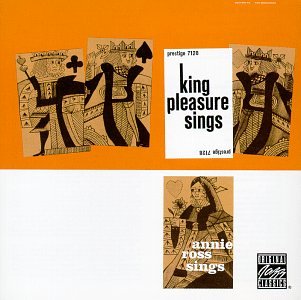
This is the fifth of five sessions Pleasure would do for Prestige. They'd be collected in the now-legendary King Pleasure Sings/Annie Ross Sings LP in 1957. By then Pleasure had gone on to record a couple of singles for Aladdin (including a remake of "Moody's Mood for Love"), then Jubilee, HiFi Jazz, and United Artists ("Moody's Mood" again). Then nothing. He died in 1981, pretty much forgotten. I was only able to find one obituary, on a blog called The People vs. Dr. Chilledair, a reprint of a piece the author had written in 1981 for the LA Jazz Dispatch, and it doesn't add much to what we know about his life, which is close to nothing. But he adds this:
Postscript: Years later, after writing this, I encountered the singer’s last drummer, John Gilbert, on the internet. Here is what he wrote on his website: “This picture of me was taken in 1965 by King Pleasure at a service club in North Carolina. He was traveling through that part of the country using local rhythm sections. [Singer] Earl Coleman recommended me to King Pleasure for the gig, and it turned out to be a lasting friendship. I came to California in 1969 and we played some in L.A. until his health failed badly (emphysema). Pleasure stayed with my wife and I for a while in Sherman Oaks, Ca. My son was an infant and he would serenade him to sleep. I was also associated with Earl Coleman at the time. King Pleasure was initially impressed with the fact that I knew all of the words to 'Moody's Mood For Love' and other tunes that he had recorded. He was a sweet man and very helpful to me. Pleasure related to me that the greatest moment in his musical career came in New England. He was at a low point in his life, sitting at the back of a bus when a group of school children boarded the bus and one was chirping out 'Moody's Mood' which was a hit at the time. They had no idea that the figure in the back of the bus was the man himself. He got a big kick out of this and often happily reflected on that moment in time.”
I had wondered if Pleasure was particularly difficult, and maybe no one could stand to have him around for more than two songs at a time. When one thinks about jazz musicians of this era, one can't help but be aware that addiction is a possibility, but I'll never assume that.
Another possibility: maybe he only had so much material. Vocalese isn't exactly like instrumental improvisation. You're basically not improvising at all. You're following someone else's improvisation, so it has to be learned, and it's a little more complicated than learning a couple of verses and a bridge to standard. Plus, you have to write lyrics to that complex and often labyrinthine musical structure. Which also means finding the solo that'll work, and exposure to too much bad vocalese over the years has certainly shown us all that that's not a guarantee. Annie Ross went home one night and came back in the morning with"Twisted," but it's not that easy. Pleasure was a great singer, but he got his start performing an Eddie Jefferson lyric, and maybe putting together a successful vocalese piece didn't come easy to him.
In this case, he had some pretty serious support-- one of the hottest arrangers in the business, and two backup vocalists who were the royal court of the kingdom of vocalese, in Eddie Jefferson and Jon Hendricks. More backing vocals were provided by the Three Riffs, who weren't a group that went on to stardom, but they were very good (one of them, Joe Seneca, actually did go on to a distinguished career as an actor).
He also had a powerful group of musicians working under Quincy Jones's direction. J. J. and Kai were really hitting their stride as a trombone team. Lucky Thompson probably never quite the recognition he deserved. This may have been 19-year-old Paul Chambers's first recording session.
The resulting songs may never have quite gotten the recognition of Moody's or Parker's moods, but they should have. "Don't Get Scared" is a Stan Getz solo, from a recording made in Sweden with Bengt Halberg and Lars Gullin. The Getz solo is sung by pleasure, the Gullin solo sung (and written) by Jon Hendricks, whose clever vocalese lyrics once earned him the nickname "the James Joyce of Jive."
"I'm Gone" is a Quincy Jones original, and the lyrics are credited to making Pleasure, but the arranged vocal ensemble parts, to the repeated phrase "I'm gone, I'm gone I'm gone I'm gone" are as important as the solo part.
So maybe this was essentially a Quincy Jones session. Jones wasn't exactly a regular in the Prestige stable, though he had done a couple of other arrangements, and he was a rising star, and maybe he brought the vocalists in as part of it, but the vocal tracks weren't all he wanted to do.
Maybe...but the vocal tracks are the ones that are remembered from this session. King Pleasure really was that good, with the right material, and he didn't record all that much.
But the instrumental tracks are worthwhile too. There's some masterful writing and masterful playing. "Funk Junction," which is sort of a continuation of the ideas in "I'm Gone," shows what happens when this same ideas are given to a bunch of talented improvisers. Of particular note is a solo by young Paul Chambers.
"I'm Gone" came out on 78 b/w "You're Crying." "Don't Get Scared" had two different releases--on 78, b/w "Funk Junction," and on 45, b/w "Red Top."
If you were going to put together a new quintet in 1954, your reason for doing it would be (a) they were so naturally attuned to each other, or (b) you thought two trombones would be an interesting combination, and who else would you go to?
The answer pretty much has to be (b). Johnson and Winding were not automatically thought of as musically compatible. They were both modernists, but Johnson the more unequivocally modern of the two, the man who had brought the trombone to bebop and bebop to the trumpet.
But...who else would you go to? Neither of them was considered the dominant trombonist of the day. Although by 1954 the beboppers had won the day from the moldy figs, the trombone (like the clarinet) was still mostly considered a swing era instrument. The trombone greats were Kid Ory, Tommy Dorsey, Glenn Miller. And the year-in, year-out poll winner on trombone for the last 5 years had been Bill Harris. But Harris was better known for his work with big band leaders like Benny Goodman and Charlie Ventura, although he had also been with Woody Herman, who was closer to the modern sound. The other trombonist of note at that time was Bennie Green, who had one foot in
the big band camp and one in the moderns'.
And in fact, Ozzie Cadena, a young jazz fan with aspirations to be a producer, who had thought up the two-trombone gimmick, at first wanted to pair Johnson with Green. But Winding and Johnson were the true modernists. Both had played (on different tracks) on the Miles Davis Birth of the Cool sessions. Their approach to the trombone, and to modern jazz, was very different, but each admired the other's work, and in their hands, the two-trombone quintet became much more than a gimmick.
Cadena (who would later become a producer for Prestige) brought the duo to Savoy Records. He recorded them in August of 1954, in the Van Gelder studio, with Billy Bauer, Charles Mingus and Kenny Clarke. The recording was a success, and it led to one of the most celebrated dual-led groups of that time. And it seems that they couldn't wait to do it again. By December, they were back in Hackensack, recording for Prestige, and in between, they recorded a live session at Birdland, which was not to be released until many years later. Bob Weinstock produced the December session. The tunes here are a mixture of originals and standards. Well, "Dinner for One Please James" was something of a minor standard--it was a 1934 tune that was something of a knockoff of Cole Porter's "Miss Otis Regrets," but it was also a current pop tune, having been recorded in 1953 by Nat "King" Cole. It did have something of a career as a jazz standard, recorded by Dexter Gordon and Branford Marsalis (and, oddly, by Western Swingster Hank Thompson as a country song). "Hip Bones" and "Riviera" are Johnson originals, "Wind Bag" and "Don't Argue" are Winding's. "Bags' Groove," of course, is one of the great jazz standards.
The Jay and Kai version of "Bags' Groove" was also released on 78, as the flip side of "Don't Argue." And on an 45 RPM EP, along with "Don't Argue," "We'll Be Together Again," and "How Long Has This Been Going On?" The other four tunes had their own EP. The entire set was released on a 10-inch LP, and a year later, as part of a 12-inch, 7000-series LP called Kai and Jay, Bennie Green With Strings. This time Kai got first billing, and they'd continue to swap for the time they were together, which was about two years. They parted amicably, because they felt at the time that they'd taken the two-trombone idea as far as was productive, although they would reunite from time to time.
Prestige had recorded Joe Holiday and Billy Taylor, separately and together, playing their own fusion of mambo and bebop, but this was their first foray into presenting a strictly Latin ensemble. There are a sprinkling of gringos (including the multitalented Don Elliott) , but this appears to have been a Latin session, aimed at a Latin market. There is one jazz tune in the session, Tirado's version of "Farmer's Market," but even that is given a subtitle, "El Baile del Campesino," or "Peasant Dance." Presumably it would have gone out to Latin markets under the subtitle -- that is, if it had ever gone out at all. "Cha Cheando" and "Shake it Easy" were released on 78 and 45, but the other two were unissued.
Which makes it ironic that the only cut from the session that still seems to exist is one of the unissued ones -- in fact, the very same "Farmer's Market Mambo," which exists on a DJ copy, and can be found on YouTube and on the Office Naps roundup of Latin jazz on Prestige.
There was a brief craze for doing mambo versions of popular standards, including Henry Mancini's jazz theme from Peter Gunn, turned by Jack Costanzo into the "Peter Gunn Mambo," but that all came later, and anyway, although "Peter Gunn" has solid jazz credentials, it was a pop hit as well, so the "Farmer's Market Mambo" may well be unique.
This is the first mambo session on Prestige that does not use a conventional jazz drum kit. All the percussion is on Latin instruments, and the beat is completely Latin. The solos by Don Elliott and Tirado, but especially the Elliott solo, are jazz. There is one other Tirado recording available, "Dorotea" on the primarily R&B Derby label, and it doesn't have the same jazz feel.
Gene Ammons is back on Prestige for the first time since his flurry of activity in 1950-51, still with the septet form that seemed to appeal to him, but with a new supporting cast -- no Sonny Stitt, and no Bill Massey, the trumpeter who had been the constant in his earlier groups. But he was back to stay: there may have been no other jazz artist who made as many recordings for Prestige as Ammons. He was one of the only musicians who was still putting out new material after Prestige had been sold to Fantasy in 1972 and become mostly a reissue label.
This session appears divided into two distinct groups. "Sock" and "What I Say" (not the Ray Charles song) are, I'm guessing, Ammons originals, and they are Ammons all the way--the rhythm and blues tone and the bebop phrasing. I'm guessing these were aimed at jukeboxes, and at the new emerging jukebox market. There's a scene in Clint Eastwood's Bird in which a strung-out Charlie Parker stumbles backstage at the Apollo and hears an old competitor out on the stage, blowing a wild, theatrical, Big Jay McNeely-type solo, to wild applause. "What's he doing playing rhythm and blues?" Parker wonders, and the other musicians backstage howl with laughter. "Where you been, Bird? That ain't rhythm and blues. That is rock and roll!"
"Sock" was released on 78 b/w a tune from an early 1955 session called "Blues Roller," and then again on 45 b/w a tune from a later 1955 session called "Rock-Roll." It still looks back to the 40s of Illinois Jacquet and the swing-to-bop purveyors of rhythm and blues, rather than ahead to the rock-and-rolling 50s of tenormen like Red Prysock and Sam "the Man" Taylor. "What I Say" is similar. Both tunes have real excitement and some solid blowing. "What I Say" came out on a 78 with a ballad, "Our Love Is Here To Stay," on the flip side, and this too was characteristic of the era, covering one's commercial bets with a honker on one side and a ballad on the other, just as the early Elvis Presley singles on Sun had an R&B tune one side and a country tune on the other, and many of the urban harmony groups would pair up a ballad and a jump tune.
The other two tunes have to have been aimed at very different jukeboxes. "Count Your Blessings" and "Cara Mia," which were released as
two sides of a 78, were both pop tunes of 1954, and neither has exactly
gone on to become a standard of any jazzman's repertoire, although
Sonny Rollins did record "Count Your Blessings." It was written by
Irving Berlin for the Bing Crosby/Danny Kaye movie, White Christmas, the schmaltzy remake of the Crosby/Fred Astaire Holiday Inn. Irving Berlin certainly knew how to write a melody, and this version would go well for an end-of-the-evening slow dance, while still offering some worthwhile Ammons soloing. "Cara Mia" was credited to Tulio Trapani, which was a pseudonym. Actually, the song was written by Mantovani. It was a huge hit in England, and a top ten hit in the US. It's not as good a song as "Count Your Blessings," and I have to wonder if Ammons played it a whole lot in club dates.
The first album release of this session did not come until 1965, as Gene Ammons -- Sock! The album's title strongly suggests that it was aimed more at the traditional Ammons audience than the Ammons/Mantovani audience.
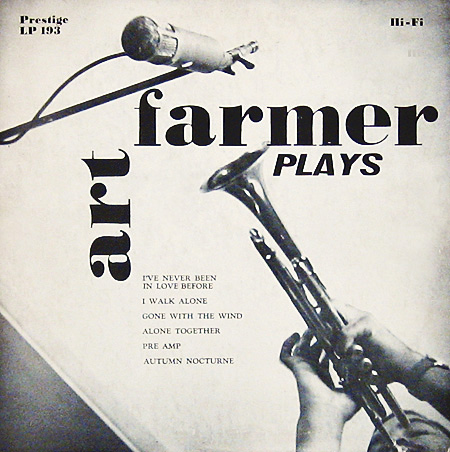
Art Farmer had a long, distinguished and varied career -- so much so
that these sessions on Prestige have recently been reissued under the
quasi-dismissive title Early Art. And it's certain that a great career was still ahead of Art. He would co-lead the legendary Jazztet with Benny Golson from 1959-62. He would be the first to popularize the flugelhorn as a jazz instrument, and introduce a new instrument: the flumpet, about which he has said:
I hate that name, but I’m stuck with it. That was made by a trumpet-maker named David Monette, who makes trumpets for a lot of very fine trumpet players, such as Wynton Marsalis, for instance, and the principal players for the Boston Symphony and the Chicago Symphony and the Chicago Symphony, etcetera. I asked him to make me a trumpet, and he made it, it was very fine, and I started really working on the trumpet. Then he got the idea that it didn’t really sound like me, but he wanted to make a flugelhorn for me — so I told him to go ahead and do it. Then he called up one day, and he said, “Well, I made it very carefully and put every part in order, made it by hand [because everything is made by hand], but it sounds like hell, and I really don’t like it. But I have another idea.” So I told him to go ahead and make it. Then a couple of months later, he called and said, “it’s ready.” I went to Chicago, where I was booked, and he brought it on the gig — and right from the start, it sounded like the answer to my prayers...you could go one way or the other on it. You could approximate the warmth of the flugelhorn or you could approximate the projection of the trumpet. If you really wanted to put a note out there, you could do it, and if you wanted to be more intimate, you could do that also. So it seemed like what I was looking for.
He would play in a wide variety of settings, from Charles Mingus to Horace Silver to Gerry Mulligan, from the big bands of Quincy Jones, Oliver Nelson and George Russell, to sessions with the French composer Edgar Varèse, because of his reputation as a guy who could play anything.
But he was already that guy when he was still Early Art, in 1954. He had started out in high school in LA with schoolmates Hampton Hawes, Sonny Criss, Ernie Andrews, Big Jay McNeely, and Ed Thigpen.* He had played rhythm and blues with Johnny Otis, Kansas City swing with Jay McShann and blues with Big Joe Turner and Pete Johnson (his first recording session), and the intergenerational, genre-defying jazz of Benny Carter, before his breakthrough 1952 session with Wardell Gray, the one that introduced "Farmer's Market." He had been part of the Lionel Hampton European tour that brought so many young musicians together.
And the same is true of Wynton Kelly. He's probably best known for his work with Miles Davis (including one track on Kind of Blue) during the same time period that Farmer was with the Jazztet. But Kelly had been playing since his early teens, and had actually been part of a Number One rhythm and blues hit in 1948 -- Hal Singer's "Cornbread."
Addison Farmer, Art's twin, also started young out on the West Coast, playing the house band of the R&B label Modern, and recording a bebop session with Teddy Edwards. When he and Art hooked up for this session, he had taken up residence in New York and studied at Juilliard and the Manhattan School of Music, as well as taking private lessons from New York Philharmonic double bassist Fred Zimmerman.
This session features a lot of standards, though if the definition of a standard is one where everyone knows the melody and can sing along at least a couple of choruses, most of these barely qualify. The one solid classic is Frank Loesser's "I've Never Been in Love Before," from Guys and Dolls, to my mind the greatest musical score ever. Farmer and Kelly take it at a brisker tempo than the many ballad singers who've done it, but they still keep it a ballad, and beautiful.
But the others have attracted jazz musicians before and since -- Charlie Parker recorded "I'll Walk Alone," Chet Baker and Paul Desmond have each done "Alone Together," and "Autumn Nocturne," by film score composer, has become something of a jazz standard.
All of them, and the one original, "Preamp," give much to love, and give plenty of reasons why this is more than "early Art," or early Wynton, for that matter.
"I'll Walk Alone"/"Autumn Nocturne" were released on 78. The session came out on a 10-inch LP in 1955, and then not again ill the reissue days many years later.
* Funny, that's two straight blog entries, two opposite coasts, two guys right around the same time hanging out with a bunch of kids who would go on to become giants of jazz. In the Monk/Rollins entry we saw the young Art Taylor with Sonny Rollins, Jackie McLean, Kenny Drew and Andy Kirk Jr.
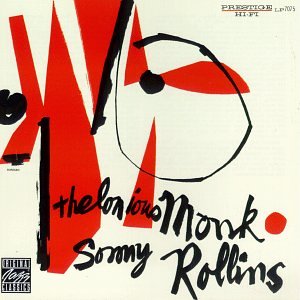
This session has Monk and Rollins recording three standards, with bebop veteran Tommy Potter and a young Art Taylor. Taylor would go on to be a mainstay at Prestige, but this was his label debut. He had recorded once for Blue Note, with Bud Powell and George Duvivier, but he had been active on the jazz scene since the late 40s--earlier, if you count his school days in Harlem with Sonny Rollins, Jackie McLean, Kenny Drew and Andy Kirk Jr.
But I started listening to these recordings, and I started thinking about ballads, and jazz.
I've written before about the American Century in music, that great artistic flowering that grew out of the blues, and generated such a profusion of genius in such a range of musical styles.
And many people have written, correctly, about exploitation of black music, black culture, and especially black musicians and composers. Ta-Nehisi Coates has written a brilliant article on the case for reparations -- the argument that
America has prospered off the backs of black people, not just in wealth, but “Our policies, our social safety net, the way we think about housing in this country, social security, the GI Bill — these things would not have been possible unless we made certain compromises with white supremacists, to be perfectly honest about that.”
Sometimes left out of this argument is yet another black creation that may be America's most profound export, and one of its most financially rewarding -- rock and roll. Which is a white expropriation of a black art form.
The economics of American music have mostly flowed one way, from black creators into white pockets. And yes, I know about the empires built by P. Diddy and Jay-Z and Russell Simmons, and more power to them, but they're still the exception, and historically they're a blip. Joseph Smith, who had some success as Sonny Knight in the 50s, as a rhythm and blues performer, later wrote a scathing and underrated novel about the white-dominated music business of his era, The Day the Music Died.
But that. too, is only part of the story. The greatness of American music is in its impurity, its mongrel nature, its ability to reach out, gather in, and blend. Economically, everything may have flowed one way, but musically, there was cross-pollination. While Elvis was covering the songs of Arthur "Big Boy" Crudup and Roy Brown, and recording the songs of Otis Blackwell, streetcorner groups from Harlem were finding new ways of interpreting standards like "Sunday Kind of Love" and "Over the Rainbow" and "Glory of Love." Earlier, Louis Armstrong had created a timeless classic from Carmen Lombardo's "Sweethearts on Parade." Jazz connoisseurs have chuckled indulgently over Armstrong's fondness for Guy Lombardo's orchestra, but Armstrong heard something in the Lombardo brothers that the rest of us didn't.
Much has been written about the Great American Songbook, and the songs which have become such a part of the soundtrack of our lives, and certainly those songs stand on their own. But the European tradition of composers like Gershwin was immeasurably enriched by their discovery and appreciation of jazz.
Perhaps the first European composer to fully appreciate this was the Czech Antonin Dvorak, who said:
"In the Negro melodies of America I discover all that is needed for a great and noble school of music. They are pathétic, tender, passionate, melancholy, solemn, religious, bold, merry, gay or what you will. It is music that suits itself to any mood or purpose. There is nothing in the whole range of composition that cannot be supplied with themes from this source. The American musician understands these tunes and they move sentiment in him."
I'd read Dvorak's famous pronouncement before, but I hadn't seen some of the unsurprising responses to it by conservatorians of the day:
Dr. Dvorak is probably unacquainted with what has already been accomplished in the higher forms of music by composers in America. In my estimation, it is a preposterous idea to say that in future American music will rest upon such an alien foundation as the melodies of a yet largely undeveloped race.
Quaint as those songs may be, it is a poor fountain from which the young American composer could sip his inspirations.
And, to be fair, those weren't the only responses.
To the Editor of the Herald: It gives me pleasure to indorse [endorse] the ideas advanced by Antonin Dvorak. I have long felt that Americans have not appreciated the beauty and originality of our native melodies. We possess a mine of folk-song, such as few, if any nation have, and it would be well if our composers should employ those themes in writing their works. In this way we should develop a really American school of music, and find our public would gladly encourage the movement. As it is the treatment of a simple melody which evinces true musicianship, why should not our composers select such airs, instead of going abroad for their ideas?
George Gershwin was probably the first, and probably the greatest composer of his age to be profoundly influenced by jazz. Still, at least until Porgy and Bess, his songs were originally written for and sung by white singers, as were the songs of all the popular composers of the day, the ones writing what became the Great American Songbook.
But nothing lasts forever, or at least nothing lasts forever without changing. Shakespeare changes with each new generation, each new production, each new interpretation. And the songs of Gershwin and Kern and Porter and the rest might not have remained such an important part of American culture if they hadn't become part of the repertoire of black singers, who come from a different musical place, a different cultural awareness. Pop singers like Ethel Waters and Lena Horne and Nancy Wilson. Jazz singers like Billie Holiday and Ella and Sarah, Carmen MacRae, DeeDee Bridgewater, Nnenna Freelon.
But I wonder if people have thought much about the impact of modern jazz on the Great American Songbook. The great jazz improvisers added a whole new dimension to these songs, and I believe, gave them new relevance. Even the Tony Martin or Jerry Vale fan, listening to Miles or Sonny or Phil Woods (or Billy Taylor or Marian McPartland or Errol Garner) go off into an improvisation, and wishing they'd come back to playing the melody -- yeah, even the squares knew that when a great modern jazz musician did play the head, he was bringing something new and strange and wonderful to that melody. The modern jazz players, creating a new music from deep in the black experience, incorporated the songs of European-American composers (and European composers like Debussy). They took, and they gave back. And that's American music.
Jerome Kern wrote the melody to "The Way You Look Tonight." When he played it for lyricist Dorothy Fields, she cried. There maybe aren't a lot of melodies these days that can make you cry. But it was the age of melody. Great lyricists like Dorothy Fields added something vital to a song, but the composer was king. His name always came first in the song's credits.
"The Way You Look Tonight" was written for Fred Astaire, and if a song is written for Fred Astaire, it's a good bet that it swings, and that it will be a natural for jazz musicians of any school. It's been recorded by Billie Holiday and Ella Fitzgerald, by Miles Davis and Dave Brubeck and Art Tatum and Oscar Peterson and Johnny Griffin and Herbie Hancock. And the song crossed another generational and cultural gap when it was adopted by the streetcorner harmonizers in the style that became known as doowop. Several groups recorded it, including the interracial foursome from Los Angeles, the Jaguars, who transformed it into something different, and something beautiful, in an era when harmony was king.
Interestingly, the beboppers, in mining the Great American Songbook, didn't stop with the Gershwins
and Kerns and the other jazz-influenced composers. They recorded songs by composers who came out of an earlier tradition, who were really from the operetta era, like Sigmund Romberg and Victor Herbert. Vincent Youmans is really of that school, too, and the other two songs from this session are both by Youmans. But Rollins and Monk find gold in them, find the basis for improvisation and innovation and discovery. I can imagine Jerome Kern listening with wonder and admiration to what Monk and Rollins do with his song. It's harder to imagine Youmans having the same reaction.
Monk and Rollins are wonderful collaborators, and they work together by letting good fences make good neighbors. Each gives the other extensive solo space. There's not much in the way of duet voicing, or trading riffs. Tony Martin/Jerry Vale/square though I may be, I think my favorite part of the session is Sonny Rollins's lyrical and imaginative statement of the melody in "The Way You Look Tonight," which is enough to make anyone cry.
This session was first released on a 10-incher which saw Sonny Rollins get top billing. "More Than You Know" was also put onto the Sonny Rollins - Moving Out LP along with the tunes recorded in August with Kenny Dorham and Elmo Hope. "The Way You Look Tonight" and "I Want to Be Happy" were grouped with the tunes from Monk's September trio session on an eponymous album in 1957, which was then rereleased as Work in 1959. This was Monk's swan song on Prestige, as he moved over to Riverside.
When I started this project, my goal was to listen to at least one cut from every Prestige album in chronological order. That went out the window pretty quickly when I realized that to do a proper chronology, I'd have to do it session by session, not album by album. And it really went out the window when I discovered that one cut was nowhere near enough. It might take a substantial chunk of time, but what better to do with my time than listen to jazz on Prestige? I was going to listen to every recording ever made for Bob Weinstock's label.
When possible. Some things I just haven't been able to find, and that would include most of this session. "Open Door" has been put up on YouTube, and that's it.
Still, every limitation has its compensations. In this case, instead of listening to four songs in rotation, I've focused on just the one, appreciating that if two guys were ever made to play together, it's Phil Woods and Jon Eardley. Of course, Phil Woods played with so many different musicians, and sounded great with all of them.
This was his first session as a leader, and maybe only his second recording session. I haven't found anything else besides the Jimmy Raney session just two months earlier. He was only 23 when he made these recordings.
George Syran seems only to have recorded on a handful of sessions with either Woods or Eardley, but his obituary (2005) offers this:
Mr. Syrianoudis played with Billy May, Hal McIntyre, Jimmy Dorsey, Richard Maltby, Cannonball Adderley, Al Cohn, Phil Woods, Lester Lanin, Dick Meldonian, Hal Prince and many others.
He was the personal accompanist for Buddy Greco, Don Rondo and Morgana King.
That's a pro's pro who can fit in anywhere, but he definitely knew how to play jazz. He has a strong solo here.
Nick Stabulas is a powerful presence throughout.
These were released on New Jazz, and the New Jazz releases seem in general to be less reissued and harder to find. "Pot Pie" and "Mad About the Girl" were also on a Prestige EP.
James Moody is back in the studio with essentially the same band he used in his January and February sessions for Prestige, the first named having particular significance as the first session engineered by Rudy Van Gelder in his parents' newly remodeled living room in Hackensack. The only new face in this session is drummer Clarence Johnston.
This is a band of musicians, who, like Moody, were Dizzy Gillespie big band alumni. They didn't all go on to record as leaders, or even appear on many small group recordings, but as Rudyard Kipling said, referring to the schoolmasters who are often the butt of pranks in his semi-autobiographical Stalky and Co.,
"Let us now praise famous men"-- Men of little showing-- For their work continueth, And their work continueth, Broad and deep continues, Greater then their knowing!
These guys played in big bands, and in small clubs, and they taught, and their legacy runs deep, and deserves to be remembered.
When trumpeter Dave Burns passed away in 2003, other trumpeters whose lives he had touched remembered him on a website.
I studied jazz improv with Dave for a couple of years. He was a real gentleman and a great, if underrated, player. I used to listen to him years ago at Sonny's Place out on Long Island. Classic bop style player. I'm glad to have known him.
I'm a drummer who had the honor of working with Dave in LI clubs in the late 80's early 90's. I was a youngster and he treated me with the respect you would give to other old timers. Peck Morrison often was the bass player and so the breaks were as much fun as the sets. I only wish I could remember all the stories they told. Rest in peace Dave, you gave me some of the greatest experience and memories of my life. I brought my Dad Ted Brown (tenor) to sit in one night and Dave hired him as a regular too. Now I will go look for the recordings we sometimes made.
I was Dave's 2nd student, back in 1970 when he was living in Malverne with his wife Judy. His first Student was Randy Andersen. To say that Dave was a phenomenal player is an understatement. I studied with him on and off for 20 years,and I have never heard incredible playing like his in my life. He was also the same way on the piano and taught you from the piano. He was also the kindest , warmest man you'd ever want to meet. His students always came first. I miss him greatly.
This just breaks my heart- I was a student of Dave's in the '90s and he was one of the finest people/ teachers/ trumpeters I have ever been around. So many good memories of him at the fender rhodes teaching me tunes and phrases. He wasn't playing at all by the time I took lessons from him but one day I finally convinced him to play for me....YIKES! WOW! I still have the recording- it is 16 bars of bebop heaven.
Clarence Johnston is still with us, as of this writing, as far as I can tell.This is from a 2011 interview:
At the age of 86, Clarence Johnston is too busy living in the present to talk much about
his past. As a world-renowned jazz drummer he has played over 50 years, traveling and performing with jazz artists Miles Davis, John Coltrane and Dinah Washington among many others. As an Army and Air Force veteran of WWII and growing up in an era where jazz was burgeoning, Mr. Johnston has some colorful stories to share. But because he remains an active professional musician, teacher, storyteller and intergenerational drum circle facilitator, our conversation focused instead on his current enterprises.
Laura Swett: Given all of your current projects, does your age affect you?
Clarence Johnston: I’ll be a bit frank with you. Age is not in my mind at all. I’m a professional musician. All I think of is the next day. I don’t think of age. All I do is work to keep up with what’s going on! I like going from one thing to the next. I still teach, and I still play. And some weeks are better than others.
LS: What do the drums mean to you?
CJ: What I get out of it is a world of happiness. How many people can go through life and do exactly what they feel like doing? You [do] have to discipline yourself for that. Jazz is the hardest music in the world to play; it takes a lot of time and patience. It takes years before you learn it. It’s a particular art, a particular sound and feeling. It took me about 10 or 11 years before I even got that sound right. I was playing but I knew the sound I wanted, and it took time. If you want the instrument to sound the way you want it to, you have to practice. [When you do] it makes you feel good and is a real accomplishment. When you don’t practice you can still play, but you get real slow.
...
LS: How long do you practice?
CJ: I have a studio where I practice. I go four hours a day. Sometimes I work a particular piece and need more time and feel I should be doing this for 8 hours.`
This session begins with a lovely version of a particularly lovely ballad, "It Might as Well Be Spring." Two takes were preserved. I've only been able to listen to the first, which is Moody at his romantic best.
"Blues in the Closet" is particularly interesting. It opens with a lengthy, bluesy, boppy duet between Johnston and bassist John Latham. Maybe they were the only ones who could fit in the closet. Then the closet door opens to let in a blast from the ensemble, then back to the duet, then another ensemble fanfare, and Moody doesn't start soloing until past the two minute mark of a four minute song. The second half is Moody and the ensemble, taking off from the groove Latham and Johnston have laid down for them.
The jazzdisco website lists the final cut as "Moody's Mood for Love," but Moody was moody, and had lots of moods, and this is Moody's Mood for Blues, and yes, this cat, and this group, can play the blues. Oh, my, yes. This one also begins with a great walking bass line.
Quincy Jones did the arrangement for the septet, and composed this Moody's Mood.
"Moody's Mood for Blues" was issued on both sides of a 78, and so was "It Might As Well Be Spring." "Blues in the Closet" and "Moody's Mood" were part of an EP entitled James Moody/Eddie Jefferson: James Moody and the Blues. The whole session was on a 10-inch LP, and it was part of a 7000-series LP called Moody, released in 1956 -- and rereleased in 1959 as a 7100-series LP called Workshop. "It Might as Well Be Spring" was included on a 7000-series LP called James Moody's Moods, rereleased as 7100-series Moody's Workshop.
On a technical note, we just got a new car, with Bluetooth connectability to the speaker system, and I finally figured out how to play Spotify through it, so I'm back to my old pattern of driving and listening to a Prestige session. This gives me some serious listening time, as one short drive generally lets me listen to a whole session through twice, and a series of short drives over a couple of days (I live in the country and have a young teenage grandson, so this is the way most of my days go) gives me a real opportunity to spend the kind of time I like with a session.
Especially fortunate that this all got worked out in time for this session, because if you're setting aside some time to spend with these four songs, you're going to need to allow for the circumstance that at first, all you're going to want to do is listen to "Blue Monk." It's that magical.
So many of Monk's greatest compositions were introduced in his recordings of this era for Prestige and Blue Note. Don't forget what it was that inspired Bob Weinstock to start his own record label. He was a 19-year-old kid in his first business venture, running a record store next to the Metropole in Times Square. The Metropole was a home to trad jazz, and that was what Weinstock sold -- on 78, of course. Until...
One day Alfred Lion, who ran Blue Note Records, came in and said, “I have something new: Thelonious Monk." I said, “What the hell's that?" Alfred said, “It's bebop." I listened to it and the more I listened, I realized it had a charm to it. It was interesting. I was strictly into swing at the time. Beboppers were calling people like us moldy figs. The next thing I knew, I became obsessed with bebop. I was attracted like a magnet...
I got curious as to some of the recording debuts of classic Monk tunes, so here are a few:
Blue Note 1947
Ruby, My Dear
Well, You Needn't
Round Midnight
In Walked Bud
Blue Note 1948
Misterioso
Epistrophy
Blue Note 1951
Straight No Chaser
Prestige 1951
Little Rootie Tootie
Bye-Ya
Monk's Dream
Prestige 1952
Trinkle Tinkle
Bemsha Swing
Prestige 1953
Think of One
Prestige 1954
We See
Blue Monk
Does that say something about (a) how important Monk was, and (b) how important these two jazz labels were?
Anyway, I did finally start listening to the whole set, all the way through -- three Monk originals, with Percy Heath and Art Blakey, and one standard, on which Monk plays solo. "Nutty" and "Work" both have little melodic hints of what would coalesce in "Blue Monk."
Thoughts: on all of the trio tunes, there are extended bass and drum solos, which has not exactly been a hallmark of earlier Prestige sessions. Perhaps we can take this as a tribute to Rudy Van Gelder's increasing confidence in his engineering skills.
And this is all great stuff. A drum solo with a Thelonious Monk trio, on Thelonious Monk tunes, is not exactly going to be a Buddy Rich drum solo, no disrespect to Buddy. Blakey integrates his own propulsive rhythmic mastery with Monk's unique approach to rhythm -- no mean feat, in a drum solo.
When I was young and pretentious, and I went out to jazz clubs, I used to always quietly disapprove of people who applauded at the end of a solo. I wanted to hear the transition, as one soloist handed the ball off to another. I've since learned that you can never have too much applause, that the soloist deserves it, that it's part of the spontaneity of live music. And you can listen to those transitions on the record.
Which I do. I've always been fascinated, in art, in music, in writing, by what happens when something is in the process of stopping being one thing and starting to be another.
And there are some great moments here. In "Nutty," when Blakey's solo seems to rise in pitch at the end, and Monk picks it up at the apex. In "Work," the handoff from Blakey to Heath to Monk.
And all the way through, there are great moments between Monk and Percy Heath. Heath's solos, his dialogs with Monk, their duets, with both instruments threading lines around each other. Outside of the melody of "Blue Monk," these may be my favorite parts of the session.
Finally, there's Monk's short, song-length, unaccompanied take on "Just a Gigolo."
Artists strike out for the deep end in all sorts of ways. If you had been invited out to Rudy Van Gelder's studio in Hackensack to record four songs, and you'd been given Percy Heath and Art Blakey to accompany you, would you do the first three, and then say "Take the rest of the afternoon off, fellas, I'm doing this one on my own"?
Of course, it might not have happened that way. Maybe the session ran long, and Percy and Art had a gig in the city. Or maybe they showed up late, and Monk decided to start without them. But those seem less likely. Monk knew what he was doing when he recorded solo, and he was generally right.
"Blue Monk" was released on a 45 with "Bye-Ya" on the flip. All four cuts were on a 10-inch, Thelonious Monk Trio. "Blue Monk" and "Just a Gigolo" were put on a 12-inch of the same title with the 1952 trio sessions, and the same grouping was rereleased as Monk's Moods. "Work" and "Nutty" joined "Friday the Thirteenth" from Monk's November 1953 session with Sonny Rollins, and a couple of tunes from a later session with Rollins, as Thelonious Monk and Sonny Rollins, and this album was also rereleased under a different title, Work. The two earlier releases were from the 7000 series in 1957, the later rereleases from the 7100 series in 1959. And of course, there are a number of later reissues.
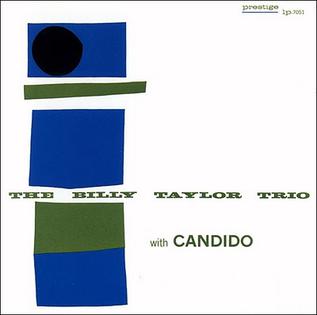
Billy Taylor wrote the liner notes for this album, and he made its purpose clear:
The purpose of this album is to present a great new jazz artist. His name is Candido, and we think that he is the most exciting jazz conga and bongo player in the business.
There are, of course, many Latin American drummers who play well with jazz groups, but I have not heard anyone who even approaches the wonderful balance between the jazz and Cuban rhythmic elements that Candido so vividly demonstrates, and his technical facility is, to say the least, astounding.
Dizzy Gillespie, of course, is one of the most important figures involved in the integration of Latin rhythms into jazz, starting with bringing Chano Pozo into his band. Even before that, Machito had one of the great jazz trumpeters, Mario Bauza, who never gets the credit he deserves--well, Latin jazz has never really gotten the acclaim it deserves. Candido played with both Machito and Gillespie before joining Billy Taylor for these sessions. Taylor, who would become one of the great educators in the jazz field, seems to have already had that mind set, as he sets out to prove that Latin jazz is real jazz, and Candido Camero is a real jazz musician.
Taylor gives Candido a lot of solo space here, and the conguero makes full use of it. He's a powerful presence throughout, soloing and trading with Taylor. And I could say accompanying, but that's not really it. He makes Taylor's solos into duets, and this is in no small part due to Rudy Van Gelder's engineering, keeping the levels of both instruments perfectly complementary.
The tracks are Taylor originals, plus a version of Cole Porter's "Love For Sale" which is breathtaking. Over nearly 8 minutes, Porter's melody becomes Latinized, boppified, turned into a vehicle for some adventurous Taylor improvisation and hot percussion by Candido.
Candido, who is still with us, was named an NEA Jazz Master in 2008, and his brief bio on the NEA's website describes some of his innovative drumming techniques:
...playing three congas (at a time when other congueros were playing only one) in addition to a cowbell and guiro (a fluted gourd played with strokes from a stick). He created another unique playing style by tuning his congas to specific pitches so that he could play melodies like a pianist.
Sanabria (Originally Published in the Autumn 2007 issue of TRAPS) which includes the mention of a group the young Candido played with in Havana, led by Chano Pozo on congas, and including Candido on tres (a Cuban three-stringed instrument designed like either a mandolin or a guitar) and Mongo Santamaria on bongos. He also describes how he came to develop his three-drum technique:
I had seen the New York Philharmonic perform and paid attention to the timpanist. I thought to myself, ’I can do the same thing with the congas.’ I began to tune the drums to specific pitches, mostly a dominant chord, so I could play melodies in my tumbaos and solos.
"A Live One" and "Mambo Inn" were released on an EP, and, with "Love For Sale," as part of a 10-inch LP. Both of these were just credited to Billy Taylor. The 12-inch LP, with the liner notes I quoted above, had the whole session, and was titled The Billy Taylor Trio with Candido.


:format(jpeg):mode_rgb():quality(96)/discogs-images/R-2873252-1320399681.jpeg.jpg) "Morning Fun" is an Al and Zoot composition, played by the quintet after Kai Winding had packed up for the day, and it's more of a blowing session, starting with vivid, uptempo cadenza leading into a two-horn riff, leading into lots more good stuff. George Wallington only takes a brief solo at the end, but his presence is felt throughout.
"Morning Fun" is an Al and Zoot composition, played by the quintet after Kai Winding had packed up for the day, and it's more of a blowing session, starting with vivid, uptempo cadenza leading into a two-horn riff, leading into lots more good stuff. George Wallington only takes a brief solo at the end, but his presence is felt throughout.




:format(jpeg):mode_rgb():quality(96)/discogs-images/R-4076578-1354790180-3149.jpeg.jpg)


:format(jpeg):mode_rgb():quality(96)/discogs-images/R-2205394-1269729515.jpeg.jpg)


:format(jpeg):mode_rgb():quality(96)/discogs-images/R-5126683-1385223126-8867.jpeg.jpg)


:format(jpeg):mode_rgb()/discogs-images/R-2767744-1367732273-6848.jpeg.jpg)





:format(jpeg):mode_rgb()/discogs-images/R-6395742-1418183859-1173.jpeg.jpg)






:format(jpeg):mode_rgb():quality(96)/discogs-images/R-3431388-1398761212-5765.jpeg.jpg)