Tad Richards' odyssey through the catalog of Prestige Records:an unofficial and idiosyncratic history of jazz in the 50s and 60s. With occasional digressions.
Showing posts with label Paul Quinichette. Show all posts
Showing posts with label Paul Quinichette. Show all posts
You could say that Weinstock and co. are still marking time, but that would be wrong. Bringing a collection of some of Count Basie's greatest sidemen together, along with pianist Nat Pierce, who did Basie better than anyone except Basie, in a group led by Paul Quinichette, who did Lester better than anyone except Lester, and what you've got is a recipe for nothing less than a soufflé of great music.
And this is one soufflé that doesn't collapse as you're taking it out of the oven.
But...if you're offered a recording of Basie musicians paying Basie's tunes, why not just pass it up and buy a Basie record?
Well, for one thing, you can never have enough good music. And if the musicians are this good, it's always going to be different. Nat Pierce can be Basie the piano player, but he can't be Basie the bandleader, so that role seems to fall to Paul Quinichette, who may not have seniority as a Basie-ite, but who has Prestige seniority as an on-and-off regular. And it's all worth having, and it's all worth listening to, and I am a better, more fulfilled person for having listened to it.
And besides, while this may be a Basie dream band (or dream small group), it isn't the current Basie band, or even precisely any one Basie aggregation.
Jo Jones goes back the farthest. He was already with the band when Basie took it over on the death of Bennie Moten, and remained behind the drums until 1948. Jack Washington, not so well known as the others but with the reputation of a jazzman's jazzman on baritone sax, was with Basie from the beginning, and stayed till 1950. Freddie Green came along just a little later, in 1937, and never left. He anchored the Basie rhythm section for five decades.
Buck Clayton spent some great years with Basie, from 1936 until he was drafted into the army in 1943. Earlier in the 1930s, he had a rather remarkable expatriate career, not in France or Sweden, but in China, where he led a group called the Harlem Gentlemen, and mentored the Chinese composer Li Jinhui, who revolutionized Chinese music before the revolution. After the revolution, Li's music was banned in China as decadent and western, and he became an enemy of the people.
So none of these guys played with Eddie Jones, who joined in 1953 and was the only active Basie-ite when this session was cut, remaining with the band until 1962, after which he went to work for IBM, which means he probably overlapped with me at IBM, though not in the same city. As a Basie-ite, he overlapped with Quinichette (1952-56).
When they get together, latecomers, early-leavers and lifers alike, they all know what to do. As ex-Marines are fond of saying, you're never an ex-Marine, and it seems you're never really an ex-Basie man either. The tunes are Basie classics. With a smaller group, there's more room for soloists, especially compared to the late 1950s version of Basie's group, where the emphasis was more on arrangements and ensemble play. It's hardly necessary to say how good Buck Clayton and Paul Quinichette are. Nat Pierce has some very nice solo moments, where he does more than just play the Count note for note. He has a musical persona of his own. There's just a great drum solo by Papa Jo Jones on "John's Idea."
I'm not exactly sure what qualifies this is a Prestige All Stars session. More like a Prestige Guest Stars session. But they are all stars, and I'm glad to have them.
The album was released on Prestige as Basie Reunion, and was later rereleased on Swingville when Weinstock started branching out into those subsidiary labels that appealed to diverse specialized tastes.
Listening to Prestige Vol. 2, 1954-1956 is here! You can order your signed copy or copies through the link above.
Tad Richards will strike a nerve with all of us who were privileged to have lived thru the beginnings of bebop, and with those who have since fallen under the spell of this American phenomenon…a one-of-a-kind reference book, that will surely take its place in the history of this music.
--Dave Grusin
An important reference book of all the Prestige recordings during the time period. Furthermore, Each song chosen is a brilliant representation of the artist which leaves the listener free to explore further. The stories behind the making of each track are incredibly informative and give a glimpse deeper into the artists at work.
The question of jazz's popularity, or lack of it, comes up about as often in music discussions as the "death of poetry" does in literary discussions, which is to say, you can't get away from it, and no one really has anything new to add to it. Including me, but that doesn't stop me from going back to it. I finished up 1957 with a reference to an article in Billboard asking once again why jazz should be so popular abroad, and still fail to reach a mass audience at home. Billboard was always a cheerleader for the business of selling music, and their writers and editors had some very sharp insights. Music editor Paul Ackerman, one of the sharpest, suggested that people really liked jazz when they heard it, but they didn't hear it enough, and he suggested that people in the jazz world should work harder at educating America's
disk jockeys. People in other countries were hearing plenty of jazz because of the popularity of Voice of America disk jockey Willis Conover, but there was no one like Conover on the home front air waves. The Voice of America, of course, was manipulated by the CIA, and the CIA was selling its own brand of culture wars -- America was the home of abstract expressionist art and modern jazz. daring art forms that were anathema to the communists. This might have been a tougher sell at home, where artists were generally suspected of being communists.
But the idea that DJs should be educated about jazz was an interesting one. Looking at another Billboard issue, this one from 1954, radio jocks were asked about their favorite jazz artists, and they couldn't come up with many. Their lists ran to dance bands like Les Brown, pop acts like Les Paul and Mary Ford, novelty acts like Jerry Murad's Harmonicats. They didn't seem to know exactly what jazz was.
It should be pointed out that the Top Forty charts of the 1950s were reasonably hospitable to instrumental music, and all kinds of instrumental music. You had perky-poppy hits like Les Baxter's "Poor People of Paris," Latin hits like Perez Prado's "Cherry Pink and Apple Blossom White," lush big band swing like Jimmy Dorsey's "So Rare," TV themes like Ray Anthony's "Dragnet," syrupy hits like Percy Faith's "A Summer Place," gutsy rhythm and blues like Bill Doggett's "Honky Tonk," and novelty rock and roll like the Champs' "Tequila." There was even some near-jazz, like Cozy Cole's "Topsy," or Red Prysock bringing his Lester Young influence to "Hand Clappin'" and "Cloudburst," which was also given a jazz cover by Lambert, Hendricks and Ross.
So maybe the jazz labels should have listened to Ackerman a little more closely. If one goes back to those 1954 disc jockey lists of favorite jazz musicians and jazz albums, one can't help but notice that they are virtually all from major labels. The only independent who makes a dent is Norman Granz, so maybe he understood the game a little better than some of the other indie impresarios.
Radio was a lot different in 1954, and here's one of the big differences. From Billboard, again:
Who selects the records played on your show?
Myself492
Program manager1
Music librarian9
Assistant1
Today virtually no DJ does his or her own programming. But back then, they did. Country legend Loretta Lynn got her start by driving around to every little radio station in the South with a crate full of copies of her first 45, meeting the DJs, schmoozing them, giving them the record. Today, no one would let her in the door. When I wrote The New Country Music Encyclopedia, back in the early 90s, I asked a record company executive, "What if it's not a kid? What if it's a veteran like Charley Pride, with a new recording, but no major label support?" "They'd let him in, because he's Charley Pride. But they wouldn't play his record."
Back then, you didn't have to do it yourself with a dusty old station wagon and a crate full of 45s. Song pluggers were an important part of the industry, and they did it for you. And you could even pay a little under the table to get your record on the air.
When people found out that was happening, it became a major scandal. Disc jockeys were fired. Congress launched a much-publicized investigation of payola. As a young person passionately in love with music, payola never seemed much of a problem to me. The assertion that Alan Freed took money under the table for playing records didn't bother me in the slightest. I loved the records he played, and I was much more bothered by the fact of his being forced off the air.
But anyway, it was 1958, and here you were. There was the persuasive power of song pluggers, and Nelson George profiles a few of them and discusses their importance to black radio in his brilliant study, The Death of Rhythm and Blues. For a little more of an investment, there was the power of greased palms. How much of an investment? I don't know, but Alan Freed played records by some pretty small independent labels, so it had to have been somewhat negotiable.
All of which brings us back to the independent jazz labels, and their
apparent invisibility to disc jockeys, be they the smooth pop purveyors like Jack
Lacy and William B, Williams on WNEW, the rock and rollers like Alan Freeds on
WINS, the black radio jocks like Jocko, your Ace from Outer Space, on WOV. What
if the song pluggers, with a little extra scratch in their wallets, had been
working for Prestige or Blue Note or Riverside, or the jazz division of
Atlantic?
They could have done worse than to start with Gene Ammons, and an album like
this one. It features five horns, for a full-throated big band sound. It has
Ammons’s rootsy connection to the blues, and some solid rhythms. I can imagine
a cut like “Ammon Joy,” with its echoes of both swing and rhythm and blues,
finding a place in a number of radio formats. “Ammon Joy is 13 minutes long, so
it would have to have been edited fairly severely, but that was a not uncommon
practice by jazz labels when the issued a cut on 45. And, in my reimagined
world of 50s music, how about that? Give the Top Forty or R&B or Make Believe
Ballroom audience a taste of the swinging head, the beautiful Jerome Richardson
solo, a bit of John Coltrane on alto, and your reimagined listeners put their
nickel in the jukebox, like what they hear, plunk down 79 cents for a 45,
listen to it a few times, get interested enough to shell out $3.98 for the LP,
and wow! Didja hear this? There’s a whole lot more to this song that we got on
the 45! And Paul Ackerman is right—if people are exposed to jazz, they’ll like
it.
Or maybe Prestige decides to try and sell the radio jocks on a familiar tune
from the Great American Songbook, like the Ammons take on Irving Berlin’s “Cheek
to Cheek” (quintet, with some playful work by Richardson) or Rodgers and
Hammerstein’s “It Might as Well be Spring” (again a quintet, this time with
Coltrane).
Or maybe not. Much as we revere the Great American Songbook today, the 50s
were not its finest decade. I don’t have any sources on this, but I’m fairly
certain the term had not been coined them. The songs from the 30s and 40s were
known as “standards,” and they weren’t the songs that song pluggers and payola
providers were pushing. So during the decade when traditional pop songs and pop
singers duked it out with the rock and rollers, the popsters were not going
with their heavy artillery. They were leading the charge with songs like “Ricochet
Romance” and “Cross Over the Bridge” and “The Naughty Lady of Shady Lane” and “Chances
Are.” Some of them were pretty good songs, some of them weren’t. Frank Sinatra
recorded standards on his great Capitol albums with Nelson Riddle and Billy
May, but his singles, his Top Forty releases, were newly minted songs like “High
Hopes” and “Young at Heart.”
The standards were left to the jazz musicians, and, interestingly, the rock
and rollers. Elvis recorded Rodgers and Hart’s “Blue Moon,” doowoppers recorded
the Kern/Fields “The Way You Look Tonight” (the Jaguars), Louis Prima’s “Sunday
Kind of Love” (the Harptones), the Benny Goodman standard “Glory of Love” (the
Five Keys) and many others.
It was left to jazz musician with a pop following, Ella Fitzgerald, to call
new attention to the songs of the cream of American popular composers, with Ella Fitzgerald Sings the Cole Porter
Songbook, the first of several such albums, and quite probably the
inspiration for whoever coined the phrase “Great American Songbook.”
So maybe a better choice for an Ammons release for the song pluggers and payola
merchants would have been a pop song of the Fifties, “That’s All,” a 1953 hit
for Nat “King” Cole.
In any event, none of that happened, and jazz floated along with its niche
audience. One song from the session, “Blue Hymn” (quintet with Jerome Richardson)
was released on 45, but much later. It’s hard to precisely pin down, It’s hard
to precisely pin down the release dates of Prestige 45s, but it probably was in
conjunction with the Bluesville compilation album, Soul Jazz, Vol. 2.
“Ammon Joy,” “Jug Handle” and “It Might As Well Be Spring” were all on a
1958 release of which the title tune was “Groove Blues.” “Blue Hymn,” “The Real
McCoy” (Mal Waldron composition), “Cheek to Cheek” and “That’s All” made up a
second album, The Big Sound, also
released in 1958, so even if they didn’t get a Top Forty single, the folks at
Prestige got their money’s worth out of this session.
Some jazz labels are linked with a particular style. Blue Note, though it had a long life starting in the swing era and extending to the present day, is very much identified with hard bop. Pacific Jazz lived up to its name and became identified with the West Coast sound, or the birth of white cool. Windham Hill is so closely associated with New Age jazz that "Windham Hill" is virtually a synonym for New Age.
Prestige also recorded a lot of hard bop and bebop, but because it was so much a one-man operation, Bob Weinstock was able to indulge his enthusiasms across a wide spectrum. Paul Quinichette had come under the Prestige umbrella in 1957, recording bop albums with John Coltrane, with Webster Young (perhaps he misunderstood, and thought Weinstock was saying "Come in for a session with Webster and Young"), and even one under his own name with a group of boppers. That came out as Paul Quinichette's New Stars, and they were all newer than him, for sure. Like his mentor Lester Young, Quinichette was open to new sounds and new ideas, but he was a Basie-ite at heart, so why not record him in a Basie context? Prestige was a big tent.
The album is For Basie, the tunes are all from the Basie playbook, and the musicians are Basie veterans.
Shad Collins' ties to Basie go back to the 30s, and the Lester Young days. He also played with Cab Calloway (he replaced Dizzy Gillespie), Benny Carter, Don Redman, Jimmy Rushing, and Sam "The Man" Taylor, another jazz-to-rhythm and blues cat. He had an important reputation as an arranger and considerable success as a composer, including "Rock-a-Bye Basie." He also wrote Cozy Cole's Top Forty hit, "Topsy."
No musicians are more closely identified with Basie than Walter Page and Freddie Green, In fact, Basie was a member of Page's band, the Blue Devils, in Kansas City. Page is credited with being one of the first to shift the primary rhythmic responsibility in a band to the bass, thus freeing up the drummer and piano player to improvise more. When you hear a singer, like Lonette McKee in Round Midnight, talk about the importance of listening to the bass, she has Walter Page to thank for it. This may have been Page's last recording, as he died suddenly and unexpectedly in the winter of 1957.
Freddie Green joined Basie in 1937, and stayed with him for the next 50 years. Jo Jones joined Green and Page as integral figures in the creation of the Basie sound. He played with Basie until 1948, then freelanced with others, including Duke Ellington.
Nat Pierce is best known for his work with Woody Herman, but also for having an uncanny ability to recreate Basie's piano style, so during the late 50s he led a number of groups of Basie veterans.
No one can resist the sounds of Count Basie, and it's pretty damn hard to resist these guys, either.
So...a step backward? No. There's really no backward in jazz. Some may have still been talking about hipsters and moldy figs, but this was an era when Louis Armstrong and Kid Ory were still making music, when Benny Goodman and Lionel Hampton were still making music, Machito and Tito Puente, the Count and the Duke, Dizzy Gillespie and Miles Davis, John Coltrane and Ornette Coleman and Eric Dolphy. Probably no other art form has ever been so inclusive.
What to say about this session? I've already talked about the pleasures of a Coltrane-Quinichette collaboration, and they're here again in abundance, all the more pleasurable when Frank Wess is added to the mix. Wess, like Quinichette, was a Basie guy and a Lester Young guy on tenor. He also played the flute, an instrument that is finding its way more and more into Prestige sessions. The tenor saxophone is never going to go away. It's the beating heart of jazz and its rambunctious cousin rhythm and blues. But new colorations are finding their way into the music, and both the solid groove and the newer sound are featured here, as Wess plays both flute and tenor. The Basie swing of Quinichette and Wess is a part of the jazz vocabulary that Coltrane is internalizing, ready to burst forth.
And I've talked more than once about the brilliance of Mal Waldron as a composer, and as an interpreter of his own compositions. Very often, when a group is playing a Waldron tune, he'll take a late solo, or the last solo, and he'll add something that the other brilliant musicians on the take have missed -- something that goes to the heart of the song.
So what to talk about here? Well, one thing that you very rarely find on a Bob Weinstock recording, the existence of alternate takes. Weinstock, as we know, valued spontaneity and didn't encourage a lot of second and third tries on a tune. Also, as we know, he valued recording tape and didn't like to waste it, so most unused takes were taped over.
Alternate takes are often a treasure to the jazz scholar, just as often a pain in the neck to the jazz lover who just wants to hear music, not study it, and whose enjoyment of the CD version of an album he once loved is marred by having to listen to five different takes of some group's version of "Ornithology." But because they are so infrequent on Prestige, and because I am sort of pretending to be a jazz scholar in this project, they're a rare treat.
I listened to the final take of "Wheelin'" first, the alternate take second, wondering if I'd hear the difference, or get why they were dissatisfied with the first. And maybe I did. This is a very swinging group, with two Lester Young acolyte Basie-ites, and a piano player who would be tapped by Pres's soulmate Billie Holiday as her accompanist, and as great as the first version is, maybe they thought that they could swing harder.
Especially Mal Waldron. On the final take, I was blown away by his piano solo, hard as nails, played almost entirely on the topmost end of the piano. The earlier version is mellower, and it seems as though Waldron decided to trade sonority for percussiveness, not unlike what Illinois Jacquet did in his classic recording of "Flying Home" with the Lionel Hampton band, when he created the honking tenor sound, with all its emotional immediacy. Waldron is doing something a lot more complex, but no less immediate.
Other thoughts about this session: I was drawn in by the inescapable beat of the rhythm section on Mercer Ellington's "Things Ain't What They Used to Be," one of the numbers that features Wess on flute. And speaking of Illinois Jacquet, his "Robbins Nest" is one of the great jazz standards, with an irresistible melody and ample room for improvisation, done proud by this ensemble. Jacquet's collaborators on "Robbins Nest" were Sir Charles Thompson and Bob Russell, a fine lyricist (Songwriters Hall of Fame) who seemed to have a penchant for writing lyrics that were rarely used, although there is a version of "Robbins Nest" by Ella Fitzgerald.
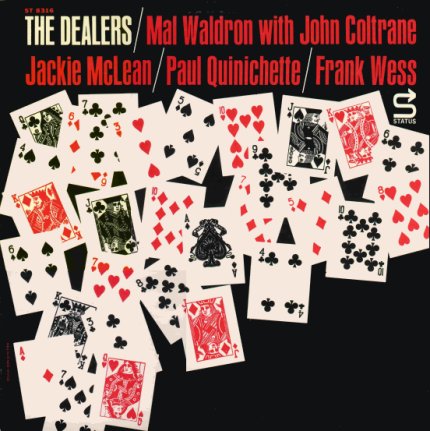
All of the final takes m this session were on the Prestige album Wheelin' and Dealin', credited to the All Stars. The two alternate takes made it to a budget Status album, The Dealers, credited to Waldron and also featuring two cuts from his April 19 session. The alternate takes inevitably made their way onto the CD reissue of Wheelin' and Dealin'. Weinstock must have been moved as I was by the irresistible beat of "Things Ain't What They Used to Be," because it was released as a two-sided 45, under Coltrane's name.
There's no one who didn't, and doesn't love Billie Holiday, but few with the devotion of Webster Young. In fact, Billie Holiday may have saved his life. Don Alberts, in his book Diary of the underdogs: Jazz in the 1960s in San Francisco, described this episode:
Young trumpeter Webster Young loved Billie Holiday. He knew all her tunes and he could sing the lyrics. Once in Los Gatos at Lorraine Miller's house, Webster was invited into the peyote experience. He was curious and he accepted. The hallucinogenic qualities of peyote cactus are legendary and the comfort mode can go either way. With Webster it may have been disquieting and he became immediately silent, he said nothing to anyone. He listened to Billie's records over and over all that night without moving from a cocoon position in front of the stereo. Billie's voice seemed to gve him peace, help him hold onto reality.
This is an unusual glimpse into the life and psyche of Webster Young. It's surprising that he was out in San Francisco in the 60s, even more surprising that he took this walk on the wild side. One thinks of Young leaving the dangers of Manhattan jazz life behind him, going back to Washington. DC, and beginning his second career as an educator, which would occupy the rest of his life.
But maybe there was a detour. There's Alberts' story, which takes him out to San Francisco, and there's a 1961 three-volume live recording of a tribute to Miles Davis, about which not much is known, but it was made with St. Louis-based based musicians, so that may have been another stop for him.
Davis was his chief influence on the trumpet, but not his only one. As a boy, he corralled Louis Armstrong backstage at the Howard Theater in Washington and convinced the trumpet legend to give him an impromptu lesson. Hearing Dizzy Gillespie for the first time drew him toward bebop. But Miles was the one who took him under his wing in New York, and on For Lady he plays a cornet loaned to him by Miles.
For Lady is one composition by Young, dedicated to Lady Day, and five songs closely associated with her. Of course, the musician most closely associated with Holiday is Lester Young, and for this session, Webster Young does the next best thing and taps Paul Quinichette, the Vice Pres, as his partner. As Marc Myers notes in his JazzWax blog,
What's particularly interesting about this album is you get to hear what Miles Davis and Lester Young would have sounded like had they recorded together in the studio in the '50s. Webster Young's blowing here is often with a mute, and his pacing is distinctly in the manner of Davis. Joining
him on tenor sax was Paul Quinichette, whose playing was a traced sketch of Lester Young's laid back and languid blues-saturated style.
You don't necessarily associate the guitar with Lady, but Joe Puma fills out the sextet, and does some excellent work, particularly on "Good Morning Heartache." Mal Waldron, who had just started working with Holiday and would be her accompanist for the rest of her career, surrenders his composing duties to the songsmiths associated with her, including herself (with Arthur Herzog) for "God Bless the Child" and "Don't Explain." Ed Thigpen was a frequent occupant of the drum seat on Prestige recordings of this era. He was also working with Billy Taylor, and brought Taylor's bassist Earl May along for this session.
For Lady was Young's only studio session as a leader.
In general, I try not to look ahead, but to consider one recording session at a time. This isn't exactly a rule, but it's a general preference, and in this case, it's one that I held to. In my last blog entry, on the Mal Waldron sextet with John Coltrane, I wondered if one could chart the seeds of progress toward the revolutionary changes to come -- Giant Steps, My Favorite Things, A Love Supreme, Ascension. And now, in the very next session, or perhaps a continuation of the same session, since they happened on the same day, Trane is paired with swing giant and Lester Young acolyte Paul Quinichette.
So--is Coltrane moving on a steady course toward a more advanced, avant-garde approach to music? Or how about this for an alternate question -- did Trane ever care about that? In 1961, during his Impulse years, when we was making his most advanced music, he recorded an album of ballads, and two years later, in 1963, he collaborated with Billy Eckstine acolyte Johnny Hartman on another album of standards. Coltrane was one of the most important developers of modal jazz, the definitive break from the improvisation around chord changes that was the hallmark of bebop, but his best known modal album--probably his most popular album of all time--was built around one of schmaltz kings Rodgers and Hammerstein's schmaltziest songs. and if he didn't exactly deliver it in a brown paper package tied up with string, he certainly knew that was where it came from.
In other words, Coltrane moved wherever the spirit moved him, and if it moved him to find a groove with the Vice Pres, that's what he was going to do. And there's no star heirarchy in this session. It's two cats blowing together, and finding that groove, and sharing the experience. Neither of them concede anything stylistically, and neither of them has to--Coltrane with a hard-edged, driving sound, and Quinichette sweeter and gentler. It really does give you a sense of what it would have been like if Trane and Lester Young had ever played together, especially on "Cattin'."
Again, Mal Waldron is called upon to supply most of the music here, with four originals and some wonderful solos--again, especially on "Cattin'."
I should, if I haven't recently, stop and give credit to the anonymous scholars who have created so many Wikipedia pages for individual albums. That's where I get most of my information on composer credits for jazz originals, hard to come by anywhere else on the web.
All the tunes from this session except "Tea for Two" came out on album called Cattin' with Coltrane and Quinichette, which for some reason was delayed a couple of years before release. "Tea for Two," where Quinichette takes the lead, eventually surfaced on the Body and Soul compilation album on Status that seems to have handled a lot of the overflow from other sessions.
The name of the group, on the session list, is Paul Quinichette's New Stars, and it lives up to its billing. Even Quinichette, while not altogether a new star, is new to Prestige, and pretty much new to recording in a bebop context. He's not new to recording, having led his first session in 1951, and even when he was new in that context he wasn't altogether new, being 35 years old and with a fairly impressive career behind him, from Jay McShann to Johnny Otis, Louis Jordan, Lucky Millinder, Hot Lips Page, and most notably with Count Basie, where he became known as the Vice President, because of his stylistic similarities to Lester Young, and of course because of taking the lead tenor sax chair in the Basie band. And his debut album with Prestige, with a new label and really a new approach, came when he was 41.
You don't play with bandleaders like McShann, Otis and Jordan without learning something about the importance of entertaining people, and as Quinichette began his association with boppish Prestige, he brought that background with him. Prestige had been started by 21-year-old Bob Weinstock after he had been jolted out of his trad jazz fandom by a Thelonious Monk 78, and his first recording session featured Lenny Tristano, so he was no stranger to the cutting edge of jazz experimentation. But he wasn't afraid of feel-good music either, and both of these tastes are what gave Prestige its vitality and importance for so many years.
Quinichette, on this and subsequent sessions with Prestige, worked in that genre that I've called, writing about artists like Zoot Sims, swing-to-bop (which was also the title of a classic cut by perhaps the original swing-to-bopper, Charlie Christian). The early boppers, of course, came out of the swing bands, but by this time, the young modern players had grown up on bebop. So it's interesting, instructional, and basically just plain delightful to hear a veteran like Quinichette with this group of New Stars.
Of the new stars, the rhythm section isn't entirely new, but is of the bebop-bred generation.
Mal Waldron was the oldest at this point, at 32, but his whole career had been with the moderns. He did begin with Ike Quebec in 1952, but soon moved to Charles Mingus, and aside from a very important stint with Billie Holiday (1957-59) always worked in a modern and even free jazz idiom.
Ed Thigpen was five years younger than Waldron, but came from a traditional background--his father was the longtime drummer for Andy Kirk's Clouds of Joy, and he was perhaps best known for his work with Oscar Peterson, Billy Taylor and Ella Fitzgerald.
Doug Watkins was still only 23, and had made his Prestige recording debut just a year earlier, with Jackie McLean (and in 1955 on a live album with Art Blakey), but he was already a veteran of some 20 sessions on Prestige alone.
John Jenkins had played on a couple of recent sessions (and was also brought up modern, starting out with Art Farmer and Charles Mingus), but he was still a pretty New Star, and Curtis Fuller and Sonny Red were the newest of the New.
Sonny Red was 25, and this seems to have been his debut on record. He was active through the 50s and 60s, never really breaking through as a major figure, but doing some good work. Curtis Fuller was two years younger, one of the Detroit guys, and did go on to make a significant name for himself. They would both come back the day after this session to record under Fuller's name, so I'll hold off saying much more about them, except to note that each of them were at one point caught up in the twin-instruments thing I got into in my last post. Well, not really. Sonny Red is featured on an album called Two Altos, and it has a picture of two altos on the cover, and the names Art Pepper and Sonny Red, but it's actually two completely different sessions, done at different times on different sides of the country. Curtis Fuller...another J.J. and Kai? Blue Note apparently thought so. They recorded him and Slide Hampton as the co-leaders of a quintet in 1958. And then apparently thought better of it, as the session went unreleased until 1980 in Japan, and 1996 in the USA.
So here we have veteran Paul Quinichette with the young cats, and with a young composer - three tunes by Mal Waldron, along with two standards, and the results are uplifiting. Someone calling himself GastonBulbous has posted "Blue Dots" on YouTube, and describes it as "a head by Mal Waldron that cleverly bridges Quinichette's origins as a Basie-ite with the more beboppish ambitions of his sidemen." It's that and more. The head is Waldron's modern-style take on a McShann or Otis-type head, and solo work, taking Quinichette's cue, is joyous swing-to-bop. All of it wonderful, but you can't help but be particularly caught up in Quinichette's solo, and Waldron's brief one at the end.
Bob Weinstock must have been as struck as I was by the infectiousness of "Blue Dots," because he released it as a 45. The album was called Paul Quinichette on the Sunny Side. The British Esquire release has the same title and the same frying pan, but adds "the Vice Pres" to Quinichette's name. The 45 changes the listing of New Stars to the familiar Prestige All Stars. It was released later, so presumably the stars weren't quite so new any more.


:format(jpeg):mode_rgb():quality(90)/discogs-images/R-7306051-1438474214-6531.jpeg.jpg)




:format(jpeg):mode_rgb():quality(40)/discogs-images/R-3818640-1345634189-2025.jpeg.jpg)


.jpg)
:format(jpeg):mode_rgb():quality(90)/discogs-images/R-3800958-1344948642-2682.jpeg.jpg)
