Showing posts with label Jimmy Raney. Show all posts

Saturday, June 12, 2021

Listening to Prestige 580: Dave Pike


As promised, a new Dave Pike with this, his third and last album for Prestige. Pike would re-invent himself often, like so many jazz musicians in this swiftly moving art form, from Miles Davis on. This, however, is not so much a reinvention as a shift in emphasis, away from the Latin rhythms, on to a more mainstream sound. How much of this was the result of commercial considerations, I can't say. If commercial considerations were the whole story, nobody would be playing jazz, but sometimes a thematic approach -- less tactfully, a gimmick -- may be a way to draw a little more attention to an artist, and sell a few more records.


Nothing wrong with that if, when you get down to making the music, you're there to play and nothing else. Which certainly seems to have been the case with Dave Pike. If you sign a recording contract at height of the bossa nova craze, and management says "Hey, how about a bossa nova album," you might do it just for the contract. That was the case when Bob Weinstock asked Annie Ross if she could write some songs to jazz solos--"I was desperate, so I said 'Sure.' If he'd asked me to learn how to fly, I would have said 'Sure.'" And the rest is history. Two of the greatests jazz vocalese pieces ever -- "Twisted" and "Farmer's Market." And Lambert, Hendricks and Ross. But it seems clear that Pike didn't do it just for the contract. Had that been the case, he wouldn't have chosen to feature the works of obscure (in the United States) composer Joao Donato.
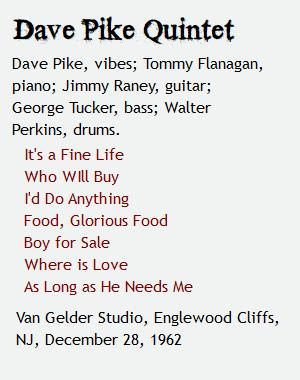

Jazz interpretations of Broadway shows had shown some commercial appeal. Oliver! had been a hit in London, had been on tour in the United States, and was about to open on Broadway, where it would be a success, but would not really spawn any hit songs. "As Long as He Needs Me" had been a British hit for Shirley Bassey, and would later become a minor hit for Sammy Davis Jr. I'm not convinced that a jazz version of Oliver! was a surefire commercial bet in 1963, and I suspect one might not find all that many people today who could hum "As Long as He Needs Me," let alone the rest of the show. So I hope it was a project that really appealed to Pike.

A confluence of reasons--not a huge Oliver! fan base among the jazz crowd, the association of Pike with more out-there genres of music--have converged to make this a not widely remembered album. Also, when one thinks of the vibes in the context of the history of jazz, there's a bit of a temptation to enumerate Lionel Hampton and Milt Jackson and then stop. But there were a lot of very good players, and a lot of individual stylists, and several of them were on Prestige. Teddy Charles, back in the label's early days, who would give it all up to become a charter boat skipper. Lem Winchester, the jazz-playing cop, dead before his time. Walt Dickerson. And Dave Pike. Here, his work with Jimmy Raney and with Tommy Flanagan, two veterans who know how to challenge and support a young player, is well worth a listen.

Dave Pike Plays the Jazz Version of Oliver! is not represented on YouTube by any individual cuts, so I can't give a Listen to One, but the whole album is there, and worth checking out.

Don Schlitten, new to Prestige, produced. Schlitten had started an independent label, Signal, in 1955, then moved on to freelance producing after he and his partners sold the label to Savoy.

Dave Pike played the jazz version of "As Long as He Needs Me" for a 45 RPM single, with "Where is Love?" as the B side.  The album was released on Moodsville.

Pike's next two albums, for Decca and Atlantic, are notable for introducing Chick Corea on the first, and employing the still-new Herbie Hancock on the second.

Tuesday, June 08, 2021

Listening to Prestige 578: Dave Pike


 Dave Pike continues his south of the border explorations, this time moving to the Caribbean. The calypso craze of Harry Belafonte and the Tarriers and even Robert Mitchum, who recorded a calypso album in 1957, had passed its zenith, but Latin dances were still enough of a thing that everyone was looking for a new one to follow the mambo and the conga line and the cha cha and the bossa nova, and even though Trinidadian calypso wasn't exactly Latin, it was close enough for pop culture (there had even been a "cha-lypso" -"When the records start a spinnin', do cha-lypso while you chicken at the hop"), so 1962 saw Chubby Checker, who had ridden the crest of the most popular dance craze of all, hitting the charts with "Limbo Rock."

Dave Pike had captured some attention with his Bossa Nova Carnival album, so why not go after the same lightning again--and again with fledgling producer Eliot Mazer? There was certainly some commercial consideration here. Chubby


LISTEN TO ONE: My Little Suede Shoes

Checker's "Limbo Rock" is covered, as are "Matilda" and "Jamaica Farewell," two of the most popular songs from Harry Belafonte's Calypso album, then regarded as the most popular LP record of all time, and still up among the contenders. Mexican-American Richie Valens's hit "La Bamba" is included, as is Nat "King" Cole's semi-hit "Calypso Blues." Sonny Rollins is represented by "St. Thomas," one of the calypso melodies he would make his own, and "Mambo Bounce," which had been a 78 RPM single for Rollins off an early Prestige session. And four songs from Pike's session became 45 RPM singles.


But "commercial consideration" just means choosing and playing songs that people like, and there's nothing wrong with that, if the musicians come to play, and put their full virtuosic dexterity and creative energy into the project, which is what happens here. 

"Limbo Rock" isn't the most subtle of melodies, but with Willie Bobo and Ray Barretto handling the percussion, it's lively and fun to listen to. Throughout the session, Pike alternates between vibes and marimbas -- he chose the marimbas, he explained to Juliet Lorca, who wrote the liner notes for the album, because they have a sound that's close to Trinidad's steel drums.

On the other extreme, there's Charlie Parker's "My Little Suede Shoes." Some have theorized that Parker adapted the melody from a Caribbean folk tune--Juliet Lorca suggests as much in the liner notes--but it's more likely a mashup of two French pop songs which Bird heard on a 1950 trip to Paris. One of the songs, ""Le Petit Cireur Noir," has a lyric about shoeshine man who hates suede shoes because everyone is wearing them and he's being put out of business. But then he finds a wallet stuffed with cash, buys his own shoe store, and gets rich selling suede shoes. There's no mention as to whether any of them are blue. Parker's melody--recorded with Luis Miranda on bongos and Jose Mangual on congas--is wonderfully catchy, and full of island spirit. It's a perfect choice for Dave Pike and his group, and it's a can't miss recording.

If "Limbo Rock" and "My Little Suede Shoes" are miles apart musically, they're also some distance apart in terms of orchestration. The percussionists remain, but the rest of the band -- Leo Wright on reeds and Jimmy Raney on guitar--are gone. Tommy Flanagan moves in on piano, and Ahmed Abdul-Malik replaces George Duvivier on bass.

Dave Pike was, of course, not Latin himself, and he would not remain on a Latin kick. His next album (and the last for Prestige) would go in a markedly different direction, and the rest of his career, lasting throughout the rest of the century, would take some remarkable twists and turns, through free jazz, acid jazz, funk and psychedelia. So is this cultural appropriation? That was, of course, a concept that would not be named or defined for many decades to come. Dave Pike isn't Machito or Tito Puente, but nobody is. He did turn the spotlight on a wonderful and little-known (in the States) Brazilian composer on the first album, and he has a lot of fun with some pop songs and a great Charlie Parker composition, and to quote Paul McCartney, "What's wrong with that, I'd like to know?"

"Jamaica Farewell" / "Limbo Rock" was the first single, and "La Bamba" / "My Little Suede Shoes" was the second. The album, on New Jazz (a little surprisingly--I'd thought of New Jazz as primarily a home for the less commercial fare) was called Limbo Carnival.


He would spend much of his career in Europe, not so unusual for a jazz musician, a little more unusual for a white jazz musician.

Friday, January 13, 2017

Listening to Prestige 231: Barbara Lea

This is the last Barbara Lea session, three more songs to fill out the Lea in Love album, with her backing group changed just a little. Trumpeter Johnny Windhurst, who worked with Lea a lot, and was on her first Prestige sessions, is back. Dick Cary stays on alto horn here, and Jimmy Lyon on piano. This time they go without a drummer.

New to the mix is harpist Adele Girard. There aren't all that many jazz harpists, and most of them are women, although the first person to use the harp as a jazz solo instrument was a man, Casper Reardon, and probably the most famous American harpist was a man, too: Harpo Marx. There aren't all that many jazz harpists because it's not always easy to
see how a harp fits into a jazz context. Corky Hale and Alice Coltrane are probably the best known. Adele Girard probably should be. Her "Harp Boogie" may be the best jazz harp tour de force ever. She doesn't do that kind of soloing on this session, but she adds nice stuff to the mix.

Lea did four songs on this day three of which made the album, and the fourth was not only unissued, but there's no record of what it was. Two that did make the cut are by Cole Porter. "You'd Be So Nice To Come Home To" has become a jazz standard, beloved by vocalists and instrumentalists alike.

"True Love" was written for the movie High Society, where Bing Crosby sings it to Grace Kelly, and she chimes in a little on the last chorus. This was enough to put her name on the label, and it became Princess Grace's only gold record. There really aren't any other jazz recordings of it (although there's a very weird one by Beatle George Harrison). Is there something about it that says Pop, not jazz? Lord knows Cole Porter has provided many many highlights of the jazz repertoire. But there's not much that says Jazz in the Barbara Lea version, either, although it's a beautiful pop song, and Lea, as always, understands the lyric and delivers it sensitively.

"A Straw Hat Full of Lilacs" is the real show stopper here, partly because it's so obscure. I can't find any other recording of it. The lyric was written by Peggy Lee (who as a 17-year-old appeared on a radio show called Hayloft Jamboree as "Freckle-faced Gertie," wearing a trademark straw hat), but there's no record of Lee ever recording it. The music was by Willard Robison, known for the hauntingly sad "A Cottage For Sale," and this song has some of the same haunting melancholy. If I were a contemporary jazz singer (Teri Roiger, are you listening?), I would take this song and Annie Ross's "The Time Was Right," another neglected gem, and add them to my repertoire.

"Straw Hat Full of Lilacs" was the flip side of a 45, with "Mountain Greenery" as the A side, as well as being on Lea in Love.


 Order Listening to Prestige, Vol. 1 here.

Thursday, January 05, 2017

Listening to Prestige 228: Barbara Lea

What's important about these growth years for Prestige? The first great Miles Davis quintet albums. The Modern Jazz Quartet forming and making the records, like Django, that they're still remembered for. The early John Coltrane, playing with Bobby Jaspar or Kenny Burrell or Jackie McLean,  or matched against two baritone saxes, finding and growing his genius.

Hell, yeah. But no. The answer is it's all important. Musicians coming into the record store of a 19-year-old kid who loved jazz and was inspired by a Thelonious Monk record played for him by Alfred Lion to start his own record company. Hey kids...we've got a barn...we've got all this talent...let's put on a show!

A girl from Detroit who grew up listening to the French light operas composed by her great-uncle, who sang with dance bands until she got a music scholarship to Wellesley, graduated, came to New York, made a 78 for a tiny label with some very good trad jazzmen -- Cutty Cutshall, Eddie Barefield, Peewee Erwin -- then found herself on two of the hottest modern jazz labels in New York, first Riverside, then Prestige, for whom she went out to Hackensack and Rudy Van Gelder's studio twice in 1956 (winning Down Beat's best new singer award), then four more times in 1957. Then a long hiatus, during which she worked as an actress and a teacher, until the late 1970s, when people started remembering that here was a singer who cared deeply about the best American popular songs, and could interpret a great lyric like no one else.

And, as always, every session is different, and the story of the leader on the date is only part of the story. Barbara Lea had recorded five days earlier with a trio. On April 24th and 26th she was back in the studio with a seven piece band. It included Dick Cary, who played on all of her sessions, and Prestige veteran Jimmy Raney.

It included some of the finest accompanists of jazz and popular singers. Jimmy Lyon was best known as Mabel Mercer's accompanist, but also worked with June Christy, Polly Bergen and Connie Haines. Beverly Peer began his career with Ella Fitzgerald in the Chick Webb orchestra, and also worked with Sarah Vaughan, Lena Horne, Johnny Mathis, and Barbra Streisand. Osie Johnson played on a session with Dinah Washington.

And it also included a musician with a truly remarkable career, one that began before some of the musicians on this session were born, and continued into the modern jazz, and even the free jazz era. Garvin Bushell recorded with some impressive female vocalists too: Mamie Smith, who recorded the first blues record ever made, and Ethel Waters. He was a member of the Louisiana Sugar Babies with Jabbo Smith, Fats Waller, and James P. Johnson. He worked
with Fletcher Henderson, Cab Calloway and Bunk Johnson. And, jumping ahead, he recorded with Miles Davis, John Coltrane and Eric Dolphy. His autobiograpy, Jazz From the Beginning, is must reading for every jazz fan. And here's a video of an interview with him, talking about those early days.

Lea called upon the services of some of the greatest songwriters in that American Songbook. Cole Porter, Rodgers and Hart, Harold Arlen and Johnny Mercer (for the obscure and wonderfully titled "Sleep Peaceful, Mr. Used-to-be") and others. She had the services of some wonderful musicians and some very interesting arrangements. And she delivered.

All of these were issued on the Lea in Love album. "Mountain Greenery" became a 45, along with "A Straw Hat Full of Lilace" from a subsequent session.


 Order Listening to Prestige, Vol. 1 here.

Friday, October 28, 2016

Listening to Prestige 213: Jimmy Raney/Kenny Burrell

This was booked as a Prestige All Star session, but clearly the center of attention is the two guitars, one of them the label's newest star, the other a veteran of the early days of Prestige, who had been away from the label for a couple of years, and would be back for just this session. Kenny Burrell and Jimmy Raney mesh beautifully here, but what's even more interesting is how well all the instruments-- two guitars and two horns--all come together, so seamlessly that you almost don't register the difference between horns and strings as they play the heads together, and one solo follows another. And since several of the pieces are by Mal Waldron ("Blue Duke," "Dead Heat" and "Pivot") you can add that to the mix too. Waldron is always a great soloist, but never better than on his own compositions.

The outliers here are the one cut each where one guitarist takes center stage, and the other sits out. For Burrell, this is "Close Your Eyes," a song that had recently been popular in a version by Tony Bennett, and I had always thought of it as a passable but not very interesting example of 50s pop, but it has a much longer history. It was written by Bernice Petkere, who broke into the boy's club of songwriting in the 1930s and made enough of an impression that Irving Berlin dubbed her "the queen of Tin Pan Alley." "Close Your Eyes" was first recorded in 1933 by Ruth Etting, and it's stuck around, with other jazz versions by Humphrey Lyttleton and Oscar Peterson, and jazz vocal versions by Ella Fitzgerald, Peggy Lee, Betty Carter, Nancy Wilson, and another queen -- Ms. Latifah. Here the spotlight is given to Burrell, and he takes off with it, bypassing the melody almost altogether (perhaps why both Spotify and YouTube have it listed as "I'll Close my Eyes") for some breathtaking improvisational flights.

He then sits out and gives Jimmy Raney a turn on "Out of Nowhere," another 1930s chestnut that became a jazz standard. most famously in a 1937 version by Coleman Hawkins, with a solo described as "so intimidating that no tenor saxophone player tried the tune until eight years later." It had a pretty intimidating guitar solo, by Django Reinhardt, but Raney's version is entirely satisfying.

And one should also mention "Little Melonae," another outlier of sorts. It features the full ensemble, but with special attention to Jackie McLean, who wrote the tune.

This is another of those Prestige All Stars albums where some All Stars are more All Star than others. All the musicians get billed in the same font, but only Kenny Burrell and Jimmy Raney get their first names, and the album is called 2 Guitars.


 Order Listening to Prestige, Vol. 1 here.


Thursday, September 24, 2015

Listening to Prestige Part 148: Bob Brookmeyer

Bob Brookmeyer, during this time period, was somewhat bicoastal. He had replaced Chet Baker in Gerry Mulligan's famous pianoless quartet, and he was still making dates in New York. This is another four song, 10-inch recording date, perhaps because Prestige already had one such session (with Teddy Charles), and needed one more to fill out a full length LP.

This New York session is also a pianoless quartet, except when it isn't. On two of the tunes, Brookmeyer plays piano. Actually, Brookmeyer had started as a pianist, with the Tex Beneke and Ray McKinley bands, before switching to valve trombone full time. This was actually true of the Mulligan-Brookmeyer quartets, as well--they were pianoless except when they weren't, since both Mulligan and Brookmeyer played piano.

To my ears, there's no falling off in technique or imagination when Brookmeyer switches to piano. He's great on both instruments, and the four tunes together, with the piano and trombone alternating, make a cohesive unit.

The quartet makes a cohesive unit, too. I believe this is Mel Lewis's debut on record. His first
important professional gig had come in just the previous year, when he had joined Stan Kenton's orchestra. Teddy Kotick had also played on the Teddy Charles session.

I continue to be impressed with Jimmy Raney, who's been on several Prestige sessions before this. His solos are beautiful, and his duet exchanges with both Brookmeyers, the trombonist and the pianist, are dazzling. He does a very cool duet with Teddy Kotick, as well, on his own composition,  "Potrezebie," the title of which tells me that in addition to his other accomplishments, Raney was an early fan of Mad comics. Mad's resident genius, Harvey Kurtzman, had run across the word in a set of Polish instructions for a bottle of aspirin (and who among us hasn't read aspirin labels in Polish?) and decided he liked thesound of it as a nonsense word (it actually means "need"). Looking on Allmusic.com to see if anyone else had recorded "Potrezebie," I discovered that although it hasn't been picked up by any other Mad-loving jazzmen, there are a number of Polish songs that use it in the title. The Polish songs spell the word correctly: Potrzebie, with no "e" between the "r" and the "z." Actually, the root word is an inflected noun, and "potrzebie" is the dative case of the noun. The various Polish songs usually use "potrzebuje" or "potrzeba," which, as near as I can make out, are verb forms. "kilkanaScie przedsiEbiorstw potrzebuje nowych dochodOw"  translates as "Over a dozen of enterprises need new incomes," which seems somehow appropriate for a discussion of jazz. I like to think that Jimmy Raney was a real Mad fan, and knew the correct spelling, but was done in by the label maker for Prestige's pressing plant.

The original 10-inch release in 1955, and the later 12-inch release, were both titled The Dual Role of Bob Brookmeyer, referencing two different sessions with two different Hall Overton students, or more likely Brookmeyer as trombonist and pianist. The same album was also given a New Jazz release, as Bob Brookmeyer -- Revelation!


Thursday, August 27, 2015

Listening to Prestige Part 139: Jimmy Raney

Jimmy Raney was back in the studio twice in the winter of 1955, February 18 and March 8, with the same lineup. It included his mentor Hall Overton, who had not been part of his session from the previous August, which had featured two horns but no piano. One of the two had been Phil Woods, who went on, as we know, to have one of the most distinguished careers in jazz history, although he and Raney were not to record together again. The trumpet player for that earlier gig, John "Doc" Wilson, who is back for these next two, also went on to have a career no less admirable, if less acclaimed, as an arranger and educator.

Wilson's first recordings were on these Jimmy Raney sessions. He went on to record with Bob Brookmeyer and Gerry Mulligan, but recording with famous names was not to be his major contribution to the jazz world. And interestingly, though he played with one of jazz's great arrangers, he does not list Mulligan as one of his most important influences.

Wilson's first big time gig was with the interesting but short-lived bebop aggregation that Benny Goodman put together with Zoot Sims and Wardell Gray. He would learn a lot from Goodman, including, as he told Nate Guidry in a profile in the Pittsburgh Post-Gazette, the way that

...when the band wasn't swinging the way he wanted, Benny would have a rehearsal early in the morning without the rhythm section so we could get our own swing thing going...I found later in my career that that's a great technique. If you've got a great rhythm section and the music isn't swinging, it's not the rhythm section's fault.
After Goodman, he played in bands led by Pete Rugolo, Neal Hefti and Claude Thornhill, all top arrangers. But he says his most rewarding experience was playing in the band led by Eddie Sauter and Bill Finegan, who first made their reputation arranging in the golden years of swing, Sauter for Red Norvo, Benny Goodman and others, Finegan for Glenn Miller:
Those guys had some really novel ideas when it came to arranging. The effects of that band are still felt today. They used woodwind doubles, extra percussions that are now commonplace. But when they started doing it, it was new.
 The Sauter-Finegan orchestra  was swimming upstream against the rock and roll tide of the 1950s, and Wilson found himself swimming against the same tide in the 1960s, as the Beatles swept away everything in their path, including jazz. Wilson recalls

...things in New York were getting bad. Musicians were going from working six days a week to one or two days. I ran into Kenny Dorham working in a music store on 48th

Street. The great Kenny Dorham couldn't find work. I had my trumpet stolen, so I go into this store, and I'm in the basement trying these different horns, and here comes Kenny and he said, 'I heard some of those licks you were playing, and I had to come down and see who was playing that.'
Wilson went back to school, got a doctorate in music from NYU, and landed a teaching job at Duquesne University in Pittsburgh in 1972. There wasn't much call for jazz in higher education then -- in 1972, only 15 colleges in the US offered degrees in jazz studies. But Wilson had his Ph.D., so he was able to  get hired as Duquesne's band director, conducting classical music and wind ensembles, and eventually to set up a jazz program.

Wilson and Raney mesh beautifully here. Raney had a wonderful sense of how to coordinate a guitar and horn, and it didn't hurt to have Rudy Van Gelder engineering the sessions. Replacing Bill Crow and Joe Morello are Teddy Kotick and Nick Stabulas.

The tunes are originals and standards on the first session, all standards on the second. Mostly Raney takes a fairly loose approach to the melodies, even on the head, and he makes it work. With the exception of "Someone to Watch Over Me," where the pure beauty of the melody engages him briefly.

I wanted to do a portrait of John "Doc" Wilson, but I can find no pictures of him anywhere on the Internet.

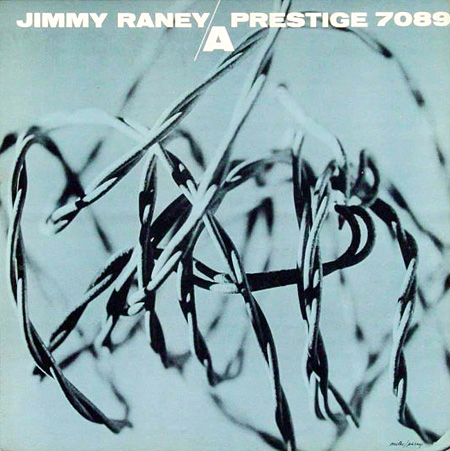
These sessions were combined on a 10-inch LP, and later included on the 12-inch Jimmy Raney - A.


Saturday, June 06, 2015

Listening to Prestige Part 117: Jimmy Raney

Jimmy Raney was last seen in Hackensack with Hall Overton, his Juilliard professor who was also Teddy Charles's mentor. Charles and Overton, to me, represent a school of musical experimentation in the early '50s that falls more or less on the same side of the street as Lennie Tristano, though Raney might not agree with me. Here he is reminiscing about his early days in Chicago:
 There were a lot of talented young musicians, and they all played bebop. They didn’t get paid for it though. Nobody liked bebop. Not the jazz fans, not the older musicians, not even the Downbeat writers. We mostly played for free in a B-Girl joint on South State Street called the “Say When.” They didn’t like bebop either, but they let us play there to make the place look like a real club, instead of a clip-joint that rolled drunks who were looking for some action...There was another style going on at the time in Chicago. This was the Lenny Tristano style. We boppers didn’t think much of Lenny, and viceversa. As far as I could figure out, nobody liked Lenny’s music except Lee Konitz and his mother. (Lenny’s mother, not Lee’s.) He hated our music and we hated his, and everyone else hated all of us. Lee and Lenny left for New York City soon afterward, so we had the unpopular music scene all to ourselves.
It would be nice to think that Lee's mother liked it, too. And I suspect that Raney did, as well. In any event, his style is often compared to that of Tristano acolyte Billy Bauer, and he recorded with another Tristano student, Ted Brown.

But here, he's slipping away from those Juilliard/Tristano moorings, and recording a straight-ahead bebop session with Phil Woods, who...uh oh...graduated from Juilliard and studied with Tristano.

But his apprenticeship with Tristano was only six lessons in the summer of 1946, when he was 15, and he learned "that I didn’t know anything and that I had a lot of work to do." And by 1954, he thrown off the mantle of Juilliard, but that's another story, for another blog entry.

This quintet starts its session with a standard, probably a good idea given Weinstock's "no rehearsal" practice, to get their legs under them, and then goes off into three originals, which do get a little farther out, but I loved all of it. It's a session clearly aimed at the album market -- all the tunes are from four to six minutes.

It's the only time Raney ever recorded with Woods, Bill Crow or Joe Morello, although he did do a couple of other sessions with John Wilson. But Morello and Crow were certainly familiar with each other: they were two thirds of the Marian McPartland trio that played at the Hickory House on 52nd Street during the waning years of Swing Street, and they mesh tightly here. In fact, it's hard to say enough about any of the musicians on this gig, but Crow and Morello are always there, the central nervous system.

Something of a surprise here for me is Joe Morello, whom I had always though of as a West Coast musician, but actually, he was mostly an Easterner, born in Springfield, MA, died in Irvington, NJ, 82 years later.

His first major exposure as a musician came at age 9, when he was a featured violinist with the Boston Symphony Orchestra, but after meeting Jascha Heifetz, he threw in the towel on the violin and switched to drums. When he signed on with McPartland, he was only 25, but already a veteran of the New York scene, having played with Johnny Smith, Gil Melle and Stan Kenton, Sal Salvador. He would leave New York and McPartland in the year after this session to play a short gig on the West Coast -- a scheduled two-month series of dates with a California piano player named Dave Brubeck. Morello accepted Brubeck's offer on a sort of tentative basis. As Brubeck recalled it, Morello said “I’m interested in your group, but your drummer’s out to lunch. I want to be featured.”  The New York Times obituary writer adds that "by this, Mr. Brubeck said, Mr. Morello meant that he wanted to be allowed to play solos and experiment." It's safe to say that he got that chance over the next dozen years and some of the most famous drum solos in jazz.


In later years, back on the East Coast, Morello became a noted teacher.

There were no singles, as I've said before, but "Stella by Starlight" and "Back and Blow" were issued as an EP. All four songs were on a ten-inch issued by both New Jazz and Prestige. Later reissues gave leader credit on the session to Phil Woods.


Monday, May 18, 2015

Listening to Prestige Part 111: Jimmy Raney

Jimmy Raney double-tracks his guitar on these tracks, using a technique that Les Paul had started to experiment with in the 30s, but had not been able to convince a record label to release a record using the technique until 1949. Interestingly, that meant that Paul was not the first artist to put out a record with multi-tracked instruments--Sidney Bechet did it in 1941.

Outside of the studio pyrotechnics, there doesn't seem to be much to connect the progressive ideas of Jimmy Raney with the more trad-focused licks of Les Paul, but it's not hard to think of them together, if one puts one's mind to it. There's a joy and a brightness in the playing of both guitarists. And, of course, wizard-like technique combined with technical wizardry.

Here again, Raney is joined by Hall Overton, and as with the Teddy Charles sessions, it's a case of the student overtaking the professor (Raney and Charles had both studied with Overton and Juilliard). But not really. Overton was an enigmatic and adventurous musician, and he prods Raney into some very cool things here.

Art Mardigan may be best known as a mainstay of the red hot Detroit jazz scene, working as the
house drummer at the Blue Bird Inn, but he did a lot of work in New York, too, with some major musicians.

I knew Teddy Kotick at the end of his career, when he was working a day job as a mailman in his native Massachusetts, and playing some great jazz with J. R. Monterose in Albany. He had been one
of Charlie Parker's favorite bassists, and was always reliable. He didn't solo much, but he has some moments here, on "Some Other Spring" and "On the Square," and he shines.


Saturday, April 25, 2015

Listening to Prestige Part 104 - Swingin' Swedes with Jimmy Raney and Sonny Clark

The early 50s were a busy and productive time for Jimmy Raney. Like so many of the beboppers who recorded for Prestige, he had come out of the Woody Herman orchestra, where he had connected with Stan Getz. Next he joined Artie Shaw, with Shaw's experimental group that wedded swing to bebop with results that were musically rewarding, commercially disastrous. He spent 1951 and 1952 mostly with Getz, and then spent some time at Juilliard studying with Hall Overton--in 1953 he was to bring those two influences together on his first album as leader, for Prestige. He'd also recorded with avant-gardist and fellow Hall Overton student Teddy Charles. So he'd experimented pushing the edges of bebop from both sides.

But Raney was a bebopper at heart. His first mentor was Al Haig, who had been the pianist on his first significant gig, with Jerry Wald's dance band. There's a wonderful bio on a web page maintained by one of Raney's sons, Jon, where he talks about Haig's influence and his dad's early development:

He did some serious woodshedding with the records that Al Haig recommended to him, in particular Charlie Parker’s and studied them religiously. Not only did he study Parker solos, but also Bud Powell’s, Dizzy’s and Miles. Because he really didn’t have a definitive example of bebop on guitar, he took it upon himself to translate the language particulars of each instrument. So for example on the piano transcriptions, he picked more, on the horn solos, more slurs. He also found different ways to execute the same idea on different strings so that he could connect his ideas and not be locked into any particular position. His picking technique was not one exclusive method – i.e. sweep picking, alternate picking etc. but rather a hybrid. He decided early on that if he just went for the sounds his solutions, with a little bit of patience and diligence, could be worked out organically. His goals were very modest at that point. He simply wanted to be the best bebop interpreter on guitar he could be. This was probably one of the keys to his success. He had a really good foundation in bebop’s linear excellence and a great work ethic that eventually would blossom into full artistry.
He has the opportunity to do some wide open, joyful, swing-to-bebop picking on this Swedish session.

Two Teddy Charles veterans, one from each coast, are united in Sweden. Sonny Clark had played on Charles's West Coasters session with Wardell Gray. He was doing a European tour with Buddy deFranco's band. He would return to the US. and the East Coast, as Dinah Washington's piano player, and then do a lot of major work for Blue Note before his untimely death in 1963. This and the Teddy Charles session were his only work for Prestige, so I'm lucky to have this one.

The principal Swede on the session is tenor man Gosta Theselius, and he wails too, meshing perfectly with the coastally and racially integrated American duo. Sweden proved a meeting ground not only for coasts, races and nations, but also genders. The drummer on the date was Elaine Leighton, best known for accompanying Billie Holiday and playing with the Beryl Booker trio. She was in Sweden in 1954 as
Jimmy Raney with Elaine Leighton


the drummer with the Beryl Booker all-girl trio (Booker, Bonne Wetzel, bass, and Leighton) that was part of the Jazz USA tour (with Billie Holiday, Buddy de Franco, Red Norvo and others) that came to Europe in 1954. The tour was organised by Leonard Feather. The Beryl Booker trio was being promoted by Feather at the time. Feather also had the trio in his 'Cats vs. Chicks' session for MGM that opposed a Clark Terry-led 'Cats' group (with Lucky Thompson, Tal Farlow, Kenny Clarke) to a Terry Pollard-led 'Chicks' group (with Norma Carson, Mary Osborne and the Beryl Booker trio including Elaine Leighton). [from the Organissimo jazz discussion forum]
 The second part of the session featured clarinetist Putte Wickman, I was able to listen to "Darn That Dream," an extended version of over six minutes which is all Raney for the first half, dreamy and romantic, with Wickman matching his mood when he comes in at the end.

These were recorded for Metronome in Sweden. Prestige released them on EP and 10-inch LP.

A complete index to musicians covered in this blog here.


Friday, February 20, 2015

Listening to Prestige Records Part 84: Jimmy Raney / Stan Getz

Just as with Charlie Parker, an alias doesn't do much to hide the sound of Stan Getz. The aliases were necessary because the artists had exclusive deals with other record companies. This can't have fooled anyone. If it happened today, there'd be lawsuits, injunctions, records pulled from the shelves.

Hall Overton is back, with his other protege, Jimmy Raney, but a session with Stan Getz on it is going to be a Stan Getz session. Still, not quite like any other Stan Getz session. Do the avant-garde leanings of Raney and Overton pull Getz a little farther out into left field? I think so. He's lyrical as only he can be, but he's edgier, too.


This is an incredibly interesting session. It has the structure of a bebop blowing session, but a different dynamic. Or maybe that's not so. Maybe bebop had a lot more flexibility, a lot more nuance, a lot more room for growth than a lot of people gave it credit for. Maybe this wasn't the death throes of bebop that so many back then were predicting, and that so many since then have taken as an article of faith. Maybe this was bebop. Listen to Hall Overton's solo in "Lee." He's soloing in the bebop tradition, taking it to some strange but logical places, trading some great stuff with bassist Red Mitchell, then setting up Getz to take it out.

I've listened to this one a lot, and every time I listen, I appreciate more and more how these musicians worked with each other. Only in jazz, and maybe especially in the jazz of this era, do you find this kind of collective experimentation, and at this high level, and with this expectation of success. Putting Stan Getz together with Jimmy Raney and Hall Overton is more than just throwing a bunch of stuff at a wall and seeing what sticks. It's an inspiration.

The songs are "Round Midnight" and three Raney compositions. I had thought that "Lee" might have been a tribute to Konitz, but it's named after Raney's wife.

It's damned hard, even in the age of Google, to track down composer credits for jazz tunes, unless you happen to have the record in front of you. My ability to give credit has been, and will be, spotty at best.

New to Prestige, and perhaps new to recording -- I haven't found anything earlier -- are Red Mitchell and Frank Isola, although they had been playing and making significant names for themselves since the late forties.


Mitchell came to New York in 1948, just out of the army, and was to leave for the West Coast not long after this recording, where he made most of his career, and where he became an important innovator, tuning his bass in fifths -- the tuning used on a violin or cello -- instead of the conventional fourths. He would later join the expatriate jazz community in Stockholm.

There's a great chapter on Frank Isola, who came to New York around the same time as Mitchell, but didn't stay in the jazz world for long, in a book called Fifties Jazz Talk by Gordon Jack (Scarecrow Press). I would love to have a copy of it, but it costs 50 bucks, so it's on my gift list. Meanwhile, it is excerpted at Google Books, so we can get part of the story. We know Isola walked away from the jazz scene in 1957, after having established an important reputation as a modern jazz drummer. He worked a lot with Stan Getz, which may explain his presence on this session, and was involved in some important Prestige recordings, so we'll see him again.

In 1942, at age 17, he won the Detroit division of a national Gene Krupa drumming contest, and would have gone on to the finals in New York, if he hadn't been disqualified as an amateur for having joined the union. Had he gone, he would have given stiff competition to the eventual winner of the contest -- Louis Bellson.

He seems to have made a number of recordings that didn't quite happen, before the Prestige date. He was with a group including Don Lanphere and Teddy Kotick that backed up Babs Gonzalez on a demo for Capitol. Babs got the contract, but they didn't use the group. He made some sides with Lanphere and Herb Geller for a nascent label that never got off the ground. And in 1950, he acompanied Charlie Parker on a private session that was recorded, but I can't find a record of its having been released.

Just as he was getting ready to leave the music biz behind in the late 50s, he got a call from the Tommy Dorsey orchestra, wanting to hire him. His response: "No, thanks. Tell Tommy I'm not in a sentimental mood."

These sessions -- Raney's first as leader -- seem not to have been released as singles. Strange if true, given Stan Getz's popularity, but then his name wasn't on them. They came out on an album called Jimmy Raney Plays, with cover art by David X. Young of the Hall Overton / W. Eugene Smith jazz loft fame, one of the first Prestige albums to take cover art seriously.

Today, they're most available because of Getz, appearing on a reissue package called Early Stan.

Sunday, January 25, 2015

Listening to Prestige Records Part 75: Teddy Charles

By the end of 1952, Teddy Charles Cohen had heeded his booking agent's warning that he couldn't book a jazz act with a Jewish name, and had become Teddy Charles full time.

This didn't exactly mean that he was going all out for popular approval. You don't name your latest tune "Composition for Four Pieces" if you're looking to compete on the jukeboxes with "Open the Door, Richard." And if you title another tune "Edging Out." you aren't sending a message that you intend to place yourself square in the center.

On two consecutive days, Bob Weinstock went into the studio with vibraphonists, and for the second straight day, with musicians who were edging out of the bebop orbit, but in different directions. Teddy Charles was lighting out for a territory close to that staked out by Lennie Tristano -- cool, cerebral, imaginative, the work of a serious and innovative composer. Wait a second -- that does sound like John Lewis, doesn't it? And in fact Charles's biographer, Noal Cohen, describes his approach to jazz very much the way Percy Heath described John Lewis's -- "he had developed a compositional approach to jazz performance that attempted to transcend the standard theme statement/solos/theme restatement format." But it's different.

A lot of people were ready to bury bebop by the closing days of 1952, but it was still more than just the musical innovation that had transformed American culture: it was still a vibrant and vital force, deeply influencing even those who were edging out of it. There's no John Lewis, no Teddy Charles, without bebop, and there's still plenty of bebop in what they're playing -- in Charles's case, the lightning fast tempi. As Chuck Berry was to say, "I have no kick against modern jazz / Except they try to play it too darn fast." But speed is exciting, especially when it's executed with the virtuoso precision of a Teddy Charles.

There are three originals here (two by Charles and one, "Composition for Four Pieces" by Jimmy Raney), and one standard -- a bebop standard, that is: Dizzy Gillespie's "A Night in Tunisia." As with the recent Monk outing and the very recent MJQ outing, the mixture of the familiar with originals by three of the most original composers in jazz serves to ground the session, and give new insight into the compositional abilities of each.

The interplay between Charles and Raney is wonderful, with Charles edging Raney further out, and
Raney keeping Charles in touch with his inner bebopper. Dick Nivison seems to have no other recording credits besides those with Teddy Charles, but Charles must have really liked him, because when Bob Weinstock, in 1953, sent Charles out to La-la-land to be his West Coast A&R man, he seems to have taken Nivison with him.

Ed Shaughnessy might have been the kind of drummer that everyone in the business wants, but no one outside of the business remembers. He did a lot of anonymous studio work for TV personalities like Steve Allen and Garry Moore. But then one of those TV studio gigs became 30 years as perhaps the most visible drummer on television, when Doc Severinsen hired him for the Tonight Show orchestra.

The tunes for this session were released on the appropriately named 10-inch LP New Directions, Vol 1, and also on a 45 RPM EP with the same title.

No selections from this session have been posted on YouTube.

Tuesday, July 29, 2014

Listening to Prestige Records Part 12: Missing Al Haig/Blossom Dearie

The first time I've struck out, and it's a shame. The session was July 28, 1949, and the group was billed as the Al Haig Sextet. Personnel Kai Winding (trombone), Stan Getz (tenor saxophone), Al Haig (piano), Jimmy Raney (guitar -1,2, guitar, vocals -3,4),Tommy Potter (bass) Roy Haynes (drums). All of which would be enough to make it interesting, but here's the kicker: Blossom Dearie (vocals -3,4).

Is this Blossom Dearie's first recording? It could be. She sang in vocal groups with Woody Herman and Alvino Rey in the 40s, but her career didn't really start until she went to Paris and formed the Blue Stars, and that was 1952. Her classic "Lullabye of Birdland" wasn't recorded till 1954.

And I can't find these cuts anywhere except British iTunes, which I can't access. The two Blossom Dearie cuts are on album called "Little Jazz Bird," which is only available in England. The titles are distinctive - the two instrumentals are "Pinch Bottle" and "Earless Engineering." The two with Blossom are "Be Still, TV" and "Short P not LP." You can find a brief clip of "Be Still, TV" on Allmusic.com (with the added info that it was written by Jimmy Raney), but it cuts out before the vocal.

If anyone has this on mp3 and would like to send it to me, I'd be delighted.