Tad Richards' odyssey through the catalog of Prestige Records:an unofficial and idiosyncratic history of jazz in the 50s and 60s. With occasional digressions.
Prestige has welcomed several of the rhythm and blues stars of the 1940a into the jazz mainstream (where they always belonged), and now the king of the rhythm and blues saxophone. If you were a rhythm and blues fan become jazz fan in the 1950s, you couldn't help but love King Curtis. His 45 RPM single of "Birth of the Blues" was one of my all time favorites, and it probably paved the way for me to fall under the spell of John Coltrane.
King Curtis is given the Prestige treatment, with Esmond Edwards producing and some major jazz figures making up an all star quintet, including Nat Adderley making his Prestige debut and Paul Chambers making and increasingly infrequent return to the label of many of his early triumphs.
But he brings the King Curtis sound with him. The other rhythm and blues veterans, like Hal Singer and Willis Jackson, bring a little nostalgia with them, remembering the R&B of the classic 1940s era. Newer players like Eddie Davis and Shirley Scott, are looking forward to the new soul era of the 1960s. Curtis, though he did begin his career with Lionel Hampton (and though he did play with Ornette Coleman in high school) is solidly right now. And why not? His sound, on countless records for Atlantic and other labels, defined the R&B saxophone of the 1950s. He explores a lot more possibilities here, but it's still the King Curtis sound.
The big difference between jazz and rhythm and blues of this era? Length. Jazz was an LP music, R&B was tailored to 45s, the jukeboxes, the radio DJs whose audiences were used to that three-minute format. That meant that an R&B instrumental number was built almost entirely around the main solo instrument, be it saxophone, guitar, piano or even harmonica. A jazz tune can easily, with extended improvisation and with solo space given to every member of the ensemble, go eight to ten minutes or longer. Obviously, this creates a whole different dynamic.
The other players here are a mixed lot. Nat Adderley pulled a stint with Lionel Hampton, but his career was almost entirely within the modern jazz idiom, In that, he finds plenty of common ground with Curtis. He turns out to have been a good choice. Wynton Kelly has a wide-ranging musical vocabulary, and he works well here. The most interesting work on the session is turned in by Chambers and Oliver Jackson, who seem to have come prepared to have a good time. Chambers does some of his signature virtuoso solos, including a very strange and haunting bowed bass at the end of "In a Funky Groove," but he also does some unusual stuff, particularly on "Da Du Dah," and Jackson just doesn't hold anything back.
I'm guessing "Little Brother Soul" is Nat Adderley composition, but it may be a Curtis original paying tribute to Cannonball's little brother. Aside from "Willow Weep For Me," the others are all Curtis originals, and he shows some nice range.
The album was called The New Scene of King Curtis. It was released on New Jazz.
Kenny Dorham is mostly associated with Blue Note, largely because of what has become his signature album, 'Roud About Midnight at the Cafe Bohemia. But as prolific as he was, he actually recorded for a wide variety of labels, both as leader and sideman, going back to the beginning of the bebop era--and even earlier: his first recordings, in 1945 were with swing-era bandleaders Mercer Ellington and Frank Humphries. Though he's probably most remembered for his work in the late 1950s and 1960s, he was literally present at the creation, replacing Dizzy Gillespie in Billy Eckstine's band in 1945 and joining Dizzy's big band in 1946. In that same year, he recorded with Sonny Stitt (they were the Bebop
Boys), Kenny Clarke, and Fats Navarro. An auspicious beginning. He would go on to record with Lionel Hampton, Mary Lou Williams, Max Roach, J J. Johnson, and Thelonious Monk before making his debut as a leader: two songs for a 78 (he also sang) that went unreleased for 40 years, so it doesn't really count.
What does count, from this same late 1940s period: he replaced Miles Davis in the Charlie Parker Quintet, and made a series of mostly live recordings that were released on Savoy and Verve.
In the early 1950s, he was a charter member of the Jazz Messengers (Horace Silver edition) and played in groups led by Sonny Rollins and Lou Donaldson, and finally got to make his real debut as a leader, for Charles Mingus's Debut Records, a label that produced some great music but did not get great distribution. He continued to record for Blue Note with the Jazz Messengers, which was a solid gig, and made two albums as a leader for Blue Note in 1955, and one for ABC-Paramount, this last as Kenny Dorham and the Jazz Prophets.
He was still "and the Jazz Prophets" when he hit the Cafe Bohemia for a tentative recording in April of 1956, and then a big evening, with three sets recorded, on May 31st.
So, a major career. But not quite a major reputation as he prepared to make his first album as a leader on Prestige, after having assisted Oliver Nelson on his debut album two weeks earlier. His legendary 'Round About Midnight at the Cafe Bohemia was a slow-developing legend. 'Round About Midnight t at the Cafe Bohemiawas still the whole title of the LP. It did not become Volume 1, and and there were no Volumes 2 and 3, until many, many years later.
His most recent showing on the Down Beat had placed him 13th, with 72 votes from jazz aficionados (Miles Davis led the pack with close to 2500).
So this session for Prestige is still an audition for the brass ring that he was never quite able to grab with his Blue Note recordings, and in fact, he was never quite able to grab.
He is joined by a dream team rhythm section of Tommy Flanagan, Paul Chambers and Art Taylor, for an album of ballads, both standards and originals. Hey, Prestige had pretty good luck with a jazz trumpeter playing ballads.
Dorham, of course, does not remotely try to emulate Miles Davis and his Harmon mute. Nor does he pull out any bells and whistles born of desperation. Like many another even more unsung jazzman than himself, he goes into the studio to make music, to explore the possibilities of a very nice group of tunes, to develop ideas with his bandmates, to improvise and create.
Today, Dorham is rated among the greatest jazz trumpeters of all time, and today, listening back, what does this album sound like?
It sounds great. A jazz master, who's paid his dues and then some, who's held his own at the highest reaches of jazz, playing what he knows, with the best people. Especially Paul Chambers, who's been absent from Prestige for a few months, I think my favorite cut here is "Blue Spring Shuffle," with some particularly nice Chambers/Dorham interplay.
Listening to Prestige Vol. 2, 1954-1956 is here! You can order your signed copy or copies through the link above.
Tad Richards will strike a nerve with all of us who were privileged to have lived thru the beginnings of bebop, and with those who have since fallen under the spell of this American phenomenon…a one-of-a-kind reference book, that will surely take its place in the history of this music.
--Dave Grusin
An important reference book of all the Prestige recordings during the time period. Furthermore, Each song chosen is a brilliant representation of the artist which leaves the listener free to explore further. The stories behind the making of each track are incredibly informative and
This is the second of three albums Benny Golson and Curtis Fuller made for Prestige, before they linked up with Art Farmer and went off to form the Jazztet. A tightly planned sextet had been on Golson’s mind for a while, and when he approached Farmer with it, Farmer shot back a note saying he’d been thinking along the same lines, and been on the point of contacting Golson.
This one features Golson playing more standards than originals. Which is actually the balance on Meet the Jazztet, too, though that album is mostly remembered for the great Golson original compositions, “I Remember Clifford,” “Blues March,” and especially “Killer Joe,” which was the new one. The originals for this album didn’t become classics, although “The Stroller” was originally written for Lou Donaldson, and has been recorded by Italian bandleader Giorgio Azzolini.
If "The Stroller" and "My Blues House" haven't become standards, hey certainly could have. They're in competition with some pretty high-level work in the Golson catalog, but as "lines... meant to be vehicles for blowing," in Golson's words, they fill the bill quite nicely.
"The Stroller" does anything but stroll, although its name doesn't come from its tempo, but from the practice of "strolling," playing a solo without piano backing. It's a high-octane thrill ride in bebop tempo, powered by Art Blakey, with exciting solo space for everyone, leading off with three minutes of nonstop strolling by Golson, an including Paul Chambers on his signature bowed bass. "My Blues House," same good stuff, more relaxed tempo.
It's a little unusual to see one of Blue Note's marquee performers moonlighting on a Prestige session, but Blakey is here in support of one of the mainstays of his great late 1950s version of the Jazz Messengers. In addition to playing and composing, Golson also mentored the Messengers' Bobby Timmons through writing "Moanin'."
"Drum Boogie" is the Roy Eldridge/Gene Krupa classic vehicle for Krupa, generally including a vocal, most famously Anita O'Day. It's so closely associated with Krupa that it's not all that often taken on by other artists, but we have heard it before on Prestige, from a Kenny Burrell-led group featuring Cecil Payne and Elvin Jones. Interestingly, even with the presence of Blakey on the one cut and Jones on the other, two of the most expressive and individual drum soloists in jazz, both groups treat it more as an ensemble piece, with a relatively short drum solo.
Golson's gone to two of the masters, Richard Rodgers and Jerome Kern, for the rest of the session.
Golson, in Ira Gitler's liner notes, discusses the musicians he chose for this session, starting with Curtis Fuller:
If I couldn't work with Curtis...I'd probably use another instrument for a two-horn grpup. We blend together so well, and he's always listening.
Fuller does a fair amount of listening here, as this is more of a Golson showcase than the later Jazztet albums will be, but when he does solo, you can absolutely hear what Golson means about how well they blend.
Of Ray Bryant: "His harmonics are great and he is so melodic too." Of Paul Chambers:
For his age, Paul seems to have attained maturity on his instrument that usually takes years to acquire. His melodic conception is uncanny. When you're strolling ... you can
lean on him without ever having to worry.
And about his old boss:
I consider it an asset having Art Blakey on any record date I make. He has made it very hard for me to play with most drummers because he swings so hard and so constant. He's a dynamo. And such a feeling for the drums--he can express himself like a horn player.
A note in passing. It's been often remarked that jazz became mainstreamed into American culture during this era with jazz themes for TV shows like Henry Mancini's "Peter Gunn" and Count Basie's "M Squad, jazz soundtracks for movies like John Lewis's Odds Against Tomorrow, Duke Ellington's Anatomy of a Murder, and Elmer Bernstein's Man with the Golden Arm. Perhaps even more indicative of the mainstreaming of jazz was the way that TV and movie producers, even when they weren't looking for a marquee name for a highly promotable soundtrack or theme, still looked to jazz musicians. Benny Golson composed and arranged soundtrack music for any number of movies and TV shows, including Mannix and Mission Impossible(main themes by Dizzy Gillespie alumnus Lalo Schifrin), Ironside, M*A*S*H, and even The Partridge Family.
Groovin' with Golson was released on New Jazz. Esmond Edwards produced.
Listening to Prestige Vol. 2, 1954-1956 is here! You can order your signed copy or copies through the link above.
Tad Richards will strike a nerve with all of us who were privileged to have
lived thru the beginnings of bebop, and with those who have since
fallen under the spell of this American phenomenon…a one-of-a-kind
reference book, that will surely take its place in the history of this
music.
--Dave Grusin
An important reference book of all the Prestige recordings during the time
period. Furthermore, Each song chosen is a brilliant representation of
the artist which leaves the listener free to explore further. The
stories behind the making of each track are incredibly informative and
give a glimpse deeper into the artists at work.
I see a lot of young fans, on various internet sites, giving short shrift to John Colttrane's Prestige sessions. They're anxious for him to get on with it, to get to A Love Supreme. They want him to stop messing around with guys like Red Garland, who just hold him back, and to get to musicians who really understand him, like McCoy Tyner and Elvin Jones. They may even be equally impatient with Giant Steps, that groundbreaking album, with Paul Chambers and Art Taylor still anchoring the rhythm section.
Well, I'm glad that there are young jazz fans, and it's fine that they have opinions, but they're wrong. They're wrong because John Coltrane was much, more than a cultural icon. He was a jazz musician.
Some of Coltrane’s Prestige albums, like John Coltrane with the Red Garland Trio, are long time favorites of mine, that I keep going back to. And some, like this, his final session for the label before moving on to Atlantic, are new to me, and are a treat to be hearing for the first time. And for themselves, for the passion and inventiveness and musicality that Coltrane brought into every piece of music that he played. You don’t have to look into them for some foreshadowing of Giant Steps or My Favorite Things.
Coltrane’s parting gift to Prestige was 20-year-old Freddie Hubbard, in one of his first record dates. Prestige would soon lose him to Blue Note, for which label he made his debut as a leader in 1960, but he would return for a few sessions over the years.
Coltrane kicks off the session with “Do I Love You Because You’re Beautiful?”, a tune that I’ve always thought of a lesser Rodgers and Hammerstein, but this rendition makes me doubt my previous judgement, especially because they stay close to the melody throughout, and make something lovely and expressive from it. Coltrane and Garland are romantic, Hubbard a little harder-edged, but all with the same melodic awareness. Coltrane, of course, would go on to show just how much truth and beauty could be found in Rodgers and Hammerstein’s schmaltziest melodies with “My Favorite Things,” so maybe there is some foreshadowing. But not really.
This is an afternoon largely given over to romantic ballads, and Bob Weinstock is back in the studio. One could hardly accuse the guy who began his record label with Lennie Tristano of pandering to popular taste or eschewing the experimental, so you've got to give him credit here. He's not asking Coltrane to sell out, he's asking him to play some ballads. Which, come to think of it, is what Miles did on his last recordings for Prestige (with Coltrane). But this is different. Miles had his Harmon mute and his cool detachment, Trane had his flights of free expression. Here Trane is totally emotionally engaged, young Freddie Hubbard a little cooler--and
Hubbard is on board for the first three numbers in the set, all ballads: "Do I Love You," followed by "Then I'll Be Tired of You" by Arthur Schwartz, and "Something I Dreamed Last Night" by Sammy Fain, two composers who may not be the kings of American song, but are certainly dauphins.
When the quintet becomes a quartet, Coltrane gets seriously eclectic, digging into the catalog of Brazilian composer Ary Barroso, known as a composer for Carmen Miranda and for Disney cartoons. His best known composition, "Brazil," was for one such Disney production, Saludos Amigos, and "Bahia," which Coltrane chose, is from The Three Caballeros.
Maybe the key ingredient in this getting-ready-for-New-Years-Eve session is fun. If Coltrane seems to be enjoying the romantic ballads, he seems to be enjoying the heck out of The Three Caballeros.
The one Coltrane original is “Goldsboro Express." Goldsboro, NC, was Trane's hometown, so this must be the express out of Goldsboro--to Philadelphia, and thence to New York. Red Garland sits it out, and Paul Chambers doesn't take a solo, so the real excitement here is listening to the duet interplay between Trane and Art Taylor, which is plenty excitement enough, as Taylor provides the steam for the express engine than only a jazzman can ride.
So farewell to John Coltrane. He'll be sorely missed, but he has new worlds to conquer. Jazz fans would be able to purchase the results of this session on three different albums. "Then I'll Be Tired of You" and "Time After Time" made it onto the Stardust collection of ballads in 1963, and "Time After Time" again onto a later compilation, John Coltrane Plays for Lovers. The Believer (1964) made a place for "Do I Love You Because You're Beautiful." "Bahia" was the title cut of a 1965 release, which also featured "Goldsboro Express."
Farewell to Trane does mean that I won't have to get irked each time I look up a Coltrane album on Wikipedia. Once again, gratitude to Wiki for the meticulous detail they provide in separate entries for a wide range of jazz albums, but I am tired of hearing "This is an album credited to John Coltrane," as if the credit were some sort of fake news. Of course it was credited to Coltrane; Coltrane made it. 1957 and 1958 were bumper years for Bob Weinstock and Co. They were in the studio 70 and 40 separate times respectively, some of them, like Shirley Scott's, huge sessions, and there was plenty of material to be spaced out and issued later. This was not, as Wikipedia's writer suggests, some sort of rapacious scam perpertrated on the public.
For a different and more contemporary look at these deferred Coltrane releases, here's what Billboard's reviewer had to say about Bahia. I like the Billboard reviews. Music editor Paul Ackerman was a real champion of jazz, and the editorial stance was above cliques and internecine feuds. Billboard was the music industry publication, and they highlighted things that music fans were listening to, or were likely to want. So this about Bahia, with full awareness that it's 1965 and Coltrane had moved on to other labels and other forms:
Trane” is wailin’ again...Some of the improvisations here are fierce and hard—some are more lyrical—all are typically Coltrane. His sax playing has been the subject of many a controversy, but his fans seem to stick by him regardless. There’s no question about it...he’s a commanding musician with something definite to say.
Listening to Prestige Vol. 2, 1954-1956 is here! You can order your signed copy or copies through the link above.
Tad Richards will strike a nerve
with all of us who were privileged to have lived thru the beginnings of
bebop, and with those who have since fallen under the spell of this
American phenomenon…a one-of-a-kind reference book, that will surely
take its place in the history of this music.
--Dave Grusin
An important reference book of
all the Prestige recordings during the time period. Furthermore, Each
song chosen is a brilliant representation of the artist which leaves the
listener free to explore further. The stories behind the making of each
track are incredibly informative and give a glimpse deeper into the
artists at work.
Everyone loves a piano trio. Mark Feldman, who ran Reservoir Records, had most of his sales in Japan, and he told me once that piano trios were what his audience wanted. If one of his artists wanted to do a vocal on one cut, and he couldn't talk him/her out of it, he knew he was saying goodbye to the profits on that album.
Even if a piano trio isn't very good, they can still make nice background music. Sometimes, even if they are very good, they can be relegated to the status of
background music, which is what happened to Ahmad Jamal until Miles Davis pointed out that people who didn't take him seriously were missing an important musician.
Even if they are very good, they can still make background music, albeit very good background music, for your hip cocktail party or whatever people have these days instead of cocktail parties, or your Christmas party, which I'll get to in a moment. But if they are very good--as good as Red Garland, Paul Chambers and Art Taylor, for example--you would do well to cancel the cocktail party and just sit and listen to them.
Garland, Chambers and Taylor visited Hackensack on two consecutive weeks in November of 1958, the second date falling on Thanksgiving Day. Perhaps they also shared a Thanksgiving dinner with the Van Gelders, but in any case, even if they weren't in a holiday mood, they were certainly in a seasonal mood. The session encompassed all four seasons and a couple of weather conditions, or perhaps ("Rain" and "Stormy Weather") a couple of variations on the same weather condition. This is, if one is in a generous holiday mood, a thematic album, and if one is feeling churlish, a gimmicky album.
I go with the former. I think it's kinda fun to gather a session around a theme, especially when you can gather tunes like these by composers like these. On the weather front, "Rain" is the most obscure, by composer Eugene Ford, who seems to be known for nothing other than this song, but "Stormy
Weather" is a certified classic from the pen of one of the greats, Harold Arlen. The seasons are equally well represented, with spring from Frank Loesser, summer from George Gershwin, autumn from hipster extraordinaire Henry (the Neem) Nemo, last heard from in a Prestige context in Davis and Scott's version of "I Let a Song Go Out of My Heart," and..."Winter Wonderland"? Well, maybe it is a little gimmicky.
Gimmicky maybe, but who says jazz musicians aren't allowed to have a little fun? This Christmas chestnut was composed by Felix Bernard, who was prolific and successful in his day, but is really only remembered for one song. And this should certainly make your mix tape for that Christmas party.
It's fun to listen to. Garland goes through the verse and bridge a couple of times, playing the melody, keeping the chirpy gaiety of the song with just enough dissonance and syncopation to keep it interesting, but just as you're starting to think "Well, even Red Garland couldn't figure out a way to improvise on this one," he takes off, and his improvisation is imaginative and rewarding, while still staying true to the essential chirpiness of the melody. Then when Paul Chambers steps in with his bowed bass statement of the melody, you know they made the right decision including this one.
Gimmick or no, thematic or no, you can always count on Red Garland for eclectic and unerring taste in his song selection.
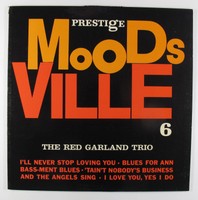
We get that again in the other, earlier session. The seasonal album was released right away, the other one held off until 1960, when Prestige launched its Moodsville label. And if Moodsville was meant to be piano trio-type background music (it wasn't) they might have asked Garland to do a little "Tea for Two" or "Autumn Leaves." And he does do a couple of ballads -- the lovely Ziggy Elman/Johnny Mercer "And the Angels Sing," and "I'll Never Stop Loving You," not one of my favorites, but mostly because of the dumb lyric, which does not get in Garland's way. However, he also does two originals, including "Bassment Blues," and if you thought "Bass Blues" was low, wait'll you get down to the
bassment. This one starts with a lengthy, show-stopping solo by Paul Chambers. He makes his stop in rhythm and bluesville with Bullmoose Jackson's "I Love You Yes I Do," and in down home traditional bluesville with "'Tain't Nobody's Business If I Do," a staple of Bessie Smith's repertoire.
The Moodsville Session was called simply Red Garland Trio. The seasonal smorgasbord is All Kinds of Weather, and it was produced by Esmond Edwards.
Oh, yes, and at this holiday season, if you google "Red Garland," you will be sent in a completely different direction. So red garlands to you all, and greetings of the season, even if a 45 degrees and sunny day in upstate New York is not exactly a winter wonderland..
Listening to Prestige Vol. 2, 1954-1956 is here! You can order your signed copy or copies through the link above.
Tad
Richards will strike a nerve with all of us who were privileged to have
lived thru the beginnings of bebop, and with those who have since
fallen under the spell of this American phenomenon…a one-of-a-kind
reference book, that will surely take its place in the history of this
music.
--Dave Grusin
An
important reference book of all the Prestige recordings during the time
period. Furthermore, Each song chosen is a brilliant representation of
the artist which leaves the listener free to explore further. The
stories behind the making of each track are incredibly informative and
give a glimpse deeper into the artists at work.
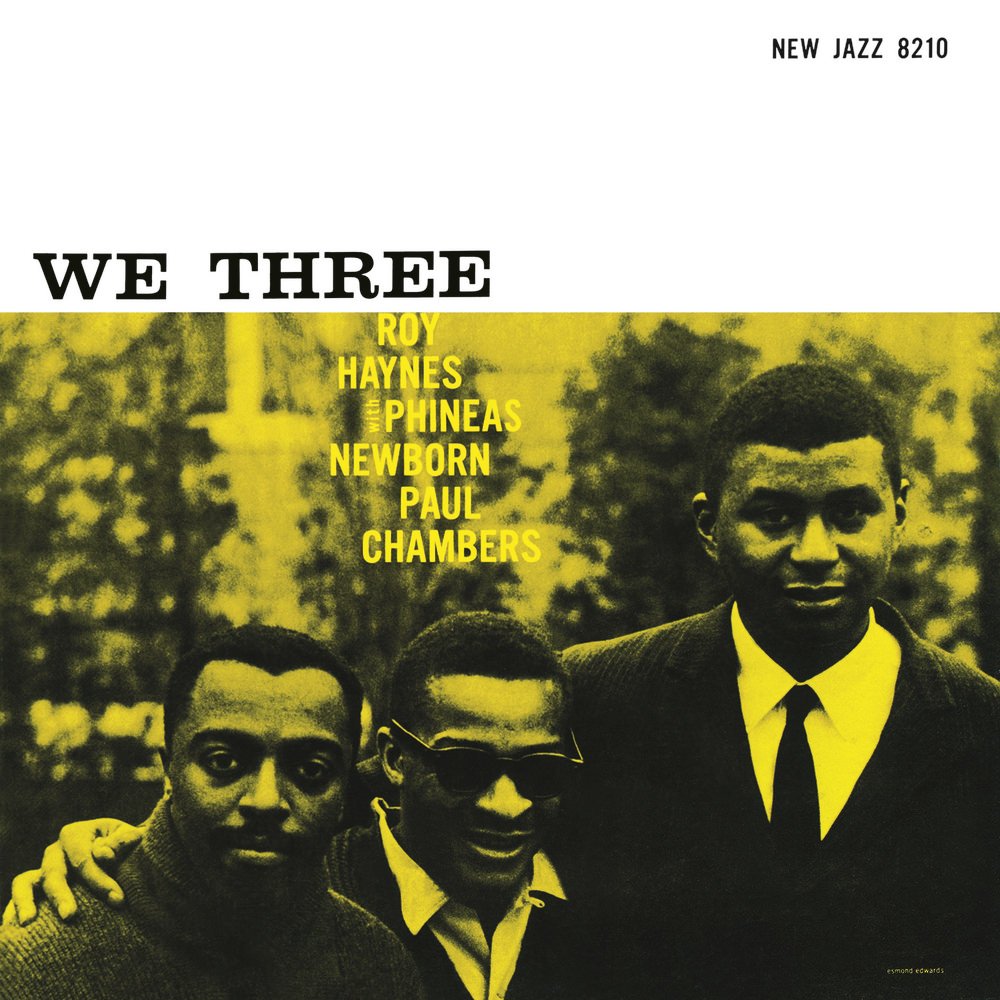
Paul Chambers practically lived in the Van Gelders' living room in Hackensack. Roy Haynes had done a few sessions for Prestige, most recently the Dorothy Ashby-Frank Wess session of September 19th. Phineas Newborn was making his Prestige debut. Together, they made an album put out under Haynes as leader, but the title, We Three, says it all. These are three players who mesh to make a perfectly attuned ensemble, working together seamlessly and supporting each other's solos.
And they weren't three guys who had worked a whole lot together. If they'd worked gigs, I can't say, but this is their first and only recording as a unit. Newborn would work a couple of other dates with Haynes, and a couple of others with Chambers, but no more than that. And don't forget that this is Prestige, so there's little if any rehearsal time.
There's so much to say about Roy Haynes, who is 92 as of this writing and still going strong. There's one lengthy interview with Christian McBride, which basically consists of McBride saying "Tell us about when you played with..." It goes through the history of jazz.
So let's look instead at Phineas Newborn, who is playing what I believe to be his only session for Prestige, and of whom Oscar Peterson once said, “If I had to choose the best all-around pianist of anyone who’s followed me chronologically, undoubtedly I would say Phineas Newborn Jr.”
He's Phineas Newborn Jr. because his father, Phineas Sr., was a drummer who led a family band that included young Phineas and his brother Calvin on guitar, and who had some very decent gigs in the south, including working as the studio band for Sam Philllips' Sun Records, in the early pre-Elvis days, where they backed up B. B. King on his first recordings. Calvin Newborn, who played on Phineas's first couple of records as a leader, for Atlantic and RCA Victor, has some very cool credentials, including teaching Howlin' Wolf how to play the guitar and Elvis Presley how to dance. He played with many of the major bands, then returned to Memphis, where he still gigs around the south.
Phineas Newborn creates another strong case to be made in the "rhythm and blues is jazz" argument. He recorded with B.B. King, toured with Jackie "Rocket 88" Brenston, and was a member of Willis "Gator Tail" Jackson's band. And on a different barrier-breaking front, after making his New York recording debut for Atlantic with brother Calvin, Oscar Pettiford and Kenny Clarke, he would make a record the following year for RCA Victor with a symphony orchestra.
As with Mal Waldron, his career would be interrupted by mental illness, and further by having several fingers broken in a mugging. He was able to make a substantial comeback before his death in 1989.
It's hard to choose a "Listen to One" for this session, but I'm going to go with "After Hours," which like all of them has sterling work by all three, but I particularly fell in love with "Blackout," covered not long before by Red Garland). "After Hours seems to have become particularly beloved by organists. In the early 1960s it was covered, in short order, by Jimmy McGriff, Richard "Groove" Holmes, Brother Jack McDuff and Earl Grant--and later by Fats Domino with Reggie Hall on organ.
Newborn's piano. "After Hours" was written by Avery Parrish, and remains his principal legacy; his career as a piano player was cut short by a paralyzing injury suffered in a bar fight (he also wrote
We Three was released on New Jazz. If you're looking for it on Spotify, you'll find it as Sneakin' Around by Paul Chambers.
Listening to Prestige Vol. 2, 1954-1956 is here! You can order your signed copy or copies through the link above.
Tad
Richards will strike a nerve with all of us who were privileged to have
lived thru the beginnings of bebop, and with those who have since
fallen under the spell of this American phenomenon…a one-of-a-kind
reference book, that will surely take its place in the history of this
music.
--Dave Grusin
An
important reference book of all the Prestige recordings during the time
period. Furthermore, Each song chosen is a brilliant representation of
the artist which leaves the listener free to explore further. The
stories behind the making of each track are incredibly informative and
give a glimpse deeper into the artists at work.
In 1955-56 Miles Davis had one foot out the door of the Prestige mansion, and he made his farewell by hurrying through three marathon sessions, playing familiar ballads, getting his contractual obligations out of the way. You certainly couldn't say he was just going through the motions, because this was Miles, and he always played for real, but he was in and out of each tune, then in and out of the studio. And he produced a series of unforgettable masterpieces.
In 1957 and 1958, John Coltrane crossed the threshold to the Van Gelders' living room some 20 times, recording as leader or sideman, and he produced a lot of very great music, not all of which is remembered quite as vividly as those Miles albums. Maybe this is because their release dates are stretched out over such a long period. Maybe it's because a lot of the sessions were sliced and diced and released here and there in various formats. Or maybe it's a function of age (mine). I was just looking at someone's album-by-album discography of Miles Davis on rateyourmusic.com, and he doesn't think anything that Miles recorded on Prestige was any good. But then, he doesn't think Birth of the Cool holds up particularly well, either, so I'll stick with my opinions.
But if Standard Coltrane or Bahia or The Stardust Session don't stick in your mind the way Workin' or Relaxin' do, the reasons are for sure not to do with musical satisfaction. These sessions, for me, come under the heading of discovery rather than revisiting old friends, and the discoveries are rewarding.
Jimmy Cobb is back to fill out the rhythm section along with Red Garland and Paul Chambers, and Coltrane has brought along Wilbur Harden on both trumpet and flugelhorn. Harden had come to New York from Detroit with Yusef Lateef, and he had quickly established a kinship with Coltrane. Before this July session for Prestige, he had recorded three sessions as leader of a quintet and sextet for Savoy, featuring Trane and, for the sextet sessions, Curtis Fuller. For his Savoy recordings, he stuck with the flugelhorn--he was one of the first musicians to introduce this European concert instrument into American jazz.
This is a lengthy session, if not quite as lengthy as the Contractual Marathon sessions, and like them, it leans heavily on standards, albeit an eclectic mix of standards. Four of them, in fact, found their way onto an LP entitled Standard Coltrane, released in 1962. They were:
"Spring is Here," a Rodgers and Hart ballad, originally written for a 1938 musical, and a favorite of vocalists. Frank Sinatra had just recorded it for his 1958 album Only the Lonely. Interestingly, all the instrumental jazz versions of it up to this point seem to have emanated from the West Coast, most notably versions by Stan Getz/Bob Brookmeyer and Shelly Manne. There's no aid-back West Coast feel to Coltrane's version, and I'm not sure the lonely would take much solace in it either. Trane isn't really doing the sheets of sound in this session, but he comes close here, and Paul Chambers adds his own sheet of sound with some incredibly fleet-fingered bass plucking. Here, as everywhere on this session, Harden is well-matched to Coltrane on the ensemble work. He was a good choice.
"I'll Get By" (melody by Fred E. Ahlert) goes back to the 1920s, but really reached public consciousness in 1944, with recordings by Harry James/Dick Haymes and the Ink Spots. It became a reliable standard for vocalists, but Coltrane was one of the few jazz instrumentalists to delve into it. Coleman Hawkins had recorded it earlier, which made it a serious tenor saxophone vehicle, and oddly enough, it was part of Sun Ra's repertoire. Coltrane treats the head as tenderly as if he were crooning it before he takes off into the stratosphere, and when he returns to it at the end, the tempo is more urgent, but the tenderness is still there. The urgency is well supplied by Jimmy Cobb. Jazz is about excitement, and a master drummer like Cobb never forgets that. Bebop took the beat away from the steady bass drum and gave it to the shimmering ride cymbal, and those who developed the bebop tradition could bring the beat from anywhere, and add so much more.
Henry Nemo wrote "Don't Take Your Love From Me" and the lyrics to Duke Ellington's "I Let a Song Go Out of My Heart," but he was chiefly known as a master of jive talk - perhaps the West Coast version of Harry "the Hipster" Gibson. Again, this was a tune that few jazz musicians had worked with--and again, one of the was Coleman Hawkins. But it drifted over into all sorts of genres, with recordings from country (Faron Young) to heavy metal (Ronnie James Dio).
"Invitation," by refugee German composer Bronislaw Kaper, who like several of his contemporaries fled Hitler and the European classical music scene to become a composer of Hollywood film scores, really did become a widely recorded jazz standard, as did Kaper's "On Green Dolphin Street." This isn't as obviously melodic as the other tunes, and Coltrane's solo work is thoughtful.
Those are the songs that made Standard Coltrane, and that's as good place as any to stop with the details. "Spring is Here" was also included on a compilation album called Miles Davis and John Coltrane Play Richard Rodgers.
Hoagy Carmichael's "Stardust" (great bowed bass solo by Chambers and, of course, great melody) and Richard Whiting's "My Ideal" are the best-known standards from the session. "Stardust" was the title tune on an album that included "Love thy Neighbor" (Mack Gordon, Harry Revel) and also featured music from Coltrane's final Prestige session, in December. It was released in 1963. "My Ideal," along with DaSylva, Brown and Henderson's "I'm a Dreamer, Aren't We All" were on the Bahia album (1965 release). "Stardust" and "Love Thy Neighbor" also came out on 45.
Listening to Prestige Vol. 2, 1954-1956 is here! You can order your signed copy or copies through the link above.
Tad Richards will strike a nerve with all of us who were privileged to have lived thru the beginnings of bebop, and with those who have since fallen under the spell of this American phenomenon…a one-of-a-kind reference book, that will surely take its place in the history of this music.
--Dave Grusin
An important reference book of all the Prestige recordings during the time period. Furthermore, Each song chosen is a brilliant representation of the artist which leaves the listener free to explore further. The stories behind the making of each track are incredibly informative and give a glimpse deeper into the artists at work.
Red Garland's music is intelligent, melodic, clever, passionate, daring, eclectic, and rooted in the blues. His long time partners Paul Chambers and Art Taylor, work in perfect sync with him and add their exquisite musicianship. And if that's not enough to make any session they set themselves to a worthwhile listening experience, how about adding Ray Barretto to the mix?
The mambo had passed its peak as a form of interest to modern jazzers, although it was still a seller on the pop charts, with Perez Prado's "Patricia" going to Number One in 1958. Garland always drew from a multiplicity of sources, and with this ensemble, what better choice than to blend the mambo with the blues? And Barretto, equally adept at rhythms from north and south of the border, was a natural for tune called "Blues in Mambo."
Except that it very nearly went unheard. This was something of a forgotten session. Nothing was released from it until 1963, and then only four tunes. The rest were to languish until 1977, when they were rediscovered and issued on a CD called Rediscovered Masters. And one, "I've Got You Under My Skin," is apparently still languishing unissued.
And the first four to see daylight were all recorded with just the trio, no Barretto. Some sort of contractual issue? It can't have been. Barretto was a regular with Prestige in this era. But be that as it may, such was the case.
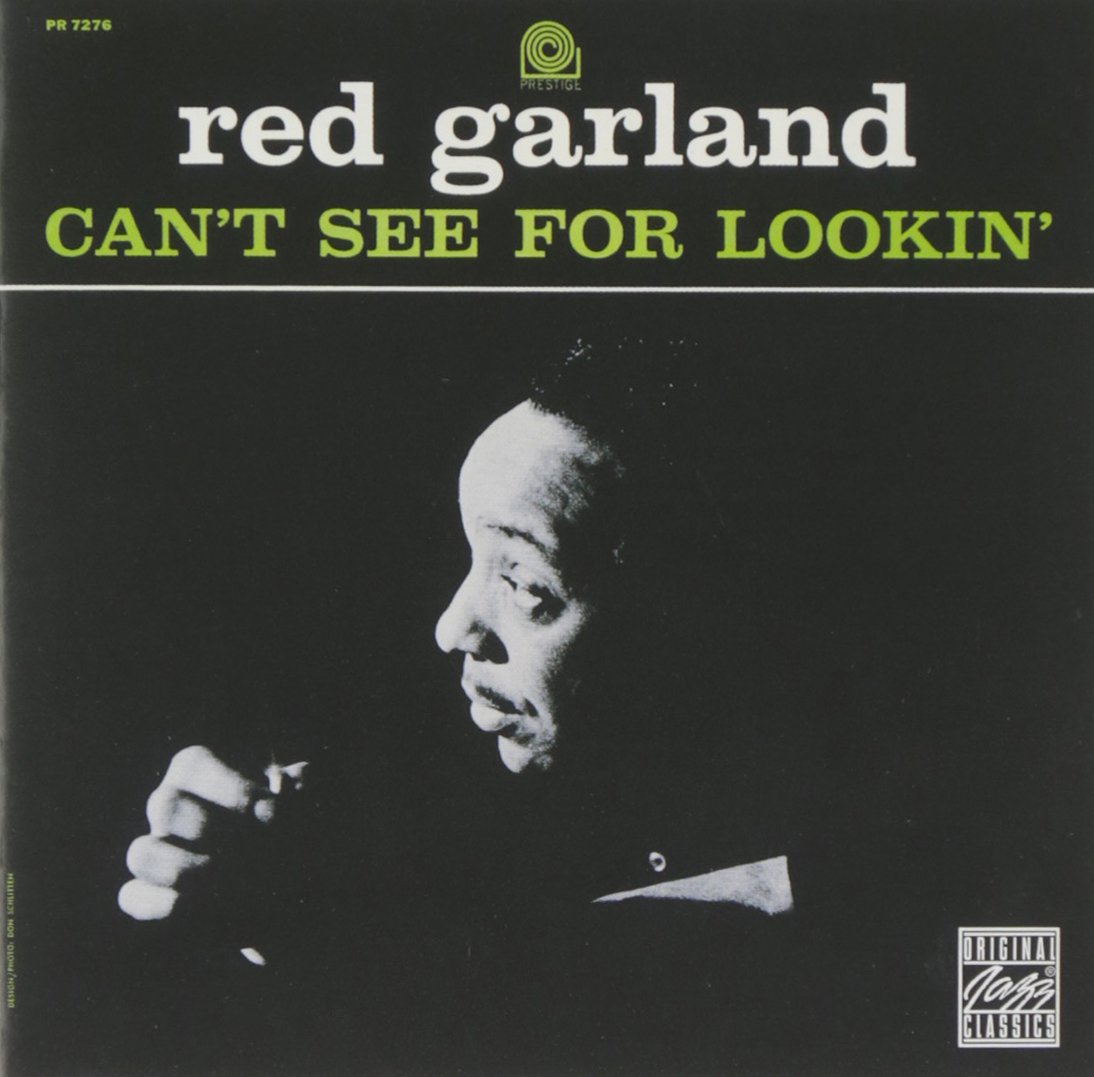
The four songs on the 1963 release demonstrate Garland's usual eclectic taste. "I Can't See For Lookin'" was co-written by Nat "King" Cole's first wife, and was one of Cole's early vocal recordings, much bluesier than his later style. "Soon" is the Gershwins. "Blackout" was written originally for Erskine Hawkins by two of his bandsmen, Avery Parrish and Sammy Lowe. Lowe went on to have a distinguished career as an arranger, with credits ranging from Benny Goodman to Nina Simone to Sam Cooke to the Platters, and perhaps most famously, to James Brown with the arrangement for "It's a Man's Man's World." Parrish had his career cut short by an injury suffered in a bar fight, and he drifted away from music.
Maybe jazz and rhythm and blues had gotten a divorce by 1958, but just as with some ex-marrieds who can't always resist the old chemistry, they could still get together for a little hanky panky. Alan Freed loved jazz, and hired jazz stars for his stage show band, including Ellington stalwart Al Sears, who continued to play his own brand of fiery tenor sax, whatever the ensemble was called. His composition, "Castle Rock," was first recorded with a group he co-led with Ellingtonian Johnny Hodges, and released under Hodges' name, although he would later re-record and release it under his own. Initially, Sears got Ellingtonian Leroy Lovett and crooner Ted Travers to write a lyric, which was performed but never recorded, and was apparently unsatisfactory, because a month later he turned to Erv Drake and Jimmy Shirl, best known for the lyrics to "I Believe," a song not exactly associated with either jazz or rhythm and blues. Frank Sinatra and Harry James recorded that version. Garland's is witty and inventive, and you could dance to it. Garland's piano carries most of the freight
in a ten-minute improvisation, but there's a Paul Chambers solo that's much admired by bass students.
Listening to a lot of Red Garland -- this 12-tune session, and the others that the prolific pianist recorded for Prestige during this period -- one really gets a chance to slow down and listen to the full extent of his talent. This would undoubtedly be true of listening to any jazz great, and I'm not just talking about the giants like Miles or Bird. But it's Garland I'm listening to right now, and marveling how a having a distinctive style doesn't mean repeating oneself or falling into a rut. In every one of these cuts, it's always Garland, but it's always a fresh and new experience, always surprises, always little unexpected thrills, always a cumulative satisfaction.
The quartet cuts with Barretto--you can't say they're better, because the trio cuts are as good as it gets--but they're superb in a different way, with a different ambience. There are standards and originals, even novelty numbers like "Five O'clock Whistle." And, as always with Garland, the unexpected, "Estrellita" is a lovely ballad written in 1912 by Manuel Ponce, a Mexican composer credited with rediscovering Mexican folk music as an inspiration for classically composed music.
Rediscovered Masters didn't come out till 1977, first as a double LP and then, with more cuts from later sessions, as a 2-CD set. It was a cause for rejoicing then,
Listening to Prestige Vol. 2, 1954-1956 is here! You can order your signed copy or copies through the link above.
Tad Richards will strike a nerve with all of us who were privileged to have lived thru the beginnings of bebop, and with those who have since fallen under the spell of this American phenomenon…a one-of-a-kind reference book, that will surely take its place in the history of this music.
--Dave Grusin
An important reference book of all the Prestige recordings during the time period. Furthermore, Each song chosen is a brilliant representation of the artist which leaves the listener free to explore further. The stories behind the making of each track are incredibly informative and give a glimpse deeper into the artists at work.
Coltrane and Donald Byrd are a great combination, back together again after a January session, so Bob Weinstock must have really liked what he heard, and what's not to like? But it's Coltrane who really holds the interest right now. The "happy young man," in Ira Gitler's words, was on a creative tear. Just five months into the year, he was already on his sixth studio session for Prestige, and that was only part of it. He had done two dates with a group led by Wilbur Harden for Savoy, and don't forget, he still had his bread and butter gig, with Miles Davis. By May 23rd, he had recorded two studio sessions and two live sessions with Miles. And when he went out to Rudy's for his Friday Prestige date on May 23rd, he had another recording scheduled with Miles for the following Monday, in New York, at Columbia's 30th Street studio.
Turning your life around, getting off drugs, gives you energy to burn, and Coltrane was burning it. But it wasn't just energy. He was burning with musical ideas, too, which is what makes this period so exciting.
The music was exciting. What Gitler called "sheets of sound," a phrase that's become firmly implanted in the jazz lexicon. It meant Coltrane playing every note associated with every variation on a given chord, more or less at the same time. Or something. It was sort of like the rapid-fire runs through variations on chord changes that the beboppers had pioneered, except that it wasn't. But it had that same questing urgency, that sense of listening for something new, just beyond the horizon. Listening to it now in the chronological order of the music being made (this session was not released until 1964), one can really feel a part of that quest.
"Black Pearls" is a Coltrane original, "Lover Come Back" is the Sigmund Romberg melody that's
become such a favorite of jazz modernists. "Sweet Sapphire Blues" is credited to Bob Weinstock as composer, and that might raise eyebrows, since it was such common practice in those days for DJs or record company executives to put their name on songs they had not in fact written. This one was a little different. They had gone through the first two tunes, and they still had studio time, and they did not yet have enough to fill out an album. This could have been OK--Weinstock wasn't planning to release the session right away anyway, and he could always have found other ways to fill it out. Or they could have done what they so often did: what Rudy Van Gelder called the "Five O'clock Blues," an impromptu improvisation on a familiar blues riff, or a half-finished idea by one of the musicians. In this case, when Weinstock asked Trane for one more tune, Trane responded, "Why don't you write one?" As Weinstock recalled, he recoiled from the idea--one thing he was sure of, he didn't know how to write a song. But Trane kept teasing him: "How about this?" and he'd play a few notes. If Weinstock said OK, he'd play a few more: "How about this?" Before long, they had strung something together, and Trane said, "OK, you wrote it."
The result is a little like the routine Steve Allen used to do on TV. He'd call up four people from the audience, have each of them strike a note on the piano, and then do a jazz improvisation based on those four notes. A little like that, except better. The melody is jagged but interesting, and five supremely gifted musicians were able to improvise on it for 18 minutes, or one full album side.
Why "Sweet Sapphire Blues"? That's lost to history, unless they'd been watching Amos 'n Andy before the session. In any case, it wasn't likely to be the title of the album, nor was the Romberg melody. So Black Pearls it was. It was also released as a two-sided 45.
Listening to Prestige Vol. 2, 1954-1956 is here! You can order your signed copy or copies through the link above.
Tad Richards will strike a nerve with all of us who were privileged to have lived thru the beginnings of bebop, and with those who have since fallen under the spell of this American phenomenon…a one-of-a-kind reference book, that will surely take its place in the history of this music.
--Dave Grusin
An important reference book of all the Prestige recordings during the time period. Furthermore, Each song chosen is a brilliant representation of the artist which leaves the listener free to explore further. The stories behind the making of each track are incredibly informative and give a glimpse deeper into the artists at work.

:format(jpeg):mode_rgb():quality(90)/discogs-images/R-7037433-1432237531-7430.jpeg.jpg)
 The most interesting work on the session is turned in by Chambers and Oliver Jackson, who seem to have come prepared to have a good time. Chambers does some of his signature virtuoso solos, including a very strange and haunting bowed bass at the end of "In a Funky Groove," but he also does some unusual stuff, particularly on "Da Du Dah," and Jackson just doesn't hold anything back.


:format(jpeg):mode_rgb():quality(90)/discogs-images/R-5689621-1436087387-2035.jpeg.jpg)


:format(jpeg):mode_rgb():quality(90)/discogs-images/R-3328193-1477857492-8455.jpeg.jpg)




:format(jpeg):mode_rgb():quality(90)/discogs-images/R-9297495-1478168135-6908.jpeg.jpg)
:format(jpeg):mode_rgb():quality(40)/discogs-images/R-2115840-1401407712-6171.jpeg.jpg)


:format(jpeg):mode_rgb():quality(90)/discogs-images/R-1324250-1457055496-1590.jpeg.jpg)
:format(jpeg):mode_rgb():quality(90)/discogs-images/R-6766535-1426183977-4881.jpeg.jpg)