Showing posts with label Chuck Wayne. Show all posts

Monday, October 23, 2023

Listening to Prestige 706


LISTEN TO ONE:My Baby Just Cares for Me

 For someone so highly respected as a jazz guitar innovator, with a career that spanned four decades, Chuck Wayne has a very small catalog as a leader: two albums in the 1950s, this one for Prestige in the 1960s, one each in the 1970s and '80s.

Wayne was  one of the first to apply the theories of bebop to the guitar, and his innovative techniques led him to be recognized as one of the most important technical innovators on the instrument. For the average layman (me), you may not be able to elucidate what sets his playing apart, but you're left with the feeling that yeah, that sure is different--but it sounds so natural, like it's the way everyone should be playing,


LISTEN TO ANOTHER: Sonny

Wayne's long-term credits include an early stint with Woody Herman (the First Herd) and many years as Tony Bennett's musical director and accompanist. That he could play all those years with Bennett is some indication of how listenable he could be; that Bennett would choose someone as original and innovative as Wayne to be his accompanist says a lot about the singer's chops. A YouTube search for "Chuck Wayne-Tony Bennett" brings up a version of "My Baby Just Cares For Me," which is a superb showcase for both men.

One of his his most famous compositions, and one of the great jazz standards, is his 1946 work, "Sonny." What's that? You've never heard of a jazz standard called "Sonny"? Well, perhaps you've heard it under another name, and credited to a different composer: "Solar," by Miles Davis. By now, it is generally acknowledged that Miles's "Solar" is Wayne's "Sonny." 


ONE MORE TIME: Someone to Watch Over Me

What else to say about the man? His technique and his technical innovation remain so important to this day, that a YouTube search on his name will lead you to a number of transcriptions of his solos on well-known standards.

And what about his session for Prestige? What can I say about it except that it's a wonderful album, in that genre that's sometimes called "mainstream" or "straight ahead" jazz, but might best be called "timeless jazz," music that comes not out of any school or any era, but out of a quest for beauty, for an edge, for virtuosity, that comes from a love of playing and a mastery of the instrument and the form. 


AND ONE MORE ONCE: See Saw

He takes on an eclectic mix of composers from Gershwin to Gordon Jenkins, and includes three of his own tunes. As a composer, he's best known for the tune he's officially not known at all for, "Solar," but contributions to this session, "See Saw," "I'll Get Along," and "Shalimar," show that he could write music worth listening to.

Perhaps the biggest surprise of the session comes when Wayne exchanges his guitar for a banjo on Steven Sondheim's "Lovely," bringing a flexibility to that instrument that would be explored by genre-bending virtuosos like Billy Faier, George Stavis and Bela Fleck.


Wayne is joined by bassist Joe Williams--not the singer, and I could find nothing else about him except that he sounds good here. The drummer is Ronnie Bedford, who recorded sparingly but always in good company, and spent much of his life in Powell, Wyoming, where he was a professor at Northwest College, and was a recipient of the Wyoming Governor's Award for the Arts.

The session was produced by Cal Lampley, new to Prestige, but an esteemed figure in American music since his graduation from Juilliard in 1949, a time when enrollment by an African American in that prestigious institution was still a rarity, and his Carnegie Hall debut as a concert pianist in 1953. At Columbia, he had produced the Miles Davis/Gil Evans Porgy and Bess sessions. He had worked with Leonard Bernstein, Mahalia Jackson, Dave Brubeck and Victor Borge.


He came to Prestige in 1964, replacing Ozzie Cadena, whoi had left to form his own label. As Prestige producer Bob Porter, who came to the label shortly after Lampley, recalled it, "Weinstock wanted someone with a greater pop sensibility—Don Schlitten would handle the hardcore jazz." Which seems odd, given Lampley's classical background experience working across a broad range of genres. Lampley would work with a broad range of talents during his Prestige years, but he did apparently have something of a pop sensibility--he would produce the label's only charted pop hit--Richard "Groove" Holmes's version of "Misty."


The album was released as Morning Mist. It would be Wayne's only Prestige session, although a 1952 recording he made with George Wallington (on mandola) would be released, along with other early Wallington recordings, on the Prestige Historical Series in 1968, an early forerunner of the the reissue label that Prestige was to become in the 1970s.

Side note -- it's hard to believe this is a Prestige album cover.


9

Sunday, January 04, 2015

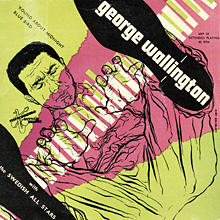
Listening to Prestige Records Part 65: George Wallington

How hard is it to be a jazz musician? George Wallington was one of the original beboppers, one of the most respected and sought-after bebop piano players, and in 1960, worn down by the grind and the constant scuffling for money, he quit to go into the family's air conditioning business. And he was lucky to have a family business to go into. Who knows how many other great musicians of this era would have made the same choice, had they been able to? Who knows for how many heroin was an alternative to the family air conditioning business?

Wallington was retired from music for a quarter century, finally returning in 1984 to record three albums before he died in 1993.

In 1952, Wallington was 28 years old and a veteran of the jazz world. He had been a part of the first band that Dizzy Gillespie brought to 52nd Street, in 1944. And even then, at 19, he was a seasoned veteran. He had grown up in an Italian immigrant family (his birth name was Giacinto Figlia - "Wallington" was a schoolyard nickname because he dressed like a British swell). His father had introduced him to opera, and gotten him started on piano and solfeggia (sight singing); Lester Young (heard on the radio with Count Basie's band) inspired him to turn to jazz. By 16 he was playing in clubs in New York, including a spot called George's, where he accompanied Billie Holiday.

About that first bebop gig with Dizzy, at the Onyx Club, Wallington said:

Dizzy used to take me to his house and we'd play and he showed me his songs. Then he and Oscar Pettiford started the band at the Onyx. Charlie Parker was supposed to join us but he couldn't get a cabaret card. Anyway we had Don Byas, then Lester Young. Billie Holiday used to sing with us sometimes and Sarah Vaughan used to come in too.
I don't know if we thought of what we were doing at the Onyx as something historic, but we did know we were doing something new and that no one else could play it.
OK, this is why, when anyone asks me "If you could go back in time to another era, what would it be?" my answer is always the same. New York, 1940s. 52nd Street, Minton's, Monroe's.


Max Roach said of Wallington'a role in that first band at the Onyx that his great virtue was knowing how to stay out of the way.
We didn't need a piano player [like Bud Powell] to show us the way to go. Piano players up to that point played leading chords. We didn't do that because we were always evolving our own solo directions. We needed a piano player to stay outta the way. The one that stayed outta the way best was the best for us. That's why George Wallington fitted in so well with us, because he stayed outta the way, and when he played a solo, he'd fill it up; sounded just like Bud.
Leading his own group, Wallington didn't need to stay outta the way, and Roach was still propelling him on, and the sidemen on these two sessions give some idea of how much respect Wallington had garnered by this time -- even from Oscar Pettiford, whom Roach remembers as not being entirely won over by Wallington when the Onyx Club gig came together:

 Every now and then, George would miss a chord, and Oscar would jump all over him, "White muthafucka can't play -- shit!" I had to spend a lot of time protecting him from Oscar.
 "Sounded just like Bud" is something you hear a lot in discussions of George Wallington. They were two of the most important pianists in the development of bebop -- and, Wallington's ability to stay outta the way notwithstanding, two of the most accomplished and daring virtuosi. But there's a lot of difference, too. Wallington's early classical training shines through, and you can hear the sorts of romantic flourishes you'd associate with a Vladimir Horowitz. But when Wallington takes on an unabashedly romantic tune like "Laura" or "Tenderly," those same flourishes become dry, ironic, brilliantly anti-romantic.

Speaking of romanticism and "Tenderly," here's a story told to me by the great pop singer Margaret Whiting, who was a close friend when I lived in New York in the 70s. She and songwriter Walter Gross had been an item, but she'd had to break it off because of his drinking. But then one night he showed up at her house about two int he morning, drunkenly banging on her door and demanding to be let in. She had no choice - she opened the door before he could wake the whole neighborhood.

He confronted her: "You fucking bitch...you ruined my life, you fucking cunt. So I came by to tell you just what I thought of you, you fucking bitch." He staggered over to the piano. "I wrote this to show you what I think of you, you fucking bitch." And he played "Tenderly."

Margaret was a romantic, but also a realist. She got some coffee into him, and immediately called...who but a lyricist? Jack Lawrence came over, and they finished the song.

On the first of these sessions, Chuck Wayne joins the group on mandola, which is an unusual instrument -- slightly larger than a mandolin, it bears the same relation to a mandolin that the viola has to the violin. It's also an unusual instrument for a bebop ensemble in that it uses the same tuning as the tenor banjo, an instrument associated with the early Dixieland bands.

But Wayne was an unusual jazz guitarist -- for one thing, he may well have been the only jazz guitarist ever to play the banjo on bebop recordings.. Like Wallington, he was the son of immigrant parents (Czech, in his case -- he was born Charles Jagelka), and his musical start was playing the mandolin in a balalaika band.

He had switched to jazz, and to the guitar, by the time he met George Wallington. They were both playing in a Dixieland group led by Joe Marsala, and Wallington introduced him to bebop. They're a good pairing on these quartet sessions.

And tossing this in -- Wallington composed "Godchild," one of the tunes on Birth of the Cool.

The trio and quartet sessions were all released on 78, and all on the same 10-inch LP (as George Wallington Trio).