Showing posts with label Teacho Wiltshire. Show all posts

Monday, January 12, 2015

Listening to Prestige Records Part 70: Forgotten Rhythm and Blues

Bob Weinstock may not have been all that deeply invested in rhythm and blues, but to the extent that he was, he didn't have the track record of betting winners the way he did in jazz. Maybe he didn't have the song plugger necessary to get a record out to black radio. But I suspect that he had pretty damn good taste. And to some extent this is speculation, because a lot of these R&B recordings deserved better than they got.

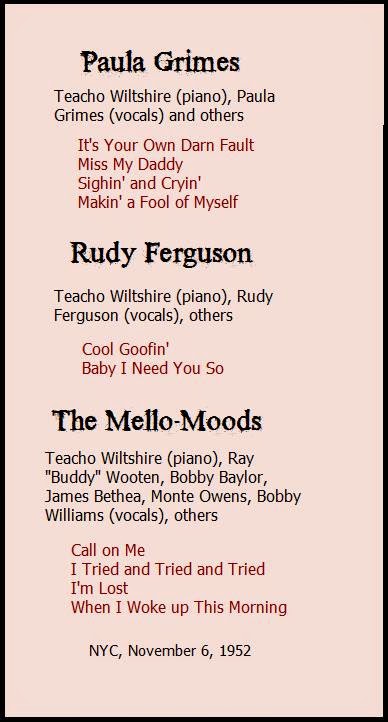
On November 6, he had Teacho Wiltshire (with unidentified musicians) in the studio with two singers -- one male, one female -- and a vocal group. The woman was Paula Grimes. She recorded four songs, and I can find none of them anywhere, but there is one 45 RPM record by her on YouTube -- You Move Me So / It's Happenin' Baby on Turf Records. It is great stuff -- Paula Grimes deserves to be much better known than she is. In the comments section for one of the YouTube cuts, someone pleads to have the Prestige sides posted, but the comment is four years old, so I guess that's not happening any time soon. I tried to find out more about the label, but when I Google "Turf Records" I get links to Secretariat and Seabiscuit.

Rudy Ferguson cut four songs, and only two of them were released -- Cool Goofin' / Baby, I Need You So. The titles of the other two may give some hint as to why they weren't released: Goofin' and Jivin' and Goofin' in a Goofball Way. Followups to Cool Goofin' if it became a hit, but it didn't.

It had some competition. In the week of its release, February 14, 1953, Billboard has it listed as number 5 in their pick rhythm and blues selections, behind records by Roy Brown, Amos Milburn, Fats Domino and Nat "King" Cole.

And it is on YouTube. And it's a really nice song...I like it a lot. It's in the jump blues/swing tradition that Lionel Hampton and Louis Jordan developed, and that Count Basie and Joe Williams were to bring to perfection. It has some of the King Pleasure/Eddie Jefferson feel to it, except that it's not following a jazz soloist -- except for one place in the middle, where he interpolates "There I go there I go there I go..."


The third act to be stuck in front of Teacho that day was a group of young teenagers singing the sort of music that had begun to be popularized by groups like Sonny Til and the Orioles, and would much, much later come to be known as doo-wop. I'm going to spend a little time on the Mello-Moods, because I love this kind of music, and because their story has an unexpected jazz connection.

A few years after the Mello-Moods, Frankie Lymon and the Teenagers would take the pop music world by storm, and they would dress in high school letter sweaters and sing about teenage love and not being a juvenile delinquent, but the Mello-Moods, led by Ray "Buddy" Wooten, were competing with the Orioles, the Cardinals, the Clovers -- the early harmony groups that were taking African-American harmony away from the smooth pop sound of the Ink Spots and the Mills Brothers, and more in the direction of rhythm and blues. The Mello-Moods had had a regional hit for Robin Records, one of the very few black-owned record labels, started by Harlem record store owner Bobby Robinson.

Doowop chronicler Marv Goldberg has a nice story about their early days:
They entered the Apollo amateur show. They were in the basement practicing, and a little guy came over to listen to them. After hearing them, he said that they were so good he wouldn't even bother to appear on the same show with them. However, he somehow got over his nervousness and went on to "tear the stage up" and win first prize that night. His name? Otis Blackwell. The Mello-Moods had to settle for second place.
They had a hit record for Bobby Robinson, one of their songs, How Could You, reaching the Rhythm and Blues top ten.

But, they were young. And they lived in a world that didn't worship youth. Marv Goldberg again:

With a hit record to their credit, you'd think that the Mello-Moods would have been swamped with personal appearances. However, remember that they were young and their parents watched them like hawks. School was the most important thing, and anything that stood in its way was to be squashed. Also, they couldn't appear at any place that sold alcohol. As James says, "Our parents wouldn't let us out of their sight. They fought tooth and nail with [manager] Joel Turnero and Bobby Robinson."
Good for the parents. Education matters. And very few of the doowoppers were able to make lifelong careers in music.

In the fall of 1952, they left Robinson and signed with Prestige, making this first recording with Teacho Wiltshire's band. There's a YouTube underground of doowop fanatics, so you can hear all of these songs there -- and also the one song that they did in a second session on December 12, which was never released -- a version of Mel Torme's The Christmas Song, can be found on YouTube.


Again, this shows a certain measure of disappointment. You don't have a group record a Christmas song unless you're expecting them to have a certain measure of popularity, and you don't not release it unless that popularity hasn't happened.

Or it could be that the recording was too late for Christmas 1952, and by Christmas 1953, the group had pretty much broken up. Marv Goldberg again:

 Says James [Bethea], "We had the feeling that Joel [Turnero] was trying to hold us back...None of us were happy with the music we were singing; we wanted real R&B. We enjoyed our singing, but there was a personality conflict. We were doing his tunes and we wanted to do other stuff. He was trying to make a Mills Brothers act out of us. Joel wouldn't release us. We realized that the group was going to break up; we had to stop singing in order to break the contract with Joel."

Also, the Christmas Song cut is not exactly a Mello-Moods song. They're on it, but basically they're just singing background vocals for an extended solo by sax player and session leader Charlie Ferguson (Rudy's brother? No information here).

We'll get to the December 12 Prestige session shortly, but one last mention of the Mello-Moods' role in it. Sadly, not even the doo-wop freaks of YouTube have been able to find these. They sang backup on early takes -- not the ones that were ultimately used -- of King Pleasure's "Red Top" and "Jumpin' With Symphony Sid."

Tuesday, January 06, 2015

Listening to Prestige Records Part 66: Annie Ross

There's so much to say about this session that I scarcely know where to start.
I decided to undertake this blog project -- well, on a whim, mostly, but because Prestige Records played such an important role in my learning about. and coming to appreciate, jazz. So many of the first records upon which I built my jazz collection were from Prestige. So I first thought that this would be a way to revisit some of my favorite sounds.
It's turned out to be three different experiences:
  • Revisiting sounds I've loved.
  • Discovering sounds I've never heard.
  • Discovering artists I've never heard of, or barely heard of.
In the third category, Joe Holiday and Chubby Jackson, for sure. George Wallington, up till now only a name I vaguely knew as a sideman. Charlie Mariano.

In the second category, so much. Early Stan Getz. Tristano recordings I hadn't heard. Miles Davis and Lee Konitz. Gene Ammons and Sonny Stitt. Mulligan before he decamped for the Left Coast. Zoot Sims (there's a Zoot session for Prestige on September 8 with George Wallington on piano. Also Al Cohn, Kai Winding, Percy Heath, Art Blakey. Spotify doesn't have it, and neither does YouTube, so I couldn't write about it, more's the pity).

In the first category -- I've talked before (and even earlier) about how important the King Pleasure/Annie Ross album was to me when I first started listening to jazz.

So let's talk about this session, starting with the incredibly fortuitous chance meeting between Annie Ross and Bob Weinstock.

Annie was a show business kid, and an early talent. She played Judy Garland's sister in a movie, and age 14, she won a songwriting contest judged by Dinah Shore and Johnny Mercer, and her winning entry, "Let's Fly," was recorded by Mercer and the Pied Pipers. You can find it on YouTube, and it's a pretty darn good song by any standards -- incredible, for a 14-year-old.

She has said in a recent Downbeat interview that what she looks for in a song is "good lyrics. I can’t sing stupid words." And even at 14, she was starting to find a way with lyrics.

Let's fly away to lands strange and unknown
Where love's free and there's no such thing as a mailman, doorbell, telephone

So...Bob Weinstock had his runaway jukebox hit with "Moody's Mood," and he was looking for something similar. In the same Downbeat interview, she describes it:

I was introduced to Bob Weinstock, head of Prestige Records. He asked me if I’d ever heard of King Pleasure. And he asked if I could do the same thing he was doing: write lyrics for solos. I was desperate, so I said, “Sure.” If he’d asked me if I could learn how to fly, I would have said “Sure.” He gave me some records and said, “Pick a tune and come back when you’re ready.” I was there the next morning with the lyrics to “Twisted.”
The thing about this session is -- every decision made, all along the line, was perfect, starting with Weinstock's decision to ask Ross if she could do it. Because this was brand new -- nobody had done it except Eddie Jefferson, and King Pleasure recording Jefferson's lyric. There was no way of knowing who could do it well and who couldn't -- or even what doing it well meant.

Then there was the decision of what records to give Ross to listen to. Obviously, he gave her a stack of Prestige 78s, because who wouldn't?  If I were a record label owner/producer, and I were becoming a midwife at the birth of a new jazz form, I'd be damn sure it was happening with artists and records from my label. I'm guessing he gave her some Gene Ammons and Sonny Stitt -- and King Pleasure was later to make a classic version of Ammons's recording of the Lionel Hampton tune, "Red Top." And he gave her the Wardell Gray/Art Farmer session.

And she picked it out -- another exactly right decision. "Twisted" is a great composition, a great solo by Wardell Gray, and a title that suggested...well, as Ross put it, "the title was infinite possibilities. You could marry anything to it." And she was in analysis at the time.

I'm guessing that one listen to Annie's version of "Twisted" and Weinstock set up a recording session as fast as he could -- giving her time to write one more song, again choosing from the same session, this time Art Farmer's "Farmer's Market."

What else for the session? An Annie Ross composition, "The Time Was Right," and a wordless scat ballad, "Annie's Lament" -- improvised by Annie right in the studio? Could be. I couldn't find any information on it.

Anyway, let's get to the session itself, and some more exactly right decisions. "Twisted" and "Farmer's Market" are recorded with a group led by Teacho Wiltshire, and that turns out to have been the right decision. "Twisted" has become such an iconic song, covered by singers from Bette Midler to Joni Mitchell to Amy Winehouse, that the song, the lyric, and Annie's vocal are indelibly stamped on our memories. But listen to the whole thing. Listen to the rhythm-and-bluesy riff from Teacho that opens the track, kicked and twisted by an amazing drum pattern from Blakey. Then Teacho wisely stays outta the way. Listen to how Blakey answers Annie's rhythmic swirls and tricks all the way through. And don't forget that Weinstock didn't rehearse his sessions, and didn't do a lot of takes. And don't forget that Ross wrote these lyrics to Wardell Gray's solo, but she's singing it as a jazz musician. She's making it her solo.

The same can be said of Percy Heath  -- and there is a bass solo here, right near the end, a powerful one. I'm assuming what we're hearing on Spotify is from the album, so it may have been remastered by Rudy Van Gelder to bring out the bass more vividly, but to be honest, I don't know how much you can remaster a monaural session with one mike. Anyway, you can hear the bass, and it's Percy Heath, and 'nuff said.

And who thought of adding Roger "Ram" Ramirez to this session? Ramirez was mostly a piano player who had just recently taken up organ. He had worked with female vocalists in the past, notably Helen Humes and Ella Fitzgerald, as a pianist. Again, a dead perfect decision. Listen to what Ramirez does at the beginning, at the end, and adding emphasis and coloration all the way through.

Listen to the incredibly fast part in the middle, between the fifth of vodka part and the double decker bus part. Listen to what Annie does, and what the rhythm section does. Hell, just put the song on
repeat and listen to it straight through about four or five times. It won't stop rewarding you.

I could say all the same things about "Farmer's Market." Wonderful stuff from Ram Ramirez. Teacho getting more space here, and doing it proud. How about listening to Annie's fast-paced rhymes, which would many hip-hop wordsmith sit up and take notice? And a nice shout-out to the guy who mentored Art Farmer, and pulled everything together on the "Farmer's Market" session, when the crew-cut kid with the crazy goatee goes out on tour with Wardell Gray.

OK, then what? We have these two tunes by Annie - not the same thing as this new sound that doesn't have a name yet but pretty soon everyone will be calling vocalese. Not the same thing at all. Maybe a rhythm and blues bandleader isn't quite the right guy for the job.

Hey, I know! We'll call George Wallington. He's been doing everything for us this summer, and he's still in town.

I like to think that's how it happened. A quick call to George, and he shows up just in time to take over on piano. In any event, another exactly right decision. Wallington doesn't get outta the way here, and he and Annie complement and inspire each other.

Why isn't "The Time is Right" one of the great pop music standards? I don't know of anyone else who's recorded it. Annie Ross wrote it, and brought it to the session with her. It is a beautiful song, worthy to be put alongside Johnny Mercer or anyone else you can name.

Was "Annie's Lament" written, or improvised in the studio? It's wordless, it's haunting, it's beautiful, and again it's Annie Ross and George Wallington.

Annie must have learned something from Bob Weinstock, because here she is, more than half a century later (same Downbeat interview), talking about her most recent album, a tribute to Billie Holiday, cut with Bucky and John Pizzarelli:

 How much pre-production did you do?

None! [laughs] They’re real musicians. I made a list of songs, we looked ’em over and then we recorded ’em. With real musicians, you don’t need to rehearse. That’s where the creativity comes in. We did one or two takes, no more than that. The level of trust between musicians and singer has got to be implicit, and it was with John and Bucky. The arrangements were done as we felt them, in the moment. It was pure joy; you know when you’ve got something good. 

Annie owed her first break in New York, in a way, to Billie Holiday:

I’d been working in France with James Moody and Kenny Clarke and I’d just come back to America. The morning after I signed with Joe Glaser—who was Billie Holiday’s agent—I got a call to get up to the Apollo. Joe asked me, “Do you have a piano player? Do you have a gown? Do you have music?” I said yes to all three and he told me to get up to the Apollo by 8:30. “You’re replacing Billie Holiday.” I was 20 or 21. It was my baptism by fire. She later became a good friend.

20 or 21 would make it 1950 or '51, a year or two before meeting Bob Weinstock and writing "Twisted" in one night.

"Annie's Lament" / "Twisted" came out on 78; "Farmer's Market" / "The Time Was Right" on both 78 and 45. All four songs were collected on a 45 RPM EP. And, of course, the 1957 release of the King Pleasure/Annie Ross LP.  The records won her DownBeat's New Star award for 1952.


Friday, December 19, 2014

Listening to Prestige Records Part 61: King Pleasure


Early in 1952, Bob Weinstock seems to have been stirring the pot a little, not entirely sure of what he was looking for. He recorded some of his old favorites, like Wardell Gray and Sonny Stitt. He did another Swedish session.

He tried some more blues and gospel. On January 3, he had Brownie McGhee back in the studio to record two songs, solo this time. "Heart in Sorrow" and "Operator Long Distance" became standards of McGhee's repertoire, and I'm not sure I can locate these particular versions, although they were released on Par Presentation. On January 23, he recorded 12 songs by two different gospel groups, and never released any of them.

So one has to wonder if he walked into his scheduled February 19 recording sessions with more of a desultory "What the hell, let's try this" approach. He hadn't recorded a lot of vocals. Looking back, I see The Cabineers, who weren't a huge success. Then nothing until the H-Bomb Ferguson/Ralph Willis/Brownie McGhee sessions of late 1951, and folk blues/rhythm and blues was not a direction he was much focused on.

So he put together a band of hard working studio musicians under hard working Teacho Wiltshire -- Leonard Gaskin and Cecil Payne the only ones to establish names for themselves in the jazz world -- and scheduled them to back up a couple of singers, doing two songs each.

One was Bobby Harris, about whom I can find nothing. There's a 1965 Atlantic Recording by a Bobby Harris on YouTube, but who knows if it's the same one? It's a common name. "Rub a ittle Boogie" is included on a compilation album called New York Blues 1945-1956, but a review in a blues magazine which goes into detail on all the other performers in the compilation, says nothing about Bobby Harris.

The other was King Pleasure.

And I wonder if Weinstock knew what he had, when he played back this one.

First off, it is one my favorite records of all time. The King Pleasure/Annie Ross LP was one of the first jazz records I ever bought, and I've never gotten tired of it.

Second, if he was looking for a jukebox hit, this was it. He'd had some chart success in 1951, with Gene Ammons's "Jug" making the rhythm and blues charts, but "Moody's Mood"was huge, making it to #2 on the R&B charts.

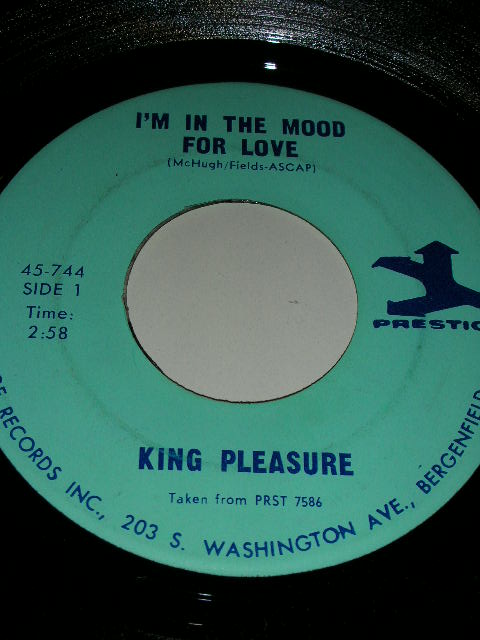
It remains one of the great jazz vocal recordings, and one of the most curiously underappreciated. Much of what's written about it tends to harp on the fact that King Pleasure didn't actually write it, although no one harps on the fact that Louis Armstrong didn't write "Sweethearts on Parade," and Frank Sinatra didn't write "I Could Write a Book." The melody is, of course, James Moody's improvised solo to "I'm In the Mood for Love," recorded in Sweden in 1949 -- actually Moody's solo and the brief solo by Swedish pianist Gosta Theselius, sung by Blossom Dearie in the 1952 recording -- and the lyrics were written to Moody's solo by Eddie Jefferson. Pleasure heard Eddie Jefferson sing it in a club, and asked if he could sing it as well. Then when Bob Weinstock signed up a couple of unknown singers for a quickie recording date with Teacho Wiltshire's band, this was one of the songs Pleasure brought with him. He must have also brought Blossom Dearie with him -- she was relatively new in New York, and had been working as a backup singer for Alvino Rey and Woody Herman.

Later in 1952, Dearie would move to Paris, where she would make her reputation. In her official bio -- another underappreciation, or perhaps it's just because she isn't credited on the record -- this recording is not mentioned.

And finally, this back of the hand from reviewer Alan Kurtz on the jazz.com website, "Singing with more gusto than skill, Pleasure put vocalese on the map and then, as online biographer Alex Henderson writes, '"faded into great obscurity.'" Kurtz has never heard "Parker's Mood"? "Don't Get Scared"? "Jumpin' with Symphony Sid"?

Eddie Jefferson created vocalese, and Pleasure, as Kurtz grudgingly admits, put it on the map. I think calling this form "vocalese" ultimately gave it a bad rap, because it came to have a reputation as a gimmick, when it was attempted by people who weren't as good as Eddie Jefferson, or King Pleasure, or Annie Ross or Dave Lambert. Or Job Hendricks, who has described the first time he heard King Pleasure's recording:

'It opened up a whole world for me...I was mesmerized. I'd been writing Rhythm and Blues songs, mostly for Louis Jordan. But I thought 'Moody's Mood For Love' was so hip. You didn't have to stop at 32 bars. You could keep going.'

There actually were a few recordings of singers reproducing an instrumental solo before Jefferson, and before anyone called them vocalese. Bee Palmer, better known as a dancer in the flapper age (called the "Shimmy Queen"), made a record of "Singin' the Blues" with Frankie Trumbauer, where she sang the Bix Beiderbecke trumpet part, and it's not very good, but it's not awful, either. Ethel Waters covered Louis Armstrong's classic "West End Blues," and she didn't exactly replicate Armstrong's trumpet part, but she did her own version of it, and it's very, very good.

Here's a note to my new friends in the Jazz Educators page of Facebook -- the vocalese version of
"Moody's Mood" -- and there are many covers, but I'd go with the Pleasure or Jefferson versions -- can, I think, be a great teaching tool to someone like me who loves music but is more knowledgeable about words. Jefferson's lyrics, which dance away from, and then back to, Jimmy McHugh's original lyrics, can be a wonderful lesson to a verbal person in how a jazzman improvises on a melody.

The other cut from this session is "Exclamation Blues," which is a not very good song, but a good rhythm and blues delivery by King Pleasure, and a terrific sax session break from Teacho Wiltshire's band. Hard not to wonder if Bob Weinstock wasn't thinking that "Exclamation Blues" might be his breakout jukebox hit. Or, for that matter, if it might be one of Bobby Harris's songs. In the music business, you never know.

Others on the session: Merrill Stepter, listed on a recording with Don Byas and Buck Clayton. Maybe also recorded with Big Bill Broonzy. Ray Abrams has a solid bio -- worked with Dizzy Gillespie, Andy Kirk,Don Redman, Slim Gaillard, Hot Lips Page, Roy Eldridge, and he is hot on this session.

Prestige issued "Moody's Mood" b/w "Exclamation Blues" on a 78, and later issued it again (as "I'm in the Mood for Love") b/w "Red Top" on a 45. "Moody's Mood" was included on the 7000-series King Pleasure Sings/Annie Ross Sings LP.

Both songs (neither of the Bobby Harris songs) are available on Spotify, but be careful. Pleasure re-recorded "Moody's Mood" some years later for United Artists, and while he still sounds great, the recording doesn't. The jazz group has been replaced by a string session, and Blossom Dearie has been replaced by a Blossom Dearie soundalike -- she actually sounds too much like Blossom to be Blossom, if that makes any sense. Too airy, too chirpy -- a Blossom Dearie imitator. And double-tracked, which is unnerving. Look for the version from King Pleasure Sings/Annie Ross Sings, not the version from Moody's Mood for Love.


Tuesday, December 02, 2014

Listening to Prestige Records Part 56: Teacho Wiltshire sessions

Weinstock tossed in a lot of sessions in mid and late December, trying a bit of everything. On December 18, he cut two sides with Dr. Alvin A. Childs (preaching) and his congregation (singing). Can't find them anywhere, nor any indication that Dr. Childs ever recorded anything else, but he did found a church in Harlem: Childs' Memorial Temple. Also in December (no specific date given) two other gospel groups, Silver Trumpets and Rev. Felix Johnson,

On December 20, he seems to have scheduled a number of performers, with Teacho Wiltshire's band backing them up.

I wish I could tell you more about Teacho Witlshire. He seems to have been incredibly prolific as a studio arranger and bandleader, mostly for rhythm and blues sessions -- but also including King Pleasure's "Moody's Mood" session -- but I can't find any biographical material at all, which is a little strange, considering how ubiquitous he was on the New York music scene. The only soloist credited here is Lem Davis, who also recorded two songs that day under his own name, which were released on a Prestige 78, but I can't find them.

The Cabineers' two songs were released on 78 and 45, under Prestige's Rhythm and Blue Series, but
they aren't really rhythm and blues -- they're more descendants of the Mills Brothers and the jazz vocal quartets of the swing era; Marv Goldberg, who knows pretty much everything about every doo-wop group, regrets that he doesn't know more about the Cabineers. They were around for a while, with several personnel changes, and these are the last two songs that they recorded. They're very good, but they're a jazz producer's idea of doowop. The genre was still pretty new in 1951, but several groups -- the Orioles, the Clovers, the Ravens, the Dominoes -- had already established a template. They can't be found on Spotify, but they're well represented on YouTube.

Next up was John Bennings -- again, nothing, He made a few records for Savoy, and this one for Prestige, but I can't find any of them. Then the Dixieaires, cutting six gospel songs, only two of which were released. The Dixieaires were a prolific group -- their name says "gospel," but they cut a lot of R&B, too. You can find them on YouTube, but not their Prestige recordings.