Showing posts with label Bill Hardman. Show all posts

Friday, December 30, 2016

Listing to Prestige 225: Mal Waldron

We're really getting into the Coltrane era at Prestige now. As with Miles, Bob Weinstock seems to have wanted to present Trane in a variety of settings, which is good. Unlike the Miles recordings, however, the Trane sessions did not necessarily present him as the heavy hitter of whatever group had been gathered.

Here's a quick rundown of his post-Miles oeuvre with Prestige, up to this current session.

  • Elmo Hope All Star Sextet, May 7, 1956. This was actually issued two different ways, at the same time and with the same catalog number, but with two different covers and two different billings: as Elmo Hope - Informal Jazz and as Hank Mobley/John Coltrane - Two Tenors. He would finally get top billing in a 1969 re-release: John Coltrane - 2 Tenors With Hank Mobley. Wikipedia's entry on the 1969 release comments: "As Coltrane's fame grew during the 1960s long after he had stopped recording for the label, Prestige assembled varied recordings, often those where Coltrane had been merely a sideman, and reissued them as a new album with Coltrane's name prominently displayed." But "merely a sideman" only describes the billing on the album cover. In a quintet or sextet album of jazz masters, there's no merely. Everyone contributes.
  • Sonny Rollins Quartet With John Coltrane, May 24, 1956. Trane gets featured billing on the session notes, not on the album cover. There it's Sonny Rollins - Tenor Madness, and on the reissue, Sonny Rollins - Taking Care of Business. But there's a reason for this. The title cut, "Tenor Madness," is an epic duet -- the only one between these two tenor legends. But it's also Coltrane's only cut on the session.
  • The Prestige All Stars, September 7, 1956I don't think any of the Prestige All Stars sessions were actually packaged as "Prestige All Stars." Generally, the album cover had the whole cast, sometimes omitting the rhythm section, with each musician getting equal billing. Such was the case here. This was two of the original Four Brothers, Al Cohn and Zoot Sims, with two new brothers, Coltrane and Hank Mobley. The album was titled Tenor Conclave, and listed the brothers (Mobley - Cohn - Coltrane - Sims) on the cover. The order isn't alphabetical, and it isn't by seniority. Maybe they just flipped a coin. Two later reissues were under Coltrane's name, the first keeping Tenor Conclave and the second including a Tadd Dameron session and titled On a Misty Night.
  • Tadd Dameron Quartet, November 30, 1956. Booked as a Dameron session. there was co-billing on the album cover: Tadd Dameron/John Coltrane - Mating Call. It would be rereleased as On a Misty Night, under Trane's name alone, and the "On a Misty Night" track would also be put on another Trane repackage, John Coltrane Plays For Lovers --misnamed, if you ask Tom Cruise. In Jerry Maguire, Cruise's friend gives him a Miles Davis and John Coltrane tape to play during lovemaking, but when the moment comes, Cruise listens to a few bars, says "What is this shit?" and throws it out.
  • The Prestige All Stars, March 22, 1957. Released as Interplay For 2 Trumpets And 2 Tenors, with the usual equal billing for all musicians. The two trumpets were Idrees Sulieman and Webster Young, the two tenors were Trane and Bobby Jaspar. This was reissued as Jazz Interplay, but never got a reisssue under Coltrane's name. 
  • Art Taylor's All Stars. March 22, 1957. One cut, from the same date, this one a quartet with Taylor, Coltrane, Red Garland and Paul Chambers, for inclusion on a different Taylor session that didn't quite fill out an album.
  • The Prestige All Stars, April, 1957. Just the day before the current session, and released as Tommy Flanagan / John Coltrane / Kenny Burrell.
Up to this point, no sessions with Coltrane as leader, although that will come, and a marvelous potpourri of musicians.

I basically approve of the democratic approach to billing on the All Stars sessions, and as stated above, I take issue with the Wiki writer's "merely a sideman." None of the were merely anything. And I suspect this is an echo of the condescension contemporary writers show toward Prestige -- in a addition to sloppy and unrehearsed, Weinstock's label is also put down for the frequency of its repackagings. You know how I feel about all of these criticisms. The hell with them.

And speaking of marvelous potpourris, the tune that Mal Waldron wrote for an earlier session with Thad Jones, Frank Wess and Teddy Charles makes its reappearance here.

"Potpourri" is pure bebop, and surely one of the reasons why bebop retains its vitality well into the 1950s is the emergence of composers like Waldron,

The other Waldron originals: "J. M.'s Dream Doll," and that must have been some dream, or some doll. Some great solos here, but Waldron's is really outstanding. And "Blue Calypso." Remember the
mambo bebop craze of a couple of years back, with Joe Holiday and Billy Taylor as its champions, but also contributions from James Moody, Sonny Rollins, Sonny Stitt, Kenny Graham (mambo bebop from England!). Well, it turns out you can do it with calypso, too. Sonnny Rollins, from island-born parents, would make calypso his own, but here in 1957, with Harry Belafonte topping the charts with one of the most popular albums of all time, Waldron, Coltrane et al. show how its rhythms can be assimilated into the language of bop.

"Don't Explain" was written by Billie Holiday and her frequent collaborator Arthur Herzog, Jr., and covering a song associated with Billie inevitably means finding a correlative to the intensity of feeling that she put into everything. "Falling in Love with Love" is by Rodgers and Hart, and nothing Lorenz Hart wrote was entirely sentimental, but this song is often given a sentimental treatment by crooners. Not here.

"Potpourri," "J. M.'s Dream Doll" and "Don't Explain became part of Waldron's Mal-2 album, Mal-2, released in 1957. "Blue Calypso" and "Falling in Love With Love" had something of an odder fate. In spite of whatever sales potential a calypso may have had in 1957, both were left off and not released until 1964--and then only on the short-lived Prestige subsidiary Status, which was definitely a budget label, pressed on cheaper quality vinyl and marketed straight to the budget bins. That album, which put together outtakes from two Waldron sessions, was called The Dealers. The session was ultimately released under Coltrane's name in a much later CD box called Side Steps, a title which suggests "like Giant Steps but less important." Well, maybe so. Very few things touch Giant Steps. But great stuff nonetheless.


 Order Listening to Prestige, Vol. 1 here.

Wednesday, September 21, 2016

Listening to Prestige 207: Jackie McLean


Just a little digression at first to vent a bit. Jazz writing is full of cliches, and I'm sure I've used more than my share of them. But sometimes you get a little irked.  I hate to draw a bead on one other writer for what is really a cumulative irkedness, but an article on Miles Davis in a recent New York Review of Books starts off with the oft used observation that "the notes he chose not to play were almost as meaningful as those he did."

What does that mean, anyway? I know that heard melodies are sweet, but those unheard are sweeter. I know that one of the myriad reasons why the novel, The Mambo Kings Play Songs of Love, is better than the movie is that you can imagine the unbearable sweetness of "Beautiful Maria of My Soul," whereas in the movie there's an actual song, composed by Robert Kraft, who's a perfectly good composer, but it's just another song, not the worst you've ever heard but not the best either.

But none of that is about the notes you don't play. When I first heard In a Silent Way, I was stunned by Miles's restraint--how much he held back from playing, and how powerful the parts that he did play. But I can't tell you anything about the notes he chose not to play, because I didn't hear them. And I'm not sure I believe that there were any notes that he chose not to play. There were times that he held back from playing, but that doesn't mean there were sequences of notes that he heard in his head and chose not to play.

And Miles didn't exactly invent not playing.  Max Roach, talking about how effective George Wallington was as a piano player in the early bebop groups, said
We needed a piano player to stay outta the way. The one that stayed outta the way best was the best for us. That's why George Wallington fitted in so well with us, because he stayed outta the way, and when he played a solo, he'd fill it up; sounded just like Bud.

And Miles, famously, told Monk to lay out while Miles was playing his solos. Monk, significantly, let Miles know that while he was laying out, he was just staying outta the way, he was not carefully choosing meaningful unplayed notes."

I used to tell my creative writing students "know everything, and write ten percent of what you know," which I either borrowed from Hemingway or pretended I had. But if you're doing that, what ultimately counts is the ten percent that you write, not the ninety percent you leave out.

The NYRB article goes on to say that
Davis shed styles as soon as they risked settling into formula. When “cool” lost its edge in the hands of white West Coast musicians, he pioneered hard bop, a simplified, funkier style of bop that reasserted jazz’s roots. When hard bop hardened into its own set of sweaty clichés, he gravitated to “modal” jazz, which used scales rather than chord changes as a harmonic frame. 
Miles had a restless muse, and it made him what he was, and some of his experiments were more successful than others, but a genre of music doesn't automatically become worthless just because Miles Davis stops playing it. "Cool" didn't simply lose its edge because Gerry Mulligan (who was in with Miles at the creation) went out to the West Coast and kept playing it, and when Jackie McLean's pal Bill Hardman led a hard bop group (with Junior Cook) into the early 1980s, he was playing exciting music, not sweaty clichés.

We are still relatively early in the hard bop era, an era defined by having no particular starting point and no particular ending point, and having no particular defining characteristics. It was jazz, or as Miles insists on calling it in the recent Don Cheadle movie (music direction brilliantly handled by my pal Ed Gerrard), "social music." The society of the men and woman who made this social music was eclectic and original and committed to musical exploration wherever it took them.

And there's an interesting bit of exploration here, right at the start of this set. We just recently listened to the Mal Waldron composition, "Flicker" (or "Flickers" -- it seems to go by both names) as played by a Prestige All Stars group augmented by Kenny Burrell and Jerome Richardson, and here we have it again by Prestige stars Jackie and his pal, the All Star Waldron-Watkins-Taylor rhythm section, this time augmented by tuba virtuoso Ray Draper. In the first version, the head is played as almost a fanfare, which then gives way to the nimble dexterity of Burrell's guitar and Richardson's flute.

In Jackie's version, the fanfare is still there, but he takes a more melodic approach. And where Burrell went into the air with a flute, McLean comes down to the ground with a tuba, providing an earthy cushion right from the start. He also takes a solo, between Bill Hardman and Mal Waldron, and all three of these solos add something new. It's fitting that Waldron, the composer, takes the last one, giving a special insight into the melody.

Draper is on two cuts: this one, and his own composition, "Minor Dreams." This is an impressive recording debut for a young musician, made all the more impressive when you consider how young: Draper was 16.

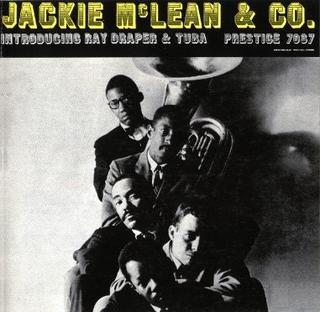
Jackie McLean, who knew something about how hard it is to break through in the music business, seems to have made a commitment, not only to introducing new talented musicians, but to making sure they got fulll recognition (Jackie certainly knew something about getting less than full recognition). We've seen how he introduced his pal, Bill Hardman, on Hardman's recording debut. The full title of this album is Jackie McLean and Co., Introducing Ray Draper and Tuba. The "introducing" part was left off when the album was rereleased on New Jazz, but by that time Draper had introduced himself on his own Prestige album.


 Order Listening to Prestige, Vol. 1 here.


Friday, August 05, 2016

Listening to Prestige 197: Jackie McLean

Jackie McLean was by now a veteran of Prestige sessions, but not quite as much of a veteran as you'd think. Yes, he goes back to the early days--1951, and the notorious Miles Davis "Dig" session (notorious for Miles having appropriated the composition as his own). But after that, a long hiatus, not just from Prestige, but from recording altogether. There was a live recording of a couple of nights at Birdland, and session a few days later for Blue Note, all in 1952 but not, I believe, released till much later. Then nothing at all until 1955, and it's hard to say why not. He was battling addiction, but lots of musicians were fighting this fight at the time, and many of them still recorded. When Jackie did come back into the studio in 1955, with Miles again, he was only used on two tunes of a four-tune session, and Miles said later that Jackie was so high, he could barely play. Miles never used him again.

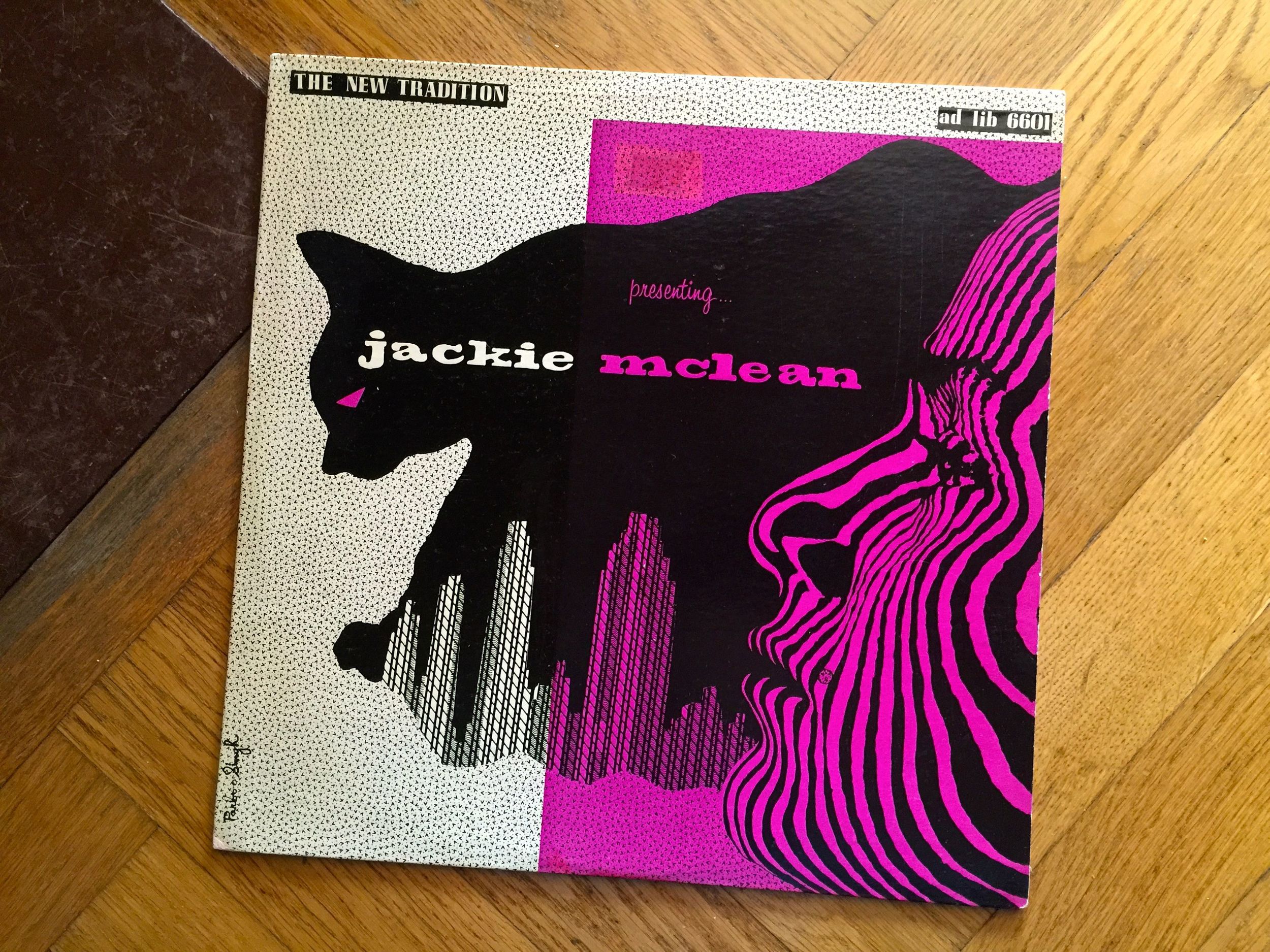
He played on a couple more sessions in '55--one with George Wallington, the other under his own leadership, Both were released on tiny labels: the Wallington live album on Progressive, the McLean Sextet album on Ad Lib. This one, according to the Rare Vinyl Jazz Collector (and aren't you glad such people exist), is "possibly the rarest of all the jazz collectibles out there." So since, like the ivory-billed woodpecker, it may never actually be seen in the wild, here's a picture of the album cover. I don't know who did the art, but it's a gem.

So, veteran or no, 1956 was really his debut year as a jazz force. He recorded for Prestige, Atlantic (with Mingus) and Columbia (with Blakey). By August, he was considered enough of a star that Bill Hardman was introduced on his first recording session as ""Jackie's Pal."

Jackie's pal is back with him for this abbreviated session, along with Red Garland, Paul Chambers and Art Taylor, who would take center stage as a trio for the rest of the afternoon. They do two standards and an original.

It's wonderful listening. The interplay between the two pals is intricate and yet straightforward, especially on "McLean's Scene." And this rhythm section continues to reward, every time out. Some great solos by Red Garland and Art Taylor, but it's Paul Chambers who takes your breath away. You expect a bass solo to come somewhere in the middle of a quintet piece, but on "Gone With the Wind" Chambers is the penultimate solo, right before McLean and and the restatement of the head.

You expect a piano vamp to begin a jazz quartet or quintet number--sometimes an extended vamp that becomes the head and an improvised solo. On "Mean to Me," though the first notes one hears are Garland's, Paul Chambers steps in and takes over that job. Cool.

Because this was an abbreviated session, it had to wait for LP release. It was combined with a 1957 McLean session with a different lineup, and released in 1959 on New Jazz.


 Order Listening to Prestige, Vol. 1 here.

Wednesday, May 25, 2016

Listening to Prestige Part 186: Jackie McLean/Bill Hardman

Bill Hardman was a youthful 23 when Jackie McLean presented him as his pal/protégé, which was actually two years older than Paul Chambers, who was already a veteran...but Chambers started mighty young. Hardman did too,  even though this is is first jazz recording. Even in high school, he was playing with Tadd Dameron's orchestra. After graduating, he joined Tiny Bradshaw's rhythm and blues ensemble, and he can be heard on some of Bradshaw's recordings, although not as a soloist.

He was with Bradshaw from 1953-55, and after that, he was hired by Charles Mingus for a short time -- long enough to become friends with fellow Mingus bandman Jackie McLean (Mal Waldron was also in that group). He would make two more albums with McLean for Prestige, and shortly after this first session, both pals were grabbed up by Art Blakey, who had signed with Columbia, for the second version of his Jazz Messengers.

Hardman would do three different tours with Blakey. And he would endure. Long after bebop and hard bop had gone out of fashion, Hardman kept the flame alive, forming a bop quintet with tenor sax player Junior Cook that was still getting gigs, and appreciative audicnces, through the 70s and 80s.

Hardman died in Paris in 1990, and the headline of his obituary in the New York Times read,
curiously, "Bill Hardman, 57, Trumpeter Known For Improvisations." What did they think jazz musicians did?

Peter Watrous, who does know what jazz musicians do, wrote the obit, and what he actually said was "A fiery but lyrical improviser, Mr. Hardman was one of the last surviving major trumpeters to come out of the 1950's. " This was Watrous's third sentence, and I guess the headline writer didn't feel he needed to read any further.

The composition credits are democratically spread around the group (Jackie was no Miles Davis). "Sweet Doll" is McLean's, "Just for Marty" and "Sublues" are by Hardman, and Mal Waldron brings in "Dee's Dilemma," making for a nice mix and a nice consistency at the same time.

The session is rounded out by Charlie Parker's "Steeplechase" and the standard "It Could Happen To You," which had also recently been recorded by Miles in one of his Contractual Marathon sessions. Listening to both versions back to back is more enjoyable than instructive. The only thing I learned was that when you give a great melody to great improvisers, the results are going to be different. Miles's group takes it at a brisker tempo, even though the tempo-setters on bass and drums are the same for both sessions.

By this time Paul Chambers was established as the bassist in one of the most recognizable ensembles in the history of jazz, and although at this time jazz history was being made, not considered in hindsight, people already knew how important this quintet was.

What people don't always remember is how short-lived it was. Miles formed it in late 1955,  recorded pretty heavily with it in 1956, and disbanded it in 1957, not getting it back together until 1958, and then as a sextet. Its rhythm section recorded independently, together or separately, and continued to grow as musicians -- one of the big differences between the Miles and the Jackie versions of "It Could Happen to You" is Paul Chambers' solo. Chambers is developing, and asserting himself.

The album was first released as Jackie's Pal: Introducing Bill Hardman, which is a little odd. New guys make album debuts all the time. But generous of Jackie. It was later rereleased on New Jazz as Steeplechase, a title that looked back to Bird rather than forward to the burgeoning career of young Hardman.