Tad Richards' odyssey through the catalog of Prestige Records:an unofficial and idiosyncratic history of jazz in the 50s and 60s. With occasional digressions.
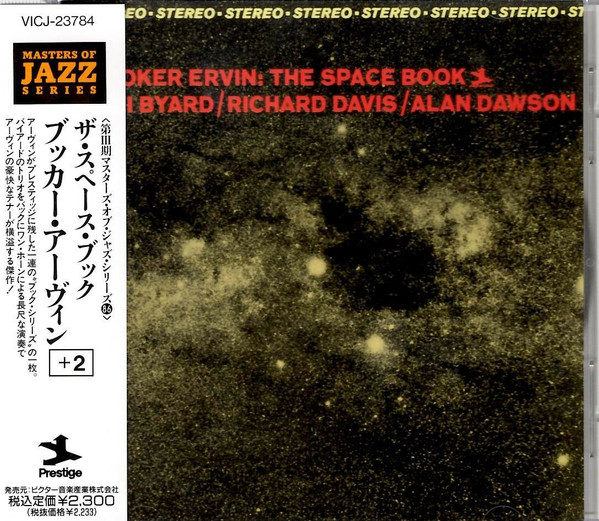
The title of this album is The Space Book, and the cover art reflects it, with what appears to be a black hole in the Milky Way. The contents live up to the packaging. With this album, Ervin crosses over the bridge to free jazz, and free jazz is the better for it. Certainly with some of the free guys -- not the best ones -- aas with some of the abstract expressionists, or the practitioners of what came to be called L*A*N*G*U*A*G*E poetry, one can't help but wonder if they're doing all this crazy stuff to cover up the fact that can't really draw, can't really play a scale, can't really write a line of poetry that will scan.
Such is not the case with Ervin. He brings all his chops with him into outer space. It's not the case with the people in his group either. Jaki Byard could play anything, and frequently did. He has as much claim as anyone you can think of to be called the greatest unsung piano player of all time. Bassist Richard Davis, Ervin's longtime collaborator, could play anything, and his discography shows it -- Eric Dolphy and Pharaoh Sanders, Louis Armstrong and Bo Diddley. Drummer Alan Dawson also worked exrensively with Ervin, after which he replaced Joe Morello in the Dave Brubeck Quartet. Outer space, Booker Ervin style, was open range for these guys, and they were home on the range. They can play as fast as any bebopper, and they always know what they're doing.
You can count on it that I don't know enough about music to tell you what's going on in free jazz, so just let me say that this is a great album. It's free, it's structured, it's melodic, it's jagged, it's rhythmic, it's somewhere beyond rhythm. It sounds as fresh and original today as it did when it was recorded. The brilliance of Ervin's solos are matched by Byard and Davis.
Ervin plays two originals and two standards, neither of which you'd expect to find on a free jazz album -- George Gershwin's swing era classic "I Can't Get Started," and "There is No Greater Love." standaed bordering on schmaltz, first recorded by composer Isham Jones in 1936, covered by Guy Lombardo and then Jimmy Dorsey, before becoming, like "I Can'r Get Started," a ubiquitous standard. For both tunes, Ervin gives you enough of the melody that you can recognize it if you're listening for it.
Don Schlitten produced. Two cuts from the session, "The Second #2" and "Bass IX," were held over and appeared on the 1966 album, Groovin' High.
What happens when Prestige puts one of its greatest veteran beboppers together with two of its brightest young stars?
Jazz happens. That's all you can say, and that's the very best you can say.
But I'll say a little more. Two saxophones, and Don Patterson's organ making up two thirds of the rhythm section--no piano, no bass. None of them strangers to each other. Patterson and drummer Billy James were close associates; the two of them had worked a number of times with Ervin, and they'd done a previous Prestige recording with Stitt. Ervin and Stitt are a new combination, and why'd it take so long? They have a lot to say to each other.
This is a real collaboration between three remarkable talents, and it would be hard, and ultimately futile, to try to single out one as the dominant voice, but there is a certain nod to Stitt as the old master. Side one of the LP is devoted to two Stitt compositions, "Soul People" and "Sonny's Book," and side two is standards that one would probably associate more with Stitt's era, Duke Ellington's "C-Jam Blues" and a medley of two from the Great American Songbook, "I Can't Get Started" and "The Masquerade is Over." The medley, particulatly, starts with an extended solo by Stitt in the manner of a ballad from the bebop era, but as the idea is developed by Ervin and Patterson, and Stitt again. it becomes very much a mutual exploration, and very much in a contemporary mode.
Those four tracks make up the LP, but there was a fifth tune cut at the session, although it didn't see the light of day until 1971, when it was tossed on to an album cobbled together from outtakes from Don Patterson sessions. That was "Flyin' Home," the Lionel Hampton tune that was a favorite of swing and rhythm and blues musicians. common ground for these collaborating generations in that it was a part of the repertory of neither, but certainly a tune to have some with. "Flyin' Home" is most famous from its renditions by 1930s-1940s players who the restriction of a 2 1/2-minute 78 RPM record. These guys stretch it out to ten minutes, give it a little bebop, a little hard bop, a little soul, a little swing, and more than a little money's worth for the listener. I love "Flyin' Home," and I'm delighted by what these guys have done with it.
Soul People was the natural choice for an album title in 1964, and Prestige didn't shrink from it. "C-Jam Blues" was released as a two-sided 45, credited to Sonny Stitt and Booker Ervin. Ozzie Cadena produced.
This is not your father's organ-saxophone trio album, and anyone looking for Jimmy Smith or Brother Jack McDuff or Shirley Scott and Eddie "Lockjaw" Davis is going to go away scratching their heads. And I say this with all due respect, and appreciation that every one of the above named is an individual with a unique sound.
But these two are going there own way. Booker Ervin already had forged a reputation as one of the most original and important new voices on the jazz scene--not as defiantly anti-establishment as Ornette Coleman or Albert Ayler, but definitely a new sound. Don Patterson was starting to make a name for himself, and the idea that his approach to the
organ would mesh well with Booker Ervin's fresh approach resonated with the Prestige brain trust from the start. After putting putting him on sessions with Eddie "Lockjaw" Davis and Sonny Stitt, they gave him Ervin as a partner for his first session as leader, and it worked well enough to reunite them here.
Perhaps the most interesting result of this pairing comes on "Just Friends." The tune is a sentimantal ballad from the 1930s that served as a vehicle for the likes of Kate Smith, Russ Colombo and Morton Downey, but it became a jazz standard after Charlie Parker included it on his Charlie Parker with Strings album. After that, a number of artists picked it up--it even had a soul jazz organ treatment by Jimmy Smith--but Bird with strings is still the version most jazz fans will think of when they hear the title.
So it's hard to resist comparing the two, especially because Ervin (like every jazz man who came of age in or after the 1940s) is very aware of Bird's version, and his "Just Friends" is very much of a dialog with the master.
Bird enjoyed the lush romanticism of his string section, though he certainly was not linited by it. And
just as Bird both honored and subverted the genre, so Ervin and Patterson both honor and subvert the organ-saxophone soul jazz genre. If there is such a thing as soul jazz-free jazz fusion, they find it here.
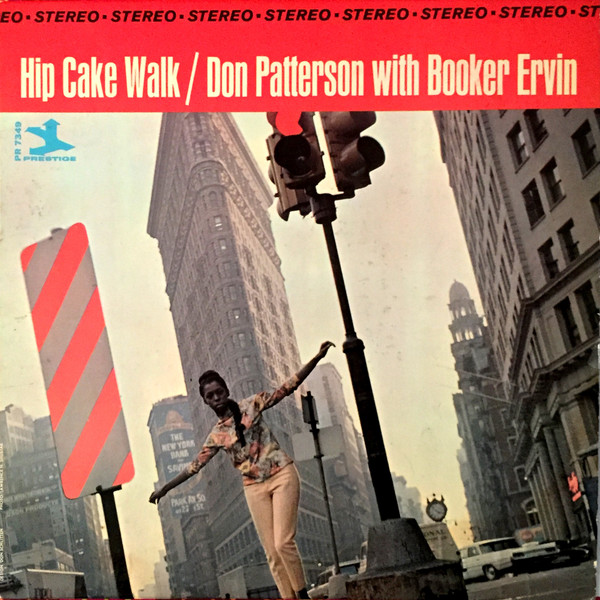
"Sister Ruth," "Donald Duck," "Rosetta" and "Under the Boardwalk" were put together with an 18-minute jam from Patterson and Ervin's previous session, "Hip Cake Walk," and issued as an LP under that name. "Sister Ruth" and "Donald Duck" were issued as a 45 RPM single, as was "Under the Boardwalk," paired with another tune from the earlier session, "Up in Betty's Room." The cover of the newly released smash hit by the Drifters is a natural for the jukeboxes. Patterson and Billy James have a good time with it, and it shows.
"Just Friends" was saved for a later album, Tune Up!, incorporating tunes from a bunch of different sessions, and released in 1971, after Ervin's death.
Booker Ervin is still in the middle of his six-year, 13-album sojourn with Prestige. Prestige knew what they had with Ervin, in more ways than one. They recognized his outsized talent--he was one of the most important young saxophone players to come along in the early 1960s. But they also could relate to his music. The label was very much staying abreast of current trends in jazz, recording some of the best of the avant gardists and the back-to-basics soul jazz artists, but its heart was still with the mainstream bebop that excited 19-year-old Bob Weinstock to form a new label in the first place. Indeed, when another decade rolled around and Weinstock sold the label, retiring from the business, he said that it was time--the music he loved wasn't being made any more.
Booker Ervin's sound, as Ira Gitler said in his liner notes to The Blues Book, was "of the '60s. but it has not lost touch with the tap roots of jazz." Gitler, one of the great chroniclers of the golden age of jazz represented by Prestige, went on to describe Ervin's sound as only he could:
Booker's phrasing (the highly-charged flurries and the excruciating, long-toned cries), harmonic conceptions (neither pallid nor beyond the pale) and tone (a vox humana) add up to a style that is avant-garde yet evolutionary, and not one that bows to fashion or gropes unprofessionally under the guise of "freedom."
Probably the gateway album to the new avant garde was John Coltrane's Giant Steps, the first one he made after leaving Prestige for Atlantic, with new harmonic ideas but still accessible to the jazz lover raised on bebop. Ervin's "avant garde yet evolutionary" style can be said to place him in the Giant Steps generation, although Ervin's approach is nothing like Coltrane's. Like Coltrane's album of four years before, it has the thrill of the new, while still being rooted deep in solid earth--in this case, the earthy truth of the blues.
The group recorded five tunes for this session, four of which were included on The Blues Book. The fifth, "Groovin' High," would be the title cut of a later album culled from various Ervin sessions. The Blues Book has two tunes on each side of the vinyl release, one long, one short. The A side is "Eerie Dearie," checking in at 14:30, and "One for Mort," 6:24. '
"Eerie Dearie" is the whole package. It begins with a soulful piano vamp from Gildo Mahones, then a solid blues riff from the horns, opening up the door for an extended solo from Ervin. And yes, it's avant garde but evolutionary. Ervin shows just how free you can get, while still with a solid anchor in the blues. With fourteen and a half minutes to play around in, everyone gets a chance to solo, but it's Ervin you come away with.
Mahones is a solid Prestige veteran. Jones was new to the East Coast when he made this recording, and probably new to Ervin. Gitler, in his liner notes, makes a point of commending Don Schlitten as producer for putting the personnel together.
Jones had been active on the West Coast since 1961, recording with Bud Shank, Gerald Wilson, Red Mitchell, Harold Land and others, including backing Sarah Vaughan in a series of West Coast recording dates in May and June of 1963. He came east to work with Horace Silver, and he had done one live recording with Silver's quintet, but it would not be released until 20 years later, so this was his real East Coast unveiling. He did work with Silver for a while, recording with him in late 1964 and early 1965, and he was to have a couple more Prestige gigs, one with Charles McPherson and one leading his own quintet.
Although they had not met until they did The Freedom Book...and play together only in the studio on an Ervin recording, D&D are about as tightly fused a duo as you will encounter anywhere in the annals of jazz. There is no loss of rapport from one date to the next. They arrive, unpack their instruments, and they're off and flying.
They would unpack together again on Ervin's next album. Then Reggie Workman would replace Davis for a couple of sessions, and Davis would return for Ervin's last hurrah on Prestige in 1966.
Prestige, in its twenty-odd years of existence, left us an amazing legacy, a portrait of two of the most fruitful periods in American jazz. The middle part of its second decade is rich with some of the key figures of the avant garde, and some of the key figures of soul jazz. But one of the richest and most wonderful parts of that legacy is surely found in the 12 albums Prestige put out by Jaki Byard, a musician who fit in neither of those categories, or any other, really. His music has been described as "spanning the 20th century from ragtime to no time," and it's an apt description. It was not just that he could play anything from the most traditional to free jazz. Other skilled technicians, other dedicated artists, could do that. Byard spoke each language, each dialect of jazz like a native, and he could express himself with subtlety and nuance, with intellect and emotion, in every one of them.
And perhaps all of that is the reason why he is not remembered as well as he ought to be. An article about him on the web page of the Music Museum of New England (Byard was born in Worcester, MA) says that he "won many awards for his contributions over the years," but then it's hard pressed to come up with anything more than:
In 1988 Mayor Ray Flynn awarded him the Dr. Martin Luther King Jr. Award for Outstanding Contributions in Black Music and Presence in Boston. In 1995 NYC Mayor Rudolph Guliani presented him with an award for his outstanding contributions with the Apollo Stompers.
This is Byard's third album as a leader with Prestige (he'd also appeared as a supporting player on several other dates, the most recent one being with Booker Ervin, who returns the gesture on the first of these two sessions). That was the May 21 session, with Richard Williams, Williams was also well known to Prestige collectors. Williams and Ervin sit out "Lush Life," as well as all of the second session.
On bass and drums for both sessions are Bob Cranshaw and Walter Perkins. Cranshaw had made his first Prestige recording just a few weeks earlier, with Shirley Scott and Stanley Turrentine, but he had already begun his long association with Sonny Rollins, and had been with Rollins on his 1962 recording of The Bridge for RCA Victor, the album that heralded Rollins's return from self-imposed exile. Perkins was by this time a familiar face in Prestige sessions.
The album shows a good deal of Byard's range and versatility, and in fact a few different styles and voicings are in evidence on a single cut--"European Episode," at just over 12 minutes more a suite than a single tune. One more facet of his versatility is showcased on "When Sunny Gets Blue," a leftover take from Byard's maiden session for Prestige in 1961, with Ron Carter and Roy Haynes, and featuring Byard on alto sax.
Esmond Edwards had produced the earlier session; the two that make up the bulk of this album were produced by Ozzie Cadena. The album was titled Out Front! "I Like to Lead When I Dance" and "After the Lights Go Down Low" were not included on the album, but made the later CD release.
As with George Benson, Prestige groomed Don Patterson for stardom before introducing him with his name above the title. Unlike Benson, Patterson would stick around to become on of the label's bread and butter soul jazz artists of the second half of the decade.
Patterson was put together with Booker Ervin for two sessions, which would produce two albums, which would be released in quick succession--and before the year was out, there would be a third album under Patterson's name, plus another with Sonny Stitt, and several 45 RPM singles. Prestige was into Patterson big time.
The first album to be released was called The Exciting New Organ of Don Patterson, and since by 1964, the idea of an organ-led jazz group was no longer new, it had better be exciting, and to help make it so, Prestige called on another one of its young heavy hitters--the full title of the album would be The Exciting New Organ of Don Patterson with Booker Ervin.
And yes, this was a combination capable of generating excitement, pressing the tempos, churning the music, generating hot but un-clichéd solos. The group was basically a trio, with Billy James, Patterson's long time associate, on drums. Alto saxophonist Leonard Houston was added for one track, "Hip Cake Walk." This appears to have been Houston's only recording on a recognized jazz label.
Five tracks from the session went onto Exciting New Organ. "S'Bout Time" is a Patterson original, and features a soaring Ervin solo, emerging with wings out of the opening riff, and urged on by the organ of Patterson, who then, in a solo of his own, lives up to the album title's hype, and also demonstrates what he was talking about when he was quoted as saying, "What I'm trying to do is keep the piano sound when I play the organ." "Up in Betty's Room" is attributed to both Patterson and James, and features some intricate but still funky work by the two lead instruments.
The rest of the album looks elsewhere for musical inspiration, and finds it in a variety of places, some not unexpected (Sonny Rollins' jazz standard "Oleo") and sone decidedly unexpected. "When Johnny Comes Marching Home" is a patriotic marching song most closely associated with the Civil War, although the tune is probably even older than that. It's a catchy melody, as could be expected from a tune that's lasted that long, but not one that would normally catch the ear of a jazz musician. But catchy is catchy, and Patterson clearly heard something he liked in this one, and it's his baby. He starts out with another patriotic lick, then goes into a funky-slippery interpretation of the familiar melody, with James playing a funky-not-entirely-slippery version of a military snare drum. It takes a while for Ervin to get into the mood, but when he does, he enters with the kind of solo that led his contemporaries to say that you could recognize a Booker Ervin solo after two notes. Patterson and Ervin end up by finding enough inspiration for ten minutes of improvisation on "When Johnny Comes Marching Home," ending up by playing the melody straight. It's quite a performance.
The final cut for the album was French composer Sascha Distel's moody ballad "The Good Life," providing a change of pace for Patterson and Ervin. Distel's melody was first titled "Marina," then, with French lyrics, "La Belle Vie." Willis Jackson had previously given Prestige a version of "The Good Life," and the tune was probably best known to American audiences through Tony Bennet's 1963 recording.
The rest of the session was parceled off to various destinations. "Hip Cake Walk," with alto saxophonist Leonard Houston added, became the title track to an album mostly recorded in July. "Love Me with All Your Heart" made it onto an album called Patterson's People. The people--not together--were Booker Ervin and Sonny Stitt. The album was leftover tracks from this session, an earlier session with Stitt, and a later session with Ervin.
"People" is the first Prestige recording since the advent of the LP era to be only released as a single, the flip side of a 45 headed by "Love Me with All Your Heart." "Up in Betty's Room" and "Under the Boardwalk" (from the July session) were also a 45 RPM single.
This is the second of the "Books" compiled by "the Book," Booker Ervin, for Prestige, the first being The Freedom Bookof the previous December. That one had Jaki Byard on piano, with Richard Davis (bass) and Alan Dawson (drums) rounding out the quartet. Davis and Dawson would remain on board for the whole series of books, but other instrumentation would vary, and here it's Tommy Flanagan on the keyboard. Flanagan makes an excellent consort, as Ervin continues to cement his place as the hottest new sound on the tenor sax.
He starts off the session by putting his imprint on "The Lamp is Low," a old tune that may never have had quite the wakeup call Ervin gives to it. The melody was taken from a piece by Maurice Ravel, "Pavane pour une Infante Défunte" (Pavane for a Dead Child). A part of Ravel's longer work was adapted by Peter DeRose and Bert Shefter,with lyrics by Mitchell Parish. Originally recorded by Mildred Bailey in 1939, covered a week later and turned into a big hit. the song takes Ravel's solemn dirge and turns it into a dreamy torch song, with lyrics about melting into the lover's arms and dreaming while the lamp is low. It's generally done to match that dreamy mood, but not always--Sarah Vaughan made it swing, and raised a few goose bumps with a thrilling interpretation. Ervin picks up where Vaughan left off, kicking into high gear almost immediately, with soaring, daring solos that are taken up and kicked again and again by Flanagan, Davis and Dawson.
The moody, introspective tone which Ervin might have adopted in "The Lamp is Low" gets its due in "Come Sunday," the churchy section from Duke Ellington's Black, Brown and Beige suite. "Come Sunday" is also the newest song in Ervin's Song Book, dating from 1943. All the others go back to the 1930s, although "Just Friends," written in 1931, is indelibly, in every jazz fan's mind, the song newly created from the bones of the of the original by Charlie Parker in 1949. There's no nostalgia in Ervin's treatment of any of these old chestnuts -- there's no danger of this album being released on Swingville, even if that fine series had not recently been closed down by Prestige. This was a solid Booker Ervin session, a musician very much aware of tradition, very much aware of his time, and in the full maturity of his own sound.
Ervin was at the midpoint of his tenure with Prestige, which is the same as saying the midpoint of his career, since the 1960s were the summit of his achievement and his reputation, and by 1970 he would be dead of a kidney disease. He had clearly marked himself by this time as one of the most distinctive stylists of his generation--critic Gary Giddins has remarked that
you know it’s him after two notes...he is completely himself...It is not avant-garde jazz — he’s playing changes — yet it has the kind of freedom and velocity you might associate with Coltrane...though Booker didn’t sound anything like Trane. He was one of the few tenors of his generation who didn’t.
But his reputation remained mostly within the jazz community. Music producer and historian Michael Cuscuna has pointed out that his Prestige recordings
had caused a lot of excitement in New York, but New York isn't America...which meant that his triumphs were mixed with incomprehensible dry spells.
His basic quartet for the "Book" sessions was Richard Davis and Alan Dawson on all of them, Jaki Byard on two of them, and yet this tight-knit and sympathetic group was not Ervin's regular touring band--they may never have played together outside of the studio. The economics of jazz in the 1960s, at least the sort of jazz that Ervin played, didn't allow for the maintaining of a regular group.
And what was that? It wasn't free jazz (although the commercial outlets for that were limited too). It wasn't soul jazz. Hard bop may have become old hat to the critics, but it certainly still had its followers. But that wasn't what Ervin played either. As a result, it was easy for Ervin to get lost in the pack. As Giddins puts it:
Everybody was talking about Coltrane and Shorter and Rollins and the big guns, and Ervin was really something of a cult figure. Those Prestige records were hardly best sellers.
Ervin's early death meant that he didn't stay around to become an elder statesman of jazz, lionized by Jazz at Lincoln Center or the NEA Jazz Masters. To modern listmakers, he generally doesn't crack anyone's list of the 50 greatest jazz saxophonists. But he should.
This second "Book" album was called The Song Book. Don Schlitten produced.
Before free jazz became the universally agreed upon name for the music that was being pioneered in the early 1960s by Ornette Coleman, John Coltrane, Eric Dolphy and others, it had other names. Arthur Taylor, in his book Notes and Tones, a collection of interviews with fellow musicians conducted between 1968 and 1972, frequently discusses "freedom music." Musicians don't always get to decide what their albums are going to be called, but it's likely that Booker Ervin had some input into The Freedom Book the title for this one, as he edges from bop toward freedom music, paying his tuition to both schools, and establishing himself as one of the distinctive voices of this period.
The quartet Ervin assembled for this session was to stay with him throughout his career with Prestige, and the three sidemen would work as a trio under Jaki Byard's leadership on a series of Prestige albums. They were the right group for where Ervin was going, eclectic musicians who could play in any style, even styles that hadn't been invented yet, and that Ervin was maybe making up as he went along.
Jaki Byard was as wide-ranging a talent as you're likely to find, from working with Eric Dolphy to playing the music of James P. Johnson and Fats Waller. Ervin was mostly unfamiliar with Byard's work before hiring him for this session on the strong recommendation of producer Don Schlitten. Schlitten was right, as their continued association would prove.
Richard Davis's credentials range from Dolphy (the great Dolphy-Booker Little Quintet) to Frank Sinatra to Van Morrison (he was on Morrison's groundbreaking Astral Weeks album). New on the New York scene after several years on the road with Sarah Vaughan, he had been making his mark all over town when tabbed for this gig.
Alan Dawson made his Prestige debut back in 1953 when, as a member of Lionel Hampton's European touring band, he joined Quincy Jones for a session in Sweden. An educator of note (Tony Williams was a student), he was teaching at Berklee in Boston when Ervin called him for this session, explaining:
Yeah, Alan's a bitch...I played with Alan in Boston about ten years ago and it was one of the greatest experiences I've had in music...with Alan you can forget about the time, go beyond it. He's got drive but he also knows how to build a climax, then take it down to a different level where you can get yourself together and then build it back up again. Man, with Alan you can play forever!
He followed his stint with Ervin by replacing Joe Morello in the Dave Brubeck quartet, where almost certainly did not duplicate his stick work with the Booker Ervin quartet.
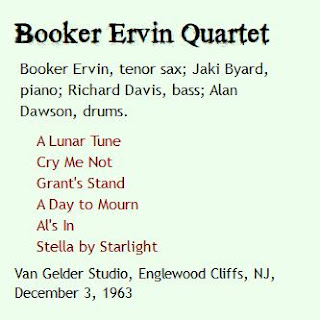
It's no accident that a musician of Ervin's gifts, and Ervin's vision, would put together a group this gifted, and it's a blessing that he was able to keep them together. This is an amazing album, that gets better every time you listen to it. I'm hard-pressed to pick a "Listen to One." The uptempo numbers, "A Lunar Tune," "Grant's Stand" and "Al's In," push the freedom envelope a little more. The ballads. especially "A Day to Mourn" have some fine ensemble playing and some remarkable individual virtuosity. You should really listen to the whole album. If the freedom sound sort of passed you by, and you think you ought to have given it more of a shot, but it was just too far out for you, you'll love this album. If you're a free jazz devotee, you'll love this album. Go out and buy it on vinyl.
Randy Weston wrote "Cry Me Not." All the others on the album are Ervin's compositions. They also recorded the standard, "Stella by Starlight," but that was held back, and appeared on a 1966 album. Groovin' High, which was the extras from all his previous sessions.
Pony Poindexter left New Orleans when he was 14. His musical career encompasses the West Coast, where he first began to make his reputation, the East Coast (although not known as a New York musician, his breakthrough as a recording artist came in the Big Apple with sessions for Epic and Prestige) and Europe (following his Prestige sessions, he moved to Spain, where he spent most of the rest of the decade). Yet, as this album clearly shows, he never left the Big Easy completely behind. Perhaps it's true that you can take the boy out of New Orleans, but...
Poindexter recorded not infrequently, and with some high-powered musicians, but he is a forgotten name today. On Ranker, a web site which features some exhaustive lists, he gets no votes at all for jazz saxophone.
I first heard his name back in the late 1950s, when I was new to jazz and a new reader of DownBeat, in connection with a minor scandal of sorts. It seems that some of Pony's West Coast admirers had attempted to stuff the ballot box for DownBeat's reader's poll, and they had somehow been caught out, and Poindexter had been stricken from the poll results altogether. This was in the days when the East Coast jazz establishment tended to view the whole West Coast scene as lightweight, anyway, and I was under that influence. So I was willing to dismiss Poindexter as a fake and a poseur, and nothing happened in the intervening years to change my view. Until this album, I had never listened to his music--and that includes his debut album for Prestige earlier in 1963, which included his take on such dubious jazz choices as "Love Me Tender," and which I was unable to find anywhere, not even a single cut.
And had I looked, I would have found that his credentials were pretty substantial. He had recorded with Wes Montgomery, with Jon Hendricks, with Lambert, Hendricks and Ross (so I might have heard him without knowing it). His debut album as a leader, 1962's Pony's Express for Epic, featured Eric Dolphy, Gene Quill, Sonny Red, Phil Woods, Dexter Gordon, Jimmy Heath, Clifford Jordan, Sal Nistico, Pepper Adams, Tommy Flanagan, Ron Carter, Elvin Jones, Charli Persip. Not too lightweight.
In 1963, New Orleans was many years removed from being a hub of jazz. There had been a revival of interest in the traditional New Orleans sound in the early 1940s, but that had long since been swamped by the modern jazz tsunami, and not even the revivalist producers of Prestige's Swingville label were much interested in New Orleans style. It's hard to imagine New Orleans without Preservation Hall, but that now-venerable institution had only been started in 1961, and was not yet a tourist draw. The most well-known musicians in the New Orleans tradition were the Dukes of Dixieland, a band that was scoffed at by jazz connoisseurs.
So maybe there wasn't much of a market then for an album of modern jazz built on the sounds of New Orleans, not even with a newly hot item like Booker Ervin on board. Yet coming upon it in the eclectic postmodern world of today, this is a most enjoyable album, and a real find.
Produced by Ozzie Cadena, Gumbo is a concept album, the Poindexter compositions offering heir composer's tour of the city, Uptown ("Where I come from") on side one, and the Creole Downtown in side two. The album's liner notes also provide a tune-by-tune guided tour of the city Poindexter remembered and loved:
Front o' Town is in the uptown section--right next to the levee...there was a little blues phrase that everyone there used to hum and whistle.
Happy Strut: Grandpa played in a parade band...I'd walk along with my clarinet (sometimes it would be three hours before they played a tune I knew) and if I didn't mess up, they'd let me play...I tried to approximate that feeling with some modern changes.
Creole Girl: She was a real pretty girl...all the men liked her and none of the women did. When I was 12 she was grown up, but I can still remember just how she looked. Creole girls...are superstitious and terrible tempered, and if they catch you with another woman, there's hell to pay. This tune is nostalgic, because you can't handle them right. But we still play it in a happy manner.
4-11-44: In New Orleans, everybody plays the policy game. This number is known as the "Washerwoman's gig" -- it's their favorite bet. It has voodoo connotations.
And with Side Two, we move downtown, down and dirty.
Back o' Town: This is the night club section, where all the sporting girls hang out. All the church people from Front o' Town look down on Back o' Town.
Muddy Dust: Voodoo is pretty strong in New Orleans...The melody kind of laughs at it, 'cause I still don't believe in it.
French Market: The people from the swamps, the farmers, the fishermen, the voodoo dealers -- all bring their wares here. There are alligator tails, gaspigous (barking swamp fish), carnivorous plants ground up into powder, candied legs of gigantic mosquitoes...my grandfather took me there.
Gumbo Filet: The tune is a blues--everything I like really well has to be the blues. It's arranged with two-bar breaks so I could get the name in there. You guessed it--I like Gumbo Filet.
The rhythm section, all Prestige veterans, are the musicians Poindexter worked with accompanying Lambert, Hendricks and Ross. The album was a 1963 Prestige release. A later CD reissue combined this album with Poindexter's earlier January 31 date for Prestige, and a Larry Young session from February 28. "4-11-44" and "Happy Strut" were a 45 RPM single.
Gumbo evoked nostalgia for a time and place that no one in the jazz world was much interested in. It carried the message of a modernity that no longer seemed on the cutting edge, although maybe it should have. Booker Ervin was one of the brightest young stars of the day. Pony Poindexter was, although this is mostly forgotten, one of the pioneers of the soprano sax. Coming upon it today, this is a very easy album to fall in love with.
For as long as there has been small group jazz, there have been artists rebelling against its strictures--the "formula" of head-solo-solo-solo-head. Well, it's not a formula, any more than the sonnet or the ballad or the three-act play is a formula. It's a form, and forms persist because they work. They can also be broken, rebelled against, turned inside out, but in a sense that's just a tribute to their durability.
Of course, the reason why the small group, head-solo-solo-solo-head formula works is twofold. First, it works because American music is full of great melodies and great riffs that are a pleasure to play and a pleasure to listen to, and pleasure is at the
heart of all music that lasts. Second, and most important, it works because it gives wonderful musicians a chance to express themselves -- a showcase to be heard in a supportive context, and space to express themselves through tonal quality and improvisational inspiration.
One such wonderful musician who flowered in the 1960s was Booker Ervin. Ervin had burst onto the scene in 1958 in the ensemble of Charles Mingus, with whom he enjoyed a long and fruitful relationship. He had recorded with Mal Waldron and Roy Haynes for Prestige, and with Horace Parlan for Blue Note, and had made three records as leader (for Bethlehem, Savoy and Candid), so he was hardly an unknown quantity when came to Englewood Cliffs for this session, but it was the beginning of his most fertile period, with ten albums for Prestige.
Prestige in this period was open to a wide range of music, from the free experiments of Eric Dolphy to the soul fundamentalism of Jack McDuff, and the tradition-maintaining sounds of Swingville and Bluesville, but Ervin came perhaps as close as any to the jazz heart of this label. Working with like-minded musicians, he used this premiere performance of his Prestige years to add a new sound to the library of small group masterpieces.
Frank Strozier had the admiration of his peers. Here's tuba virtuoso Howard Johnson:
No one was ever really up to the task of playing with that much technical proficiency, deep harmonic expression and all the while keeping a foot deeply in the blues. For me, Frank is joined by Harry Carney, Benny Golson, Sonny Red and Paul Gonsalves in the league of players who were never imitated because their way was too hard to figure out, much less execute. And at the same time they were as deeply inspirational as some of the widely acknowledged innovators.
He recorded with a wide variety of musicians, but never quite broke through to the level of popularity he deserved. Finally, in the late 1980s, he gave up playing the saxophone and returned to his first instrument, the piano. He never recorded on the piano, but his concerts were well reviewed and appreciated by those who heard them. Then he left music to become a math and science teacher.
Horace Parlan was also a Mingus associate. It was he who first heard Ervin when he came to New York, and recommended him to Mingus, and Ervin played on two records Parlan made as leader for Blue Note. His unique piano style, marked by heavy emphasis on the left hand, was formed by a childhood bout with polio which robbed him of the use of three fingers on his right hand.
I've written about Butch Warren on his one previous Prestige gig, with Walter Bishop Jr. He was much in demand during the early 1960s, but substance abuse and mental health issues caught up with him, and he left the rat race of big time jazz and returned to his home in Washington, DC, where he played but little.
Walter Perkins began his career in Chicago with Ahmad Jamal, and as leader of his own ensemble MJT+3, which included Frank Strozier. He came to New York in 1962, and immediately became ubiquitous, with several sessions for Prestige alone before signing on for this gig. They included Gene Ammons, Etta Jones, fellow Chicagoan John Wright, and Dave Pike.
I said earlier that the basic small group jazz form has endured because of good musicians and good music. That's in evidence here. Broadway was still yielding up tunes with the feel of standards, such as Jule Styne's "Just in Time," from Broadway (1956) and Hollywood (1960) hit Bells Are Ringing. Fats Waller was the source for "Black and Blue." The others were originals from either Ervin ("Mooche Mooche" and "Tune In") or Perkins ("Mour," which Ervin liked enough to record again for Blue Note), or the two of them together ("No Man's Land"). All good stuff, but I've chosen "Mooche Mooche" as our "Listen to One" for sustained excitement and top notch solos from all concerned.
Exultation! was the title of the Prestige album. Short versions of "Just in Time" and "No Man's Land" were issued as a 45 RPM single, and later added to a 1971 re-release. Don Schlitten produced.
Booker Ervin had been in the studio for Prestige earlier in 1963, for a session with Larry Young, that was inexplicably shelved, not to see the light of day until many years later, in the CD reissue era, when it was coupled with an Ervin-Pony Poindexter recording which was made later in the year. He had appeared on one previous New Jazz recording, with Eric Dolphy and Mal Waldron. He was to become a mainstay of Prestige over the next few years.
Roy Haynes was already a Prestige mainstay, appearing with musicians covering the spectrum
from Willis Jackson to Phil Woods to Eric Dolphy. He'd played soul jazz with Shirley Scott, harp jazz with Dorothy Ashby, blues with Sonny Terry and Brownie McGhee, and a little bit of everything with master of eclecticism Jaki Byard.
He had led his own trio (Phineas Newborn, Paul Chambers) in 1958, for a particularly beautiful album, We Three, and followed it in 1969 with another trio album (Richard Wyands, Eddie de Haas), Just Us. He had put together a couple of earlier sessions as leader with Mercury/EmArcy, and one with a smaller independent label. He told Ira Gitler that wanted to do more work as leader, because he could "set more of a pace," or as Gitler put it, he could "[pick] the tunes, the order they should be programmed in, and the tempo they should follow. The last, of course, is closest to the drummer's domain. Before he can do any of these things, a leader has to make his most important decisions--choosing the men who will play with him. Haynes has chosen well in the past, and his current quartet again reflects his good taste."
For his first Prestige album, Haynes had chosen two of the finest--and most talked about--of the younger musicians on the scene. For his second, he chose musicians who would never have the honors or name recognition of Phineas Newborn and Paul Chambers, but who were bold and sensitive, and delivered the music that Haynes was looking for. A 1962 session for Impulse! featured the rising star Roland Kirk.
Here, in Booker Ervin, he has another rising star, that would blaze forth through the rest of the 1960s on albums for Prestige and Blue Note, before Ervin's untimely death from kidney disease in 1970.
At 28, Ronnie Mathews was another young talent, and one who apparently appealed to the era's finest drummers--he had been discovered by Max Roach, and also worked extensively with Art Blakey. He had made his recording debut for Prestige in 1961 with Roland Alexander, and would lead a session of his own for the label later in 1963.
Larry Ridley was 26 when this record was made, and he had a fine career as a bassist ahead of, playing with Chet Baker, Kenny Burrell, Dexter Gordon and Stephane Grappelli among others, but perhaps an even more important contribution to the music was his work as an educator and administrator. He served as (and I'll just quote his Wikipedia entry here):
chairman of the Jazz Panel of the National Endowment for the Arts (NEA) and was the
organization's National Coordinator of the "Jazz Artists in Schools" Program for five years (1978–1982). Ridley is a recipient of the MidAtlantic Arts Foundation's "Living Legacy Jazz Award", a 1998 inductee the International Association for Jazz Education Hall of Fame (IAJE), an inductee of the Downbeat Magazine Jazz Education Hall of Fame, a recipient of the Benny Golson Jazz Award from Howard University, and was honored by a Juneteenth 2006 Proclamation Award from the New York City Council. Ridley is currently the Executive Director of the African American Jazz Caucus, Inc., an affiliate of IAJE. He is also the IAJE Northeast Regional Coordinator. He continues to actively teach as Professor of Jazz Bass at the Manhattan School of Music. Ridley is currently serving as Jazz Artist in Residence at the Harlem based New York Public Library/Schomburg Center for Research in Black Culture. He established an annual series there dedicated to presenting the compositions of jazz masters that are performed by Ridley and his Jazz Legacy Ensemble.
Haynes also utilized the composing talents of the musicians he brought in. Ronnie Mathews composed "Dorian" and "Honeydew." Booker Ervin contributed "Scoochie," and Haynes finished the session with his own "Bad News Blues." Randy Weston is represented by his tribute to Melba Liston, "Sketch of Melba."
They play one semi-standard, "Under Paris Skies," originally composed by Hubert Giraud for the French film Sous le Ciel de Paris, later recorded by Edith Piaf. With English lyrics, it became a favorite of vocalists and mostly of sweet-music dance bands, although it has had some jazz adherents, most prominently Duke Ellington. Art Van Damme and Quincy Jones both also recorded it. Haynes liked the tune, and featured it in his club performances, often with Frank Strozier soloing on flute. Haynes's virtuoso lead-ins are a strong feature of all the tracks on this album, but on this one he really goes to town, driving all thoughts of sweet strings out of your head. Larry Ridley joins him on bass before--over thirty seconds in--Ervin enters, playing the familiar melody, and sticking mostly close to the melody for a full three minutes, as Haynes continues to kick it hard. The real improvisation starts with Mathews, and continues with Ervin, until the head is briefly restated at the end, this time by Mathews, perhaps somewhat sardonically.
"Bad News Blues" is a first rate example of what sound engineer Rudy Van Gelder used to call a "five-o-clock blues" -- it's the end of a session, we've played all the tunes we came in with, let's just play some blues. Prestige founder and president Bob Weinstock loved a good jam session, and a lot of good ones came out of this approach, with "Bad News Blues" being a prime example, Haynes setting the pace and everyone getting some room to blow.
Mathews's "Dorian" is in the Dorian mode, the minor-key modal structure made most famous by Miles Davis's "So What" and here turned into a moody, emotionally stirring piece, particularly in Mathews's own solo. All of this is taken at a quick tempo, not what you'd think of as the first choice for moody introspection, but it works. "Honeydew" is altogether different, with Ridley playing the blues right out of the gate, with Mathews and Ervin joining to create a full-bore, major scale excursion into rhythm and blues with Haynes providing a complex but driving alternative to the back beat.
"Scoochie" is Ervin's, and it is not only scoochie, it is downright scorchy. Ervin had introduced the tune a few years earlier in the sculpture garden of the Museum of Modern Art, in a group led by Teddy Charles and also featuring Booker Little. If that rendition scooched the statues into life, this one would have scorched and singed them, with Haynes providing the beat, Ervin flying high, and Mathews turning in a piano solo that echoes and extends what Teddy Charles did in the Garden.
Haynes had entered a phase of his career where he wanted to work more as a leader, with his own groups, but he was only to make one more record for Prestige, and then one for Pacific Jazz, and nothing else in the 1960s, though the 1970s were a much more fruitful decade for him in the leader role, and he was to continue as a jazz stalwart, and a jazz legend, into his 90s.
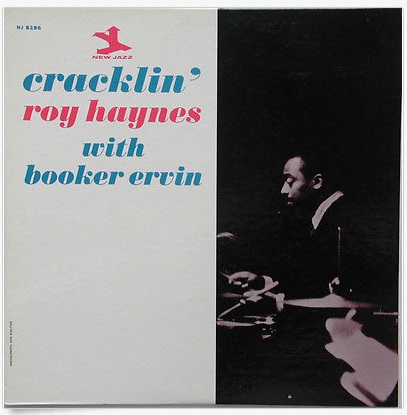
Cracklin' was the title of the New Jazz album release,and the title credit was Roy Haynes with Booker Ervin. The two Mathews compositions, "Dorian" and "Honeydew," were a 45 RPM single. Ozzie Cadena produced.
Mal Waldron was recognized in his time by those who paid attention, and for more than just being Billie Holiday's pianist on the night that Frank O'Hara immortalized in "The Day Lady Died," even though he didn't get the votes in the Playboy or Down Beat reader's polls. Billboard, in reviewing this album, said, "As a composer and pianist in avant garde jazz, Mal Waldron has few peers." The Billboard reviewer put "composer" first, and that's no mistake. For whatever reason, the general public, even the Down Beat reading public, never got the message, but musicians and jazz record producers surely did. On virtually every session that Waldron was called to play on, he was asked to compose a few tunes (look at my comments for his sessions of May 2 or September 26, 1958.
"Soul Eyes," written for John Coltrane, is his best known composition, but "Fire Waltz," from this session, written for Dolphy, has attracted its share of musicians, especially in recent years. One of the many pleasures of this album is getting the chance to reconsider and re-appreciate Waldron as a composer. All the pieces recorded this day were his.
Billboard puts Waldron with the avant garde, and although his talents and interests covered the breadth of modern jazz, being asked to compose for a session with Eric Dolphy certainly gives him an opportunity to spread his avant garde wings, and he's up to the task.
There were two important jazz musicians in this era who were named after the pioneering African American educator Booker T. Washington, and both died of illness way before their time. Trumpeter Booker Little, whose collaborations with Dolphy can only leave us wondering what more the two of them might have achieved, died on October 5, 1961, at age 23.
Ervin died at age 40, in 1970...both of them of kidney failure. He had a chance to leave behind a substantial body of work, much of it on Prestige.
Originally from Texas, he got his start in the southwestern territorial band of Ernie Fields, then moved to New York in 1958, where he very quickly caught the attention of Charles Mingus. Although Dolphy and Ervin were both part of the Mingus family, they only appeared together on one recording, the Complete Town Hall Concert. This appears to be their only other joint outing.
I won't comment on each selection individually. I'd like to, but I don't have the knowledge or the vocabulary. I will say that this session made me stop and listen over and over again, and not want to go on. Charlie Persip's drumming kicks and drives and complicates the rhythm. Joe Benjamin's solid bass makes it possible for Ron Carter to move his cello up to the front line. The cello is always a touchy instrument for jazz, but Waldron finds a place for it that works. And while Waldron always adds something unique and valuable to any group that he's in, his solos on his own compositions are particularly expressive. This is a beauty of an album.
It was released on New Jazz as The Quest. Esmond Edwards produced. It would later be rereleased on Prestige under Dolphy's name as Fire Waltz. The tune, "Fire Waltz," was also played by Dolphy, Booker Little and Waldron on the Dolphy/Little Live at the Five Spot sessions, and in recent years, it has gone into the repertoire of a number of jazz musicians.
Listening to Prestige Vol 4, 1959-60, now available from Amazon! Also on Kindle! Volumes 1-3 are also available from Amazon. The most interesting book of its kind that I have ever seen. If any of you real jazz lovers want to know about some of the classic records made by some of the legends of jazz, get this book. LOVED IT. – Terry Gibbs







:format(jpeg):mode_rgb():quality(90)/discogs-images/R-3157686-1394829100-7811.jpeg.jpg)


:format(jpeg):mode_rgb():quality(40)/discogs-images/R-4474656-1365916304-2625.jpeg.jpg)