Tad Richards' odyssey through the catalog of Prestige Records:an unofficial and idiosyncratic history of jazz in the 50s and 60s. With occasional digressions.
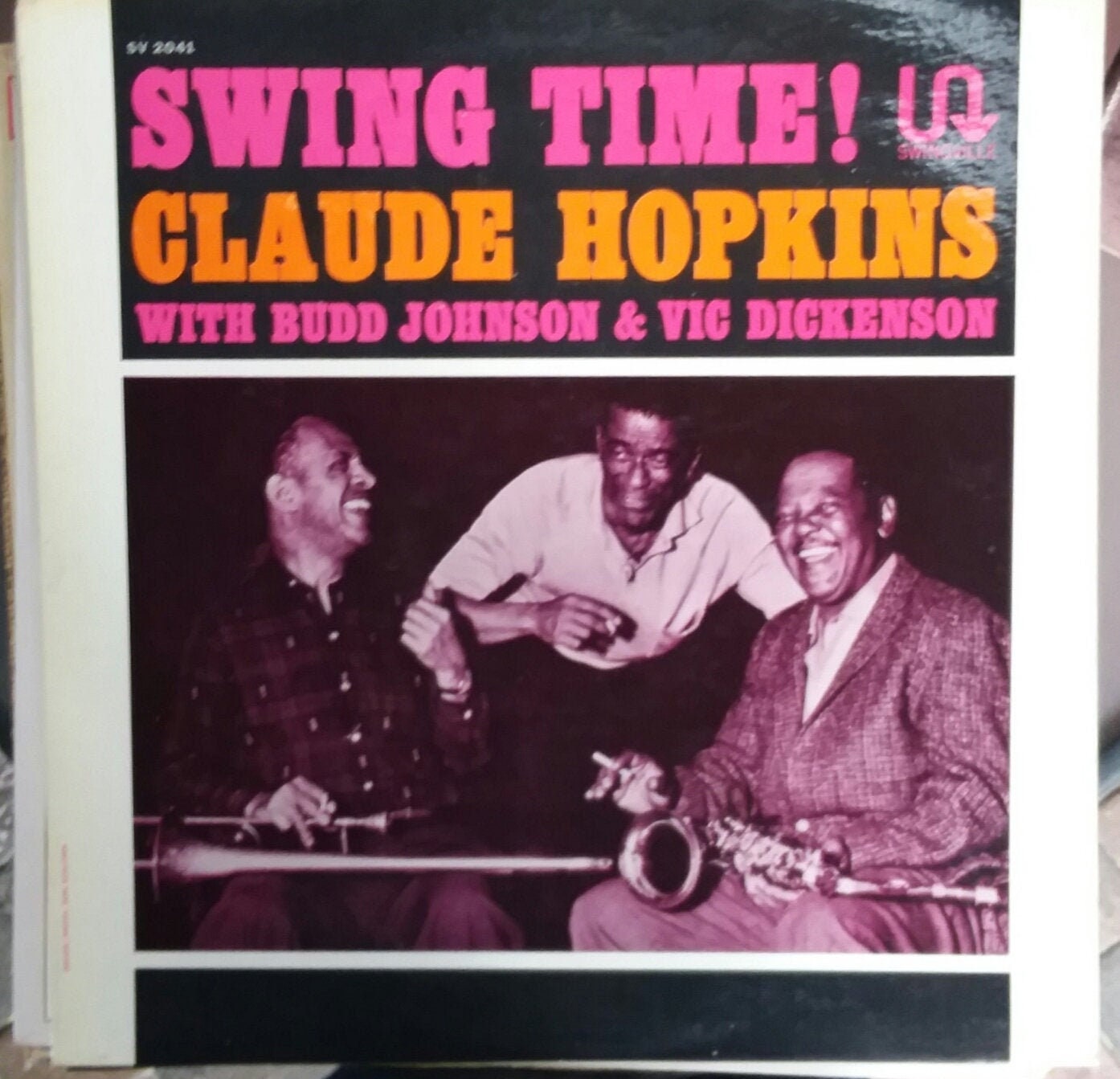
Claude Hopkins had a long and distinguished career as pianist and bandleader, but live music is evanescent, and so are the reputations based on it. Lasting reputations are built on recorded music, so it'sm thanks to Prestige and Swingville that Hopkins is chiefly remembered today -- with the Swingville All Stars, backing up Bud Freeman and Lonnie Johnson, and most indelibly for the three albums he recorded as leader: Yes Indeed!, Let's Jam, and this final one, Swing Time! Esmond Edwards gave him great support for the first two (Buddy Tate, augmented by Chu Berry on Yes Indeed! and Joe Thomas on Let's Jam), and Don
Schlitten, not to be undone, gives him a masterful group here, led by Vic Dickenson and Budd Johnson.
Hopkins had the kind of career that jazz fans and jazz historians can dream about, and conjure up a mythos around -- musical director of Josephine Baker's ensemble in Paris (which included Sidney Bechet), leader of a 1930s band which included Vic Dickenson and which had long residencies at the Cotton Club and Roseland. But to actually hear him, these recordings are the place to go. Swing Time! includes two Hopkins originals plus the kind of old chestnuts that, when they're in the hands of masters, you never get tired of hearing.
New to Prestige are trumpeter Bobby Johnson and drummer
Ferdinand Everett. Johnson was a much-in-demand section man who played with Duke Ellington, Billie Holiday and Erskine Hawkins, among others. Everett's only record date appears to have been this one, but he carries his weight.
This is the first part of a two-session, double-album extravaganza released by Prestige as The First Annual Prestige Swing Festival, Spring 1961. The festival appears to have taken place entirely in the Van Gelder Studio in Englewood Cliffs--I can find no record of an actual festival. And it appears to have been the only annual Swing Festival.
Nevertheless, a cause for celebration. Prestige had put together various collections of All Stars over the past few years, including one other set of Swingville All Stars (in March of 1960, with Taft Jordan, Hilton
Jefferson, and Al Sears as the front line), and all of their all star sessions were worthy of the name, but this one has some solidly heavy hitters, and a bunch of them. The heyday of swing was also the heyday of the 78 RPM record, so your typical swing session recording was three and a half minutes or less--maybe a little more if they decided to split a song over two sides. And the typical swing recording was section players with one soloist.
But bebop changed some of that, and the long playing record changed the rest of it, and this aggregation includes a number of all stars who deserve solo space, and who get it, and the length of the selections reflects that. "Jammin' in Swingville" is nine and a half minutes, "Spring's Swing" eight minutes, "Love Me or Leave Me" a little over seven. "Cool Sunrise" nearly eleven.
"Love Me or Leave Me" is the standard by Gus Kahn and Walter Donaldson, first recorded by torch singer Ruth Etting in 1928, picked up by Billie Holiday in 1941, then covered a few scattered times in the late 1940s and early 1950s. It was Etting's signature song, and Etting was basically a forgotten star by the 1950s, but it turned out her life, including a disastrous marriage to a brutal gangster, was more interesting than her career. It became a movie with Doris Day and James Cagney, and "Love Me or Leave Me" became the movie's title song, and jazz musicians as well as pop singers started recognizing its potential.
"Jammin' in Swingville" and "Swing's Spring" are both credited to Vivian Hamilton, who I'm guessing was the wife of Jimmy. Her only credited compositions are on albums by Jimmy (although "Spring's Swing" was recorded in 2005 by Swiss-born, Chicago-based tenor saxophonist Sam Burckhardt), and Jimmy was the arranger for this session. "Cool Sunrise" is credited to Esmond Edwards, so important as a producer for Prestige during these years, but rarely listed as a composer. All of them provide an ample basis for joyous interpretation.
Swing, as its name suggests, is a joyful music, and extended jams like these sound like a lot of fun, like good friends getting together and producing something delightful. Let's hope this was the case, and why not? These guys were old enough, and far enough past their years of stardom, to have been able to simply enjoy getting together and making music. We continue to owe Prestige big time for recording these Swingville sessions.
Edwards produced. The title of the double album was Things Ain't What They Used to Be. When they were rereleased separately, that became the title of the record that had "Spring's Swing" and "Love Me or Leave Me" on it. The other separated LP was called Years Ago. A later rerelease as double album and CD was called Jam Session in Swingville.
I haven't been able to find the February 17 Buddy Tate session that yielded the Swingville album, Groovin' with Buddy Tate.
Claude Hopkins had a real career revival with Prestige. Since his heyday as a bandleader in the 1930s he had worked steadily but anonymously until tapped by Chris Albertson to appear on the rediscovery session for jazzman/bluesman Lonnie Johnson in March of 1960. Just a couple of weeks later, he was called back into Rudy Van Gelder's studio to make his debut album for Swingville.
There would be three Swingville sessions in all, and he would go on leading groups and recording for smaller labels well into the 1970s.
He was back in the studio 11 months after his first Swingville session with essentially the same group, Joe Thomas replacing Chu Berry. Thomas had done a Swingville session once before, with Coleman Hawkins. With Esmond Edwards producing, the selections here play to the strengths of Hopkins and his group, ballads and foot-stomping blues, with an emphasis on rhythm and a strong bass line. The material is familiar to Hopkins--just how familiar can be deduced from one of his originals. "I Would Do Anything For You," his mot successful composition, was co-written with pianist Alex Hill, who died in 1937. "Safari Stomp" is, for me, the catchiest, with a solid groove and hot solos by Tate and Thomas.
The Swingville album was called, fittingly, Let's Jam. A Prestige reissue on CD was retitled Swing Time.
Listening to Prestige Vol. 2, 1955-56, and Vol. 3, 1957-58 now include, in the Kindle editions, links to all the "Listen to One" selections. All three volumes available from Amazon. And Volume 4 in preparation! The most interesting book of its kind that I have ever seen. If any of you real jazz lovers want to know about some of the classic records made by some of the legends of jazz, get this book. LOVED IT. – Terry Gibbs
I suppose one could look ar this period as sort of an interregnum between John Coltrane and Eric Dolphy. Dolphy had actually made his Prestige debut the previous month, but although it was titled Outward Bound, it wasn't as outward as Dolphy was going to go, and though his era was poised to explode, it hadn't quite done so yet.
One could look at it that way, but one would be wrong. Jazz doesn't begin and end with the superstars, and it doesn't exist only on the cutting edge. Or maybe it's always the cutting edge, because you're out there every night taking risks, which is the definition of improvisation, whether you're John Coltrane playing every note there is at the same time or Ahmad Jamal playing cocktail hour at the Pershing Hotel for salesmen who don't care that you're giving
lessons in the possibilities of jazz improvisation, or Henry "Red" Allen playing for the lunch crowd at the Metropole. And if Prestige in the 1960s is remembered more for Dolphy than for the Swingville and Bluesville and Moodsville recordings, these labels recognized the fact that jazz was living history, and the people who had made that history were still living and playing, which made it a lot more than just history.
Bud Freeman came out of the Chicago high school band that became a legend, the Austin High School Gang with Jimmy McPartland and Frank Teschemaker, and he grew to be known as the master of the swing era tenor saxophone. In
fact, he was one of the original jazz tenormen, since it was not an instrument common to that style of music, and he developed a sound all his own--Lester Young counted Freeman as one of his early influences. He never lacked for work, or for people who wanted to record him, be they major labels (Columbia), top independents (Bethlehem), labels not much given to jazz (Dot), or more obscure small labels. This would be his only recording for Prestige.
It was one of the very few small group recordings Shorty Baker would make for any label, and the only one where he got featured billing. Baker was a respected section man who played off and on with Duke Ellington's orchestra during these years, and he makes the most of his chance in the spotlight. You wouldn't be looking for this album to fill out your Shorty Baker collection, because you won't have a Shorty Baker collection, bur he plays well enough on this session to make you glad you've had a chance to hear him.
Claude Hopkins was brought to Prestige by Chris Albertson to play on Lonnie Johnson's first session, and was brought back to make an album under his own name, which featured J. C. Heard on drums. George Duvivier, of course, is an old friend.
Like most of the Swingville sessions, these are musicians who got their start in an earlier era, but didn't stay there--in fact Freeman, though he continued to play in a traditional setting, with Eddie Condon, with Yank Lawson and Bob Haggart's World's Greatest Jazzband, and with his own groups, had studied for a while in the late 1940s with Lennie Tristano. Freeman, in a 1980 conversation with radio interviewer Studs Terkel, said "My old fans would prefer that I play the way I played a hundred years ago, but I prefer to play the way I feel, and I feel that I'm improving."
The Swingville album is called The Bud Freeman All Stars Featuring Shorty Baker.
Listening to Prestige Vol. 3 makes a great Christmas gift for the jazz fan who has Volumes 1 and 2! And for those who haven't, the complete set makes a fabulous gift!
I can't find a producer credit for this, but it has to be part two of Chris Albertson's welcome into the Prestige fold. He had brought Claude Hopkins on board with the Lonnie Johnson session, and Hopkins would stick around to do a couple of sessions as leader for Bob Weinstock's labels--something he did remarkably little of, in a long career. He did record with his orchestra in the early 1930s, but after that nothing. In fact, it would have taken a dedicated aficionado like Albertson to even remember him, though once remembered, he wouldn't have been that hard to find. Unlike Lonnie Johnson, he hadn't vanished from sight. He always found work with trad jazz or Dixieland ensembles.
A few thoughts about Bob Weinstock and his Swingville label. Looking back, it seems like a natural. All those great musicians were still around, and it would have been a shame if their later music had gone undocumented. And from a business standpoint, it had to have been a good gamble. No jazz musician made the really big bucks, but Claude Hopkins had to come a lot cheaper than John Lewis or Erroll Garner.
But remember the era. We were past the 1940s, but the jazz wars between the progressives and the moldy figs were not entirely over, and they had been fierce. Nowadays, on your mixtape if anyone still made them, on your Spotify playlist or Pandora radio station, you might perfectly easily go from Ornette Coleman to Jimmie Lunceford, and be admired for it by that discerning friend who happened to be looking over your shoulder. But back then, you really were expected to choose sides. You had to stand with Eddie Condon, who said, "We don't flat our fifths, we drink 'em!" or Louis Armstrong, who railed against bebop as "Chinese music," or Tommy Dorsey who said it had set music back twenty years. Or you could be like the Down Beat critic dismissing Louis Armstrong and Bing Crosby's "Now You Has Jazz" from High Society with "Jazz? I'm still waiting to hear it."
In 1960, we stood on the brink of change. Rock and roll would turn in rock, would start becoming culturally respectable, would make a new trend out of what jazz had always done by inventing "supergroups" and jams. The blues would be rediscovered (Weinstock was again ahead of his time with the Bluesville label), and the jazz culture wars of the 1940s and 1950s would fade into oblivion, But there was some serious apostasy in a bebop/progressive label embracing the moldy fig sound the way that Weinstock did with his Swingville line. He may have played it safe out of the box with Coleman Hawkins, because no one of any age or musical taste was going to put down the Hawk, but with this group led by Claude Hopkins, the mold was seriously on the fig,
And we, in the 21st century, can only be grateful.
Hopkins is joined by Emmett "Chu" Berry on trumpet, Buddy Tate on tenor, Prestige stalwart Wendell Marshall on bass and J. C. Heard on drums. Tate is a Prestige veteran by this time, having debuted with Eddie "Lockjaw" Davis and Shirley Scott and then led his own session. Berry had been with Fletcher Henderson (replacing Roy Eldridge) and Count Basie. He had also been featured on some of Billie Holiday's classic recordings. Heard, like Marshall, was equally at home with swing and bop ensembles. He had begun his career with Teddy Wilaon, had worked for the Big Three (Armstrong, Goodman, Ellington), and had also played with Charlie Parker and Dizzy Gillespie.
They play standards, a Bessie Smith blues, and the Sy Oliver swing composition that became the title tune, and which was having a renaissance, with recent versions by Ray Charles and Shirley Scott. They play uptempo swing and moody blues. They take great solos and work together in ensemble sections like the old pros they are. Wendell Marshall demonstrates his facility as a swing bassist.
Yes Indeed! was released on Swingville. A later CD release saw Hopkins sharing leader credit with Tate. Nothing on 45, and there could have been. Swing was, after all, the original dance music.
I've skipped over one session, with guitarist Al Casey. I'll come back to it as soon as I find my notes.
Prestige plucked Lonnie Johnson from obscurity for this recording, and a few more that he'd make for their Bluesville line, but then he kind of fell back into it. As the blues craze of the 1960s developed, it was a rising tide that lifted two kinds of boats. The ethnic folkie crowd, energized by Columbia's release of Robert Johnson's 1936-37 recordings, started looking for and resurrecting the careers of Mississippi Delta bluesman like Son House, Furry Lewis and Mississippi Fred McDowell. The young British blues enthusiasts who came to dominate the American pop charts loved the high-octane, electrified Chicago blues. The Rolling Stones demanded that Howlin' Wolf be featured on the white teen-oriented TV show Shindig when the made their American debut in 1965, and the careers of artists like Wolf, Muddy Waters and John Lee Hooker were in the ascendant.
Lonnie Johnson fit neither of these categories. He was from an earlier generation than the Chicago bluesmen, and he was from a different musical aesthetic than the Delta bluesmen, closer to jazz. He was, in fact, the first and most important innovator of the single-string guitar solo, the basis of nearly all jazz guitar improvisation.
Johnson made his first mark as a blues singer, winning a recording contract with Okeh at a 1925 blues competition.
But that was 1925, right in the middle of the decade of the first blues craze. After the unexpected commercial success of Mamie Smith's recording, "Crazy Blues," had shown that there was a black audience that would buy records, all the record companies wanted a piece of it, and they all figured that the way to get it was through the blues. At first that meant the urban, jazz-oriented blues of Mamie Smith, Alberta Hunter, and especially Bessie Smith. Then it meant the rural blues of street singers and rural juke joint performers like Blind Lemon Jefferson and Charley Patton.
And those guys weren't necessarily bluesmen. They were songsters. They were trying to make a buck, and that meant playing anything their audiences wanted to hear. Sometimes those audiences were black, and sometimes they were white. Sometimes they wanted to listen and sometimes they wanted to dance, so the songster had to be prepared. You can hear a vestige of this in Robert Johnson's "Hot Tamales and They're Red Hot."
Then an important audience became the record company, and the record companies wanted blues, so they became bluesmen, and the best bluesmen were successful. Lonnie Johnson, later in life, would come to resent the label a little, feeling it was too restrictive and did not show the scope of what he could do. But in 1925 he was desperate to get a recording contract, and the blues was his ticket of entry, though once inside the door, he was able to expand his scope, recording with both Louis Armstrong and Duke Ellington, among other jazzmen, including guitarist Eddie Lang, with whom he made some exciting recordings even though music was supposed to be made on a strictly segregated basis in those days.
But the blues was his meal ticket, and so it remained until that cafeteria dried up.The Depression was a time of shrinkage and retrenchment for the record companies, and the black artists were the first to be retrenched.
With the rise of independent rhythm and blues labels in the 1940s, he began to build a second career, but it ultimately dried up too, and he had settled back into obscurity for most of the 1950s.
His next comeback, and the contract with Prestige, coincided with another Prestige debut. Iceland-born Chris Albertson, who had begun making a career in radio in England, Iceland and Norway, latched onto American Armed Forces Radio as a disc jockey in Iceland, and followed his love of jazz to the United States, where found work as a disc jockey with a Philadelphia radio station. His special interest was in traditional jazz and blues, and one night he played some records by Lonnie Johnson, wondering over the air what had happened to the forgotten blues great.
He didn't have to wonder for long. A listener called the station. The hotel where he worked had a janitor named Lonnie Johnson, and though he never talked about music, he was always very careful of his hands. Could it be...?
It was. Albertson had him as a guest on his show, then brought him to Bob Weinstock's new Bluesville label, where Johnson was signed as an artist and Albertson as a producer.
Albertson put him together, for his first effort, with some first rate jazz musicians, all of them veterans with roots in traditional jazz, but nonetheless representing two different generations,
Pianist Claude Hopkins was Johnson's contemporary, born in 1903 to Johnson's 1899, and when Johnson was making his first blues recording in 1925, Hopkins was on his way to Paris as musical director of Josephine Baker's revue.
There's always work for a good piano player and bandleader, and Hopkins stayed busy throughout the following decades, including the 1950s, as there was still a demand for a pianist in the traditional style, not everyone being on board with this modern stuff. In fact, 52nd Street, once the cathedral of bebop, was by the end of the 1950s represented only by two Dixieland clubs, Eddie Condon's and Jimmy Ryan's.
When Johnson made that first recording for Okeh, his other future bandmates were barely out of diapers. Tenor saxophonist-to-be Hal Singer was six, bassist Wendell Marshall five and drummer Bobby Donaldson three.
All three of them were seasoned veterans by 1960, and all four of Albertson's musicians could play the blues, especially Singer, whose instrumental "Corn Bread" had topped the rhythm and blues charts in 1948. Together, they add jazz depth to a session that is Johnson's. and very rightly so. His single-string guitar soloing may not have been revolutionary any more, but few did it as well as he.
The album came out on Bluesville as Blues by Lonnie Johnson. The 45 RPM single was "You Don't Move Me" / "Don't Ever Love."



.jpg)


:format(jpeg):mode_rgb():quality(40)/discogs-images/R-10078585-1491231592-4861.jpeg.jpg)

:format(jpeg):mode_rgb():quality(40)/discogs-images/R-3655600-1339241885-8226.jpeg.jpg)


