Showing posts with label Curtis Fuller. Show all posts

Friday, May 04, 2018

Listening to Prestige 332: Benny Golson

"April in Paris" was written in 1932 by Vernon Duke and E. Y. Harburg for a Broadway show called Walk a Little Faster. The show was not exactly a flop, not exactly a hit (118) performances, but the song was an instant classic, and it's never wanted for performers eager to take it on. It's had vocal interpretations from Sinatra to Ella and Louis to Shirley Basey, but the most successful, and still the definitive version was, amazingly enough, a jazz instrumental. Count Basie recorded it in 1955: bold, brassy, and so exuberant that it demanded not just "one more time" but "one more once" after that.

But a great tune is always going to find great artists with new approaches. In 1956 alone there were ten new jazz recordings, including piano versions by Errol Garner, Thelonious Monk and Nat "King" Cole, and a treatment by Thad Jones, who had contributed a memorable solo to the Basie recording.

In 1959, Benny Golson was ready to add his voice to the "April in Paris" story, and his was a very different approach from Basie's: moody and subdued. Paris in the springtime may be a time for lovers, but for every lover there's a broken heart, and a sad story to tell in a late night bistro. Golson has the thoughtful commiseration of Tommy Flanagan, but for the most part this is is his tone poem, and he plays it with deep understanding.

But he snaps out of the meditative mood with "Tippin' on Through." This is the composer of "Blues March," a hit for Art Blakey's Jazz Messengers, and "Tippin'" has some of that march feeling to it. It seems like an odd fit, but Golson has proved it can work, and in a way, jazz and march compositions have certain commonalities, They both have a predilection for riff-based melodies, at least as funneled through the musical imagination of Benny Golson.

Tommy Flanagan takes a world-weary approach to intro to the next number, as though baubles, bangles and beads, no matter how they jing-jing-aling, are still the stuff of vanity. Golson and Curtis Fuller soon set him straight, kicking off a celebration.

The blues take center stage for the rest of the session, with two Golson compositions, "Tom Hurd's Blues" and "Blue Streak." The blues really never do grow old.

Doug Watkins and Art Taylor rounded out the quintet. Watkins had spent much of the previous year in Europe with Donald Byrd. He would continue to be a mainstay sessions for Prestige and other labels until his untimely death in 1962, the result of an auto accident. Gettin' With It was produced by Esmond Edwards, released on New Jazz. We have two thirds of the Jazztet-to-be here, as on Golson's previous New Jazz recording--and as on a Savoy album cut during the fall, under Fuller's leadership, as the Curtis Fuller Jazztet: the first time that name was used, with Lee Morgan as the third Tet. The next time it would be used would be just six weeks away, in early February, on the Argo release Meet the Jazztet, with Art Farmer. Farmer, Golson and Fuller had first united as the Jazztet for club dates in November.


Order Listening to Prestige Vol 2 

  (and expect Volume 3 very soon!)
 

Listening to Prestige Vol. 2, 1954-1956 is here! You can order your signed copy or copies through the link above.


Tad Richards will strike a nerve with all of us who were privileged to have lived thru the beginnings of bebop, and with those who have since fallen under the spell of this American phenomenon…a one-of-a-kind reference book, that will surely take its place in the history of this music.

                                                                                                                                                --Dave Grusin

An important reference book of all the Prestige recordings during the time period. Furthermore, Each song chosen is a brilliant representation of the artist which leaves the listener free to explore further. The stories behind the making of each track are incredibly informative and give a glimpse deeper into the artists at work.
                                                                                                                --Murali Coryell

Thursday, February 15, 2018

Listening to Prestige 316: Benny Golson

This is the second of three albums Benny Golson and Curtis Fuller made for Prestige, before they linked up with Art Farmer and went off to form the Jazztet. A tightly planned sextet had been on Golson’s mind for a while, and when he approached Farmer with it, Farmer shot back a note saying he’d been thinking along the same lines, and been on the point of contacting Golson.

This one features Golson playing more standards than originals. Which is actually the balance on Meet the Jazztet, too, though that album is mostly remembered for the great Golson original compositions, “I Remember Clifford,” “Blues March,” and especially “Killer Joe,” which was the new one. The originals for this album didn’t become classics, although “The Stroller” was originally written for Lou Donaldson, and has been recorded by Italian bandleader Giorgio Azzolini.


If "The Stroller" and "My Blues House" haven't become standards, hey certainly could have. They're in competition with some pretty high-level work in the Golson catalog, but as "lines... meant to be vehicles for blowing," in Golson's words, they fill the bill quite nicely.

"The Stroller" does anything but stroll, although its name doesn't come from its tempo, but from the practice of "strolling," playing a solo without piano backing. It's a high-octane thrill ride in bebop tempo,  powered by Art Blakey, with exciting solo space for everyone, leading off with three minutes of nonstop strolling by Golson, an including Paul Chambers on his signature bowed bass. "My Blues House," same good stuff, more relaxed tempo.

It's a little unusual to see one of Blue Note's marquee performers moonlighting on a Prestige session, but Blakey is here in support of one of the mainstays of his great late 1950s version of the Jazz Messengers. In addition to playing and composing, Golson also mentored the Messengers' Bobby Timmons through writing "Moanin'."
 
"Drum Boogie" is the Roy Eldridge/Gene Krupa classic vehicle for Krupa, generally including a vocal, most famously Anita O'Day.  It's so closely associated with Krupa that it's not all that often taken on by other artists, but we have heard it before on Prestige, from a Kenny Burrell-led group featuring Cecil Payne and Elvin Jones. Interestingly, even with the presence of Blakey on the one cut and Jones on the other, two of the most expressive and individual drum soloists in jazz, both groups treat it more as an ensemble piece, with a relatively short drum solo.

Golson's gone to two of the masters, Richard Rodgers and Jerome Kern, for the rest of the session.

Golson, in Ira Gitler's liner notes, discusses the musicians he chose for this session, starting with Curtis Fuller:
If I couldn't work with Curtis...I'd probably use another instrument for a two-horn grpup. We blend together so well, and he's always listening.
Fuller does a fair amount of listening here, as this is more of  a Golson showcase than the later Jazztet albums will be, but when he does solo, you can absolutely hear what Golson means about how well they blend.

Of Ray Bryant: "His harmonics are great and he is so melodic too." Of Paul Chambers:
For his age, Paul seems to have attained maturity on his instrument that usually takes years to acquire. His melodic conception is uncanny. When you're strolling ... you can
lean on him without ever having to worry.
And about his old boss:
I consider it an asset having Art Blakey on any record date I make. He has made it very hard for me to play with most drummers because he swings so hard and so constant. He's a dynamo. And such a feeling for the drums--he can express himself like a horn player.
 A note in passing. It's been often remarked that jazz became mainstreamed into American culture during this era with jazz themes for TV shows like Henry Mancini's "Peter Gunn" and Count Basie's "M Squad, jazz soundtracks for movies like John Lewis's Odds Against Tomorrow, Duke Ellington's Anatomy of a Murder, and Elmer Bernstein's Man with the Golden Arm. Perhaps even more indicative of the mainstreaming of jazz was the way that TV and movie producers, even when they weren't looking for a marquee name for a highly promotable soundtrack or theme, still looked to jazz musicians. Benny Golson composed and arranged soundtrack music for any number of movies and TV shows, including Mannix and Mission Impossible(main themes by Dizzy Gillespie alumnus Lalo Schifrin), Ironside, M*A*S*H, and even The Partridge Family.

Groovin' with Golson was released on New Jazz. Esmond Edwards produced.


Listening to Prestige Vol. 2, 1954-1956 is here! You can order your signed copy or copies through the link above.

Tad Richards will strike a nerve with all of us who were privileged to have
lived thru the beginnings of bebop, and with those who have since
fallen under the spell of this American phenomenon…a one-of-a-kind
reference book, that will surely take its place in the history of this
music.
                                                                                                                             
--Dave Grusin

An important reference book of all the Prestige recordings during the time
period. Furthermore, Each song chosen is a brilliant representation of
the artist which leaves the listener free to explore further. The
stories behind the making of each track are incredibly informative and
give a glimpse deeper into the artists at work.
                                                                                                                --Murali Coryell


Tuesday, February 06, 2018

Listening to Prestige 312: Benny Golson

Benny Golson is a jazz legend for all sorts of excellent reasons: saxophone great, composer, and co-leader of a legendary if short-lived 1960s group, the Jazztet.

As a composer, he can lay as legitimate a claim as any to the title of Third Most Important Modern Jazz Composer--Thelonious Monk and Duke Ellington will always be one-two, although their order can be debated. Then there are Dave Brubeck and Dave Grusin, Tadd Dameron...and others, but Golson is in that group. Few can match him for the number of compositions that have become jazz standards-- the
tunes that every jazz musician can be expected to know if they're called at a jam session, and that virtually every jazz ensemble has recorded at one time or another. "Killer Joe" has been recorded over 50 times; "Stablemates," the tune that first drew attention to Golson as a composer, has over 70 versions, as does "Whisper Not;" musicians have gone into the studio with "I Remember Clifford" well over 100 times. And these are all jazz standards, not popular songs with lyrics which have also become favorites with instrumentalists.

"Stablemates" was first recorded by Miles Davis in 1955, when Golson was 26, but the story of how it got to Miles goes back to Golson's childhood in Philadelphia, a city that spawned a lot of young jazzmen (and women: don't forget Shirley Scott). Young Benny had studied piano until, at 15, he went to hear Lionel Hampton in concert, and when Arnett Cobb stepped out in front to play his solo, he knew that there was nothing else to do but play the saxophone. If he only had one. And if he knew which saxophone he wanted to play. He told his mother of his longing, and she asked which saxophone he wanted. "Oh...the one with the curve in the neck."

The Golsons were about as poor as you could get. Mrs. Golson took in washing, and one day young Benny found her crying because she didn't have five cents to buy soap to do her loads of wash. But she somehow put together the money to buy her son a saxophone with a curved neck.

He and his friends began practicing and playing together by the open window of his mother's apartment, to the bemusement of their long-suffering neighbors, but as Golson recalls it, they knew they were starting to get good when their neighbors started calling requests in through the window.

Benny went to Howard University and studied music theory, then started playing professionally with rhythm and blues bands: Tiny Grimes, Bull Moose Jackson, Earl Bostic. Jackson's band included Tadd Dameron on piano, and Dameron became his mentor and strongest influence as a composer. He was more and more drawn to writing music, and he began handing out lead sheets to every bandleader and musician he met. He didn't know if anyone actually looked at them until he gave one to his best friend from the open window days. John Coltrane had just been summoned from Philadephia, on the recommendation of fellow Philly cat Philly Joe Jones, to join Miles Davis' band, and he brought the lead sheet for "Stablemates" with him. When that record came out, musicians all over began digging through their piles of lead sheets and saying "Golson? Wasn't that the name of the kid who...?"

Tadd Dameron once said that the most important element to him in a composition was beauty, and that's a lesson that Golson learned. His work is simple, direct, melodic and beautiful. If a tune like "I Remember Clifford" weren't complex and capable of great musical exploration, it wouldn't have been recorded so many times, even by young musicians who don't remember Clifford. But the simplicity and beauty come first.

And although there aren't any greatest hits from Golson's pen on this album, those qualities are very much in evidence -- beauty, simplicity, melody.

"Stacatto Swing" is a play on one of his big ones, "Blues March," recorded the year before by Art Blakey's Jazz Messengers. "Blues March" was an unlikely combination. When Golson told Blakey he was writing it, Blakey advised him to forget it. No one wanted to hear a march, and nothing could be a march and the blues at the same time. But when they debuted it at Smalls Paradise, a club known for a listening, not a dancing audience, chairs were kicked back right and left as couples couldn't keep to their seats. "Stacatto Swing" is not as insistently stacatto as "Blues March" is with its smoky march beat, but it's a melody as lovely as any in Golson's better known songs.

Curtis Fuller is the other horn on the session, and he would stay with Golson in 1960 as they joined forces with Art Farmer to make the Jazztet. Ray Bryant is a continuing supportive presence, and here he brings his brother Tommy to take over the bass duties. Al Harewood makes his Prestige debut here. but he was an in-demand drummer, and had worked with Curtis Fuller on two other recent sessions, one of which--for Savoy--had also included Golson.

The session was produced by Esmond Edwards. The album appeared on New Jazz as Gone With Golson. Curtis Fuller's one contribution as composer, "A Bit of Heaven," was left off the album but included in a later CD rerelease.

Benny Golson continues to perform as of this writing.


Listening to Prestige Vol. 2, 1954-1956 is here! You can order your signed copy or copies through the link above.

Tad Richards will strike a nerve with all of us who were privileged to have
lived thru the beginnings of bebop, and with those who have since
fallen under the spell of this American phenomenon…a one-of-a-kind
reference book, that will surely take its place in the history of this
music.
                                                                                                                                  
--Dave Grusin

An important reference book of all the Prestige recordings during the time
period. Furthermore, Each song chosen is a brilliant representation of
the artist which leaves the listener free to explore further. The
stories behind the making of each track are incredibly informative and
give a glimpse deeper into the artists at work.
                                                                                                                --Murali Coryell

Friday, March 24, 2017

Listening to Prestige 252: Jackie McLean

"Jazzy" is a slang term that's fairly commonplace in our national discourse, and as it's generally used, it has nothing to do with jazz. If jazz musicians don't care for the word "jazz," as many of them don't (perhaps not so many as at one time), maybe it's not just because of its origin as a slang term for sexual intercourse. After all, there are a lot worse things than having your art form compared to sexual intercourse. Maybe it's the ancillary meanings that have grown up around it. The Jazz Age -- drinking bathtub gin and shallow partying. Don't give me any of that jazz - don't give me any of your insincere bullshit. He's studying Greek literature and all that jazz -- and a lot of other stuff that's not really important enough to talk about.
Let's jazz it up -- let's add some bells and whistles.

And "jazzy" means showy, glitzy, with lots of surface flash. If it's used in connection with music--well, it almost never is--it's not related to jazz. Will Smith's hip hop partner, when he was starting out, was Jazzy Jeff. If you watch movies on TV with closed captioning, which some of us older folks have to do, sometimes a caption will inform you that a "jazzy theme" is being played, and if your hearing ain't all that bad, you can tell that the background music for the scene has about as much relationship to jazz as...well, as the "noirish jazz" that also pops up on closed captions.

That being said, Jackie McLean's version of "Chasin' the Bird" is jazzy. It starts out with an odd dirgelike intro from Curtis Fuller, and the whole ensemble bursts into a lively, glitzy, spirited rendition of the head. Proving that something can be jazzy and real jazz at the same time. "Chasin' the Bird" is one of the many jazz compositions based on Gershwin's "I Got Rhythm," which is one of the products of the Jazz Age.  And it's a joyous melody. We've heard it recently by Herbie Mann and Bobby Jaspar, and the joy comes through loud and clear in their version: chasin' a bird is a sunny, open pastime.

And "A Long Drink of the Blues" is bluesy. And long, And deeply satisfying: 20 minutes of jamming on the blues with a bunch of cats who know how to play the blues.

Gil Coggins is the newcomer on this session. He was raised in Harlem and Barbados by a mother
who played piano in church and encouraged him to play until he joined the army. Stationed in St. Louis, he received some encouragement from his tap-dancing sergeant, Honi Coles, but his real inspiration came when he met a jazz-loving 16-year-old kid who was playing trumpet with a local band in a bowling alley. Ten years later, he would reunite with that teenager in New York to record an album for Blue Note, the one called Miles Davis Volume 2.


Coggins was another one of those jazzmen, like Wendell Marshall, George Wallington and Teddy Charles, who gave himself a day job to fall back on. In 1954, he began selling real estate, and eventually he phased out of the music business and into real life, and realtor life. Like Wallington, he made a return to music later in life, recording his only two albums as a leader in 1990 and 2003. At the time of his death from an auto accident in 2004, he was playing regularly at an East Village club. His last album, Better Late Than Never, was released posthumously.

This is another one of those mix-and-match sessions. "What's New" was released first, on the Strange Blues" album. "Chasin' the Bird" and "Jackie's Ghost" both came out on a 1960 New Jazz release, Makin' the Changes, resulting in two dropped g's from the same session."A Long Drink of the Blues" waited until 1961 and the eponymous album, also on New Jazz. All three of these albums also included cuts from the earlier February 15 session.


 Order Listening to Prestige, Vol. 1 here.

Thursday, February 02, 2017

Listening to Prestige 239: Prestige All Stars (Fuller/Hawes)

These days, of course, CD sales are a very poor guide to what music is actually being listened to, but they are documented by Amazon, so they can give some sort of a sense of relative popularity. And we know that relatively speaking, not many people are listening to jazz, although perhaps more than jazz is generally given credit for. Using the admittedly poor yardstick of CD sales on Amazon, Kind of Blue ranks (as of today) #307 on the music sales list. Kind of Blue is an outlier, of course, widely considered the most popular jazz album of all time. More typical of might be a representative album from Davis's Prestige years, like Walkin' (111,455). That means it's not exactly wearing out the folks in the mail room at Amazon, but more than a few people are still buying it, and it's over 60 years old. So, while we're on the subject, let's look at a couple of other albums that I've just finished writing about -- fairly typical albums from 1956. The Paul Quinichette-John Coltrane album comes in at #137,128. People still listen to John Coltrane. Mal Waldron'sMal-2 is #233,258. It's over 60 years old, Mal Waldron is not a household name, so it's not a huge seller, but people are still buying it--and the box set of the Complete Mal Waldron remastered recordings, going for a hefty $55, is #88,713, which means that a decent number of people are still buying it.

Curtis Fuller and Hampton Hawes with French Horns is #1,187,225, which means that no one is buying it, and maybe no one ever did. It was recorded in 1957, put on the shelf, released, according to Wikipedia, "possibly December 1964 (liner notes are dated November 1964)." So released without much fanfare, and released on the Status label, which means it was dumped in the budget racks with reissues and repackagings. Oh, yes, and it was also included on the Baritones and French Horns album, released in 1957, and if there was any format guaranteed to be less bought and less listened to than a budget-rack Status album, it would be this one: Baritones and French Horns was released on 16 2/3.

And this is a crying shame, because this is a wonderful album. It has Curtis Fuller just coming into his own. It has Hampton Hawes, who had just won the "New Star of the Year" award in Down Beat and "Arrival of the Year" award in Metronome, and was making one of his very few East Coast recordings. It has a remarkable instrumentation, with two French horns as featured front line horns.

And what else? Someone spent some time planning this album, Maybe not rehearsal time, this being a Prestige production, but some time planning the instrumental lineup, getting the soloists...and some time in choosing the tunes for the session. They aren't your typical mix of standards and originals by the guys who showed up. Bob Weinstock is listed as the producer for the session, but you have to figure Charles was pretty deeply involved, too. The Teddy Charles web site at http://attictoys.com lists this as a session supervised or produced by Charles, and the Status LP liner notes say "supervised by Teddy Charles."

Three of the tunes are by Charles. The first is "Roc and Troll," which Fuller had just recorded four days earlier on a date which Charles did produce. On that version, there are only two horns, Fuller and Sonny Red, and the tempo is a little slower. Here, the pace is picked up, and the twin lines of trombone and saxophone in the head are replaced by some intricate interplay between Sahib Shihab and the ensemble, followed by a Hawes solo, followed by lots more good stuff.

"Lyriste" was was part of a more ambitious Charles composition, Take Three Parts Jazz Suite, which would be recorded the following month by Charles and Mal Waldron. Charles takes over for Hawes on this cut.

"No Crooks" doesn't seem to have ever been recorded elsewhere, and it's a fine vehicle for Fuller and Shihab, following a dense and intriguing ensemble head.

David Amram composed "Five Spot."  Amram, a regular at the Five Spot in its glory days as a jazz hot spot of the 1950s, would become better known as a composer of modern classical music, and as one of the most eclectic figures of modern times. He has worked with Jack Kerouac (participated with Kerouac in the first poetry and jazz performances, appeared in and wrote the music for the Robert Frank Beat Generation film Pull My Daisy). He has won the Jay McShann Lifetime Award of the Oklahoma Jazz Hall of Fame and the Pete and Toshi Seeger Power of Song Award, which is a fairly wide cultural stretch. He has worked with Dizzy Gillespie, Langston Hughes, Levon Helm, Willie Nelson and Raffi. "Five Spot" is a neat piece of work, with room for French horn solos and a particularly delightful finish.

For the other two tunes on the album, Charles (or whoever was picking them) called on composer Salvatore "Torrie" Zito, who ultimately was known as less a composer than as an arranger, primarily for strings, and his credentials are pretty near as eclectic as Amram's. He did jazz arrangements for Herbie Mann and James Moody, and for Doc Severinsen and the Tonight Show orchestra, and for jazz singers Morgana King and Helen Merrill (his wife of many years). He did pop arrangements for Bobby Darin, Frank Sinatra, Perry Como, and especially Tony Bennett, for whom he was pianist/conductor/arranger for seven years. He did string arrangements for rockers whom one doesn't associate with string arrangements, like George Michael, and especially John Lennon (the arrangements for Lennon's Imagine album). Tony Bennett, who knew one hell of a lot about music, once said that Zito "gave me the greatest musical education I ever had."

Put it all together, and you get one of the best and most interesting albums that nobody ever heard. A guy named "Rare Jazz Records" has put the whole album up on YouTube, and I guess at least a few people have heard it, because it has 52 thumbs up. Listen. Give it more. Thank you, Bob Weinstock and Teddy Charles, for recording it, but what the hell, Bob? Why didn't you give it its due?

Wednesday, January 25, 2017

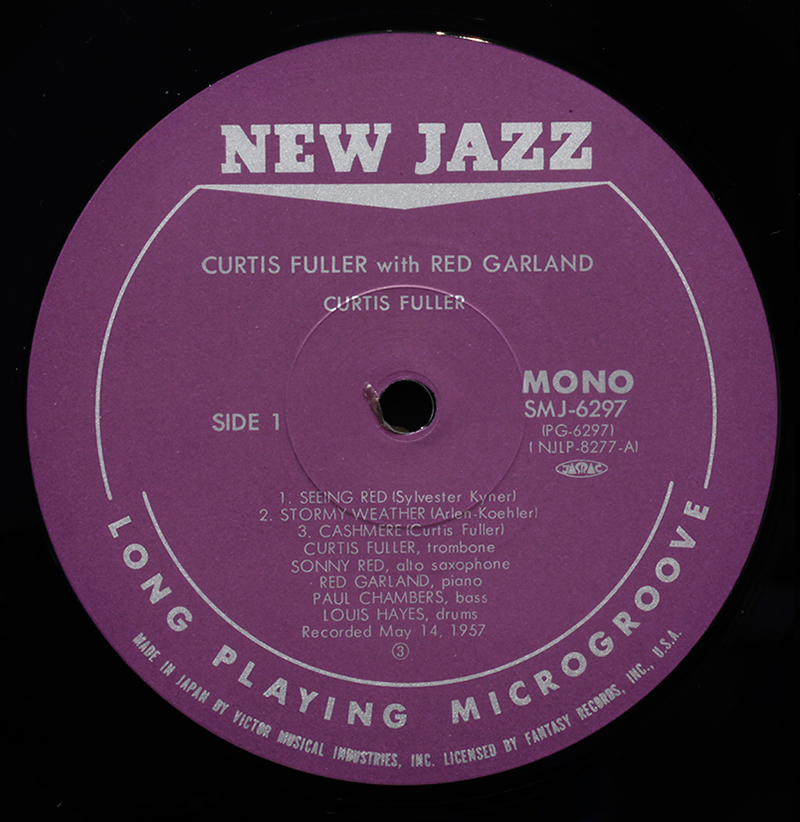
Listening to Prestige 236: Curtis Fuller / Red Garland

Bob Weinstock had Curtis Fuller back in the studio three days later, with some continuity and some changes. There's still a Detroit nucleus, with Fuller, Sonny Red and Louis Hayes. And the switch of bass players -- Paul Chambers for Doug Watkins -- still keeps the Detroit motif. But Detroiter Hank Jones gives way to Texan Red Garland. And perhaps the key change was the addition of a New Englander: Teddy Charles takes over for Bob Weinstock as producer.

Weinstock produced most of the Prestige sessions during the 50s. In the 60s, he would largely turn
that task over to others -- Chris Albertson, Ozzie Cadena (who originally put J. J. and Kai together), Esmond Edwards, Don Schlitten. Weinstock's production philosophy, as we know, was mostly hands off - create the open, spontaneous feel of a jam session. And as we've seen, it was a successful philosophy. 

Charles may have been a little more hands-on, which could explain why this session, three days after Fuller's debut, is so different. 

The difference begins with the first cut. Paul Chambers has replaced Doug Watkins, and Watkins was a great bass player, but Paul Chambers was Paul Chambers. "Slenderella" (mislabeled "Cinderella" in the set notes) is one of two Sonny Red compositions, but Red may not have thought of starting it with a 30-second walking bass vamp that immediately lets you know this is going to be different. Or, I should say, immediately lets the musicians know there's going to be a new sound, because although "Slenderella" was recorded first, it wasn't first on the album as released.

Much has been made of the way J. J. Johnson introduced a new fluidity to the trombone, an instrument thought to be too unwieldy to handle the fast pace of bebop. Certainly there had been very good trombonists in the earlier days of jazz--Kid Ory, Glenn Miller, Tommy Dorsey, Trummy Young (whom Fuller nearly replaced in Louis Armstrong's group)--but bebop created a whole new set of demands. Curtis Fuller is often mentioned as Johnson's most accomplished successor, and he certainly shows it already, on this early album. In "Slenderella," he sets himself some amazing challenges for fast fluid runs on the trombone, and meets them all.

The two standards on the session include Harold Arlen's beautiful and oft-parodied "Stormy Weather" (viz Ronny Graham: "Can't go on, all my nembutals are gone...Leonard Feather"). The mournful tone of this one has been indelibly set by Arlen's melody and Lena Horne's definitive version of it, so Fuller is called upon to trade in his bebop dexterity for sensitivity, and he does just that, starting from a haunting vamp by Chambers and Garland, never straying far from the melody, and taking most of the solo work on himself.

And the Teddy Charles touch really asserts itself in the last cut of the day, and the last cut on the finished album, which is a Charles composition, "Roc and Troll." This is not the kind of thing that you'd have expected to hear at the Blue Bird Inn in Detroit. It's a whole different kind of challenge, and it really shows Fuller's and Garland's versatility. Sonny Red's solo takes it back to the
language of bebop, which is interesting in itself, and shows once again that the often-maligned head-solo-solo-solo-head structure of much small group jazz makes for some fascinating conversations between styles and approaches

The session notes give this as the Curtis Fuller-Red Garland Quintet. The album cover tilts the credit a little more in favor of Fuller--Curtis Fuller with Red Garland. And for some reason, it was released on New Jazz--perhaps because it followed so closely on the heels of another Fuller album? But that wouldn't necessarily be a problem. Albums weren't always released in the order of their being made.

Tuesday, January 24, 2017

Listening to Prestige 235: Curtis Fuller

In an interview in later years (from an article published in 2010), Curtis Fuller describes John Coltrane's seminal Blue Train recording for Blue Note as his first recording. And Lord knows it was important. Trane has described it as his favorite album. And it's impossible to overstate the importance of John Coltrane to the young Fuller In the same interview, he says "meeting Trane was the greatest thing that ever happened to me. It was Miles Davis who took me to New York, and Coltrane was in the band, as well as Paul Chambers, Philly Jo Jones. Trane took me aside...he had confidence that I didn’t have; he saw something that I didn’t see. A great man."

But actually, Blue Train wasn't recorded until September of 1957-- well after the Paul Quinichette session, and after this session, a day later.

As important as Blue Train was in young Fuller's development, this early couple of days in May, a Fridays with Rudy session that spilled over into Saturday, with Fuller as sideman and then leader, should not be overlooked.

So, about Curtis Fuller...but it's so easy to get sidetracked, isn't it? Hank Jones is on this session, too, and he did a number of sessions for Prestige over the years, but wasn't really one of their regulars. Before this session, he had only been on board for two dates supporting vocalist Earl Coleman. And just listen to him on "Blue Lawson." His vamp leading into the head is enough to draw you in, and his solo coming out of it would melt the resistance of Doris Day on a blind date with Rock Hudson. Oh, heck, just keep on listening to "Blue Lawson," and you'll come right back to thinking about Curtis Fuller again, whose trombone solo has been studied by succeeding generations of trombone players. And Sonny Red. And Doug Watkins.
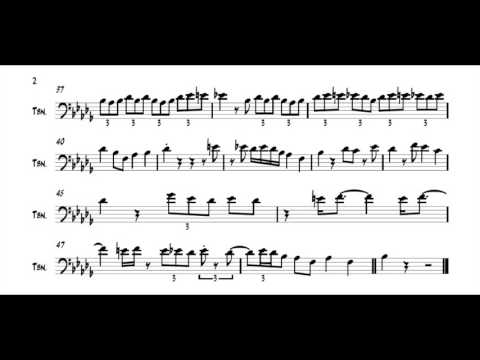
Transcription of Curtis Fuller's solo on "Blue Lawg.


Fuller is yet another musician to have had his initial training in the jazz cauldron of Detroit. His Jamaican-born parents died when he was very young, and he was raised in an orphanage, but went to school with Paul Chambers and Donald Byrd, and later, at Wayne State University, roomed with Joe Henderson. Everyone in Detroit in those days must have fallen under the jazz spell, because young Curtis had his life turned around when a nun at the orphanage took him to hear J. J. Johnson (in a theater--it's too much to ask, to imagine a nun at the Blue Bird). Fuller told interviewer Jon Solomon,
He was coming out the side of the theater. He stopped and squeezed my hand, and he gave me that look — the J.J. Johnson look. And throughout the years, he never forgot me. And as I got older and went to school, and then went to the service and came out, I saw him again with Kai Winding, and he remembered me. When I got to New York, he told Miles [Davis] about me and about my progress.
Fuller would study with both Johnson and Frank Rosolino, and many years later (1980), he would team up with Kai Winding in a reprise of the famous J. J. and Kai pairing. Now a jazz legend himself (and still with us), Fuller has some serious legends as mileposts in his career. Coltrane and Winding are two, but just as important was Lester Young. "I remember talking to Billie Holiday about being surprised that Lester wanted me," Fuller told Solomon. "She said, 'Well, he asked for you. He must've wanted you.'"

And then there was the legend that got away. He auditioned to replace Trummy Young in Louis Armstrong's All Stars, and he really wanted this gig -- for one thing, Young was getting $1500 a week, which was about three times what he had ever earned. But his sound was too modern for Armstrong.

Hank Jones was another Michigan native, but not so much a part of that Detroit scene. He played in territorial bands around Michigan and Ohio, and he left for New York in 1944, before the Blue Bird Inn had really become a bebop mecca.

Sonny Red was known by that name pretty much throughout his career, starting with Two Altos, released in 1959 but recorded in 1957, and his 1960 debut as leader on Blue Note, but on these early Prestige albums he's billed as Red Kyner, and although most of his composer credits are as Sonny Red, there's at least one tune credited to Sylvester Kyner. He was another Detroiter, whose early work in the Motor City included gigs with Barry Harris and Doug Watkins. He came to New York with Fuller, and they started out together, sharing digs and gigs. Before Motown: A History of Jazz in Detroit 1920-60, by Lars Bjorn, includes a reminiscence about Sonny from a fellow musician*:
So me and my friends, we go down to the Craftsman's Club one night and there is Sonny Red playing alto and it floored me because I didn't know he had that kind of talent. I said "Wow!" because he sounded like Charlie Parker to me. And I went up to him and said, "Red, I didn't know that you could do this." He said, "Yeah, man." I said, "How long have you been playing? Tell me!" He said, "You just do it!" So he became a motivator to me. I said if he can do it, I can do it. You know, he was with Barry Harris, Doug Watkins on bass, Sid Roman on drums and Claire Roquemore on trumpet. Man, you can hardly believe what these guys were blowing. And the thing about it, no matter how much they played, we could still dance.
Swing-to-bop. Like Paul Quinichette. In New York, the virtuoso soloist became king because dancing was not allowed in the small clubs. In Detroit, a guy could be playing like Charlie Parker and they were still dancing.

Louis Hayes also came out of Detroit, where he was leading groups in  clubs before he was 16, and where he first played with Yusef Lateef.

Completing the all-Detroit tenor of this session, "Blue Lawson" is a tribute to Detroit piano man Hugh Lawson, who came to New York with Lateef and worked in his group.

When people talk about "if you could go back in time, where would you go?" The Globe Theater in Shakespeare's day? The Renaissance? Conservative political theorists want to go back to McKinley's presidency. Woody Allen, in Midnight in Paris, wanted to go back to Paris in the Twenties, and one of the characters in that movie thought the Twenties were boring, and wanted to go back to La Belle Epoque. I've always said I want to go back to New York in the 1940s, to 52nd Street and Minton's and Monroe's. Now I think I'd like to make a side trip in that time travel, and go to Detroit as well. I would have heard some bad cats I could never hear anywhere else. Who was Claire Roquemore? Again from Lars Bjorn's book (no Google references to Roquemore anywhere else):
Claire Roquemore was by many accounts a very promising young trumpeter who never fulfilled his promise. Frank Gant's assessment: "Claire had technical fluidity: I saw him wipe Miles out many a time. He seemed like he had that breath control where he can play forever.
All of the cuts from this session except "Alicia" were included on the album Curtis Fuller - New Trombone. "Alicia" was ultimately put into a Status budget album called Body and Soul.


 Order Listening to Prestige, Vol. 1 here.


* This is taken from the excerpt in Google Books, and the name of the musician who provided this oral history is cut out. You can get a hardcover copy of Before Motown from Amazon for $350, but I also found a used paperback for ten bucks, including shipping, so I've ordered it and will be able to fill in this information later.


Monday, January 23, 2017

Listening to Prestige 234: Paul Quinichette

The name of the group, on the session list, is Paul Quinichette's New Stars, and it lives up to its billing. Even Quinichette, while not altogether a new star, is new to Prestige, and pretty much new to recording in a bebop context. He's not new to recording, having led his first session in 1951, and even when he was new in that context he wasn't altogether new, being 35 years old and with a fairly impressive career behind him, from Jay McShann to Johnny Otis, Louis Jordan, Lucky Millinder, Hot Lips Page, and most notably with Count Basie, where he became known as the Vice President, because of his stylistic similarities to Lester Young, and of course because of taking the lead tenor sax chair in the Basie band. And his debut album with Prestige, with a new label and really a new approach, came when he was 41.

You don't play with bandleaders like McShann, Otis and Jordan without learning something about the importance of entertaining people, and as Quinichette began his association with boppish Prestige, he brought that background with him. Prestige had been started by 21-year-old Bob Weinstock after he had been jolted out of his trad jazz fandom by a Thelonious Monk 78, and his first recording session featured Lenny Tristano, so he was no stranger to the cutting edge of jazz experimentation. But he wasn't afraid of feel-good music either, and both of these tastes are what gave Prestige its vitality and importance for so many years.

Quinichette, on this and subsequent sessions with Prestige, worked in that genre that I've called, writing about artists like Zoot Sims, swing-to-bop (which was also the title of a classic cut by perhaps the original swing-to-bopper, Charlie Christian). The early boppers, of course, came out of the swing bands, but by this time, the young modern players had grown up on bebop. So it's interesting, instructional, and basically just plain delightful to hear a veteran like Quinichette with this group of New Stars.

Of the new stars, the rhythm section isn't entirely new, but is of the bebop-bred generation.

Mal Waldron was the oldest at this point, at 32, but his whole career had been with the moderns. He did begin with Ike Quebec in 1952, but soon moved to Charles Mingus, and aside from a very important stint with Billie Holiday (1957-59) always worked in a modern and even free jazz idiom.

Ed Thigpen was five years younger than Waldron, but came from a traditional background--his father was the longtime drummer for Andy Kirk's Clouds of Joy, and he was perhaps best known for his work with Oscar Peterson, Billy Taylor and Ella Fitzgerald.

Doug Watkins was still only 23, and had made his Prestige recording debut just a year earlier, with Jackie McLean (and in 1955 on a live album with Art Blakey), but he was already a veteran of some 20 sessions on Prestige alone.

John Jenkins had played on a couple of recent sessions (and was also brought up modern, starting out with Art Farmer and Charles Mingus), but he was still a pretty New Star, and Curtis Fuller and Sonny Red were the newest of the New.

Sonny Red was 25, and this seems to have been his debut on record. He was active through the 50s and 60s, never really breaking through as a major figure, but doing some good work. Curtis Fuller was two years younger, one of the Detroit guys, and did go on to make a significant name for himself. They would both come back the day after this session to record under Fuller's name, so I'll hold off saying much more about them, except to note that each of them were at one point caught up in the twin-instruments thing I got into in my last post. Well, not really. Sonny Red is featured on an album called Two Altos, and it has a picture of two altos on the cover, and the names Art Pepper and Sonny Red, but it's actually two completely different sessions, done at different times on different sides of the country. Curtis Fuller...another J.J. and Kai? Blue Note apparently thought so. They recorded him and Slide Hampton as the co-leaders of a quintet in 1958. And then apparently thought better of it, as the session went unreleased until 1980 in Japan, and 1996 in the USA.

So here we have veteran Paul Quinichette with the young cats, and with a young composer - three tunes by Mal Waldron, along with two standards, and the results are uplifiting. Someone calling himself GastonBulbous has posted "Blue Dots" on YouTube, and describes it as "a head by Mal Waldron that cleverly bridges Quinichette's origins as a Basie-ite with the more beboppish ambitions of his sidemen." It's that and more. The head is Waldron's modern-style take on a McShann or Otis-type head, and solo work, taking Quinichette's cue, is joyous swing-to-bop. All of it wonderful, but you can't help but be particularly caught up in Quinichette's solo, and Waldron's brief one at the end.

Bob Weinstock must have been as struck as I was by the infectiousness of "Blue Dots," because he released it as a 45. The album was called Paul Quinichette on the Sunny Side. The British Esquire release has the same title and the same frying pan, but adds "the Vice Pres" to Quinichette's name. The 45 changes the listing of New Stars to the familiar Prestige All Stars. It was released later, so presumably the stars weren't quite so new any more.


 Order Listening to Prestige, Vol. 1 here.