Showing posts with label Percy Heath. Show all posts

Wednesday, October 28, 2015

Listening to Prestige Part 151: Miles Davis

Does Miles already have one foot out the door? Certainly he's thinking about it. He must at least have a couple of toes out. It's just a couple of weeks since the Newport Jazz Festival jam session after which he was approached by George Avakian, wooing him for Columbia Records.

Avakian wanted Miles to put together a group that he'd work with consistently. Today, using one of the words I've grown to loathe, this would be called a brand. It was opposite from the approach Bob Weinstock had taken, having Miles record with different musicians in different combinations.

So if Miles had those couple of toes out the door, he had to have been at least to some degree auditioning young musicians. He obviously wasn't going to recruit Milt Jackson or Percy Heath, but the others were all possibilities.

Miles had kicked his heroin habit by this time, and he was understandably impatient with young musicians who had not. That meant young Jackie McLean, then 24, would not make the cut. Miles said of him later,
Jackie was so high at this session that he was always scared he could not play anymore. I don't know what's the shit was all about, but I have never hired Jackie after this session.
McLean only appears on two cuts "Dr. Jackle" and "Minor March." Miles would have the same problem with the saxophonist he did choose, John Coltrane, and they went through some rough patches, with Miles at one point firing Trane and disbanding the quintet, then putting it back together.

Art Taylor, at 26, was beginning a long association, not with Miles, but with Prestige. He may have been the drummer on a 1954 session with Art Farmer (this is up in the air), but he was definitely on this session. He would work off and on again with Miles over the years. but we would become known as the "house drummer" for Prestige, working on many sessions. Unlike Miles, he would also record again with Jackie McLean--and he had worked with him before. The two of them, and Sonny Rollins, had grown up in the same Harlem neighborhood, and had played music together as teenagers.

For 24-year-old Ray Bryant, 1955 was his breakout year, but he had actually first recorded at age 14.

This was in his native Philadelphia, in a band that included John Coltrane (on alto) and Benny Golson. And continuing my policy of never meeting a digression I didn't like, especially when it involves the twisting careers of working jazz musicians. the band was led by drummer Jimmy Johnson, who must have kept working and getting his name known in jazz circles, because 15 years later he was hired by Duke Ellington.

Trombonist Gino Murray later worked with Gene Ammons and Sonny Stitt, but doesn't seem to have recorded with them,

Bassist Tommy Bryant didn't quite achieve the renown of his younger (by one year) brother, but he had a solid career, playing and recording with both his brother and Benny Golson from the 1944 session, and also with Dizzy Gillespie, Jo Jones, Roy Eldridge, and may others.

But the really interesting career out of this aggregation belongs to trumpeter Henry Glover. In the mid-1940s, that burgeoning time for independent jazz and rhythm and blues labels, he was touring with Lucky Millinder, and met Syd Nathan, who had recently started King Records as a country label, but was discovering that there was a market for the sort of jazz that bands like Millinder's played, which was soon to be called rhythm and blues.

Nathan hired Glover to build a rhythm and blues presence on his label, and, incidentally, to build him a studio. But Glover ended up doing more than that. Originally from Arkansas, Glover had grown up listening to country music on the radio, and -- like his contemporaries Ray Charles, Chuck Berry and Fats Domino-- loving it. So Glover found himself producing country artists like Cowboy Copas, Hawkshaw Hawkins (those two would die int he plane crash that killed country legend Patsy Cline), Grandpa Jones, and the Delmore Brothers, with whom he co-wrote "Blues, Stay Away From Me," which became their signature song and a country music standard. Glover was almost certainly the first successful African American producer in the country field.

He had his first rhythm and blues hit with Bull Moose Jackson, and went on to record Lucky Millinder, Tiny Bradshaw, Wynonie Harris, Bill Doggett, Hank Ballard and the Midnighters, Little Willie John, and Jame Brown. Later moving to Roulette, he came back into the jazz fold, producing records for Sarah Vaughan, Dinah Washington and Sonny Stitt, as well as creating a rock 'n roll presence on Roulette with the k\likes of Ronnie Hawkins. He became close to Ronnie Hawkins' backup band, later to become The Band, and in the 1970s moved to Woodstock where he helped Levon Helm found his own independent label. As a songwriter, he wrote "Drown in My Own Tears," a hit for Ray Charles, and one of the biggest hits of the 60s, "Peppermint Twist."

The record that Glover, Bryant and the gang made was never released, and the personnel list for the session comes from the memory of Benny Golson.


Bryant would go another four years before getting a record date, this time with Tiny Grimes' Rockin' Highlanders. Grimes was another one of those cats who made music at the intersection of jazz and R&B. I know that tenor sax great Red Prysock, who was on this session, quit Grimes shortly thereafter because of the bandleader's insistence that his band members all wear kilts. So...Ray Bryant in a kilt? Or Philly Joe Jones?

Then nothing till 1955, Bryant's breakout year. Before the Davis session, he had recorded with Toots Theilemans on Columbia, with Betty Carter on Columbia subsidiary Epic (the label for which he would record most often, and then with the same trio (Wendell Marshall, Jo Jones) under his own name. He would record again for Prestige in December, with Sonny Rollins.

Miles and Milt Jackson had played together before, on the notorious Miles/Monk session, They play off each other beautifully here, and so does Jackie McLean. Although he's only on two tracks. "Dr. Jackle" and "Minor March." He gets composer credit on both, and fairly extensive solo space. "Bitty Ditty" is a Thad Jones composition that's been widely recorded; "Blues Changes," also known simply as "Changes," is Ray Bryant's. All the cuts are extended--from 6 1/2 to 9 minutes long -- giving plenty of room for improvisational experimentation.

Again, we have to grateful to Weinstock and Prestige for giving Miles this kind of exposure, in different settings and with different musicians. And, as in the case of this session, with different musicians bringing different material.

The session was planned for a 12-inch LP, with just over 15 minutes on each side, but the album wasn't released right away, for whatever reason. It came out as Prestige PRLP 7034, and is variously known as a Miles Davis or Miles Davis/Milt Jackson album (see the typefaces on the album cover.

The cover art is that muted color photo reproduction which would appear on a lot of Prestige covers; the photo is by Bob Weinstock.

Wednesday, October 07, 2015

Listening to Prestige Part 149: Modern Jazz Quartet

This is the first MJQ album with Connie Kay, and the last for Prestige, before they decamped for their long and fruitful association with Atlantic.

Kenny Clarke was beginning to feel a little claustrophobic within the strict confines of the MJQ. One of the pioneers, and one of the most prolific drummers of the bebop era,  He was the original house drummer at Minton's, which means he played with everyone -- and as the modern jazz decade progressed, everyone wanted him, or Max Roach or Art Blakey, to play with them.

In 1955, after severing his ties with the MJQ, Clarke made fouralbums for Savoy as leader of co-leader:a septet session with Ernie Wilkins;  The Trio, in which all three players--Clarke, Wendell Marshall and Hank Jones--go co-credit; Telefunken Blues, for which he enlisted MJQ-mates Jackson and Heath, along with a front line of Henry Coker, Frank Morgan and Frank Wess; and a third album featuring a rhythm section of Horace Silver (Hank Jones on one track) and Paul Chambers, and a front line of Donald Byrd on trumpet and Jerome Richardson on tenor sax and flute. He also gave two young brothers their first exposure on record: a trumpeter and alto sax player named Nat and Julian Adderley. It's safe to say that Cannonball made an impressive debut--impressive enough that Bohemia After Dark has often been re-released under his name.The session was successful enough that two weeks later the same two brothers and the same rhythm section recorded under Cannonball's name, and two weeks after that under Nat's name, with Jerome Richardson replacing Nat's brother.

He also recorded with Gene Ammons (Prestige), Eddie Bert (Savoy), Donald Byrd (Savoy),Milt Jackson (three albums on Savoy), Hank Jones (two more on Savoy in addition to The Trio), Duke Jordan and Gigi Gryce (Savoy),  Lee Konitz and Warne Marsh (Atlantic), Charles Mingus (Savoy), Thelonious Monk (Riverside), and Little Jimmy Scott (Savoy).

And that's just the tip of the iceberg. He also  recorded with:

  • Johnny Mehegan, best remembered for his seminal books on jazz improvisation. 
  • Wally Cirillo (Cirillo's album, also featuring Mingus and Teo Macero, included what is probably the first recorded jazz composition written in a 12-tone scale).
  • Johnny Costa, whom Art Tatum dubbed "the white Art Tatum" and who later became musical director of Mr. Rogers' Neighborhood. It's nice to remember, in this day of disappearing live music, that Fred Rogers employed a live jazz trio, which played (per Wikipedia), "the show's main theme, the trolley whistle, Mr. McFeely's frenetic Speedy Delivery piano plonks, the vibraphone flute-toots as Fred fed his fish, dreamy celesta lines, and Rogers' entrance and exit tunes."
  • Chuz Alfred, who made two albums as leader in 1955, then gave up jazz to play with Ralph Marterie's dance orchestra, then returned to Columbus, Ohio, where he became a charter member of the Columbus Musicians' Hall of Fame. And you thought the only musicians' hall of fame in Ohio was the one in Cleveland.
  • Johnny Coates, who as Jazz King of the Poconos, employed the young Keith Jarrett as a drummer.
  • Mike Cuozzo, described by Marc Myers of Jazzwax as "a gifted player... a Lester Young sound with a Lennie Tristano vibe." He gave up music to become a building contractor in New Jersey, but not before making an album with Mort Herbert, who would become deputy district attorney of Los Angeles,
  • Al Caiola, who branched out from jazz to record hit versions of the themes from The Magnificent Seven and Bonanza, and who recorded with  Elvis Presley, Frank Sinatra, Percy Faith, Buddy Holly, Mitch Miller, and Tony Bennett, among others.
Not only is that just 1955, that's just Savoy.

Clarke might have been able to keep up this prodigious schedule and still make dates with the MJQ, but he was also feeling claustrophobic about America, By 1956, he was a full-time resident of France, where he could make more money and deal with less racism. He played many sessions with visiting American musicians, and led the Clarke-Boland Big Band with Belgian pianist Francy Boland.

Connie Kay had followed Kenny Clarke before he followed him into the Modern Jazz Quartet. He became the house drummer at Minton's.

Before that, as a teenager, he had worked at a club called Ann's Red Rose in his Bronx neighborhood, getting the gig a week after he had bought his first drum kit. The house drummer for the Red Rose had quit suddenly, and someone at the bar said "Well, there's a drummer around the corner because I hear him practicing every night as I come home from work." So he played for comedians, singers, tap-dancers and chorus girls (from the NY Times obituary and a NY Times profile).

He moved from there into the jazz world, playing behind every major figure at Minton's, and also in Lester Young's band for several years. He was also putting his Ann's Red Rose experience to good use as the drummer for various rhythm and blues ensembles, including that of Frank (Floorshow) Culley, who had had a hit for Atlantic Records with "Cole Slaw." Culley brought him in to Atlantic in early 1951 to record a demo for The Clovers, who had just signed with the label. The song was "Don't You Know I Love You," and the bass player didn't show up for the session, so Kay had to double his part on the bass drum. He got paid for the gig, and thought no more about until a couple of weeks later, when "I'm driving my car and hear the tune and I say, 'Wait a minute, that sounds like the tune we made a demo of.' A week later I went to Atlantic and I went into Ahmet Ertegun's office and he said: 'Man, I'm glad to see you. We've been trying to find you. I like the beat you used on that record.' From that time on they kept calling me for record dates. When I couldn't make record dates, they'd postpone them.''

Supposedly, the "concept album" began with Sergeant Pepper's Lonely Hearts Club Band, which began with a vague idea by the Beatles to make an album that would represent a collection of songs by a fictitious village band, an idea which got discarded pretty quickly, but floated around the album sufficiently that "concept album" became the goal of mostly some pretty pretentious rock groups. If you wanted a real concept album, what about My Fair Lady Loves Jazz or Dave Digs Disney, or for that matter any Broadway show original cast album? Or Louis and the Angels? Or Birth of the Cool, which wasn't even made as an album but is still one of the greatest concept albums of all time?

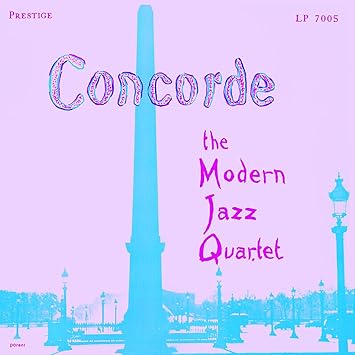
Anyway, Concord is a concept album in that the concept was that it would be an album. It was the third recording session scheduled by Prestige to produce a full 12-inch LP's worth of music: in this case, six selections, and over 36 minutes worth of music.

It's an album that's mostly standards. Perhaps in Lewis's mind, the group already had one foot out the door, so they were saving original material for Atlantic--although in fairness, the MJQ tended to be standard-friendly until later in its career, and the first Atlantic album only had three originals. The originals are Jackson's "Ralph's New Blues" and Lewis's title track. I'd wondered if "Ralph's New Blues" was a tribute to Ralph Ellison -- I'd sort of hoped it was -- but appears to be for jazz critic Ralph J. Gleason, which is pretty good too. It's built on an irresistibly bluesy riff, and is the catchiest number on the record.  "Concorde" is another Francophile nod from Lewis, and inspired the Eiffel Tower cover of the album. It has a richness of tone, a catchy melody, and an uptempo swing.

Lewis and Jackson know how to sustain a note for dramatic effect, and they know how to let loose a torrent of notes. But as always, the the MJQ is a quartet, not a leader and sidemen, and you're always aware of the contribution each member is making to the sound.

"Softly as a Morning Sunrise" was released as a two-sided 45. The album's initial release, as noted, was the 12-inch LP.


Wednesday, September 09, 2015

Listening to Prestige Part 143: Milt Jackson

Again the other MJQ, with Horace Silver instead of John Lewis, and yes, it's a very different sound. Not necessarily funkier, however, even though the session was rereleased in 1962 on album called Soul Pioneers. Silver had not yet made the fists-first commitment to funk that would bring him his greatest acclaim, and this was a session heavy on ballads, composed by some impressive balladsmiths.

"I Should Care" was co-composed by orchestra leaders Axel Stordahl and Paul Weston, with lyrics by Sammy Cahn.. Stordahl had been an arranger for Tommy Dorsey when Frank Sinatra joined the band, and he became the arranger and orchestra leader for Sinatra's Columbia recordings. The Modern Jazz Quartet would later record the same tune, so it's interesting to look at the differences. The MJQ's arrangement is, unsurprisingly, the more intricate, with some very closely worked-out duet work between John Lewis and Milt Jackson. The version by the other MJQ is much more built around Jackson, and he explores different territories, with a lot more reverb and a lot more pushing the upper register.

One significant difference between the Milt Jackson Quartet and the Modern Jazz Quartet is the part given to Percy Heath. Heath certainly gets solo time with Lewis's MJQ, but he seems more assertive here, particularly on Rodgers and Hart's "My Funny Valentine." "Valentine," as well as Hoagy Carmichael's "The Nearness of You," are very familiar tunes, and with good reason. There are two ways a jazz player can handle a melody like this, both with value. You can get outta the way, and give the melody a chance to express itself. Or, like Jackson and Silver, you can count on everyone knowing the melody, and just use it as a point of departure and a point of reference.

The group gets more uptempo, too, for instance in "Stonewall," with a lot of walking bass and and lot of  virtuoso vibing. I do love the ballads, but I might take "Stonewall" as a favorite from this session.

"Stonewall," in two parts, was released as a 45. Milt Jackson Quartet was Prestige PRLP 7003. Before it (PRLP 7002) came a Stan Getz reissue, featuring one session from 1949 and two sessions from 1950.


Friday, July 31, 2015

Listening to Prestige Part 135: Modern Jazz Quartet

I've mentioned that the MJQ was formed in part out of John Lewis's dissatisfaction with the head-solos-head format that had become ubiquitous in bebop, and this recording session, in its own unique way, is a break from that format, in that it's solo-solo-solo-solo.

Well, not exactly. But perhaps Lewis, in his own way, is simultaneously playing tribute to the classic bebop form and standing it on its ear.  "La Ronde" in a shorter version was part of an earlier MJQ session. The shorter version was a reworking of an earlier Lewis composition, "Two Bass Hit,"originally composed for the Dizzy Gillespie orchestra. The newly Europeanized title -- La Ronde is a fin de siecle play by the Viennese playwright Arthur Schnitzler -- is in keeping with the European classical -- and particularly Francophile -- overlay that Lewis was putting on American bebop. Under either title, it's a good piece, and as "Two Bass Hit" it's become a jazz standard.

As "La Ronde," it makes more sense in its extended suite version. The Schnitzler play is a tag team
series of sexual encounters, and "La Ronde Suite" is a sort of tag team, as well. It's in four sections, with each section featuring a different member of the group in an extended solo.

Kenny Clarke is the drummer for the "La Ronde Suite," and it was his last recording with the group. By their next session, in July, Connie Kay had replaced him.

Most people think of Kay as the quintessential MJQ drummer, and with good reason. He was with them for 40 years. He was a perfect ensemble drummer, in a group that emphasized the ensemble sound. Clarke was one of the innovators of bebop drumming, and like his fellow pioneers Max Roach and Art Blakey, he was much more of a soloist. "La Ronde Suite" would have been different without him.

"La Ronde Suite" was first issued on a 10-inch, The Modern Jazz Quartet Vol. 2, but it's most famous as part of the MJQ's Django album.


Wednesday, July 08, 2015

Listening to Prestige Part 130: Modern Jazz Quartet

Given the long and illustrious career of the Modern Jazz Quartet, the many amazing recordings they made, and the fact that most people consider the real MJQ to date with the installation of Connie Kay as drummer, it would be hard to point to any one album as their best.

But Django, the album that includes this session, and which has Kenny Clarke on drums, is the one that frequently makes lists of the hundred best jazz albums.

Perhaps it's because this is an almost mythic era in modern jazz. The late 40s (mostly because of Charlie Parker) and especially the 1950s were the time that really defined it.

Or that's one theory. I decided to put it to a test, so I looked at the New Yorker's list of 100 essential jazz albums, and found that 29 of them were recorded in the 50s, or partly in the 50s. There were a few more that I could have counted because they were released in 1960, and so were probably recorded in 1959, but they were albums like My Favorite Things that really belong to the 60s. Actually, a lot of the albums recorded in the 50s were by artists we don't really associate with the 50s, but what can you do? If I left them out, it would mess up my theory. Anyway, here's the list: Armstrong, Ellington, Basie, Benny Carter, Parker, Monk and Coltrane, Tristano, Davis 2, Powell, Mulligan, MJQ, Tatum, Brown/Roach, Vaughan/Brown, Mingus 2, Fitzgerald, Rollins 2, Puente, Sun Ra, Abbey Lincoln, Blakey, Jamal, Brubeck, Witherspoon, Coleman, Dinah Washington, Betty Carter, Sinatra.

Not every great jazz classic is a great composition. Some of the best -- best performances, best improvisations, best damn records -- are based on simple riffs. Look at Dexter Gordon and Wardell Gray's unforgettable "The Chase." Look at "One Bass Hit," from this session. It was written by Dizzy Gillespie for Ray Brown, and it's a showpiece for bass virtuosity -- one that allows a bass to become the lead instrument for an entire piece of music. Here, it allows Percy Heath to show what he can do, and it's delicious.

But "Django" is a great composition. It's one of the most haunting melodies I've ever heard. It carries a touch of the Eurojazz of Django Reinhardt, a touch of the blues, a touch of...well, here's guitarist Jim Hall describing it:
This tune has a beautifully constructed melody. It starts out with a kind of a simple motive in F-minor. Kind of a slightly sad idea for a melody, and then so it's this, and then there's a sequence, which is up a second, except that goes up instead of down. So first, it's this perfect answer and then it continues. It's going into the relative major key, if anybody cares, now it has some surprises. It has a great arrival point, that high G, and then it winds its way down. Almost sounds like he's saying Django's name here. And then the same thing an octave lower. So that's the tune anyway. It has kind of simple chords, but beautiful.
 "Milano" is the third tune on the session. Another beautiful melody, but there's a reason "Django" became the title cut for the album, and a reason why it's the one that's most remembered. They also recorded "I'll Remember April" that day, and it was never released. It's hard to imagine the MJQ screwing up "I'll Remember April" and maybe they didn't -- maybe it was a technical flaw of some sort. In any event, they re-recorded it successfully the following July.


 "Django" was released as a two-sided 45, and the three tunes made an EP, and were included (with "La Ronde") on a 10-inch LP, before the release of the classic 12-inch album which has made so many top 100 lists.

Sunday, June 21, 2015

Listening to Prestige Part 121 - Thelonious Monk

On a technical note, we just got a new car, with Bluetooth connectability to the speaker system, and I finally figured out how to play Spotify through it, so I'm back to my old pattern of driving and listening to a Prestige session. This gives me some serious listening time, as one short drive generally lets me listen to a whole session through twice, and a series of short drives over a couple of days (I live in the country and have a young teenage grandson, so this is the way most of my days go) gives me a real opportunity to spend the kind of time I like with a session.

Especially fortunate that this all got worked out in time for this session, because if you're setting aside some time to spend with these four songs, you're going to need to allow for the circumstance that at first, all you're going to want to do is listen to "Blue Monk." It's that magical.

So many of Monk's greatest compositions were introduced in his recordings of this era for Prestige and Blue Note. Don't forget what it was that inspired Bob Weinstock to start his own record label. He was a 19-year-old kid in his first business venture, running a record store next to the Metropole in Times Square. The Metropole was a home to trad jazz, and that was what Weinstock sold -- on 78, of course.  Until...
One day Alfred Lion, who ran Blue Note Records, came in and said, “I have something new: Thelonious Monk." I said, “What the hell's that?" Alfred said, “It's bebop." I listened to it and the more I listened, I realized it had a charm to it. It was interesting. I was strictly into swing at the time. Beboppers were calling people like us moldy figs. The next thing I knew, I became obsessed with bebop. I was attracted like a magnet...
I got curious as to some of the recording debuts of classic Monk tunes, so here are a few:

Blue Note 1947
  • Ruby, My Dear
  • Well, You Needn't
  • Round Midnight
  • In Walked Bud
Blue Note 1948
  • Misterioso
  • Epistrophy
Blue Note 1951
  • Straight No Chaser
Prestige 1951
  • Little Rootie Tootie
  • Bye-Ya
  • Monk's Dream
Prestige 1952
  • Trinkle Tinkle
  • Bemsha Swing
Prestige 1953
  • Think of One

Prestige 1954
  • We See
  • Blue Monk
Does that say something about (a) how important Monk was, and (b) how important these two jazz labels were?

 Anyway, I did finally start listening to the whole set, all the way through -- three Monk originals, with Percy Heath and Art Blakey, and one standard, on which Monk plays solo. "Nutty" and "Work" both have little melodic hints of what would coalesce in "Blue Monk."

Thoughts: on all of the trio tunes, there are extended bass and drum solos, which has not exactly been a hallmark of earlier Prestige sessions. Perhaps we can take this as a tribute to Rudy Van Gelder's increasing confidence in his engineering skills.

And this is all great stuff. A drum solo with a Thelonious Monk trio, on Thelonious Monk tunes, is not exactly going to be a Buddy Rich drum solo, no disrespect to Buddy. Blakey integrates his own propulsive rhythmic mastery with Monk's unique approach to rhythm -- no mean feat, in a drum solo.

When I was young and pretentious, and I went out to jazz clubs, I used to always quietly disapprove of people who applauded at the end of a solo. I wanted to hear the transition, as one soloist handed the ball off to another. I've since learned that you can never have too much applause, that the soloist deserves it, that it's part of the spontaneity of live music. And you can listen to those transitions on the record.

Which I do. I've always been fascinated, in art, in music, in writing, by what happens when something is in the process of stopping being one thing and starting to be another.

And there are some great moments here. In "Nutty," when Blakey's solo seems to rise in pitch at the end, and Monk picks it up at the apex. In "Work," the handoff from Blakey to Heath to Monk.

And all the way through, there are great moments between Monk and Percy Heath. Heath's solos, his dialogs with Monk, their duets, with both instruments threading lines around each other. Outside of the melody of "Blue Monk," these may be my favorite parts of the session.

Finally, there's Monk's short, song-length, unaccompanied take on "Just a Gigolo."

Artists strike out for the deep end in all sorts of ways. If you had been invited out to Rudy Van Gelder's studio in Hackensack to record four songs, and you'd been given Percy Heath and Art Blakey to accompany you, would you do the first three, and then say "Take the rest of the afternoon off, fellas, I'm doing this one on my own"?

Of course, it might not have happened that way. Maybe the session ran long, and Percy and Art had a gig in the city. Or maybe they showed up late, and Monk decided to start without them. But those seem less likely. Monk knew what he was doing when he recorded solo, and he was generally right.

"Blue Monk" was released on a 45 with "Bye-Ya" on the flip. All four cuts were on a 10-inch, Thelonious Monk Trio. "Blue Monk" and "Just a Gigolo" were put on a 12-inch of the same title with the 1952 trio sessions, and the same grouping was rereleased as Monk's Moods. "Work" and "Nutty" joined "Friday the Thirteenth" from Monk's November 1953 session with Sonny Rollins, and a couple of tunes from a later session with Rollins, as Thelonious Monk and Sonny Rollins, and this album was also rereleased under a different title, Work. The two earlier releases were from the 7000 series in 1957, the later rereleases from the 7100 series in 1959. And of course, there are a number of later reissues.


Thursday, May 28, 2015

Listening to Prestige Part 114: Miles Davis

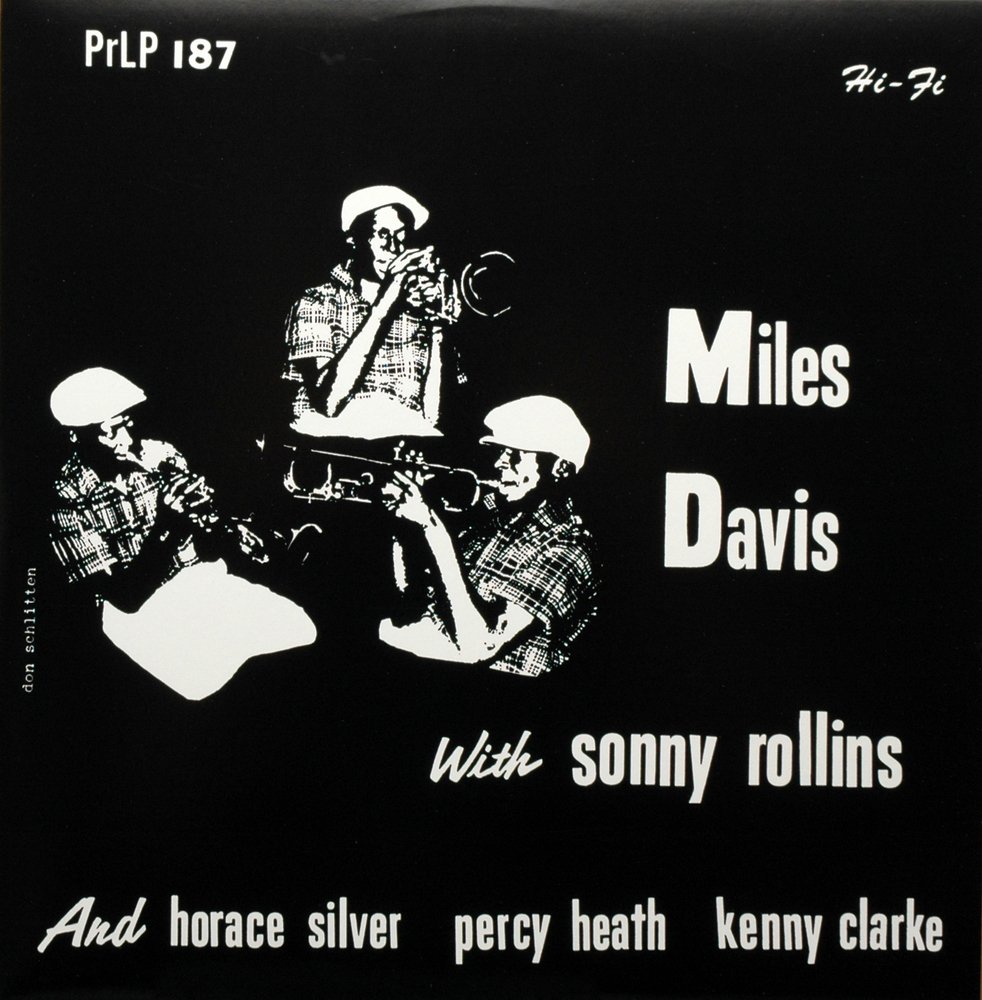
The most interesting thing about this session from a listener's standpoint is easy: the music. Miles Davis, Sonny Rollins. Horace Silver, Percy Heath, Kenny Clarke (after the confusion as to who was drumming on the June 4 Art Farmer, date, I triple-checked, and it is Kenny Clarke).  Three originals and a Gershwin standard. Great tunes, great playing. Rollins is back in the studio for a third Prestige session with Miles, and it's always a welcome pairing. And it was a busy month in Rudy Van Gelder's parents' living room. This will have been the third time they've had to have dinner out, or stay in the
kitchen.

From a blogger's standpoint, there are a couple of things of note. First, all three of the originals are Rollins compositions, and they've become jazz standards.

"Airegin" falls into the category of backwards-spelled words as titles, which was becoming nearly as popular as puns on "bop" had been a few years earlier. Miles would record it again with John Coltrane, and it's been waxed by Tito Puente, Stan Getz and Chet Baker, Wes Montgomery, Maynard Ferguson, among others. The jazz greats who've recorded "Oleo" include George Benson, Grant Green and Lee Konitz. Dexter Gordon, John Coltrane, Shelly Manne, Cal Tjader, Branford Marsalis and John McLaughlin have all done "Doxy." Phil Woods used it as his theme.

Second, this session is of historical interest in that it's the first time Miles recorded with a Harmon mute (on "Oleo"). This isn't as earth-shaking as it might seem. Miles had already found his mature tone, and the Harmon mute may have refined it, but didn't fundamentally change it. If you listened to all five of the cuts from this session (including the two takes of "But Not For Me"), and you were a trumpet player, you'd be able to pick out the Harmon mute instantly. The less sophisticated listener (like me), maybe not.

"But Not For Me" was released as a two-sider on both 78 and 45. Prestige was nearing the end of its 78 RPM days, but not quite ready
to pull the plug yet. The whole session (only one version of "But Not For Me" was on a 10-inch, and all five tunes were on the Bags Groove 7000-series LP.


Saturday, May 23, 2015

Listening to Prestige Part 113: Milt Jackson

There was an MJQ before there was a Modern Jazz Quartet, and it had essentially the same lineup, with Milt Jackson and John Lewis and Kenny Clarke (Percy Heath hadn't joined yet). That MJQ was the Milt Jackson Quartet.

So here's another MJQ, this time a quintet, with Horace Silver filling the piano spot.

The Modern Jazz Quartet is one of the most justly revered of all jazz groups, but it wasn't always so. The MJQ were going their own way as bebop was turning into hard bop, and a lot of devotees of the harder sound professed to find the MJQ too safe, too genteel. They weren't, of course, but that was what their detractors said.

But nobody didn't like Milt Jackson, and it was an article of faith among the detractors that the MJQ was holding Jackson back, not letting him play the funky, bluesy, hard-boppy music he was capable of, and secretly wanted to play.

That way of thinking is long behind us, along with the wars between the beboppers and the moldy figs, but we still do have the recordings that Jackson made apart from the Modern Jazz Quartet, and yes, with Horace Silver on board, it is a different sound.

The fifth musician here is trumpeter Henry Boozier, and his inclusion certainly suggests that Jackson was going for a funkier sound. Boozier is probably better known for his work in blues and rhythm and blues, which is an odd way of putting it, since blues bands didn't generally list all their personnel on their recordings. So not better known to the general public, but better known in the sense that he'd more likely be called to work on a blues date. He recorded with B. B. King, Bobby "Blue" Bland, Clarence "Gatemouth" Brown, Paul "Hucklebuck" Williams. His song, "Ask Me 'Bout Nothin' but the Blues," was recorded by Bland, Boz Skaggs, and others. He doesn't seem to have any other jazz recording credits, but Jackson brought him back in 1960 to record with his octet.

"Funky" has been around as long as jazz has been around: 
I thought I heard Buddy Bolden say
Funky-butt, funky-butt, take it away.
 And according to at least one authority, it has an African etymology. According to Yale art historian Robert Farris Thompson in his 1984 work, Flash of the Spirit: African and Afro-American Art and Philosophy:

The slang term 'funky' in black communities originally referred to strong body odor, and not to 'funk,' meaning fear or panic. The black nuance seems to derive from the Ki-Kongo lu-fuki, 'bad body odor,' and is perhaps reinforced by contact with fumet, 'aroma of food and wine,' in French Louisiana. But the Ki-Kongo word is closer to the jazz word 'funky' in form and meaning, as both jazzmen and Bakongo use 'funky' and lu-fuki to praise persons for the integrity of their art, for having 'worked out' to achieve their aims. In Kongo today it is possible to hear an elder lauded in this way: 'like, there is a really funky person!--my soul advances toward him to receive his blessing (yati, nkwa lu-fuki! Ve miela miami ikwenda baki) Fu-Kiau Bunseki, a leading native authority on Kongo culture, explains: 'Someone who is very old, I go sit with him, in order to feel his lu-fuki, meaning, I would like to be blessed by him.' For in Kongo the smell of a hardworking elder carries luck. This Kongo sign of exertion is identified with the positive energy of a person. Hence, 'funk' in black American jazz parlance can mean earthiness, a return to fundamentals.
However, I wouldn't have thought of "funk," as a noun referring to a genre of music, to have been commonly used much before the 60s, but we have it here, in a Horace Silver composition, and an opus de funk it is, with some great interplay between Silver and Jackson, and a solo by Boozier that shows solidly why Milt Jackson called on him for this gig.

Silver also composed "Buhaina," presumably a tribute to Art Blakey, who had taken the Muslim name Abdullah ibn Buhaina, though he continued to use what many black Muslim converts would come to call his slave name. This one has some striking interplay between Jackson and Boozier, and later between Silver and Percy Heath--and, a little surprisingly, no extended drum solo for Kenny Clarke.

Jackson composed the other two. "I've Lost Your Love" is sort of an unusual title for a modern jazz instrumental, and I'd love to hear the story behind it. It's a ballad, and it features a knockout trumpet solo by Henry Boozier.

"Soma" is another Jackson composition, and maybe what I love most about it is the ensemble work on the head. You don't every day hear a trumpet, vibes and piano working as an ensemble front line. Jazz surpasses expectations so often, and in so many ways.


Wednesday, May 20, 2015

Listening to Prestige Part 112: Art Farmer

Art Farmer seemed to do very well with the mid-sized group, six to eight pieces. He was perhaps best known for the six-man Jazztet with Benny Golson in the late 50s - early 60s, and his work in the early 50s also tended toward that format. His early Wardell Gray session for Prestige in 1952 was a sextet, although only two of the group were front line players (the sixth was a percussionist). He led a septet in 1953 before joining the Lionel Hampton tour, and played with various mid-sized ensembles during the Hampton tour in Europe. His first two 1954 sessions were quintets - Sonny Rollins and Gigi Gryce -- but he returned to the studio again with seven pieces for this one. The group included   Horace Silver and Percy Heath, and maybe Kenny Clarke, according to the jazzdisco.com website, which has the set lists for every Prestige session. But they may be wrong. The label on the 45 says the drummer was Art Taylor, and the Art Taylor Wikipedia page credits him with both this and the quintet session with Gigi Gryce (Art Blakey was the drummer on the Rollins session). Scott Yanow's bio on Allmusic.com puts Taylor in the Prestige studios for the second half of the decade, so 1954 would be on the cusp. Taylor's obituary in the New York Times gives a list of musicians he played with, and does not include Farmer. Your guess is as good as mine. My ear isn't good enough to choose between the drumming techniques of two modern masters (and two eventual expatriates).

Jimmy Cleveland, who had played in the earlier septet, returned for this one. The other two were
Danny Bank and Charlie Rouse, and all of these guys were veterans, with extensive experience in swing and bebop...and rhythm and blues. Jimmy Cleveland's resume would include soul jazz with Gene Ammons and funk with James Brown. Charlie Rouse, whose chief fame would come later as Thelonious Monk's right hand man, began his career with the classic Billy Eckstine band that included Charlie Parker and Dizzy Gillespie, but he also played with Bull Moose Jackson. He played big band swing with Basie and Ellington, bebop with Dizzy and Tadd Dameron. Danny Bank had a similarly varied career, playing with virtually every major swing band, with Charlie Parker, with Clifford Brown, with Ray Charles. He's probably best known, though, for his work with Miles Davis and Gil Evans on their classic collaborative albums.

And this versatility is put to use here. On "Evening in Paris," a Quincy Jones ballad, they lend support to a piece that mostly features Farmer and Silver, who also dominate "Elephant Walk," a piece which demonstrates that even elephants get the blues. "Wildwood" is a Gigi Gryce composition, as Farmer continued his close association with the two young composer/arranger stars of the Hampton tour, and it gives a wild, full romp to the whole ensemble. They give the same treatment to "Tiajuana," again a Gryce composition, which is complex and straight-ahead at the same time.

I don't want to lose the real thrust of this blog, which is the experience of listening to this music. Secondarily, it's exploring the history of jazz in this period. Finding out who Charlie Rouse was and what he did before his years with Monk. Learning about the work done by professionals like Danny Bank who didn't make a mark as leader, but contributed so much. Thinking about what an ear Art Farmer had for the great jazz composers of his era: Quincy Jones and Gigi Gryce here, Benny Golson later.

But listening to this session, it's the bluesy chording and rhythmic virtuosity of Horace Silver, and the warm, pure tone of Art Farmer. It's the ensemble work of a septet, and how if Art Farmer worked in the shadow of arrangers like Jones, Gryce and Golson, he was one hell of an arranger himself. It's the
music I love.

These were released on 45 and 78, and on a 12-inch, 7000-series LP, The Art Farmer Septet. It's the first Prestige session I've seen that didn't come out on a 10-inch LP first.


Friday, May 08, 2015

Listening to Prestige Part 107: Miles Davis in April

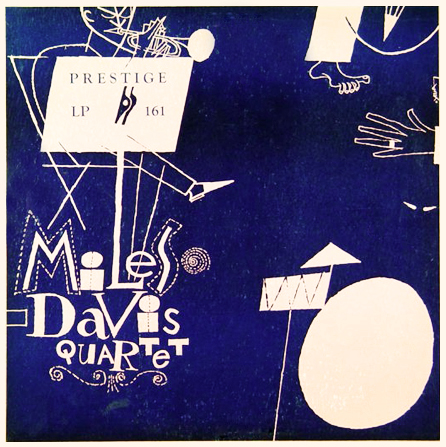
1956 was the big Miles Davis marathon, in which Miles finished up his obligation to Prestige in a blaze of glory, one session after another, so that he could move on to Columbia. But he was almost as busy in 1954. His March quartet session at Beltone was followed by two in April at the Van Gelder studios, and there'd be more before the end of the year.

Each of these sessions featured a different front line (well, the first one was just Miles, which may not exactly make a line), but mostly the same rhythm section. Horace Silver, Percy Heath and Kenny Clarke had come together for the Art Farmer session. Miles had used Art Blakey for the March quartet session, but Clarke was on drums for these two.

The quintet for the April 3 session included Davey Schildkraut on alto. Schildkraut was a veteran at
29, having gotten his first major professional gig at 16, with Louis Prima. He had early on heard the siren song of bebop, and mastered it to the point that when Charles Mingus was given "I'll remember April" on a Leonard Feather blindfold test, he identified the alto player as Charlie Parker.

Actually, Parker and Schildkraut overlapped a few times in the early 50s. There's a live recording of Bird with Stan Kenton -- I had never known they played together -- from a couple of months before the Miles session, with a Kenton reed section that includes Schildkraut. And there's a session from 1953, released on the Roost Jazz label in 1990 as More Unissued, Vol 2. That is, more unissued Charlie Parker sessions. But the alto player on that date has since been authoritatively confirmed as Davey Schildkraut.

Bill Holman, who was Kenton's arranger while Schildkraut was with the band, sees no similarity between the two. In an interview with Schildkraut student Rob Derke, Holman said:
Dave had a completely introspective way of playing...and played according to how he felt at any particular time. A lot of guys take the easy way out and say ‘Oh, another bebop alto player so we’ll compare him to Bird.’ I never heard [Schildkraut] using Bird’s or anyone else’s licks, it was all completely original and I really enjoyed hearing his playing for that reason.
"Solar" is based on the chord changes for "How High the Moon," and as I've stated before, I never know quite what to make of "based on the chord changes." Pretty much every blues, country and rock and roll song is based on the same three chords. I looked up "How High the Moon chords" on Google, and the chords to the Les Paul version, which is the most familiar one, are a little different from the chords in another jazz standards fake book. Anyway, I don't always hear the melody in a bebop "based on the chords" version of a standard, but I can hear "How High the Moon" in "Solar." The same chord changes were used by Chuck Wayne in a composition called "Sonny," recorded in 1946 and unissued (and uncopyrighted). Wayne claimed that Miles had ripped off his melody, and maybe he did. The general consensus is yes. I don't know the difference between ripping off a melody and basing a melody on chord changes. Anyway, here's a bit of the Chuck Wayne tune on a scratchy acetate, if you're interested. "Solar" became a jazz standard, although Miles never recorded it again.

"Love Me or Leave Me," based on the chord changes to "Love Me or Leave Me," is so firmly ensconced in the public consciousness as a pop song, thanks to great pop renditions by Doris Day and Sammy Davis, Jr. (I'm too young to remember Ruth Etting), that I had never really thought of it as a jazz standard until I heard the Miles Davis version. After that, I spent a little time seeking it out, and found jazz vocal versions by Nina Simone, Billie Holiday, Anita O'Day and others; instrumental versions by Benny Goodman, Lester Young, Gerry Mulligan--and, in a more modern setting, Tuba Skinny. I've always loved the Sammy Davis, Jr., version, with its rapid-fire faux scatting, ending with the exhortation, "Blow, Sam!" I always thought he was cheering himself on, but recently it's occurred to me that it must be Sam Butera coming in with the sax solo.

But ever since I first heard the Miles recording, it's been the definitive version for me, and I was glad to spend some serious time listening to it and absorbing it in preparing this blog entry.

Miles is best known, for most of his career, for playing with a Harmon mute, but he experimented with different mutes before settling on the Harmon. On this session he used a cup mute, and it suits "Love Me or Leave Me" perfectly. The tune is taken at an uptempo bebop pace, and yet it still maintains a plaintive, bluesy tone. There are two ways of approaching "Love Me or Leave Me."
There's the torchy, moody Doris Day/Billie Holiday way, the lost lover who'd rather be lonely than happy with someone else, or the slap-happy Sammy way, you can love me, you can leave me, what do I care? I'm here for the rhythm and the chord changes and the chance to wail out, and "blow, Sam!" Miles manages to do both.

The sextet session came at the end of the month, with the same rhythm section and a new front line.It became immediately, and remains, one of the most potent sessions in the Davis canon. New Yorker jazz critic Whitney Balliett called it "some of the best jazz improvisations set down in the past decade." Both cuts are amazing, but "Walkin'" will send nonstop chills up and down your spine.

Davis bolted Prestige for Columbia for a number of reasons. One of them was money. One was that Columbia had...well, more prestige than Prestige. But one was that Columbia wanted him to put together a regular group, while Bob Weinstock had wanted him to play with a variety of musicians:

So our basic idea was just to make records with different people, to record with the best people around. That's what we did until the end, when he had the quintet with John Coltrane, Red Garland, Paul Chambers, and Philly Joe Jones. But everything up to that point developed from where we would sit down and talk about it. Miles would mention who was in town, who he would like to record with. I'd say who I'd like to hear him record with. We'd kick ideas around.
If I sound like a cheerleader for this entire era of music, and for everything that Bob Weinstock, Ira Gitler, Rudy Van Gelder and the Prestige record company did, I'm OK with that. These are a fan's notes, and this era, this label, stands as one of the great gifts to American culture and the American Century in music. So I'll say it. The Miles Davis quintets and sextets were inspired, and the source of great art.  But we are just as lucky to have these records with different people, with the best people around, with the ideas that were kicked around. One suspects, from what one knows about Miles, that after a while he didn't want to kick ideas around with anyone, except maybe Gil Evans.

But we have these records. This rhythm section, with Horace Silver really starting to come into his own. And different front lines for Miles to jam with--and jamming was what it was. Jamming was the Bob Weinstock philosophy,

J. J. Johnson was one of the true beboppers, there from the beginning.

I knew very little about Lucky Thompson. I have his Tricotism album, so I knew he was good. I knew that he'd played the expatriate game for a spell. Allmusic.com has an excellent bio by Jason Ankeny, which I recommend.

I discovered that Thompson was called "Lucky" because "of a jersey, given him by his father, with the word "lucky" stitched across the chest," not because he ever had any luck in his life. His mother died when he was five, and from that early age, he became responsible for taking care of his younger siblings. He always loved music, and always wanted a saxophone, with such passion and dedication that he "carved imitation lines and keys into a broom handle, teaching himself to read music years before he ever played an actual sax. According to legend, Thompson finally received his own saxophone by accident -- a delivery company mistakenly dropped one off at his home along with some furniture."

Thompson was one of those guys who moved from swing to bop -- he played with Erskine Hawkins and Lionel Hampton before arriving on 52nd Street, where he was asked to fill in for Ben Webster at the Three Deuces, and "Webster, Coleman Hawkins, Lester Young, and Art Tatum were all in attendance at Thompson's debut gig, and while he deemed the performance a disaster (a notorious perfectionist, he was rarely if ever pleased with his work), he nevertheless quickly earned the respect of his peers and became a club fixture."

Ankeny describes Thompson's sound as "never fit[ting] squarely within the movement's paradigm -- his playing boasted an elegance and formal power all his own, with an emotional depth rare among the tenor greats of his generation."

It was battles with the jazz establishment, particularly record label owners, more than racism that drove Thompson to Paris, and that would drive him in and out of the music business.

"You Don't Know What Love Is" was the flip side of "Old Devil Moon" on a 45, and "Walkin'," split in two, made both sides of a 45. These would be the first Prestige singles to come out on 45 and not 78. The sextet sessions were also released on 45 RPM EPs and a 10-inch LP. The quintet sessions also had a 10-inch, and the two sessions were combined on the 12-inch Walkin'.


Sunday, May 03, 2015

Listening to Prestige Part 106: Miles Davis

Horace Silver and Percy Heath packed up from their session with one of the noblest peers of the trumpet realm and moved on to the Dark Prince himself, this time with Art Blakey on drums.

You look back at these years and you can see how often a small label like Pre stige or Blue Note, or Dial or Roost, was able to get Art Blakey or Kenny Clarke or Max Roach to anchor a session. No wonder jazz was so great back then.

Miles didn't seem to care for the Prestige studio. His early recordings tended to be somewhere else, often the WOR radio studios, but he had used Beltone, located at 1650 Broadway, across the street from the Brill Building and nearly as legendary in the music business, before. No Rudy Van Gelder, and I had imagined this whole scenario when Silver and Heath showed up for the gig.

"Say, man, you gotta check out this cat's pad in Hackensack."

"Oh, yeah? What's in Hackensack?"

"This cat. He built a recording studio in his folks' living room."
 
"Huh."

"No shit, Miles, this dude got a sweet little setup. He made Art Farmer sound better than you."

"No motherfucker sounds better than me. What'd you say this cat's name was?"

Nice bit of fancy. And it could have happened that way, except for one thing. Miles had recorded at the Van Gelder studio the previous week. So why not for this session? Who knows? Maybe Blue Note had already booked the space, or maybe the senior Van Gelders were having folks over for dinner, or maybe Rudy had optometry patients scheduled for that day (he still made his living as an optometrist, getting amazing quality of sound for the legends of jazz not exactly paying the bills).
 
This is an important session because of course it's an important session. It's Miles Davis. It's still the period of experimentation -- Bob Weinstock recording Miles in different settings, before the quintet. It's the first recording of "Four," which was to become a staple of the Davis repertoire.

"Old Devil Moon" is a lovely, moody ballad by Burton Lane and E. Y. Harburg which has been recorded by nearly every jazz singer (including, a little surprisingly, Mose Allison), and by some of the best ballad interpreters in jazz, including Sonny Rollins, Stan Getz and Chet Baker. Miles, working in a quartet setting, has ample space to explore its smoky beauty.

"Blue Haze" is another Miles composition, and while it didn't become the staple that "Four" did, it's an equally beautiful tune, and it's a showcase for the other members of the quarter, particularly Percy Heath, who opens the piece with an extended solo.

Prestige, in 1954, was still wedded to the 78 for single release. "Blue Haze" came out on one 78 as parts I and II. The 78 of "Four" was b/w "Old Devil Moon," unaccountably retitled "That Old Devil Called Love." "Old Devil Moon" also made it to 45 RPM, under its real name, b/w "You Don't Know What Love Is" from a later session. The EP continues to be the 45 format of choice, though, and the whole session did come out on an EP, and on a 10-inch LP, as well as various reissues, including Miles Davis Plays for Lovers.


ppp
wW studio in hos

Friday, May 01, 2015

Listening to Prestige Part 105: Art Farmer

There are the trumpet players who one listens to with reverence. The ones who changed the face of American music with their vision and their talent. Louis Armstrong, Dizzy Gillespie, Miles Davis. They would be pretty much everyone's list. Then there are the trumpet players who seem to capture the essence of jazz music: the ones you listen to and say "yes, that's what I love about jazz." A jazz fan will have her/his own list here, but a whole lot of those lists would include Bix Beiderbecke. And Roy Eldridge. And Clifford Brown.

And Art Farmer.

And all I can think, listening to this oddly forgotten session (released on a 10-inch and then buried, not included on any of the 7000-series Prestige releases of the 50 sort of brought out on the less-distributed New Jazz label in 1961, then not again until the 7600 reissue series in 1969, pretty much the end cycle for Prestige) is what a wonderful session this is. It's everything that makes me love jazz.

Art Farmer broke in with Wardell Gray on the session that introduced "Farmer's Market." He did the septet session with Quincy Jones arrangements for Prestige in the summer of 1953, then headed for Europe on the Lionel Hampton tour that produced a series of recordings. This was his first session back in the States, as a leader, and it should have been his breakthrough to jazz stardom, and maybe it was. He certainly was back in the studio a number of times in 1954.

Sonny Rollins was with him on this date, and Rollins is another of those everything that makes me love jazz guys.

If there's ever an artist whose name is synonymous with a jazz label, it's Horace Silver and Blue Note.
He had actually started with Blue Note in 1952, first with Lou Donaldson and then as leader, and Blue Note kept him pretty busy, but during 1953-54 he also found time to record with Lester Young (released on the Italian Philology label and on Ambrosia), Sonny Stitt (Roost), Al Cohn (Savoy), both Art Farmer and Miles Davis on Prestige, and a few others. He had already started what became one of Blue Note's most famous groups, the Jazz Messengers, with Art Blakey. Blakey was to lead the group for years, but originally it was Horace Silver and the Jazz Messengers.

The session kicks off with "Wisteria," an achingly beautiful ballad (I believe an Art Farmer original) that has wonderful work by everyone, but perhaps especially Horace Silver. "Soft Shoe," again by Farmer (there's a Gerry Mulligan composition called "Soft Shoe," but it's different) picks up the tempo, with the boppish ensemble riffing and inspired soloing that presages Farmer's work with Benny Golson in the Jazztet.

"Confab in Tempo" confabs in a blistering set by Kenny Clark, followed by some great high-octane bebop, with Clarke pushing it all the way and coming back for a wild drum solo.

"I'll Take Romance" was written by Ben Oakland (also known for the Ink Spots' great novelty "Java Jive"), with lyrics by Oscar Hammerstein. It's probably best known in the pop rendition by Eydie Gorme. There's a hipper version by June Christy, but Eydie did right by the song. Its cool passion and flowing lyricism make it a great choice for jazz improvisation, and it's been recorded by Max Roach, Bud Shank, Kenny Dorham, McCoy Tyner and others. It's a good way to end the set.

This is the second session to be recorded in Rudy Van Gelder's studio. I wonder if it was difficult to cajole musicians into trekking out to Hackensack in the middle of January. It certainly wouldn't have been difficult to get them to go a second time, once they'd heard the results.


Sunday, April 05, 2015

Listening to Prestige Records Part 97: Thelonious Monk

Looking back over the fall of 1953 at Prestige, I'm seeing a sort of mini-unit, starting with Sonny Rollins and a cerebral, groundbreaking pianist, going through a couple of other piano stylists, and ending up with a cerebral, groundbreaking pianist of a very different mindset, and Sonny Rollins.

All significant jazz musicians are innovators, finding new expression in every solo, adding to the vocabulary and the lore of America's music, but some are a little farther out in the forefront. It was great to listen to Billy Taylor's intonation and richness of tone, his way of developing and enriching a ballad. It was wonderful and surprising to hear Bengt Hallberg and realize that even in the early 50s, Europe was producing expressive talents whose technique made even Miles Davis sit up and take notice. But John Lewis was taking jazz composition in a direction no one had thought of. And Thelonious Monk had taken it, and was continuing to take it, in directions no one else could possibly have thought of. Lewis took everything that he had thought about while playing on gigs and sessions with some of the giants of his era, including his contribution to the gamechanging Miles Davis nonet, and decided that he could go his own way and take it further. Monk never went any way except his own.

The earlier session is a Sonny Rollins gig, the current one is a Monk gig. The difference is more historical than aesthetic. They're both great to listen to, and if you were there at the time, that's pretty much all you'd be thinking about.

Time changes your perspective. When I was teaching college courses in the early 2000s, and I'd show The Wild One, my students would invariably fix on a scene that I would scarcely have noticed as a teenager. It's after the mob catches up with Brando. They take him to a garage, put him down in a chair, and the chief bully starts beating him. Brando snarls back, "My old man used to hit me harder than that." The lines my friends and I remembered, and recited back and forth to each other, were lines like, "What're you rebelling against, Johnny?" "Whaddya got?" Or "I don't like...cops." Or "Write my mother and tell her I'm in jail! Tell her to send me a case of beer!" When I would ask my students, "What do we know about Johnny?" They'd say "His father beat him." And yeah, it's there. It is one key to his personality. But the emphasis is different.

And so with these two recording sessions. Listening to Rollins and the MJQ, it's hard not think they won't be making too many more like this. They'd record with other soloists again, including Rollins. Just three years later, they'd record a live concert at Music Inn in Massachusetts with Jimmy Giuffre, and again two years after that with Sonny Rollins. Both of those feature great performances by two great reedmen, but they're both MJQ concerts.

All of which is a distraction from the session at hand, which is terrific. How can it not be? Monk and Rollins at top form. Actually, one member of the MJQ, Percy Heath, who always adds something special.

There are a bunch of Willie Joneses in jazz, two of whom are drummers, and none of whom are related, although the current one, a drummer who's played with Horace Silver, Herbie Hancock, Artuo Sandoval and others, calls himself Willie Jones III, to distinguish himself from Monk's drummer, who was sometimes called Willie Jones, Jr., to distinguish him from Willie Jones the piano player, sometimes known as "the piano wrecker" because he could play an upright piano so hard it would vibrate, who recorded with Gene Ammons and Clark Terry, among others. Willie Jr. is playing his first recording gig here with Monk. He would have a short career but agood one, including Charles Mingus's classic Pithecanthropus Erectus.

Julius Watkins was almost certainly the first significant French horn player in jazz, and there have been precious few since. Another of Detroit's seemingly endless stream of jazz greats, he heard a French horn when he was nine, fell in love with it, and the horn was life from there on. Jazz came later, as it became clear that there were not going to be openings for black hornists in major symphony orchestras. Also, he wanted to solo, and that meant jazz.

He does solo on this date with Monk, to particularly powerful effect on the ten-and-a-half minute "Friday the Thirteenth," and when he and Rollins play together, the tonal quality is wonderful, and very appropriate for Monk's music.

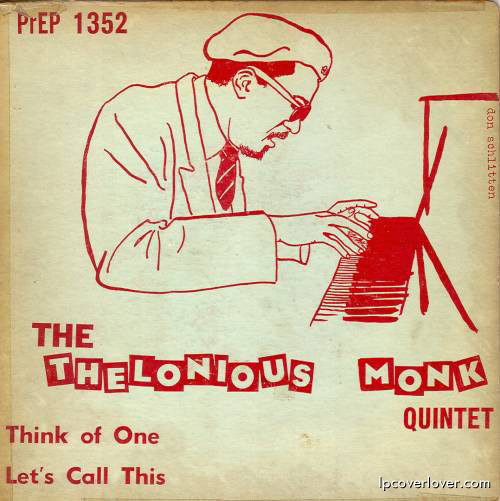
No 78s for these five and ten-minute cuts."Let's Call This" and "Think of One" were released on EP. The whole session was on a 10-inch called Thelonious Monk Blows for LP, and later on 12-inchers: Monk and Thelonious Monk and Sonny Rollins.


Friday, March 27, 2015

Listening to Prestige Records Part 94: Sonny Rollins / Modern Jazz Quartet

The Modern Jazz Quartet were a fairly rare phenomenon in jazz in the 50s -- a stable group that had a collective name, as opposed to, say the Gene Ammons Septet or the Stan Getz Quartet, which would be Gene or Stan and whoever else was in town for the recording or club date. The musicians had come together as Dizzy Gillespie's rhythm section, and then had become the MJQ -- that is, the Milt Jackson Quartet. As the MJQ1, they were, as far as anyone knew, three guys whom Milt Jackson had gotten together for a gig. As the MJQ2, they were a different entity, but no one knew what. Certainly, no one knew that they would, with one change, be together for the next 40 years, thus becoming not just rare but unique.

So what had Prestige done with them to date?

John Lewis had done a number of sessions for Prestige, starting in 1949 with J. J. Johnson's
Boppers, when he was 29 and already a veteran of the New York jazz world, from his days newly out of the army with Dizzy Gillespie through his work as one of the major contributors to the Miles Davis nonet. He worked with Zoot Sims, with Miles and Sonny. And even after the first MJQ session--it was pretty clear how good these tunes were, and it had always been clear how good these musicians were, but there was no hint that they were to become. probably rivaled only by the Dave Brubeck Quartet, the most legendary sustained unit in the history of jazz. Yes, there have been other legendary units, like the Miles Davis quintet of the 50s, but that group was only a small part of Miles's career, and only a small part of Coltrane's. So they went on working. Lewis and Kenny Clarke worked on one Prestige recording date with Miles, Lewis and Percy Heath on another. Heath also played on the Miles and Bird (Charlie Chan) session. And they did sound good together, no doubt about it. The three of them were brought in to back up King Pleasure and the Dave Lambert Singers, and the quartet was brought in for a session with Sonny Rollins, and although Rollins was the featured performer on the gig, the Modern Jazz Quartet was credited as such. This would change, a few years later, when Atlantic would bring out The Modern Jazz Quartet at Music Inn, Vol 2 -- guest artist, Sonny Rollins.

The Atlantic album has been in my collection since the 50s, but I'd never heard this earlier collaboration before. It's a fascinating one. This is definitely a Sonny Rollins session, but it's definitely MJQ, too. This is probably the first time all four of them had worked as the MJQ with another artist, and it's an experiment worth listening to.These guys knew how to play together as a rhythm section, and they show that here. But they also knew who they were, and they show that here, too. And all five of
them make a pretty convincing argument that bebop is not dead.

They would go on to make enough tunes for Prestige to fill  two 12-inch albums which are no strangers to Greatest Jazz Albums of All Time lists. But before they were legends, they were working musicians playing the gigs that they got -- sort of unlike the Brubeck Quartet, who pretty much made it clear that they were legends to begin with. And working musicians like these are always worth listening to. 

These came out on 78, 45, EP, 10-inch and ultimately 12-inch LP.