Tad Richards' odyssey through the catalog of Prestige Records:an unofficial and idiosyncratic history of jazz in the 50s and 60s. With occasional digressions.
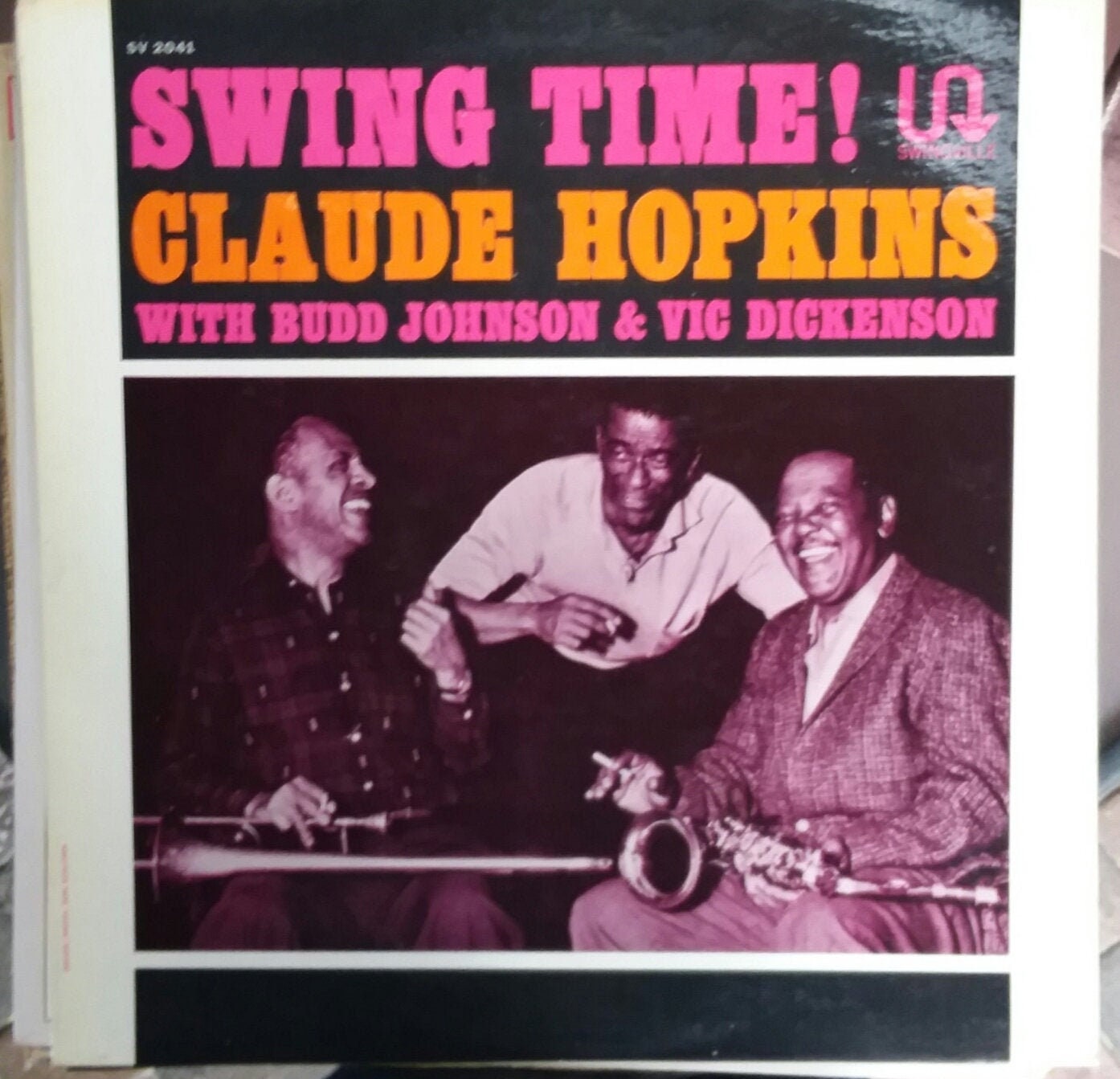
Claude Hopkins had a long and distinguished career as pianist and bandleader, but live music is evanescent, and so are the reputations based on it. Lasting reputations are built on recorded music, so it'sm thanks to Prestige and Swingville that Hopkins is chiefly remembered today -- with the Swingville All Stars, backing up Bud Freeman and Lonnie Johnson, and most indelibly for the three albums he recorded as leader: Yes Indeed!, Let's Jam, and this final one, Swing Time! Esmond Edwards gave him great support for the first two (Buddy Tate, augmented by Chu Berry on Yes Indeed! and Joe Thomas on Let's Jam), and Don
Schlitten, not to be undone, gives him a masterful group here, led by Vic Dickenson and Budd Johnson.
Hopkins had the kind of career that jazz fans and jazz historians can dream about, and conjure up a mythos around -- musical director of Josephine Baker's ensemble in Paris (which included Sidney Bechet), leader of a 1930s band which included Vic Dickenson and which had long residencies at the Cotton Club and Roseland. But to actually hear him, these recordings are the place to go. Swing Time! includes two Hopkins originals plus the kind of old chestnuts that, when they're in the hands of masters, you never get tired of hearing.
New to Prestige are trumpeter Bobby Johnson and drummer
Ferdinand Everett. Johnson was a much-in-demand section man who played with Duke Ellington, Billie Holiday and Erskine Hawkins, among others. Everett's only record date appears to have been this one, but he carries his weight.
Was the world really panting for a jazz version of All American? They hadn't exactly been panting for the original version of All American. The musical by Lee Adams and Charles Strouse, who had hit it big with Bye Bye Birdie, ran for 80 performances on Broadway, panned by critics and unloved by audiences. An account of the show's history in Wikipedia is a compendium of wrong moves.
First, the show's producers hired Mel Brooks to write the book, which doesn't sound like a bad idea, except that Brooks was then young and inexperienced. He'd had some success as a TV gag
writer, but didn't know much about writing a play. For one thing, he discovered, plays are longer than sketches for Your Show of Shows, and you had to sustain momentum all the way through them. This proved too much for Brooks to handle, and he gave up when he discovered that after you'd finished the first act, you had to write a second act. So the producers brought in Joshua Logan, who had lots of experience as a successful Broadway director and script doctor, but not so much with the kind of broad sketch comedy favored by Brooks, so the second act ended up not exactly meshing with the first act. Then the producers, sensing trouble, brought in a star--Ray Bolger, the Scarecrow from The Wizard of Oz and a veteran Broadway star. So the script was rewritten around Bolger, which might have been a good idea except for two things: the story wasn't much of a fit for Bolger, and in 1962 no one cared about Bolger any more. Nothing good came out of all of this for the producers of All American, but something eventually did for Brooks: The Producers, inspired in part by this experience.
For all that, a musical can at least sort of succeed if it produces a few hit songs, though by 1962, that was also pretty much an idea whose time had passed. And the score of All American was not the most memorable. The website secondhandsongs.com lists cover versions of over 100,000 songs -- it's not complete by any means, but it's pretty comprehensive and a good resource. Only two of the songs from All American are listed at all on the site, so if there are any covers of the others, they are slim and scattered. "Once Upon a Time." first recorded by Tony Bennett, has had a good run of action among crooners, both pop and country, although not even the Bennett version cracked the Billboard Top 100. Instrumentally, it has mostly been picked up by orchestras like Lester Lanin's and Percy Faith's, with very little jazz interest. Charlie Byrd has recorded it, and Kenny Barron.
The only other song from the score to get any cover action at all is "I've Just Seen Her," which has ten recordings, per secondhandsongs...and all by jazz performers. Terry, followed by Gary Burton, Pepper Adams, Scott Hamilton, Bill Charlap, Scott Hamilton with Bill Charlap.
Nothing for any of the others. Perhaps they weren't very good songs. Certainly, they weren't the hippest of the hip. Nat Hentoff, in the album's liner notes, says rather charitably of Strouse and Adams:
Both are knowledgeable writers for the current state of the Broadway musical, but no one would claim that either or both has more than a peripheral acquaintance with jazz.
One wonders who thought this was a good idea in the first place. Esmond Edwards? Bob Weinstock? Did Weinstock get such a cut rate deal on the score that he couldn't refuse? In any event, a silk purse had to be made out of a sow's ear.
The history of sow's ears into silk purses, in American culture, is an interesting one, and there have been some notable successes. Louis Armstrong turned a fairly pedestrian tune, "Sweethearts on Parade," by square's square Carmen Lombardo, into one of the most sublime jazz vocals of all time. Some would argue that history repeated itself, if not quite as sublimely, with "Hello, Dolly."
There's that great story of film director Howard Hawks trying to convince Ernest Hemingway to write for the movies. Hemingway said he didn't like movies, and every time he saw a movie based on a good book he hated it. "That's because good books don't make good movies," Hawks told him. "But sometimes a bad book can make a great movie. I'll prove it to you. I'll take the worst piece of garbage you ever wrote and turn it into a great movie."
"What's the worst piece of garbage I ever wrote?" Hemingway demanded.
"No question about it. To Have and Have Not."
Hawks, like virtually everyone else, shortchanged To Have and Have Not, which is a pretty interesting novel. But he did make a great film of it.
The poet and classicist David R. Slavitt, who has been praised for his translations of Seneca and Ovid, also published a collection of a little-known Roman author, The Fables of Avianus. Because Avianus was an undiscovered gem? "Heavens, no," Slavitt told me. "Avianus was a terrible writer. This way, all the credit for quality is mine alone."
And it's been reported that Clint Eastwood wanted the challenge of making a quality film out of a perfectly awful novel. Hence, The Bridges of Madison County.
"It was clear to me," Oliver Nelson told Hentoff,
...that without the action on state, Ray Bolger's dancing, and the comedy, the music by itself needed quite special treatment to stand up on a jazz date.
In short, Nelson was nearly as accomplished a diplomat as he was an arranger.
So, did he do it? Did he make the silk purse?
Oh, my yes. It was silk, it was silk and satin and linen that shows, rings and things and buttons and bows. "I've Just Seen Her," the one tune from the show that intrigued some jazz musicians, may be the weakest track here. Nelson has crafted a pure delight, and unexpected delight. Probably no one much took this album seriously. The contemporary website AllMusic.com gave it three stars; there are no listener reviews at all on Amazon, no comments on the cuts on YouTube. So this is one of those gems of a golden age of American that's just waiting there for you to discover it. And it may not be the equivalent of David R. Slavitt and Avianus, because Strouse is certainly an adequate tunesmith, but this is Nelson's music.
Clark Terry must have been scratching his head when Prestige contacted him about this gig. Also the diplomat, he describes, not his first reaction, but his second:
I was surprised at how much Oliver had been able to do with the tunes, not only with regard to making them more interesting harmonically, but also in terms of the naturally flowing rhythm patterns he set them in. And once we all got into it, it turned out to be a thoroughly enjoyable date. As I think the recording shows, we all had a ball.
It does. There's no guarantee that a bunch of performers having a ball will translate into a good time for the audience--look at the Rat Pack's version of Ocean's Eleven -- but in this case, you can hear them having a ball, and you can also hear them digging into miraculous arrangements, and doing right by them.
The band was quite likely a Nelson-Terry collaboration. Les Robinson was a veteran section man with a number of big bands, and was probably known to both men--certainly to Terry, who had played with him on the West Coast. George Barrow was frequently called upon by Nelson, both on baritone, as here, and tenor. He played on Nelson's Prestige sessions, and on The Blues and the Abstract Truth.
Of Budd Johnson, Terry told Nat Hentoff:
It was a great help, of course, to have Budd Johnson along. First of all, no matter what you give him, Budd will swing it. And he has such a solid knowledge of chords that you can't lose him. He always knows what's happening and what can be done to make the proceedings more interesting. You listen to him here. He's like an old pitcher -- he's got so much "stuff" going for him, not only a fast ball, but curves and twisters and changes-of-pace. And always there's that big tone.
This comes back to Nelson again. Not to put down the excellent musicians, including some jazz greats tired of the road, who play in the pit orchestras of Broadway musicals, but the score of a show like All American isn't going to have chord changes so unexpected that they might lose a lesser musician than Budd Johnson.
Eddie Costa played on a couple of Prestige sessions in 1957. Terry singles him out for much-deserved praise as well.
The man simply can't go wrong rhythmically. Eddie also contributed a lot to the good feeling that pervaded the session.
Costa's rhythmic brilliance, especially on the vibes, and his good camaraderie were both approaching a tragic end. In July of that year, just two months later, he would die in an auto accident at age 32.
Esmond Edwards produced. The album was recorded over two sessions. It was released on Moodsville, although it was far from being a Moodsville album. The title, and I appreciate the gentle irony, is Clark Terry Plays the Jazz Version of All American.
Budd Johnson never lacked for work over a five-decade career. The gig he's best known for is Earl Hines, for whom he worked in the 1930-1940s, and then again in the 1960s-1970s, but when he wasn't with Hines he was with someone, from the Kansas City sound of Jesse Stone to the hot jazz of Louis Armstrong to the swing of Roy Eldridge, Ben Webster and Benny Carter. When the Count met the Duke, he was there. When Coleman Hawkins went to 52nd Street to help develop bebop, he was there, and he played with beboppers like Dizzy Gillespie, Bud Powell and Sonny Stitt, with soul jazzers like Cannonball Adderley and Jimmy McGriff, with jazz
singers like Carmen McRae and rhythm and blues singers like Ruth Brown And that just scratches the surface. For a few years in the late 1950s-early 1960s he recorded as a leader (just this one album for Prestige), and again for a few years in the early 1970s. He certainly had the stuff to step out front under his own name, as he proves here, and he shows his range and versatility, from the sweet sound of "Someone to Watch Over Me" to the hard-edged drive of his own "Uptown Manhattan" and "Downtown Manhattan," to the bebop subversion of Harry Warren's "I Only Have Eyes For You." The sentimental, dreamy side of this tune had recently been brought to the fore with the Flamingos' doowop hit; Johnson and his group romp and stomp through it.
The group includes Johnson's older brother Keg on trombone. Budd had the more prominent career of the two brothers, but both claimed their place in jazz history. They started out together in Dallas playing in their father's band and also--an unusual credit--in the ensemble of Portia Washington Pittman, the daughter of Booker T. Washington and a noted music educator in Dallas. They played in bands together in Dallas and later in Kansas City, but then Keg struck out on his own for Chicago, where he joined Louis Armstrong's ensemble. He put together a solid career in music, including 15 years with Cab Calloway. This was his only recording with his brother. Shortly thereafter, he would join Ray Charles's band, and remain in that group until his death in 1967.The rhythm section of Tommy Flanagan, George Duvivier and Charlie Persip is impeccable, and all three are active participants, especially Duvivier and Persip. Duvivier has some memorable exchanges with Budd, and Persip some infectious solos.Duvivier by this time was a solid regular on many Prestige sessions. Persip had done a few others, starting in 1956 with Phil Woods and Donald Byrd. And he had been a spectator at a memorable early Prestige session--the 1954 Miles Davis Quintet, where Miles and Monk almost came to blows. Persip had been invited along as a protégé of Kenny Clarke, the drummer on the session, and his account of the conflict, and the story behind one of Monk's oddest piano solos, is in our entry on the date.
Tommy Flanagan, straight from Detroit in 1956, had made his Prestige debut that same year on a Miles Davis session. In those days, coming from Detroit was virtually all the credential one needed to gain a foothold in New York's highly competitive jazz world, but Flanagan was one of the best Detroit had to offer. He had already played on over two dozen Prestige sessions, and would do many more, including a few as leader later in the 1960s. He is particularly strong here on "Blues by Budd," my favorite cut, and my "Listen to One."
The album was called Let's Swing!, and it was appropriately released on Swingville. Esmond Edwards produced.
Listening to Prestige Vol. 2, 1955-56, and Vol. 3, 1957-58 now include, in the Kindle editions, links to all the "Listen to One" selections. All three volumes available from Amazon. And Vol. 4 is very close to completion. Watch for it! The most interesting book of its kind that I have ever seen. If any of you real jazz lovers want to know about some of the classic records made by some of the legends of jazz, get this book. LOVED IT. – Terry Gibbs